


A reliable eyelash tweezers manufacturer should help professional buyers match tweezer tip geometry to the intended lash technique, verify gripping and release performance, define acceptable closing force, confirm material and finishing requirements, and establish quality controls for repeatable bulk production.
For lash brands and salon distributors, the strongest supplier evaluation combines working samples, technician feedback, documented specifications, private-label packaging approval, and clearly defined quotation terms. A visually attractive tweezer is not automatically a dependable professional lash tool.
Explore OLIMOR BEAUTY's tweezer collection and discuss model-specific applications, customization requirements, and sample availability before ordering in volume.
A professional lash artist may handle hundreds of individual extensions during a busy working day. Each movement requires controlled isolation, pickup, positioning, or release. The tweezer used for these tasks therefore plays an important role in workflow consistency, technician comfort, and the quality of the finished service.
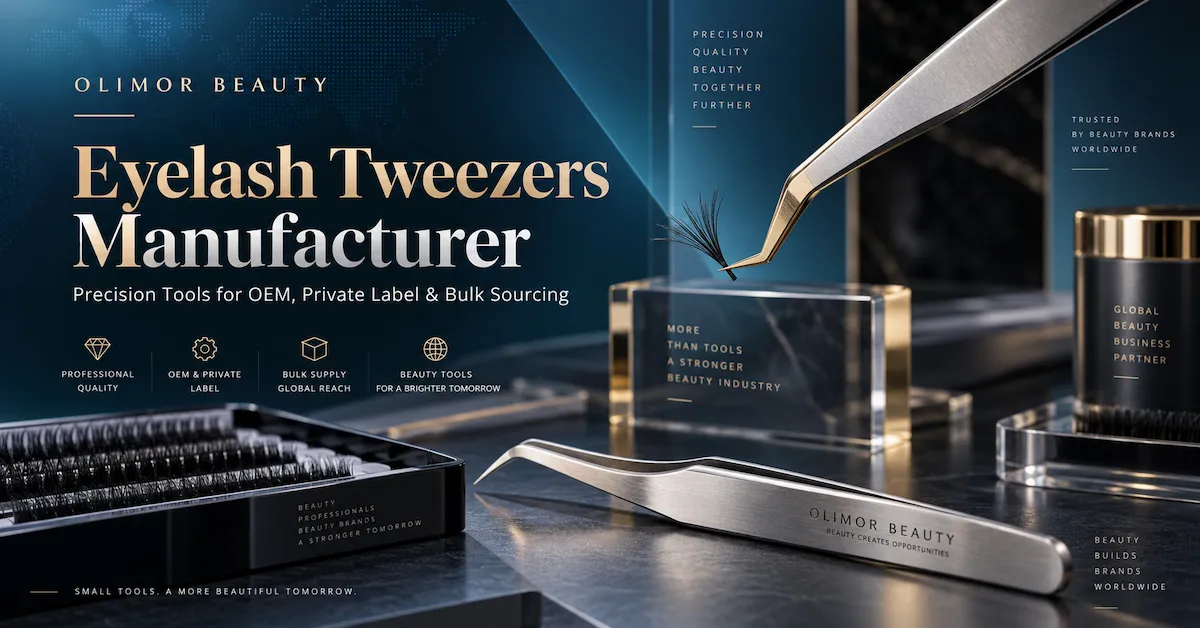
For a beauty brand developing private-label lash tools, the purchasing challenge is more complex than identifying a visually appealing product. Two tweezers that appear nearly identical in a catalogue may have different contact characteristics, closing resistance, weight distribution, and working angles. Those differences become noticeable when technicians use the tools repeatedly.
Importers and wholesale distributors face another challenge: product consistency. A carefully selected sample may perform well, but the commercial result depends on whether subsequent production batches retain the same important characteristics. Without written acceptance requirements, buyers may struggle to explain precisely why a later batch feels different.
This guide approaches eyelash tweezer sourcing from the perspective of a professional buyer. It explains how lash tweezer designs differ, which specifications deserve attention, how to organize sample testing, what to include in an OEM project, and how to compare manufacturers beyond their opening price.
1. What Should an Eyelash Tweezers Manufacturer Provide?
An eyelash tweezers manufacturer develops, produces, or coordinates the production of precision hand tools used for professional lash services and related beauty applications. Depending on its capabilities, the supplier may offer existing models, customized finishes, private-label packaging, modified working tips, or development based on a buyer's own specifications.
For professional lash applications, manufacturing quality begins with the working ends. The two tweezer arms must move predictably, bring the intended contact surfaces together, and release the gripped material without uncontrolled movement. The closing action should be appropriate for the target technique and the person using the tool.
The finished product also needs suitable material selection, surface finishing, comfortable handling, tip protection, and identifiable product specifications. A manufacturer capable of explaining these requirements gives buyers a stronger basis for decision-making than a supplier offering only product photographs.
An important distinction is whether the supplier is proposing an established product or a new customized version. An existing model may already have defined tooling, manufacturing experience, and a reference sample.A revised shape or working-tip design may require additional feasibility review, new samples, and functional approval.
Buyers should not assume that the terms OEM, ODM, and private label describe identical manufacturing arrangements. The correct development model depends on who supplies the design, who controls the specifications, and how much customization the buyer actually needs.
OLIMOR BEAUTY presents a beauty-tool product range for international distributors, retailers, and private-label buyers. Its portfolio includes tweezers and complementary personal-care tools, while its sourcing information addresses product development, sampling, and order quality.
Buyers considering professional lash tweezers should request confirmation of the exact models and performance characteristics suited to their work. Not every general-purpose precision tweezer is automatically suitable for advanced eyelash extension techniques.
2. Who Purchases Wholesale Eyelash Tweezers?
The target customer determines the most important purchasing criteria. Professional salons need tools that support repeatable daily work. Training academies may prioritize predictable handling across groups of new technicians. Distributors need stable product identification and replenishment. Private-label brands require performance and visual consistency.
| Buyer Segment | Application | Primary Purchasing Concern |
|---|---|---|
| Lash Extension Brands | Professional lash tool collections | Precision, branding, repeat-order quality |
| Lash Studios | Daily isolation and extension placement | Comfort, tip control, clean release |
| Training Academies | Student practice and technician education | Consistent geometry, clear identification |
| Beauty Distributors | Wholesale supply to salons and retailers | SKU stability, packaging, replenishment |
| E-commerce Brands | Professional and consumer beauty accessories | Product accuracy, presentation, customer feedback |
| Salon Equipment Suppliers | Professional workstations and tool kits | Assortment coordination, quality, durability |
A specialist lash brand may want several different tweezer profiles within one collection. These could include tools for isolation, classic extension pickup, or volume-focused techniques. Each model should have a clear purpose rather than relying on vague labels such as "premium" or "professional."
For salon operators, product choice should reflect the actual service menu and staff preferences. Purchasing many similar-looking tools does not necessarily improve operational efficiency. A smaller, well-defined selection with clear identification and backup inventory may be more practical.
For importers, a useful product range should also be easy to manage commercially. Model codes, color variations, packaging formats, reorder procedures, and product descriptions should remain consistent across documentation and sales channels.
3. Eyelash Tweezers vs Eyebrow Tweezers vs Eyelash Curlers
These products belong to related beauty tool categories but perform different functions. Confusing them can lead to incorrect sourcing specifications and misleading product descriptions.
Eyebrow tweezers are primarily associated with gripping and removing individual brow hairs during grooming. Many use slanted or pointed working tips designed for that contact and movement.
Professional eyelash extension tweezers are selected for manipulating fine extension fibers and, depending on their design, assisting with isolation, pickup, positioning, or controlled handling. Their working-tip geometry may differ considerably from an ordinary eyebrow tweezer.
An eyelash curler is a different tool. It uses a frame and pressing mechanism to shape natural lashes rather than gripping individual extension fibers between tweezer tips.
| Tool | Primary Function | Critical Quality Feature |
|---|---|---|
| Lash Extension Tweezers | Isolation and manipulation of lash extensions | Tip contact, tension, controlled release |
| Eyebrow Tweezers | Brow hair gripping and grooming | Grip edge, alignment, handling |
| Eyelash Curlers | Mechanical shaping of natural lashes | Frame alignment, pad contact, movement |
This distinction matters particularly for private-label product descriptions. Buyers should not market general cosmetic tweezers as specialist volume lash tweezers without testing the intended function.
OLIMOR offers a tweezer product category and a separate eyelash curler category . These categories can support broader lash and brow product assortment planning.
4. Which Eyelash Tweezer Types Are Best for Different Lash Techniques?
There is no single ideal lash tweezer for every technique or technician. Tool selection depends on the working angle, intended task, extension material, grip preference, and the user's hand position.
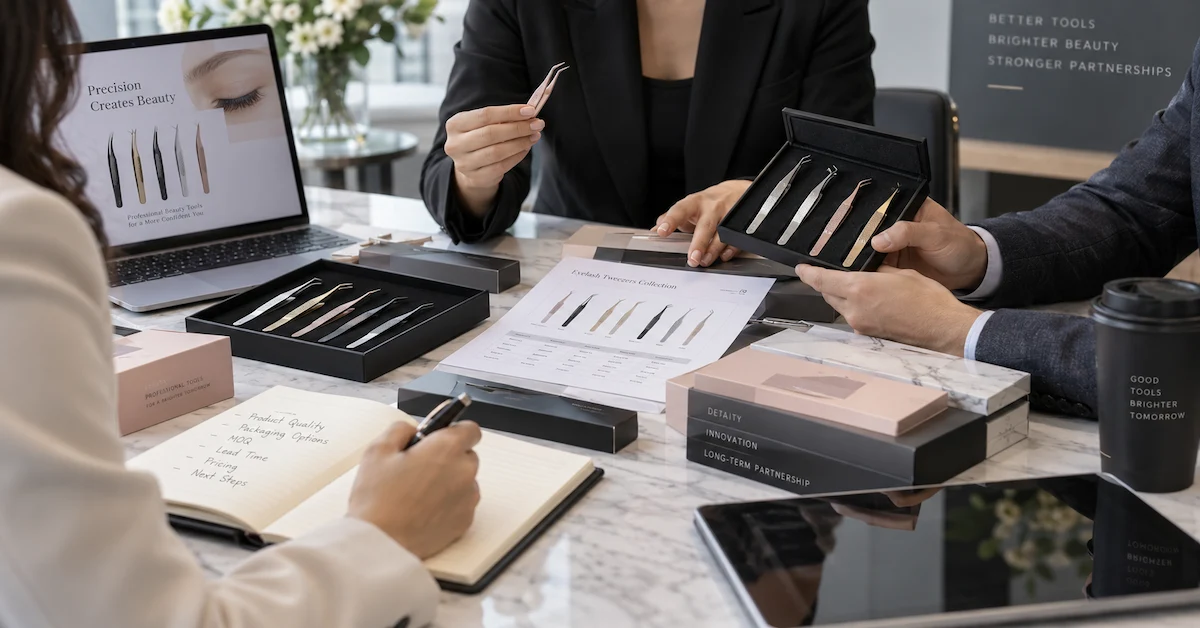
The following designs are common reference categories in the professional lash-tool market. Their inclusion does not mean that every design is currently available as a standard OLIMOR model. Buyers should confirm catalogue availability and customization feasibility for their project.
4.1 Straight Isolation Tweezers
Straight tweezers are frequently considered for separating or isolating natural lashes during professional extension work. Their relatively direct working profile can help technicians identify an individual lash within the visible lash line.
The important requirement is controlled tip movement. Tips that cross unexpectedly, misalign during closure, or have rough contact areas may make delicate isolation more difficult.
A buyer should assess the shape from the technician's normal working position rather than judging the tool only while holding it vertically in front of a camera.
4.2 Curved Eyelash Tweezers
Curved lash tweezers feature a working end that changes direction relative to the handle. This geometry may help certain technicians approach their work without unnecessarily blocking visibility.
However, curvature alone does not establish product quality. The working surfaces still need suitable contact, the curve must match the intended technique, and the tool should release extensions predictably.
A comparison should include actual technician feedback. One artist may prefer a particular curve, while another may work more comfortably with a different approach angle.
4.3 Angled and L-Shaped Tweezers
Angled, L-shaped, or boot-style working ends are considered for certain pickup and volume-lash techniques. Their functional contact region can differ from that of straight tweezers.
For these designs, buyers should investigate where the intended gripping zone is located and how reliably it contacts fine extensions. A visually impressive working tip may still perform poorly if only a small or inconsistent region closes.
The precise geometry should be evaluated against the target technique and approved by representative professionals. Different technicians may use different contact positions even on the same nominal design.
4.4 Volume-Focused Lash Tweezers
Volume lash tweezers are often chosen for handling multiple fine fibers or prepared fans, depending on the technique. Their suitability depends on the contact characteristics of the working tip and the operator's handling method.
Some technicians discuss the "sweet spot," meaning the portion of the working tip that provides their preferred contact during pickup. This region should be identified through testing rather than assumed from the product's external appearance.
A volume-focused tool should be assessed for controlled pickup and release without unnecessary pressure or unintended fiber movement.
| Tweezer Design | Typical Task | Main Quality Check | Purchasing Advice |
|---|---|---|---|
| Straight | Isolation and fine separation | Point alignment and visibility | Test natural hand position |
| Curved | Controlled pickup and placement | Curve, closure and release | Compare preferred approach angles |
| Angled / L-Shaped | Selected pickup and volume techniques | Effective working contact region | Validate with target extensions |
| Boot-Style | Technique-specific volume handling | Grip zone and force consistency | Test with experienced technicians |
| General Precision | Selected lash and brow beauty tasks | Suitability for defined application | Do not assume specialist performance |
For further product context, see OLIMOR's guide to choosing tweezers for lash extensions . For a product reference involving both lash and brow applications, review Precision Tweezers for Eyebrows and Lash Extensions .
Developing a Professional Lash Tweezer Range?
Share the lash techniques your customers use, the preferred working-tip designs, and your estimated order quantities.Ask OLIMOR about suitable existing models, sampling, branding, and customization feasibility.
Discuss Your Lash Tweezer Requirements →5. Critical Technical Specifications for Eyelash Tweezers
A professional purchasing specification should translate the intended lash technique into identifiable product characteristics. Descriptions such as "high precision" or "excellent quality" may be useful marketing language, but they are not sufficient production acceptance criteria.
Buyers should define the characteristics that matter to users and agree how those characteristics will be inspected.
Working-Tip Geometry
Tip geometry includes the intended profile, relative position of the two working ends, contact region, and shape of the finished surfaces.
Different lash applications may require different relationships between tip thickness, angle, curvature, and access. The best specifications start with an approved sample or engineering reference rather than an arbitrary number copied from another tool.
Alignment and Closure
The two working ends should meet according to the approved functional design. Buyers should check for unintended crossing, lateral displacement, twisting, or inconsistent contact during closure.
Alignment can change if a fine tweezer is dropped, subjected to side pressure, or handled improperly. Packaging and workstation storage are therefore part of preserving functional quality.
Closing Force and Spring Response
Closing force influences how much effort a technician must apply to operate the tweezer. Excessive resistance may feel tiring during repeated movements, while unsuitable low resistance may affect the sense of control.
Rather than declaring a universal ideal force, buyers should compare samples using a consistent method and the preferences of the intended professional user group.
Length, Weight and Balance
Overall length and weight influence how the tool sits in the hand. Balance is particularly important when a technician performs precise, repeated movements.
A model that feels suitable during a brief demonstration may feel different over a longer working session. Practical approval should therefore include realistic duration and normal technician posture.
| Specification | What to Define | Why It Matters |
|---|---|---|
| Tip Profile | Straight, curved, angled or approved drawing | Matches the intended lash task |
| Working Contact | Approved pickup and closure behavior | Supports controlled grip and release |
| Arm Response | Agreed operating feel or measurement method | Supports comfortable repeated handling |
| Dimensions | Model-specific reference and tolerances | Maintains product identity |
| Material | Confirmed material designation | Clarifies manufacturing and care requirements |
| Finish | Color, texture and approved appearance | Supports consistent branding |
| Packaging | Tip protection and retail configuration | Protects quality after inspection |
Not every project requires a complex engineering drawing. However, a supplier should be able to connect the approved physical sample with identifiable specifications, artwork versions, and inspection requirements.
6. How to Test Lash Tweezer Tip Precision Before Bulk Orders
A controlled sample evaluation is one of the most valuable steps in sourcing professional lash tweezers. It helps separate functional quality from appearance and gives both buyer and manufacturer a shared basis for discussion.
The purpose is not to declare a product successful after one quick demonstration. It is to determine whether the tool works reliably under the conditions for which it will be sold.
Step 1: Inspect the Working Ends
Examine the sample under suitable lighting. Look for unintended tip offset, irregular surfaces, burrs, visible damage, or unexpected asymmetry.
The appearance should correspond to the approved design. Different tip shapes require different inspection positions, so the test should be appropriate to the intended geometry.
Step 2: Check the Closing Movement
Open and close the tool in a controlled way. Observe whether the working ends meet in the intended position and whether the arms move predictably.
Record any twisting, unexpected side movement, uneven contact, or abnormal resistance. Visual evaluation should be supported by functional testing where practical.
Step 3: Test Isolation Performance
For isolation-focused designs, use a suitable training environment or representative practice material. Assess whether the tip shape allows controlled separation and maintains the intended visibility.
The evaluation should reflect actual user technique without exposing a client to an unapproved product.
Step 4: Test Pickup and Release
For pickup-focused tools, use agreed representative lash fibers or practice materials under repeatable conditions.
Check whether the tool grips the intended material, whether pickup is predictable, and whether release is controlled after pressure is removed.
If the tool is intended for a specialist volume technique, include that specific handling method in the approval process. A generic grip test cannot prove suitability for every application.
Step 5: Evaluate User Comfort
Have representative lash technicians compare the samples using the same general tasks. Ask about handle feel, closing effort, balance, visibility, and control during a realistic working period.
If multiple professionals participate, record their results separately. A disagreement may reflect different techniques rather than a simple manufacturing defect.
Step 6: Compare Multiple Samples
Do not rely exclusively on the single most successful unit. Ask whether the supplier can provide several samples representing the proposed commercial configuration.
Compare their working-tip contact, finishing, closure, and handling. Unexpected variation during sampling deserves attention before the order quantity increases.
Step 7: Approve a Reference Sample
Once a design is accepted, retain a clearly identified reference sample and its corresponding specification version.
Photographs and written observations help document the approval, but they should not replace the physical working reference for characteristics that cannot be judged accurately from images.
7. Materials, Coatings and Surface Finishing
Material selection influences the structural behavior, appearance, corrosion resistance, and maintenance characteristics of eyelash tweezers.
Stainless steel is widely used for precision beauty tools, but the label "stainless steel" does not identify a single material specification. Different steel grades, forming processes, surface treatments, and manufacturing conditions can produce different results.
Buyers should ask for the actual material designation for the selected product model, especially when their market or customer requires specific documentation.
Polished and Satin Finishes
Polished finishes create a traditional metallic appearance. Satin or matte finishes may offer a different visual identity and handling feel.
A premium finish should be evaluated for consistency across the handle and working-tip areas. The manufacturing process must not introduce unintended roughness, damaged contact surfaces, or inconsistent geometry.
Colored Lash Tweezers
Colored finishes may help private-label brands distinguish model families and build recognizable professional collections. They can also help technicians identify different tool types at a workstation.
However, color should not determine product selection before functional suitability is confirmed.
When requesting a decorative finish, ask about the process, sample color approval, appearance consistency, and cleaning compatibility. Do not assume that every coating tolerates the same professional care procedures.
Material and Coating Documentation
Request documentation relevant to the specific model and destination market where necessary.
Claims such as "medical grade," "hypoallergenic," or "permanently rustproof" should not be used without appropriate supporting evidence.
For private-label products, transparent specifications are generally more useful than promotional claims that cannot be verified from supplier records.
8. Why Ergonomics Matter for Professional Lash Technicians
Professional lash tools are used through many repeated hand movements. As a result, small differences in shape, balance, and closing resistance may become important during a longer working period.
An ergonomic design should support the intended hand position without requiring unnecessary force. The handle should also allow the user to maintain control while working at the selected angle.
Comfort is not identical for every technician. Hand size, grip habits, working position, training, and lash technique all influence preference.
A supplier may describe a tool as lightweight or ergonomic, but buyers should establish whether those attributes are meaningful for their target users.
A practical evaluation compares at least two suitable designs and records technician feedback after repeated tasks rather than only one short test.
When a brand is developing a professional range, it may be beneficial to offer a small number of clearly differentiated working profiles instead of many cosmetic variations of the same tool.
9.Eyelash Tweezers Manufacturing Process: From Design to Finished Tool
Manufacturing consistency depends on how accurately the supplier translates the approved design into a repeatable production process.
The actual operations depend on the material, tool geometry, and manufacturing arrangement. A typical precision tweezer project may involve material preparation, cutting or forming, shape adjustment, tip finishing, polishing, surface treatment, inspection, branding, and packaging.
These steps should not be interpreted as a claim that every supplier performs all operations internally or in the same sequence.
Design and Engineering Review
The supplier should review the intended working-tip geometry, material, overall dimensions, handling requirements, and customization scope before commercial production is confirmed.
Changes to critical working features may require additional prototype development and testing.
Tip Processing
The working ends are particularly sensitive to manufacturing variation. Their shape and contact characteristics influence pickup, release, and the perceived control of the tool.
Buyers should understand how the supplier checks working-tip quality during production, not only after final packaging.
Finishing and Branding
Final polishing, decorative treatments, and logo application should maintain the approved appearance without compromising the intended function.
If a tool is coated or marked after tip adjustment, the finished product should be inspected again where those operations may affect performance.
Final Inspection and Packing
A finished unit should match the agreed model, function, appearance, branding, and protective packaging configuration.
For wholesale orders, the supplier and buyer should establish how nonconforming products will be identified and managed before goods are released.
For more information about beauty-tool development workflows, read OLIMOR's OEM beauty tools manufacturer guide .
10. Quality Control Standards for Bulk Eyelash Tweezers
Quality inspection for professional lash tweezers must address both functional characteristics and visible appearance. A consistent finish cannot compensate for poor tip contact. Similarly, excellent gripping performance does not excuse damaged packaging or incorrect branding.
The quality agreement should define which defects are considered critical, major, or minor for the intended application.
The following table is a suggested buyer inspection framework. It is not a statement that a particular international standard automatically applies to every lash tweezer.
| Inspection Area | Suggested Method | Potential Defect |
|---|---|---|
| Tip Geometry | Compare with approved master sample | Incorrect profile or visible deformation |
| Tip Alignment | Observe closure under suitable lighting | Offset or unintended crossing |
| Functional Pickup | Agreed representative fiber test | Slipping or unstable contact |
| Release Behavior | Repeated controlled grip and release | Inconsistent release |
| Closing Response | Approved functional comparison | Excessive or inconsistent resistance |
| Working Edges | Visual and appropriate physical inspection | Unintended burrs or damaged tips |
| Surface Finish | Appearance against approved reference | Scratches, marks, color variation |
| Logo | Check approved artwork and placement | Incorrect marking or poor clarity |
| Packaging | Verify protection, label and contents | Tip exposure or incorrect configuration |
| Shipment | Review cartons and order documents | Wrong quantity or SKU identification |
A successful inspection program should connect the approved sample with the production lot. The product code, specification version, finishing requirements, and packaging configuration should be identifiable throughout the order.
Where sampling inspection is appropriate, establish the lot definition, sample selection method, defect classifications, and acceptance criteria.
It is inappropriate to invent a universal inspection tolerance or acceptance rate without considering the actual product, test method, and consequences of defects.
For fine-tip tools, a defect that changes the intended working contact may have a more serious functional consequence than a small cosmetic difference away from the working area.
The buyer should also understand what happens if the inspection identifies a problem. Possible corrective actions may include segregation, review, rework where appropriate, reinspection, or replacement according to the purchase agreement.
A professional supplier should be willing to discuss how quality requirements are translated into production instructions and how changes are controlled between orders.
Reduce Quality Risks Before Bulk Production
Discuss sample approval, tip alignment, working performance, surface finishing, inspection criteria, and packaging with OLIMOR BEAUTY before committing to a commercial production quantity.
Request Sample and QC Information →11. OEM, ODM and Private Label Lash Tweezers
OEM and private-label eyelash tweezers can help beauty brands create product ranges that reflect their professional customers, brand identity, and distribution strategy.
However, successful customization depends on understanding which features actually need to change. Adding complexity does not automatically create a better tool.
OEM Development
OEM projects generally begin with buyer-defined requirements, drawings, reference samples, or technical specifications.
This route can be suitable for brands seeking control over working geometry, handle design, or other important product characteristics.
Changes may involve additional engineering review, prototype development, sample approval, and manufacturing feasibility confirmation.
ODM Development
ODM projects may begin with an existing supplier-developed product platform that can be adapted to the buyer's requirements.
This may be attractive when an established design already performs well for the intended lash application.
Buyers still need to approve the finished customized product, particularly if a change affects tip contact, surface treatment, arm response, or packaging protection.
Private Label Branding
Private-label lash tweezers may include custom logos, selected finishes, branded packaging, and coordinated professional tool sets.
The available marking or finishing method depends on the selected model and manufacturing route.
A strong private-label project should connect product performance with brand presentation, not allow decorative features to undermine working precision.
Product Brief
Define lash application, user group, preferred tip design, quantity and market.
Model Selection
Review existing models or discuss custom product development requirements.
Sample Validation
Test contact quality, closure, handling comfort and working performance.
Brand Approval
Confirm finish, logo artwork, packaging layout and product identification.
Production and Inspection
Manufacture against approved requirements and conduct agreed quality checks.
Delivery and Repeat Orders
Verify shipping documents and retain references for future replenishment.
For a related explanation of custom beauty-tool development, see OLIMOR's custom tweezers guide .
12. Professional Hygiene, Cleaning and Tool Maintenance
Lash tweezers are used close to the eye area, so professional buyers must consider cleaning, handling, storage, and safe working practices.
Hygiene requirements may vary according to the destination market, service type, and local regulations. Salons should follow current requirements from their relevant licensing or public health authorities.
A manufacturer's material or finish description does not automatically establish compatibility with every cleaning chemical or disinfection method.
Buyers should request product-specific care information and verify that the selected tool can be maintained under their intended professional procedures.
Care should also protect mechanical precision. Fine tips can be damaged through drops, side pressure, or unprotected contact with other tools.
A practical workstation routine should include inspection of visible tip condition, appropriate cleaning and disinfection, thorough drying where required, and protected storage according to applicable procedures.
Tools showing bent working ends, damaged surfaces, uncontrolled closure, or other functional defects should be removed from service until properly assessed.
Do not describe a tool as sterile, medically certified, or suitable for a particular disinfection cycle without evidence covering the actual product and process.
13. Private Label Packaging for Professional Lash Tools
Packaging influences both product protection and perceived brand value.For precision lash tweezers, it also plays a functional role because damage to the working ends may compromise performance.
Depending on the product and channel, buyers may consider tip protectors, protective sleeves, individual pouches, retail cartons, professional cases, or coordinated multi-tool sets.
Packaging should prevent unintended pressure on the working tips during packing, transportation, storage, and customer delivery.
For a professional salon range, each model should be identifiable by its intended task. Clear product coding can reduce confusion between isolation and pickup designs.
Private-label packaging may also include a brand logo, product description, barcode, care instructions, model identification, and market-specific information.
The exact labeling requirements depend on the destination and sales channel. Buyers should review these obligations rather than assume that a generic retail box satisfies every market.
When developing a wider beauty range, lash tweezers may be coordinated with other grooming products available through OLIMOR's beauty-tool catalogue .
However, combining several tools in one package should not remove the need to approve each component individually.
14. MOQ, Pricing and Lead Time for Wholesale Eyelash Tweezers
Wholesale pricing is determined by the complete product configuration, not only the fact that the item is a pair of tweezers.
Two quotations may represent very different manufacturing scopes. One may refer to an existing standard model in simple packaging, while another includes a revised tip, custom finish, logo application, printed packaging, and additional quality requirements.
A useful comparison must separate these differences.
| Cost Factor | Potential Influence | Buyer Question |
|---|---|---|
| Tip Geometry | Processing and precision requirements | Is the design standard or customized? |
| Material | Metal specification and processing | What exact material is quoted? |
| Surface Finish | Polishing, treatment and color | Is the approved finish included? |
| Logo | Artwork setup and marking | What is the branding method? |
| Packaging | Protector, case, inserts and printing | What is included in unit price? |
| Quantity | Production setup and purchasing efficiency | What are the MOQ and price tiers? |
| Quality Control | Agreed inspections and records | Which tests are covered? |
| Delivery | Freight terms and shipment arrangements | Which Incoterm applies? |
Understanding MOQ
Minimum Order Quantity may differ by model, color, branding method, packaging configuration, or custom development requirements.
A supplier's standard product MOQ should not be assumed to apply to a new engineering project.
Ask for the MOQ of the exact SKU and the conditions under which it may change.
Understanding Lead Time
Lead time depends on whether the tool is already available, requires sample development, or needs new manufacturing arrangements.
Artwork confirmation, material availability, custom finishing, inspection, and packaging preparation may also affect the project schedule.
Ask whether the quoted production time begins after sample approval, deposit, artwork confirmation, or another agreed milestone.
Understanding Total Purchase Cost
The lowest unit price does not automatically create the best commercial result.
Inconsistent gripping, misidentified products, damaged tips, and poor packaging may lead to complaints, replacements, or disruption to professional customers.
For a distributor, the right supplier should support a manageable total sourcing cost and a predictable repeat-order process.
15. How to Evaluate an Eyelash Tweezers Manufacturer
Selecting a manufacturing partner should involve more than comparing website photographs and promotional claims.
Professional buyers should verify company information, product references, manufacturing responsibilities, sampling arrangements, quality management, customization capabilities, and commercial terms.
Check Product Specialization
Ask whether the proposed tweezer is intended for isolation, pickup, volume handling, or another defined lash application.
A supplier should be able to discuss model suitability instead of presenting every tweezer as universally appropriate.
Review Sample Quality
Request working samples representative of the intended order.
Test tip alignment, contact behavior, release, closing resistance, appearance, and overall handling.
If a product is customized after initial sampling, approve the final configuration again.
Confirm Production Responsibilities
Understand which operations the supplier performs or coordinates and how important outsourced processes are controlled.
Buyers should know who is responsible for final product inspection and corrective action when a problem is discovered.
Check Documentation and Claims
Request evidence for certifications, material specifications, test results, or special product claims that matter to your destination market.
Documentation should be applicable to the quoted product. A general company certificate does not automatically establish the properties of every model.
Evaluate Communication
Clear communication reduces the risk of misunderstandings between sample approval and shipment.
Look for precise answers about customization feasibility, product limitations, technical changes, inspection methods, pricing scope, and delivery milestones.
OLIMOR BEAUTY provides company and quality-related information through its About Us page . Buyers can use this as an initial reference and request documentation relevant to their particular purchase.
16. Eyelash Tweezers Manufacturer RFQ Checklist
An accurate Request for Quotation begins with a product brief that identifies what the buyer actually wants to manufacture.
Providing more relevant details at the enquiry stage can reduce back-and-forth communication and make different supplier offers easier to evaluate.
| RFQ Field | Information to Provide |
|---|---|
| Buyer Type | Lash brand, distributor, salon or training academy |
| Application | Isolation, classic pickup, volume or other defined task |
| Tip Type | Straight, curved, angled or reference sample |
| Product Reference | Catalogue link, image or approved existing sample |
| Material | Required designation or request for recommendation |
| Finish | Polished, satin, matte or preferred color |
| Branding | Logo file, marking location and appearance |
| Packaging | Protector, retail card, box or professional case |
| Quantity | Initial order and forecast by individual SKU |
| Quality | Functional tests and acceptance requirements |
| Destination | Country and preferred shipping term |
| Timeline | Sample deadline and planned launch schedule |
Example of an Effective Wholesale Enquiry
Subject: OEM Eyelash Extension Tweezers for Private Label Brand
We are developing a professional lash tool collection for salon and lash extension customers.
We are interested in suitable isolation and pickup tweezers and would like to compare available models before confirming our specifications.
Please provide information about sample options, tip design, material, surface finishes, custom logo application, protective packaging, MOQ by model, quantity-based quotations, quality inspection, and estimated production schedule.
We can provide our brand artwork, target quantities, and destination details for further discussion.
A clear enquiry helps the supplier respond with relevant model suggestions and identify requirements that still need technical confirmation.
To begin an OLIMOR sourcing discussion, review the tweezer product category and submit a model-specific enquiry through the OLIMOR contact page .
Start Your Private Label Lash Tweezer Project
Whether you are sourcing professional lash extension tweezers for a salon distribution business or building an OEM lash tool collection, provide your product requirements for a focused manufacturing discussion.
17. Frequently Asked Questions About Eyelash Tweezers Manufacturing
1.What does an eyelash tweezers manufacturer do?
An eyelash tweezers manufacturer produces or coordinates the manufacture of precision tools for lash applications. Depending on the supplier and project, services may include product selection, design development, tip finishing, OEM branding, quality inspection, and customized packaging. The exact capabilities should be verified for the chosen model.
2. Which tweezers are best for eyelash extensions?
The right tweezers depend on the intended lash technique. Straight designs are often considered for isolation, while curved or angled designs may suit selected pickup and placement methods. Professional buyers should test working-tip contact, closing resistance, and release performance before choosing a model.
3. What is the difference between isolation and volume lash tweezers?
Isolation tweezers are selected to help separate individual natural lashes during professional extension work. Volume-focused tweezers may be selected for handling multiple fine extension fibers or fans, depending on the technique. Their functional tip requirements can differ.
4. Can eyelash tweezers be customized with a private label?
Private-label lash tweezers may include custom logos, selected finishes, model identification, branded packaging, and coordinated tool collections. Customization feasibility, minimum quantities, and available marking methods depend on the product and supplier arrangement.
5. What materials are commonly used for lash tweezers?
Stainless steel is commonly used for precision beauty tools. However, different grades and manufacturing processes provide different characteristics. Buyers should request the actual material designation when it matters for performance, documentation, or destination-market requirements.
6. How can I test tweezer tip alignment?
Inspect the working ends under suitable lighting, observe their movement during controlled closure, and perform an agreed functional test with representative practice material. Check for unintended crossing, offset, irregular contact, and inconsistent grip or release.
7. What is the MOQ for wholesale eyelash tweezers?
There is no universal minimum order quantity. MOQ may vary according to the selected model, finish, logo method, packaging, tooling, and number of individual product variations. Request an MOQ specific to your complete configuration.
8. How long does OEM lash tweezer production take?
Production schedules depend on product availability, design changes, sample approval, material preparation, manufacturing capacity, custom finishing, packaging, and inspection requirements. Confirm the project milestones and when the quoted lead time begins before placing an order.
9. What quality controls matter most for lash tweezers?
Important checks include working-tip geometry, alignment, functional pickup, controlled release, closing response, surface condition, logo accuracy, protective packaging, and correct product identification. Inspection criteria should be agreed before production.
10. Are all stainless steel lash tweezers suitable for salon disinfection?
Not necessarily. Cleaning and disinfection compatibility depends on the actual material, surface finish, chemical or process, and applicable professional requirements. Buyers should confirm care instructions and follow current local sanitation regulations.
11. Can one lash tweezer model work for every technician?
A single model may not suit every hand position, technique, or professional preference. Brands and salons should evaluate representative users and select products for clearly defined applications rather than assume universal performance.
12. How do I reduce quality problems on repeat orders?
Keep an approved working sample, written specification, artwork version, packaging reference, and agreed inspection procedure. Confirm changes before production and identify each repeat order by the correct approved version.
13. Can eyelash tweezers be included in professional beauty kits?
Yes, depending on the supplier's available assortment and packaging services. Lash tweezers may be combined with other suitable beauty tools. Each component should be approved individually, and packaging should protect fine working tips during handling and transportation.
14. What information should I send when requesting an OEM quotation?
Include your intended lash application, tip profile, product reference, quantity by SKU, preferred material and finish, logo requirements, packaging, quality expectations, destination market, and launch schedule. These details help the manufacturer prepare a more relevant quotation.
Conclusion
Choosing the right eyelash tweezers manufacturer requires careful attention to professional applications, working-tip design, manufacturing consistency, and the commercial requirements of the target market.
The most effective sourcing strategy begins with understanding how the tweezers will be used. Isolation, classic pickup, and volume-focused tasks may require different working profiles, grip characteristics, and inspection methods.
For beauty brands, salon distributors, and importers, sample evaluation should extend beyond appearance. Buyers need to consider tip alignment, controlled gripping and release, closing resistance, material suitability, technician comfort, and protective packaging.
OEM and private-label customization can provide valuable differentiation, but product identity should be built around genuine working requirements. A distinctive color or branded package cannot replace reliable tool performance.
Clear specifications, approved working samples, defined quality checks, and transparent commercial terms help buyers manage bulk sourcing and maintain consistency across repeat production.
For buyers planning a professional lash tool collection, OLIMOR BEAUTY provides a starting point for exploring beauty-tool products and discussing private-label requirements.
Visit the OLIMOR tweezer collection to review product references, or contact OLIMOR BEAUTY with your preferred lash application, tip design, quantity range, branding requirements, and packaging expectations to discuss a suitable manufacturing and wholesale sourcing solution.
Tag:
Related articles
- Lash & Brow Tools
- OEM & Private Label
Eyebrow Tweezers Manufacturer: A Buyer’s Guide to Precision Tips, OEM Customization, and Reliable Bulk Orders
- Lash & Brow Tools
- OEM & Private Label
Custom Tweezers Manufacturer: How Beauty Brands Build a Retail-Ready Product Range
- Lash & Brow Tools
- OEM & Private Label Solutions