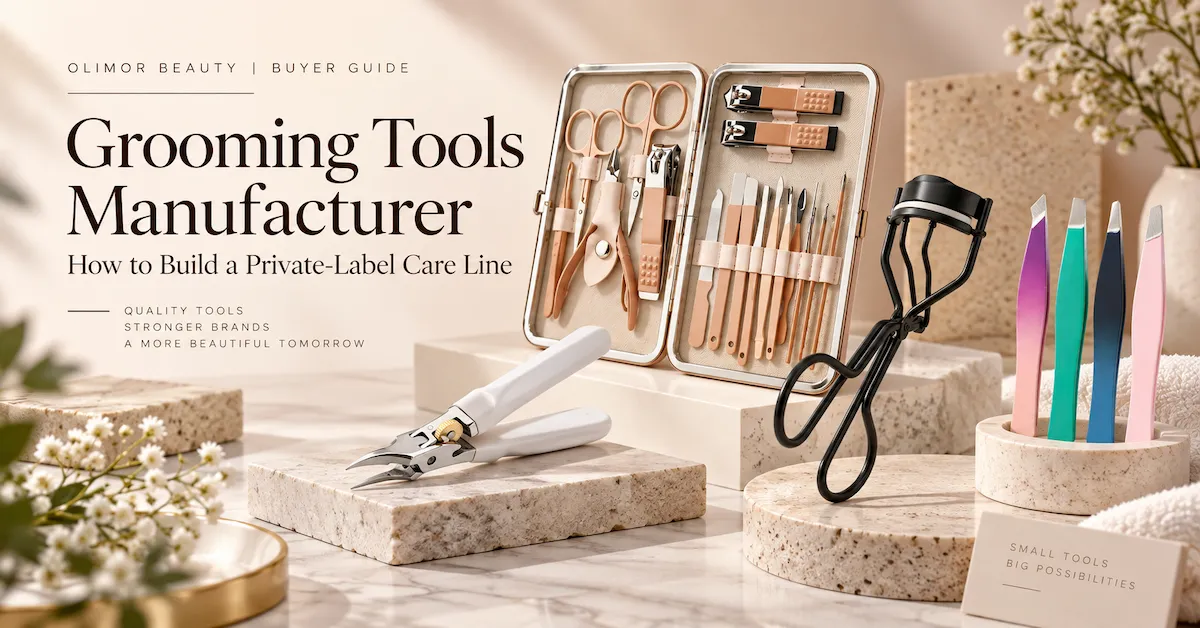
Direct answer: An OEM beauty tools manufacturer should do more than place a logo on a catalogue item. A capable partner turns a buyer's user scenario into a written specification, makes a traceable sample, identifies product-specific quality checks, coordinates branded packaging, and preserves the approved result through production and repeat orders. Look closely at that trail of documents. It tells a buyer far more than a low opening price or another unqualified promise about quality.
Who will find this useful? Product teams at beauty brands, importers, distributors, retailers, and ecommerce businesses, especially those buying tweezers, eyelash curlers, nail clippers, manicure sets, or similar personal-care tools. The discussion follows the order in which decisions tend to arise: commercial use, product brief, development route, sample, quality evidence, packaging, quotation, and inquiry.
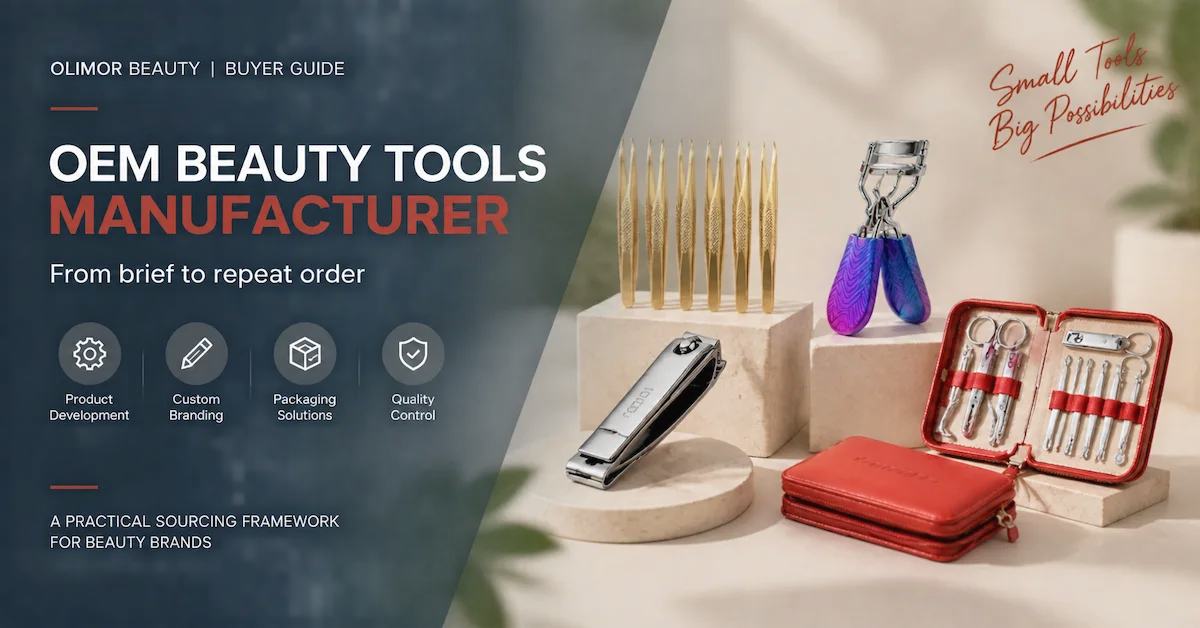
OLIMOR BEAUTY dates the business to 2011 and the factory to 2017 in its current company profile. It also names metal stamping and heat treatment, alongside plastic injection, polishing, water deburring, assembly, inspection, packing, and export coordination. That is helpful background, although it is not a product specification. Before an order is agreed, the parties still have to settle the chosen SKU's material, route, minimum quantity, calendar, pack, and documents.
| Buyer question | Short answer | Evidence to request |
|---|---|---|
| Can the supplier make the selected tool? | Match the SKU to its actual production route. | Process map, drawing, sample, and critical checkpoints. |
| Can it be branded? | Logo feasibility depends on the surface, geometry, and method. | Decoration proof on the final material and finish. |
| Will production match the sample? | Only if the reference and revisions are controlled. | Approved sample code, inspection plan, and change record. |
| What will the project cost? | Compare the same configuration and separate one-time charges. | Itemized quotation covering tooling, unit, logo, pack, and freight assumptions. |
| When can it ship? | There is no useful date until the development work and order scope are known. | A dated route through artwork, samples, approval, production, inspection, and dispatch. |
1. Which route fits: OEM, ODM, or private label?
Buyers often use the three labels loosely. The practical difference is the amount of product definition they bring to the table. OEM fits a team that already has something concrete: perhaps a drawing, a sample on the desk, dimensions, a mechanism requirement, or a controlled reference. The factory then has to turn that material into something production can repeat. An ODM beauty tools manufacturer starts further upstream, offering a platform or design direction that can be adapted. Private label usually begins with an established item and changes its brand, finish, colour, set, or packaging.
A buyer searching for a private label beauty tools manufacturer may only need a retail-ready version of a proven platform. A team seeking a custom beauty tools manufacturer may expect a new shape, tip, handle, hinge, or combination. Put that distinction in the opening brief. It avoids a costly crossed wire: one side budgeting for engineering while the other has priced decoration, or new tooling being proposed for a job that only needed a configuration change.
A three-column note works well at this stage. Label the columns "fixed," "preferred," and "open." The shopper task or maximum pack size may be fixed. A finish colour could be preferred. Laser marking versus printing might remain open. Now both sides can propose alternatives without quietly moving the requirements that define the project.
2. Begin with the shopper task, not the catalogue photograph
A catalogue photograph is useful for direction, yet it cannot describe the conditions that make a tool satisfactory. For tweezers, the real question may be whether the tips meet evenly and grip a fine hair without excessive hand pressure. For a nail clipper, the question may be whether the cutting edges meet correctly and the lever moves predictably.An eyelash curler has no single deciding part; its curve, pad, hinge, and handles have to behave as one mechanism. A manicure kit adds a second problem: each tool must work, and the case must keep every piece where it belongs.
Write one plain sentence describing the job. For example: "A compact brow tweezer for a mid-price ecommerce line, packed on a recyclable hanging card and intended for routine eyebrow grooming." That sentence guides geometry, finish, packaging, product copy, image selection, and inspection. It also gives an answer engine a clean, extractable description instead of a cloud of unrelated adjectives.
Then document the sales channel. A pegboard retail pack needs a hanging feature and visible product information. An ecommerce item needs protection against parcel handling and enough factual content for the product page. A travel kit needs secure retention and a case that closes without pressing on sharp or delicate working ends. A gift set may require closer control of colour and finish across several tools.
3. Build a product brief that a factory can actually quote
A useful brief does not need to be a finished engineering drawing. It needs to expose the decisions that affect function, cost, and timing. Include the intended user, target market, reference image or sample, quantity range, preferred material, dimensions, finish, logo, packaging format, target launch window, and any documents the destination market requires. Mark every unknown instead of hiding it.
The same framework can support several categories. Buyers can examine a professional tweezers set to discuss tip variety, grip area, colour, and set presentation. An eyelash curler reference can anchor questions about curve, pad, hinge, and handle. A nail clipper reference can start a conversation about edge meeting, lever action, handle construction, and package restraint. A manicure set reference can show how a multi-tool assortment and case should be reviewed together.
A quotation should separate product requirements from commercial targets. Include a unit-cost ambition, but label what that number means. Is it a hard ceiling, a working target, or merely the figure used in an early business case? The answer matters. It should never alter the specified material, function, or pack by implication. Give a quantity range too, since a universal MOQ is not meaningful. An existing item in a stock finish cannot be priced on the same basis as a new shape with special coating, branding, and a custom box.
- Who will use the product, and what grooming task must it perform?
- Which reference model, drawing, or physical sample defines the direction?
- Which dimensions, materials, mechanisms, and finishes are fixed?
- Which logo method, position, size, and artwork version are requested?
- What package format, insert, label fields, barcode area, and carton requirements apply?
- What quantity range, destination market, launch window, and shipping assumption should be quoted?
- Which safety, material, labelling, or import documents does the buyer require?
- Which decisions remain open for the supplier to recommend?
4. Convert the brief into a controlled specification
The specification is the bridge between the commercial idea and production. It should be detailed enough for purchasing, product development, quality, packaging, and the factory to identify the same item. A practical specification includes a SKU name, revision number, date, product image, drawing or measurement table, material by part, surface finish, colour reference, logo details, functional checkpoints, included accessories, package construction, and approval status.
Circle any adjective that an inspector could not verify.Words such as "strong," "premium," "comfortable," or "high quality" may belong in a design brief, yet they give an operator nothing definite to check. Translate each one into an observable result. On a tweezer, that means tip style, contact, alignment, grip area, finish, and protection of the working end. On a curler, it means the frame curve, pad position, hinge movement, handle geometry, finish, and replacement-pad arrangement. On a clipper, look to blade meeting, lever movement, body finish, accessories, and restraint in the package.
Define a hierarchy of requirements. Critical features affect safe or intended function. Major features affect use, assembly, branding, or saleability. Minor features affect appearance but do not prevent intended use. The exact classifications must be agreed for the SKU; they should not be copied blindly from another tool. A tiny mark on an inner case surface is not equivalent to a misaligned tweezer tip or a clipper edge that does not meet.
Freeze the specification before production. The word does not ban later changes; it makes them visible. Give a change its own revision, name the person responsible, record why it happened, and capture approval. A coating revision may call for another look at dimensions, logo appearance, or assembly fit. A new package deserves another fit and protection check. A changed tool may also make the insert or retail copy inaccurate.
5. Identify critical features by product category
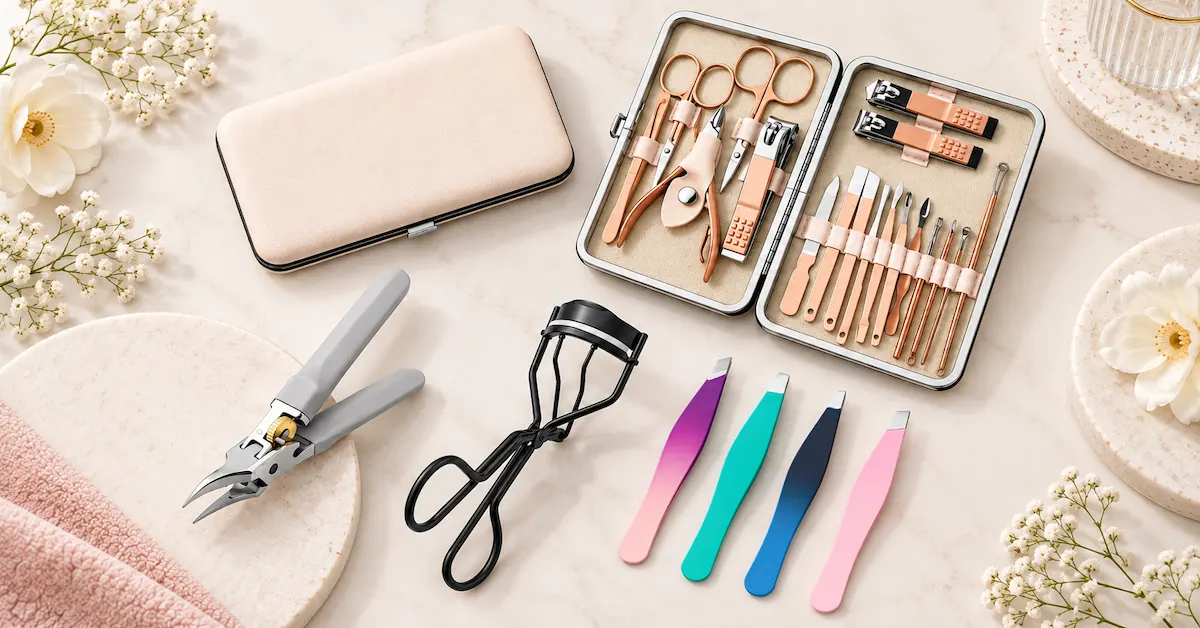
A custom beauty tools manufacturer should not apply one generic inspection list to every tool. Product categories share basic checks such as quantity, visible finish, logo, and packaging, but their critical functional features differ. The quality plan should follow the shopper task and the mechanism.
Tweezers
Review tip geometry, alignment, closing contact, spring feel, grip area, edge condition, finish, and protection in the pack. Test the intended task with an agreed method instead of relying only on visual inspection. A pointed lash tweezer and a slant-tip brow tweezer may need different handling and acceptance criteria. If the project uses a coating, verify whether it changes tip contact or surface appearance.
Checking an eyelash curler sample
Start with the frame curve and the way the two sides meet. Then work back through pad position, hinge play, handle control, visible finish, and replacement-pad fit where applicable. Judge the curve against the intended user profile in the brief; no single shape should be presented as universal. The pack has a job here as well, because pressure can deform the frame or leave the pad compressed.
Nail clippers and cuticle tools
Review blade or edge meeting, cutting action, lever movement, hinge or joint, hardness where relevant, burrs, visible finish, and any catcher or accessory. A sample that performs well once does not prove repeatability. Ask how the applicable forming, heat treatment, grinding, polishing, and assembly controls will be recorded for production.
Manicure and grooming sets
Review every included tool individually, then review the set as one retail product. Confirm item count, item identity, finish consistency, case dimensions, elastic or moulded retention, zipper or closure movement, logo, package copy, and carton configuration. A set is not acceptable if the individual tools pass but shift, rub, or fall out of position in the case.
Plastic-handled and multi-material tools
Review colour, surface texture, flash, sink marks, fit, insert position, alignment, and bonding or assembly. If the design combines metal and injected parts, identify the dimension or position that controls the relationship between them. Confirm whether production will use a physical colour chip, master sample, or approved colour reference.
6. Treat sampling as a decision process
A sample is valuable only when it answers defined questions. Before the factory makes it, list what the sample must prove: shape, mechanism, dimensions, material, finish, colour, logo, package fit, and functional result. If the first sample uses a temporary material or decoration method, label that limitation. Otherwise, the team may approve an appearance that cannot be repeated through the final process.
Review each sample in three passes. First, perform the intended grooming task and note control, movement, contact, and visible result. Second, compare the measurable and visible features with the current specification. Third, inspect the retail pack and shipping configuration. Photograph the relevant details under ordinary light and record comments against the sample code.
A useful revision comment is specific: "Tip contact is even, but the handle colour is darker than the approved chip; move the logo 2 mm toward the centre; increase insert retention at the pointed end." An unhelpful comment is "make it better." Specific comments let the beauty tools OEM factory identify which process or artwork needs adjustment.
Do not approve a sample in one email and modify it in another without updating the reference. On the approval sheet, identify the product revision and the code written on the physical sample. Add the artwork filename, colour reference, package drawing, date, and the person who approved it. Sometimes a buyer cannot retain the sample. In that case, detailed photographs plus a signed measurement or inspection sheet offer a workable record, provided both sides agree which document controls.
7. Plan custom logo beauty tools as a controlled feature
Buyers asking for custom logo beauty tools should provide vector artwork, desired size, position, colour, and orientation. The factory then needs to confirm which decoration methods suit the selected material, finish, and geometry.A logo that appears sharp on a flat paper box may lose detail on a narrow, curved, polished, or textured tool surface.
Approve decoration on the final substrate whenever possible. Review line clarity, fill, contrast, position, orientation, and visible damage around the mark. Ask how the decoration will be protected during assembly and packing. If a protective sleeve or insert touches the logo, the packed sample should be reviewed after handling.
Logo approval remains separate from functional approval. A crisp mark cannot correct an uneven tweezer tip, a clipper lever that binds, or a curler pad that sits off centre. Keep the decoration proof, functional reference, and package artwork within the same revision record, so that design, purchasing, and production all use the same version.
8. Make custom packaging part of the specification
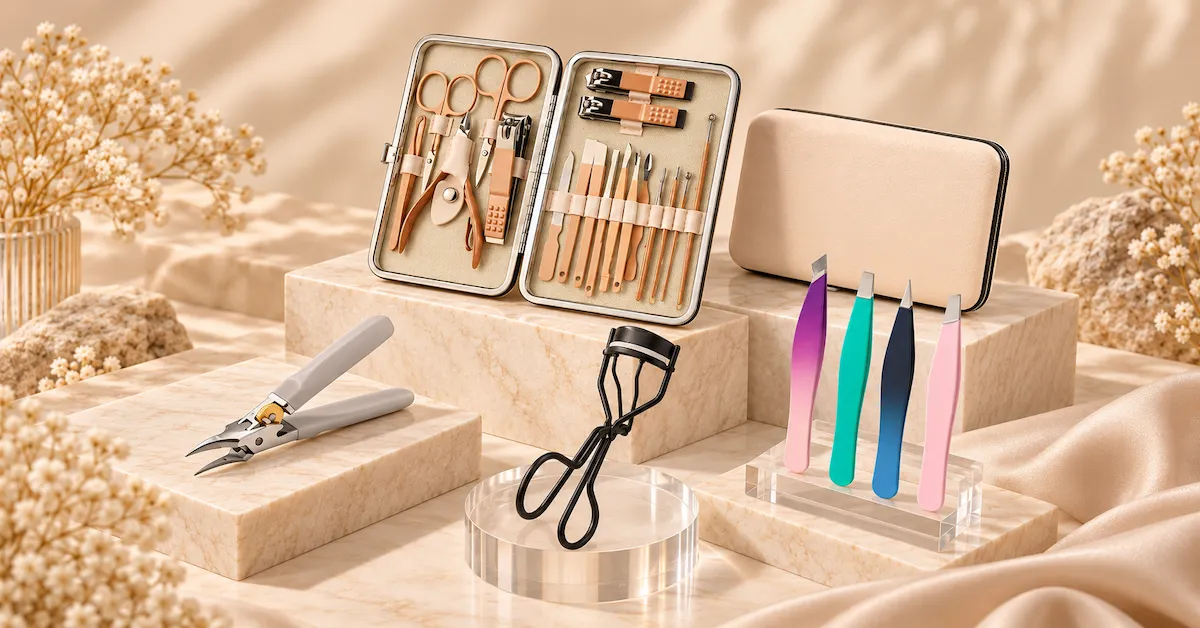
A beauty tools custom packaging manufacturer should connect presentation with physical protection. A pointed tweezer needs restraint around the working end. A nail clipper package should prevent lever movement and edge contact. An eyelash curler needs space that prevents frame deformation and pad compression. A manicure set needs retention for every component and a closure that works when the complete set is loaded.
Start with channel requirements: hanging card, window box, paper box, pouch, case, or ecommerce mailer. Then define insert material, product orientation, opening experience, barcode area, required language, warnings, material statements, recycling marks where appropriate, and the quantity per carton.Confirm who owns the dieline and who checks final artwork.
Approve a packed sample rather than a flat artwork file alone. Shake and handle the package in a way that reflects transport and shelf handling. Look for movement, scratching, crushed corners, bent cards, pad pressure, tool-to-tool contact, and barcode readability. The appropriate test method depends on the pack and shipping route, so agree it for the actual project rather than claiming a universal standard.
Packaging changes affect more than appearance. A larger box can change carton count, freight volume, pallet pattern, labelling position, and unit economics. A smaller insert may save material but fail to restrain the tool. Ask the quotation to show the exact pack version, carton quantity, and dimensions. That keeps cost comparisons honest and makes the replenishment file useful.
Discuss Your Sample and Packaging
9. Build a product-specific quality control plan
Quality control becomes useful when it is written as a sequence of decisions.OLIMOR's company information lists production-process inspection, finished-product inspection, and shipment inspection, as well as torque and hardness testing equipment. The important buyer question is how those capabilities connect to the selected model. Not every test is relevant to every tool, and a generic equipment list does not define acceptance.
A practical control plan can contain five layers:
- Incoming checks: confirm the identity and visible condition of metal, plastic, pads, springs, packaging, and other model-specific components.
- First-piece approval: inspect the first completed pieces after setup, tooling adjustment, material change, or process change against the current drawing and sample.
- In-process checks: monitor dimensions and functional features that can drift during forming, heat treatment, injection, grinding, polishing, decoration, or assembly.
- Finished-product checks: review function, appearance, colour, finish, logo, accessories, and primary packaging on completed items.
- Shipment checks: confirm quantities, carton marks, pack integrity, selected inspection records, and dispatch documents.
Use language that matches the tool. "Function test" is too vague if nobody knows what result counts as acceptable. For tweezers, specify tip alignment, closing contact, and grip. For nail clippers, specify edge meeting, lever action, and applicable hardness or finish criteria. For eyelash curlers, specify curve, hinge movement, pad fit, and handle control. For a set, include item count and retention.
Agree how nonconforming pieces will be identified, isolated, reviewed, corrected, and rechecked. The goal is not to promise that variation can never occur. The goal is to make the response visible and repeatable. If a defect reveals that the specification was unclear, update the specification before the next run.
10. Use ISO references carefully and accurately
ISO 9001 provides a recognized framework for quality management systems, including controlled processes, documented information, evaluation, and improvement. Buyers can use that framework to ask practical questions: Who owns the current specification? How are revisions distributed? How are inspection records retained? How are complaints investigated and corrective actions followed?
ISO 9001 should not be used as a substitute for product evidence. A quality-management certificate does not by itself prove that a tweezer tip, nail clipper edge, or eyelash-curler pad meets the buyer's requirement. Ask which current certificate applies to the legal entity and site supplying the order, then connect the management system to the model-specific control plan.
For lot inspection, ISO 2859-1 describes sampling procedures indexed by an acceptance quality limit. It can provide a shared vocabulary for sample size and acceptance or rejection decisions. The buyer and supplier still need to define defect classes, inspection level, and acceptance values for the actual SKU.A cosmetic mark, a missing accessory, and a functional failure should not automatically carry the same consequence.
Use external standards as working references, not decorative badges. Name the standard, link to the issuing organization, identify the decision it supports, and avoid implying certification where none has been verified. This approach gives purchasing teams traceable information and gives search systems a clear distinction between an industry framework and a supplier-specific claim.
11. Understand MOQ, tooling, cost, and lead-time drivers
There is no responsible universal MOQ for OEM beauty tools. The minimum depends on the product platform, material, finish, colour, logo method, package, tooling, component procurement, and order configuration. A standard tweezer in an existing finish may have a different minimum from a new tip geometry with a custom coating and printed retail box. Ask for the MOQ of the exact configuration rather than relying on a category-wide number.
Request an itemized quotation. Separate one-time costs such as tooling, sample development, colour matching, or packaging setup from recurring unit, decoration, insert, box, and carton costs. State the trade term, destination, currency, validity period, and shipping assumptions. Without those fields, two unit prices may describe different products and different responsibilities.
Lead time should be presented as milestones rather than one unexplained number.Typical stages can include feasibility review, artwork preparation, tooling where required, sample production, buyer review, revision, package proof, material preparation, production, inspection, and dispatch. Ask which stages can run in parallel, which require buyer approval, and which date starts the production clock.
When comparing a beauty tools factory China quotation with another source, normalize the scope. Confirm that both quotations use the same tool, material, finish, logo, pack, quantity, inspection responsibility, and shipping basis. A lower number is not a saving when it excludes the package, uses another finish, or assumes no development work.
12. Compare suppliers with a weighted scorecard
A scorecard keeps the decision from being dominated by one attractive sample or the lowest opening price. Choose weights that match the project. A premium brow tool may assign more weight to tip performance and finish. A mass retail manicure set may assign more weight to package efficiency, item consistency, and replenishment control.
| Evaluation area | What to score | Example weight |
|---|---|---|
| Product fit | Understanding of user task, category mechanics, geometry, and material. | 20% |
| Process fit | Connection between the SKU and forming, finishing, assembly, and packing route. | 15% |
| Sample quality | Function, dimensions, hand feel, finish, logo, and package against the brief. | 20% |
| Quality evidence | Critical checkpoints, records, lot inspection, and corrective-action method. | 20% |
| Commercial clarity | MOQ, cost breakdown, tooling, schedule, and shipping assumptions. | 15% |
| Communication | Open-question tracking, revision control, response quality, and export coordination. | 10% |
Score evidence rather than promises. A supplier receives a stronger score for a marked-up sample report than for saying "quality is good." A milestone schedule is stronger than saying "delivery is fast." An itemized quotation is stronger than a bare unit price. The scorecard should also record unresolved questions, because uncertainty has a commercial cost even when it cannot yet be converted into a number.
13. Connect the selected SKU to factory capability
Factory scale and equipment matter only when they support the selected product route. OLIMOR's current information lists metal stamping, heat treatment, injection moulding, polishing, water deburring, assembly, packaging, production-process inspection, and finished-product or shipment inspection. A buyer should ask which of those operations apply to the selected SKU, which are completed in-house, and where the critical handoffs occur.
For a metal tweezer, the route may include blank forming, shaping, joining, polishing, decoration, alignment, and packing. For a nail clipper, it may include forming, heat treatment where applicable, grinding, polishing, lever assembly, function checking, and packing.For a plastic-handled curler, metal frame and injected handle work need to meet during assembly. Not every model follows these examples, so the supplier should map the actual route.
Capacity figures require context. Installed or annual capacity does not automatically equal capacity available for a particular month, product family, finish, or package. Ask which operation is likely to govern the schedule and how the production plan responds if an artwork approval or component arrives late. A precise answer is more useful than a large headline figure.
Export experience can help with carton handling and documents, but it does not automatically prove compliance in every destination. Confirm the legal entity, factory site, product classification, material information, labelling, testing, and import documents required for the target market. Do not assume that a certificate for one entity, site, or product covers another.
14. Control the handoff from approved sample to production
Many avoidable quality disputes begin after a good sample has been approved. Production staff may receive an old drawing, a newer logo file, and a package comment buried in an email. Prevent this by creating one production-release package. It should identify the current product specification, sample code, artwork, colour reference, package drawing, carton requirement, control plan, quantity, and approved deviations.
Hold a short handoff review before production. Purchasing confirms commercial scope. Product development confirms the revision. Quality confirms the critical checkpoints and sample plan. Packaging confirms artwork and retention.The factory confirms materials, tooling, routing, inspection, and timing. Any contradiction is resolved before the production release is accepted.
Use first-piece approval after setup and after meaningful process changes. The first piece should be compared with the current reference, not with memory. If the finish, logo, mechanism, or package is outside the agreed result, stop and correct the setup before producing the full quantity. The exact process belongs to the supplier, but the buyer should understand the approval gate.
Changes during production need the same discipline. A substitute component, changed colour, revised carton, or adjusted mechanism may affect function and saleability. Record the reason, affected quantity, evidence, decision owner, and whether new testing or sample approval is required. Silence is not approval.
15. Build a repeat-order evidence file
A repeat order should not restart from a product photograph and an old invoice. Build one evidence file for every SKU. Include the latest specification, drawing, approved sample photographs, material information, finish and colour reference, logo proof, package artwork, packed-sample record, carton data, inspection checklist, approved deviations, complaint history, and change log.
Before replenishment, ask what has changed. Has any material source, component, finish, tooling condition, package supplier, artwork, or destination requirement changed? Has the buyer revised a barcode, claim, warning, or insert? If nothing changed, reference the previous approved revision. If something changed, identify its impact and approve the new reference.
This file also helps a wholesale beauty tools supplier respond quickly. The supplier can confirm whether the previous route is still available, while the buyer can compare new commercial terms without reopening settled product decisions. Clear history reduces ambiguity for both sides and supports more consistent product-page content.
16. Common OEM project failures and practical fixes
The sample looks right, but production feels different
Likely cause: the visual sample was approved without measurable functional checkpoints, or the approved reference was not controlled on the production floor. Practical fix: define the relevant tip, edge, hinge, pad, lever, spring, or handle checks; identify the sample revision; use first-piece approval; and record any accepted range.
The logo is clear on artwork but weak on the tool
Likely cause: the artwork was approved without testing the final material, coating, curve, or texture. Practical fix: make a decoration proof on the intended surface, review minimum line width and contrast, and protect the mark during assembly and packing.
The tool passes inspection but arrives scratched or bent
Likely cause: the package was reviewed as graphic design rather than a protection system. Practical fix: approve a packed sample, check product movement and contact points, review the carton configuration, and agree a handling or transport test appropriate to the shipment.
Two quotations cannot be compared
Likely cause: suppliers quoted different materials, finishes, package scopes, quantities, trade terms, or development assumptions. Practical fix: issue one comparison sheet, ask each supplier to list exclusions and one-time charges, and normalize the configuration before scoring price.
A revision is lost between design and production
Likely cause: files were shared through separate messages without one current release package. Practical fix: use revision numbers, a change log, named owners, and a production handoff that identifies every current file.
The MOQ or delivery date changes late
Likely cause: the early number was based on a standard model while the final project added colour, tooling, decoration, or packaging. Practical fix: reconfirm MOQ and schedule whenever the configuration changes, and show milestones rather than one unsupported promise.
17. Send an inquiry that receives a model-specific answer
The first inquiry does not need to solve every engineering question. It should give the supplier enough context to identify the project route and the missing decisions. Use this checklist:
- Company, market, sales channel, and target launch period.
- Product category, intended user, and the grooming task to be performed.
- Reference product link, annotated photograph, drawing, or physical sample.
- Expected dimensions, material preference, mechanism, finish, and colour.
- Logo file, preferred method, position, size, and colour.
- Package type, insert, required printed information, and shipping destination.
- Estimated first-order and annual quantity ranges.
- Required documents, inspection expectations, and any buyer-specific standards.
- Target price position and which requirements are fixed, preferred, or open.
- Finish with the commercial unknowns: present feasibility, first-sample scope, any new tooling, the reason behind the MOQ, the proposed calendar, and the quote expiry date.
A photograph with arrows and short notes is usually easier to work from than a folder of unexplained images. When the inquiry covers several products, give each one a temporary code. Have the supplier repeat the configuration next to its price. This modest discipline catches crossed wires before anyone pays for a sample, tool, or printed box.
Frequently asked questions about OEM beauty tools manufacturing
What does an OEM beauty tools manufacturer do?
Its starting material comes from the buyer: perhaps a design, a drawing, a physical sample, or a written specification. From there, the factory works out a route that production can follow. Depending on the job, that may touch feasibility, development, tooling, materials, finishing, samples, decoration, assembly, inspection, packing, and export. The quotation and development agreement should say which of these are actually included.
What is the difference between OEM and ODM beauty tools?
OEM usually starts with more buyer-controlled product input. ODM usually starts with a supplier platform or design direction that the buyer adapts.Private label often uses an existing item with logo, colour, finish, set, or packaging changes. The terms should be defined in the quotation so both parties understand who owns each decision.
How much do custom beauty tools cost?
There is no reliable universal price. Even two tools with a similar outline can land at different numbers once the material, dimensions, mechanism, finish, colour, mark, tool investment, pack, order size, inspection, trade term, and destination are known. Have the supplier price the exact configuration. The quotation should put development charges in their own section instead of burying them in the recurring unit cost.
What is the MOQ for OEM beauty tools?
MOQ varies by model and customization. Existing platforms, standard finishes, special coatings, injection colours, packaging print runs, and new tooling can produce different minimums. Send the intended configuration and quantity range, then ask the supplier to explain which component or process controls the MOQ.
How long does an OEM beauty tool project take?
The schedule depends on feasibility, tooling, sample rounds, artwork approval, material preparation, production, inspection, and shipment. Request a milestone plan for the selected SKU. Confirm what starts each stage and how a buyer revision affects the date. Avoid relying on a category-wide promise.
How can a buyer protect a beauty tool design?
Design protection often starts with mundane habits. Put a date and revision on the drawing, restrict the working folder, and settle ownership of development output and tooling in writing.Legal terms for confidentiality and intellectual property need review in every relevant jurisdiction. During the factory discussion, ask practical questions too: Where will a drawing be stored? Who is allowed to send out a sample? What happens to an obsolete artwork file? A qualified lawyer, rather than this operational checklist, should settle the contract language.
How should production quality be checked?
Connect inspection to the product's intended function. Use incoming, first-piece, in-process, finished-product, and shipment checks where appropriate. Define critical, major, and minor conditions for the SKU; agree the sample method; compare results with the approved reference; and record corrective action when a requirement is missed.
Which certificates should a buyer request?
Request current documents tied to the legal entity, factory site, product, material, destination, and buyer program in question. A certificate placed in a general presentation may cover a different site or scope. Read the scope line, note who issued it and when, then check its relevance with the supplier and a qualified compliance adviser for the destination market.
Is a multi-category supplier suitable for all four tool families?
A manufacturer may cover several categories, but capability should be evaluated model by model. OLIMOR presents these product families and describes metal and plastic processing, assembly, inspection, packaging, and OEM/ODM support. Buyers should still confirm the route, materials, critical checks, and available capacity for each selected item.
What should a buyer approve before mass production?
Approve the current specification, drawing, physical or documented sample, material and finish, colour reference, logo proof, package artwork, packed sample, carton requirement, inspection plan, commercial scope, and agreed deviations. Put the approved files into one release package with a revision number and date.
From product idea to repeatable supply
The best OEM sourcing process leaves a readable trail. First comes the shopper's task. The brief turns that task into product choices, and the sample tests whether those choices work together. From there, the specification, inspection plan, packed sample, and change record keep the approved result intact. Only then do price and timing refer to a real configuration instead of an attractive but incomplete idea.
OLIMOR's stated combination of beauty-tool categories, metal and plastic processing, assembly, inspection, packaging, OEM/ODM development, and export coordination gives buyers a practical base for a model-level conversation. The next step is not to request a generic catalogue promise. It is to send a focused brief and ask which product route, sample plan, quality checkpoints, and quotation assumptions apply.
Get a Model-Specific Beauty Tools Quote
Include your target product, reference image or drawing, intended user, market, material preference, finish, logo, packaging idea, quantity range, and launch window. A clearer first message gives the manufacturer a better chance to return a useful feasibility answer, sample plan, and quotation.