

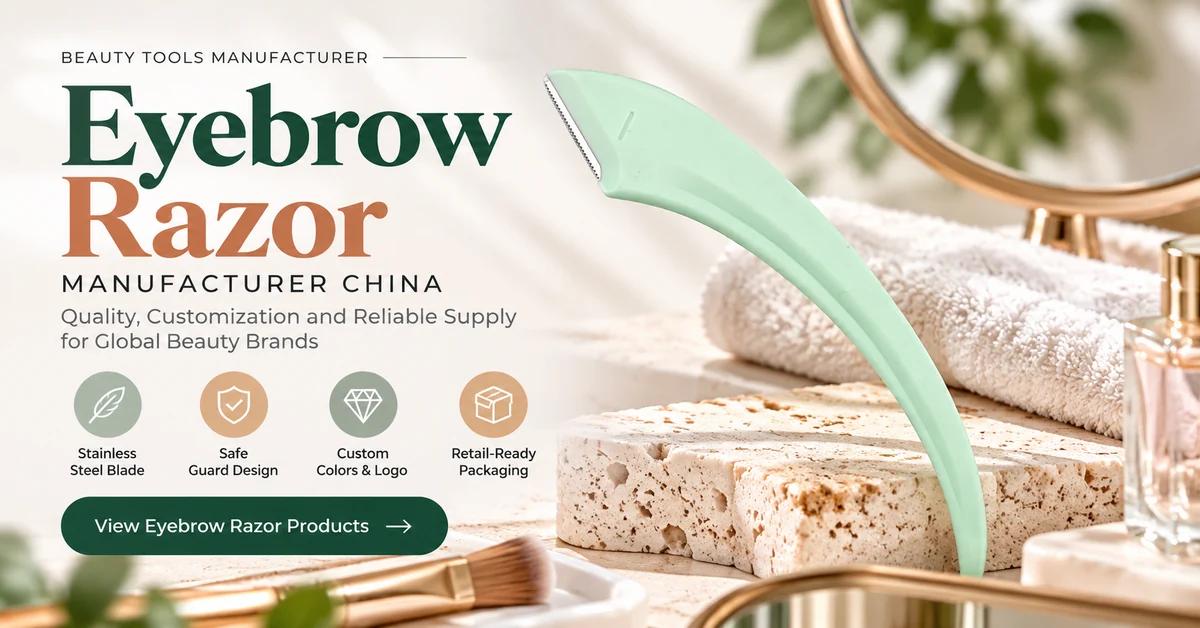
Quick answer: When evaluating an eyebrow razor manufacturer China sourcing partner, approve the complete grooming tool rather than judging a blade photograph or a low unit price. Identify the blade and guard construction, verify the handle and assembly, test samples under a documented non-medical grooming protocol, and confirm protective packaging, product information, lot identification, and repeat-order controls. For overseas beauty brands and importers, these checks help convert a promising sample into a retail-ready product specification that can be inspected again on future shipments.
An eyebrow razor is a small, sharp-edged cosmetic accessory used for controlled brow grooming and, where the particular product is suitable and instructions allow, other superficial facial-hair grooming. It is not automatically a medical instrument or a treatment for skin conditions. Its compact format can make shipping and merchandising convenient, but it also makes blade protection, user instructions, storage and product traceability important commercial decisions.
This guide is written for private-label beauty brands, importers, chain retailers, e-commerce buyers and salon-supply distributors. Unlike a general customization article, it focuses on the evidence a purchaser should require between choosing a China supplier and releasing a production lot: blade-to-handle specification, sample acceptance, twelve checks, risk classification, export-carton controls and a decision-ready RFQ.
Explore OLIMOR Eyebrow Razors | Request a Product-Specific Quote
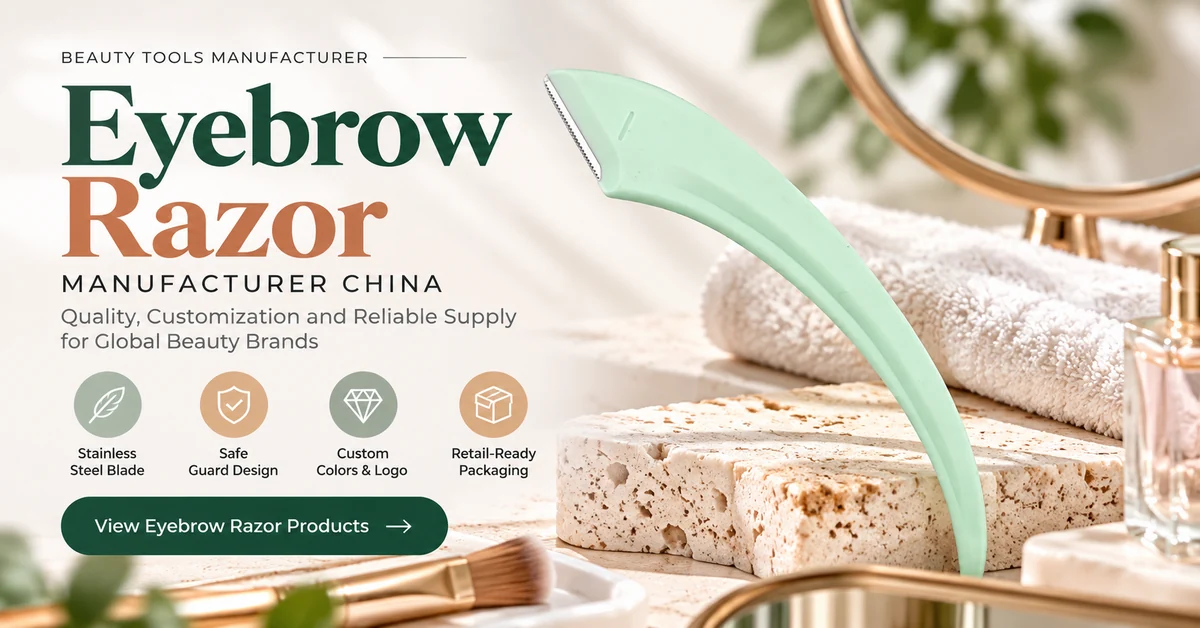
1. What Should an Eyebrow Razor Manufacturer in China Actually Provide?
A useful manufacturer or coordinated sourcing partner should be able to identify the product being quoted, explain its manufacturing and assembly responsibilities, arrange representative samples, and agree on a standard against which the buyer can inspect the finished order. A statement such as “premium eyebrow razor factory” is not a substitute for this evidence.
At minimum, request an item reference, current photographs of the actual model, component materials, dimensions, blade configuration, storage protection, packing configuration and information about which variations can be supplied. Then ask how samples are approved, whether outside component suppliers are involved and how proposed changes will be communicated before repeat production.
An overseas buyer should distinguish a legal seller, an actual production site and subcontracted component processes. A company may manufacture some parts, assemble others and coordinate printing or packaging elsewhere. That arrangement can work, but the responsibilities must be transparent. A factory tour alone does not prove that the inspected site makes every component of your SKU.
The commercial question is straightforward: can the supplier deliver the defined eyebrow razor consistently, with suitable evidence and a quotation that includes the complete packed unit? The rest of this guide turns that question into measurable checks rather than marketing language.
2. Which B2B Buyers Need Different Eyebrow Razor Specifications?
A beauty brand building a brow-grooming collection may prioritize a recognizable shape and coordinated color. A drugstore buyer may place greater weight on packaging, barcodes, warnings and retail display. An online seller may need compact protective packing and accurate close-up photographs. A professional brow-tool distributor may focus on grip, blade access and dependable repeat orders. These buyers should not copy one another's purchase specifications.
| B2B customer | Intended retail or professional setting | Selection priority | Common sourcing risk |
|---|---|---|---|
| Private-label beauty brand | Branded brow-grooming range | Product feel, finish, identity and pack | Decoration approved before blade function |
| Importer / wholesale distributor | Multi-customer supply | Stable SKUs, cartons and reorders | Unrecorded changes between batches |
| Drugstore / beauty chain | Shelf display and home use | Legible information, protected blade, barcode | Incomplete retail presentation |
| E-commerce retailer | Marketplace and direct delivery | Accurate images, pack restraint, dimensional data | Transit damage or listing mismatch |
| Brow studio supplier | Professional cosmetic grooming | Grip control, defined working edge, cleaning guidance | Undefined functional acceptance |
| Gift and travel-kit buyer | Portable grooming collection | Protective cap, case fit, tool count | Blade exposure or loose items in a kit |
The product is not automatically suitable for clinical procedures, treatment of skin disorders, use on irritated or broken skin, or use by unsupervised children. Claims for such applications require separate evidence and evaluation; they should not be attached to ordinary cosmetic eyebrow razors through marketing copy.
Before selecting products, write one sentence defining the main purchaser and use case. For example: “A protected precision brow razor for adult home grooming, sold in a two-piece retail pack through a European beauty chain.” This will guide the blade, handle, label and carton decisions.
3. Compare Razor Designs by Protection and Handling, Not Appearance Alone
Eyebrow razors may differ in their blade guard design, cutting-edge profile, handle length, folding construction, protective cap and packaging. These features affect how the user accesses the brow area, stores the tool and avoids unintended contact. They also change how the manufacturer must inspect and pack the product.
A fixed-head brow razor with a close-fitting cap may be useful for simple retail presentation. A folding configuration can reduce exposure when closed, provided its hinge and closure are validated. A guarded or micro-tooth blade profile adds another interface that must be checked for consistent geometry and unwanted defects. None of these designs is universally safer or better without product-specific assessment.
| Design direction | Buyer should examine | Benefit to investigate | Approval concern |
|---|---|---|---|
| Fixed-head razor with cover | Cover retention, exposed edge, handle | Straightforward storage and packaging | Cap loosens during shipping |
| Folding razor | Pivot, closure, handle and edge | Folded storage where appropriate | Blade exposed after unintended opening |
| Guarded or micro-tooth edge | Guard regularity and edge condition | Controlled cosmetic grooming when used as intended | Inconsistent guard or burrs |
| Compact travel razor | Overall length, grip and protective pack | Kit fit and portability | Reduced control or insufficient protection |
| Coordinated multi-pack | Unit consistency and individual protection | Retail value and range building | Mixed versions or missing covers |
Treat this table as a design-comparison framework, not a claim that each option is presently available in every OLIMOR SKU. When comparing candidates, make sure their intended application is the same. A folding structure should not be accepted merely because it appears sophisticated, nor a shorter handle because it looks more convenient in a photograph.
4. Two Public OLIMOR Eyebrow Razor Models: ERF1030 and ERF1020
OLIMOR BEAUTY, associated with Bonet Houseware Co., Ltd. in Yangjiang, Guangdong, China, lists eyebrow razors among its beauty and personal-care tools. Its Eyebrow Razor product category provides a practical starting point for sourcing discussions.
Two publicly documented reference models allow buyers to compare real stated dimensions instead of invented catalog specifications:
| Product | Listed material | Listed length | Listed weight | Buyer interpretation |
|---|---|---|---|---|
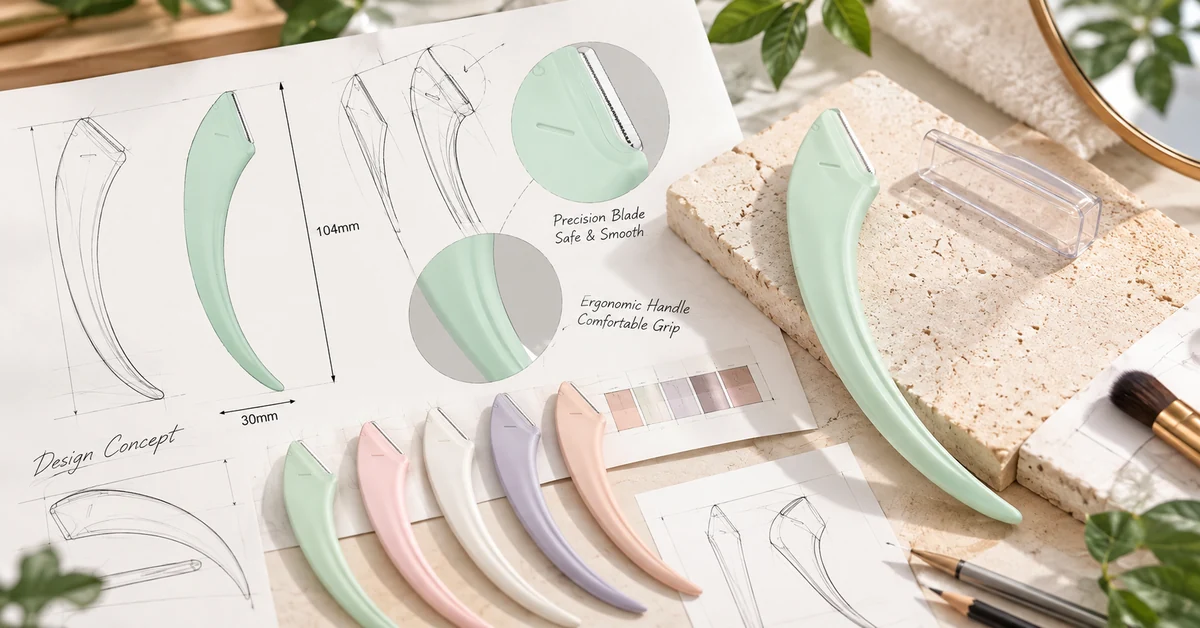
| ERF1030 – Eyebrow Razor | Stainless steel + plastic | 104 mm | 4.1 g | Compact published reference; examine actual grip and protection |
| ERF1020 – Eyebrow Razors | Stainless steel + plastic | 137 mm | 7 g | Longer published reference; compare handling and packed size |
These are published listing values, not independent laboratory measurements. The product pages reviewed showed out-of-stock indications, and the listings do not establish exact stainless-steel grade, blade thickness, hardness, edge profile, packaging details, available colors, MOQ or present bulk manufacturing status. The word “customized” on a color field is not an unconditional promise of every possible finish.
The 33 mm difference in published length can be useful for preparing a comparison trial, but it does not prove either model is easier to use. A sample evaluation should include complete assembly and protection, not just the number printed in the size field. Confirm that the published lengths refer to the same measurement convention before making an engineering comparison.
For an RFQ, share the exact ERF1030 product page or ERF1020 product page, request updated sample information and confirm the supplier's current commercial terms.
5. Build a Component-Level Technical Specification
A material label such as “stainless steel + plastic” is useful, but insufficient for final production approval. It does not say which steel grade is used for the blade, which polymer is used for the handle, whether a cap is included or how the blade is secured. Those are component-level questions that affect manufacturing, inspection, product copy and the buyer's quality file.
| Component or attribute | Information to request | Why it matters |
|---|---|---|
| Blade | Material grade where relevant, edge profile, thickness and surface condition | Cutting behavior, durability and inspection |
| Protective guard | Guard geometry and relationship to the cutting edge | Intended working contact and protection |
| Blade holder | Assembly method and retention specification | Prevents loose or misaligned components |
| Handle | Material, length, cross-section, grip finish | User control and cosmetic consistency |
| Folding pivot, if present | Joint construction and closed-position retention | Functional reliability and storage |
| Protective cap, if present | Material, fit and retention | Storage and transportation protection |
| Product finish | Color, decoration and permitted surface variation | Branding and repeat-order consistency |
| Packed unit | Unit count, insert, instructions and carton identity | Retail accuracy and damage prevention |
Only add numeric tolerances when the buyer and supplier have a product drawing, an agreed measuring method and a reason for the requirement. Generic “high precision” is not an inspection criterion. A definite check such as “cover remains on the approved sample under the agreed handling test” is more useful.
The same applies to corrosion and cleaning claims. Stainless-steel components vary in properties. Do not promise that a razor is “rustproof,” “sterile” or “medical grade” because the catalog uses the word stainless. Product-specific testing and destination-market review are required for claims beyond the verified specification.
6. Blade and Guard Geometry: The Most Important Functional Interface
The working end of an eyebrow razor includes the cutting edge and, on relevant designs, guard teeth or a protective structure. A buyer must evaluate them as one system. An evenly shaped guard may help users control access to the edge under the intended use instructions, but the presence of a guard alone does not guarantee the absence of nicks or irritation.
Sample inspection should look for damaged guard features, protruding or poorly secured blade edges, unexpected burrs and visible misalignment. The supplier and buyer should agree on a functional trimming medium or other suitable test method before placing a bulk order. The aim is to compare consistent results, not to pressure the tool against skin or demonstrate extreme sharpness.
For a folding model, inspect what happens when the tool is opened and closed. Check whether the folded razor actually shields the blade under reasonable storage and packing conditions. For capped products, confirm whether the cap seats correctly and stays in place under a defined handling check. For fixed exposed-end designs, packaging may need additional restraint and user information.
These controls are particularly important because eyebrow razors are used near sensitive facial areas. A procurement evaluation should avoid encouraging use on broken skin, eyelids or other inappropriate areas. If the supplier provides claims such as “painless,” “no cuts” or “suitable for every skin type,” ask for substantiation and evaluate whether the wording belongs on the destination-market pack at all.
7. Handle Material, Grip and Assembly Quality
The handle is not merely a place to put a logo. Its shape, surface and connection to the head affect the user's ability to position the tool consistently. A short handle may suit some portable formats; a longer handle may change reach and control. Actual ease of use is a question for sample testing with the intended customer, not an assumption based on dimensions.
Evaluate gripping zones, abrupt edges, visible molding defects, color consistency and how securely the head is attached. Where the design uses two materials, check that they are assembled without unacceptable gaps, looseness or rough seams. If the item folds, test whether the pivot moves predictably and whether the razor stays in its intended closed configuration.
The handle material should be identified precisely enough to support the product description and any destination-market documentation. “Plastic” covers many materials; do not claim a particular polymer, recycled content or heat resistance without evidence.
A proposed color change may seem cosmetic but can introduce different batches of molded parts, printing processes or protective packs. When discussing custom appearance with a manufacturer, approve an actual decorated sample and decide which functional tests must be repeated after the change.
8. Manufacturing Process: Ask for the Actual Production Route
Depending on the chosen architecture, an eyebrow razor production route may involve sourcing or processing blades, preparing molded or formed handles, installing blade holders or guards, assembling folding pivots where applicable, checking function, applying branding and packing retail units. A supplier may perform some stages internally and coordinate others with specialist partners.
This is a general possible process map, not confirmation of OLIMOR's equipment list or the exact steps used on ERF1020 and ERF1030. The purchaser should ask the supplier to map the selected SKU, identify incoming components and explain who performs each critical operation.
An informative manufacturing flow should answer: How is the approved blade identified? What prevents a wrong guard being assembled with a particular handle? Is the first piece checked after a setup change? How are defects segregated? Who can authorize rework, and how are finished cartons linked to a production lot?
Where new molds, blade holders or packaging inserts are proposed, request a feasibility assessment and any one-time charges separately from the recurring unit quotation. A product that is easy to illustrate may still require tooling changes, assembly fixtures and additional sample approvals.
9. The 12-Checkpoint Blade-to-Carton Quality Plan
A useful inspection plan covers the whole retail product, including the blade, holder, handle, protector, pack and carton. The following matrix is a recommended buyer audit checklist, not a claim that OLIMOR has already completed each check or a certified quality rating.
| No. | Quality checkpoint | What the buyer should verify | Typical evidence |
|---|---|---|---|
| 1 | Correct SKU and revision | Model, finish and approved version match order | SKU sheet and signed reference |
| 2 | Blade identity | Approved blade material and configuration | Component specification / incoming record |
| 3 | Edge condition | No unacceptable chips, burrs or damage | Agreed visual and functional test |
| 4 | Guard geometry | Protective features match approved sample | Close-up inspection and reference |
| 5 | Blade retention | Blade is securely assembled | Defined assembly check |
| 6 | Handle integrity | No unacceptable cracks, sharp seams or loose parts | Visual / tactile inspection |
| 7 | Folding action, if applicable | Stable opening, closing and retention | Repeated functional check |
| 8 | Cap or cover fit | Correct protection stays in place | Approved handling test |
| 9 | Finish and logo | Color, print and surface meet accepted sample | Boundary sample and artwork |
| 10 | Retail unit completeness | Correct quantity, instructions, accessory and insert | Packed-reference comparison |
| 11 | Carton identity | Correct SKU, quantity, lot and markings | Packing list and carton check |
| 12 | Lot release and change control | Accepted lot documented; deviations closed | Inspection report and release signoff |
The point of twelve checks is not to generate paperwork for its own sake. It is to establish a repeatable definition of an acceptable order. For example, a beautiful carton cannot offset a badly secured blade, and a good blade cannot offset a missing protective cover when the approved product includes one.
Before approving production, decide who makes each check, what sample or record is acceptable, and which findings block shipment. A critical edge or blade-retention problem should not be averaged away by a high overall cosmetic score.
10. Sample Approval: Bench Testing Before Real-World Claims
A rigorous sampling program starts with the written intended use and a representative actual product. The first evaluation should be on the bench: inspect the assembly, blade condition, guards, cap or folding mechanism, and handle. Test on an agreed non-skin medium suitable for checking consistency. Only consider further user evaluation once a qualified team has confirmed that the sample is suitable for it.
Record the test method, number of samples, model revision, observed differences and rejection conditions. Do not describe an improvised test as a recognized standard. Cutting through a chosen test material may tell a buyer something about consistency, but does not by itself establish safety for every facial-hair type or skin condition.
For an ergonomic evaluation, adult participants representing the intended user group can assess grip and visibility under a controlled, non-contact positioning task. Record preferences separately from observable failures. Keep any actual-use evaluation within appropriate instructions and safety review, and stop immediately if the tool appears damaged or uncomfortable.
The result should be a signed or otherwise documented golden sample, not just a photograph. The golden sample needs an identifier and the associated packing reference. If the supplier later changes the guard, blade or handle, determine which sampling and testing must be repeated before the modified item is shipped.
11. How to Classify Defects and Choose an Inspection Plan
Defect severity should follow the real user and business risk. A damaged or insecure cutting edge can present a different problem from a small color variation. Packing errors can also matter if a sharp tool is shipped without an approved guard or safe storage arrangement.
| Defect category | Example | Buyer action |
|---|---|---|
| Safety-related / critical | Loose blade, unacceptable exposed sharp component, broken guard | Stop release; investigate and resolve |
| Major functional | Folding latch fails, cap does not retain, wrong blade specification | Reject or hold as specified; corrective action |
| Major commercial | Wrong model, missing protector, incorrect retail contents | Correct and reinspect before release |
| Minor cosmetic | Surface mark inside agreed acceptable boundary | Apply approved defect limit |
For lot-by-lot inspections, ISO 2859-1:2026 provides acceptance-sampling schemes by attributes. It does not certify eyebrow razors or define the correct hazards and functional requirements for a particular product. Sampling plans require agreed lot definitions, defect classes, inspection levels and acceptance rules; serious safety issues need additional controls regardless of statistical sample size.
Ask to see records that refer to your exact order and inspection criteria. A generic “100% checked” marketing claim is less useful than a traceable report showing what was checked, by whom, against which reference and what happened when a defect was found.
12. Traceability from Blade Batch to Finished Retail Carton
A repeatable eyebrow-razor order needs a product identity that survives through components, assembly and packing. The buyer should be able to determine which finished SKU and production lot were shipped, which critical materials were approved and what changes occurred between orders.
Not every consumer product requires serial numbering. A proportionate batch or lot scheme may be sufficient, depending on the market and applicable obligations. The key is to decide how a lot links to blade components, assembly records, packed units and shipment documentation. Where different subcontractors are involved, ask who collects and retains those records.
For an importer, traceability also supports corrective action. If a group of razors has a defective cap or incorrect instruction insert, the buyer needs to identify affected cartons and downstream customers. A clear lot reference reduces the ambiguity of relying on undated catalog photographs or item names that multiple suppliers use.
Record permitted product changes in writing. If the supplier proposes a new blade source, guard profile, handle mold or packaging material, determine whether the technical specification, approved sample, product claim or market documentation must be updated.
13. Retail Packaging: Protect the Blade, Not Just the Brand
Packaging should perform two jobs: protect the grooming tool and communicate the approved product. A beautiful box can still fail if the razor moves freely, the cap comes off or the blade contacts the packaging wall during transport.
Discuss packaging formats such as a secured hanging card, protective blister or sleeve, folding carton with insert, travel case or coordinated grooming kit. These are possible commercial formats; actual availability and minimum quantities must be confirmed with the selected supplier. Test the final packed unit, not an empty printed box.
For e-commerce, pay attention to package dimensions, restraint and how the item survives normal shipping handling. For physical retail, review front-of-pack clarity, barcode placement, shelf format and information legibility. For multi-packs, verify the exact number of tools, individual protection and consistency of colors and blade types.
Care instructions and warnings should reflect the actual design. Avoid implying that the razor can be used safely on damaged skin, that it is sterile or that a protective guard makes injury impossible. Retail photography should show the final shipped product and its actual contents. Do not use a mockup of a protective cap if the commercial pack will not include it.
14. Destination-Market Compliance and Claims Review
Eyebrow razors are sharp cosmetic grooming accessories, so product safety, labeling and distribution responsibilities deserve an early review. Requirements depend on the importing jurisdiction, product classification, intended users and sales channel.
For products offered to consumers in the European Union, Regulation (EU) 2023/988, the General Product Safety Regulation, establishes general product-safety obligations and relevant information requirements for economic operators and online offers. The exact obligations should be assessed for the product, transaction and operator role. It is not accurate to call the GPSR a product-specific “eyebrow razor certificate.”
For advertising and retail descriptions, claims must be supportable. “Hypoallergenic,” “guaranteed no cuts,” “medical grade,” “dermatologist approved” and “sterile” should not appear without appropriate, product-specific evidence. Similarly, avoid presenting ordinary brow razors as a treatment for acne, dermatitis or other skin disorders.
Ask the supplier and the responsible market team to agree on product identity, material wording, instructions, warnings, manufacturer or importer details where required, traceability and packaging language. Do this before artwork is printed. A last-minute labeling correction can create avoidable rework and launch delays.
15. Standard Wholesale, OEM and Private Label: Select the Right Scope
Not every buyer needs a newly engineered razor. A retailer testing demand may prefer a confirmed existing model with suitable protective packaging. A developing beauty brand may need branded colors, logo artwork and coordinated packs. A genuinely different handle, blade holder or folding mechanism can require a broader OEM or ODM feasibility project.
| Cooperation route | What is being purchased | Main approval emphasis | Potential added cost |
|---|---|---|---|
| Standard wholesale | Existing confirmed SKU | Product identity, function, packing | Quantity and shipping |
| Private label | Existing suitable tool with agreed brand treatment | Decorated sample, copy and pack | Logo, print, packing MOQ |
| Modified-platform OEM | Existing design with selected functional changes | Drawings, revised samples and validation | Components, fixtures, testing |
| New development / ODM discussion | New or supplier-led design configuration | Feasibility, tooling, IP and pilot approval | Engineering and tooling |
| Grooming-set program | Several approved tools in one pack | Individual tool QC plus set completeness | Insert, assembly and extra SKUs |
A phrase such as “OEM available” does not establish which route the supplier can support for ERF1030 or ERF1020. Ask OLIMOR for the selected model's actual customization scope, quotation conditions and sample process. Keep the difference between an available commercial option and a proposed development idea clear in all documents.
16. MOQ, Lead Time and Capacity: Questions That Need Order-Specific Answers
There is no verified universal MOQ or production lead time for all OLIMOR eyebrow razors. Minimum quantities may vary between existing models, colors, blade configurations, printed boxes, display packs and brand-specific tools. A quote that mixes several models may have different minimums from a single-SKU order.
A useful supplier response separates sample preparation, artwork approval, component readiness, production, final inspection and freight. It also states whether quoted dates refer to factory completion, shipment departure or delivery. If a particular blade or packaging component comes from another manufacturer, the supplier should explain how that affects scheduling.
Ask capacity questions in relation to your model and order size, not just a generic monthly output number. A company-wide shipment claim cannot establish the production capacity of one eyebrow razor version. Where equipment or factory size matters to the project, request current evidence rather than assuming public marketing figures apply to every production line.
For buyers working to a retail launch date, protect schedule risk by freezing artwork and samples before bulk production. Late changes to a blade cover, instruction card or printing can delay the complete packed unit even if the razor itself is ready.
17. Understand the Full Cost of a Bulk Eyebrow Razor Order
A very low catalog number is not necessarily the landed cost of a sellable branded razor. Compare quotations for equivalent blade, handle, protector, packing and delivery terms. Include sampling, custom decoration, packaging, quality checks, freight and relevant import expenses in your planning.
A simplified hypothetical example for 2,400 units is shown below. These are invented teaching values, not OLIMOR prices or confirmed import charges.
| Illustrative cost element | US$/unit |
|---|---|
| Base razor and approved protector | 0.32 |
| Logo and color work | 0.08 |
| Retail packaging | 0.14 |
| Allocated inspection | 0.05 |
| Allocated freight | 0.16 |
| Assumed import-related allocation | 0.05 |
| Illustrative landed unit cost | 0.80 |
If a distributor hypothetically sells that unit for US$1.30, the gross margin before other expenses is (1.30 - 0.80) / 1.30 = approximately 38.5%. This is not a profit guarantee. Sales commissions, storage, returns, merchant fees, marketing and overhead may materially change the result.
A good RFQ therefore asks for itemized prices, feasible quantity breaks, pack options, product and carton dimensions, Incoterm with named place and quote validity. Buyers can then compare like with like instead of choosing a supplier using a screenshot of an unexplained retail price.
18. A Supplier Verification Scorecard for Overseas Importers
When buying from China, the question is not simply whether a company calls itself a manufacturer. It is whether the legal seller, actual manufacturing process, sample approval and product responsibilities are transparent enough to manage risk.
| Verification question | Evidence to request | Procurement concern |
|---|---|---|
| Who is the contracting supplier? | Registered name and quotation header | Contracting identity |
| Where is the selected SKU made or assembled? | Production-responsibility explanation | Factory vs. subcontractor visibility |
| Who controls blade and guard specification? | Approved drawing or component reference | Incorrect or substituted components |
| Can samples be traced to the quoted SKU? | Item number, sample ID, revision | Showroom / production mismatch |
| What happens after a failed inspection? | Nonconformance and correction process | Shipment release risk |
| How are OEM changes approved? | Revision and artwork procedure | Silent material or design changes |
| How are export cartons identified? | Packing standard and sample marks | Receiving and recall difficulty |
This is a buyer assessment checklist, not an official certification or a rating assigned to OLIMOR. If a supplier does not immediately possess every requested document, the right response is to clarify what evidence is necessary for the product and market, what can be prepared and what remains unconfirmed.
A professional sourcing discussion is improved by concrete questions. “Can you show us how a loose blade is detected before packing?” is more useful than “Do you have strict QC?” The answer can be evaluated against the actual SKU and the purchaser's risk tolerance.
19. Build a Coordinated Brow-Grooming Range Without Losing Product Control
An eyebrow razor can be sold alone or alongside other brow accessories. A brand may develop a grooming collection using eyebrow razors, tweezers, beauty scissors and selected eyelash curlers. The commercial advantage is a clearer assortment for retail buyers, not an assumption that every tool has identical manufacturing characteristics.
If the razor will be part of a gift or travel set, approve each tool independently and then inspect the combined pack. The razor's blade protector should not be removed simply because a tray looks more attractive without it. A shared insert needs to secure all parts, and the final product description must match the actual contents.
For a new brand, launching one well-defined razor can be more manageable than introducing several untested variations. After initial sales, use return reasons, damage reports, customer feedback and reorder stability to decide whether additional blade styles or packs deserve development.
20. Send a Quote-Ready Eyebrow Razor RFQ
A strong request for quotation is specific about the product and honest about unknowns. It should allow the supplier to tell the buyer which features are confirmed, which need sample evaluation and which require engineering or packaging work.
Copy-ready RFQ example:
We are sourcing eyebrow razors for a beauty retail program and are comparing OLIMOR ERF1030 and ERF1020 as possible references. Please confirm current availability for samples and new bulk orders, actual blade and handle specifications, guard or cap design, and functional inspection criteria. We are interested in a protected retail-ready product and would like pricing for the existing model and any feasible private-label packaging option. Our initial forecast is [quantity] units for [destination], with potential reorders. Please quote MOQ by SKU, sample requirements, carton dimensions, lead-time stages, commercial terms and the information needed for destination-market review. We will approve the exact finished and packed sample before mass production.
Include your target customer, reference links, retail channel, packaging concept, quantity range and destination. If the buyer has a mandatory cutting or storage requirement, state it in measurable terms or ask the supplier to help develop an appropriate acceptance method.
21. How OLIMOR BEAUTY Fits the Sourcing Decision
OLIMOR BEAUTY presents beauty and grooming tools associated with Bonet Houseware Co., Ltd. in Yangjiang, Guangdong, China. Its publicly listed categories include eyebrow razors, tweezers, beauty scissors, eyelash curlers, manicure tools and related accessories. Its About Us page describes product-development support and quality checks against approved order requirements.
For this product category, the most helpful sourcing conversation starts with a current model and clear buyer requirements. ERF1030 and ERF1020 provide published reference specifications, but their current manufacturing availability, blade grade, protection details, finish options and bulk terms should be confirmed. Do not assume an old webpage stock label or displayed single-unit price describes a new wholesale order.
OLIMOR's breadth of related beauty-tool categories can be relevant when developing a coordinated brow collection. Still, each product requires its own specification and risk-based inspection. The buyer should ask OLIMOR to identify any proposed customization, sampling stages, documentation and final inspection plan for the exact items included in the quotation.
Review OLIMOR's eyebrow razor products, then use the contact form to discuss project-specific details. A qualified inquiry creates a better basis for feasibility review than a generic request for the “best factory price.”
22. Frequently Asked Questions About Eyebrow Razor Manufacturers in China
1. What should I look for in an eyebrow razor manufacturer China partner?
Confirm the legal supplier, production responsibilities, actual product models, blade and guard specifications, sample process, quality-control records, packaging and order terms. For sharp cosmetic tools, a documented blade-retention and protective-storage check matters more than a general claim of premium quality. Ask for evidence relevant to the exact SKU and shipment.
2. Are ERF1030 and ERF1020 made from the same materials?
Their OLIMOR pages list the broad material combination stainless steel + plastic. That does not prove they use the same steel grade, plastic resin, blade geometry or assembly. ERF1030 is listed at 104 mm and 4.1 g; ERF1020 at 137 mm and 7 g. Confirm the current component specifications before ordering.
3. Is a guarded eyebrow razor completely safe from cuts?
No protective feature should be described as eliminating all injury risk without suitable evidence. Evaluate the actual blade and guard construction, instructions, packaging and intended use. Avoid absolute promises such as “never cuts” or “safe for every skin type.” Buyers should require product-specific functional checks and supportable claims.
4. Can a China supplier produce private-label eyebrow razors?
Private-label possibilities may include approved logo placement, color, protective packing and retail artwork. The feasible scope, MOQ, cost and timing depend on the selected model and supplier arrangements. A structural blade-holder or folding redesign is a different engineering project from adding branding to an existing suitable razor.
5. What is the MOQ for wholesale eyebrow razors?
There is no verified universal MOQ across OLIMOR eyebrow razor models. Minimum quantities may depend on model, color, blade component, printing and carton or pack configuration. Request SKU-specific quantity breaks and confirm whether packaging has its own minimum before comparing quotations.
6. How should eyebrow razor blade quality be inspected?
Agree on the blade and guard reference, then examine edge condition, guard uniformity, visible damage, blade security and consistent function using an appropriate documented test method. Do not infer skin safety from a simple sharpness demonstration. Reject or contain product with unacceptable exposed or loose blade components.
7. Can eyebrow razors be included in a travel grooming set?
They can be considered for an appropriately designed set, but the blade must be protected and the complete pack evaluated. Check individual tool restraint, travel or carrier restrictions where applicable, contents, instructions and destination-market requirements. Do not market the set as universally permitted in airline cabin baggage.
8. Which quality standard can guide bulk lot inspection?
ISO 2859-1:2026 provides attribute-based acceptance sampling schemes that may be used in an agreed lot inspection plan. It does not certify eyebrow razor performance or replace product-specific safety controls. Define defects, lot size, sampling approach and rejection rules with competent personnel.
9. What should be included in an eyebrow razor import quotation?
Include the exact model, component and protection specification, quantity by SKU, branding, finished retail packaging, inspection scope, carton dimensions, delivery terms, commercial currency, lead-time assumptions and quotation validity. Confirm the relevant importer and labeling responsibilities for the destination market before final artwork approval.
10. How can I request a quotation from OLIMOR BEAUTY?
Visit the OLIMOR Eyebrow Razor range, select a model such as ERF1030 or ERF1020, and submit requirements through Contact Us. Provide your target customer, destination, quantity, requested branding and packaging, and the key functional questions to help the team respond to the exact project.
Conclusion
Choosing an eyebrow razor manufacturer China partner is ultimately a product-control and procurement decision. The right supplier relationship is built on an identified blade and handle configuration, a clear intended use, protection that remains effective under agreed handling, documented sample approval, and a retail pack that arrives with the correct product, instructions and traceability.
For beauty brands, importers and distributors, the twelve blade-to-carton checkpoints provide a practical way to compare suppliers without relying only on a low price or general factory claims. Use real model information, request component-level clarification, define critical defects separately from appearance issues, and confirm MOQ, production scheduling and documentation for each specific order. Where a private-label program is needed, approve the functional tool before finalizing decorative branding and packaging.
OLIMOR BEAUTY's eyebrow razor collection provides starting references for product selection, including publicly listed ERF1030 and ERF1020. For a current quotation or an evidence-based sourcing discussion, contact OLIMOR with your intended retail channel, model references, estimated quantities, destination and blade-protection requirements. A clear specification and a traceable lot-release process are more valuable foundations for long-term B2B purchasing than unsupported promises of perfect performance.
Tag:
Related articles
- Quality Control
- Manufacturing & OEM Solutions
Eyelash Curler Factory China: A 12-Point Production Audit for Safer Bulk Orders
- OEM & Private Label
- Professional Beauty Tools
- Quality Control
OEM Custom Tweezers for Lash and Brow Beauty Sets
- OEM & Private Label
- Professional Beauty Tools
- Quality Control