
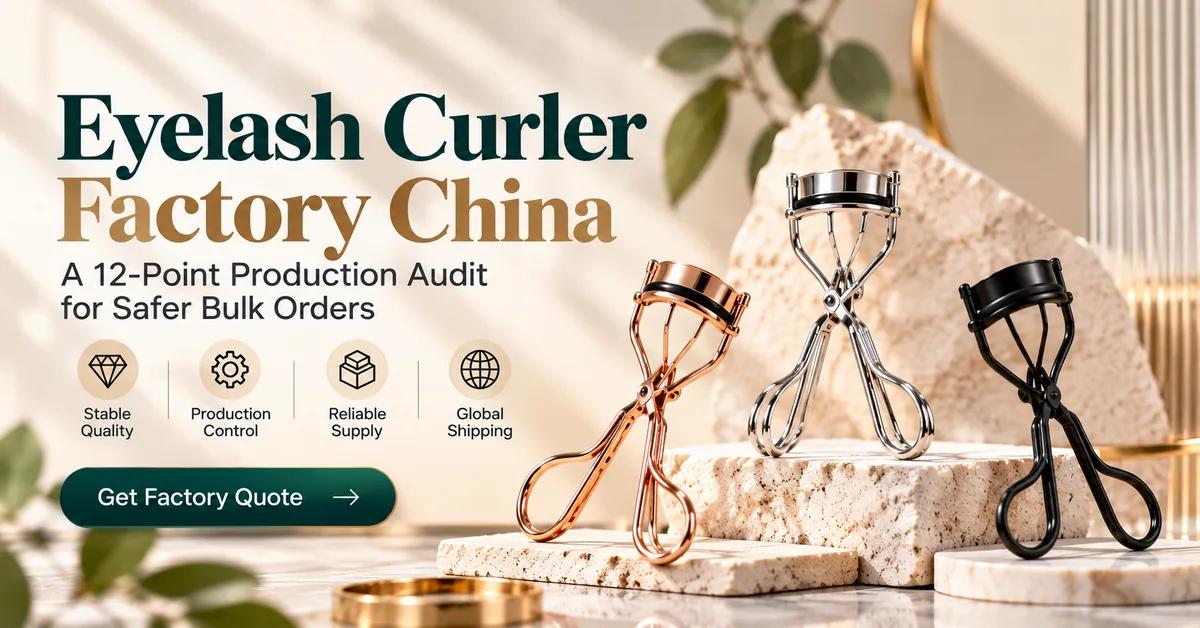
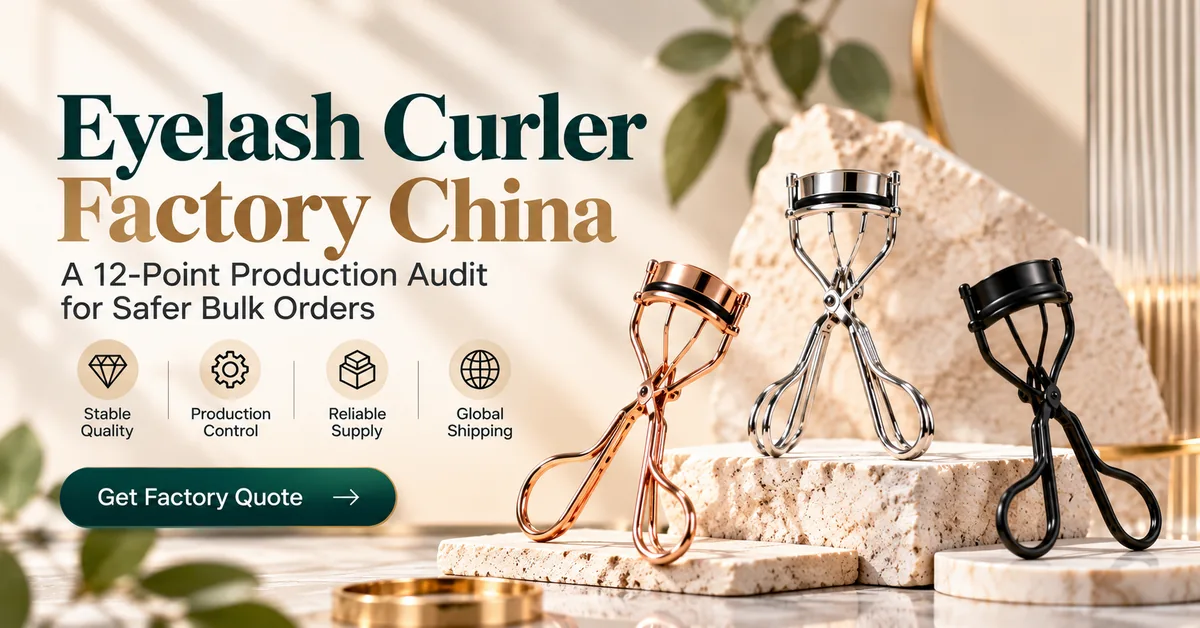
Quick answer: When choosing an eyelash curler factory China sourcing partner, verify who controls the production site, which operations are performed in-house or outsourced, how approved materials and tooling are identified, and whether first-piece checks, in-process records, finished-product inspection, packaging controls, and change approvals can be traced to your exact SKU. A factory tour is useful, but a documented trail from incoming components to a released shipment is stronger evidence of repeatable supply.
For beauty brands, importers, wholesale distributors, and purchasing managers, the real challenge is not finding a photograph of an attractive eyelash curler. It is determining whether the supplier can repeatedly deliver the same frame, pad, hinge operation, appearance, accessories, and packed configuration after a sample has been approved. This guide turns that decision into a practical factory-audit workflow, with evidence requests, failure indicators, a weighted scorecard, and a factory-ready request for quotation.
The approach applies to standard mechanical lash curlers and selected customized designs. It is a buyer evaluation framework, not a claim that a particular OLIMOR facility has already passed an independent audit.
Start with the exact eyelash-curler model.
View Eyelash Curler Range →Discuss Factory Requirements →1. What Does “Eyelash Curler Factory China” Mean to an Overseas Buyer?
An eyelash curler factory in China is a production operation that makes or assembles mechanical lash-curling tools, sometimes coordinating separate component, finishing, pad, or packaging suppliers. Buyers should distinguish the legal contracting company, the actual manufacturing location, and any external subcontractors. All three may be involved in one order, and they do not automatically have the same responsibilities.
This distinction matters because a quotation alone cannot show who owns the tooling, performs frame forming, sources cushion pads, conducts final functional inspection, or decides whether a changed component is acceptable. The supplier may legitimately coordinate several qualified facilities; the essential question is whether roles, approvals, and accountability are transparent.
An overseas brand usually needs answers to three commercial questions: Can the supplier produce the specified design? Can the process reproduce the approved sample across a full order? Can the buyer obtain enough records and communication to correct a problem before the goods reach retail shelves?
Buyers who need only a small quantity of non-branded retail stock may be better served by a distributor with suitable inventory. Those developing repeat wholesale orders, an exclusive finish, or a private-label collection have a stronger reason to inspect manufacturing and change-control capabilities. Neither buying route is automatically superior; the right choice depends on volume, customization, risk, and service requirements.
2. The Most Useful Distinction: Factory, Trading Company, or Coordinated Supply Network
“Factory direct” is not, by itself, a quality certificate or proof of the lowest delivered cost. A manufacturing company can use outside sources for pads, cartons, coatings, or tooling. A trading company can also provide competent inspection, product development, and export coordination. A buyer should compare the real operating arrangement rather than rely on a label.
Request the supplier's registered company name, factory or assembly-site address, business-license information where appropriate, production-stage responsibility map, and a contact who can answer technical questions. When an audit is performed remotely, ask for a scheduled live walkthrough and follow-up records rather than accepting only a promotional video.
An audit should verify what the buyer actually intends to purchase. A facility that makes scissors or nail clippers may have useful metalworking knowledge, but those product categories alone do not prove it can consistently make the specified eyelash curler.
3. Start With a Real Product Reference: OLIMOR ECH4004
OLIMOR BEAUTY, associated with Bonet Houseware Co., Ltd. in Yangjiang, Guangdong, China, lists eyelash curlers among its personal-care and makeup-accessory categories. Its public eyelash curler collection provides product starting points, while its About Us page describes product development and internal quality-control work. The website does not establish that every component of every curler is made at one location.
A useful concrete example is the ECH4004 eyelash curler. Its publicly listed specifications can anchor the initial request for information.
At the time of review, the product page displayed out of stock. That status does not prove current bulk availability, and the site's displayed unit price should not be treated as a confirmed wholesale quotation. Ask OLIMOR to verify production feasibility and current commercial terms before planning a launch.
The next step is not to invent missing specifications. Send the reference URL, your intended user group, estimated order quantity, market and packaging brief; then request a technical sheet, representative sample, and a list of any undecided features.
4. Map the Manufacturing Route Before Auditing Machines
A production audit should follow the physical product through its relevant operations. For a mechanical eyelash curler, the route may involve metal-component forming, trimming or deburring, surface finishing, hardware preparation, pad sourcing, assembly, movement checks, packing, and shipment release. The exact route depends on the model; some operations may be outsourced or omitted.
Ask the supplier to create a one-page process flow that names the responsible party for each operation. Do not infer a stamping press, plating line, injection-molding machine, or specialized measuring system exists at a particular facility without seeing suitable evidence. Equipment capability is relevant only when tied to your approved product.
A factory's willingness to explain this route is useful evidence of organizational control. It is not a substitute for actually reviewing records from recent or representative production work.
5. The 12-Point Eyelash Curler Factory Audit Checklist
Use the checklist below during a scheduled on-site visit or a structured remote review. The weights form an illustrative buyer scorecard, not an external accreditation standard or a factual score assigned to OLIMOR. A high total should never override a critical safety issue or a failure to identify the contracting entity.
A practical scoring convention is to award full points when records and demonstrated practice match; partial points when practice is plausible but evidence is incomplete; and zero when the requirement cannot be demonstrated. Record the auditor, date, product revision and evidence reviewed. Scores from different suppliers are useful only when the same requirements and method were applied.
Audit points 1–3: Can you trace the supplier and the real production route?
Begin with legal identity, site name and ownership of the relevant work instructions. Ask which company signs the purchase order and which site makes or assembles the goods. Confirm who will contact you if there is a tooling change, material shortage or packaging deviation.
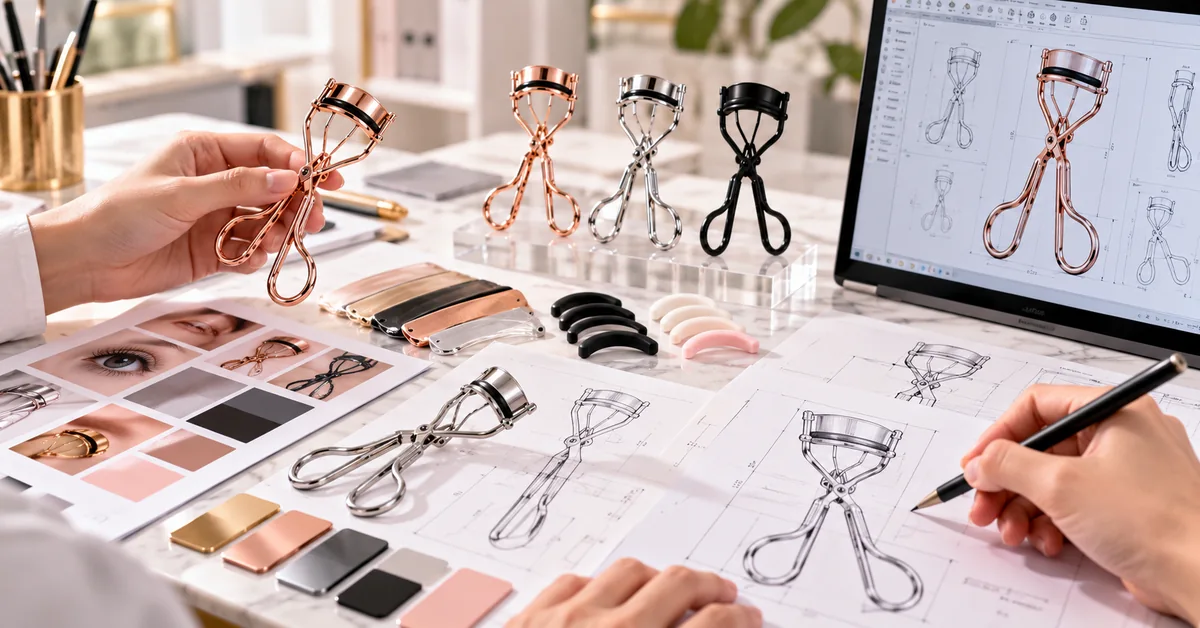
Then select the exact curler SKU and ask someone on the production or quality team to explain the approved drawing and bill of materials (BOM). The BOM should identify the frame, upper pressing bar, hinge components, handles, cushion pad, optional replacement pad, decorative parts and packaging as applicable. A photograph is useful for recognition but cannot define every technical attribute.
Finally, follow the route through subcontractors. The important evidence is not a promise that everything is in-house; it is a controlled handoff. When coatings or pads are sourced externally, the importer should know who authorizes the specification, checks incoming goods, and approves a new supplier.
Audit points 4–6: Can the factory control variation while making parts?
Inspect how incoming materials are labeled and segregated. A metal stock label should connect to an approved material description; a pad delivery should connect to the correct pad reference. Ask what happens when a shipment fails the receiving check.
For frame geometry, request the drawing or control sample and ask the team to demonstrate its relevant measuring or checking method. Check how tools, templates and fixtures are identified and maintained. A special gauge is not automatically necessary for every characteristic, but any chosen method must be capable of differentiating acceptable and unacceptable parts.
First-piece approval should occur when a production run starts or when defined conditions change. Ongoing checks should focus on characteristics that can drift during production, such as frame shape, position of pressing surfaces and assembly fit. Ask to see a completed record rather than a blank template.
Audit points 7–9: Do component selection and assembly remain controlled?
Treat the cushion pad as an engineered component, not a generic accessory. Confirm the chosen material description, dimensions, surface condition, installation position and compatibility with the intended frame. Silicone should not be assumed unless the actual pad specification confirms it. Replacement pads, if offered, require a separate compatibility and included-quantity statement.
For hinge and handle assembly, observe the defined operational check. The moving parts should meet the approved movement, clearance and return requirements without sharp or rough contact in areas likely to be touched. The correct acceptance criteria must be established for the chosen design and application.
Surface finish is a separate control problem. Ask what cosmetic defects are unacceptable, which sample governs the color or texture, and how rejected parts are handled. If coating thickness changes fit or movement, that effect must be considered in approval rather than treated as purely decorative.
Audit points 10–12: Will the approved configuration survive shipment and reorders?
For finished-product inspection, examine the actual pass/fail rules, sampling method and handling of nonconforming pieces. A claim of “100% inspection” should specify what is inspected on every piece; it should not be interpreted as proof that every conceivable failure has been tested.
Review the complete packed unit. The pack should hold the frame securely, protect the pad and identify the product and accessories accurately. Compare artwork and barcodes with the purchase order, and confirm the carton labeling system supports warehouse receiving and traceability.
Finally, ask for an example of a process change or corrective action. A mature system records the issue, affected lot, immediate containment, root-cause investigation when appropriate, corrective action, verification and communication to the buyer. The strongest evidence is not the absence of every problem; it is clear ownership when something changes.
Turn the checklist into a real supplier conversation.
Ask About the Production Audit →Explore OLIMOR Capabilities →6. Conduct an On-Site or Remote Audit That Produces Verifiable Evidence
An on-site audit can reveal workflow, housekeeping, material separation and actual production practice. A remote audit is useful when travel is impractical, but it should be designed to reduce selective presentation. In either case, the buyer should send a structured agenda in advance.
Before the audit, identify the SKU and revision, requested quantities, critical characteristics, production route and agreed evidence list. Ask for redacted examples where commercial confidentiality prevents unrestricted access. Allow the supplier to protect sensitive information while still demonstrating the relevant control.
During the audit, follow a material or component through at least two stages, ask an operator or supervisor to demonstrate a real check, and review a filled-in record. Compare the control document with the sample and label in front of you. A polished factory showroom does not replace this traceable walkthrough.
After the audit, record findings as accepted, conditionally accepted or unresolved. Assign each open item an owner, evidence required and target decision date. Do not approve an order on the assumption that missing evidence will appear later; make the needed verification a clear purchase condition.
A remote review can use a live video call, time-stamped photos, appropriately redacted lot records, a sample shipped for independent inspection and, when justified, a qualified third-party factory audit. The buyer should define which issues require physical verification rather than accepting all evidence formats as equivalent.
7. Technical Control Points: Frame, Bar, Pad, Hinge and Surface
The previous step examines whether a process exists. Technical approval asks whether the process can reproduce the specific eyelash-curler mechanism the customer expects. An eyelash curler works close to the eye, so seemingly small variations in frame shape or pad position may affect handling and user experience.
Frame curvature and symmetry. Identify the defined dimensions or accepted boundary sample for the head shape. Evaluate whether the working surfaces close in the intended relationship and whether obvious twisting, deformation or unstable fit occurs. No single curve should be marketed as fitting every eye shape without appropriate evidence.
Upper pressing bar. Determine how its contact profile is controlled relative to the cushion pad. The inspection should address the full relevant contact area, not only one visually convenient point. Misalignment can make the mechanism perform differently from the approved sample.
Pad seating and compression. The pad should match the selected holder and remain in the intended position during the agreed functional check. Buyers may request material or hardness information where it matters, but must not assume all pads use the same formulation or are mutually interchangeable.
Hinge and handle movement. Review side play, opening range, resistance, return and stability after a defined number of operations. The test-cycle count and acceptance criteria should be proposed and agreed for the intended SKU; this article does not claim a universal industry cycle limit.
Edges and finish. Evaluate accessible edges, decorative finish, pivot area and coating contact points. For a carbon-steel frame, specify its protective finish and realistic care instructions; “rust-proof,” “hypoallergenic” or “medical grade” should not be used without relevant evidence.
Packing protection. A frame that passes at the inspection table can still be distorted by poor retail inserts or carton compression. Check the actual packed sample and document any agreed distribution or handling test.
Example: Three sourcing directions and their different audit emphasis
This table compares sourcing routes, not three independently verified OLIMOR production models. Request actual product numbers and sample records before presenting any proposed configuration as available inventory.
8. How to Build a Sampling Plan Without Inventing a “Factory Standard”
A useful incoming or pre-shipment inspection plan has two layers: specific functional requirements and a method for selecting units from the lot. These are different decisions. Sampling a lot according to a recognized scheme cannot compensate for an undefined product specification.
ISO 2859-1:2026, published by the International Organization for Standardization, provides acceptance-sampling schemes indexed by acceptance quality limit for lot-by-lot inspection by attributes. ISO 28590:2017 introduces the ISO 2859 family of acceptance-sampling systems. These references can help a qualified buyer or inspection company select a consistent sampling approach. They do not certify OLIMOR, determine eyelash-curler safety, or supply curler-specific defect thresholds.
For the product itself, define critical, major and minor defects with examples. An unstable frame or exposed hazardous contact point should not be classified the same way as a small cosmetic mark outside the primary viewing area. Exactly where each defect belongs depends on the design, intended use and buyer-approved criteria.
Where the tool will be sold in a regulated market, the importer should separately review product safety, labeling, traceability and the required technical records. For example, the European Union's Regulation (EU) 2023/988 on General Product Safety provides a relevant regulatory framework for consumer products within its scope. This is not an assertion that an OLIMOR item has completed an EU compliance assessment. Market-specific obligations should be checked for the actual product and sales route.
9. Certifications and Factory Claims: What Counts as Proof?
A factory may mention a quality-management certificate, social-compliance audit, internal inspection system or specialized testing equipment. These statements are not interchangeable. A quality-system certificate describes a management-system scope; a social audit addresses another area; neither automatically proves that a specific eyelash curler meets its technical specifications.
Request the document holder, site address, scope, issue date, expiry or surveillance status, and a verifiable copy where appropriate. A certificate issued to a related company or different site should not silently be represented as coverage for the production location.
Also distinguish an inspection record from a test report. A visual check of pad installation is not the same as a material characterization test. A general statement that hardness equipment exists does not establish a hardness requirement or result for a carbon-steel curler frame.
For buyer communications and retail marketing, use only claims that the final approved SKU can substantiate. This may include factual material identification and dimensions, together with accurate usage and care instructions. Avoid unsupported statements such as “universal eye fit,” “guaranteed long-lasting curl,” “certified safe for all eyes,” or “100% defect-free.”
10. Capacity, MOQ and Lead Time: Ask for a Production Plan, Not a Slogan
Factory size and the number of machines are not enough to calculate reliable monthly capacity. A supplier's available output depends on the specific SKU, shared equipment, production scheduling, component availability, external finishing, assembly labor, inspection and packaging.
A useful capacity conversation is built around your actual order. Ask the supplier how many units can be completed within an agreed period for the selected configuration, what assumptions the estimate relies on, and where the bottleneck lies. This avoids turning a company-wide headline number into an incorrect model-specific promise.
Separate lead time into stages: technical confirmation, sample preparation, buyer approval, material allocation, manufacturing, final inspection, packaging, and shipping. Any buyer change to logo artwork, finish, pad, retail insert or product geometry can affect the timetable.
MOQ should likewise be explained by component and process. An existing frame may have one commercial minimum, while a custom pad color, coating batch or printed box has another. A supplier should identify whether the order must meet the highest component minimum or whether other arrangements are feasible.
12. OEM, ODM and Private Label: Change the Audit Scope With the Product Scope
A standard-model wholesale purchase usually needs identification, functional approval, packing confirmation and lot-release controls. Private label adds logo, artwork, colors and presentation. Structural OEM/ODM development may involve frame geometry, pad tooling, hinge configuration or modified handles, making first-article approval and change management more demanding.
Do not let these three routes share one vague purchase specification. A new coating may affect contact areas and package fit. A pad formulation change may affect installation or performance. A redesigned frame may require a different measuring fixture and different acceptance criteria.
To review possible branding choices, buyers may explore OLIMOR's existing eyelash curler product category and its separate custom eyelash curler sourcing guide. These links support the buying decision, but final available options still need confirmation for the chosen model.
13. The Factory Audit Evidence Pack Buyers Should Request
A practical audit produces a small set of usable documents rather than an impressive stack of unrelated promotional material. Prioritize items that connect the approved sample to the actual production and shipment.
- Company and site details: contracting entity, relevant manufacturing or assembly address, contact ownership, and subcontractor map.
- Current product specification: SKU, revision, dimensions, material by component, approved images or drawings, and included accessories.
- Production route: stage-by-stage responsibilities and required inspections, with outsourced operations identified.
- Approved sample record: functional sample, finish or color reference, pad reference and packaging sample.
- Quality plan: defect definitions, first-piece checks, in-process controls, lot inspection approach, and test responsibilities.
- Representative production records: redacted material receipt, inspection results, nonconformance handling and corrective action examples.
- Commercial offer: quantity tiers, MOQ assumptions, tooling or customization fees, sample terms, lead-time stages and agreed trade terms.
- Shipment configuration: retail pack, carton dimensions and marks, included spares, packing list requirements and final release responsibilities.
A buyer does not need every confidential supplier formula or internal customer name. It needs enough product-specific evidence to understand the risk and enforce the agreed purchase specifications.
Get technical and commercial details for your project.
Request a Factory-Ready Quote →See Curler Product Options →14. Factory-Ready RFQ: Make a Quote Comparable Across Suppliers
A short but specific RFQ reduces avoidable clarifications. Instead of asking for “best price for eyelash curler factory China,” tell the supplier what will actually be delivered and what you expect to verify.
Example procurement message: “We are evaluating a China sourcing partner for a branded mechanical eyelash curler for [market]. Our starting reference is ECH4004, subject to confirmation of availability and final specification. Please provide the current technical sheet, component and pad details, available packaging options, MOQ and quotation terms for [quantity], sample plan, manufacturing responsibilities, and proposed inspection evidence. We would like to agree on a production-representative sample before bulk approval.”
Send model references, desired quantities, packaging expectations and destination through the OLIMOR contact page. Clear specifications make quotation discussions more productive than unqualified requests for the lowest price.
15. Why OLIMOR Belongs on a Curler Supplier Shortlist—and What Must Still Be Verified
OLIMOR BEAUTY presents itself as a Yangjiang-based provider of precision beauty and personal-care tools, operating with Bonet Houseware Co., Ltd. Its website lists eyelash curlers as well as tweezers, eyebrow razors, beauty scissors, nail clippers and manicure sets. The company describes product development and internal quality-control activities, which are relevant to buyers planning standard assortment or private-label programs.
Those public statements are useful for creating a shortlist, not a substitute for an independent facility audit. An importer should still confirm the specific manufacturing site, current model availability, material details, subcontracted operations, applicable inspection records and terms for its proposed order. Do not equate the historical details of related companies with evidence that each eyelash-curler operation is performed under one roof.
For a first discussion, identify the desired model from the OLIMOR eyelash curler range. If ECH4004 matches your design direction, reference its listed material and dimensions while asking about pad composition, finish specifications, sample availability and packaging. If it does not match your customer, request a shortlist of other currently available, identified models, rather than accepting unverified specifications.
This transparent approach helps both parties: buyers receive more comparable proposals, while the supplier can evaluate feasibility, sample needs and commercial terms against a specific request.
Ready to assess an actual lash-curler supply program?
Send Specifications to OLIMOR →Compare the Available Lash Curlers →16. Ten Frequently Asked Questions About Eyelash Curler Factories in China
1. How do I verify an eyelash curler factory China supplier?
Start with the registered seller, actual manufacturing or assembly site, product-specific process map, approved samples and filled inspection records. Check who controls frame forming, pad sourcing, assembly, finishing and shipment release. A live audit or qualified third-party inspection can supplement the documentation. Neither a factory photograph nor a company slogan proves the full production route.
2. Is buying directly from a factory always cheaper than using a trading company?
Not necessarily. A factory quotation may exclude packaging, inspection or coordination that another supplier includes. Compare like-for-like specifications, minimum quantities, development costs, quality responsibilities and delivered terms. A trading business with transparent qualified partners may be suitable; a direct manufacturer should still show control over the selected product.
3. Which eyelash curler manufacturing processes should a buyer inspect?
Inspect whichever processes are relevant to the selected SKU, potentially including metal forming, trimming, deburring, surface finishing, pad sourcing or molding, hinge assembly, functional checks and packing. Ask which operations are performed internally and which are subcontracted. The process route should match the actual approved product.
4. What is the main difference between a supplier audit and product inspection?
A supplier audit examines the organization's ability to control work repeatedly, including records, responsibilities and corrective action. Product inspection evaluates sampled units from a specific lot against defined criteria. Both may be useful. A good audit cannot guarantee every lot is defect-free, and one successful shipment does not prove the factory has a reliable management system.
5. How should I assess eyelash curler cushion pads at a factory?
Verify the specified material, geometry, fit, contact condition, installation method and any replacement-pad arrangement. Review a sample and the relevant receiving or assembly checks. Do not assume the pad is silicone, hypoallergenic, universally compatible or included as a spare unless the approved SKU documents confirm those claims.
6. What are the MOQ and lead time for OEM eyelash curlers from China?
They vary by frame model, finish, pad sourcing, branding, packaging and order volume. Ask for an itemized quotation separating existing products from new tooling or decoration requirements. Production timing should be stated after sample approval and material confirmation, with shipping time treated separately. No single figure can accurately describe every project.
7. Can I request a factory audit before placing a bulk order?
Yes, factory evaluation is a normal procurement option to discuss with a potential supplier. Agree on the audit scope, confidentiality, date, relevant production area and evidence access. If an on-site visit is not practical, consider a structured remote review supported by records, samples and independent inspection where warranted.
8. Does ISO 2859-1:2026 certify the safety of an eyelash curler?
No. ISO 2859-1:2026 describes acceptance sampling by attributes for lot inspection. It is not an eyelash-curler product certificate or proof of regulatory compliance. The buyer must separately define defects, intended-use requirements, relevant market obligations and the evidence needed for its actual product.
9. What should change when I order private-label eyelash curlers?
Add approved artwork, logo location, finish references, packaging, included accessories and version control to the standard functional specification. A different pad, frame or handle can require new technical approval. Require the supplier to notify you of material and process substitutions instead of assuming a prior sample covers every new variant.
10. How can I request a product and audit discussion with OLIMOR?
Choose a model from the eyelash curler collection, or send your reference drawing and desired configuration. Include your destination market, estimated quantity, packaging, inspection needs and commercial timeline. Use the contact form to request sample and specification information, current availability, and clarification of the production and quality evidence available for the selected SKU.
Conclusion
Choosing an eyelash curler factory China partner is an evidence-based procurement decision, not a competition between attractive catalog photographs or unsupported claims of superior quality. Global beauty buyers need to know who is responsible for each production stage, how the approved frame and pad configuration is reproduced, where inspection records originate and what happens when materials, tooling or packaging change.
A 12-point supplier audit makes the buying process more transparent. It connects legal and site identity, controlled specifications, incoming components, manufacturing operations, first-piece checks, pad qualification, assembly, finish, lot inspection, packing and corrective action into a coherent risk-management plan. Used with representative samples and a realistic RFQ, the approach can reduce ambiguity before a wholesale or OEM purchase order is issued.
OLIMOR BEAUTY provides a relevant eyelash-curler product range and a starting point for supplier discussions. Review the available curler category, check any model-specific details against the current offer, and contact OLIMOR with your specifications, quantities and audit questions. A clear, verifiable production plan is the foundation for dependable sourcing and successful repeat orders.
Tag:
Related articles
- Quality Control
- Beauty Tools Manufacturing
Eyebrow Razor Manufacturer China: 12 Quality Checks from Blade Guard to Export Carton
- OEM & Private Label
- Professional Beauty Tools
- Quality Control
OEM Custom Tweezers for Lash and Brow Beauty Sets
- OEM & Private Label
- Professional Beauty Tools
- Quality Control