OEM custom tweezers: what buyers are really choosing when they source a private-label set
When sourcing OEM custom tweezers, the decision is usually bigger than the tool itself. Buyers are not only choosing a pair of precision tips; they are choosing the feel in the hand, the consistency of the finish, the storage format, and whether the set makes sense for lash work, eyebrow grooming, or broader beauty use. That matters because a tweezer set that looks good on a product page can still disappoint in the salon if the tips are hard to control, the case wears badly, or the assortment is mismatched to the task.
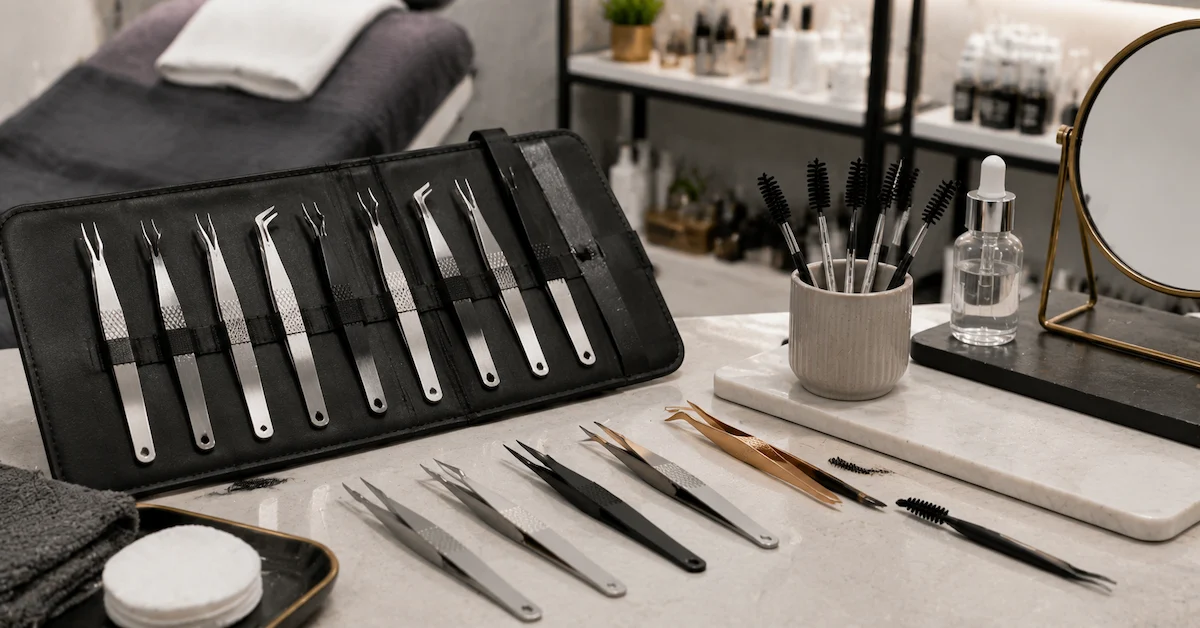
The image provided shows a compact beauty-focused tweezer kit arranged in a black carrying case, with several loose tweezers on the countertop in front. The visible shapes include straight, curved, angled, and fine-point styles, which is exactly the sort of mix a sourcing team would expect for eyelash extension work or precision cosmetic grooming. It also suggests the product is not a single-tool sale but a bundled, organized set — something private-label buyers often prefer because it creates a cleaner shelf story and a more complete user experience.
What a buyer should read from the product form
A tweezer set like this does a few things at once. First, it signals specialization. Different tip geometries solve different grip problems: one style may help isolate lashes, another may reach into tighter angles, and another may suit brow shaping or detail cleanup. Second, the case changes the product’s perceived value. A fitted, fold-out case with stitched compartments and retention bands tells the customer the tools are meant to stay organized, protected, and portable. That is not a small detail for salon professionals, who often carry several tools between stations or between appointments.
Third, the visible finishes matter. The set appears to include matte, brushed, and polished silver surfaces, plus at least one black and one gold-toned tweezer. In beauty tools, finish is more than decoration. It affects how premium the set feels, how the product photographs, and, in some cases, how fingerprints, glare, or wear marks show up during use. Buyers should be cautious here: a stylish coating can help merchandising, but it should not come at the expense of tip control or grip comfort.
Why OEM custom tweezers are a different sourcing category from commodity tweezers
Commodity tweezers are usually bought for simple utility. OEM custom tweezers, by contrast, are often developed as a branded product line. That means the supplier may need to support custom packaging, logo application, selected surface finishes, set composition, and sometimes a specific mix of tip styles. For beauty brands, this is useful because a private-label assortment can be tailored to one target user: lash technicians, brow artists, travel retail buyers, or general beauty consumers looking for an organized kit.
There is also a commercial reason. A branded multi-piece set can carry more perceived value than a lone tool. If the assortment is coherent, the packaging is tidy, and the metalwork looks clean, the product can sit comfortably in a more premium segment without requiring an entirely different manufacturing platform. That said, the opposite is also true: if the set includes too many styles the user does not need, the package can feel padded rather than purposeful.
Material and finish: what to ask before you place an order
The visible tools appear to be metal, most likely stainless steel or another corrosion-resistant alloy, but the exact grade is not confirmed. Buyers should treat that as a checkpoint, not an assumption. For beauty tools, material questions tend to be practical rather than theoretical. You want a metal that can hold a stable shape during repeated use, accept a clean finish, and resist everyday wear in a salon environment. If the product will be cleaned often, the surface should also be evaluated for how it handles routine maintenance.
For stainless steel tweezers, the main sourcing questions are usually about consistency, finish quality, and whether the tips align properly across the lot. A pretty exterior does not rescue poor tip geometry. Likewise, colored finishes can be useful for brand differentiation, but the buyer should ask whether those finishes are decorative, plated, painted, or otherwise applied. If the process is not clearly defined, it is safer to request samples and inspect how the coating holds up around the tips and edges.
One practical aside: beauty buyers sometimes focus too heavily on the case and forget the tweezers themselves. The case can be replaced more easily than the working feel of the tool. If the tips do not close cleanly or the handles flex too much, the set will frustrate users regardless of how good the packaging looks.
Choosing the right assortment for lash and brow work
Not every salon needs the same set. A lash-focused kit usually benefits from multiple precision geometries because technicians may move between isolation, pickup, placement, and cleanup tasks. Brow work can be simpler, but it still calls for control and good visibility at the tip. The visible mix in this product makes sense for a buyer who wants one organized kit rather than several separate SKUs.
For sourcing teams, the key question is whether the assortment is intentional. A straight tweezer, a curved tweezer, an angled style, and a fine-point option can each justify a place in the case if the target user truly needs them. If the set includes styles that overlap too much, the bundle may look impressive but function redundantly. This is where OEM custom tweezers can be planned more intelligently than off-the-shelf inventory: the supplier and brand can shape the kit around actual use cases instead of default catalog logic.
Quick buyer check
Before signing off on a custom set, ask three simple questions:
Does the assortment match the intended workflow?
Do the finishes support both branding and daily use?
Will the case protect the tools without making them awkward to remove and return?
Those questions sound basic, but they catch a lot of avoidable mistakes.
Packaging and presentation: the case is part of the product
The black fold-out case shown here is not just storage. In beauty categories, packaging affects trial, gifting potential, retail display, and travel convenience. The stitched compartments and retention bands suggest an organized layout that keeps each tweezer in place. That matters because loose tools can scuff each other, and scuffed tools look older than they are. For a brand selling into salons or beauty supply channels, tidy presentation is often the difference between a kit that feels professional and one that feels improvised.
Private-label buyers should also think about how the case affects unboxing. A set with clearly arranged tweezers tends to photograph well and gives the customer an immediate sense of value. Still, buyers should avoid overbuilding the packaging. A heavy or awkward case can inflate shipping cost or reduce day-to-day convenience. The best version is usually the one that protects the tools without pretending to be luxury luggage.
Common sourcing mistakes with custom tweezer programs
One common mistake is assuming all precision tweezers perform the same way if they share a similar silhouette. They do not. Small changes in head angle, tip taper, handle stiffness, and surface finish can alter how the tool behaves in the hand. Another mistake is locking in the packaging before the tool design is settled. If the case is too tight, the final product can be annoying to use; if it is too loose, tools can shift and rub.
A second issue is asking for too many color or finish variations without confirming the manufacturing method. The set shown here includes visible silver, black, and gold-toned pieces, which may be perfectly sensible for merchandising. But any mixed-finish program should be checked for consistency, especially if the brand wants a uniform look across repeat orders. It is better to specify the visual system early than to clean up mismatched samples later.
Finally, do not let the phrase “custom” become vague. Custom can mean branding only, custom packaging, a custom set mix, or more extensive product development. Buyers should define what is actually changing and what is staying standard. That keeps the project on budget and avoids confusion when the first samples arrive.
What sourcing teams should request from a supplier
For an OEM beauty tool project, the useful documents are usually straightforward: clear product photos, sample units, packaging mockups, and a written description of materials and finish options. If the supplier says the tools are stainless steel or corrosion-resistant alloy, ask for the exact spec if it matters to your application. If coating or color is part of the brand story, ask how those finishes are applied and whether they are available across all tools in the set.
For eyebrow tweezers custom projects, you should also ask how the tips are intended to function. A brow customer may care about different handling than a lash technician. The “best” geometry is not universal; it depends on whether the user needs isolation, gripping, plucking, or detailed cleanup. That is one reason a sample review is worth more than a polished catalog description.
FAQ for buyers evaluating OEM custom tweezers
Are multi-piece tweezer sets better than single tweezers?
Not always. Multi-piece sets make sense when the user needs several tip styles and a case for organization. If the end user only needs one working tool, a set can be unnecessary clutter.
Is stainless steel always the right choice?
It is a common and practical choice for beauty tweezers, especially when durability and corrosion resistance matter, but the actual grade and finish still need to fit the use case.
Can the case be treated as a branding surface?
Yes, often it can. But the packaging should still function as storage first. A beautiful case that is awkward in daily use will not help repeat sales.
A practical next step for buyers
If you are building a private-label beauty tool line, start with the end user, not the catalog. Decide whether the set is meant for lash technicians, brow grooming, travel kits, or broad salon use. Then confirm the mix of tip styles, finishes, and packaging around that use case. OEM custom tweezers work best when the assortment is purposeful and the presentation matches the job.
For sourcing teams, the smartest next move is to request samples and inspect them in real handling conditions. Look at the tip behavior, the grip feel, the case fit, and how the tools sit together as a set. The product on the page may look complete, but in this category, small details decide whether the buyer gets a shelf-ready kit or just a bundle of shiny metal pieces.