

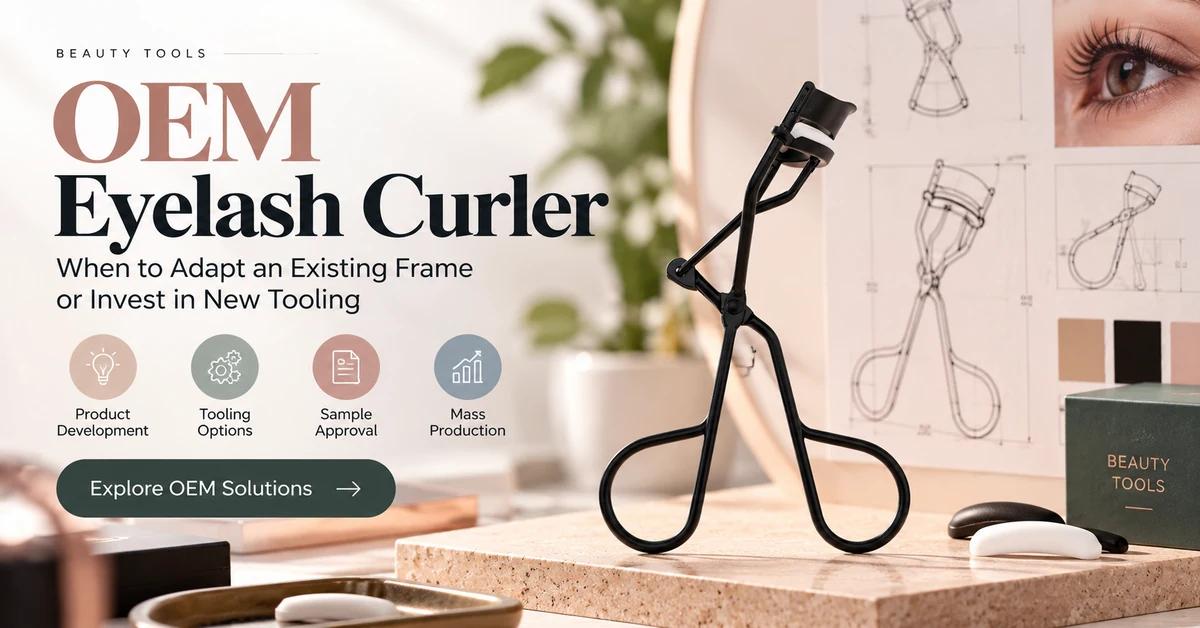
An attractive concept drawing cannot tell a buyer whether the upper bar contacts the pad evenly, whether a revised handle changes leverage, or whether a new surface treatment will remain consistent in production. For a makeup brand, product manager or sourcing director, those are the questions that determine whether an OEM launch can become a repeatable product line.
This article offers a different approach from a generic private-label buying guide. It explains how to compare existing-model branding, modified-platform development and new-tooling development, how to protect design decisions with stage gates, and how to request useful evidence before releasing a bulk order. It uses publicly listed OLIMOR product information where available and identifies all other figures and options as items to verify for the specific project.
View Eyelash Curlers → · Discuss OEM Requirements →
1. What Is an OEM Eyelash Curler—and What Is It Not?
An OEM eyelash curler is a mechanical lash-grooming tool supplied to an agreed buyer specification, potentially covering the selected frame, handle, pad, finish, branding, packaging and production acceptance criteria. Depending on the commercial arrangement, the product may start from an existing design or involve new components and tooling. The abbreviation OEM does not, by itself, prove that a design is exclusive, that a supplier owns every production process, or that the buyer owns the tooling.
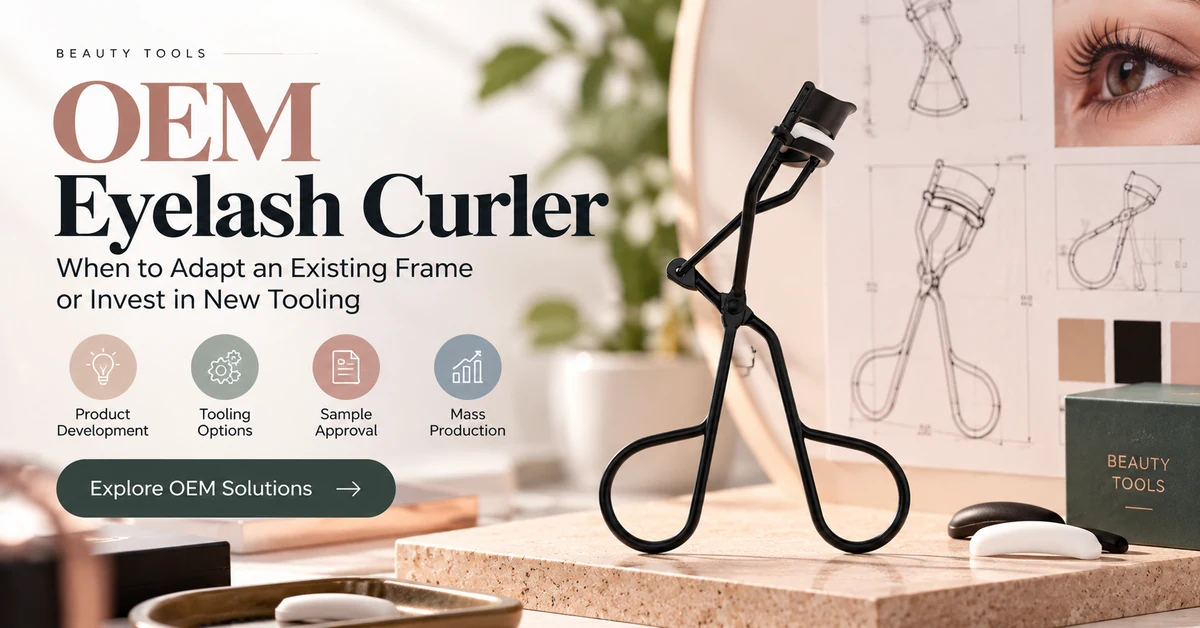
A standard wholesale order generally purchases an existing item in a stated quantity. Private label commonly adds a buyer's brand identity and retail presentation to a suitable established product. OEM may involve a more detailed, buyer-controlled product specification. ODM generally refers to supplier-led design development or a design platform that can be adapted, although suppliers and buyers use these labels differently in contracts.
The important question is what is being changed and who approves it. A rose-gold finish on an unchanged frame is a very different development problem from an entirely different upper-pressing-bar curve. The first emphasizes finish consistency; the second can change the way the tool interacts with the cushion and lashes.
This distinction matters to brand teams preparing launch budgets. If product development starts with vague phrases such as “premium quality,” “universal fit” or “luxury appearance,” the manufacturer cannot determine which requirements are essential and which are visual preferences. Define the intended user, function, retail channel and measurable constraints before choosing the route.
2. Which Buyers Benefit From an OEM Development Program?
An OEM route is most useful when a brand can explain why a standard catalog model is insufficient. A cosmetics brand may seek a coordinated color and handle aesthetic across a lash range. A professional lash supplier may prioritize a clearly defined operating feel. A retailer may require a protective pack with a known shelf footprint. A distributor may need an identifiable product revision that can be reordered without unapproved changes.
| Buyer | Primary need | Sensible first route | What must be demonstrated |
|---|---|---|---|
| Emerging makeup brand | Distinct identity without excessive launch complexity | Existing model + approved decoration/packaging | Functional sample and viable MOQ |
| Established cosmetics brand | Brand-consistent product family | Modified existing platform, where feasible | Controlled modifications and repeatability |
| Professional beauty supplier | Specified control and grip characteristics | Existing model comparison, then targeted engineering | Repeatable user evaluation and function checks |
| Retail-chain private label team | Shelf, barcode and carton compatibility | Existing or modified model | Fully packed reference and supply documentation |
| Product-design-led brand | Unique handle or contact geometry | New-tooling feasibility assessment | Drawings, prototypes, test plan and ownership terms |
| Gift-set or travel-kit buyer | Package integration and assortment consistency | Existing model with tailored insert | Kit fit, secure placement and packed-unit quality |
Not every buyer should finance new tooling. If the intended sales volume is unknown, a validated existing model can help test demand and protect cash. Conversely, a brand that has a genuinely differentiated design and sufficient planned volume may find that new-tooling investment creates a more defensible product—provided technical and contractual risks are addressed.
3. Three OEM Development Routes: Standard, Modified or New Tooling
Treat route selection as an engineering-and-business decision rather than a marketing label. The available routes should be confirmed with OLIMOR or the actual supplier for the specific model.
| Route | Typical development work | Advantage | Main limitation | Best commercial use |
|---|---|---|---|---|
| A. Existing model + brand package | Approve a catalog frame; assess feasible logo, finish and packaging | Fewer new structural unknowns | Distinctive geometry may be limited | Market validation, first product launch |
| B. Modified established platform | Review selected handle, pad, finish or other feasible changes | Targeted differentiation without necessarily replacing the whole platform | Modifications can still require fixtures, testing or tooling | Growing brands refining user experience |
| C. New tooling / new architecture | Develop drawings, prototypes, tools, component plans and validation | Potential for a distinctive functional design | Development cost, schedule and change risk | Proven demand or meaningful innovation |
A practical decision rule is to ask whether the desired difference can be defined, measured and verified. “Make it more premium” is not a sufficient new-tooling reason. “Modify the finger opening while retaining an agreed closing path and pad-contact profile” is closer to an engineering request, although it still needs feasibility testing.
A new-tooling route is not inherently higher quality. An established product can be excellent when its manufacturing process is controlled. A brand-new design can fail if prototype performance is not reproduced at production scale. The factory's ability to maintain the approved condition matters more than the novelty of its tooling.
4. Start With a Buyer Brief That Separates Function From Decoration
A good OEM project starts with a product requirements document, or PRD, that purchasing, design and technical personnel can all understand. It should avoid mixing customer benefits with unsupported claims about engineering performance.
Write down the intended use: daily makeup, professional cosmetics application, gift-set inclusion or another defined, non-medical grooming scenario. Specify target users, anticipated market, sales channel, planned first-order quantity, possible replenishment and target cost ceiling. Then classify each design request as mandatory, preferred or optional.
Functional requirements may address the allowable frame outline, upper-bar profile, cushion position, opening and closing travel, contact surfaces and grip. Presentation requirements may include finish, marking, pad color, retail packaging, label languages and barcode. Commercial requirements include MOQ, sampling, tooling, terms of sale and the ownership of approved design files.
A useful PRD also records exclusions. For instance, the project may be inappropriate for heated curling functions, medical use, unsubstantiated “all eye shapes” claims or a proprietary pad architecture that cannot be supported with reliable replacement components.
The brief should identify who is allowed to approve each decision. Product design can accept appearance, quality can approve the functional acceptance plan, and purchasing can approve commercial terms. When these roles are blurred, last-minute changes frequently enter production without adequate evaluation.
5. Engineering Dependencies: Frame, Upper Bar, Cushion Pad and Hinge
An eyelash curler is a small mechanical system, not a frame plus an unrelated cushion. The upper bar and lower pad must operate together through the closing path. If a designer modifies the frame curvature, the existing cushion may no longer contact it as intended. A change in pad thickness or material can alter the final feel and resting position. A change in the handle changes how force is applied through the pivot.
Frame geometry and visual symmetry
The drawing should identify the product's critical reference features. The relevant measurements may include overall width, upper-bar contour, frame symmetry, handle geometry and contact relationship to the cushion. Do not invent universal dimensional tolerances; the intended design and approved inspection capability determine what needs to be controlled.
Cushion material and replacement strategy
Do not automatically call every pad “silicone.” Request the actual pad specification and the suitability of any proposed alternative. Review dimensions, retention, surface condition, compression response under agreed checks and whether replacement pads will be sold or included. A spare pad that resembles the original but does not fit the chosen frame is a preventable customer-service problem.
Hinge, pivot and leverage
The hinge should provide stable operation throughout the intended range. Excessive looseness, binding or asymmetric closing can affect the feel of the tool. If the buyer requests a different handle, a physical prototype should be tested before assuming that the original closing characteristics remain unchanged.
Surface finishes and visible contact areas
Decoration must not obscure inspection of the working parts. Evaluate the finish for unacceptable roughness, scratches, flaking or appearance inconsistency on the approved materials. A decorative coating must not be credited with corrosion resistance or biocompatibility claims without appropriate evidence.
The design review should answer a simple question: which changed component can affect another component, and what additional check follows from that change? This dependency-based approach is more reliable than approving each part separately.
6. Turn the OEM Concept Into a Controlled Technical Specification
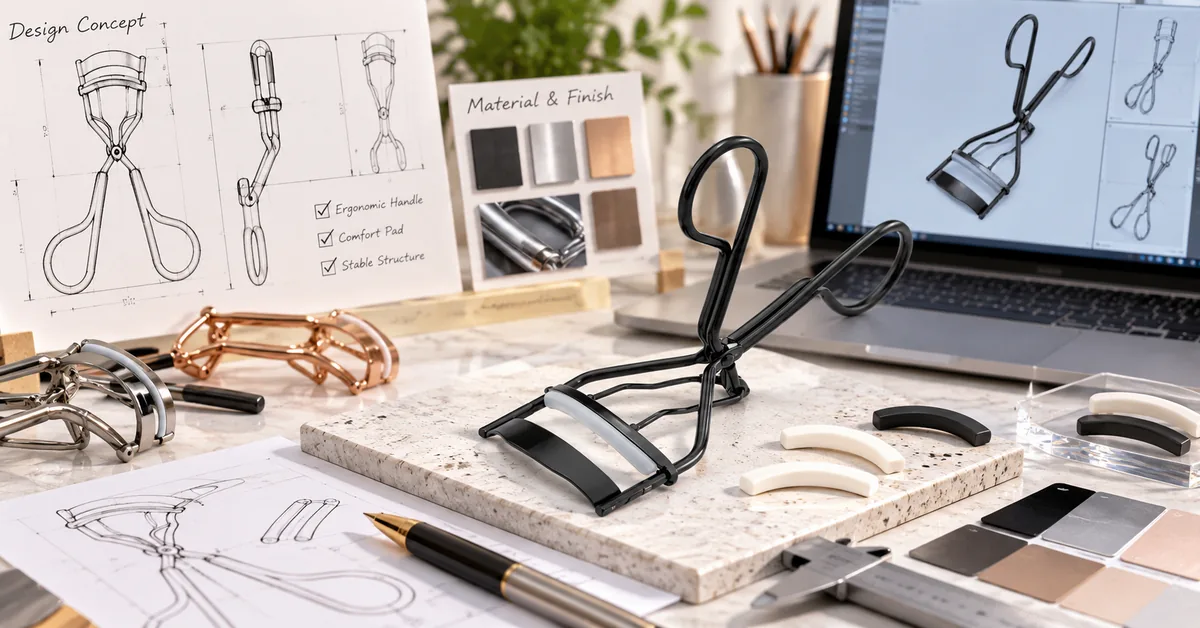
A supplier cannot reliably reproduce a product defined only by photographs. Use a single controlled specification for every SKU and refer to the same revision in drawings, samples, artwork and purchase orders.
| Specification field | Detail to record | Approval evidence |
|---|---|---|
| SKU and drawing revision | Product reference and current approved version | Controlled drawing / item record |
| Intended function | Defined user scenario and applicable exclusions | Product brief and functional test plan |
| Frame / upper bar | Geometry, contact surface and relevant dimensions | Dimensioned drawing and reference sample |
| Handle / pivot | Construction, movement and grip requirements | Assembly drawing and function sample |
| Material | Identity by relevant component | Supplier material statement or agreed evidence |
| Cushion pad | Actual material, size, position, replacement policy | Pad specification and fit test |
| Finish and logo | Color reference, marking method and permitted location | Decorated master sample and artwork |
| Retail pack | Box/card, insert, instructions, barcode and language | Signed packed sample |
| Carton | Units per carton, weight, dimensions and marking | Approved packing standard |
| Inspection | Methods, defect categories and lot approval process | Quality agreement / inspection plan |
Use measurable language. “Consistent pad seating against the approved reference” is actionable; “excellent softness” is not. “Logo matches the signed artwork within agreed location limits” is clearer than “perfect branding.”
A specification freeze is not a refusal to improve the product. It establishes that revisions require review, documented consent and, where relevant, new sampling before being treated as the production standard.
7. Sample Approval Should Follow Four Distinct Stages
Many OEM delays occur because buyers approve a rendering as if it were a production-ready sample. For any substantive development project, distinguish four sample stages. Not every project needs all four, but the buyer should know which have been completed.
Stage 1 — Concept review: Review appearance, user brief, estimated feasibility and major component changes. Deliverables may include reference images, an annotated sketch, preliminary drawing or CAD model. The output is a decision to prototype, not permission to mass produce.
Stage 2 — Engineering prototype: Evaluate physical form, pad fit, pivot action and the effect of proposed changes. Prototype methods may differ from actual serial production; record those differences. The objective is to identify design problems before committed tooling or decoration costs increase.
Stage 3 — Pre-production sample: Use the intended production construction as far as feasible, with final surface appearance, branding and packaging. Establish a reference for visual and functional acceptance. This sample should reflect the agreed SKU, not an unrelated showroom unit.
Stage 4 — First-article or pilot-lot approval: Check products made under representative manufacturing conditions. Compare several units with the approved specification and review important variation, packaging and traceability. Decide whether to release larger production, correct the process or revise the design.
A buyer should record sample ID, revision, approval date, remaining deviations and the approver's role. A digitally signed record or documented email authorization is better than an undocumented phone call. Keep retained reference samples where practical.
8. Public OLIMOR Product Reference: ECH4004 Without Unsupported Claims
OLIMOR BEAUTY, associated with Bonet Houseware Co., Ltd. in Yangjiang, Guangdong, China, lists multiple eyelash-curler products in its eyelash curler category. Its website describes beauty-tool product selection, OEM and private-label discussions and sampling considerations.
The publicly listed ECH4004 Eyelash Curler provides an identifiable reference for an initial discussion:
| ECH4004 public field | Listing information | OEM implication |
|---|---|---|
| Item number | ECH4004 | Identify the reference unambiguously |
| Listed material | Carbon steel | Do not describe it as stainless steel |
| Listed color | Black | A different finish needs a feasibility check |
| Listed size | 100 × 62 mm | Confirm orientation and critical drawing dimensions |
| Listed product weight | 23 g | Verify whether accessories or pack are excluded |
| Pad grade / composition | Not confirmed by the listing | Request the actual pad specification |
| Webpage availability | Displayed out of stock when checked | Confirm sample and bulk-production possibilities |
| MOQ, tooling and lead time | Not established by this listing | Obtain a project-specific quotation |
ECH4004 is a reference to investigate, not proof that it is available for immediate shipment or can be re-engineered in every way described here. If it already fits the target user, a buyer might discuss branding and packaging. If it does not, the supplier should identify suitable alternative models or evaluate a defined redesign.
Avoid extrapolating one SKU's material or dimensions to the entire category. Equally, a retail-looking webpage price is not a binding B2B order quotation. The signed product specification and current commercial offer should govern the project.
9. Manufacturing Feasibility: Ask Which Operations Actually Apply
A mechanical lash curler may involve metal forming, trimming, surface finishing, assembly, cushion sourcing and packaging. Specific operations vary by design, material and manufacturing route; some components may be purchased or processed by outside specialists. Do not assume one company performs every operation in-house.
For the chosen route, ask the supplier to identify manufacturing responsibilities and critical production stages. If the product requires a new forming die, what geometry will the tool control? If the pad changes, how will incoming pad lots be identified and compared with the approved specification? If the surface treatment is subcontracted, who approves the finish reference and handles nonconforming lots?
An engineering review can be organized around design for manufacturability (DFM). A drawing may look impressive but feature tight or poorly defined requirements that increase yield loss or inspection effort. Work with the supplier to identify which features affect function and which can be simplified without changing user value.
Require engineering change proposals to identify technical impact, affected parts, new tools or fixtures, expected cost and required requalification. For modified products, these are more important indicators of supplier suitability than generic claims about “advanced equipment.”
10. Quality Validation: Build Tests Around the Changes You Made
A custom finish needs a finish-approval method. A new pad needs pad-fit and retention checks. A new hinge design needs movement evaluation. A newly engineered frame needs geometry and closing-contact verification. There is no single generic OEM test that replaces a change-specific plan.
| Changed or critical feature | Suggested buyer-side verification | Evidence to retain |
|---|---|---|
| Frame geometry | Check critical dimensions and symmetry against drawing | Inspection sheet and approved sample |
| Upper-bar/pad relationship | Examine contact and closing behavior under agreed conditions | Function check results |
| Pad material or size | Verify identity, fit, seating and replacement compatibility | Pad lot/specification record |
| Pivot or handle design | Compare opening/closing action and stability across samples | Assembly and operation record |
| Decoration/coating | Compare color, finish and adhesion where a suitable method is agreed | Signed finish reference and test results |
| Logo and retail artwork | Compare position, legibility, content and barcode | Artwork approval and pack sample |
| Packed unit | Check restraint, movement and protection during agreed handling | Packing test record |
| Production lot | Sample finished units using an agreed plan | Lot inspection report |
Where acceptance sampling is appropriate, buyers can refer to ISO 2859-1:2026, which specifies acceptance-sampling schemes indexed by acceptance quality limit for inspection by attributes. It is not a certification for an eyelash curler and does not establish product-specific safety requirements. Sampling plans require defined lot formation, defect classifications and acceptance rules.
Do not rely solely on random inspection to control foreseeable hazards. A potentially hazardous edge or serious contact defect requires specific control, investigation and disposition even if the statistical sample would otherwise be accepted.
11. Design-to-Cost: When Does New Tooling Make Economic Sense?
New tooling may be justified when the difference delivers meaningful customer value and enough expected sales to spread the development investment. But a lower unit price or higher aesthetic ambition alone does not establish the answer. Calculate both the development exposure and the expected cost per sellable unit.
A useful comparison is:
Total project cost = engineering and tooling + samples and revisions + per-unit manufacturing and packaging + inspection and logistics + expected quality-related costs.
For a simplified illustrative decision, imagine Route A has no new tooling charge and a unit manufacturing cost of US$1.35. Route C requires US$5,000 in development/tooling and offers a unit manufacturing cost of US$1.10 for a comparable packed specification. The difference is US$0.25 per unit, so the direct tooling break-even quantity would be 5,000 ÷ 0.25 = 20,000 units before financing costs, scrap, maintenance, quality risks or any difference in retail revenue.
| Hypothetical planning variable | Route A: existing model | Route C: new tooling |
|---|---|---|
| Development/tooling cost | US$0 | US$5,000 |
| Comparable unit manufacturing cost | US$1.35 | US$1.10 |
| Unit difference | — | US$0.25 lower |
| Direct break-even quantity | — | 20,000 units |
| At 10,000 units, including initial tooling | US$13,500 | US$16,000 |
| At 30,000 units, including initial tooling | US$40,500 | US$38,000 |
These are hypothetical numbers solely for explaining a decision method; they are not OLIMOR quotations, forecasts or guaranteed savings. A new design may also create revenue differentiation, but that should be modeled with evidence rather than assumed.
The financial comparison should consider who pays for rejected prototypes, what happens if a design fails validation and whether the brand has a credible volume forecast. A launch that cannot justify new tooling may still be commercially attractive with a well-selected existing model and superior retail execution.
12. Tooling Ownership, Design Files and Confidentiality
For a new-tooling OEM eyelash curler, commercial terms should cover more than the cost of a die or mold. Buyers and suppliers should establish ownership, custody, access, permitted use, maintenance and retrieval in a written agreement before tooling development begins. The appropriate legal protections depend on jurisdiction and should be reviewed by qualified advisers.
A practical contract discussion should address whether the tool is supplier-funded or buyer-funded; whether the design and CAD files can be reused for other customers; who holds the production tool; how it is identified; what happens if it wears out or fails; who pays for corrections; and how a transfer or end-of-relationship request will be handled.
Similarly, agree on control of brand logos and supplied artwork. Provide files through an approved channel, mark their revisions and document who can authorize changes. Confidentiality promises are more useful when they connect to identifiable materials and access responsibilities, not merely a vague statement that “all designs are confidential.”
A photo of a custom-colored product does not establish exclusivity. Nor does paying for an initial sample automatically mean a buyer owns every design feature. Resolve these matters before they become disputes in a successful repeat-order program.
13. OEM Finishes, Branding and Retail Packaging Must Match the Design Route
Customization can involve finish, logo, pad color, additional accessories, retail cards, boxes, pouches or gift-style packaging. The specific feasible options must be confirmed for the selected model and manufacturing process. No single finish or decoration method is suitable for every base material.
For an established model, color and logo changes may be the main project scope. The buyer should request a decorated sample using the actual substrate and surface treatment intended for production. Logo legibility, location and appearance should be agreed against a reference. For a modified or newly tooled product, do not approve final artwork until the geometry and retail-pack dimensions are stable.
A protective insert must restrain the frame and avoid unintended compression of the pad. The packed sample should include all promised accessories and instructions. For e-commerce, confirm listing photography against the final product; for physical retail, check shelf footprint, barcode readability and display suitability.
Packaging claims should not overreach the evidence. “Suitable for all eye shapes,” “never pinches,” or “clinically tested” are not automatic outcomes of OEM manufacturing. Regional labeling, warnings and importer responsibilities must be reviewed for the intended destination market.
For a wider lash-and-brow assortment, a compatible tweezer range or eyebrow razor category may help create a coordinated brand presentation. Every tool still needs its own performance and safety assessment.
14. Quote the Entire OEM Program, Not Just the Curler Unit
The final purchase decision depends on tooling, sample iterations, materials, finish, packaging, MOQ, freight and potential quality costs. A “factory price” without context cannot be compared fairly with a quotation that includes custom components and a complete retail pack.
Separate the quote into one-time costs and recurring costs. One-time costs may include drawings, prototype work, tooling, fixtures and setup. Recurring costs may include materials, operations, decoration, packaging, inspection and shipment preparation. Clarify whether replacement pads, packaging artwork and carton setup are included.
MOQ can differ by frame, finish, pad variant and packaging. An order of 3,000 units in three colors may be less feasible than a single 3,000-unit configuration if coatings or printed packaging require their own minimum batches. Request the feasible quantities for each actual option rather than assume flexibility.
Agree on the Incoterm and named delivery place when comparing international quotations. The ICC's Incoterms® 2020 rules clarify delivery responsibilities, costs and risk transfer, but do not replace the sales contract or resolve intellectual-property and product-quality obligations.
A good OEM quotation should therefore reference the exact product specification revision, sample approval status, included modifications, commercial assumptions and quotation validity.
15. Release Bulk Production Through Documented Gates
Many problems happen when prototype approval is interpreted as unlimited permission to change the product. Use a short release checklist that links engineering, purchasing, quality and packaging.
- Specification signed: approved drawing, component identification, intended use and finish version.
- Functional sample approved: confirmed handling, contact behavior, pad fit and critical features.
- Decoration and package approved: final logo artwork, barcode, instructions, retail pack and carton standard.
- Production responsibility defined: manufacturing stages, approved outside processes, component controls and quality records.
- Pilot or first-article review completed: representative pieces meet the agreed plan, or deviations are formally dispositioned.
- Commercial agreement recorded: price, currency, quantities, timing assumptions, tooling obligations and delivery basis.
- Shipment release criteria set: lot identification, inspection evidence and packing documentation.
When a gate fails, do not hide the issue in an email thread. Record the problem, corrective action, revised sample and reapproval decision. The discipline can be proportionate to project size; a simple customized package may need fewer engineering records than a newly tooled frame, but both benefit from traceable approvals.
16. Common OEM Risks—and the Evidence That Reduces Them
| Risk | What often goes wrong | Practical preventive evidence |
|---|---|---|
| Unclear definition of OEM | Buyer expects exclusive engineering; supplier quotes decoration | Written scope and route choice |
| Unapproved geometry change | Pad contact changes after a frame or handle revision | Updated drawing plus functional validation |
| Unspecified pad material | Different batches use inconsistent cushion materials | Component specification and incoming checks |
| Visual sample mistaken for pilot sample | Hand-built prototype does not reflect production process | First-article or pilot-lot comparison |
| Coating mismatch | Final lot differs from appearance reference | Signed finish sample and defect rules |
| Packaging damage | Frame shifts or pad is compressed in transit | Complete packed sample and agreed handling checks |
| Tooling ownership dispute | Buyer cannot retrieve or control paid-for tooling | Written ownership and custody conditions |
| Surprise MOQ or artwork cost | Printed boxes require a larger batch than the curler | Itemized quote and variant-level quantities |
| Uncontrolled repeat-order change | Different pivot, pad or supplier without notice | Change notification and reapproval records |
| Unsupported marketing claim | Package promises universal fit or safety | Claims review and evidence file |
The common theme is that the supplier and buyer must agree on what a finished, acceptable SKU actually is. Attractive rendering, a low price and general praise for factory quality cannot substitute for that definition.
17. Build an OEM Reorder System Before the First Shipment
The first sale is only the beginning of a consumer beauty-tool program. A successful line needs stable product identity across reorders, sales channels and seasonal packaging updates.
Keep a product master record with SKU, revision, approved material and pad, drawing, logo file, finish reference, retail packaging, barcode and carton plan. Record which parts can be substituted only after written approval. If the supplier proposes a different pad or hinge, evaluate its effect on fit, operation, claims and accessories before release.
Collect customer feedback into categories that connect to real engineering or fulfillment decisions: opening movement, pad retention, contact comfort, coating appearance, pack damage, missing spare pad or listing mismatch. Avoid treating every complaint as a reason for a wholesale redesign. Look for repeated patterns and trace them to lots and versions.
A design may be optimized after launch, but revisions should not quietly change product photographs or customer expectations. Stable documentation reduces operational friction as order volume grows.
18. A Decision-Ready OEM Eyelash Curler RFQ
A useful inquiry should allow a supplier to classify the project as existing model branding, platform modification or new development. It should also make cost and timing assumptions visible from the start.
| RFQ topic | Buyer should provide or request |
|---|---|
| Company and market | Brand, country, intended sales channel and customer |
| Product reference | Existing OLIMOR SKU, reference product or design sketch |
| Proposed route | Branding only, modified platform or new-tooling assessment |
| Function | Intended use, required frame/pad characteristics and exclusions |
| Materials | Component requirements or specifications to be proposed |
| Design files | Drawings, dimensions, illustrations and ownership expectations |
| Appearance | Finish, logo, artwork and color references |
| Pad system | Pad identity, replacement policy and accessory quantity |
| Packaging | Retail format, instructions, barcode and destination requirements |
| Order estimate | Pilot quantity, first order and expected replenishment |
| Quality | Sample stages, acceptance criteria and third-party inspection needs |
| Commercial terms | One-time and recurring charges, MOQ, timeline and delivery basis |
Example inquiry:
We are developing an OEM eyelash curler for a cosmetics brand. Please help us compare an existing suitable model with a modified-platform option before proposing new tooling. Our priorities are an agreed frame-to-pad function, comfortable grip, consistent finish and protective retail packaging. Please identify available reference models, component specifications, sample stages, likely engineering changes, one-time costs, MOQ by configuration and production assumptions. We would also like to clarify tooling ownership and the approval process for future component changes. We can share expected volume, destination market and artwork for a more detailed quotation.
This request creates a more productive discussion than “Please send OEM eyelash curler best price.” It helps the supplier decide what is known, what needs measurement and what cannot be priced without engineering review.
19. Working With OLIMOR BEAUTY on an OEM Discussion
OLIMOR BEAUTY is presented on its website as a supplier of beauty and personal-care tools associated with Bonet Houseware Co., Ltd., with product categories that include eyelash curlers, tweezers, beauty scissors and manicure accessories. Its company and blog materials discuss product selection, OEM/private-label collaboration and sample-based quality confirmation.
For a credible project discussion, ask OLIMOR to identify which published model best matches your function and market. ECH4004 can be a reference, subject to confirmation of availability, component details and modification possibilities. If the buyer's requirement needs geometry changes, request a feasibility assessment rather than assume that every standard SKU can support a new frame and cushion design.
The company information and contact page help buyers establish a direct communication channel. Actual equipment, ownership of the tooling, MOQ, capacity, certificates, lead time and engineering prices should be documented for the project rather than asserted from general promotional language.
A good OEM partner is not simply the one that says yes to every requested variation. It is the partner that explains trade-offs, identifies what must be tested and makes the cost and approval boundaries clear before the buyer commits.
20. Frequently Asked Questions About OEM Eyelash Curler Projects
1. What does OEM eyelash curler mean?
It means a curler supplied to a buyer-agreed specification, which can involve an existing frame with buyer-approved branding or more substantial engineering and tooling. “OEM” does not automatically mean design exclusivity, new tooling or guaranteed control of every supplier process. The specific commercial scope should be stated in the agreement.
2. Should a new beauty brand start with an existing curler or fund new tooling?
If a suitable established model meets the intended user need, it often makes sense to validate demand through controlled branding and packaging first. New tooling deserves consideration when a meaningful feature cannot be achieved otherwise and the expected volume, cost and risk justify the investment.
3. Can I customize the frame curvature and handle shape?
They may be engineering topics for feasibility review, but the ability to change them depends on the selected design, production route and available tooling. A change may affect pad contact, hinge movement and user experience. Request drawings and revised physical samples before treating the change as approved.
4. Are all OEM eyelash curler pads made of silicone?
No universal material assumption should be made. Confirm the actual pad composition, size, seating, replacement compatibility and any proposed alternative on the specific SKU. A pad that looks similar may not fit or operate like the approved reference.
5. What sample stages are useful for a custom lash curler?
For substantive changes, distinguish concept review, engineering prototype, pre-production sample and first-article or pilot-lot review. The correct sequence depends on project scope. Each approved stage should have an identified sample, findings and version record.
6. What is the MOQ for an OEM eyelash curler?
MOQ depends on the base model, finish, component sourcing, pad options, packaging, tooling and planned quantity. No universal MOQ should be assumed from the product category. Ask for feasible quantities for each route and individual configuration.
7. Who owns a custom eyelash curler mold or tool?
Ownership depends on a written agreement and the applicable law, not merely on use of the term OEM. Before paying for development, clarify funding, ownership, custody, maintenance, permitted use, design-file access and transfer conditions with qualified advisers as appropriate.
8. How can I control bulk product consistency?
Use one approved SKU specification, retained reference samples, component and packaging records, defined inspection methods and a change-approval process. ISO 2859-1:2026 may inform an agreed acceptance-sampling plan but does not certify individual curlers or replace product-specific controls.
9. Can OEM eyelash curlers be sold in matching lash-and-brow sets?
Yes, where the supplier and buyer agree on suitable tools, compatible branding and complete set packaging. The curler can be considered alongside tweezers and eyebrow tools, but every item should retain its own functional and packaging approval requirements.
10. How can I request an OEM eyelash curler quotation from OLIMOR?
Start with the OLIMOR eyelash curler range, then send the contact team your target user, preferred reference, estimated quantities, proposed changes, branding, pack and destination. Ask OLIMOR to confirm feasibility, sample requirements, current MOQ, production conditions and itemized development charges.
Conclusion
The right OEM eyelash curler strategy is not necessarily the most customized one. It is the route that creates meaningful product value while keeping manufacturing, quality and commercial risks proportionate to the opportunity.
For many brands, a proven existing frame with approved decoration and packaging is a sensible first step. A modified platform can provide targeted differentiation when its engineering effects are understood. New tooling is more defensible when the brand has a measurable functional requirement, adequate volume expectations, clear ownership terms and a validation plan.
In every case, buyers should link the intended user to a controlled specification, physical sample approvals, frame-and-pad verification, itemized costing, production release and reorder change control. These are the practical safeguards that allow a concept to become a consistent retail product rather than a one-off sample.
OLIMOR BEAUTY provides a lash-tool product range and a starting point for discussing available OEM and private-label options. To explore a project, Request OEM Quotation → with your concept, preferred reference model, expected volume, target market and the modifications that matter most. Ask for the facts and approvals that apply to your exact SKU before committing to tooling or bulk production.
Tag:
Related articles
- OEM & Private Label
- Beauty Tools Product Development
Private Label Eyelash Curler: A Retail-Ready SKU Launch Kit for Beauty Brands
- Lash & Brow Tools
- OEM & Private Label
Private Label Beauty Scissors: A 7-Gate Launch Plan for Brow Tool Brands
- OEM & Private Label
- Beauty Tools Manufacturing