

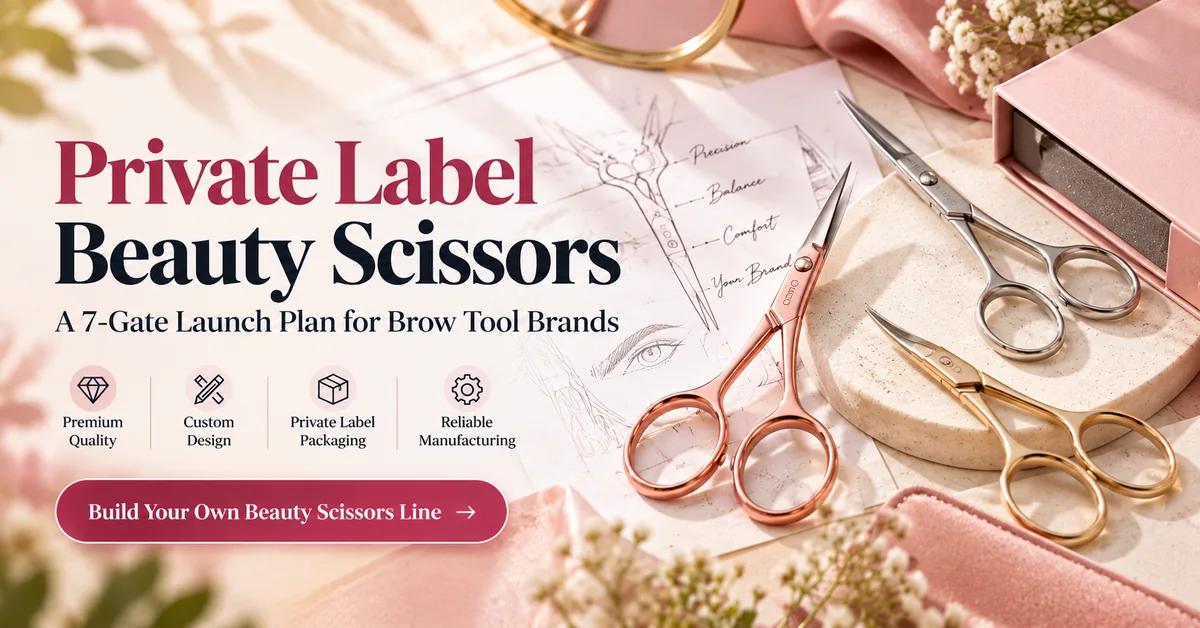
Private label beauty scissors are precision grooming tools supplied under a retailer's or beauty brand's own name, with agreed product specifications, branding and packaging. For a successful B2B launch, buyers should evaluate blade geometry, cutting performance, pivot movement, materials, sample consistency and retail presentation before ordering in bulk.
This practical guide helps beauty brands, importers, professional brow suppliers and e-commerce retailers turn an initial scissor concept into a controlled, retail-ready SKU that can be reordered consistently.
1. Why Private Label Beauty Scissors Need a Product-Specific Sourcing Strategy
Beauty scissors may look simple, but their function depends on closely related mechanical details. Blade geometry determines how the tool approaches a fine trimming area. The pivot affects opening resistance and blade contact. Finger loops influence grip stability, while the surface finish and retail packaging affect how buyers perceive the product.
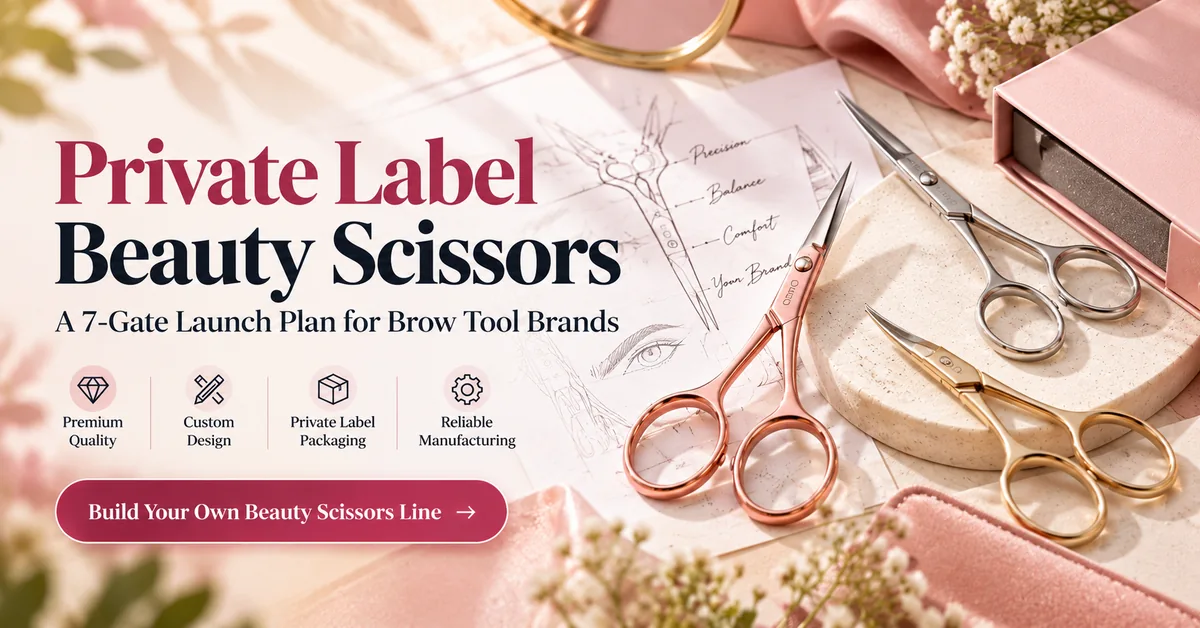
For a beauty brand selling brow grooming accessories, these details are part of the customer experience. Two scissors may look similar in a catalog but behave differently when used. One may have narrow, straight, pointed blades intended for fine-detail work, while another may use a curved profile that changes the user's trimming position.
If a product is described only as “premium eyebrow scissors,” the buyer has little information about whether the design fits the intended application. A useful private-label program connects four elements: the grooming task, the selected tool design, measurable acceptance criteria and the brand's commercial position.
What B2B buyers actually need
For overseas buyers, the question is broader than whether a supplier can print a logo. A beauty brand must determine whether the model supports its product promise. An importer needs repeatable quality, suitable documentation and clear shipment requirements. An e-commerce seller needs accurate dimensions and packaging that protects the working end in fulfillment. A professional brow-tool distributor examines cutting control, handling and performance under realistic use.
These buyers may purchase the same product category, but they do not necessarily need the same scissors. The supplier conversation should begin with the intended application and user expectations, not decoration or the lowest quoted price.
2. Who Should Develop Private Label Beauty Scissors?
Custom-branded beauty scissors are especially relevant to businesses building a recognizable grooming collection, extending an existing product line or selling accessories under a consistent private-label identity.
| Buyer segment | Main purchasing priority | Possible product direction |
|---|---|---|
| Beauty and makeup brands | Brand identity, performance, packaging | Compact eyebrow scissors with coordinated branding |
| Brow studios and professional distributors | Cutting control, blade geometry, handling | Precision scissors approved through functional sampling |
| Beauty retail chains | Barcode, SKU and retail packaging consistency | Retail-ready single packs and coordinated collections |
| E-commerce brands | Differentiation, listing accuracy, transit protection | Compact scissors with protective packaging |
| Beauty wholesalers | Assortment breadth, repeat supply, commercial stability | Established models with agreed inspection checks |
| Grooming-kit and gift brands | Product combinations, visual presentation | Beauty scissors incorporated into branded sets |
When private labeling may not be the right choice
A buyer seeking a small quantity of unbranded replacement tools may find ordinary wholesale purchasing more practical than creating custom artwork or packaging. A business sourcing medical-use instruments should not assume that cosmetic scissors meet medical-device specifications, sterilization requirements or regulatory obligations. Likewise, compact eyebrow scissors are not automatically appropriate for full-length hair cutting, even if the blades appear sharp.
OLIMOR's Beauty Scissor collection provides an initial reference for grooming and precision beauty tools. The selected model, intended use, technical requirements and customization feasibility should be confirmed before ordering.
3. Beauty Scissor Types: Choose the Cutting Task Before the Appearance
One common purchasing error is treating every pair of small beauty scissors as interchangeable. Blade length, tip profile, curvature and handle construction influence how a tool is controlled and where it can be used.
Straight precision eyebrow scissors
Straight, narrow blades are a practical starting point for controlled brow trimming where the user needs a clear view of the cutting area. Buyers should examine how the tips meet, whether the blades cut without snagging and whether the finger loops offer adequate control.
Curved eyebrow scissors
Curved scissors create a different working profile. They may suit selected detailed-grooming routines, but a curved blade is not automatically superior. Evaluate the curve's direction, the preferred hand position, visibility and the actual cutting action. Curved and straight designs may complement one another in a product range.
Alternative handle materials
Some compact models include nonmetallic handle components, offering a different visual character or grip feel. Check the complete assembly: a comfortable handle cannot compensate for poor blade contact, and an attractive handle does not establish durability on its own.
Protective-tip grooming designs
Some grooming applications favor a more rounded or protective tip rather than an exposed pointed end. Such options must be assessed against intended users and packaging. Do not change the tip design without updating product images, sample approvals and descriptions.
| Scissor type | Primary selection factor | Typical concern | Private-label direction |
|---|---|---|---|
| Straight eyebrow scissors | Tip and blade alignment | Precise cutting and control | Branded brow grooming tool |
| Curved beauty scissors | Curvature and cutting contact | Access and handling | Specialist eyebrow tool |
| Compact grooming scissors | Overall length and grip | Portability and storage | Travel grooming range |
| Mixed-material handle scissors | Grip construction and assembly | Comfort and material consistency | Distinctive retail accessory |
| Protective-tip scissors | Tip design and intended use | Controlled handling | Specialized grooming product |
| Professional hair scissors | Longer-use blade geometry | Comfort and cutting performance | Separate salon product line |
These are design categories for purchasing decisions, not a claim that every configuration is offered by every OLIMOR model. Starting with one clear use case makes sampling, product photography, claims and customer communication more manageable.
4. Real OLIMOR Beauty Scissors: Published Model Comparison
OLIMOR BEAUTY, associated with Bonet Houseware Co., Ltd. in Yangjiang, Guangdong, China, offers beauty scissors alongside tweezers, nail clippers, eyelash curlers, manicure sets and other personal care tools. Product-specific sourcing becomes more useful when the guidance connects to actual published models.
| Model | Listed material | Listed size | Listed weight | Selection consideration |
|---|---|---|---|---|
| SCB3057 | Stainless steel | 4.8 × 8.6 cm | 16 g | Compact pointed-blade brow grooming design |
| SCB3058 | Stainless steel + plastic | 4.7 × 9.8 cm | 16 g | Alternative handle construction for brow grooming |
| SXS5005 | Stainless steel | 9.1 × 4.3 cm | 14 g | Curved-blade eyebrow-scissor option |
The figures above reproduce the respective public product listings. They do not establish an exact steel grade, hardness, dimensional tolerance, inventory position or confirmed customization scope.
SCB3057: compact stainless-steel starting point
The SCB3057 professional beauty scissors are publicly listed in stainless steel with a silver finish, compact dimensions and a 16 g weight. The pointed design is worth reviewing for a precision-oriented brow-tool line. Request an actual sample and evaluate the blade profile, cutting response, pivot motion and available logo area. Confirm whether any proposed finish or packaging modifications can be applied to the selected model.
SCB3058: different component combination
The SCB3058 eyebrow trimming scissors are listed as stainless steel plus plastic. This is a reminder that materials should be recorded by component. An RFQ saying only “stainless-steel scissors” can be inadequate when the handle contains plastic parts. A material schedule should distinguish blades, handle components, pivot and any additional elements. Assess feel, assembly and durability on an actual sample.
SXS5005: curved eyebrow-scissor alternative
The SXS5005 beauty scissors use a listed curved-blade design with stainless-steel material and a silver finish. Curvature may help create a differentiated assortment, but it changes the user's working position. Evaluate the scissors through the intended trimming task rather than choosing a model only because it looks distinctive in photography.
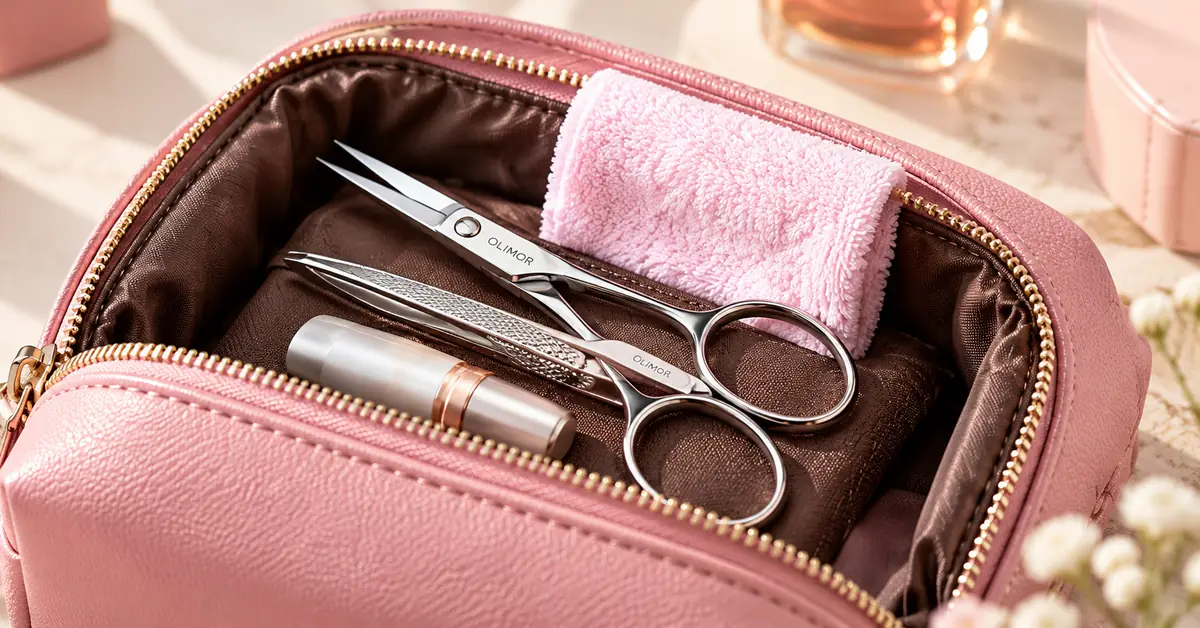
How to compare the three options fairly
Request representative samples, define one consistent evaluation procedure and record cutting performance, handling, construction and appearance. Test the same relevant medium where practical and examine whether cutting contact remains consistent. A model should not be considered higher quality merely because it is lighter or has fewer listed materials. The correct choice is the one that passes the agreed application-specific requirements.
Choose a reference model, share your target application and request confirmation of the appropriate customization, sampling and order terms.
Explore Beauty Scissors →Request Model Advice →5. The Seven-Gate Approval Framework for Private Label Beauty Scissors
Instead of treating a quotation as the final definition of a product, divide the project into approval stages. Each stage records what the buyer and supplier have agreed, what still requires checking and what evidence authorizes the next decision. The seven-gate approach below is a recommended purchasing method, not a statement that every OLIMOR order follows an identical formal workflow.
Gate 1: Confirm the buyer, application and commercial brief
Identify the intended customer first. Is the scissor designed for consumer eyebrow care, professional brow services, a makeup-accessory collection or a compact travel kit? Then define the sales channel and target position. A retail product may require a hanging card and readable on-pack information. E-commerce requires accurate photography and parcel protection. A gift set introduces insert, case-fit and coordinated appearance requirements.
The brief should record destination markets, initial order estimate, expected retail positioning and launch timing. Separate nonnegotiable requirements from optional decoration. A particular blade profile may be essential, while an unusual coating may only be a preference. Approval output: a buyer-approved product brief with application, intended user, essential features and commercial requirements.
Gate 2: Choose the base model and blade geometry
Compare candidate products through blade length, tip shape, curvature, handle structure and operating motion. Request images showing the full tool, working end, pivot and finger loops. For important dimensions, ask for drawings or dimensioned photographs instead of inferring scale from promotional imagery. Use the same grooming task and evaluation conditions wherever possible. Do not authorize custom surface decoration until the underlying product design is suitable. Approval output: an approved reference model, or a documented shortlist with open questions.
Gate 3: Freeze the technical specification and materials
Before bulk production, create a controlled specification listing the model, dimensions, material by component, blade profile, intended function, pivot and handle construction, finish and packaging. Confirm any required steel grade separately: the term “stainless steel” does not itself establish a specific alloy or hardness. Describe the agreed cutting action, finish and visual tolerances. If decoration may affect working surfaces, verify that functional performance is retained. Approval output: dated specification revision supported by drawings and reference photographs.
Gate 4: Approve a functional sample
A visually attractive pair of scissors can still perform poorly. Assess blade alignment and contact, the opening-and-closing action, pivot stability and grip comfort. Use an agreed test medium relevant to the intended application. Ordinary office-paper cutting should not automatically be treated as proof of professional eyebrow trimming performance. Compare more than one sample where possible; one acceptable piece does not establish process consistency. Record faults, changes and results. Approval output: a functional golden sample and inspection checklist.
Gate 5: Approve logo, finish and brand presentation
Once the functional design is accepted, evaluate logo position, marking method, finish, color and other appropriate branding options. Available methods vary with material, geometry, quantity and the particular product. The mark should remain legible without interfering with blade movement, the pivot or comfortable handling. Approve actual finish samples rather than relying exclusively on digital renderings. Approval output: approved artwork, logo-position reference and visual sample.
Gate 6: Approve the complete retail package
Packaging should protect the blades, identify the correct product, communicate intended use and work in the planned sales channel. Pointed ends need secure positioning. Test the actual product in the final package and inspect the insert, orientation, opening experience, artwork and protection during handling. Product imagery, material descriptions, sizes and included accessories must match the approved tool. Review destination-market labeling rather than assuming one set of requirements applies everywhere. Approval output: accepted packed pre-production sample.
Gate 7: Release the production lot and protect future reorders
Before release, confirm that the bulk goods correspond to the accepted specification, golden sample and packaging reference. Inspect product identity, cutting function, pivot movement, surface condition, logo and packed contents. For reorders, retain model numbers, specification revisions and artwork versions. Proposed changes to materials, parts or production methods should trigger an agreed review. Approval output: documented inspection and lot-release decision, with records for replenishment.
| Approval gate | Decision to make | Evidence to keep | Risk reduced |
|---|---|---|---|
| 1. Commercial brief | Who uses it, and why? | Approved product requirements | Wrong market positioning |
| 2. Model selection | Which blade and handle? | Reference model and images | Unsuitable design |
| 3. Technical specification | What exactly will be produced? | Drawings and approved specification | Ambiguous requirements |
| 4. Functional sample | Does the scissor perform? | Golden sample and test record | Cutting and handling complaints |
| 5. Brand approval | Does appearance match the brand? | Artwork and finish sample | Inconsistent logo or finish |
| 6. Packaging approval | Is the retail unit acceptable? | Packed pre-production sample | Damage and listing mismatch |
| 7. Production release | Does the lot match approvals? | Inspection and revision records | Batch and reorder inconsistency |
Choose a reference model, share your target application and request confirmation of the appropriate customization, sampling and order terms.
Discuss Your Project →View All Beauty Tools →6. Materials, Components and Workmanship That Affect Scissor Quality
When comparing suppliers of OEM beauty scissors, distinguish material selection from measured product performance. Stainless steel is widely used for personal-care tools, but it represents a family of alloys. Properties depend on the grade, manufacturing, heat treatment, geometry and use conditions. The phrase “stainless-steel blade” cannot by itself prove hardness, edge retention or resistance to every cleaner.
Blade material and hardness
Material choice influences what forming, processing and finishing methods are appropriate. Certain scissors may involve metal forming or machining, heat treatment, grinding, polishing and assembly, but the actual route differs by design. Buyers should confirm the selected model's material specification and whether a meaningful hardness criterion is required. A higher hardness number alone does not ensure better cutting: edge geometry, alignment and toughness also matter.
Blade geometry and cutting edges
Effective scissors depend on the interaction of two blades. Cutting-edge shape, crossing action, contact and tip profile affect performance. During sampling, examine whether the tool cuts cleanly rather than folding or snagging the intended medium. Inspect for inconsistent blade contact, lateral movement, rough edges and damage around the tips. Small geometry differences can be important in fine-detail brow grooming.
Pivot construction and movement
The pivot governs both stability and how the tool opens and closes. A loose joint can permit unwanted motion; excessive resistance can make operation uncomfortable. Examine multiple units under the same procedure. If a particular model supports adjustment, record its approved setting and finished operating condition rather than merely saying that the scissors feel “smooth.”
Finger loops and ergonomics
Finger loops influence hand placement and control. All-metal designs and models with added handle components may serve different design goals. Inspect sharp edges, usable loop size, grip comfort and balance. If the product is targeted at professional users, evaluate repeated use rather than judging it after a single cut.
Surface finishing and decoration
Polishing, brushing, plating or other decoration can affect appearance and perceived brand value. A decorative finish should not be assumed to improve cutting performance or corrosion resistance without evidence. Check scratches, uneven color, roughness, coating defects and conformity with the approved finish reference.
7. Quality Control: What Should a Buyer Inspect?
Quality control should be specific enough to produce repeatable decisions. The buyer and supplier need to agree on what is inspected, how it is measured or evaluated, and what constitutes an unacceptable result. “Strict QC” is not a meaningful purchasing requirement unless supported by concrete checks.
| QC category | Inspection focus | Recommended evaluation | Example rejection concern |
|---|---|---|---|
| Material | Component identity | Compare documentation with specification | Unapproved material |
| Dimensions | Length, width, critical geometry | Measure against approved drawing | Outside agreed tolerance |
| Blade contact | Interaction of cutting edges | Agreed functional cutting test | Snagging or incomplete cut |
| Tip alignment | Position and finish | Visual and functional comparison | Misaligned or damaged tips |
| Pivot movement | Opening and closing action | Repeated operation to agreed criteria | Excessive stiffness or looseness |
| Handle | Finger loops, exposed edges | Visual and tactile inspection | Burrs or poor handling |
| Surface finish | Color and treatment | Compare with approved sample | Uneven finish, visible defects |
| Branding | Logo location and quality | Compare with approved artwork | Incorrect or unclear logo |
| Packaging | Protection, insert, contents | Inspect complete packed unit | Exposed tips or wrong components |
| Cartons | Identification and quantity | Compare with purchase order | Wrong SKU or carton label |
Use a functional test relevant to the application
Agree on the medium, cutting area, test method and acceptance criteria before sampling. A clear method might describe which blade zone is used and whether incomplete cutting, snagging or excessive force is unacceptable. Do not claim conformity with a standard unless the correct standard and evidence have actually been established.
Check variation, not only the best sample
Inspect several representative units where practical. Performance can vary in blade contact, pivot movement and finishing. For bulk lots, agree on inspection sample size and acceptance criteria based on the order and risk; do not invent a universal acceptable quality limit for every project.
Keep evidence for reorders
Inspection photographs, drawings, sample records and approved packaging references help compare subsequent batches and identify unauthorized changes. This documentation is particularly valuable for retailers maintaining the same SKU and listing over multiple selling seasons.
8. Branding and Packaging Options for Retail-Ready Scissors
A successful private-label program connects tool function and brand identity. Potential discussions include logo marking, surface finish, color, protective accessories, packaged presentation and coordinated beauty-tool sets. The available options must be confirmed for the exact scissor model.
Logo placement and marking
A logo helps identify the product as part of a consistent range. However, its location must take account of the available surface area, material, legibility and blade operation. Marking methods can behave differently on different finishes. A physical decorated sample is preferable to an image-based promise of the final result. Ask separately about setup costs, minimum quantity and visual acceptance criteria.
Choose packaging for the sales channel
Retail stores may need hanging cards or compact boxes with clear product identification. E-commerce brands may emphasize protective inserts, package dimensions and safe handling during fulfillment. Gift ranges may use coordinated cases or pouches. In every case, the tool should be secured inside the package and its working end protected from unwanted contact.
Artwork and labeling checks
Confirm that the product name, intended use, image, listed materials, quantity, instructions, care information, warnings and barcode requirements reflect the actual packed product. Check country-of-origin and responsible-party labeling for the relevant destination market. Do not copy compliance claims from unrelated products.
Build a coordinated brow-tool collection
A brow product range might combine precision scissors with a beauty tweezer and a compatible eyebrow razor. Consistent packaging colors and visual language can help shoppers recognize the collection. Still, every product requires its own functional sample approval and safe packaging review. A coordinated look is useful only if each included tool meets its intended purpose.
9. Private Label vs OEM vs ODM: Which Route Is Right?
The expressions private label, OEM and ODM are often used together, but they represent different possible levels of product change. Distinguishing them helps buyers anticipate development work and compare quotations.
| Route | Starting point | Typical requirements | Main planning issue |
|---|---|---|---|
| Standard wholesale | Existing catalog model | Quantity and packing | Stock and order volume |
| Private label | Existing approved scissor | Logo, finish and packaging | Decoration and packaging setup |
| OEM development | Buyer-defined specifications | Drawings, geometry and functions | Tooling, sampling and approvals |
| ODM adaptation | Existing design platform | Agreed product modifications | Technical feasibility and development |
| Branded multi-tool set | Several approved tools | Coordinated identity and packaging | Set assembly and inventory |
When to select an existing model
An established design can help a new brand concentrate on product-market fit, sample performance, branding and retail presentation. It does not remove the need for testing. Buyers should still verify that the catalog model actually suits the intended user.
When deeper customization is justified
More extensive development may be appropriate if an existing model cannot meet essential requirements for the blade shape, handle or size. Before investing in tooling, define the user benefit. Customization that does not improve function, positioning or differentiation can increase costs without improving the offer.
10. What Determines Cost, MOQ and Landed Price?
The unit price is only one element of an importer's financial decision. Total project costs can include sampling, logo setup, decorative processes, packaging, inspection, transport, customs-related charges and inventory handling. Compare quotes only when they cover equivalent specifications and deliverables.
| Cost factor | Why it matters | Buyer action |
|---|---|---|
| Base model | Construction affects production | Compare models for the same use |
| Material | Impacts processing and technical requirements | Confirm material by component |
| Blade processing | Precision affects manufacturing work | Define acceptance tests |
| Logo method | May involve tooling or setup | Ask for feasible methods and charges |
| Surface finish | May require a separate process or batch | Approve appearance and terms |
| Packaging | Affects cost, volume and assembly | Quote packaging separately |
| Quantity | Batch economics can change the price | Request realistic tiered quantities |
| Sampling | Revisions require work and coordination | Define stages and charges |
| Inspection | Depends on scope and criteria | Agree on QC plan in advance |
| Freight | Changes landed cost | Confirm shipping terms and destination |
Why there is no single universal MOQ
Minimum order quantity depends on the base model, customization, decoration, materials and packaging. The packaging manufacturer's minimum may differ from the tool manufacturer's minimum. Request separate quotations for the standard model, achievable private-label options and more extensive development. OLIMOR's public listings do not establish one MOQ for all beauty scissors.
Assess the landed cost, not only the unit price
For a purchasing comparison, consider product cost, agreed customization, packaging, freight and applicable import-related expenses. Sampling, inspection, warehousing or fulfillment charges may need to be allocated separately. A higher unit price can be commercially rational if it delivers more appropriate packaging or better specification control, but savings and reduced returns should never be promised without evidence.
11. Planning Samples, Production and Delivery
Buyers often ask how quickly branded scissors can be launched. The timeline varies according to model selection, design changes, materials, packaging, order quantity, approval speed and logistics. Separate the stages rather than relying on a single unspecified “lead time.”
Sample preparation
Sampling begins when product requirements are sufficiently clear. Existing-product samples and substantially modified designs may follow different schedules. Provide intended use, drawings or reference images, materials, preferred finish, logo artwork and package expectations to avoid unnecessary revisions.
Artwork and packaging approvals
Packaging development can proceed alongside some product tasks, but the final insert and artwork should match the approved tool. Request dielines and physical packaged samples where necessary. Verify that the scissors fit securely and that printed descriptions match the item inside.
Production scheduling
After technical and packaging approvals, ask the supplier for a schedule tied to the quantity, actual materials and available processing route. Special finishes, new components and custom printing may create additional preparation work. Distinguish factory production timing from transit and customs processes.
Replenishment and changes
Future purchase orders should reference model number, current specification revision and artwork version. “Silver eyebrow scissors” may not identify the exact approved tool when similar configurations exist. Any material or process changes should be reviewed before they enter an approved repeat order.
12. Match the Product to the Sales Channel
The strongest private-label product is not necessarily the one with the most features. It is the one suited to its target customer and distribution channel.
Beauty brands and makeup retailers
These companies need scissors that fit a recognizable visual identity, coordinate with complementary tools and offer appropriate cutting performance. Cohesive naming, finishing, imagery and packaging help present a complete brow-tool range.
Professional brow studios
Professional users often emphasize blade control, visibility, pivot feel and comfort. Use a realistic task-based sample evaluation before positioning a model as a professional tool; polished photographs alone do not demonstrate professional performance.
E-commerce sellers
Online customers rely on accurate photographs and descriptions. Show the actual blade shape, measurements, handle and included accessories. Protect the pointed working end throughout the parcel fulfillment process. Returns or complaints caused by mismatched product images are avoidable specification problems.
Travel and grooming-kit brands
Travel sets introduce limits on overall size, packing space and weight. Test the scissors inside the full kit. Do not promise unrestricted carry-on acceptance during air travel: rules may differ by country, carrier and security authority.
Wholesale distributors
Distributors may prioritize a manageable model assortment with stable identifiers, consistent quality, clear carton markings and repeat ordering. Good specifications and reliable change communication often matter as much as decorative differentiation.
13. Write an RFQ That Produces a Useful Scissors Quote
A generic request such as “please send your best price for custom beauty scissors” seldom includes enough information for a useful quotation. A structured request for quotation (RFQ) should explain the buyer's requirements and clearly distinguish confirmed needs from open questions.
| RFQ field | What to specify |
|---|---|
| Product type | Eyebrow scissors, precision beauty scissors or another type |
| Reference | Preferred OLIMOR model number or photograph |
| Target user | Retail customer, brow professional or gift recipient |
| Intended task | Precise brow trimming or another non-medical grooming use |
| Materials | Specific requirement or request for grade confirmation |
| Blade design | Straight, curved, pointed or other geometry |
| Dimensions | Target measurements or suitable existing model |
| Branding | Logo artwork, position and finish preference |
| Packaging | Retail card, printed box, pouch or set case |
| Quantity | Trial quantity and possible reorder volume |
| Destination | Country or region and shipping terms |
| Quality | Required sample and batch checks |
| Timeline | Target launch and quotation schedule |
Example inquiry for a brow-scissor brand launch
We are developing a private-label eyebrow grooming collection and would like to compare OLIMOR SCB3057 and SXS5005 as possible base models. Our priorities are controlled cutting performance, comfortable handling, consistent finishing and protective retail packaging. Please advise which logo and packaging options are feasible, as well as the relevant sampling process, MOQ, production schedule and quotation terms for our intended quantities.
This type of RFQ links the commercial opportunity to specific product decisions. Send requirements and reference images through the OLIMOR Contact Us page.
Choose a reference model, share your target application and request confirmation of the appropriate customization, sampling and order terms.
Send Your RFQ →Select a Scissor Model →14. Common Mistakes When Sourcing Custom Beauty Scissors
Choosing only from product images
Photographs can show shape and appearance but cannot prove blade contact, cutting behavior or pivot stability. Order appropriate samples before authorizing volume production.
Assuming every stainless-steel scissor is equivalent
Stainless steel is a general material category. Grade, processing, geometry and assembly matter. Confirm materials and functional criteria rather than assuming all products with the same material label perform identically.
Decorating before functional approval
A logo or premium finish does not correct poor blade alignment. Approve cutting performance, tip profile and handling before accepting decoration as the final product.
Accepting undefined quality statements
“Strict quality control” does not explain sample quantity, measurements or reject conditions. Require documented product-specific checks that can be repeated during batch inspection.
Ignoring packaging until shipment
A packaging rendering may look good while failing to protect the working end. Test the real product inside a real protective insert and review shipment handling needs.
Launching too many variants at once
Multiple blade shapes, color finishes and pack formats multiply approval and inventory requirements. A focused first launch can provide clearer customer feedback before adding variants.
Failing to control repeat orders
Keep golden samples, model numbers, accepted artwork and product revision records. Review any changed component or processing route before it affects the next lot.
15. How OLIMOR BEAUTY Fits Into a Private-Label Scissors Project
OLIMOR BEAUTY, associated with Bonet Houseware Co., Ltd. in Yangjiang, China, supplies beauty and personal-care tools, including scissors, nail clippers, cuticle nippers, tweezers, eyelash curlers, eyebrow razors and manicure sets.
For a project involving private label beauty scissors, the practical starting point is the Beauty Scissor product category. Buyers can examine listed models, identify designs for comparison and ask about relevant branding, packaging and production options. OLIMOR's company information describes product development, sampling, private-label discussions and quality checks. The final customization scope, specific materials, quantity and schedule should be confirmed per inquiry.
A practical starting route for a new beauty brand
Begin with an existing model that matches the intended grooming application. Approve its performance and handling, then evaluate the feasible logo, finish and packaging options. Document the resulting approved product so it can be produced and reordered consistently.
For a broader eyebrow collection, consider complementary tweezers and eyebrow razors with consistent visual identity, while treating each tool as a separate technical and safety approval. The commercial objective is a credible branded collection with repeatable specifications—not merely printing a logo on unrelated products.
16. Frequently Asked Questions About Private Label Beauty Scissors
1. What are private label beauty scissors?
Private label beauty scissors are grooming or cosmetic scissors supplied under a buyer's own brand. They may use an approved existing model with branding and packaging, or involve more extensive changes. The key decisions are intended use, cutting performance, approved specifications, branding and repeatable batch quality.
2. Can I add my logo to eyebrow scissors?
Logo customization may be available depending on model geometry, material, surface, marking method and quantity. Confirm placement, readability, process and price. Approve a physical decorated sample rather than relying only on a digital mock-up.
3. What is the MOQ for private label beauty scissors?
There is no single MOQ for every model and customization route. Minimum quantity may depend on the base product, marking process, custom finish, packaging, materials or tooling. Request project-specific quotations for a standard configuration and for the private-label version.
4. Are straight or curved eyebrow scissors better?
Neither is universally better. Straight and curved designs support different handling and cutting approaches. Evaluate actual samples for the target grooming task, visibility, comfort and cutting control rather than choosing by appearance alone.
5. Which steel should I request for custom beauty scissors?
Stainless steel is frequently listed, but a product's correct grade must be verified for its design and intended use. Specify required performance where practical, request actual material details and do not assume a grade, hardness or test result that the supplier has not confirmed.
6. How do I evaluate a scissor sample?
Check blade contact, tip alignment, pivot movement, grip, visual finish and cutting on an agreed medium relevant to its intended application. Inspect several representative samples where possible and document accept or reject criteria before ordering in bulk.
7. Can the scissors be combined with tweezers or eyebrow razors?
These tools can form a branded brow-grooming collection when suitable models and packing options are agreed. Every item should be functionally approved individually, then the combined set should be checked for correct contents, visual consistency and secure protection.
8. What influences production lead time?
Timing depends on model choice, materials, order quantity, custom finishing, branding, packaging and the number of approval rounds. Ask the supplier to separate sample lead time, production lead time and shipment arrangements after the requirements are defined.
9. What must I verify before a repeat order?
Reconfirm the approved model, specification revision, materials, blade geometry, finish, logo and packaging. Compare previous inspection findings, and arrange additional sample approval if the supplier proposes a meaningful component or process change.
10. How do I obtain a private-label quotation from OLIMOR?
Use the OLIMOR Contact Us page and provide preferred model or sample, target use, destination market, estimated quantity, logo requirements, package concept and quality expectations. The team can then discuss appropriate product options and project-specific commercial terms.
Conclusion
Launching successful private label beauty scissors requires more than selecting an attractive compact tool and adding a company logo. Brands and distributors need to connect the real grooming application with blade geometry, pivot movement, material requirements, sample performance, decoration, packaging and repeatable inspection.
The seven-gate approach provides a practical sequence: define the buyer, select a model, freeze the specification, approve functional samples, approve branding, approve the packaged unit and release production through documented controls. These steps help prevent product ambiguity, avoidable complaints and inconsistency in later replenishment.
OLIMOR BEAUTY's published beauty-scissor models are useful starting points for a tailored sourcing conversation. Review the OLIMOR Beauty Scissor range and then contact OLIMOR BEAUTY with the intended application, model references, estimated quantity, preferred logo and packaging design. Confirm technical feasibility and order terms before final approval.
Choose a reference model, share your target application and request confirmation of the appropriate customization, sampling and order terms.
Request Private Label Quote →Explore Beauty Scissors →Tag:
Related articles
- Lash & Brow Tools
- Materials & Quality Control
Eyelash Curler Manufacturer China: Frame-to-Pad QC Blueprint for Global Beauty Buyers
- Lash & Brow Tools
- OEM & Private Label
Eyelash Tweezers Manufacturer: How Lash Brands Evaluate Tip Precision, OEM Samples, and Bulk Quality
- Lash & Brow Tools
- OEM & Private Label