

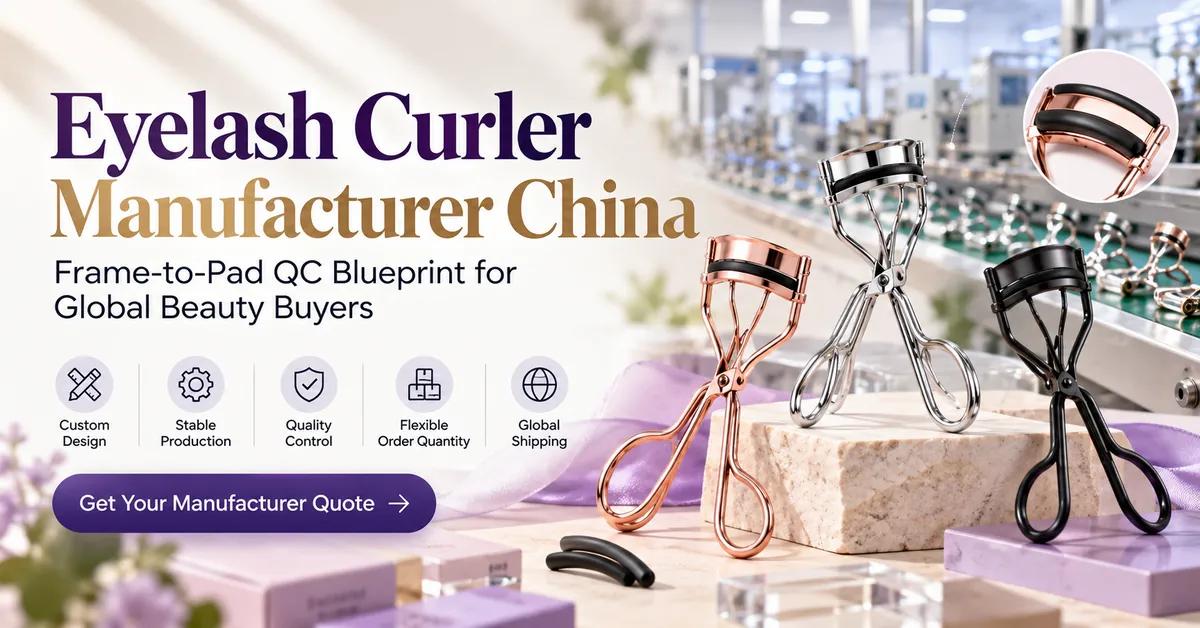
Quick answer: When selecting an eyelash curler manufacturer China partner, evaluate the finished frame and cushion pad as one functional system.
A mechanical eyelash curler works close to the eye. Even small differences in the upper pressing bar, cushion position, frame shape, or hinge can change the way the tool feels and performs. That makes supplier selection a product-engineering and quality-control decision as well as a commercial purchase. For a makeup brand, importer, beauty wholesaler, or professional lash-accessory distributor, the central question is whether an approved product can be reproduced in the right packaging across successive orders.
This guide introduces a frame-to-pad evaluation method, a component-level specification, an incoming-quality matrix, practical OEM options, a quotation comparison framework, and a request-for-quotation template. It also uses one verified OLIMOR BEAUTY model to demonstrate how to separate published specifications from details requiring supplier confirmation. The emphasis is on procurement decisions that can be documented and checked, not generic claims about an ideal curler for everyone.
1. What Should a China Eyelash Curler Manufacturer Prove Before You Place an Order?
The most useful factory discussion starts with the exact product experience the buyer intends to sell. Ask which frame geometry the proposed model uses, what pad belongs to that frame, how the assembly is checked, and what will remain unchanged when the next purchase order is placed. A supplier offering several colors of a curler should be able to explain whether those colors share the same structural model or represent different tool geometries.
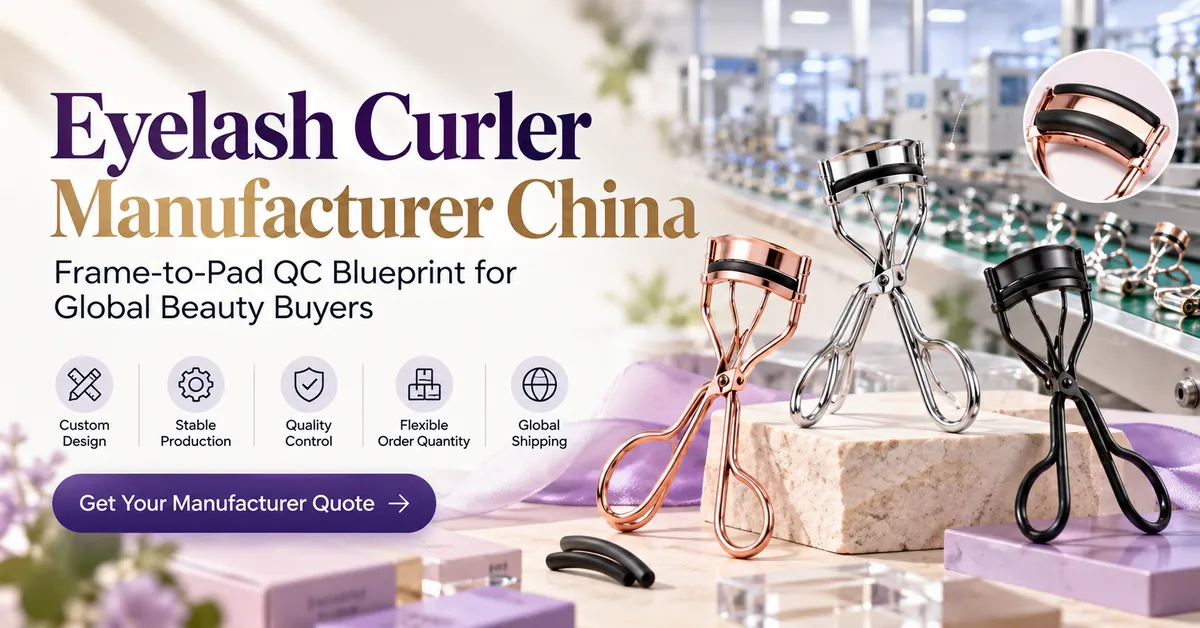
For beauty brands, the question is whether the tool's functional design and branded presentation support a defensible product promise. For importers and distributors, the priorities include model identification, batch consistency, cartons, replacement accessories, and defect management. For online retailers, physical dimensions, complete package contents, realistic product imagery, and protection in transit also matter. For professional beauty-supply channels, controlled grip, smooth closing action, pad condition, and practical maintenance instructions deserve a closer look.
An experienced procurement team should request a controlled specification and a representative physical sample instead of accepting descriptions such as “comfortable,” “premium,” or “fits all eyes.” These words are not inspection criteria. The agreed reference must say what to measure or observe, which changes need buyer approval, and how a nonconforming item will be handled.
There are situations where this sourcing route may not be suitable. A buyer seeking a medical instrument, a powered heating device, or a claim of guaranteed compatibility with every eyelid shape requires a different technical brief and evidence. A standard manual eyelash curler should be marketed according to the features and intended cosmetic use actually supported by its documentation.
2. Understand the Eyelash Curler as a Five-Part Mechanical System
A manual curler is a small assembly, not simply one metal frame. The upper pressing bar, lower pad support, elastomer cushion, moving joint, and handle work together. A defect in one part can change how all the others operate. When reviewing a sample, inspect each component separately, then repeat the evaluation with the complete unit assembled.
| Part or interface | Functional role | Key buyer question | Evidence to request |
|---|---|---|---|
| Upper pressing bar | Transfers controlled pressure toward the pad | Does its curve track the pad evenly? | Close-up and functional sample check |
| Lower pad seat | Holds the cushion in position | Is the pad retained without rocking or displacement? | Seat drawing or approved sample |
| Cushion / refill pad | Provides compliant contact under the lashes | Does the specified pad fit and remain stable? | Pad material, dimensions, approved assembly |
| Hinge or pivot | Controls opening, closing, and alignment | Is movement repeatable without objectionable play? | Movement-check method and sample record |
| Handle and frame | Sets leverage and handling geometry | Can the intended user control pressure and positioning? | Physical handling evaluation and product drawing |
| Surface finish and package | Protects appearance and retail presentation | Is the approved finish intact and the assembly restrained? | Finish boundary sample and packed reference |
The upper bar and pad must be designed as a pair
The pressing bar is not a generic interchangeable part. Its visible curve must correspond to the lower contact zone. If a curved bar meets the pad strongly at one end but weakly at the other, the user may experience irregular pressure. A catalog photograph taken at an angle may conceal this difference. Evaluate the full contact line through an agreed closing test and compare the left and right ends.
The hinge changes the entire feel
A pivot that feels loose can create inconsistent alignment, while a stiff or uneven mechanism may encourage users to apply more force than necessary. Specify the acceptable movement against a signed sample, and ask the supplier how the same condition is checked after assembly. Do not invent a torque requirement simply because a generic quality form contains a torque field; use a value only when it is justified and agreed for the actual model.
The handle is part of functional quality
Ring handles, scissor-style handles, and alternative grips can serve different retail positions. A distinctive handle may support visual differentiation, but it must also preserve access, comfortable operation, and the intended opening range. For a professional product, ask representative users to assess handling under a controlled evaluation rather than inferring comfort from the shape alone.
3. Frame Curvature: How to Evaluate Fit Without Claiming “One Size Fits All”
Frame curvature is often discussed as if there were one ideal dimension. In practice, users have different eyelid contours, lash distributions, and hand preferences. A responsible supplier should help the buyer compare available designs rather than promise universal fit. The purpose of sample evaluation is to identify a geometry appropriate for the target group and to document the accepted configuration.
Begin with the visible curvature of the upper contact bar and its relationship to the pad. Then review effective opening, frame symmetry, distance between the pressing area and handle, and the user's ability to position the tool without unwanted contact near the eyelid. The sample should be evaluated in a suitable, controlled way and not used to justify unsupported statements such as “never pinches” or “works for every eye shape.”
A useful buying brief can separate three dimensions of fit. Geometric fit considers the curve, width, and contact surface. Mechanical fit considers how the hinge moves and how the pressing bar meets the cushion. User fit considers whether the selected design is controllable for the intended customer. A model may satisfy one of these categories without satisfying the others.
Practical curvature-review sequence
- Identify the exact base model and obtain its agreed product view or drawing.
- Compare the left and right sides of the frame for obvious asymmetry or twisting.
- Confirm that the upper pressing bar meets the pad consistently across the intended working zone.
- Operate the curler several times to check whether closing alignment changes.
- Review accessibility and grip with the defined user group, using a cautious cosmetic-use protocol.
- Record the approved curve and sample revision so a future color or decoration change does not silently alter the geometry.
Never use “wide-angle,” “Asian-eye fit,” or similar marketing labels as a substitute for physical evaluation. If a manufacturer offers several curve options, request samples and describe the difference in observable engineering terms. Any claim about suitability for a specific population or eye shape should be based on appropriate evidence, not an unsupported assumption.
4. Silicone Pads and Replacement Parts: The Compatibility Matrix Buyers Often Miss
The cushion pad is a small consumable component with a disproportionate influence on the product experience. It must remain seated, provide suitable compliance during closing, and tolerate the expected cleaning and handling conditions. Some retail packages include replacement pads; others do not. Those choices change both the product specification and the promises that a brand can make to its customers.
When requesting silicone pads, do not assume that “silicone” alone establishes an exact formulation, hardness, dimensions, or compatibility. Ask the supplier to confirm the component material for the selected model. The pad's profile, length, cross section, compression behavior, and retention method can differ between curlers. An apparently similar pad may fit loosely or rise above the seat in another frame.
| Pad purchasing situation | What must match | How to validate | Commercial implication |
|---|---|---|---|
| Original pad supplied with curler | Pad geometry and frame seat | Inspect seating and closing contact on finished units | Included in base SKU approval |
| Spare pad in retail box | Same approved pad specification | Confirm count, fit, and secure packing | Changes product contents and package copy |
| Separately sold refill pads | Exact compatible model or range | Verify cross-reference with physical samples | Requires refill SKU and replenishment planning |
| Color-changed pad | Geometry, material performance, and finish appearance | Re-approve assembly after the change | Color-specific MOQ and appearance control may apply |
| Changed pad supplier or formula | Retention, compression, aging behavior | Requalification agreed with buyer | Requires change notification and possible testing |
What a pad-fit inspection should record
Check whether the pad is fully seated, oriented correctly, and retained during repeated normal operation. Look for premature deformation, cracks, tears, hard spots, residue, or inconsistent surface texture. Evaluate how the upper pressing bar meets the pad, not simply whether the loose pad looks undamaged on a table.
If replacement pads are sold, create a compatibility reference that identifies the curler model, pad SKU, version, and supported packaging. A drawing can help, but a verified physical fit test remains important. The supplier should state whether spare pads are routinely available or must be ordered as part of a custom program; availability should never be promised without confirmation.
Care instructions affect the specification
Because eyelash curlers are used near the eye area, the finished retail product should communicate appropriate cleaning, inspection, and replacement advice. Worn, loose, or damaged pads should not be used. Exact maintenance guidance should be appropriate for the approved materials and market. Avoid fixed lifetime guarantees or unsupported “hypoallergenic” and medical claims.
For a broader discussion of pad maintenance, buyers can review OLIMOR's eyelash curler pad sourcing guide. This article focuses instead on qualifying pads as part of a manufacturer procurement system.
5. Actual OLIMOR Product Reference: ECH4004 and What Its Listing Does Not Prove
OLIMOR BEAUTY, associated with Bonet Houseware Co., Ltd. in Yangjiang, Guangdong, China, publishes an Eyelash Curler collection that includes several visual designs. A publicly listed example is the ECH4004 Eyelash Curler. Its visible specification provides a useful starting point for a serious buyer, but it should not be treated as a complete technical drawing or an unconditional wholesale offer.
| Published field | ECH4004 website listing | Buyer follow-up needed |
|---|---|---|
| Item number | ECH4004 | Confirm SKU and current version |
| Main listed material | Carbon steel | Confirm the exact component material and finish details |
| Listed color | Black | Confirm available colors and decoration options |
| Listed dimensions | 100 × 62 mm | Confirm dimension orientation, critical tolerances, and drawing |
| Listed product weight | 23 g | Confirm weight tolerance and packed weight |
| Pad specification | Not stated in the cited listing | Ask for pad material, dimensions, fit, and spare-pad policy |
| MOQ, current supply and lead time | Not established by the specification | Request a current model-specific quotation |
Availability note: The retrieved ECH4004 detail page displayed an out-of-stock label. This is a website observation, not a forecast of future manufacturing capability. Buyers should ask OLIMOR to confirm present availability, alternatives, and project feasibility. The price appearing on a retail-style listing is not a verified bulk quotation.
Carbon steel is not the same as stainless steel
The ECH4004 listing says carbon steel. That information should not be silently rewritten as stainless steel merely because other beauty tools use stainless material. Component-level material identity, any coating or surface protection, and cleaning instructions should be confirmed for the exact product. It is also necessary to ask what material is used in the pad, hinge, and any handle covering if those details matter to the buyer's claim or inspection plan.
Compare engineering configurations without inventing additional OLIMOR model specifications
Beyond ECH4004, the website shows other eyelash curler designs, but the information gathered for this article does not establish the complete material and dimension set for each one. A practical comparison can therefore separate an existing standard curler, an existing model with customized finish or packaging, and a modified frame-and-pad design. Those are procurement routes, not three claimed OLIMOR stock models.
| Procurement route | Expected development burden | Main verification | Suitable buyer scenario |
|---|---|---|---|
| Existing approved catalog design | Lower, if in supply | Verify sample, fit, pad, movement, packing | Distributor or market-test order |
| Existing design with branding/finish | Medium, project-dependent | Recheck finished assembly and retail pack | Private-label brand launch |
| Altered frame, pad, or handle | Higher; tooling may be involved | New drawing, sample validation, change-control plan | Differentiated brand product |
This distinction helps buyers obtain comparable quotes and avoids turning unverified catalog variants into fabricated specification tables.
6. Materials and Workmanship: What a Factory Should Explain
An eyelash curler manufacturer in China should be able to explain the operations relevant to the selected design. Possible processes in a metal-and-pad assembly include forming or stamping metal components, bending or setting the frame profile, treating or finishing surfaces, assembling the hinge, fitting the pad, performing a functional check, and packing the tool. The precise route is model-specific; do not assume every factory or curler uses all of these steps.
The product bill of materials should identify the frame, pressing bar, pad seat, cushion, pivot, handle components, decorative parts, and packaging. Each component should have a version or supplier identity appropriate to the order. Where a color coating or decorative finish is used, ask whether it is applied before or after an assembly step and how the finished surfaces are protected from scratches and unintended roughness.
Frame forming and dimensional control
A bent or formed frame can vary in symmetry, opening, and the relative position of its contact surfaces. The factory should specify the critical product characteristics and explain how representative units are compared with the approved reference. A fixture may support repeatability, but buyers should ask for evidence rather than assume that a fixture exists.
Pad assembly and retention
The pad should be installed in the correct position and orientation. The relevant work instruction should prevent substitution of a visually similar but incompatible pad. A first-piece inspection can be useful when starting a production batch or changing a component; the buyer should agree on what will be checked and recorded.
Surface treatment and final finishing
A mirror-like finish, colored plating, or powder-coated appearance can increase shelf appeal, but visual presentation does not prove durability or biocompatibility. Buyers should define acceptable scratches, finish variation, rough edges, and treatment defects. If a finish is changed for private labeling, the completed curler should be tested again because appearance-related processes can affect fit or movement.
Assembly and movement
The final mechanism is the functional product. The hinge, handles, frame, and pad should be assessed as a finished assembly after decoration and packaging preparation. A product that passes a component-level visual check can still fail to close correctly once assembled.
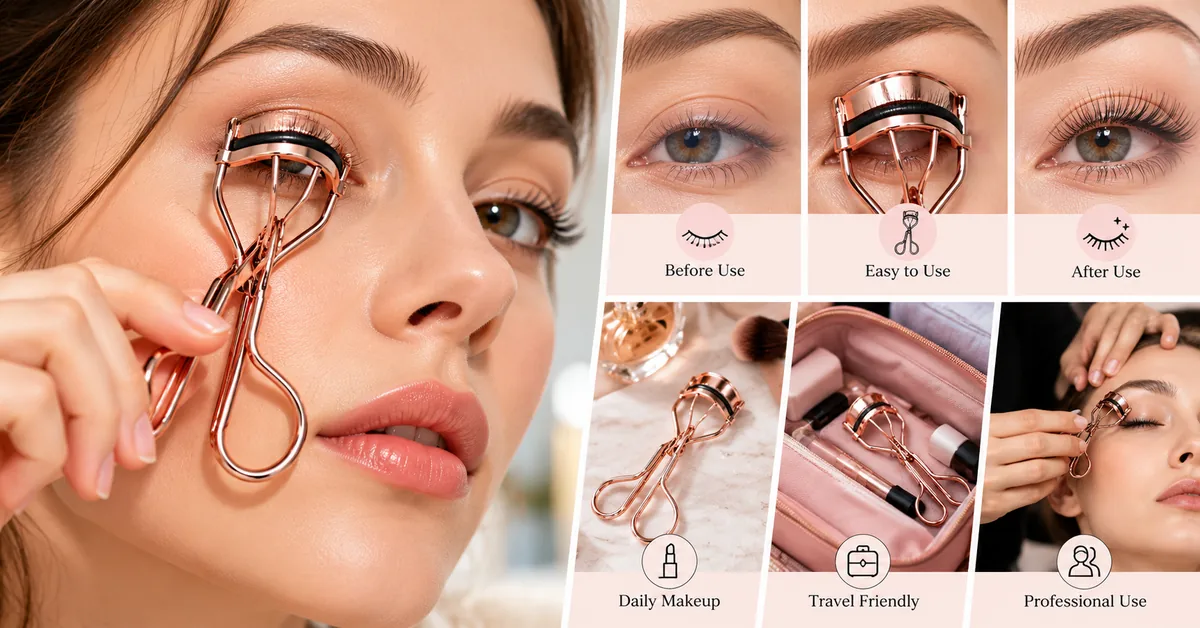
7. A Five-Stage Sample and Quality-Control Plan for Bulk Orders
The most useful quality plan connects purchase requirements with inspection checkpoints. It should tell the factory and buyer what the finished product must be, what to test, when to inspect, and how to address failures. “100% quality guaranteed” is not a meaningful substitute for a written plan.
Stage A: Pre-production specification and golden sample
Create a controlled specification with model number, intended user, frame geometry, materials by component, pad code, hinge design, color, logo, packaging, and approved functional checks. Approve a physical golden sample and record its version. Where possible, retain a sealed reference at both buyer and supplier locations. Any disagreement between a web photo, drawing, and physical sample should be resolved before production.
Stage B: Incoming component verification
Check relevant incoming parts against purchase requirements. For a curler, this can include frame components, pads, decorative material, and packaging artwork. A missing pad, wrong logo card, or incompatible component should be identified before final assembly rather than discovered at dispatch.
Stage C: First-piece and in-process inspection
Inspect the first completed pieces of a production run for curve, contact geometry, pad retention, operating movement, and finish. During assembly, periodic checks can help identify drift or mixed components. Determine check frequency according to the agreed risk and production process; avoid publishing an arbitrary universal interval.
Stage D: Finished-product function and appearance
Check representative finished curlers for frame distortion, consistent bar-to-pad contact, handle movement, pad condition, exposed sharp points, finish defects, logo accuracy, and correct accessories. Define defect categories in advance. A loose pad or badly distorted frame may be more serious than a minor cosmetic mark on an agreed noncritical surface.
Stage E: Packed-lot and pre-shipment inspection
Inspect the completed retail pack. Confirm the correct SKU, packaging artwork, language, barcode, item count, spare pads if promised, carton labeling, and protection from pressure or deformation in shipping. Record nonconformities and require a disposition decision before the affected lot ships.
| Control point | Objective evidence | Suggested decision rule |
|---|---|---|
| Frame symmetry | Approved drawing, sample or fixture result | Pass if consistent with agreed limits |
| Upper-bar-to-pad contact | Defined closing inspection | Reject uneven contact outside approved criteria |
| Pad seating | Visual/retention check after repeated movement | Reject misplaced, loose or damaged pads |
| Hinge action | Repeated operation against reference | Reject abnormal play, binding or unstable feel |
| Finish and edges | Boundary sample and visual inspection | Reject unacceptable roughness or coating defects |
| Logo and artwork | Signed artwork reference | Reject wrong mark, version or placement |
| Pack and carton | Packed reference and packing list | Reject incorrect contents or inadequate restraint |
Sampling note: ISO 2859-1 may be used where a buyer adopts a suitable acceptance-sampling system, but that standard does not define an eyelash-curler-specific defect list or certify the manufacturer's products. The sampling plan, defect definitions, and acceptance limits must be agreed for the actual order. Critical safety-related defects should not be excused by a generic cosmetic-defect allowance.
8. Frame-to-Pad Change Control: Protect the Second and Third Orders
Many buyers approve an excellent first sample but have no process for ensuring that later production matches it. A repeat order may use the same commercial name while changing a pad source, hinge detail, color process, or packaging insert. Some substitutions are harmless; others can affect the finished product. The correct approach is to define which changes require written buyer approval and which require renewed testing.
Use one controlled product record per SKU. Its minimum contents should include the model and version, drawing or reference images, frame specification, pad identification and material statement, hinge construction, finish, logo placement, packaging artwork, and inspection method. For a refillable product, add the compatible pad number and the packaging claim about included spare parts.
A change request should state what is changing, why, which inventory or orders are affected, and what evidence supports equivalence. A new pad color may need appearance and compatibility checks. A changed pad material may need deeper compression and fit review. A changed frame curve requires revalidation of its interaction with the pad. A new retail box may not change the mechanism, but must still protect the product in shipment.
Record a sign-off before implementing significant changes. Where a buyer operates more than one sales channel, inform listing and artwork teams when the approved product image, contents, dimensions, or material description changes. This simple discipline helps prevent a common e-commerce failure: customers receiving a product that no longer matches the page they purchased from.
9. OEM, ODM, and Private Label: Choose the Right Development Level
A Chinese eyelash curler supplier may offer standard wholesale, private label, OEM manufacturing, or ODM development. These terms can overlap in ordinary sales conversations, so the practical question is what work and ownership are actually included in the proposed project.
| Sourcing method | Typical starting point | Buyer decisions | Major sourcing risk |
|---|---|---|---|
| Standard wholesale | Available standard model | Quantity, finish, pack, delivery terms | Assuming listed stock or price is current |
| Private label | Existing functional design | Logo, color, retail artwork, bundle | Approving decoration but not final function |
| OEM specification | Buyer-supplied requirements | Dimensions, components, acceptance tests | Incomplete drawings or uncontrolled substitution |
| ODM development | Design adaptation or new concept | Curve, pad seat, handle, tooling ownership | Revalidation, cost and schedule complexity |
Logo and decorative finish
Branding can distinguish one collection from another, but location and process matter. A logo must not interfere with the grip, movement, or contact surfaces. A proposed plating, paint, or coating should be tested on a completed sample, not approved solely from a digital mock-up. Color matching and finish limits should be written into the specification.
Pad colors, refills, and accessories
A spare pad can be a useful value proposition, but the pack must contain the agreed number and compatible type. Decide whether refill pads are included with the tool, separately sold, or supplied only for after-sales service. Do not promise continuing spare-part availability without a supplier agreement and actual inventory plan.
Custom handle or curve
Changing a handle or frame curve may introduce new tooling or fixtures and often changes the inspection plan. Confirm development ownership, sample charges, approval rounds, design rights, and the effects on MOQ. A distinctive shape is commercially worthwhile only if it improves differentiation or user suitability enough to justify the additional project burden.
Coordinated lash-and-brow assortments
An eyelash curler can form part of a broader grooming range with OLIMOR tweezers, eyebrow razors, and other beauty tools. Shared finishes and packaging can create an identifiable collection, but each tool requires its own functional checks. One approved curler sample cannot validate a tweezer's tip alignment or a razor's guard construction.
10. MOQ, Pricing, Lead Time, and Landed-Cost Comparison
Buyers searching for an eyelash curler manufacturer China partner often ask for a “factory price” before defining the product. That can create misleading quotations. Two visually similar curlers may differ in material, pad specification, assembly requirements, replacement accessories, finish, packaging, inspection scope, or freight terms. A meaningful comparison uses the same written specification.
MOQ can depend on whether the project uses a current model or requires custom components, colors, printing, packaging, or tooling. Ask for separate MOQ figures for standard supply, logo-only decoration, color changes, custom boxes, spare-pad sets, and frame modifications. Packaging suppliers can also impose minimums independent of the metal-tool order quantity.
For lead time, separate technical confirmation, sample preparation, artwork approval, material procurement, production, inspection, packing, and shipping. The factory's quoted manufacturing period is not the same as the delivered date at the buyer's warehouse. Record which milestones depend on buyer approval and which fees are excluded.
| Quotation variable | Why it changes the quote | Comparison question |
|---|---|---|
| Frame model and material | Different design and component costs | Is the exact model and construction identical? |
| Cushion material / spare pads | Adds component cost and QC work | Are compatible spares included and specified? |
| Finish and logo | May require setup and decoration operations | Is a finished sample included in approval? |
| Retail packaging | Changes print setup, protection, and carton volume | Is the quoted packaging retail-ready? |
| Inspection scope | Adds testing, records, and possible third-party work | Who pays for inspection and reinspection? |
| Order quantity and MOQ | Influences batch economics | Are quotes based on the same quantity? |
| Incoterm and freight | Defines cost and risk transfer | Are freight, clearance and duties excluded? |
A useful planning formula is estimated landed cost per sellable unit = (product + packaging + setup allocation + inspection + transport + import-related expenses) / accepted units. This is a framework, not an OLIMOR quotation or guaranteed margin. Include a realistic allowance for damaged or nonconforming units only when the buyer has appropriate historical data or a documented planning assumption.
Never promote a retail-style web price as an agreed OEM or export price. Ask OLIMOR to confirm a current quotation for the chosen model, packaging, volume, destination, Incoterm, and requested quality documentation.
11. Packaging, Claims, and Destination-Market Readiness
Packaging is part of product quality because it protects the frame and pad before the customer first uses them. A curler can pass a factory function check and arrive with a distorted frame or displaced cushion if the package allows heavy pressure or movement. Evaluate the actual packed sample rather than a flat box drawing.
Retail formats may include hanging cards, blister-style packs, cartons, pouches, or gift sets. The preferred type depends on sales channel and target price. The packaging should restrain the curler, protect the contact area, and accurately identify any extra pads or accessories. An e-commerce seller should also confirm shipping-package dimensions and the likelihood of crushing or scratches during parcel handling.
Product copy should distinguish verified facts from persuasive language. Carbon steel, black finish, 100 × 62 mm, and 23 g are published fields for ECH4004, subject to model confirmation. Statements such as “safe for sensitive eyes,” “medical-grade silicone,” “guaranteed no pinching,” or “lasting curl for 24 hours” need evidence appropriate to the claim and target market; they should not be copied from generic beauty advertising.
For regulated destinations, the importer should assess applicable consumer product safety, labeling, traceability, packaging, and documentation requirements using current authoritative sources or a qualified adviser. The existence of a generic quality-system certificate does not by itself establish conformity of a specific curler for a specific market. Do not invent CE, FDA, ISO, or other certifications when current documents have not been confirmed.
Also consider the product-use instructions. A manual curler should be used with controlled pressure and maintained appropriately; damaged pads should be replaced. The final directions must match the supplied product, its verified material and its intended market. The packaging designer, product team, and commercial team should sign off on the same claims.
12. Supplier Verification Scorecard: Compare Evidence, Not Superlatives
Selecting a lash-tool factory involves verifying both the product and the supplier's ability to reproduce it. A polished catalog is useful, but it cannot substitute for a production record, a controlled specification, or a clear quotation. Buyers can use the following weighted scorecard internally; the weights are an illustrative decision tool, not a certified supplier rating.
| Evaluation area | Illustrative weight | Evidence buyers should seek |
|---|---|---|
| Model and technical fit | 25% | Frame-and-pad sample, drawings, component detail |
| Sample performance and QC | 25% | Functional checks, defect criteria, inspection records |
| OEM and packaging communication | 15% | Finish options, approved artwork, scope clarification |
| Commercial clarity | 15% | Comparable quote, MOQ, terms, lead-time milestones |
| Repeat-order change control | 10% | Revision system, component-change approval |
| Export and after-sales readiness | 10% | Packing information, claims review, issue-resolution process |
When evaluating a manufacturer, ask a production representative to explain what would happen if a pad failed retention inspection or a frame closed unevenly. The ideal response describes containment, cause investigation, correction, retesting, and a record. “Our products are always perfect” is much less informative.
It is also important to verify the contracting and manufacturing entities. OLIMOR BEAUTY is the public brand, and Bonet Houseware Co., Ltd. appears in its website information. For your transaction, confirm the seller name on the quotation, invoicing details, production site if relevant, and which organization holds any audit or certification document being presented.
A supplier's geographical location in Yangjiang or elsewhere in China may be relevant to sourcing and industry context, but it is not an independent guarantee of quality. The controlling evidence is the exact product, the approved sample, the process and inspection plan, and the terms actually agreed.
13. A Complete RFQ Template for Bulk and Private-Label Lash Curlers
A request for quotation should help the sales and production teams identify the same product. Avoid sending only “Please quote 10,000 eyelash curlers in rose gold,” because quantity and color do not define the frame, pad, packaging, or inspection requirements. A structured RFQ can reduce unnecessary rounds of clarification and produce quotes that buyers can compare fairly.
| RFQ field | Recommended information |
|---|---|
| Buyer and market | Brand or importer, destination country, retail or professional channel |
| Product reference | OLIMOR URL, ECH4004 or another confirmed model, photos if useful |
| Functional requirements | Frame curve, opening, pad seating, hinge and grip expectations |
| Materials | Required component-level material statements and any finish preferences |
| Pad arrangement | Standard pad, additional spare pad, refill SKU or compatibility requirement |
| Branding | Logo artwork, marking method, color and finish reference |
| Retail packaging | Card, box or pouch, language, barcode, insert, warning and count |
| Quantity and timing | Initial volume, forecast, launch target and requested sample date |
| QC and documentation | Golden sample, inspection method, defect categories, destination needs |
| Commercial basis | Preferred Incoterm, destination, payment discussion and quote validity |
Example message for an importer
We are evaluating eyelash curlers for a branded beauty-accessory range in our market. Please review your available models, including the current status of ECH4004, and recommend options suitable for a controlled frame-and-pad sample evaluation. We need to confirm materials by component, dimensions, pad seating, hinge movement, available color and logo options, retail packaging, and whether compatible spare pads can be supplied. Please provide model-specific MOQ, sampling steps, indicative production milestones, quotation terms, and quality-inspection options for our proposed quantity. We will approve the final product and packaged sample before bulk production.
This inquiry gives the supplier permission to recommend suitable alternatives without implying that ECH4004 is currently in stock. It also encourages a documented response instead of a generic “best price” message.
14. Where OLIMOR BEAUTY Fits in a China Eyelash Curler Sourcing Program
OLIMOR BEAUTY presents a range of beauty and personal-care tools for brands, distributors, wholesalers, and professional buyers. The website identifies Bonet Houseware Co., Ltd. in Yangjiang, Guangdong, China, and provides an eyelash curler category alongside tweezers, eyebrow razors, beauty scissors, nail tools, and other grooming accessories.
For an international buyer, a practical first step is to shortlist an existing curler design and request current specifications, sample availability, and any supported OEM or private-label options. The published ECH4004 reference can help frame that discussion, but its listed carbon-steel body, black color, dimensions, and weight do not establish the pad formula, curve tolerances, current MOQ, lead time, or available custom colors.
Buyers planning a coordinated lash-and-brow assortment can also review OLIMOR's tweezers and eyebrow razor categories. Discuss matching finishes, packaging families, and SKU planning, then test each tool against its own functional requirements. Do not assume the company has approved a particular bundle or pad refill without project confirmation.
A productive discussion with OLIMOR should establish a clear product requirement, an approved sample and frame-and-pad combination, the available branding scope, packaging, and a documented quality and quotation basis. These are the decisions that make the commercial relationship more reliable than a list of unverified product superlatives.
15. Frequently Asked Questions About Eyelash Curler Manufacturing in China
1. How do I choose an eyelash curler manufacturer in China?
Start with a model that matches your target users and obtain a finished frame-and-pad sample. Evaluate frame symmetry, contact geometry, pad seating, hinge movement, finish, packaging, and repeatability. Request a controlled specification and a quotation for your actual volume and customization rather than selecting solely by catalog photos or unit price.
2. Does OLIMOR supply eyelash curlers for wholesale buyers?
OLIMOR lists an eyelash curler category and positions its beauty-tool range for professional and wholesale inquiries. The availability and commercial conditions of a particular model must be confirmed through its contact page. A website retail-style price should not be assumed to be a live export quotation.
3. What is the material of the OLIMOR ECH4004 eyelash curler?
The publicly listed specification identifies carbon steel, a black color, dimensions of 100 × 62 mm, and a product weight of 23 g. It does not specify every component material, pad formula, tolerance, or test result. Request a current component-level specification before using additional material or performance claims.
4. Can I customize the logo, handle color, or packaging?
These may be possible within a private-label or OEM project, depending on the selected model, process, quantity, and technical feasibility. Send the artwork, preferred finish, packaging concept, and target volume for confirmation. Approve a finished decorated sample because a changed finish or component can affect the complete curler.
5. Are silicone eyelash curler pads interchangeable between models?
Not necessarily. Pads can differ in cross section, length, profile, material characteristics, and retention method. A pad that looks similar may not seat securely or contact the upper bar correctly. Approve a model-specific pad code and verify replacement-pad compatibility with the actual frame before promising interchangeable refills.
6. What is the usual MOQ for custom eyelash curlers?
There is no reliable universal MOQ. Quantities can depend on the base model, logo technique, coating, color, packaging, pad arrangement, and tooling. Ask the supplier to quote standard wholesale, logo-only, custom-packaging, and modified-design routes separately. Confirm any packaging-specific minimums as well as the curler order quantity.
7. How should eyelash curlers be inspected before shipment?
Use a written plan covering frame shape, symmetry, upper-bar-to-pad contact, pad seating, hinge movement, handle feel, finish, logo, contents, and protective packaging. Set defect categories and agreed sample sizes before the lot is produced. Record results against the approved sample and control any nonconforming units before release.
8. What determines the lead time for an OEM eyelash curler order?
Lead time depends on the selected model, stock or material status, sample revisions, finish, tooling, print packaging, quantity, production schedule, and shipping method. Obtain separate dates for sample approval, material procurement, production, packing, and dispatch. Request a current project schedule instead of relying on a generic factory-wide promise.
9. How can I avoid inconsistent quality on repeat orders?
Keep a controlled product file with the frame specification, pad code, hinge design, material and finish, decoration, packaging, golden sample, and inspection criteria. Require notification and approval before material, pad supplier, curve, tooling, or artwork changes. Requalify the product whenever a change could influence function or customer expectations.
10. What should I include when requesting an eyelash curler quote from OLIMOR?
Provide the preferred product link or model, destination market, target customer, expected order volume, frame or pad requirements, colors, logo file, retail package, spare-pad arrangement, requested quality checks, and delivery terms. Use the official OLIMOR inquiry page so the team can review the exact requirements and respond with a model-specific proposal.
Conclusion
Finding the right eyelash curler manufacturer China partner is not merely a search for an attractive catalog or a low entry price. For brands, importers, and distributors, dependable sourcing begins with the relationship between frame geometry, pad compatibility, hinge movement, handling, and the finished retail package. Those details should be approved together, measured where appropriate, and retained in a controlled product file for future orders.
A practical procurement program starts with the intended user, selects an appropriate base model, confirms materials and pad fit, approves the full functional sample, defines manufacturing and inspection checkpoints, and documents any private-label changes. Commercial decisions should then be based on comparable quotations that clearly state MOQ, packaging, sampling, quality scope, delivery terms, and exclusions.
OLIMOR BEAUTY offers an online eyelash curler collection and related lash-and-brow tools that global buyers can evaluate as starting points. To turn a shortlist into a workable project, explore OLIMOR's eyelash curler products and send a detailed request for quotation identifying your chosen model, target market, quantities, pad expectations, packaging, and quality requirements. A precise inquiry is the best starting point for an informed manufacturing discussion and consistent repeat supply.
Tag:
Related articles
- Lash & Brow Tools
- OEM & Private Label
Private Label Beauty Scissors: A 7-Gate Launch Plan for Brow Tool Brands
- Lash & Brow Tools
- OEM & Private Label
Eyelash Tweezers Manufacturer: How Lash Brands Evaluate Tip Precision, OEM Samples, and Bulk Quality
- Lash & Brow Tools
- OEM & Private Label