

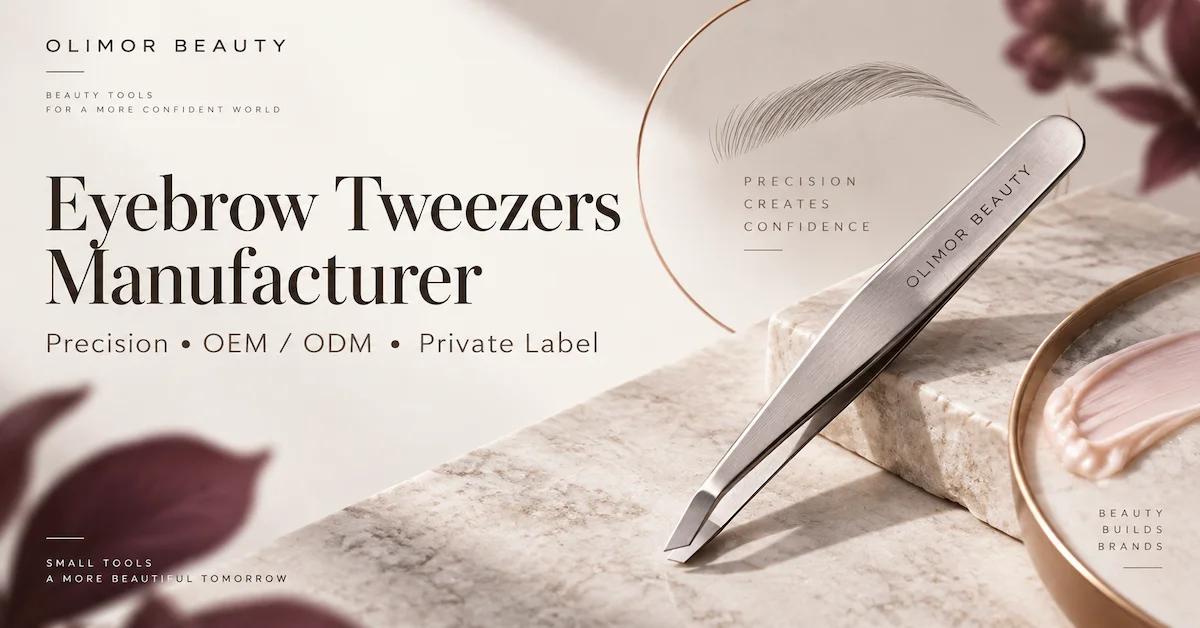
Eyebrow tweezers are small tools, but their manufacturing quality has a direct influence on customer satisfaction. A tweezer that looks elegant in a photograph may perform poorly when its tips fail to meet correctly, when the gripping surfaces slip, or when the user must apply excessive pressure. These problems become especially expensive when hundreds or thousands of products carry the same private-label brand.
For beauty brands, importers, salon distributors, and e-commerce sellers, sourcing eyebrow tweezers is therefore not simply a matter of selecting a metal finish and requesting a wholesale price. It involves understanding how the tool will be used, selecting a suitable working-tip profile, reviewing the supplier's production process, and agreeing on realistic quality acceptance criteria before bulk manufacturing begins.
This guide explains how to evaluate an eyebrow tweezers manufacturer from a professional B2B purchasing perspective. It covers product types, materials, precision requirements, inspection methods, OEM/ODM development, private-label packaging, wholesale pricing, supplier evaluation, and practical steps for requesting a more accurate quotation.
1. What Does an Eyebrow Tweezers Manufacturer Actually Provide?
An eyebrow tweezers manufacturer is a supplier involved in developing, producing, or coordinating the manufacture of precision gripping tools intended for eyebrow grooming. Depending on its business model, a manufacturer may offer established products, customized models, branded packaging, or new product development based on buyer specifications.
The central function of eyebrow tweezers is controlled contact between two working tips. When pressure is applied to the arms, the tips must meet in a predictable way and hold an individual hair during the intended movement. When pressure is released, the arms should return without permanent deformation under normal use.
Although the tool appears simple, its performance depends on several interacting factors: material properties, metal forming, tip finishing, contact geometry, arm elasticity, surface condition, and assembly consistency. Decorative coatings, logos, and packaging introduce additional requirements that should not compromise the original working function.
Manufacturers and suppliers may support different levels of customization. Some projects begin with an existing catalogue product and focus on logo printing or retail packaging. Others involve changing the working-tip design, handle geometry, finish, or overall product dimensions. A completely new development project may require additional sampling, tooling review, and performance verification.
Buyers should distinguish between the commercial promise of customization and the actual operations controlled by the supplier. It is reasonable to ask who handles forming, polishing, tip alignment, coating, inspection, and packing, and whether any of those operations are subcontracted. Clear responsibility is more valuable than an unsupported claim that every production step takes place in one factory.
OLIMOR BEAUTY presents a beauty-tool sourcing and customization business serving professional buyers and private-label projects. Its product range makes it relevant to customers seeking eyebrow tools alongside complementary grooming products. Exact manufacturing processes, order quantities, and available customization options should be confirmed for the chosen model.
2. Which Buyers Need Wholesale Eyebrow Tweezers?
Different customers evaluate eyebrow tweezers through different purchasing criteria. A professional brow artist may prioritize repeated controlled gripping, while a cosmetics retailer may focus on visual presentation, customer-friendly handling, and stable replenishment. Importers and distributors must often satisfy several downstream customer groups at the same time.
Understanding the final application before choosing a product is one of the most effective ways to reduce sourcing mistakes. A model designed for general household grooming should not automatically be promoted as suitable for every professional service environment. Similarly, a narrowly pointed tweezer intended for detailed work may not be the best first product for inexperienced retail consumers.
| Target Customer | Main Requirement | Purchasing Priority |
|---|---|---|
| Private-Label Beauty Brands | Distinctive branded grooming products | Tip quality, customization, packaging, consistency |
| Eyebrow Salons | Controlled gripping for repeated grooming tasks | Alignment, comfort, precision, suitable cleaning |
| Beauty Distributors | Reliable supply for several customer segments | Specifications, reorder consistency, product range |
| Amazon and E-commerce Sellers | Products matching advertised functionality | Quality, appearance, protective packaging, reviews |
| Retail Chains | Standardized, shelf-ready product lines | Barcode, packaging, price, stable inventory |
| Gift and Travel Kit Brands | Compact coordinated grooming products | Assortment, presentation, tip protection |
Private-label beauty brands should begin by defining their product positioning. A premium collection may require a particular surface texture, refined visual finish, and custom packaging. An entry-level grooming line may place greater emphasis on an easy-to-use slant tip and straightforward retail presentation. Both segments benefit from controlled functional quality.
Professional salon buyers should evaluate how the tool behaves in the hand during repeated use. Arm tension, closing position, handle texture, and the relationship between the working surfaces affect handling. Claims about professional suitability should be supported by the actual intended application and relevant evidence.
E-commerce sellers must consider the entire customer experience. The product should correspond to its photographs and description, the tips should arrive protected, and packaging should clearly distinguish different tip styles. A small mismatch between the listing and the delivered product may lead to avoidable complaints.
3. Slant, Pointed, Pointed-Slant and Flat Tweezers: Which Type Should You Choose?
Selecting the right tweezer tip is one of the most important decisions in wholesale eyebrow tweezer sourcing. Different tip profiles provide different access, contact areas, and handling characteristics. The best option depends on the intended user and grooming task rather than a universal ranking.
Slant Tip Eyebrow Tweezers
Slant-tip tweezers are a practical starting point for everyday eyebrow shaping. Their angled working ends offer a contact region that can be positioned against individual hairs during routine grooming.
This design is commonly considered for consumer grooming kits, beauty retail collections, and many brow-maintenance applications. However, an attractive slanted profile does not guarantee effective gripping. Buyers should examine whether the intended working region meets evenly and performs consistently.
Pointed Tip Eyebrow Tweezers
Pointed tweezers have a narrower working region and may suit selective detail tasks where controlled access is needed. Their performance is especially sensitive to the relative position of the two points.
When evaluating a pointed model, buyers should examine whether the tips meet without crossing, whether the points are appropriately finished, and whether the tool can be handled safely for the intended task. Narrow working points may be less forgiving for inexperienced users.
Pointed-Slant Tweezers
A pointed-slant design combines an angled gripping area with a more defined corner. It may offer a suitable compromise for brands that want a versatile eyebrow tool. Both the angled region and the pointed corner should be included in the functional review, rather than testing only one part of the tip.
Flat or Broad Contact Tweezers
Flat or broader-contact designs may suit selected gripping preferences and grooming applications. Their wider working region can provide a different handling feel, but may not offer the same access as a narrow point in detailed brow work.
| Tip Style | Typical Application | Key Inspection Priority | Buyer Consideration |
|---|---|---|---|
| Slant Tip | Everyday eyebrow shaping | Consistent contact along the working edge | Versatile consumer positioning |
| Pointed Tip | Selective individual-hair work | Point alignment and controlled contact | Requires careful handling |
| Pointed-Slant | Combination grooming tasks | Angled edge and pointed corner | Useful for multifunctional ranges |
| Broad / Flat Tip | Selected gripping preferences | Contact width and working position | May limit access in detailed tasks |
A practical first sourcing step is to request one suitable slant-tip sample and one detail-oriented sample, then compare them under the same conditions. Buyers should establish the intended grooming task, handling method, and acceptance criteria before drawing conclusions.
Explore the OLIMOR tweezer product collection to identify candidate models. For an eyebrow-focused product reference, see the eyebrow tweezer product page . Specifications and available variations should be confirmed directly for the selected item.
Looking for Custom Eyebrow Tweezers?
Tell OLIMOR your preferred tip style, target customer, approximate quantity, and branding requirements. Request suitable product references and sampling options before confirming a bulk order.
Discuss Your Eyebrow Tweezer Project →4. Why Tip Alignment and Gripping Precision Matter
Tweezer precision depends on the relationship between its two working surfaces. Even small differences in contact position can influence whether the tool grips an individual hair or slips during movement. These differences may be difficult to identify from ordinary product photographs.
One of the most useful checks is to observe the tool while closing it slowly. Buyers should examine where the tips first make contact, whether the contact region remains stable, and whether the arms twist or move laterally under pressure.
With slant-tip tweezers, inspect the intended gripping edge rather than assuming that every part of the angled surface must behave identically. For pointed tweezers, observe whether the two points arrive together in a controlled manner without crossing or creating an unintended sharp projection.
Functional gripping should be tested with a consistent, agreed comparison method. This might involve using the same representative material, gripping position, handling movement, and amount of force each time. The buyer and supplier should approve the procedure before it is used to accept or reject production.
Arbitrary tolerances copied from unrelated products should be avoided. A useful dimensional tolerance requires a defined measurement point, suitable equipment, and an explanation of how the measurement relates to actual product performance.
The ideal approval process combines physical inspection, functional testing, and a controlled sample. When the same inspection procedure is used during development and bulk manufacturing, misunderstandings about expected quality become easier to resolve.
5. Stainless Steel Selection and Surface Finishing
Stainless steel is a common material family used in eyebrow tweezers because it can provide a combination of corrosion resistance, structural performance, practical cleaning characteristics, and attractive appearance. However, the description "stainless steel" does not identify a particular alloy or guarantee the same result in every environment.
Different steel grades, processing methods, finishing operations, and storage conditions can produce different levels of performance. Buyers should ask the manufacturer to identify the actual material designation for the model they intend to purchase.
If the destination market requires specific material information or supporting documentation, those requirements should be included in the original purchase enquiry. Marketing terms such as "surgical grade" should not replace traceable material evidence.
Polished Stainless Steel
Polished finishes provide a classic metallic appearance often associated with personal grooming tools. The degree of polishing should be controlled so that the finished product meets the approved visual standard without compromising functional gripping surfaces.
Matte and Satin Finishes
Matte and satin finishes may suit brands seeking a more understated or contemporary presentation. Surface texture can influence appearance and handling feel, so the finished sample should be evaluated rather than relying only on a digital color reference.
Colored and Decorative Finishes
Gold-tone, rose-gold, black, and other decorative appearances may help distinguish a private-label collection. The available process depends on the selected product platform and manufacturing route. Buyers should confirm coating feasibility, color consistency, surface durability, and whether the treatment affects the working ends.
Decorative finishing and gripping performance should be evaluated together. A sample that functions correctly before surface treatment may require additional checking after coating, decoration, and final packaging.
For products intended for bathrooms, professional beauty stations, or humid storage environments, discuss reasonable care instructions and appropriate corrosion-related testing. Stainless steel is not automatically rustproof under every condition, and a cosmetic grooming tool should not be described as sterile or suitable for medical use without appropriate evidence.
6. Manufacturing Workmanship and Production Consistency
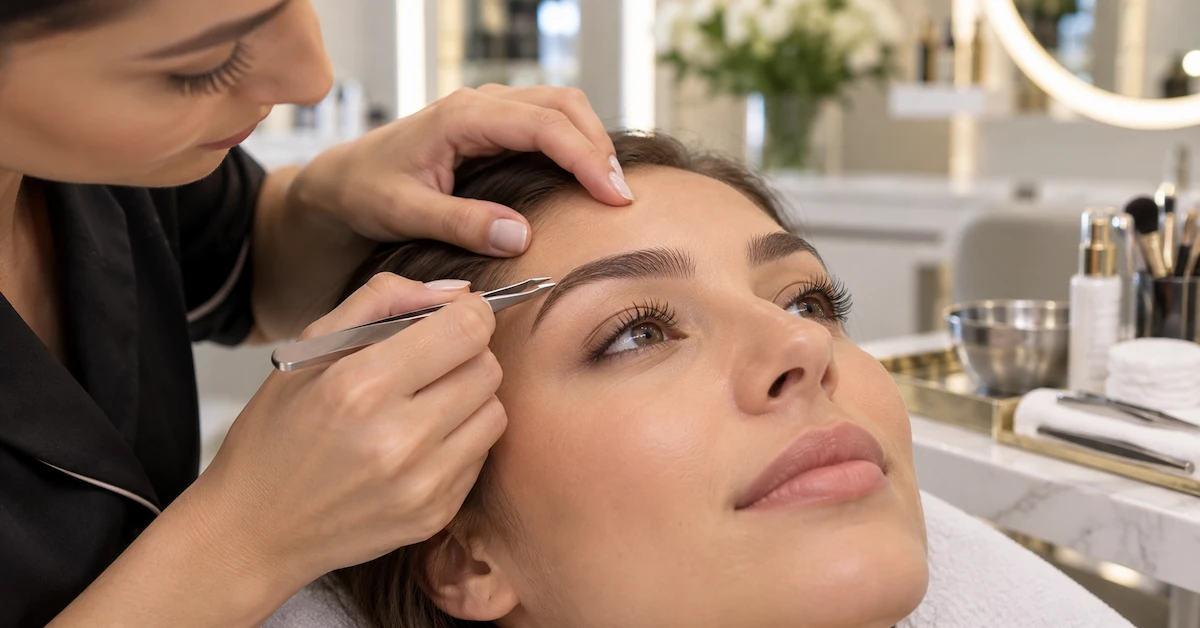
Reliable eyebrow tweezer manufacturing depends on repeatable workmanship, not simply the appearance of one successful sample. The relationship between forming, metal preparation, grinding, polishing, alignment, finishing, and final inspection determines whether production units behave like the approved reference.
A typical development program begins by selecting an existing platform or defining a new design. The manufacturer then reviews material requirements, dimensions, tip geometry, finish, branding, and packaging. Samples are produced or selected for buyer evaluation before commercial production conditions are finalized.
Critical production operations should be reviewed according to their potential effect on gripping performance. For example, working-tip preparation can influence contact quality, while finishing or packaging operations may introduce physical damage if the tool is not handled correctly.
Buyers should ask which operations are considered critical to the approved product specification and where inspections occur in the manufacturing sequence. It is useful to know whether the final functional test takes place before or after decorative finishing and packaging.
A strong manufacturing specification should identify the product model, version, material, dimensions, working-tip geometry, appearance reference, branding artwork, packaging configuration, and inspection procedure. Whenever a specification changes, the revised version should be approved before it replaces the previous one.
Repeat orders deserve the same attention as the first shipment. Buyers should retain a coded master sample and written records of any agreed alterations. This helps prevent a later production batch from drifting away from the original customer-approved product.
7. Quality Control Checklist for Bulk Eyebrow Tweezers
Quality control is one of the most important factors when selecting an eyebrow tweezers manufacturer. A sample that performs well does not prove that every subsequent unit will meet the same standard. Buyers and suppliers need a practical inspection plan covering both appearance and function.
The inspection method should reflect the intended use and the actual approved design. It should also distinguish between defects that prevent normal gripping, defects that could create unsafe handling conditions, and minor cosmetic variations that do not affect the agreed function.
| Inspection Item | Suggested Check | Purchasing Value |
|---|---|---|
| Tip Geometry | Compare with approved sample or drawing | Confirms correct product design |
| Tip Alignment | Observe both working ends during closure | Identifies offset or crossing tips |
| Gripping Performance | Use an agreed functional comparison method | Reduces slipping-related complaints |
| Arm Tension | Evaluate closing action and return behavior | Improves handling consistency |
| Surface Finish | Inspect coating, color, marks and visible defects | Supports consistent product appearance |
| Working Edges | Inspect unintended burrs and damaged areas | Supports safe, controlled handling |
| Logo | Verify placement, size, clarity and artwork | Protects private-label presentation |
| Packaging | Check protectors, contents, labels and cartons | Reduces shipping and retail problems |
The listed checks form a suggested buyer inspection framework, not a claim that every supplier uses an identical process. Testing equipment, sample quantity, allowable tolerances, and acceptance rules should be agreed for the actual product before production begins.
A critical question is what happens when a production lot fails an agreed inspection. The buyer should understand how affected products are identified, separated, reviewed, corrected, and rechecked. Written responsibility for nonconforming products can prevent disputes at the shipment stage.
Where statistical sampling is appropriate, define the inspection lot, sampling approach, defect classification, and acceptance conditions. Do not use a generic inspection percentage without considering the nature and consequences of each possible defect.
Need Consistent Quality for Wholesale Orders?
Discuss tip alignment, working samples, inspection requirements, finishing, and packaging with OLIMOR before production.
Ask About Samples and Quality Requirements →8. OEM, ODM and Private Label Eyebrow Tweezers
Custom manufacturing can help beauty brands distinguish their products in competitive retail markets. However, the right development route depends on the buyer's starting point, design expectations, quantity, budget, and project schedule.
OEM Eyebrow Tweezers
Original Equipment Manufacturing is commonly used when a buyer provides defined product requirements, a drawing, a reference sample, or a detailed specification. The manufacturing partner evaluates feasibility and works toward reproducing the agreed design and performance.
OEM projects can offer greater control over product identity but may require additional design review, tooling discussion, sample iterations, and technical approvals. Buyers should clarify intellectual-property arrangements, tooling ownership, and responsibilities for modifications.
ODM Eyebrow Tweezers
Original Design Manufacturing generally begins with a supplier-developed or adaptable product platform. Buyers select an appropriate model and discuss modifications to dimensions, appearance, or other approved features.
This approach may reduce certain development tasks, particularly when an established design already satisfies the intended grooming application. Nevertheless, any change affecting the working tips, material, coating, or handle behavior should be evaluated on the revised finished sample.
Private Label Eyebrow Tweezers
Private labeling usually emphasizes branding an existing or adapted product with a custom logo, coordinated color, retail packaging, or branded grooming set. It can be appropriate for cosmetics brands, e-commerce sellers, salon retail programs, and distributors establishing their own product lines.
A standard model with well-designed packaging may be more commercially effective than an expensive redesign that offers no clear benefit to the user. Product differentiation should support a meaningful customer promise rather than simply increasing manufacturing complexity.
| Manufacturing Route | Starting Point | Main Advantage | Buyer Responsibility |
|---|---|---|---|
| OEM | Buyer-defined design or reference | Greater control over specifications | Detailed technical approval |
| ODM | Adaptable supplier platform | Balances customization and development effort | Approval of every agreed change |
| Private Label | Existing model with brand customization | Streamlined branded product development | Logo, appearance, function and pack approval |
OLIMOR provides beauty-tool product references and OEM/ODM sourcing information for international buyers. To understand the broader project workflow, review its OEM beauty tools manufacturing guide . Current customization feasibility, minimum quantities, development charges, and lead times should be confirmed for each project.
9. Why Packaging Matters for Precision Eyebrow Tweezers
Packaging performs more than a marketing function. It also protects the tool's working ends during storage, transportation, retail handling, and delivery to the final customer.
Improper packaging may allow the tweezer points to contact surrounding objects or experience unnecessary pressure. A product that passed inspection before packing may arrive damaged if its tips are inadequately protected.
For retail presentation, buyers may evaluate protective caps, sleeves, pouches, display cards, individual cartons, or reusable cases. The correct choice depends on the shape of the tool, distribution channel, target price position, and expected customer experience.
Packaging also supports product identification. Clear labeling should distinguish tip styles, colors, and product variants. Barcodes, instructions, material information, and other markings should match the requirements of the intended sales market.
When eyebrow tweezers are combined with eyebrow razors , beauty scissors , or other grooming tools, the entire set should be checked as a finished retail unit.
A coordinated beauty set can create additional retail value, but the included products need separate functional approval. The packaging should prevent the components from damaging one another during transportation.
10. What Determines Wholesale Eyebrow Tweezer Prices and MOQ?
Wholesale eyebrow tweezer pricing depends on the complete product specification.A standard model with simple packaging cannot be compared directly with a customized design requiring special tip finishing, decorative coating, branding, accessories, and a complex gift box.
Material selection, manufacturing complexity, product dimensions, surface treatment, order quantities, customization, inspection requirements, and packaging all influence the commercial offer.
Minimum Order Quantity, or MOQ, may also vary by product configuration. The minimum for a standard existing model may differ from the minimum for a custom color, branded packaging, or newly developed tip design.
| Cost Factor | Possible Price Influence | What Buyers Should Confirm |
|---|---|---|
| Material | Different metal specifications and processing | Exact material designation |
| Tip Design | Working geometry and finishing requirements | Approved functional specification |
| Coating | Color matching and finishing processes | Sample and finish consistency |
| Logo | Marking method, setup and artwork | Position, appearance and durability |
| Packaging | Retail box, insert, protector and printing | Complete packed unit cost |
| Quantity | Production setup and purchasing efficiency | MOQ by SKU and quantity tier |
| Inspection | Agreed tests and documentation | Acceptance method and responsibility |
| Shipping | Freight, destination and delivery terms | Incoterm and quotation scope |
A useful wholesale quotation should identify the exact product model, tip type, material, finish, branding method, packaging specification, order quantity, sample conditions, delivery basis, and quotation validity.
Ask suppliers to quote several meaningful quantity ranges for the same configuration. This makes it easier to understand the relationship between order volume and unit cost without confusing price changes caused by different product specifications.
Buyers should also confirm when the quoted production lead time begins. Some schedules depend on final sample approval, payment, materials, or packaging artwork confirmation. Delivery planning should distinguish production time from inspection and transportation.
The lowest quoted price is not always the lowest total purchasing cost. Functional defects, inconsistent branding, packaging damage, customer returns, and emergency replacement orders can create significant additional expense. The actual financial impact depends on the sales channel, order size, and defect severity.
11. How to Evaluate an Eyebrow Tweezers Manufacturer Before Placing a Bulk Order
Supplier evaluation should focus on verifiable information rather than broad promotional claims. A professional buyer needs to understand the proposed product, the manufacturing arrangement, the quality-control process, and the supplier's ability to communicate and manage changes.
Begin by confirming the company's legal identity, contact information, product range, and relevant business experience. Then request documentation directly related to the proposed eyebrow tweezer rather than assuming that general company information proves every product claim.
The OLIMOR BEAUTY company information provides background on the supplier and its beauty-tool business. Buyers should follow up with specific questions about the models, processes, documentation, and service conditions that matter to their own purchase.
Verify Product Samples
Review actual finished products, not only digital photographs. Samples should represent the proposed material, tip geometry, finishing, branding, and packaging wherever practical.
Review Manufacturing Responsibilities
Ask which operations are performed or managed by the supplier, how critical subcontracted work is controlled, and how product changes are communicated. The buyer should know who is responsible for final acceptance.
Discuss Quality Evidence
Request an explanation of functional inspections, appearance checks, production records, and nonconforming-product handling. Any required certificate should be checked for holder, validity, scope, and relevance to the actual order.
Confirm Commercial Terms
Compare quotations using the same specification. Confirm quantities, customization charges, sampling requirements, payment milestones, production schedule, packaging, and delivery responsibilities.
Evaluate Communication and Change Control
Clear communication is an important part of supply-chain management. A supplier should distinguish between confirmed capabilities and requirements still awaiting feasibility review. Product versions should remain consistent across quotation, samples, purchase orders, and repeat production.
12. How to Request an Accurate Eyebrow Tweezer Quotation
A detailed Request for Quotation, or RFQ, helps the manufacturer understand exactly what the buyer needs. It also makes offers from different suppliers easier to compare because each quotation refers to the same intended product.
Begin with the intended customer and application. Identify the preferred working-tip style, product reference, material requirements, finish, branding, packaging, quantities, destination market, and proposed launch period.
If particular details are not yet decided, identify them as open questions and request recommendations. This is more useful than leaving the entire specification undefined.
| RFQ Information | Details to Provide |
|---|---|
| Product Application | Everyday eyebrow grooming, professional use, retail or kit |
| Tip Style | Slant, pointed, pointed-slant or reference sample |
| Material | Preferred specification or request for alternatives |
| Finish | Polished, satin, matte or requested color |
| Branding | Logo artwork, location and marking preference |
| Packaging | Protector, pouch, retail card, box or set |
| Order Quantity | Trial volume and expected bulk quantities |
| Quality Requirements | Functional tests, appearance and acceptance criteria |
| Destination | Country and preferred shipping terms |
| Schedule | Sample deadline and planned product launch |
For example, a private-label buyer could write: "We are developing a stainless steel slant-tip eyebrow tweezer for retail customers in our target market. Please recommend a suitable existing model and provide quotation options for our planned quantity ranges. We require custom branding, protective packaging, product specifications, sample information, and an explanation of functional inspection."
This approach gives the supplier a practical basis for recommending products, reviewing customization feasibility, and preparing an accurate commercial response.
Buyers can begin with the OLIMOR eyebrow tweezer category and submit their requirements through the OLIMOR contact page . Including a reference model or product image can help make the enquiry more specific.
Ready to Source OEM or Private Label Eyebrow Tweezers?
Send OLIMOR your target tip design, application, quantity range, finish, logo, packaging, and destination market. Request samples, customization information, and a quotation based on your actual product specification.
Send Your Eyebrow Tweezer RFQ →Frequently Asked Questions About Eyebrow Tweezers Manufacturing
1. How do I choose a reliable eyebrow tweezers manufacturer?
Evaluate the supplier's product options, working samples, material information, tip alignment, manufacturing responsibilities, customization process, inspection methods, packaging, and commercial terms. Compare approved products and documented requirements rather than relying only on catalogue photographs.
2. Which eyebrow tweezers are better: slant or pointed?
Slant-tip tweezers are commonly selected for everyday brow grooming, while pointed tweezers may suit selective detail work. Neither is universally superior. The appropriate choice depends on the intended task, user experience, tip alignment, and verified gripping performance.
3. Can I order private-label eyebrow tweezers with my logo?
Private-label customization may include a brand logo, selected surface finish, color, retail packaging, or coordinated product set. Available methods and minimum quantities depend on the selected model and project requirements. Approve an actual branded sample before bulk production.
4. What material is commonly used for eyebrow tweezers?
Stainless steel is a common material family used for eyebrow grooming tools. However, material properties vary among grades and processing conditions. Ask the supplier for the specific material designation and relevant documentation when required.
5. What is the minimum order quantity for OEM eyebrow tweezers?
There is no universal MOQ for eyebrow tweezers.Minimum quantities can vary according to product model, tip geometry, finish, branding, packaging, tooling, and the number of separate product variants. Request a configuration-specific MOQ from the manufacturer.
6. How long does bulk eyebrow tweezer production take?
Lead time depends on sampling, product changes, materials, tooling where applicable, finishing, packaging, production scheduling, inspection, and shipment arrangements. Ask for a milestone schedule and clarify when the quoted production period begins.
7. Why do some eyebrow tweezers fail to grip fine hairs?
Possible causes include unsuitable tip geometry, lateral misalignment, uneven contact surfaces, inconsistent edge preparation, or differences in handling. Reproduce the issue using a consistent test before determining whether the design or manufacturing process requires adjustment.
8. What quality inspections are important for bulk tweezers?
Important checks include tip identity, alignment, gripping function, closing action, surface finish, unintended burrs, logo appearance, packaging protection, labeling, and product quantity. Acceptance rules should be defined before manufacturing.
9. Can eyebrow tweezers be included in customized beauty kits?
Yes. Eyebrow tweezers may be combined with complementary grooming tools such as eyebrow razors, beauty scissors, and selected manicure accessories. Each component and the completed package should be evaluated for suitability, functionality, and safe transportation.
10. Does stainless steel mean eyebrow tweezers never rust?
No. Corrosion resistance depends on the specific alloy, manufacturing processes, finish, cleaning practices, and environmental exposure. Avoid unconditional rustproof claims and request suitable product-specific evidence where corrosion performance matters.
11. Is an approved sample enough to guarantee repeat-order quality?
An approved sample provides an important reference, but it should be supported by written specifications, agreed inspection methods, packaging requirements, and change control. Repeat orders should reference the current approved product version.
12. What should I send OLIMOR when requesting a quotation?
Provide the intended application, preferred tip style, product reference, estimated quantities, target market, material or finish preference, logo, packaging requirements, and expected timeline. Use the OLIMOR contact page for a model-specific enquiry.
Conclusion
Choosing an eyebrow tweezers manufacturer requires more than comparing catalogue designs and wholesale prices. The most important purchasing question is whether the supplier can help deliver a product that performs reliably for its intended user and remains consistent across manufacturing batches.
Tip geometry, alignment, gripping performance, material selection, surface finishing, arm tension, and protective packaging all contribute to the final customer experience. OEM and private-label development can create valuable brand differentiation, but customization should never replace functional verification or clear production specifications.
For importers, beauty brands, salon distributors, and retail buyers, a sound sourcing process begins with a clearly defined application. It continues through sample evaluation, confirmed product specifications, quality acceptance criteria, branding approval, packaging review, and an accurate commercial quotation. Maintaining these references also supports more reliable repeat orders.
Explore the OLIMOR BEAUTY eyebrow tweezer collection to review potential product options. Learn more about the supplier through its company information and contact OLIMOR BEAUTY with your preferred tip design, target quantity, destination market, branding requirements, and packaging expectations to discuss a suitable OEM, ODM, or private-label project.
Tag:
Related articles
- Lash & Brow Tools
- OEM & Private Label
Eyelash Tweezers Manufacturer: How Lash Brands Evaluate Tip Precision, OEM Samples, and Bulk Quality
- Lash & Brow Tools
- OEM & Private Label
Custom Tweezers Manufacturer: How Beauty Brands Build a Retail-Ready Product Range
- Lash & Brow Tools
- OEM & Private Label Solutions