
An OEM beauty tools manufacturer is most useful when it can turn a buyer's idea, drawing or physical reference into a product that can be sampled, inspected and repeated in production. For a brand owner, importer or distributor, that means defining the working geometry, material, finish, branding and packaging before treating a quotation as final. OLIMOR BEAUTY supports OEM and ODM discussions across beauty and personal-care tools, including nail clippers, tweezers, eyelash curlers, cuticle tools, beauty scissors, manicure products and related categories shown in the OLIMOR BEAUTY product range.
The buying question is therefore not simply, “Can this factory put my logo on a product?” A stronger question is, “Can the supplier understand what cannot change, develop a representative sample, explain how it will be checked and keep the approved result consistent when the order moves into production?” That distinction matters when a private-label program contains several SKUs, finishes or packaging formats.
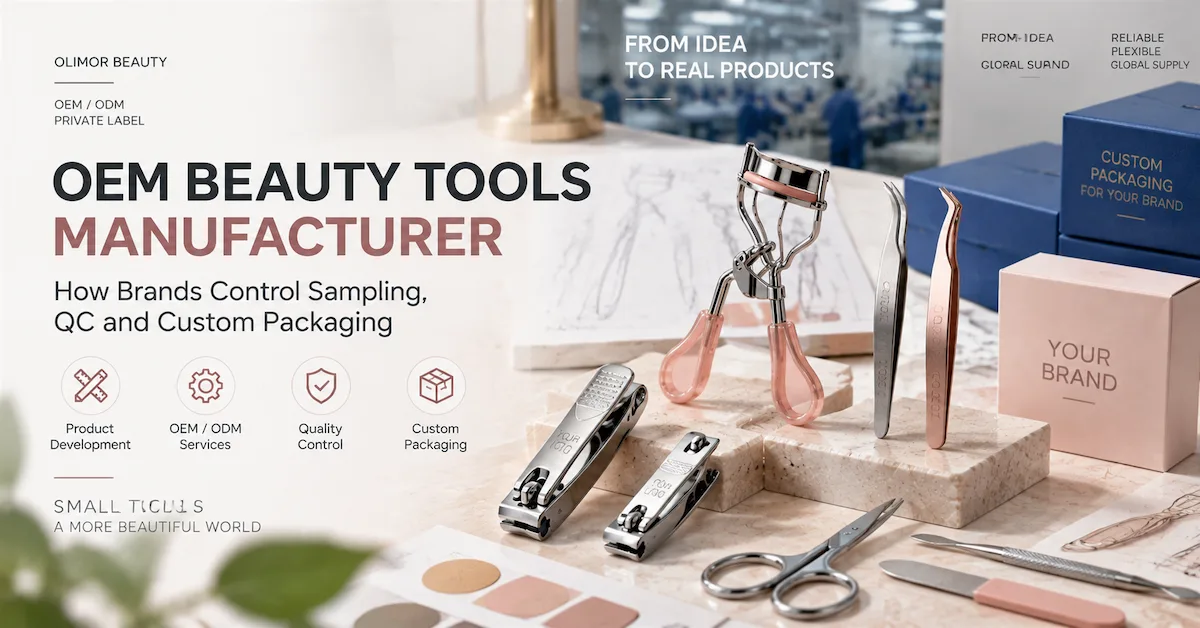
What Should an OEM Beauty Tools Manufacturer Actually Control?
A capable OEM beauty tools manufacturer should be able to connect commercial requirements with product-level decisions. If a buyer says only “I need premium tweezers,” too many variables remain open. The tip geometry, closing contact, body shape, finish, logo position, package and target sales channel can all affect the final result. The same problem applies to nail clippers, eyelash curlers and manicure sets.
A practical supplier review therefore starts with evidence connected to the exact item under discussion.
| Buyer requirement | What should be clarified before approval |
|---|---|
| Product function | Intended grooming task and target user |
| Geometry | Tip, blade, frame, hinge, handle or other critical structure |
| Material | Material by relevant component rather than one category-wide claim |
| Finish | Polish, coating, colour,texture or decoration for the selected SKU |
| Branding | Logo method,position, artwork version and acceptable appearance |
| Packaging | Primary package, insert, accessories, pack count and carton requirements |
| Quality control | Product-specific functional and appearance checkpoints |
| Commercial terms | Configuration-specific MOQ, sampling, tooling and production assumptions |
This approach also helps procurement teams compare suppliers fairly. Two quotations are not genuinely comparable if one is based on an existing catalogue item and another includes a changed tip, custom finish and printed retail box.
Start with a Product Brief, Not a Screenshot
Many OEM inquiries start with a photograph and “Please quote.” A photograph is useful for identifying style, but it rarely defines what the factory is expected to reproduce. A product brief does not need to be complicated. It needs to make the important decisions visible.
The buyer should identify the product category, target user, intended use, destination market, approximate quantity range, desired material or material preference, important dimensions, colour and finish, logo requirements and packaging concept. If some decisions have not yet been made, mark them as open rather than guessing. That gives the factory room to propose an option without treating the proposal as an approved specification.
For example, a request for a brow tweezer should state whether the desired working end is slanted, pointed or another geometry. A lash-tool inquiry should explain the intended operation rather than simply saying “eyelash tweezer.” A nail clipper brief should clarify whether it is a single retail product, part of a manicure set, a catcher design or another defined configuration.
The goal is not to write an engineering document before contacting the supplier. It is to prevent the most important assumptions from remaining invisible.
OEM, ODM and Private Label Are Different Development Routes
An OEM project generally starts with more buyer-defined information.The buyer may provide a drawing, physical sample, dimensions, structure or other product requirements and ask the manufacturer to reproduce or develop against that reference.
An ODM beauty tools manufacturer may instead start from an existing product platform and help the buyer adapt it through approved changes such as appearance, finish, colour, selected structure, accessories or packaging. This route can be useful when a brand knows the commercial result it wants but has not fully designed the product.
Private label sits across both approaches. A brand may private-label a largely standard tool with custom branding and packaging, or develop a more extensive OEM product with its own structure. A custom beauty tools manufacturer should therefore explain which requested features are standard options, which require process adjustment and which may require new tooling or development.
| Development route | Typical starting point | Main buyer responsibility | Main supplier discussion |
|---|---|---|---|
| Standard private label | Existing product platform | Brand, artwork, packaging direction | Available model and customization scope |
| ODM adaptation | Existing platform plus modifications | Target user and required differences | Feasibility,sample changes and approval |
| OEM development | Drawing, sample or detailed requirement | Product definition and approval criteria | Development route and repeatable production |
| Multi-SKU collection | Several coordinated products | Range architecture and brand consistency | Per-SKU specification plus shared visual rules |
There is no need to force every project into one label. What matters is that both sides agree on which elements are already fixed and which are still being developed.
Product-Specific Engineering Matters More Than Generic “High Quality”
A buyer should expect an OEM beauty tools manufacturer to discuss different product families differently. A nail clipper does not use the same acceptance logic as a tweezer, and a tweezer cannot be evaluated with the same functional checklist as an eyelash curler.
Nail Clippers
For nail clippers, the useful discussion starts with the cutting system: blade meeting, lever movement, opening, handle configuration and any catcher or accessory. OLIMOR's supplied catalogue includes different clipper configurations and different material descriptions, including carbon-steel references and zinc-alloy handle series. That is exactly why material should be confirmed by SKU and component instead of assuming that every clipper uses the same construction.
If heat treatment or hardness is relevant to the selected design, ask which part receives the treatment and what requirement applies to the approved model. A generic statement such as “hard steel” is less useful than a model-specific material and inspection record.
Tweezers and Lash Tweezers
For tweezers, tip geometry and the relationship between both working ends are central. OLIMOR's catalogue presents slanted, flat, pointed and lash-oriented designs, as well as different decorative and surface options. A buyer should therefore define the intended gripping task first and review contact, alignment and hand feel against that use.
Colour and decoration matter for a private-label range, but appearance should not hide functional variation.A rose-gold finish does not prove that two tweezer models have the same tip, pressure or application.
Eyelash Curlers
An eyelash curler should be reviewed as a combination of frame, curvature, hinge, pad and handle. Changing one component can affect the way the complete tool operates. Buyers should confirm the actual frame and pad combination during sampling rather than approving the frame image and assuming every pad configuration behaves identically.
Cuticle Nippers and Beauty Scissors
Cuticle nippers and scissors rely on cutting-edge contact, joint movement and handling. The buyer should record the approved geometry and expected movement rather than use “sharp” as the complete quality specification. Where the product is sold into professional channels, sample evaluation should reflect the intended task.
Manicure and Grooming Sets
A set creates another layer of control because each tool must be approved individually and then approved again as part of the complete assortment. Tool count, insert position, case closure, branding consistency and package contents become part of the specification.
Materials and Finishes Should Be Confirmed at SKU Level
An OEM beauty project becomes risky when category descriptions turn into blanket material claims. OLIMOR's product materials show why this matters: different metal tools can use different material constructions, while plastic components, handles, pads and accessories add another group of material decisions.
When a supplier proposes stainless steel, carbon steel, zinc alloy or a plastic component, ask which part of the selected SKU the description refers to. The quotation, sample record and eventual product copy should all use the same terminology.
Finish needs the same discipline. The 2026 catalogue shows multiple tweezer surface and appearance directions, including polished and coloured treatments. These examples can support design discussions, but the selected finish still needs model-level confirmation. A finish available for one shape should not automatically be promised across an entire product family.
For brands developing custom logo beauty tools, it is also worth separating functional approval from decoration approval. The logo can look correct while the working end is wrong, and the product can function correctly while the artwork position needs revision. Keeping those decisions separate makes re-sampling easier to manage.
Connect the Specification to the Real Manufacturing Route
OLIMOR's company information describes a production setup that includes metal stamping equipment, cutting-edge heat-treatment equipment, polishing and grinding, water deburring, injection moulding, assembly lines, torque and hardness testing equipment and packaging equipment. More information about the company and manufacturing background is available on the OLIMOR About Us page.
Those capabilities should not be converted into one universal process diagram for every product. The useful question is which operations apply to the SKU being quoted.
A metal tweezer may require forming, tip preparation, surface processing and final alignment checks. A clipper may involve forming, treatment of relevant cutting components, grinding or polishing and assembly. An eyelash curler has different frame, hinge, pad and assembly considerations. A tool with an injected handle introduces plastic moulding and fit requirements.
This is one area where a beauty tools OEM factory can create real value: not by presenting the longest equipment list, but by showing how the selected product moves through the relevant operations and where important deviations are checked.
Quality Control Should Describe What Is Actually Checked
A strong OEM beauty tools manufacturer should be able to move beyond “strict QC.” OLIMOR's provided company materials describe production-process inspection and finished-product or shipment inspection, together with torque and hardness testing equipment. For a buyer, the next step is to connect those capabilities with the selected product.
| Product family | Critical points worth defining | Useful approval evidence |
|---|---|---|
| Nail clipper | Blade meeting, lever action, relevant material/finish, assembly | Approved sample plus functional checklist |
| Tweezer | Tip geometry, contact, alignment, pressure, surface | Tip reference plus sample comparison |
| Eyelash curler | Frame, hinge, pad location,handle movement | Approved frame-and-pad sample |
| Cuticle nipper | Cutting edge, joint movement, handle control | Functional sample and inspection points |
| Manicure set | Individual tools, contents, insert and case | Complete packed sample |
| Decorated tool | Colour, coating, logo position and appearance | Signed decoration reference |
Incoming components, first-piece approval, in-process checks, final product checks and shipment checks can form a useful control sequence. The wording should remain product-specific. “Check tweezer tip alignment against approved sample” is clearer than “professional inspection.”
Where ISO or BSCI documentation is provided, buyers should review the current document itself, including its holder, site, scope and date, rather than treating a catalogue logo as proof of every product claim.
Sampling Is Where the Product Becomes Real
Sampling is not simply a sales step. It is the stage where the buyer's brief becomes a physical reference that production can follow. A sample review should therefore answer more than “Do I like it?”
First examine function and geometry. Then review appearance, branding and package fit. Record what has been accepted and what remains open. A useful approval note might state that the working end and silver finish are approved while the logo position and box insert still require revision.
Version control becomes especially important when several products are being developed together. The drawing, artwork, sample and packaging should be identifiable by date or revision. If the tip, blade, hinge, pad, handle, coating or package changes later, both buyer and supplier should be able to see whether the earlier approval still applies.
This sounds procedural, but it saves time. Most confusion occurs not because there was no sample, but because different teams later refer to different versions of “the approved sample.”
Custom Packaging Is Part of Product Development
A beauty tools custom packaging manufacturer should treat packaging as more than a printed box. For a pointed tweezer, packaging needs to protect the working end. A nail clipper should not move in a way that damages its finish or leaves the cutting mechanism exposed. An eyelash curler should be packed so that its frame and pad are not unnecessarily compressed.
OLIMOR's catalogue displays packaging examples such as blister cards, paper boxes and PET bags for selected products. Buyers can use these as starting points, then confirm availability and suitability for the chosen SKU through the OLIMOR product catalogue and product range.
Brand owners should confirm the final artwork version, logo position, product name, barcode area, pack count and any market-specific information they are responsible for supplying. A digital dieline alone should not close the approval. The complete packed sample is what shows whether the product and packaging actually work together.
MOQ, Cost and Lead Time Should Follow the Configuration
One of the weakest sourcing questions is “What is your MOQ?” without identifying the exact product configuration. A stock model with existing packaging is not the same commercial project as a new colour, custom logo, revised metal geometry and printed gift box.
The same applies to cost. Buyers should separate recurring unit cost from any sample, tooling, decoration, packaging or setup items that apply to the project. Otherwise, two quotations can appear different simply because each supplier has included different work.
Lead time should also be linked to the development route. Sampling, tooling, finish development, artwork approval, component sourcing and final packaging can change the schedule. Rather than publishing or relying on one universal figure, ask the supplier to confirm timing against the approved SKU, quantity and customization scope.
For a repeat program, this information becomes even more useful because replenishment can then be compared with the original development order instead of starting from zero.
How Should Buyers Compare Two OEM Suppliers?
A sourcing team comparing one OEM beauty tools manufacturer with another should use the same product definition for both. Price matters, but price becomes meaningful only after the underlying configuration is comparable.
| Evaluation area | What a strong response looks like |
|---|---|
| Product understanding | Supplier identifies intended use and critical product features |
| Manufacturing fit | Relevant process route can be explained |
| Sampling | Approval stages and open decisions are clear |
| QC | Checks are tied to the selected SKU rather than generic slogans |
| OEM capability | Supplier distinguishes standard changes from new development |
| Packaging | Product protection and branding are considered together |
| Commercial clarity | MOQ, development cost and timing assumptions are visible |
| Repeatability | Supplier explains how the approved result is carried into production |
| Communication | Questions and changes are documented rather than lost in messages |
A large catalogue is useful, but it is not enough by itself. Likewise, a factory visit is valuable only when buyers know what evidence they are trying to verify. The manufacturing route, samples, QC records and change-control process usually tell more about project fit than a showroom display alone.
Where OLIMOR Fits into an OEM Beauty Tools Project
OLIMOR BEAUTY's supplied company information describes an integrated beauty-tool development and export business supporting OEM and ODM, product development, production, quality inspection and export services. Its listed product scope includes manicure sets, eyelash curlers, nail clippers, cuticle nippers, tweezers, lash tweezers, beauty scissors, tongue scrapers, eyebrow razors, nail files and related beauty and grooming products.
For buyers looking for an OEM beauty tools manufacturer, the useful value of that range is the ability to discuss several related product categories within one development program while still keeping each SKU's technical specification separate. A coordinated collection may share finish, colour, logo style and packaging language, but a tweezer tip, nail clipper cutting system and eyelash-curler frame still require different approvals.
Company materials also describe both metal and plastic processing capabilities and international export activity. These are useful starting points for a supplier review, but buyers should still confirm the exact manufacturing route, material specification, current documentation, MOQ and production terms that apply to their project rather than assuming every catalogue item follows identical conditions.
What Should You Send with Your First OEM Inquiry?
A useful inquiry gives the supplier enough information to recommend a realistic route without forcing the buyer to solve every engineering question in advance. Include the product category and intended user, a reference image, physical sample or drawing where available, preferred material or finish, logo idea, package concept, expected quantity range, destination market and target launch timing. Clearly separate requirements that cannot change from features where you want the supplier to recommend an option.
If you are planning several products, send a simple SKU matrix showing which visual elements should remain consistent across the collection and which specifications must be reviewed independently. That helps an OEM supplier coordinate the range without treating one product's material or geometry as the standard for everything else.
You can review OLIMOR's beauty tools product range before preparing the brief, then contact OLIMOR BEAUTY with your target category, references, estimated quantity and customization requirements.
FAQ About OEM Beauty Tools Manufacturing
What does an OEM beauty tools manufacturer do?
An OEM beauty tools manufacturer turns buyer-defined product requirements, drawings, samples or specifications into an approved product and repeatable production process. Depending on the project, the work can include product development, material and structure confirmation, sampling, manufacturing, branding, packaging and quality inspection.
What is the difference between an OEM and ODM beauty tools manufacturer?
OEM normally starts with more buyer-defined design requirements, while ODM typically uses an existing manufacturing platform or supplier-developed design as the starting point. In practice, many beauty-tool projects combine the two approaches, so the important step is to document which product elements are fixed and which are open to supplier development.
Does OLIMOR support OEM and ODM projects?
Yes.OLIMOR's supplied company information states that both OEM and ODM are supported and that development can start from customer drawings, samples, appearance concepts or structural requirements. The exact feasibility and commercial conditions should be confirmed for the selected SKU.
Can I customize only the logo and packaging?
A private-label project can begin with an existing product and focus primarily on branding and packaging if the selected model supports the requested options. Logo method, finish, packaging format, artwork and MOQ should be confirmed before the order is treated as final.
Can a manufacturer develop a completely new beauty tool?
A buyer can submit a drawing, physical sample or concept for feasibility review. Whether new tooling, structural development or additional sampling is required depends on the product and the requested change, so it should be treated as a project-specific decision.
What should I check when approving an OEM sample?
Check the features that matter to the product's function first, followed by material, geometry, hand feel, finish, colour, branding, package fit and contents.Record the approved version and keep unresolved items visible rather than issuing a general “approved” message.
What is the MOQ for OEM beauty tools?
There should not be one universal MOQ assumed for every OEM project. The requirement can vary with the product, quantity, finish, tooling, branding and packaging. Buyers should request an MOQ for the exact quoted configuration.
How long does OEM beauty tools development take?
Timing depends on whether the project uses an existing platform, a modified ODM product or new development, as well as the number of sample revisions, tooling, surface treatment and packaging work involved. Confirm a schedule only after the development scope is clear.
What quality documents should a buyer request?
Request documents that apply to the legal entity, manufacturing site and product under consideration. Company-level ISO or audit information should be checked for current holder, scope and date, while product-specific materials and test information should be connected to the selected SKU.
Can one OEM supplier develop a complete beauty-tool collection?
A multi-category supplier may be able to coordinate several beauty and grooming tools under one brand program, but every SKU still needs its own functional and material specification. Shared colour, logo and packaging standards can create a consistent collection without pretending that every product follows the same manufacturing process.
Conclusion
Choosing an OEM beauty tools manufacturer should be a product-development decision rather than a catalogue or price decision. The strongest supplier relationship begins with a clear brief, turns that brief into a traceable sample, defines product-specific quality checkpoints, approves the complete branded package and keeps those decisions controlled when production begins.
OLIMOR BEAUTY's product range and supplied manufacturing information provide a basis for OEM and ODM discussions across multiple beauty and grooming categories. Buyers can explore OLIMOR products and submit an OEM project inquiry with the intended product, target market, reference design, customization requirements and expected quantity so that the next discussion is based on a defined product rather than a generic quotation.