


An OEM tweezers manufacturer should be able to manufacture a defined gripping result, not only a recognizable metal shape. For a beauty brand, that means agreeing on which task the tweezer performs, how its two tips meet, what closing pressure feels acceptable, how the working edges are finished, and how those characteristics will be checked in bulk production. A neat logo or rose-gold coating will not compensate for tips that slip off a hair or close at the wrong point.
The purchasing challenge is that many tweezer defects are too small to see in a catalog photograph. Two samples may look almost identical while one grips a fine brow hair predictably and the other needs extra squeezing. The difference may come from tip geometry, lateral alignment, arm stiffness, contact-surface preparation or adjustments made after finishing. A serious OEM project turns those variables into an agreed design and test plan rather than a sequence of subjective comments such as “make it sharper” or “more precise.”
This guide is written for brand product managers, professional brow and lash suppliers, importers, retailers and e-commerce buyers planning OEM beauty tweezers. It takes you from a first drawing or physical reference through design-for-manufacturing (DFM), working samples, critical-to-quality (CTQ) controls, branded packaging, pilot production and repeat orders. You can begin by reviewing the existing OLIMOR tweezer collection, then decide which features your brand must control and which can remain model-specific supplier proposals.

What Should an OEM Tweezers Manufacturer Actually Prove?
When selecting an OEM tweezers manufacturer, the clearest evidence is not a factory slogan. It is an approved tool whose performance can be described, tested and reproduced. A manufacturer should demonstrate how the buyer's design intent becomes a specification; which operations determine the working tip; where variations can enter; how a sample is approved; and which reference production inspectors will use. The same evidence should remain available when the brand reorders months later.
There are four separate approvals. Product identity covers the model, length, tip form and construction. Functional approval covers contact, grip and closing feel during the intended task. Cosmetic approval covers finish, color and logo. Packed-unit approval covers tip protection, artwork, labeling and transit contact. Combining these into one vague “sample approved” message makes later disagreements far harder to resolve.
A supplier should also be clear about the boundary between its general manufacturing capabilities and a particular model. A factory may have forming, grinding, polishing and inspection capabilities, but the selected SKU's material grade, tolerance, test frequency, coating process, production capacity and lead time still require confirmation. Treat each as a project-specific answer, not a default promise.
Start With the Intended Grip Task, Not the Tweezer Silhouette
A slant-tip eyebrow tweezer and a pointed precision tweezer serve different handling goals. A lash-oriented tool may need its own grip behavior and tip geometry. Trying to make one general-purpose tweezer satisfy every job usually creates confusing performance criteria and product claims. Write the intended task before approving a drawing.
| Intended application | What users are trying to do | Useful OEM design questions | What not to assume |
|---|---|---|---|
| Everyday eyebrow grooming | Grip an individual hair with controlled hand pressure | Slant angle, usable contact zone, arm feel, access around brow | One slant angle fits all users |
| Fine-detail brow work | Select a precise location with a smaller working area | Tip symmetry, approach angle, point finish, visual access | A sharper-looking point always grips better |
| Lash accessory handling | Control a small lash-related object in a defined workflow | Tip style, inside-surface contact, hand position and release | Every lash tweezer can be substituted for another |
| Beauty retail / travel | Offer predictable personal grooming in a compact pack | Comfortable length, tip protector, corrosion-appropriate care | Compact size guarantees professional suitability |
| Multi-tip branded set | Give buyers distinct, understandable functions | One component code and quality reference for each tip type | Different tips may share one inspection method |
These are purchasing criteria, not clinical guidance. Ordinary cosmetic tweezers should not be promoted for medical extraction, diagnosis or treatment without product-specific regulatory evidence. Similarly, an attractive fine tip does not establish that a tool is intended for every lash-extension method. The claim must follow the actual design and end user.
A one-sentence product brief makes the project easier to review: “We need a slant-tip eyebrow tweezer for a mid-priced DTC beauty collection; it should grip a fine brow hair with a controlled squeeze, fit a branded retail sleeve, and remain consistent on repeat orders.” That statement is more useful than asking for “premium stainless steel tweezers” alone.
Build a Tip-Geometry Specification That Goes Beyond a Photograph
The working tip is the part of a tweezer that makes contact with the object being gripped. Its geometry deserves more detail than the overall product outline. In an OEM drawing package, identify the tip type, working-face width, approach angle, end profile, closure plane, side-to-side symmetry and edge condition. Which dimensions are critical depends on the chosen design and task.
For slant tips, the diagonal working edges should form the intended contact pattern when closed. For pointed tips, the approach and meeting point should match the design without crossing, unintended twisting or sharp exposed burrs. For broad tips, a larger area may be useful, but uniform contact cannot be assumed from the width alone. The buyer and factory should agree what a good result looks like with the actual sample in hand.
If a drawing provides only total length and surface color, the manufacturer still has considerable freedom to change the details that control grip. A more useful specification package distinguishes controlled characteristics, supplier-proposed characteristics, and visual reference only. A physical competitor product can help communicate scale or feel, but buyers must resolve design and intellectual-property rights rather than treating a photographed item as an unrestricted copying instruction.
A disciplined design review should ask: When the arms close, where does first contact occur? Do the tips remain in the correct relative orientation? Does the intended object sit between the right surfaces? Can a user release the grip without excessive force? Does grinding or coating alter the contact zone? These questions should be answered on working samples, not guessed from CAD alone.
Use a Tip-Contact Map During Sample Approval
One useful buyer-side technique is to create a tip-contact map: a simple record of where the two working faces meet and what happens during closure. This is a proposed OEM validation method, not a claim that OLIMOR currently uses a named proprietary test. Its purpose is to replace “tips look aligned” with observable evidence.
Review the tweezer in a repeatable orientation at three conditions. First, inspect the open tips for visible symmetry and unintended edge damage. Second, close gently and observe the initial contact point. Third, apply the agreed working squeeze and observe whether contact remains in the intended zone, whether one tip slides across the other, and whether the arms twist.Record the behavior using marked sample photographs or appropriate magnification where needed.
The map should be tied to the design's application. A slant brow tweezer might need useful contact along a particular working edge; a pointed tool may be judged at a smaller contact region. There is no responsible universal contact length or gap value for every tweezer type. If your product needs dimensional limits, define them through engineering review and approved performance evidence for that SKU.
A sample can pass a simple appearance check and still fail this review. Conversely, small harmless visual differences may not matter if the tool meets the agreed contact and gripping criteria. Separating the two helps buyers avoid rejecting useful products for irrelevant reasons while missing true functional defects.
How Should an OEM Tweezers Manufacturer Evaluate Closing Force?
Closing force is one of the most misunderstood parts of tweezer quality. “Soft,” “firm” and “professional tension” may describe user impressions, but they cannot serve as complete manufacturing limits. The closing response changes with arm length, width, cross-section, material condition, body geometry and where the user squeezes.
For OEM validation, agree on a measurement method before discussing a numeric limit. Define the initial opening, where force is applied along the body, the direction of loading, the amount of closure or displacement, the measurement equipment where appropriate, and the condition of the tool (for example, before or after an agreed operation sequence). If the buyer asks for a force range without defining these factors, two teams can obtain inconsistent results from the same sample.
A practical evaluation should compare a few approved and borderline samples. Ask testers to perform the intended grip task with a consistent hand position. Document whether the tool is difficult to close, uncomfortable to hold, prone to slipping, or difficult to release. Where the project justifies quantified testing, the supplier and buyer can establish a force-displacement method and tolerance from verified samples. Do not invent a universal spring-force value and apply it to every beauty tweezer.
This also explains why thicker material or a longer arm cannot be marketed as automatically better. A design change can improve one part of the handling experience while making another less suitable. The functional sample, rather than a material adjective, should govern the approval.
Material, Surface Finish and Tip Performance Are Separate Decisions
Stainless steel is common in OLIMOR's public tweezer range, but the phrase does not identify a universal grade, heat treatment, surface condition or corrosion result. If the buyer needs a specific designation or documented performance property, include it in the RFQ and request evidence for the selected model and actual production version. Do not use a grade from an unrelated listing or assume a whole category shares one specification.
Surface finish creates another layer of control. Polished, satin, colored, coated or plated appearances can change how the tool looks, feels and is protected during packing. The coating or finishing operation may affect the working faces differently from the body. Ask the supplier whether the tips are prepared or adjusted before or after decorative finishing, and how contact is rechecked if later processing can alter it.
A logo can make the brand distinctive without affecting function, but only when placed on a suitable surface away from the critical tip and grip areas. Laser marking, engraving, printing or other methods may be discussed according to the selected substrate and finish; availability should be tested, not assumed. Approve the physical mark at actual size and under representative lighting.
Care claims also require discipline. Do not promise autoclave suitability, universal chemical resistance, antimicrobial action, or medical-grade performance merely because the body is stainless steel. A personal grooming product, a professional shared-use tool and a product proposed for a regulated application may need different documentation and instructions.
Trace the OEM Manufacturing Route and Its Sources of Variation
An OEM tweezers manufacturer may use operations such as material preparation, forming, shaping, grinding, adjustment, polishing, decoration, inspection and packaging. The actual sequence depends on the model and the supplier. A buyer's goal is not to prescribe every machine setting but to identify which operations can change the CTQs and how that variation is controlled.
Body forming and arm geometry. Shape, symmetry and stiffness can influence closing force and the location where tips meet. A dimensional change early in production can create a gripping problem that later polishing will not fix.
Tip shaping and working-face preparation. Grinding or other precision finishing establishes the contact geometry. Workmanship here may influence slippage, edge condition and consistency. Request a sample inspection point at or after this operation if it is critical to your design.
Alignment and adjustment. Some tweezer designs require controlled adjustment after shaping. Ask who is responsible, what reference they use and whether later finishing or packing can disturb the result. Avoid relying on a single technician's judgment without a shared acceptance reference.
Decorative finish and branding. Cosmetic treatments may introduce surface variation or handling damage. Compare post-finish samples with the approved functional standard, especially around the tips.
Inspection and tip protection. The finished tool should receive the relevant functional and cosmetic checks before it is placed in a sleeve, blister, case or card. Packaging that presses on or exposes the tips can damage an otherwise acceptable product before sale.
OLIMOR's company profile describes OEM support and checking orders against approved samples, material requirements and export specifications. It does not publish a universal tip-alignment tolerance or force target for all tweezer models. Those values and the associated process records belong in a model-specific approval plan.
DFM: Which Design Changes Need Engineering Review?
Design for manufacturing (DFM) is particularly important when a brand wants a unique outline or working tip. Changes that seem cosmetic on a drawing may affect forming, alignment, finishing, hand pressure and packaging.The factory should return a change-impact review before committing to a finished sample price.
A longer arm may change closing feel. A narrowed end may demand a new working-face process. A thicker grip section can alter flexibility. A new textured handle can create a different logo area. A colored coating may require different finish protection. Each change should be linked to the requirements that must be revalidated, rather than approved as an isolated design detail.
Ask the supplier to mark each change as an existing production option, an adaptation needing samples, or a new geometry that may require tooling. A true OEM proposal should expose open questions. A quick quotation that promises all changes without reviewing their effect on tip contact and body response is not enough for a dependable launch.
For a coordinated product family, decide which characteristics are common across all SKUs and which are tip-specific. Shared finish and packaging can create visual unity while each model retains its own gripping specification. Reusing one generic QC checklist across different tip types is a common shortcut worth avoiding.
OEM, ODM and Private Label: Choose the Right Level of Control
The terms overlap in commerce, but they matter during project planning. OEM is appropriate when the buyer controls meaningful geometry, performance requirements or an original reference. ODM may be appropriate when the supplier contributes an established design platform and develops selected changes. Private label focuses on the brand identity of a product, and may be used alongside an OEM or ODM arrangement.
| Development route | What the buyer typically controls | What requires confirmation | Main source of uncertainty |
|---|---|---|---|
| OEM custom tweezers | Defined tip, contour, performance reference or drawing | DFM, tooling, tolerances, inspection and design ownership | Reproducing new geometry at production scale |
| ODM adaptation | End-user task and selected changes to a supplier platform | Which features are standard, adjustable or new | Hidden dependencies of a modification |
| Private label | Logo, color/finish, packaging, selected model | Marking compatibility, physical sample and artwork | Attractive decoration on an unverified base tool |
If only the logo and retail sleeve need changing, do not assume expensive structural tooling is necessary. If the customer's experience depends on a distinct tip contact pattern or hand response, an OEM specification and validation plan may be justified. Make the trade-off explicit rather than using “OEM” as a premium-sounding synonym for “customized.”
OLIMOR's existing article on OEM versus ODM stainless steel tweezers discusses the choice of route. This article goes further into the engineering handoff and how to approve a repeatable tip-and-grip result once the OEM route has been chosen.
The Drawing-to-Sample Handoff: What Your RFQ Should Contain
An OEM RFQ should enable the manufacturer to decide what can be made, what needs further detail and what must be tested. The best drawing package distinguishes the cosmetic outline from the working surfaces. The following is an illustrative buyer-supplier document list rather than a mandatory OLIMOR form.
| RFQ input | Minimum useful information | Expected supplier response |
|---|---|---|
| Product use | Brow, lash or defined personal-care task and intended user | Appropriate model/geometry questions |
| Reference | Controlled drawing, actual sample, dimensional outline or sketch | Feasibility differences and assumptions |
| Tip definition | Slant/point/flat form, relevant contact zone, edge finish | Proposed working-face method and CTQs |
| Closing behavior | Target user feel or approved sample; test concept | Repeatable evaluation method and risks |
| Material | Model-specific requirement or a clear request for options | Confirmed material description and available evidence |
| Body/finish | Overall dimensions, arm form, surface/color direction | Process route and cosmetic acceptance plan |
| Artwork | Logo master, size, location and retail messaging | Physical proof requirements and constraints |
| Packaging | Protector, sleeve/box, barcode, target market | Pack-fit and tip-protection proposal |
| Commercial plan | Trial quantity, potential reorders, desired milestone | MOQ by configuration, timeline and itemized quote |
| IP and changes | Drawing ownership, acceptable substitutions, approval contacts | Tooling/fixture terms and revision procedure |
Do not confuse a picture of another company's product with a complete specification. If your starting point is a reference sample, identify which features are measured, which are only visual inspiration and which features you have the right to reproduce. A proper engineering conversation can reduce several rounds of needless decorative samples.
A useful supplier response contains confirmed, proposed and open fields. Avoid treating silence as approval. If the supplier cannot confirm the material grade or measurement method, the correct status is “to be established for the selected model,” not a made-up technical claim.
Four Sample Gates Before a Full Production Release
Separating sample stages helps the buyer resolve function before committing to expensive decoration and packaging. For many OEM tweezer projects, the following four gates provide a clear structure.
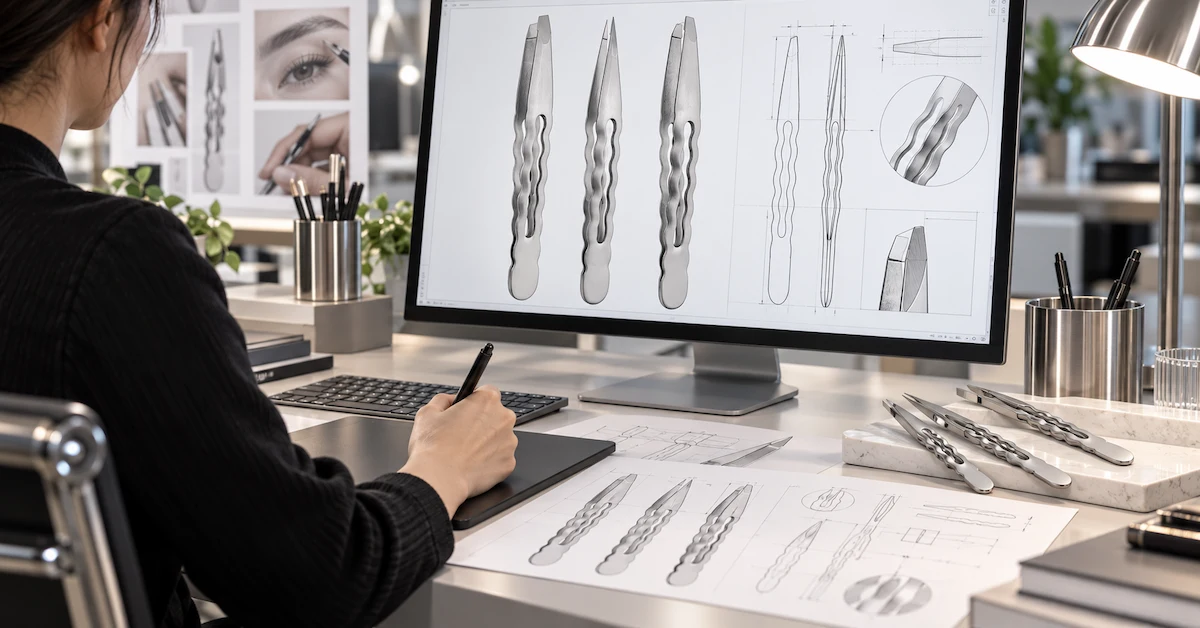
Gate 1: Geometry and function
Approve the intended tip type, initial and loaded contact, usable gripping area, closing feel and overall handling. Compare working samples in the intended task. Keep both a passing reference and clear rejection examples where appropriate. Avoid focusing on color before the working end is satisfactory.
Gate 2: Material and decorative finish
Confirm the selected material wording, finish appearance and any process that might alter the working faces. Recheck grip after finishing. A physical sample reveals glare, texture, coating contact and small cosmetic variations that a rendered mockup cannot.
Gate 3: Branded packed sample
Approve logo position, the tip protector or case, artwork, product identity, instructions, barcode and protection against rubbing or compression. A protective sleeve should not force the arms into a state that can damage the tip or change the agreed behavior during shipping.
Gate 4: Pre-production and first-piece release
Verify that early production tools, inspected with the intended procedure, match the approved reference. Record which work instructions, drawings, component codes and pack versions govern the lot. Release full production only after critical nonconformities are resolved and approvals are complete.
For each gate, write down what was approved, what remains open, who approved it and which sample or file proves the decision. One message saying “samples approved” is inadequate if the tool, finish and pack were reviewed at different times.
Define a CTQ Plan for Incoming, In-Process and Final QC
For an OEM tweezers manufacturer, a sound QC plan tests the characteristics that affect the real gripping task. It does not automatically apply the same test to every model or depend on the operator remembering what the buyer liked. The table below is a proposed validation framework; actual inspection frequencies and tolerances must be agreed for the selected SKU.
| CTQ / characteristic | Suggested production checkpoint | What inspectors should compare | Possible disposition if it fails |
|---|---|---|---|
| Material identity | Incoming material/components | Confirmed material description or required evidence | Hold suspect material for clarification |
| Arm profile and symmetry | After forming / first piece | Controlled drawing or approved geometry reference | Review setup and affected output |
| Working-tip geometry | After tip preparation | Tip type, edges, contact surfaces and approved sample | Rework or reject based on agreed criteria |
| Initial and loaded tip contact | After alignment and final finish | Contact map and task-based functional reference | Segregate nonconforming tools |
| Closing response / grip | Functional sample and lot checks | Agreed squeeze location and test behavior | Investigate spring/body variation |
| Surface and logo | After decoration / final inspection | Physical finish and marking references | Sort or correct appearance defects |
| Protector and retail pack | Pack-out | Clearance, fit, label, artwork and SKU identity | Stop packaging and fix the mismatch |
| Lot / reorder identity | Shipment release | Current revision, quantity and relevant inspection records | Hold incorrect variants before dispatch |
The severity of defects should be agreed in advance. A tweezer whose tip cannot grip the defined test object should not be treated identically to a minor appearance variation that the buyer has already accepted. If attribute sampling is used, ISO 2859-1:2026 provides a recognized framework for AQL-indexed lot-by-lot acceptance sampling. It is a sampling methodology, not a certification of OLIMOR tweezers, not proof of zero defects and not a substitute for the agreed CTQ tests.
A buyer may request additional inspection or independent verification for its target channel. The supplier should be able to explain what records are actually maintained for the proposed order instead of claiming that a generic international standard automatically proves product performance.
Diagnose Common Tweezer Failures Before You Change the Design
Customers describe symptoms, not root causes. “The tweezers keep slipping” can point to different technical problems. It is unwise to respond by polishing more, increasing pressure or changing the whole tip without first identifying what failed. A small troubleshooting matrix helps the buyer and factory communicate clearly.
| Buyer-observed symptom | Possible factor to investigate | Useful follow-up observation | Avoid this shortcut |
|---|---|---|---|
| Fine hair slips despite closure | Tip contact zone, surface or task mismatch | Compare grip across approved test samples | Assume the steel is low quality without evidence |
| Tips meet on one side only | Lateral alignment or tip geometry | Record initial and loaded contact pattern | Approve from top-view photos alone |
| Tool feels too stiff | Arm geometry, material response, squeeze position | Repeat the closing test at a defined location | Dictate a force number without a method |
| Tips cross when squeezed | Arm twist or misadjustment | Compare open, first-contact and loaded states | Treat it only as a cosmetic issue |
| New colored version grips differently | Finish or adjustment sequence | Recheck contact after finishing | Assume color can never affect function |
| Tips arrive chipped or bent | Exposed point and inadequate pack protection | Inspect post-packing and post-handling samples | Blame all defects on manufacturing rather than shipping |
This diagnostic approach creates useful project records. Instead of writing “sample 3 bad,” record the sample code, intended task, orientation, observed failure, affected tip region and whether the result differs from the reference. The factory can then evaluate geometry, finishing, adjustment or packing one issue at a time.
The buyer should not prescribe rework based only on a suspected cause. A supplier may identify a better correction after checking the actual component and production sequence. Record the proposed change and the tests that must be repeated before approval.
Protect the Tip Through Branding, Packaging and Transport
Tip protection is not just a retail presentation detail. A fine working end may be vulnerable to contact with other metal items, loose inserts, pressure or rough handling. Packaging should be evaluated using the final finished tool, not only an uncoated prototype. The question is whether the customer receives the same tip geometry that passed the sample test.
For retail card or blister-style concepts where suitable, check whether the tool is restrained without deforming the arms and whether the working end can contact the pack. For cases and pouches, test removal and replacement: customers should not scrape the tips against a zipper or rigid opening. For multi-tweezer sets, separate each tool and label its intended function clearly.
Branding options may involve product marks, colored finishes, custom sleeves, inserts or cartons, depending on the selected model. Approve a real marked sample to confirm contrast and placement. The manufacturer's proposal should indicate any restrictions imposed by surface shape or treatment. The final retail copy must reflect the actual tool: a pointed tweezer should not be depicted as a slanted model on the packaging.
If your brand is building a coordinated brow and lash collection, it may be useful to link the tweezer category with complementary eyelash curlers and eyebrow razors at the assortment-planning stage. Each product nevertheless needs its own functional approval and claims.
Match the Product to Retail, Brow Studio, Lash and Travel Buyers
B2B buyers often say they want “professional quality,” yet the term can conceal very different needs. A brow studio may prize a particular slant and reliable contact; a DTC brand may need approachable hand feel and scratch-free delivery; a lash-accessory supplier may care about a distinct working end; a retailer needs clear product identity and replenishment. Define the precise use before asking for manufacturing modifications.
For beauty retail, packaging and product photographs must describe the delivered SKU. Avoid small printed claims that cannot be tied to an approved tip or material. For e-commerce, customers can inspect images closely and review grip performance quickly, so both function and surface presentation matter. For professional buyers, task-specific geometry and appropriate cleaning or handling instructions are more important than vague promises that a tool “works for every technique.”
For travel sets, control size, tip protection and pack accessibility without making unverified universal transport claims. For multi-piece sets, supply a clear component list and avoid selling near-identical tweezers as distinct specialist tools unless there is a documented difference in intended use.
The supplier relationship is most valuable when it helps a brand avoid the wrong product position. Recommending an existing slant-tip platform for an everyday brow audience may be more responsible than engineering an unnecessarily sharp tip simply because it looks premium in a product render.
EU Retail and Quality Documentation: What Should Be Verified?
Product safety, labeling and claims depend on the destination and intended use. For consumer products on the EU market, Regulation (EU) 2023/988 (General Product Safety Regulation, GPSR) is a relevant framework, applicable from 13 December 2024. The obligations need to be assessed for the actual product, economic operators and sales context; citing the regulation does not establish that a particular tweezer has been assessed or certified.
For any export market, buyers should clarify who is responsible for product identification, traceability, relevant warnings or care information, importer details and supporting documentation. Material claims and corrosion or cleaning statements should be based on the actual selected finish and available evidence. A company-level certificate does not automatically cover every SKU or demonstrate a particular tip-grip performance result.
Avoid importing language from medical tweezers or instruments into ordinary beauty-tool marketing. Terms such as “sterile,” “medical grade,” “surgical,” “autoclavable” and “antimicrobial” can carry technical or regulatory implications. Use them only when supported for that specific product and market. An honest, clear care instruction is more valuable than an unsupported high-stakes promise.
MOQ, Tooling, Price and Lead Time: Compare Like-for-Like Quotes
A quotation from an OEM tweezers manufacturer is meaningful only when all suppliers are pricing the same design and service scope. A standard loose tweezer with no logo cannot be compared directly with a custom geometry, a plated finish, a tip protector and a printed retail box. Ask for a documented base specification and a transparent list of additions or development charges.
Potential cost drivers include the complexity of the working tip, body design, material requirements, forming or adjustment work, finishing, branding, tooling or fixtures, inspection, protective packaging and order quantity. The project may involve different minimums for metal production, a specific finish, logo processing or printed packaging. There is no verified universal MOQ or lead time across all OLIMOR tweezer models.
A useful schedule separates feasibility review, sample rounds, tooling where required, decoration approval, materials, production, QC, packing and shipment. A design change after the golden sample has been approved can reopen testing and affect the schedule. Rather than promise a launch date based on the fastest catalog item, ask which unresolved approval sits on the critical path.
When evaluating quotes, consider the commercial cost of inconsistent tips or scratched retail units. A small nominal factory-price saving can be outweighed by sorting, customer complaints or returns. It is more useful to compare cost per accepted sellable unit under a fixed specification, plus the evidence that the supplier can reproduce it.
Drawing Ownership, Tooling Rights and Engineering Change Control
A buyer bringing its own drawings or proprietary design should agree on confidentiality, tooling and intellectual-property arrangements before extensive development. OEM does not automatically mean that a buyer owns every supplier process file, fixture or historical design platform. Different elements can have different ownership and licensing terms, so record them explicitly in the agreement.
For repeat orders, create a simple engineering change procedure. Every proposed substitution should identify the reason, affected drawing or BOM, impact on tip contact and closing feel, cosmetic effect, packaging fit, and what testing must be repeated. The buyer approves the revised sample before the change becomes part of normal production.
For instance, switching to a different handle contour may alter the squeeze point and closing response even if the tips remain visually similar. Changing a coating may affect contact or logo appearance. Moving to a new insert may create tip damage. These changes should not be approved solely from a photo of the finished tool.
Maintain a released master record including the approved physical tweezer, working-tip and closing reference, drawing revision, material statement, cosmetic sample, logo artwork, protective pack and inspection plan. Refer to that record on every repeat purchase order rather than writing “same as last time.”
OLIMOR Tweezer Products Buyers Can Use as OEM References
OLIMOR's current tweezer collection includes different finishes, dimensions and product formats. The following examples come from individual published product specifications; they are starting references, not evidence that every possible OEM tip or branding change is already available.
- TZB3088 — Stainless Steel Tweezers: Precision & Durability. The published listing identifies stainless steel, a rose-gold color, 96 × 20 mm, and 26 g. It can support an initial discussion of a compact decorative format, but the specific tip geometry and allowable OEM modifications must be checked on a physical sample. View the TZB3088 product reference.
- TZH2078 — Discover the Best Tweezers for Flawless Eyebrows. The listing identifies stainless steel, a silver finish and 14 g; its published size field contains a typo, so buyers should verify the physical length rather than reproduce the incorrect value. View the TZH2078 product reference.
- TZB3087 — Precision with Stainless Steel Tweezers: Ultimate Grooming Tools. The listing identifies a red variant, stainless steel, 96 × 30 mm, and 30 g. It offers a different visual and format reference, with final tip specification and current availability to be confirmed. View the TZB3087 product reference.
These examples help a brand communicate the desired product scale, finish and assortment position. A photo or catalog specification cannot establish the closing-force range, exact steel grade, quality sampling limit or production tolerance. Those belong in the technical project file once the selected design is reviewed.
OLIMOR's About Us page describes beauty-tool development and OEM support for international customers, while the contact team invites detailed product, quantity and customization inquiries. A useful first conversation compares available reference platforms with the buyer's controlled functional requirements rather than starting with price alone.
Send an OEM-Ready Tweezer RFQ That Produces a Useful Response
When contacting an OEM tweezers manufacturer, send enough information to define the intended task, the product features that must match, and the order you are realistically planning. A first message can be concise, but it should make the technical questions visible.
Include the target market and buyer type, a product reference or drawing, tip geometry and use case, any required material designation or questions, finish and artwork, expected first-order quantity and reorder potential, desired packaging and destination, critical grip requirements, available samples and launch milestones. If a proprietary drawing is involved, address its handling and the intended confidentiality arrangement.
You can use this request as a starting point:
We are developing OEM beauty tweezers for a [brow/lash/personal-care] range sold in [market] through [channel]. The attached [drawing/sample] defines our preferred body and working-tip form. Please review tip-contact feasibility, closing-force evaluation, possible material and finish options, tooling needs and the sample plan. We would like an undecorated functional sample, then a finished branded and packed sample. Please identify the exact model specification, proposed CTQ checks, MOQ by version, development charges, estimated milestones and required approvals. We will confirm drawing rights and substitutions before production.
A strong supplier response should list confirmed facts, proposed options and unresolved decisions. If it gives only a low price, ask for the grip-and-tip plan. If it gives only cosmetic mockups, ask for functional evidence. If it promises a material grade or certification, request the relevant document and scope. Productive OEM work is a controlled exchange of decisions, not just a rapid exchange of catalogs.
Frequently Asked Questions About OEM Tweezers Manufacturing
What should I look for in an OEM tweezers manufacturer?
Look for a partner that can turn the intended gripping task into an approved tip geometry, consistent closing response, model-specific material and finish, appropriate inspection criteria and protective packaging. Ask for DFM feedback, functional samples, CTQ controls and a plan for repeat orders. A catalog and a broad claim of precision are not sufficient evidence.
What is the difference between OEM tweezers and private label tweezers?
OEM generally involves more buyer-controlled design or performance requirements, such as a defined working tip, contour or reference drawing. Private label may begin with an established model and focus on logo, finish and packaging. The two can overlap; ask which features require new engineering and which are already approved production options.
How can I check tweezer tip alignment before ordering in bulk?
Inspect the open tips, first contact during gentle closure and contact under the agreed working squeeze. Record how the tips meet and perform the intended gripping task on a physical sample. Use a repeatable orientation and clear reference. A top-view photograph cannot fully establish alignment or practical grip.
Is there a standard closing force for all eyebrow tweezers?
No one value should be assumed for every design. Closing response depends on arm geometry, material condition, tool length and the position where force is applied. If force is important to your product, agree on a measurement location, method, displacement and acceptance range using approved reference samples rather than importing a generic number.
Are stainless steel tweezers always made from the same grade?
No. “Stainless steel” does not identify a single material grade or all its performance properties. Confirm the actual designation for the selected SKU and request supporting evidence where a specific claim matters. Do not copy a grade or corrosion claim from an unrelated product page.
Can I add a custom logo or colored finish to OEM tweezers?
Potentially, depending on the selected material, surface and marking area. Ask the supplier to confirm available finishing and logo methods and show a physical decorated sample. Functional tip performance and closing response should still be checked after any process that could affect the working end.
What is included in an OEM tweezer golden sample?
The approved working geometry, contact and grip behavior, material description, appearance, logo, tip protector and finished retail pack should be recorded together. Assign sample and file revision codes. Where different samples govern function and cosmetics, make the relationship explicit and release one unambiguous production specification.
What MOQ should I expect from a tweezer manufacturer in China?
MOQ depends on the exact model, custom geometry, finish, logo, packaging and component or tooling setup. Ask whether minimums apply per tip type, color, artwork or finished SKU. OLIMOR's public category pages do not establish a universal OEM MOQ; request project-specific commercial terms.
How should a supplier handle defects found in a pilot run?
The supplier should identify the failed criterion, segregate affected units, investigate the relevant production step, document corrective action and verify the revised output against the approved sample. A pilot is useful only when its results change the production decision. The buyer and supplier should agree on release authority before the run.
What should I include when requesting an OEM tweezers quote?
Include the user task, sales market, drawing or reference sample, tip type, controlled dimensions, desired closing behavior, material requirements, finish, branding, tip protection, quantity and timeline. Request DFM questions, sample gates, inspection scope, tooling terms and a written explanation of what is standard versus newly developed. You can send the brief to OLIMOR for model-specific discussion.
Conclusion
Choosing an OEM tweezers manufacturer is ultimately about reproducing a reliable gripping result. Define the intended task, approve the working-tip geometry and closing response, inspect the finished tool after decoration, and protect the tips in the retail pack. Tie production and reorders to a controlled sample, CTQ plan and revision record rather than a catalog photograph. For an OEM brow or lash tool project, share your drawing, tip requirements, branding plan and target quantity with OLIMOR to request a model-specific feasibility and quotation review.
Tag:
Related articles

- Lash & Brow Tools
- OEM & Private Label
Custom Tweezers Manufacturer: How Beauty Brands Build a Retail-Ready Product Range
- Lash & Brow Tools
- OEM & Private Label
Eyelash Curlers for Makeup Brands Supplier: B2B Sourcing Guide for Beauty Companies
- Beauty Tools Sourcing Guide
- Lash & Brow Tools