

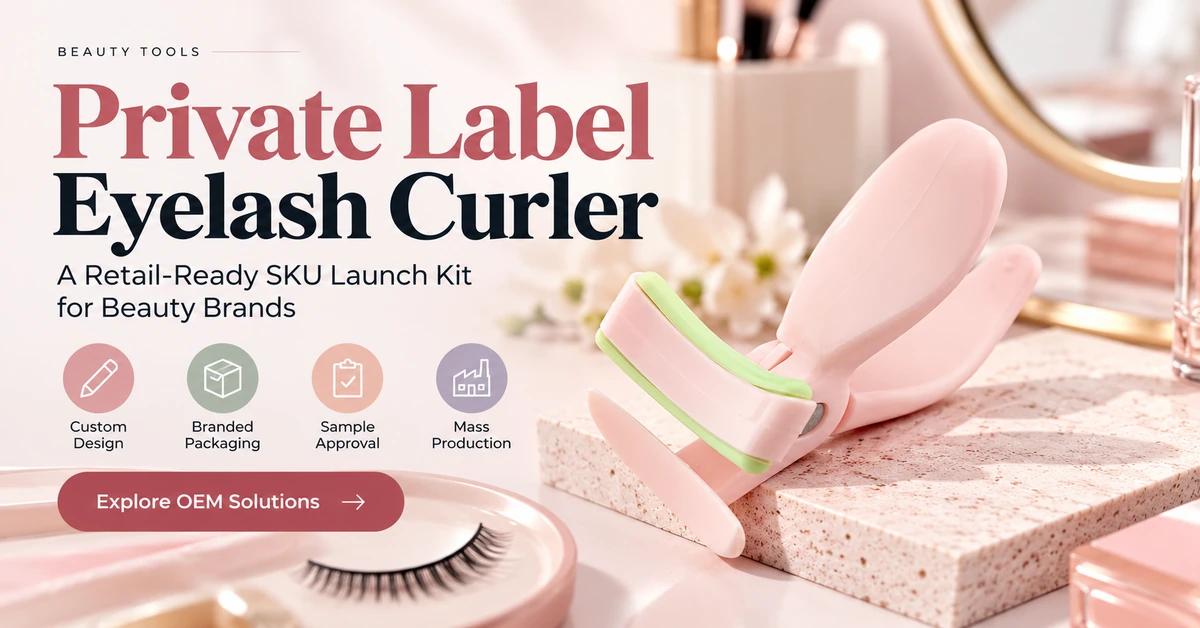
Quick answer: A successful private label eyelash curler is not simply an existing tool with a new logo. Before a beauty brand approves bulk production, it should confirm the working curler, select the intended retail format, approve finished artwork and accurate product claims, check barcode and SKU information, validate the packed sample, and establish a controlled set of launch files. These steps connect product quality with what consumers actually see, buy, use and reorder.
For a cosmetics founder, a retail category manager or an import purchasing team, the most expensive surprise often happens after the initial tool sample looks good. A printed box may carry the wrong material statement; an e-commerce listing may show the wrong finish; a replacement pad may be advertised without a confirmed fit; or a master carton may lack the identifiers required for warehouse receiving. Any one of these errors can delay launch or create avoidable returns.
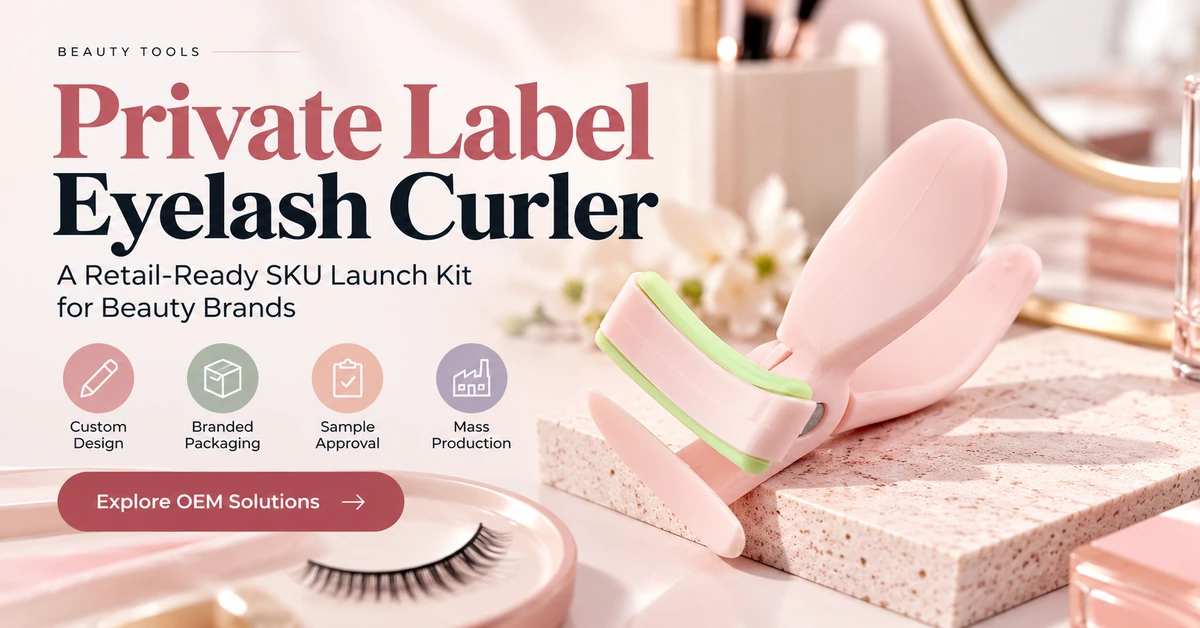
This guide focuses on retail readiness after product selection. It is deliberately different from a factory audit, a wholesale inventory playbook or a new-tooling engineering guide. You will find a product-and-pack specification, channel comparison, claims review, barcode and listing checklist, approval workflow, illustrative cost model and a supplier-ready RFQ. All company-specific details below are limited to published OLIMOR information, and any project-dependent capability is identified for confirmation.
1. What Does a Private Label Eyelash Curler Need Before Launch?
A private-label lash curler is a mechanical grooming accessory marketed under a buyer's own brand, normally using a selected product platform and approved visual or packaging customization. The manufacturer or supplier may handle production and coordination, while the brand takes responsibility for how the product is represented to its customers under the applicable commercial and market arrangements.
The operational goal is to create one retail-ready, reproducible SKU. That means a person in the supplier's quality team, the brand's design team, a warehouse and a marketplace listing team should all be able to identify the same physical product and packaging version.
At minimum, the launch package should answer six questions: Who is the product for? Which curler is being sold? What does the package contain? What evidence supports the material and performance descriptions? How will finished units be inspected? Which files and references will be used for repeat orders?
A brand planning an early launch should also recognize when a private-label route is unsuitable. If it needs a radically different frame geometry or proprietary hinge, it may be planning an OEM development project rather than a straightforward relabeling program. Likewise, a buyer expecting only a handful of generic, unbranded tools may be better served by standard wholesale purchasing.
For a broader introduction to private-label tool customization, see OLIMOR's existing private-label eyelash curler guide. This article instead concentrates on the retail launch documents and approval decisions made after a suitable base product has been selected.
2. Define the Target Customer and Sales Channel First
Private labeling creates little commercial value if the finished item does not match the channel in which it will be sold. A premium cosmetics boutique, a marketplace listing, a salon supply catalog and a gift set do not evaluate the product in the same way. Before discussing color or printing, define the primary customer and the buying situation.
| Customer / channel | What the buyer expects | Retail-ready requirement | Common mistake |
|---|---|---|---|
| Independent cosmetics brand | Recognizable brand identity and credible function | Coordinated look, truthful product details, approved sample | Spending on decoration before function |
| Beauty-chain buyer | Easy shelf recognition and reliable replenishment | Barcode, package dimensions, consistent SKU, carton identifiers | Incomplete retail data |
| E-commerce seller | Accurate images, manageable fulfillment and fewer surprises | Real product photography, clear contents, protected pack | Listing a rendering as the shipped product |
| Professional lash retailer | Predictable handling and appropriate product care | Defined use, pad fit, handling evaluation, instructions | Unverified professional-performance claims |
| Subscription or gift business | Attractive set presentation and secure arrangement | Approved insert, complete set count and shipping protection | Uncontrolled accessories or shifting tools |
For each intended channel, write a short brief defining the market, buyer persona, price position, product story, preferred retail pack, target launch date and initial forecast. Make a separate note for nonnegotiable features and optional decorative ideas.
A useful brand proposition is specific: a compact, clearly described lash-grooming accessory presented in a coordinated makeup collection. An unhelpful proposition is: the world's best eyelash curler for everyone. The first can guide product selection and packaging; the second is untestable and creates claims risk.
3. Select a Real Curler Reference and Record What Is Known
OLIMOR BEAUTY, associated with Bonet Houseware Co., Ltd. in Yangjiang, Guangdong, China, presents eyelash curlers among its personal-care and beauty-tool categories. Buyers can start from the current product range, but should not assume that every illustrated finish, accessory or private-label configuration is available for every model.
One published example is the ECH4004 eyelash curler. The listing identifies carbon steel, a black color, a size of 100 × 62 mm and a stated product weight of 23 g. It showed an out-of-stock status when reviewed; that means current sample and bulk-order options need confirmation, not that production is impossible or immediately available.
| ECH4004 data point | Publicly listed information | What a brand must confirm |
|---|---|---|
| Item reference | ECH4004 | Correct SKU and most recent drawing or photo |
| Material | Carbon steel | Actual component materials and finish details |
| Color | Black | Whether another color or finish is feasible |
| Size | 100 × 62 mm | Dimension orientation and packed-unit dimensions |
| Weight | 23 g | Whether the stated weight excludes packaging |
| Cushion pad | Not fully specified on this listing | Material, fit, retention and spare-pad arrangements |
| Available stock | Out-of-stock indication at review | Present sample, MOQ and production availability |
| Logo / package | No confirmed project-specific offer on the listing | Available methods, costs and approval conditions |
This separation between published facts and unconfirmed project information is essential. Do not call ECH4004 stainless steel, claim a universal silicone pad, or advertise immediate delivery without a current supplier confirmation. A retail label stating the wrong material can be more damaging than a plain label with fewer claims.
4. Choose the Right Product-and-Pack Configuration
A strong retail launch usually begins with one approved curler platform and a small number of meaningful presentation choices. Retailers can compare configurations without inventing additional factory models. The options below are commercial concepts, not confirmed OLIMOR stock-keeping units.
| Concept | Intended buyer | Product approach | Packaging direction | Launch complexity |
|---|---|---|---|---|
| Everyday essential | Mass beauty retailer | Existing suitable frame and approved standard finish | Protective hanging card or compact carton | Lower, if existing resources fit |
| Branded signature | Independent makeup label | Existing frame with feasible brand marking and color selection | Printed retail box with usage card | Moderate |
| Gift or beauty set | Cosmetic gift brand | Approved curler plus separately approved companion tool | Protective coordinated gift insert | Moderate to higher |
| Professional assortment | Lash-tool distributor | Function-first reference model, clearly specified pad system | Information-led protective package | Depends on requirements |
A buyer should resist introducing five colors and three packs simultaneously unless there is clear demand. Every additional combination may create new artwork, inventory identifiers, approval samples and packaging material minimums.
If the goal is a branded first launch, a practical starting point is one functional model, one primary finish and one retail package. A second variation can follow after the brand has evidence about customer response, returns and realistic replenishment quantities.
5. The Technical Specification Still Comes Before the Brand Artwork
Even a packaging-focused project must protect the curler's actual function. The frame geometry, pressing bar, pivot, cushion pad and handle form one operating mechanism. Small changes can affect contact, movement or comfort, particularly because the tool is used near the eye.
The brand does not need to invent precision tolerances. It needs to agree with the supplier on the requirements that matter to the selected model and how they will be checked. An approved product reference should describe the frame profile, pad identification and seating, hinge movement, handle condition, finish and relevant visual defects.
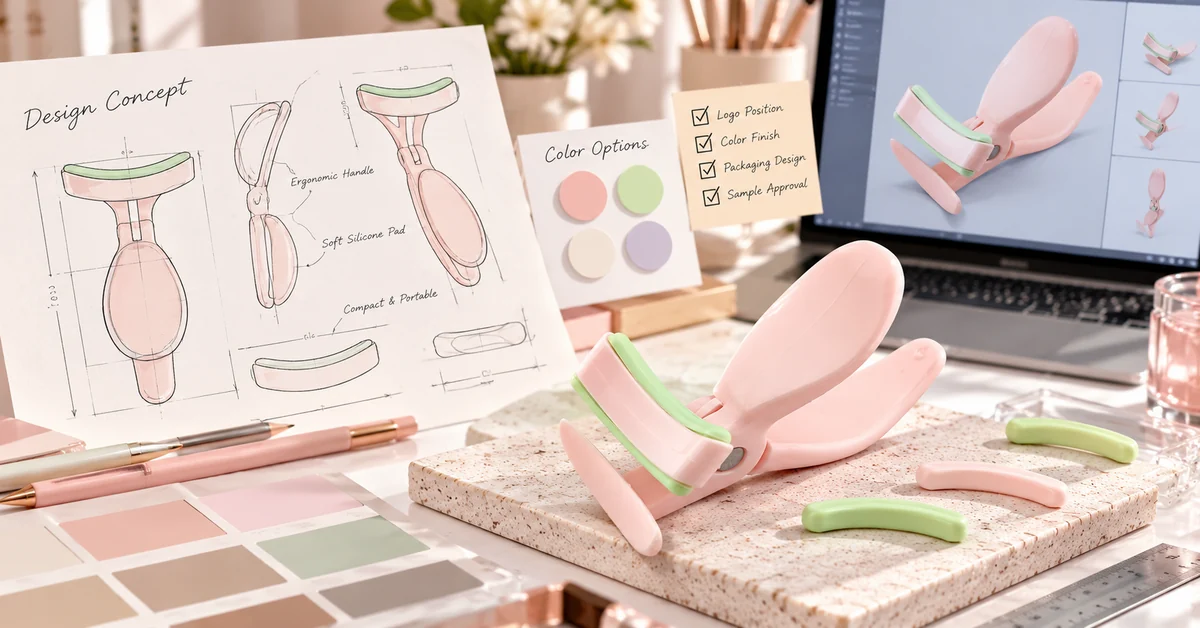
A proposed logo should not cross a hinge, obscure a moving joint or create a rough contact surface. A new decorative finish should be tested on the actual material, not approved only from a color swatch. If a pad color or composition is modified, the buyer should confirm that fit and function remain acceptable with the approved frame.
For an existing model, this is primarily an approval and change-control problem. For a new handle or frame design, the project becomes a wider engineering effort and requires an appropriate development plan. The brand should not describe an attractive rendering as proof that a manufactured version has been qualified.
6. What Can Be Customized Without Making Unsupported Promises?
Private-label discussions can include logo marking, cosmetic finish, color, pad presentation, instructions, packaging, protective inserts and product combinations. Their feasibility depends on actual model geometry, process availability, order quantity and the supplier's commercial terms.
Logo and decorative treatment
Supply vector artwork and ask for recommended marking location, maximum area and method. Approve a physical decorated sample. Keep a signed logo proof showing placement, orientation and size. Ask whether a proposed coating or decoration changes the product's care requirements.
Pad and accessory options
Ask whether the selected model has a defined spare-pad part number. Do not assume the pad is interchangeable with another curler or promise a replacement unless the supplier confirms the correct component. If a replacement is included in the retail box, its quantity, color, composition and location must appear in the packed-unit specification.
Instructions and branded inserts
A product insert can make a compact tool easier to understand, but it should describe the actual product. Keep instructions concise, legible and consistent with agreed care guidance. Avoid medical language or unsupported performance promises.
Packaging structure
Retail cards, printed cartons, gift sleeves and molded or folded inserts can be discussed as packaging possibilities. The chosen format should protect the frame and pad, fit the destination channel and make the contents clear. Request a physical package prototype before printing a large run.
Customization becomes valuable when it supports product identity and customer understanding, not merely when it produces another decorative color.
7. Retail Packaging Design: Compare Shelf, E-Commerce and Gift Formats
The same curler may need very different protection and information architecture depending on how it is sold. The packaging design brief should be developed alongside the target channel, not added after product pricing is finalized.
| Package format | Primary advantage | What to verify | Commercial concern |
|---|---|---|---|
| Hanging card / protective display format | Easy merchandising and visible product | Tool retention, exposed contact points, label area, barcode | Display compatibility and packaging damage |
| Folding carton with insert | Information and branding space | Internal fit, cushioning, print accuracy, closure | More material and shipping volume |
| Compact e-commerce box | Parcel efficiency and protection | Movement in pack, readable identity, real dimensions | Fulfillment damage and dimensional cost |
| Gift box / kit insert | Coordinated beauty-set presentation | Separation of components, completeness, protection | Higher assembly and storage complexity |
Start with an accurate dieline supplied or approved by the packaging producer. Place the actual curler into a prototype and test whether the handle, pad or upper bar contacts vulnerable areas. Make sure decorative windows or cutouts do not expose sharp corners or compromise stability.
Shelf-oriented products also need a logical information hierarchy. The front should quickly identify the item and its intended cosmetic use; the side or back can carry composition statements, instructions, appropriate precautions, barcode and responsible-company information relevant to the destination market.
For e-commerce, test the finished retail pack in the expected shipping configuration. A product that remains secure in a retail box may still move inside an oversized parcel. The final package should be assessed against realistic handling, not just photographed on a studio tabletop.
8. Build a Claim-Safe Product Label and Avoid Risky Marketing Language
A private label eyelash curler is both a physical tool and a set of statements made about that tool. Packaging copy, online product titles, retailer data and influencer briefs should use the same verified facts. The United States Federal Trade Commission states that advertising claims should be truthful and evidence-based; the principle is especially useful for beauty-brand copy review.
| Example claim | Status without supporting evidence | Safer brand-copy approach |
|---|---|---|
| “Stainless steel construction” | Unsupported for ECH4004, listed as carbon steel | Use the confirmed material for the selected model |
| “Fits every eye shape” | Broad performance claim requiring support | Explain the actual frame design without universal-fit promises |
| “Never pinches or pulls” | Absolute safety promise | Provide careful usage instructions and verified inspection criteria |
| “Hypoallergenic pad” | Requires relevant material and claim support | Identify the confirmed pad material, if documented |
| “Clinically tested” | Do not use without applicable study evidence | Describe the product's visible, verified characteristics |
| “Includes replacement pad” | Accurate only when included in that SKU | State accessory count only after packed-sample approval |
| “Easy to use” | Could be subjective | Pair any claim with accurate instructions and product images |
A good claim gate works in four steps: list every claim; identify which exact product data or test supports it; have the appropriate owner approve it; then preserve the approved copy version. If substantiation is unavailable, remove or narrow the claim.
EU-market brands should separately assess the General Product Safety Regulation (EU) 2023/988 and other relevant obligations with qualified compliance personnel, including requirements relevant to product identification and distance-sales information. Applicability and labeling depend on the product and market. A supplier's generic certificate or website claim is not a substitute for the brand's market-specific review.
Do not describe ordinary mechanical lash curlers as medical products or claim that a factory has a particular approval without verifying the exact certificate, scope and holder.
9. Barcode, GTIN and SKU Data Are Part of the Product
A retail-ready item needs a stable identity. That identity should connect the approved curler to its packaging artwork, retailer listing, warehouse records and purchase order. If the box changes to a different commercial product variant, the brand should evaluate whether a distinct product identifier is required.
GS1 explains that a GTIN identifies a trade item and the barcode carries that identifier in a scannable format. Brands should follow the applicable GS1 and retailer rules when assigning or using identifiers; do not invent a barcode image or reuse an unrelated item's number.
Build a product-data sheet containing at least the brand, item name, SKU, GTIN when applicable, selected model reference, verified material, color, dimensions, weight basis, country-of-origin declaration after confirmation, pack contents, carton information, approved images and the responsible contact required for the market.
Check barcode readability on the final printed package, especially where metallic colors, gloss, curvature or a transparent window may interfere with contrast or scanning. Artwork approval is incomplete until the number and its representation match the intended product record.
For online retail, data syndication matters too. A reseller, marketplace and brand-owned website should not present three different product sizes or pad-material claims. Assign one owner to the master data file and update all channels when a verified change occurs.
10. Create a Launch-Ready File Kit That Your Whole Team Can Use
Many brands approve a physical sample but forget to assemble the files needed to sell and reorder it. A practical retail launch kit is a controlled folder of documents, images and signed decisions tied to one product revision.
| Launch asset | Primary owner | What it should contain |
|---|---|---|
| Product master specification | Product / sourcing | Model, drawing, material, pad, finish, dimensions, revision |
| Approved tool sample record | Quality / product | Sample ID, acceptance notes and approved photos |
| Logo and finish reference | Brand / design | Vector logo, location, approved color and surface reference |
| Retail dieline and print proof | Packaging / brand | Structural design, final copy, barcode, instructions |
| Packed reference sample | Product / packaging | Actual tool, accessory count, protective insert and carton |
| Claims evidence register | Marketing / compliance | Claims, evidence, approval and exclusions |
| Product photo set | E-commerce / creative | Accurate angles, details, scale and contents |
| Product listing data | E-commerce / sales | Product title, bullets, attributes, SKU / GTIN mapping |
| Carton and shipping standard | Logistics / sourcing | Pack counts, weights, dimensions, labels and handling |
| Supplier quotation and PO | Purchasing | Itemized cost, quantity, Incoterm, timing and terms |
| Incoming QC plan | Quality | Tests, defect categories, inspection responsibility |
| Reorder change log | Sourcing / quality | Allowed revisions, owners and new approval requirements |
Keep these assets in one accessible location with clear versions. For example, label an approved package proof with the SKU, language, revision and approval date. Avoid circulating a file named only “final-final-new.pdf.”
This approach reduces confusion when the product changes hands between suppliers, importers, marketplaces and sales teams. It also gives procurement staff a clearer evidence trail during repeat orders.
11. Approve Three Things Separately: Tool, Appearance and Retail Pack
A branded launch is safer when three approval decisions are explicit. First, the functional tool must meet the intended specification. Second, the decorated product must match the agreed appearance without affecting operation. Third, the packed unit must have correct contents, information and protection.
Do not treat a digital print proof as approval of the package's physical fit. Do not treat a functional metal sample as approval of a later colored or coated variation. And do not allow a retailer listing to go live while the final packaged sample is still under revision.
A recommended sign-off sequence is:
- Product team signs off model and use case.
- Quality team signs off the working sample and acceptance criteria.
- Brand team signs off actual decoration and product photography references.
- Packaging team signs off the physical pack and print proof.
- Compliance or responsible market team reviews claims and applicable labeling.
- Purchasing confirms the quoted configuration, quantity and lead-time assumptions.
- Logistics confirms carton and destination details.
- An authorized approver releases the retail-ready SKU revision.
These are recommended controls, not a claim about a mandatory OLIMOR workflow. A small brand may combine roles, but should keep the decisions traceable. The central question is whether the item entering production is the same item that marketing intends to sell.
12. Quality-Control Checks That Connect the Tool to the Box
A product can pass a mechanical inspection and still fail at retail if it arrives with the wrong insert or barcode. For a branded curler, inspection should cover the complete packed unit.
| Inspection area | Specific check | Practical failure example |
|---|---|---|
| Product identity | Model, finish and revision | Wrong version inside correct-looking box |
| Frame and hinge | Agreed movement and visible alignment | Binding or excessive looseness |
| Cushion pad | Correct component, position and retention | Pad displaced during packing |
| Surface and handle | Approved finish, acceptable edges | Rough finish or visible coating defects |
| Brand marking | Position and legibility | Logo inconsistent with proof |
| Accessories | Count and fit where included | Promised spare pad missing |
| Package contents | Tool, instruction and insert accuracy | Wrong language or wrong component |
| Barcode and label | Match to product master data and scannability | Package identifies another SKU |
| Shipping carton | Quantity, labels, packaging integrity | Mixed variants without clear cartons |
A lot inspection program may use a mutually agreed acceptance-sampling method, where suitable. ISO 2859-1:2026 defines sampling schemes for inspection by attributes; it does not certify that a particular eyelash curler is safe or meets market requirements. Product-related safety issues require targeted controls and documented decisions, not only a sampling percentage.
Maintain retained references and a record of corrective actions. If a new print run changes color, or a supplier substitutes a pad, assess whether samples, photos, labels and listing data need to be reapproved.
13. Source Manufacturing and Capacity Statements With Evidence
The language used for a supplier should match what is actually confirmed. OLIMOR's public site identifies the brand and Bonet Houseware Co., Ltd. in Yangjiang, and describes beauty-tool sourcing, private-label discussions, sampling and checks against approved requirements. That supports a useful procurement discussion, but it does not prove any particular production quantity, ISO certification, equipment list, material grade or lead time for the selected curler.
A serious buyer can request evidence appropriate to the project: the supplying legal entity, production and assembly responsibilities, material identification, sample and packaging approval process, applicable inspection records, and procedures for correcting a rejected lot.
If a supplier names a quality system certificate, verify the document's issuer, holder, covered location and current scope. Do not call a general quality certificate a product approval. Ask whether pads, printed packaging or finishes are purchased from external vendors and how those inputs are controlled.
This is particularly relevant when the design incorporates custom packaging from a separate printer. The brand may be buying one retail SKU whose components originate from several companies. The final quotation should identify who is responsible for getting the pieces to the approved packed condition.
14. What Drives Private-Label Price, MOQ and Lead Time?
The economic decision is not only whether the curler is affordable. It is whether the complete branded SKU can be stocked, presented and reordered profitably. Ask the supplier to separate base tool, finish or decoration, package, accessories, inspection, sampling, tooling where applicable and freight-related assumptions.
MOQ may vary by base model, decoration batch, pad option and printed packaging. A small first order may be feasible with a standard product and simple package but not with a newly developed coating and custom-printed accessory. Neither outcome should be assumed without a quotation.
For illustration only, imagine a 2,400-unit project with the following hypothetical per-unit costs:
| Example cost element | Illustrative US$/unit |
|---|---|
| Base curler | 1.10 |
| Logo and decorative treatment | 0.12 |
| Printed retail box and insert | 0.28 |
| Allocated inspection | 0.07 |
| Allocated freight | 0.21 |
| Assumed import-related allocation | 0.13 |
| Total illustrative landed unit cost | 1.91 |
If the brand sells this unit to a distributor for US$3.60, its illustrative gross margin before other selling and operating expenses is (3.60 − 1.91) / 3.60 = approximately 46.9%. This is a calculation example, not OLIMOR pricing, a freight quote, a customs rate or an expected margin.
A buyer should also include photography, marketplace charges, payment processing, returns, storage and marketing in the relevant channel contribution model. The investment can change materially when packaging volume, finish complexity or minimum quantities change.
Lead time should be broken into sample, artwork, material readiness, production, inspection and transport. A single promise such as “fast delivery” cannot replace a dated schedule tied to the final approved configuration.
15. Retail Product Photography and Listing Copy Must Match the Shipped SKU
Beauty accessories are highly visual, but that makes inaccurate listings especially risky. A shopper should see the same finish, frame type, handle style, pad color, contents and packaging that arrive in the box.
A useful image set includes a clear front product photograph; an angled view showing hinge and handle; a close-up of the pad and upper bar; a scale or dimension graphic; a truthful contents image; a package photograph; and an application image that depicts use appropriately. Avoid using a concept illustration as a substitute for the shipping product.
Alt text should describe the image rather than repeat the core keyword mechanically. An accurate phrase such as “Black mechanical eyelash curler with white cushion pad in retail box” can be more informative for a product-detail image than another instance of the full commercial keyword.
The listing title and bullet points should use a consistent product name, verified dimensions, intended cosmetic use and approved contents. A care statement should reflect the approved guidance. A visual showing spare pads should not lead customers to expect them unless the retail pack actually includes them.
For AI-oriented search and shopping discovery, the practical advantage comes from stable product entities and specific, consistent data across the product page, article, packaging and listings. Tables, clear answers and descriptive links help search systems understand the relationship, but cannot guarantee inclusion in AI-generated recommendations.
16. Launch One Hero SKU, Then Expand the Lash-and-Brow Collection
A private-label eyelash curler can become the anchor for a broader grooming assortment, but launching multiple unverified tools simultaneously multiplies quality and inventory questions. Start with a hero SKU that fits your customer and retail position. Learn from sales, returns, customer support and reorder performance before extending the range.
Potential companions include beauty tweezers, eyebrow razors and beauty scissors. Each related item should be selected for a clear purpose, not merely because the finish can match. A lash curler and tweezer set needs separate functional approvals for both tools and a secure shared insert.
A reasonable product-family story is lash shaping, brow detail and travel-ready grooming. The same palette and typography can unify the line without claiming every product shares the same materials or technical characteristics.
Some buyers prefer gift-style sets or subscription-box assortments. Those combinations can support merchandising, but they also require carton accuracy, packaging protection, correct counts and clear product descriptions. The brand should treat the final set as an additional retail configuration, with its own version and quality checks.
17. Build Reorder Stability Into the First Purchase Order
Private-label products become valuable when a brand can order the same approved result again. Repeatability requires more than emailing the supplier a photograph of the previous shipment.
Include the SKU, approved revision, exact base model, accepted finish, pad reference, logo artwork, retail-package files, accessory count and carton standard in the purchase order or its controlled attachments. If a component or packaging supplier changes, require notification and decide whether further sampling or testing is necessary.
Keep retail feedback separated by cause: functional complaint, finish issue, pad retention, damaged packaging, inaccurate listing or missing accessory. Different problems require different corrective actions. A warehouse carton-label mistake cannot be solved by changing the frame geometry.
For repeat orders, compare actual sell-through against new MOQ and packaging quantities. A popular color may justify more inventory, while a slow-moving gift pack may require a revised order plan. Those decisions should be informed by real results rather than by the most attractive factory quotation.
18. A Supplier-Ready RFQ for a Private Label Eyelash Curler
A useful request for quotation should be specific enough to distinguish standard stock, branding, packaging and optional design changes. The supplier should be able to identify which details are approved and which require feasibility review.
| RFQ field | What the buyer should provide |
|---|---|
| Brand and target market | Company, destination country and sales channels |
| Product reference | Actual OLIMOR model link or approved reference photo |
| Customer profile | Mass retail, independent brand, salon, e-commerce or gift buyer |
| Key function | Selected frame and pad requirements, sample acceptance criteria |
| Appearance | Color, finish, logo position and artwork format |
| Pack | Carton/card/gift option, instructions, accessories and barcode needs |
| Quantity | First-order estimate and likely reorder range |
| Claims and labeling | Target-market review requirements and approved content |
| Inspection | Packed-unit checks, approval sample and lot inspection expectations |
| Commercial | Sampling charges, MOQ by variant, price tiers, delivery basis and timing |
Example inquiry:
We are launching a private-label eyelash curler for our beauty retail brand. We would like to review suitable OLIMOR reference models and discuss an approved branded finish and protective retail carton. Our priority is a correct functional sample, clear pad and material specifications, accurate labeling, a final packed sample and consistent repeat-order documentation. Please confirm available model options, sample feasibility, logo and packaging methods, MOQ by configuration, estimated stages and an itemized quotation for our planned quantity and destination market. We can provide our brand artwork, proposed product copy and launch timeline for review.
This request is more actionable than “Please give us the lowest private-label eyelash curler price.” It gives product, design, quality and sales teams a shared starting point and gives the supplier a basis to distinguish confirmed services from options that require additional work.
19. Why Discuss the Project With OLIMOR BEAUTY?
OLIMOR BEAUTY presents a range of beauty tools and grooming accessories associated with Bonet Houseware Co., Ltd. in Yangjiang, China. Its publicly listed product categories include eyelash curlers, tweezers, beauty scissors, nail tools and other personal-care accessories. The company site describes product selection, sampling, private-label requirements and quality checks against approved product information.
For a brand developing a retail-ready lash tool, this provides a relevant place to start the conversation. Review the eyelash curler collection, identify candidate references, then ask which specific decoration, pad, protective packaging and production arrangements can be supported. A complete request also needs quantity, destination and the intended sales channel.
OLIMOR's public company information and contact page provide the next steps. The final decision should rely on current samples, written specifications and an itemized offer rather than on unverified claims of universal fit, test certification, fixed MOQ or immediate stock availability.
20. Frequently Asked Questions About Private Label Eyelash Curlers
1. What is a private label eyelash curler?
It is a curler marketed under a buyer's own brand, normally using an approved base product and agreed decoration, packaging or other defined changes. A successful program also controls the functional sample, product description, retail contents and repeat-order specification. It is not automatically a completely new mechanical design.
2. Can I launch a private label curler without new tooling?
Potentially yes, if an existing model meets the intended function and the supplier confirms feasible branding and packaging. This route can reduce new engineering work, but the brand must still approve the actual tool, decoration and complete retail pack. New frame geometry may require a separate OEM feasibility project.
3. Can OLIMOR add my brand logo and custom retail packaging?
OLIMOR's public materials discuss private-label and packaging projects. Exact methods, available surfaces, order quantities, charges and timing depend on the selected model and project requirements. Ask for a model-specific feasibility response and approve a physical sample rather than assuming all options are universally available.
4. What is the MOQ for private label eyelash curlers?
There is no verified universal MOQ across models and packaging formats. Base tools, custom finishes, printed boxes and accessories may have different minimums. Request separate quantities for the standard model, decorated product and fully packed private-label SKU, including carton multiples and any one-time charges.
5. How can I approve the cushion pad correctly?
Request the actual pad material, dimensions, seating and retention details for the selected frame. Evaluate the physical sample and confirm spare-pad compatibility if replacements will be offered. Never assume a universal silicone specification or promise a replacement pad unless the exact configuration is documented.
6. What belongs on an eyelash curler retail package?
At minimum, the product and its intended use should be identified clearly, with accurate contents, instructions and appropriate product information. Barcodes, responsible-party details, origin marking, warnings and language requirements depend on the destination market and selling channel. Obtain qualified market-specific review before final printing.
7. What claims should a beauty brand avoid without evidence?
Avoid absolute or unverified statements such as “fits every eye,” “never pinches,” “clinically proven,” “hypoallergenic,” or an incorrect material grade. Use precise, supportable descriptions. Keep a claim evidence register so packaging, marketplace listings and advertising all refer to the approved product facts.
8. How do I make sure the barcode and listing match my product?
Maintain a product master file containing the approved SKU, product identity, applicable GTIN, variant, materials, color, dimensions and packaged contents. Test the final printed barcode where required and review the published online listing against the approved physical sample. Apply the relevant retailer and GS1 identification rules.
9. What should be inspected before a branded bulk shipment?
Inspect the correct curler and revision, frame and hinge function, pad fit, finish, logo, accessories, packaging protection, artwork, barcode, carton labels and order quantities. Define defect categories and a suitable lot inspection method before production. Retain evidence and establish a corrective-action path for mismatches.
10. How do I start a private-label lash curler project with OLIMOR?
Browse OLIMOR's eyelash curlers, select a model or share reference images, and send an inquiry through Contact Us. Include the intended market, customer type, quantities, branding, packaging, pad expectations and target dates. Request sample and commercial terms for the exact configuration rather than relying on generic catalog figures.
Conclusion
A private label eyelash curler becomes a genuine brand asset when the physical tool, its claims, packaging, product data and purchasing records describe the same approved SKU. Attractive branding alone cannot prevent mismatched materials, incorrect accessories, misleading listings or inconsistent repeat orders.
For a first launch, define one target customer and one primary sales channel. Select a suitable curler reference, approve real functional and decorated samples, protect the product in its final retail pack, review every printed and online claim, and create a launch file kit that connects the supplier with the brand, retailer and warehouse. Use itemized quotations and project-specific MOQ rather than unverified public prices or fixed promises.
OLIMOR BEAUTY's eyelash curler selection offers a starting point for identifying product references, while its related beauty-tool portfolio can support later range planning. To discuss a product that fits your brand's intended market, contact OLIMOR with your proposed SKU, quantity, finish, packaging needs and launch checklist. Clear specifications and careful approvals create a stronger foundation for retail presentation, customer confidence and repeat purchasing.
Move from concept to an approved private-label SKU
Request a Private Label Quote →View Curler Collection →Tag:
Related articles
- OEM & Private Label
- Beauty Tools Product Development
OEM Eyelash Curler: When to Adapt an Existing Frame or Invest in New Tooling
- Lash & Brow Tools
- OEM & Private Label
Private Label Beauty Scissors: A 7-Gate Launch Plan for Brow Tool Brands
- OEM & Private Label
- Beauty Tools Manufacturing