

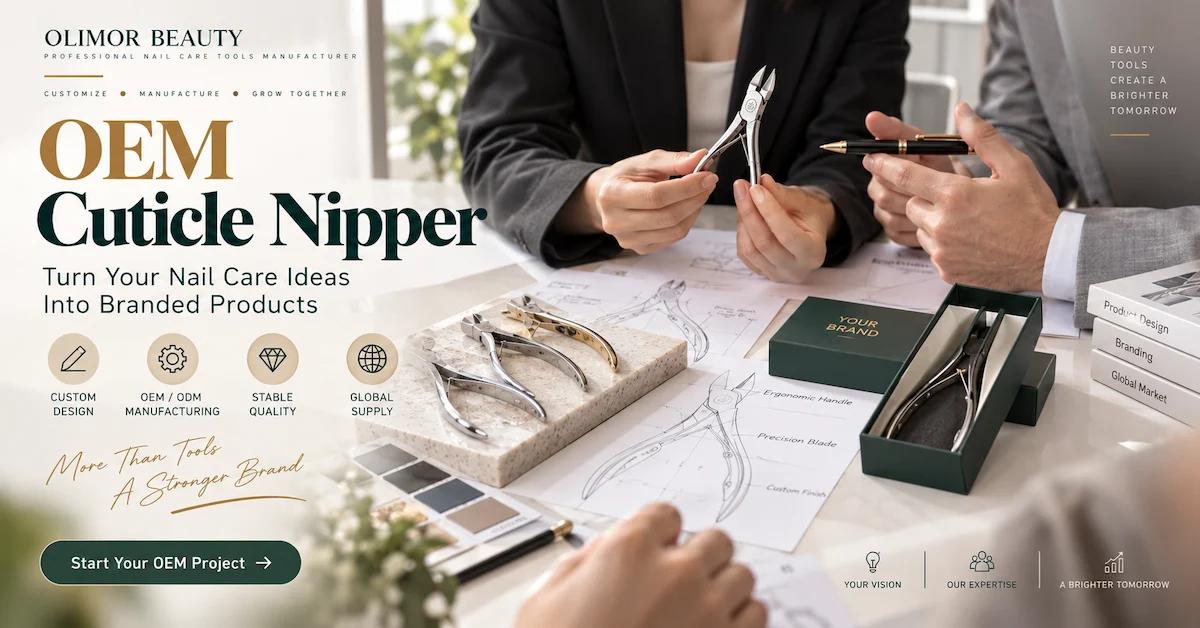
An OEM cuticle nipper project should begin with a clearly defined nail-care application, an approved jaw design, a suitable spring and handle mechanism, and documented material and finishing requirements.
Before bulk manufacturing, buyers should approve functional samples, confirm OEM branding and packaging, establish quality inspection criteria, and agree on quantity, pricing, development responsibilities, and delivery conditions.
The key objective is to turn a custom product concept into a repeatable manufacturing specification. A logo and an attractive sample are not enough if the cutting jaws, spring response, and finished product cannot remain consistent across batches.
OLIMOR BEAUTY offers beauty-tool product references and supports international buyers discussing OEM, ODM, and private-label nail-care projects. Its cuticle nipper collection provides a starting point for model selection and customization enquiries.
Developing a cuticle nipper under your own brand may appear straightforward. The tool is compact, the manufacturing concept is familiar, and many available products share similar handle shapes and cutting-jaw arrangements.
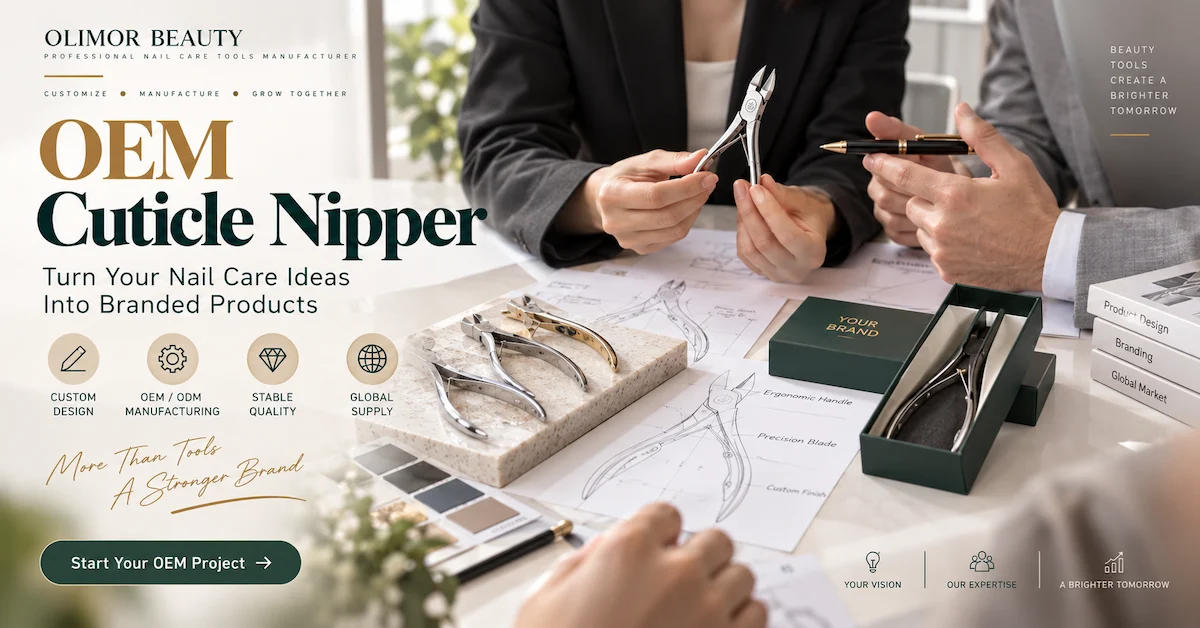
However, creating a dependable OEM product requires much more than choosing a design from a catalogue and adding a logo. The two cutting jaws must meet correctly, the pivot must move predictably, the spring must provide a suitable reopening action, and the handles must allow controlled operation during the intended nail-care task.
For beauty brands and wholesale importers, the challenge becomes greater when the product moves from prototype development to commercial manufacturing. A carefully adjusted sample may perform well, but production reliability depends on controlling the important characteristics throughout an entire manufacturing batch.
Custom colors, logo treatments, decorative finishes, retail packaging, and product sets introduce additional variables that need to be managed. A coating process may affect appearance. A redesigned handle may alter spring positioning. A poorly fitted protective cap may damage the working jaws after the product has already passed inspection.
This guide explains how international buyers can manage those decisions step by step. It focuses on OEM product development, design specifications, sample approval, manufacturing control, private-label customization, commercial costs, and repeat-order consistency. The goal is to help purchasing teams create products that are technically appropriate, commercially practical, and easier to reorder with confidence.
1. What Is an OEM Cuticle Nipper?
An OEM cuticle nipper is a manicure or nail-care cutting tool manufactured according to a buyer's agreed product requirements. The buyer may define the product through a technical drawing, physical reference sample, specification, working mechanism, or a combination of these documents.
OEM stands for Original Equipment Manufacturing. In practical beauty-tool sourcing, an OEM project often involves more buyer-controlled design input than purchasing an existing standard product without modification.
The development scope can vary considerably. A relatively simple project may use an established nipper platform with agreed changes to the finish, handle appearance, logo, or packaging. A more complex project may require different jaw geometry, body dimensions, joint construction, or spring configuration.
These variations are important because not every custom feature has the same manufacturing impact. Changing a printed box is different from changing the tool's cutting mechanism. A new blade design may require additional engineering review, process adjustments, specialized tooling, and functional testing.
For a purchasing team, the value of OEM development is the ability to define the product that customers will actually receive. The manufacturer should help translate this definition into a technically feasible and repeatable manufacturing plan.
A professional OEM discussion should therefore cover product function, materials, dimensions, working-jaw geometry, finishing, branding, packaging, quality acceptance, and production control.
The exact operations performed by a supplier should be verified for the selected model. Not every OEM arrangement requires completely new tooling, and not every supplier performs every manufacturing operation internally.
2. Who Needs Custom OEM Cuticle Nippers?
Different business customers have different reasons for developing custom cuticle nippers. These reasons should guide the design brief before the supplier begins discussing engineering changes.
| Target Buyer | Product Application | Main OEM Priority |
|---|---|---|
| Nail-Care Brands | Branded manicure collections | Product differentiation and consistent quality |
| Professional Salon Suppliers | Repeated salon manicure use | Jaw accuracy, spring response and comfort |
| Beauty Importers | Bulk wholesale distribution | Specification control and stable replenishment |
| Retail Chains | Consumer nail-care accessories | Usability, packaging and product identification |
| E-commerce Brands | Private-label online products | Product accuracy, presentation and returns risk |
| Manicure Kit Brands | Multi-tool grooming sets | Coordinated styling and protected packaging |
Professional salon suppliers often evaluate cuticle nippers through repeated handling. Their customers may compare jaw visibility, closing movement, grip comfort, and the consistency of spring-assisted reopening.
Consumer retail brands may place additional emphasis on product instructions, straightforward operation, and protective packaging. The tool should still perform its intended task, but the buying experience includes clear product identification and ease of storage.
Beauty importers must consider both product quality and commercial execution. Their purchase orders may involve several sizes, finishes, and packaging configurations. Each variation needs a stable SKU and clearly defined replenishment requirements.
The most useful OEM brief therefore begins with one specific customer scenario. Instead of asking for the "best professional nipper," describe who will use it, what work it is intended to perform, and what the user should experience.
3. OEM vs ODM vs Private Label Cuticle Nippers
OEM, ODM, and private-label manufacturing are related, but they describe different approaches to product development and sourcing responsibility.
OEM Product Development
An OEM project typically begins with the buyer providing stronger control over the product definition. This may include dimensions, jaw design, handle profile, material requirements, and working specifications.
This route may be appropriate when the brand wants a distinctive functional design or needs to match an established product specification.
ODM Product Selection
An ODM project generally begins with a supplier-developed design that the buyer can select or adapt. An established product platform may provide a practical basis for changing appearance, branding, or certain approved features without redesigning the entire cutting mechanism.
Private Label Manufacturing
Private labeling often focuses on adding a brand identity to an existing or adapted tool. Customization may involve a logo, surface finish, color, retail packaging, or a coordinated manicure set.
These approaches can overlap. For example, an existing ODM platform may become a private-label product. An OEM design may also be sold exclusively under the buyer's own brand.
| Development Route | Starting Point | Typical Buyer Benefit |
|---|---|---|
| Standard Wholesale | Existing finished product | Limited development requirements |
| Private Label | Existing or adapted model with branding | Branded retail presentation |
| ODM | Supplier-supported design platform | Customization with an established base design |
| OEM | Buyer-defined specification or reference | Greater control over product characteristics |
A useful purchasing decision depends on how much customization the customer actually needs. A new handle or cutting-jaw design should provide meaningful functional or commercial value.
Over-customizing a small tool can increase development complexity without improving its intended performance.
For additional information about broader nail-care branding, review OLIMOR's private-label manicure tools guide .
4. How to Create a Production-Ready OEM Cuticle Nipper Brief
A manufacturing brief is one of the most important documents in an OEM project. It connects the commercial product concept with the specifications the supplier will eventually manufacture.
Without a clear brief, the supplier may interpret terms such as "precision," "sharp," or "ergonomic" differently from the buyer. These words describe desirable qualities, but do not establish measurable acceptance criteria.
Begin with the intended user. Identify whether the product is designed for trained nail technicians, consumer manicure kits, beauty retail, or another defined application.
Then describe the working requirements. Explain the preferred cutting-jaw profile, handle shape, opening response, surface finish, and product presentation.
Finally, distinguish requirements that are essential from those that can be discussed with the manufacturing partner. This helps the supplier propose technically suitable alternatives without changing the product's core customer promise.
| Specification Area | Information to Define | Approval Reference |
|---|---|---|
| Application | Professional salon, retail or manicure set | Written use statement |
| Jaw Geometry | Profile, working area and required dimensions | Drawing or approved sample |
| Spring Mechanism | Required configuration and reopening behavior | Functional approval |
| Handle | Length, shape, texture and grip preference | Physical sample |
| Material | Required designation or material options | Confirmed product specification |
| Finish | Color, polish, texture and appearance | Approved finish reference |
| Branding | Logo size, location and marking method | Artwork and decorated sample |
| Packaging | Protector, insert, retail box and labels | Complete packed sample |
| Quality | Functional tests and defect criteria | Agreed inspection plan |
The product specification should also include a document revision number. When the drawing, finish, or packaging changes, the revised version should be reviewed and approved.
This avoids a common manufacturing problem: different departments working from different versions of the same product concept.
5. Jaw Geometry, Blade Alignment and Cutting Performance
The cutting jaws are the most functionally important parts of a cuticle nipper. Their geometry determines where the tool makes contact, how the user approaches the intended trimming area, and how the two cutting edges meet during closure.
For an OEM design, the buyer should define the required jaw profile before approving decorative changes.
Jaw Length and Access
Different jaw profiles may provide different levels of access and visibility during the intended manicure task.
A relatively narrow working profile may support selected detailed tasks, while other designs may provide a different working contact area.
There is no universal jaw size that is ideal for every user. The appropriate design depends on the intended task, technician handling, and working position.
Blade Meeting Accuracy
The two cutting edges should meet according to the approved design. When the handles close, the working region should behave predictably.
Buyers should look for unintended gaps, crossing jaws, lateral movement, or inconsistent contact that affects the intended operation.
A small difference in jaw alignment may change the cutting result, particularly during fine movements.
Edge Preparation
Cutting-edge quality depends on more than visible sharpness.
The working edges should be finished appropriately for the intended task and should not contain unintended burrs, damage, or irregular contact areas.
The buyer and supplier should agree on a suitable functional test using representative, non-biological practice material where appropriate.
The method should identify the testing material, the tool's working position, the closing movement, and the expected result.
Why Product Photos Are Not Enough
Catalogue photographs may show overall shape and visual finishing, but they cannot reliably demonstrate cutting performance, jaw contact, or assembly consistency.
Before approving commercial production, evaluate actual finished samples. Where necessary, review several samples to understand product variation.
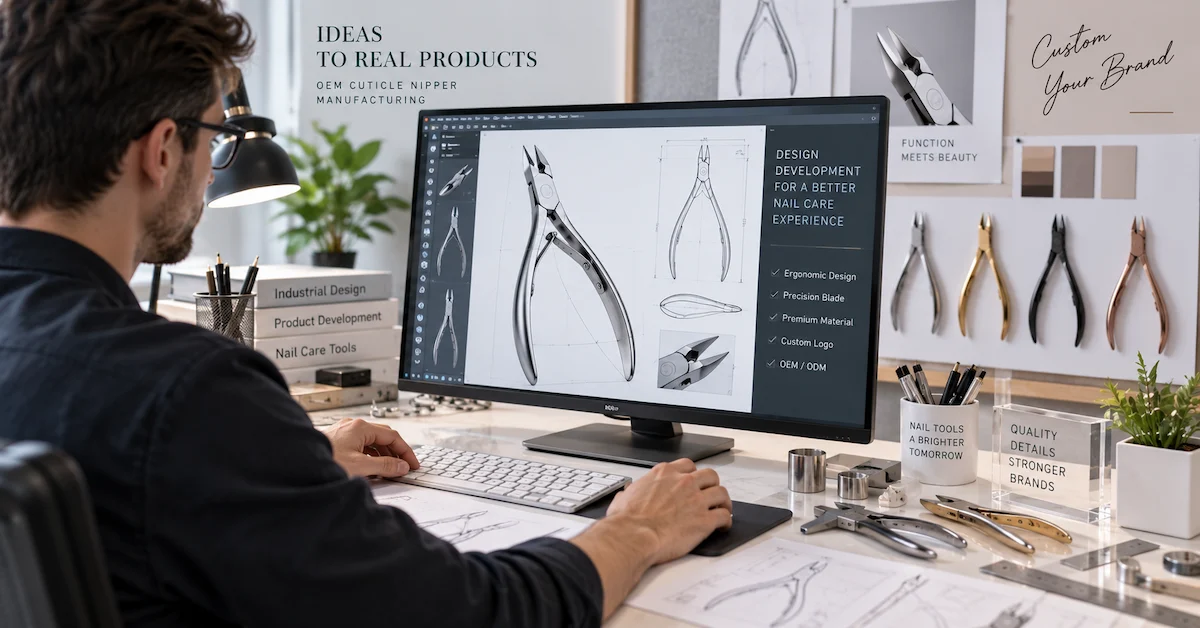
6. Spring Mechanisms, Joint Stability and Handle Design
A cuticle nipper operates through a combination of handle movement, joint rotation, cutting-jaw closure, and spring-assisted reopening where a spring is fitted.
These characteristics are closely related. Changing the handle shape or joint geometry may influence the feel of the entire tool.
Single-Spring and Double-Spring Options
Different cuticle nipper designs may use single-spring or double-spring configurations.
Each arrangement can provide a different reopening response depending on its design, material, assembly, and relationship with the handles.
Double spring does not automatically mean greater durability. The appropriate configuration should be evaluated on the actual product.
Spring Return Testing
During sample evaluation, open and close the nipper repeatedly under consistent conditions.
Observe whether the spring returns predictably, whether it remains properly positioned, and whether the mechanism produces unwanted movement or resistance.
If the project requires a defined cycle-life claim, agree on the test procedure and acceptance criteria before making that claim.
Pivot and Joint Quality
The joint should support controlled movement without excessive looseness or unwanted binding.
Joint instability may influence the relationship between the cutting jaws.
For that reason, jaw quality and joint quality should be evaluated together.
Handle Comfort
Handle design should reflect the user's normal grip.
Professional technicians may compare opening distance, contact points, surface texture, and control during repeated operation.
Different users may prefer different handle profiles. A realistic approval should include representative handling feedback rather than assume one design will suit everyone.
7. Stainless Steel Selection, Hardness and Custom Finishes
Material selection influences the manufacturing and performance characteristics of an OEM cuticle nipper.
Stainless steel is commonly used in nail-care tools, but it includes multiple material grades with different properties.
The phrase "stainless steel" does not establish a specific alloy, hardness level, corrosion resistance, or cleaning compatibility.
Material Specification
For an OEM project, the buyer should ask the supplier to identify the actual material used for the selected model.
Where different components use different materials, the specification should distinguish them clearly.
A suitable material statement should support the product's intended use and relevant destination-market requirements.
Hardness and Cutting Performance
Hardness can influence the behavior of metal cutting components, but an arbitrary hardness claim does not prove a superior finished product.
If hardness is specified, the buyer should agree on a measurement method, test location, and acceptance range.
These requirements must be appropriate to the actual manufacturing design.
Polished and Satin Finishes
Polished finishes provide a bright metallic appearance. Satin and matte finishes may create a softer visual effect or a different handling texture.
The selected finish should be compatible with the intended product geometry and manufacturing process.
Custom Colors
Gold-tone, rose-gold, black, and other decorative finishes may help establish a private-label product identity.
However, available colors and treatments must be confirmed for the chosen model.
The finished decorated sample should be checked for appearance, marking quality, and any functional effects of the treatment.
Claims about scratch resistance, corrosion performance, or compatibility with specific cleaning processes should be supported by appropriate product evidence.
8. OLIMOR Cuticle Nipper Models as OEM Development References
Existing catalogue models can help buyers establish a practical starting point for custom development.
Rather than beginning with an undefined product concept, a buyer can review a physical reference and identify which characteristics should remain unchanged and which may require modification.
BNS1020 Stainless Steel Cuticle Nippers
OLIMOR lists Stainless Steel Cuticle Nippers for Precise Nail Care under product code BNS1020.
Its published specifications include stainless steel, dimensions of 4.7 × 11.2 cm, and a weight of 39 g.
The product information also identifies a customizable color option.
For an OEM buyer, these details can support initial size and product-positioning discussions.
The actual jaw geometry, spring mechanism, available finishes, and customization scope should still be confirmed for the project.
BNB3044 ElegantCut Pro
The ElegantCut Pro Cuticle Nipper is listed under product code BNB3044.
The published product details include stainless steel construction, a silver finish, dimensions of 11.3 × 4.4 cm, and a weight of 47 g.
Its product description also discusses a double-spring mechanism.
These details are relevant when comparing product design directions, but buyers should inspect a current sample before making final technical decisions.
Other Nipper Product References
OLIMOR also offers products within its cuticle nipper collection that buyers can review for different retail and professional nail-care positions.
A catalogue reference is not evidence that every model shares the same material grade, jaw tolerance, MOQ, price, or production capability.
Each proposed OEM configuration should receive its own technical and commercial confirmation.
Have a Custom Cuticle Nipper Concept?
Share your reference model, preferred jaw design, spring requirements, finish, branding concept, and expected quantities. Ask OLIMOR about suitable product platforms and development feasibility.
Discuss Your OEM Product Design →9. OEM Cuticle Nipper Sampling: From Prototype to Golden Sample
Sample development should be organized around clear approval stages.
Trying to approve function, finish, branding, and packaging in one unstructured review can make it difficult to identify which problems need correction.
A more reliable approach is to divide development into stages with defined objectives.
Concept Review
Confirm the intended customer, application, design direction, and manufacturing feasibility.
Functional Prototype
Review jaw contact, cutting action, spring return, joint movement, and handling.
Design Revision
Record approved changes, resolve technical questions, and update controlled drawings.
Decorated Sample
Approve material appearance, surface finish, logo position, and color.
Packed Sample
Approve protective components, retail packaging, artwork, and product identification.
Golden Sample Approval
Retain the final reference with the matching specification, artwork, and inspection plan.
Functional Sample Evaluation
A functional sample should be reviewed against the intended application.
Inspect the jaw contact, edge condition, joint movement, spring return, and handle operation.
For professional salon products, include relevant user feedback where appropriate.
Record the testing conditions so that later samples can be compared fairly.
Revision Control
Each sample should have a model code or revision identifier.
When a buyer requests a change, record what needs to be modified, why it is necessary, and which earlier features must remain unchanged.
For example, a handle adjustment should not silently change the approved cutting performance.
Golden Sample Approval
The final approved sample should represent the intended commercial product as closely as practical.
It should be connected to the relevant drawing, material description, finish reference, logo artwork, packaging files, and inspection requirements.
A golden sample is a reference, not a substitute for written quality criteria.
If certain requirements cannot be verified from the physical sample alone, identify the document or test method that controls those characteristics.
10. How OEM Cuticle Nippers Move into Bulk Manufacturing
Once the product design has been approved, the manufacturing team must translate the specification into repeatable production steps.
Depending on the product, manufacturing may involve material preparation, metal forming, machining, edge processing, grinding, polishing, heat treatment where applicable, joint assembly, spring installation, surface finishing, and final inspection.
The actual sequence varies by design and supplier.
Buyers should ask which operations control the characteristics that matter most to their product.
Critical Process Identification
For a cuticle nipper, critical operations may influence the cutting-jaw geometry, edge condition, pivot stability, spring response, and final surface quality.
The supplier should identify where these characteristics are established and how they are checked.
First-Piece Approval
Before large quantities are produced, the initial completed pieces should be compared with the current approved requirements.
The objective is to identify setup or process problems before they affect a larger production quantity.
In-Process Inspection
Quality checks during manufacturing can help detect variation before additional value is added through finishing, branding, or packaging.
A finished product inspection is valuable, but it should not be the only point where quality is considered.
Final Product Verification
After all relevant processes are completed, the finished nipper should be checked against its approved functional, appearance, and packaging requirements.
This should include any changes introduced by decorative finishing, assembly, or packing.
11. OEM Cuticle Nipper Quality Control and Inspection Criteria
Quality control should be specific to the actual product rather than based only on general claims of strict factory inspection.
For cuticle nippers, the quality plan should connect the user's intended task with the working characteristics of the tool.
| Quality Item | Inspection Method | Possible Defect | Approval Reference |
|---|---|---|---|
| Jaw Geometry | Compare with drawing or sample | Incorrect profile | Approved design |
| Blade Alignment | Observe controlled closure | Offset or crossing jaws | Functional reference |
| Cutting Function | Agreed representative test | Pulling or irregular cutting | Documented test result |
| Joint Movement | Repeated open-close evaluation | Binding or looseness | Approved sample |
| Spring Return | Controlled movement evaluation | Unstable reopening | Functional criteria |
| Surface Finish | Appearance comparison | Scratches or finish defects | Finish reference |
| Logo Marking | Compare actual mark with artwork | Incorrect position or clarity | Approved artwork |
| Packaging | Check finished packed unit | Unprotected jaws or missing contents | Packed master sample |
Functional Defects vs Cosmetic Defects
Not all defects have the same consequence.
A cutting-jaw problem that affects the intended operation may be more serious than a small visual variation on a non-working handle surface.
The purchasing agreement should define appropriate defect classifications for the actual product and market.
Sampling Inspection
Statistical sampling may be appropriate for certain bulk inspection activities.
However, the inspection level, lot size, sample size, defect classes, and acceptance criteria must be selected for the actual risk.
An AQL-based plan should not be treated as a universal quality guarantee.
It also does not replace the need for process control during manufacturing.
Corrective Action
Before production, confirm what will happen if a batch fails agreed inspection.
The response may include identification, segregation, investigation, appropriate correction, reinspection, or replacement according to the contract.
Written procedures help avoid disputes about who is responsible for nonconforming products.
Need Consistent Quality Across OEM Orders?
Discuss cutting-edge alignment, spring mechanisms, material requirements, functional testing, and bulk inspection with OLIMOR before confirming production.
Ask About OEM Sample and QC Requirements →12. Custom Logo, Color and Private Label Branding
Private-label branding can help an OEM cuticle nipper become part of a recognizable nail-care product range.
However, branding should be developed around the approved tool rather than used to compensate for uncertain functional quality.
Logo Placement
The handle often provides a location for branded marking.
The ideal position depends on the body shape, surface finish, available space, and expected grip.
A logo should not interfere with normal handling or critical moving components.
Marking Methods
Possible branding methods may include laser marking, printing, engraving, or other techniques, subject to model feasibility.
The buyer should confirm which methods are suitable for the actual material and finish.
Artwork should be approved at its final physical size, not only as a digital preview.
Color Consistency
A coordinated product line may require several color variations.
Each approved finish should have a clear appearance reference, including acceptable variation where appropriate.
Color differences may become more visible when several metal tools are packaged together.
Brand Ownership and Confidentiality
OEM buyers should also clarify ownership of artwork, custom drawings, tooling, and other developed files.
If a design is based on a third-party reference, buyers should confirm that they have the right to use the relevant intellectual property.
Clear agreements help protect both the customer's brand and the manufacturing partner.
13. Custom Packaging for OEM Cuticle Nippers
Packaging has both a commercial and a functional role.
It presents the product to the customer and helps protect the cutting jaws during storage, handling, and transportation.
Protective Components
An appropriate protector, sleeve, pouch, or tray should prevent unintended contact with the cutting edges.
The package should not apply damaging pressure to the jaws or force the tool into an unsuitable position.
Retail-Ready Packaging
Depending on the target market, the brand may require a printed box, product card, barcode, instructions, warnings, or additional identification.
The final artwork should match the actual product and its approved intended use.
Custom Manicure Sets
A cuticle nipper can be part of a broader nail-care assortment.
Buyers may also review OLIMOR's manicure set collection and nail-care tools when considering coordinated products.
Each component should be approved individually, followed by inspection of the complete packed set.
Transport Validation
Review the finished package after realistic handling and transport-related checks suitable for the distribution route.
A product that passes functional inspection before packing may still arrive damaged if its working jaws are inadequately protected.
Packaging approval should therefore cover the complete commercial unit rather than only a graphic design file.
14. OEM Cuticle Nipper MOQ, Manufacturing Cost and Lead Time
OEM pricing depends on the complete project specification.
A standard product with custom branding is a different commercial arrangement from a new cutting-jaw design requiring additional development and production changes.
Buyers should separate recurring unit costs from one-time project expenses where applicable.
| Cost Factor | Potential Impact | Buyer Question |
|---|---|---|
| Custom Jaw Design | Engineering and process development | Is new development required? |
| Material | Metal specification and processing | What exact material is included? |
| Spring System | Components and assembly | Which mechanism is quoted? |
| Surface Finish | Decoration and finishing operations | Does the quote include the final finish? |
| Logo | Marking setup and processing | Which branding method is included? |
| Packaging | Printing, protectors and inserts | Is the price for a retail-ready unit? |
| Quantity | Production setup and purchasing efficiency | What is the MOQ per SKU? |
| Quality Control | Testing and documentation | Which inspections are covered? |
Minimum Order Quantity
MOQ depends on the product platform, custom components, finish, logo, packaging, and quantity of individual variants.
There is no reliable universal MOQ for every OEM cuticle nipper project.
Buyers should request a model-specific minimum quantity and ask which component or production process creates that minimum.
Development Charges
Custom tooling, prototype development, special packaging, or other project-specific work may create additional charges.
These should be identified clearly in the commercial proposal.
Where relevant, confirm tooling ownership, maintenance responsibility, and reuse conditions.
Production Scheduling
OEM lead time should be considered as a series of milestones.
These may include feasibility review, sample development, buyer approval, material preparation, production, quality inspection, packaging, and shipment.
Ask which approval or commercial event starts the quoted production period.
Total Landed Cost
International buyers should consider the cost of bringing accepted, sellable products to their destination, not only the factory unit price.
Landed Cost per Accepted Unit =
(Goods Cost + Allocated Development Costs + Branding + Packaging + Inspection + Freight + Insurance + Applicable Import Charges)
÷ Accepted Sellable Units
This calculation is a purchasing framework rather than a fixed customs or accounting rule.
The applicable tax treatment and import costs depend on the destination and commercial arrangement.
The lowest factory quotation may not provide the lowest total cost if it creates higher defect, replacement, or inventory risks.
15. Destination-Market Requirements, Product Claims and Care
Cuticle nippers are used close to the nail and surrounding skin.
Buyers should therefore consider accurate use instructions, appropriate product positioning, safe handling, and market-specific requirements.
A nail-care tool should not be marketed as a medical instrument without relevant legal and technical support.
Similarly, statements such as "sterile," "medical grade," "FDA approved," or "100% rustproof" should not be used without evidence applicable to the actual product and claim.
Professional salons may have specific cleaning, disinfection, storage, and licensing requirements.
The relevant procedures may vary by jurisdiction and intended use.
Buyers should verify the selected material and finish against applicable care requirements.
A stainless steel description does not automatically establish compatibility with every cleaning or sterilization process.
Product labeling, chemical restrictions, documentation, and import obligations should be reviewed for the destination market before mass production.
Where certification or testing is required, request documentation that actually covers the quoted product.
16. How to Maintain OEM Quality Across Repeat Orders
The first successful OEM order is only the beginning of a reliable supplier relationship.
A product becomes commercially valuable when the approved configuration can be reproduced consistently.
For repeat orders, the buyer and supplier should retain a controlled record of the product version.
This record should identify the current drawing, material requirements, working-jaw design, spring mechanism, surface finish, logo, packaging, and inspection criteria.
Change Notification
The purchasing agreement should identify changes that require buyer review.
A change in material, cutting-edge processing, spring assembly, coating, or packaging may affect the final product.
Even when the product name remains unchanged, the approved performance or appearance may be influenced.
Complaint and Defect Records
Customer complaints can provide useful information about product performance, but they should be investigated carefully.
A complaint about pulling or uneven cutting may involve jaw geometry, edge condition, joint movement, or user handling.
Record the model, batch, observed issue, and conditions where the problem occurred.
This supports more focused communication with the manufacturing partner.
Reorder Approval
Before beginning a new production run, confirm the current product version and any approved changes.
Where relevant, review first-piece samples against the current master reference.
Repeat-order control helps prevent gradual changes in function, appearance, or packaging that were never approved by the buyer.
17. OEM Cuticle Nipper RFQ Checklist for Nail Brands
An accurate Request for Quotation gives the manufacturing partner a clear understanding of the proposed product.
It also helps buyers compare different commercial offers using the same requirements.
| RFQ Information | What to Provide |
|---|---|
| Buyer Profile | Brand, importer, distributor or salon supplier |
| Application | Professional manicure, retail or kit |
| Product Reference | Existing model, physical sample or drawing |
| Jaw Requirements | Preferred profile and cutting expectations |
| Spring System | Requested mechanism and handling preference |
| Material | Required designation or supplier proposal |
| Finish | Polish, texture, color and appearance reference |
| Branding | Logo artwork, location and method preference |
| Packaging | Protector, insert, pouch, box or manicure set |
| Quantity | Initial order and forecast per SKU |
| Quality Control | Functional tests and inspection expectations |
| Destination | Country and preferred delivery terms |
| Timeline | Sample deadline and expected launch |
Example OEM Manufacturing Enquiry
Subject: OEM Stainless Steel Cuticle Nipper Development for Private Label Brand
We are developing a professional nail-care product collection for our target market.
We would like to evaluate OEM cuticle nipper options with controlled cutting-jaw performance, a suitable spring mechanism, custom branding, and protective retail packaging.
Please recommend available product references and provide information about materials, jaw designs, sample development, OEM customization, MOQ, quantity-based pricing, inspection requirements, packaging, and estimated production scheduling.
We can provide our logo artwork, target order quantities, preferred finish, and destination market details for further discussion.
This type of enquiry helps the supplier identify the scope of the project and avoid preparing a quotation for the wrong product configuration.
Buyers can review the OLIMOR nipper product range and submit project requirements through the OLIMOR contact page .
Start Your Custom Cuticle Nipper Project
Whether you need a branded existing model, an adapted ODM design, or a buyer-defined OEM product, share your application, specifications, quantity range, logo, and packaging requirements for a focused manufacturing discussion.
18. Frequently Asked Questions About OEM Cuticle Nippers
1. What is an OEM cuticle nipper?
An OEM cuticle nipper is a nail-care cutting tool manufactured according to agreed buyer requirements. The specification may define jaw geometry, material, handle design, spring mechanism, finish, branding, packaging, and quality acceptance.
2. What is the difference between OEM and ODM cuticle nippers?
OEM usually involves stronger buyer control over the product specification or design. ODM typically begins with an existing supplier-developed platform that may be adapted. Both routes require appropriate sample approval and quality control.
3. Can I customize the cutting-jaw design?
Custom jaw development may be possible depending on the supplier's manufacturing capabilities and the specific design. Changes may require engineering review, tooling adjustments, additional samples, and functional verification. Confirm feasibility before finalizing the commercial project.
4. What material should I choose for OEM cuticle nippers?
Stainless steel is commonly used for cuticle nippers. However, different grades and processing conditions have different properties. Request the actual material designation and evaluate the complete finished product rather than relying only on a general material description.
5. Are double-spring cuticle nippers better?
Not automatically. The suitable spring design depends on the product geometry, assembly, operating response, and user preference. A double-spring mechanism should be evaluated against the same functional requirements as other designs.
6. How do I approve an OEM cuticle nipper sample?
Review jaw alignment, cutting performance, joint movement, spring return, handle comfort, material, finish, branding, and packaging. Use consistent test methods and retain a coded final reference linked to the approved specification.
7. Can OEM cuticle nippers have custom logos and colors?
Custom logo and finish options may be available depending on the selected model and manufacturing route. The buyer should confirm the marking method, color reference, sample requirements, MOQ, and effect on production cost.
8.What is the MOQ for custom cuticle nippers?
There is no universal MOQ for all OEM projects. The minimum may depend on product design, materials, finishing, branding, packaging, tooling, and the number of different SKUs. Request a configuration-specific quotation.
9. How long does OEM cuticle nipper production take?
Lead time depends on development scope, sample revisions, material availability, manufacturing scheduling, custom finishing, packaging, inspection, and delivery arrangements. Confirm the project milestones and the event that starts the quoted production period.
10. How should buyers inspect bulk OEM cuticle nippers?
Important checks include the approved model, jaw geometry, blade meeting, cutting function, joint stability, spring response, surface finish, logo, packaging, and quantity. Inspection methods and acceptance criteria should be agreed before production.
11. Can OEM cuticle nippers be included in manicure kits?
Yes, where the selected tool and packaging design support the intended set. Cuticle nippers may be combined with other suitable nail-care products. Each component should be approved individually, and the complete packed kit should be checked.
12. Do OEM cuticle nippers require certification?
Requirements vary according to the destination market, product classification, materials, intended use, and marketing claims. Buyers should identify applicable rules and request relevant product-specific evidence where necessary.
13. How do I prevent quality differences between production batches?
Maintain a controlled product specification, approved working sample, material requirements, finish reference, artwork, packaging, and inspection plan. Require review of relevant changes before repeat production begins.
14. What information should I send OLIMOR for an OEM quotation?
Provide the intended application, preferred model or drawing, jaw design, spring requirements, material and finish preferences, logo artwork, packaging, quantity range, quality requirements, destination, and expected timeline. Use the OLIMOR contact page to submit your enquiry.
Conclusion
Developing an OEM cuticle nipper requires a structured approach to product design, manufacturing feasibility, sample approval, quality control, and commercial planning.
For nail-care brands, importers, salon distributors, and private-label buyers, the most important decisions begin with the actual function of the tool.
Jaw geometry, cutting-edge alignment, joint stability, spring response, material selection, and handle comfort should be defined before decorative customization is finalized.
A successful OEM project also requires clear communication between the buyer and manufacturing partner.
The approved product should be supported by a controlled specification, functional sample, finish reference, branding artwork, packaging configuration, and agreed quality inspection criteria.
These records provide a practical foundation for consistent bulk production and reliable repeat orders.
For brands developing professional nail-care collections, OEM manufacturing can create meaningful product differentiation when customization is based on real customer requirements.
OLIMOR BEAUTY offers beauty-tool product references and supports international buyers exploring OEM, ODM, private-label, and wholesale nail-care projects.
Explore the OLIMOR cuticle nipper collection to identify suitable product references, or contact OLIMOR BEAUTY with your preferred jaw design, spring mechanism, finish, branding, packaging, quantity range, and destination market to discuss a model-specific OEM manufacturing solution.
Tag:
Related articles
- OEM & Private Label
- Nail Care Manufacturing
Cuticle Nipper Factory China: How Importers Verify Blade Alignment, Spring Quality, and OEM Bulk Orders
- OEM & Private Label
- Wholesale & Sourcing
Tweezers Wholesale China: How Importers Compare Suppliers, Control Quality, and Reduce Bulk Sourcing Costs
- Lash & Brow Tools
- OEM & Private Label