

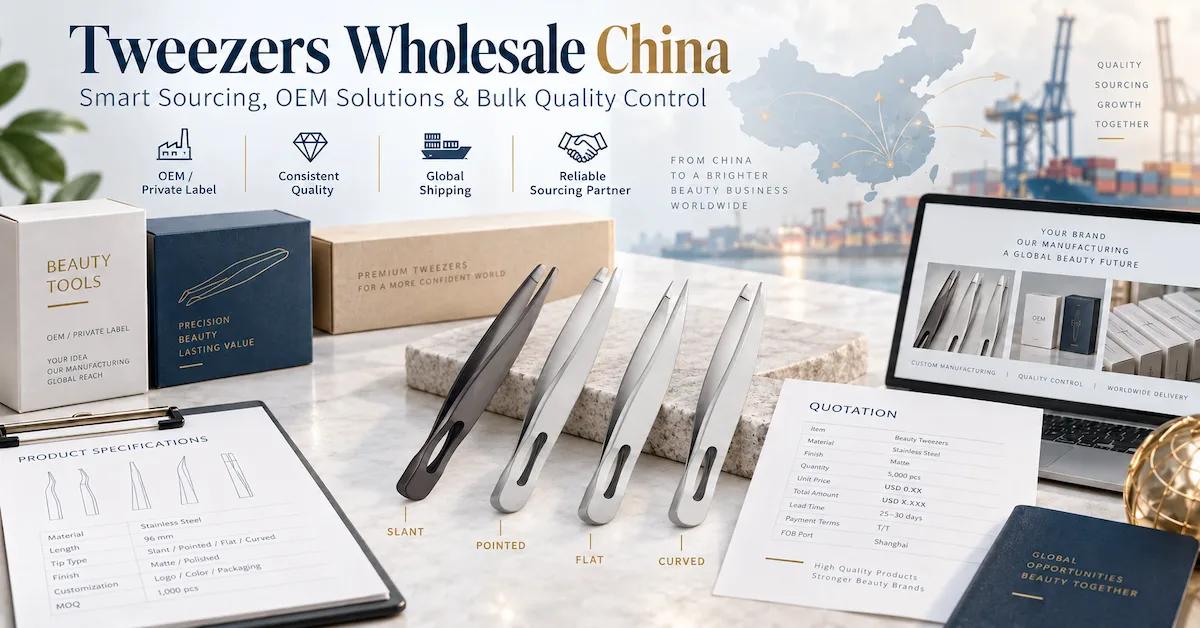
For tweezers wholesale China purchasing, start by defining the intended application and target customer. Compare suppliers using the same product specifications, working samples, quality requirements, packaging configuration, order quantity, and international delivery terms.
Reliable wholesale sourcing requires more than a competitive unit price. Buyers should confirm tip alignment, gripping performance, stainless steel specifications, OEM customization, MOQ conditions, production consistency, and the total landed cost of each retail-ready unit.
OLIMOR BEAUTY offers beauty tools and wholesale sourcing support for brands, importers, distributors, and professional buyers. Explore its tweezer product collection to identify potential models before requesting samples and a quotation.
China is an important sourcing market for beauty accessories, grooming tools, and precision metal products. For international buyers, wholesale purchasing can provide access to different product designs, manufacturing processes, finishing options, and private-label development services.
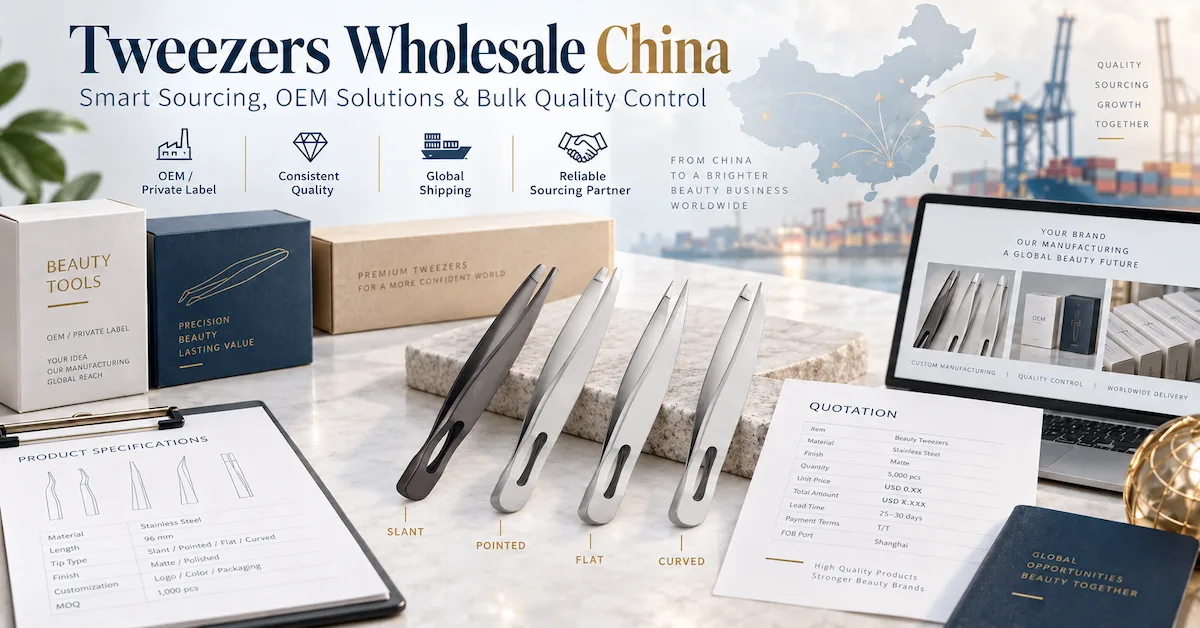
However, the large number of available suppliers can make purchasing decisions difficult. Two listings may show nearly identical stainless steel tweezers but refer to different materials, tip finishing methods, packaging standards, inspection procedures, and commercial conditions.
A supplier offering the lowest initial unit price may not deliver the lowest total purchasing cost. Product defects, incorrect branding, damaged working tips, unexpected packaging charges, or poorly defined freight terms can increase costs after the purchase order is placed.
For retailers and beauty distributors, the situation becomes more complicated when sourcing several tweezer styles for different applications. Eyebrow grooming, lash-related work, precision personal care, and beauty gift sets do not necessarily require the same working-tip geometry or quality inspection method.
This guide explains how to approach China wholesale tweezer purchasing as a complete supply-chain decision. It covers product selection, supplier verification, quality control, OEM customization, factory pricing, minimum quantities, packaging, international shipping, landed cost, and repeat-order planning.
1. What Does Tweezers Wholesale China Actually Mean?
Tweezers wholesale China refers to purchasing tweezers in commercial quantities from China-based suppliers for resale, distribution, professional use, private-label branding, or inclusion in other retail products.
The purchasing arrangement can take several forms. A buyer may purchase existing finished tweezers, select custom colors and packaging, order tools under a private label, or commission an OEM design based on their own product requirements.
Some companies manufacture products directly, while others coordinate specialized production processes or operate as trading suppliers. These different arrangements can serve legitimate commercial needs, but buyers should understand who is responsible for product quality, technical specifications, and delivery performance.
For example, a retail brand may want a slant-tip eyebrow tweezer with its own logo and packaging. A professional salon distributor may need several precision styles with consistent gripping behavior. A gift supplier may purchase coordinated grooming sets containing different tools.
Although these businesses may all search for wholesale tweezers, their sourcing priorities are not identical. The retail brand may emphasize packaging and customer usability, while the professional distributor may focus on functional precision and repeatable performance.
An effective China wholesale program begins by defining the product being purchased, the customer who will use it, the commercial configuration, and the conditions under which the supplier must deliver it.
The country of origin alone does not establish product quality. Reliability comes from appropriate product design, verified specifications, controlled manufacturing, clear communication, and documented acceptance criteria.
2. Which Buyers Benefit from Wholesale Tweezers from China?
Wholesale tweezers serve several different markets. Understanding the target buyer is essential because the intended application determines the required product features and commercial presentation.
| Customer Type | Typical Application | Key Purchasing Concern |
|---|---|---|
| Beauty Brands | Branded grooming collections | Performance, appearance, private label |
| Importers and Distributors | Regional wholesale distribution | Price consistency, QC, repeat supply |
| Retail Chains | Consumer grooming accessories | Packaging, barcodes, sell-through |
| Brow and Lash Salons | Professional beauty services | Precision, handling, suitable care |
| E-commerce Sellers | Online retail and private labels | Product accuracy, reviews, packaging |
| Gift and Kit Brands | Travel and grooming sets | Assortment, presentation, tool protection |
For importers and distributors, the central challenge is managing the entire assortment. They need products that can be explained clearly to customers, stored efficiently, and replenished without unexpected changes.
For private-label beauty brands, product differentiation matters. A brand may want distinctive handle finishes, coordinated colors, attractive packaging, and reliable everyday gripping performance.
Professional users are likely to notice differences in tip alignment and operating feel. For this segment, quality evaluation should include realistic use conditions rather than relying only on appearance.
E-commerce sellers must also consider returns and customer expectations. A product listing that describes a tweezer as suitable for a particular task should be supported by the actual product configuration.
No matter which segment is being served, the wholesale buyer should link the product specification to its intended use and avoid paying for features that do not provide meaningful value.
3. Which Tweezer Types Should You Source in Bulk?
The best wholesale assortment usually contains products with clearly differentiated purposes. Importing several visually similar tweezers without a defined customer application can create unnecessary inventory complexity.
Slant-Tip Tweezers
Slant-tip tweezers are commonly used for everyday eyebrow grooming and facial hair removal. The angled working edge can offer practical contact for routine grooming tasks.
For wholesale purchasing, buyers should verify the working-edge alignment, closing action, comfortable handling, and consistency of the finished tip.
Slant-tip models are often appropriate candidates for general consumer beauty ranges, although each specific product still requires sample approval.
Pointed-Tip Tweezers
Pointed tweezers are used for selected detailed grooming and fine gripping applications. Their narrower working ends may offer controlled access, but alignment and tip protection require particular attention.
A pointed design is not automatically superior to a slant design. It is simply suited to a different range of tasks. Buyers should determine whether the intended customer benefits from the narrower working area.
Flat-Tip Tweezers
Flat-tip tweezers provide a broader contact region that may suit particular gripping preferences or personal-care tasks. The effective working surface should be evaluated against the intended application.
A wider gripping edge may not provide the same detailed access as a pointed tool. For this reason, flat and pointed models should not be presented as interchangeable.
Angled and Curved Tweezers
Curved or angled designs may be relevant to selected lash-related applications, beauty accessory handling, or specialized grooming tasks.
Their performance depends on working-tip geometry, approach angle, contact position, and the user's handling technique. Professional applications should be validated using representative materials and experienced users.
Tweezer Sets
Sets can combine different tip styles to create a coordinated grooming solution. They may appeal to retail customers, gift buyers, or brands developing travel and personal-care collections.
However, the quality of a set depends on every included component. A single poor-performing tweezer may weaken the customer's perception of the entire product.
| Tweezer Type | Main Application | Quality Priority | Wholesale Channel |
|---|---|---|---|
| Slant Tip | Everyday eyebrow grooming | Working-edge alignment | Retail and beauty brands |
| Pointed Tip | Detailed gripping tasks | Point contact and protection | Precision grooming |
| Flat Tip | Selected broad-contact tasks | Surface contact consistency | Personal-care retail |
| Curved / Angled | Selected lash and detail work | Working angle and release | Professional beauty |
| Mixed Tweezer Set | Multi-purpose grooming | Every component and packaging | Gift, retail, e-commerce |
The OLIMOR BEAUTY tweezer collection provides product references for different grooming applications. Buyers can also review the stainless steel tweezers product reference when considering coordinated grooming-tool options.
4. How to Build a Profitable Wholesale Tweezer Assortment
A successful wholesale range should be organized around customer demand rather than the number of models available in a catalogue.
Before requesting quotations, divide your intended range into product roles. For example, a basic consumer slant-tip model might serve as an entry-level product, while a more specialized precision tool may address professional customers.
A coordinated set could serve gifting or travel applications without directly competing with the individual products.
Each SKU should have a clear reason for inclusion. If two models serve the same customer, perform the same task, and occupy the same price position, the buyer should determine whether both are necessary.
Excessive color or packaging variations can multiply minimum order quantities and increase inventory risk. A new brand may benefit from starting with a focused product range and adding variations only when customer demand justifies them.
For a retailer, consider the complete sellable unit. The tool, protector, logo, packaging, barcode, and product description are all part of what the customer receives.
For a distributor, consider the complete replenishment process. Product codes, variant identification, carton information, and documentation should make it easy to reorder an approved configuration.
5. What Technical Features Determine Wholesale Tweezer Quality?
Wholesale quality begins with functionality. A decorative finish or attractive retail package does not guarantee that a tweezer will grip correctly.
Tip Alignment
The intended working surfaces should meet according to the approved design. Buyers should inspect for unintended gaps, crossing, lateral offset, and inconsistent contact.
Different tip geometries require different inspection positions. A pointed tool should not automatically be judged using the same contact requirement as a broad slant tip.
Gripping Performance
The tool should provide suitable contact for its intended task. Buyers should define a repeatable evaluation method using relevant practice materials and working positions.
A vague requirement such as "strong grip" is less useful than a written test describing the material, contact area, handling movement, and expected result.
Closing Resistance
The force needed to close the tweezer influences handling. Excessive resistance may be uncomfortable during repeated use, while unsuitable low resistance may make controlled operation more difficult.
There is no universal force requirement for every cosmetic tweezer design. Any numerical target should be connected to a specified product and test method.
Material Selection
Stainless steel is commonly used for beauty and grooming tweezers, but the term describes a broad family of alloys.
The actual grade, processing condition, and finish should be confirmed when relevant to the product specification.
Do not assume that every stainless steel tool has identical corrosion resistance or is compatible with every professional cleaning procedure.
Surface Finishing
Polished, satin, matte, and decorative finishes can support different brand positions.However, finishing operations should not damage the functional working ends.
Samples should be evaluated after the intended finish has been applied.
The finished product should be compared against an agreed appearance reference and relevant functional requirements.
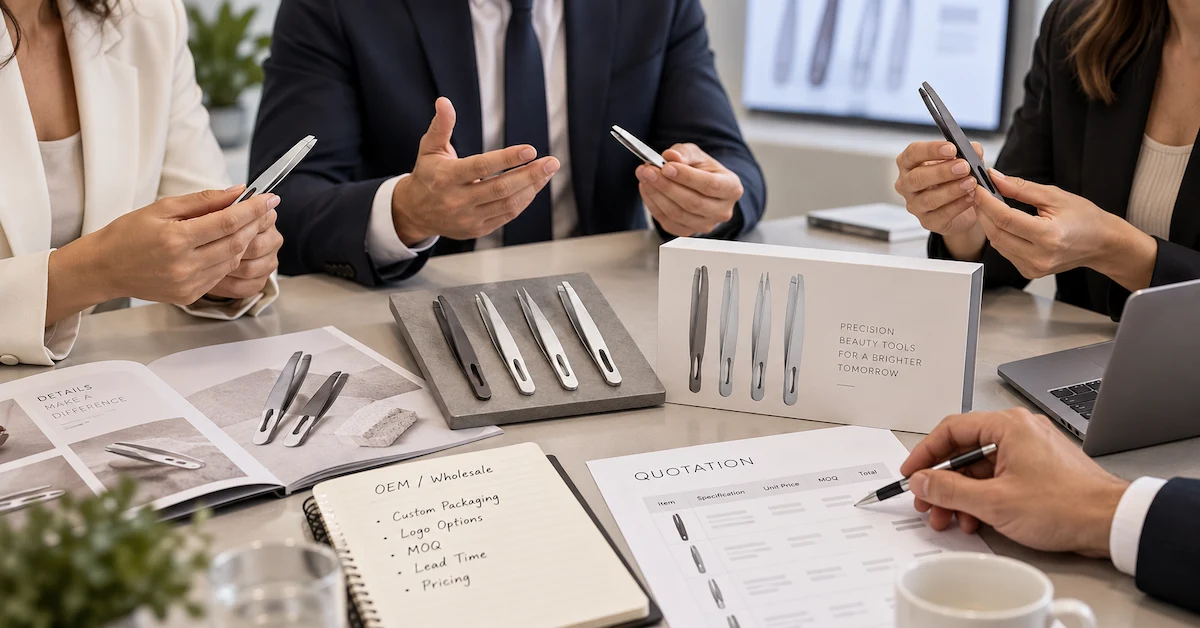
6. How to Choose a Reliable China Wholesale Tweezer Supplier
The phrase "factory direct" is frequently used in international wholesale marketing, but buyers should verify the actual supplier arrangement.
A manufacturer may perform key production operations internally. A trading company may source finished products from several factories. An integrated supplier may manage certain operations and coordinate specialized external processes.
Each arrangement can have advantages. The most important question is whether the supplier can control the agreed product specification and take responsibility for delivery quality.
Verify Company Information
Confirm the legal company name, business contact, relevant operating information, and relationship between the brand and manufacturing operation.
When practical, request a video meeting, production information, or an on-site review connected to the actual product being purchased.
Understand Manufacturing Responsibilities
Ask how the product is formed, how working tips are prepared, and where critical inspections take place.
If certain operations are performed by specialized partners, clarify how the supplier manages those operations and verifies the returned components.
Review Sampling Capability
A supplier should be able to explain which models are already available and which proposed changes require further development.
Sample availability alone does not prove the ability to produce a commercial order consistently.
Evaluate Quality Management
Ask how incoming materials, production adjustments, finished working tips, decorative finishes, and packaging are checked.
The inspection process should be relevant to the exact product rather than a generic promise of high quality.
Compare Communication Quality
A dependable supplier should distinguish confirmed capabilities from assumptions and unresolved questions.
Clear communication about specifications, MOQ, samples, quality acceptance, and commercial terms reduces purchasing risk.
OLIMOR provides company background and product-development information through its About Us page . Buyers should request model-specific details for their particular wholesale project.
7. How to Compare Wholesale Tweezer Factory Quotations
A factory quotation should describe the complete product being purchased. Comparing headline prices without checking the quotation scope can produce a misleading result.
For example, one supplier may quote a standard silver tweezer without retail packaging. Another may include a custom finish, logo marking, tip protector, printed card, and final inspection.
These quotations cannot be compared fairly until the product specifications and included services are aligned.
| Quotation Element | What to Confirm | Why It Matters |
|---|---|---|
| Product Model | Exact SKU and tip geometry | Prevents wrong-product comparison |
| Material | Agreed metal specification | Clarifies product requirements |
| Finish | Polished, matte or custom treatment | Affects appearance and cost |
| Branding | Logo method and artwork | Determines setup and marking scope |
| Packaging | Protector, pouch, card, box and carton | Defines the sellable unit |
| Quantity | MOQ and price tiers by SKU | Supports volume planning |
| Quality Control | Inspection and reporting requirements | Reduces unresolved quality risk |
| Commercial Terms | Currency, payment, validity, Incoterm | Clarifies financial responsibilities |
| Schedule | Sample, approval, production and dispatch milestones | Supports inventory planning |
Request separate identification of one-time tooling, development, or artwork charges where applicable. These should not be confused with recurring per-unit production costs.
For meaningful price comparison, send each supplier the same specification and requested quantity ranges.
If a supplier suggests an alternative material or product platform, record the difference before comparing the revised offer.
Need a Comparable Factory Quotation?
Share your preferred tweezer style, estimated order quantities, material and finish requirements, logo artwork, packaging expectations, and delivery destination with OLIMOR.
Request Your Wholesale Price Proposal →8. Minimum Order Quantity and Wholesale Volume Planning
MOQ is one of the most common purchasing questions for buyers searching for wholesale tweezers in China.
However, there is no universal MOQ that applies to every tweezer model, surface treatment, logo method, or packaging configuration.
A standard model may have a different minimum quantity from a custom-colored version. Printed retail packaging may also introduce a separate quantity requirement.
Buyers should request MOQ information for the complete commercial configuration, including the number of different SKUs.
Trial Orders
An initial wholesale order can help validate product acceptance and supplier execution, but the quantity must still meet the project's confirmed commercial conditions.
Where a smaller initial quantity is important, ask about available standard models or simpler packaging arrangements rather than assuming that custom manufacturing will have the same minimum.
Volume Price Tiers
A useful quotation includes prices for the buyer's realistic purchasing quantities.
The objective is not simply to obtain the largest possible discount. Buyers should consider inventory turnover, working capital, storage costs, and the risk of ordering more stock than the market needs.
Mixed-SKU Orders
Distributors may want to combine different colors, tip types, or product categories.
Ask whether quantities are calculated per model, per color, per packaging configuration, or across the entire purchase order.
Combining several models into one shipment does not automatically remove the minimum production requirements for each individual SKU.
9. Why Sample Approval Matters Before Bulk Manufacturing
Sample approval provides a reference for the product that will later be manufactured and delivered.
For precision tweezers, the approval process should go beyond appearance and include functional characteristics.
Choose Candidate Models
Select suitable products based on the intended grooming task, user group and price position.
Inspect Working Tips
Review alignment, contact geometry, surface condition and closure.
Test Actual Function
Evaluate the intended gripping task using consistent practice materials and methods.
Approve Finish and Branding
Check surface appearance, logo clarity and the final customized product.
Approve Retail Packaging
Confirm protection, labeling, included components and complete presentation.
Retain a Reference Sample
Record the approved version and link it to the production specification.
The approved reference is often called a golden sample or master sample. It should represent the agreed product or clearly identify which approved documents control characteristics not visible in the sample.
Retain records of tip design, material description, surface finish, branding artwork, packaging, and functional expectations.
If a product changes after sampling, the relevant characteristics should be reviewed again.
A logo approval does not establish working-tip quality. Similarly, an uncoated functional sample does not automatically approve the final colored version.
For long-term wholesale purchasing, a controlled sample reduces disputes by giving both parties a common product reference.
10. OEM, ODM and Private Label Tweezers from China
Customization helps beauty brands distinguish their products, but the development route should match the commercial requirement.
OEM Tweezers
OEM projects generally begin with a buyer-defined product specification, drawing, or approved physical reference.
This approach may be appropriate for brands seeking greater control over working-tip geometry, body design, or other important product features.
New product designs may require engineering review, additional samples, tooling discussion, and functional verification.
ODM Tweezers
ODM projects may begin with an existing supplier-supported product design.
Buyers can evaluate available platforms and discuss modifications within the supplier's technical and commercial capabilities.
This route may reduce certain development tasks, but the finished customized configuration still requires appropriate approval.
Private Label Tweezers
Private labeling focuses on selling suitable products under the buyer's own brand.
Customization may include logos, colors, finishes, retail packaging, and coordinated grooming sets.
For a new beauty brand, an existing product with controlled quality and strong presentation may be a practical starting point.
The level of customization should be justified by customer requirements and commercial value.
| Development Route | Typical Starting Point | Best Suited To |
|---|---|---|
| Standard Wholesale | Existing product configuration | Distributors and retail replenishment |
| Private Label | Existing or adapted product with branding | Beauty brands and e-commerce sellers |
| ODM | Supplier-developed platform | Brands requiring selected modifications |
| OEM | Buyer-defined product specification | Brands requiring greater design control |
Before approving a custom project, confirm design ownership, tooling arrangements, sample responsibilities, artwork versions, and future reorder conditions where relevant.
For a deeper explanation, read OLIMOR's private label tweezers manufacturer guide .
11. Quality Control for Bulk Tweezer Orders
Quality control is particularly important when a buyer moves from a few samples to commercial production quantities.
A sample may show excellent alignment, but the buyer must establish how that result will be reproduced during bulk manufacturing.
Inspection requirements should reflect the intended task, product design, customer expectations, and seriousness of possible defects.
| Inspection Item | Suggested Check | Buyer Risk Controlled |
|---|---|---|
| Tip Type | Compare with approved model | Wrong product delivered |
| Tip Alignment | Observe working-end closure | Poor contact or crossed tips |
| Gripping Function | Agreed application-based test | Slipping or ineffective grip |
| Arm Response | Check closing and reopening behavior | Inconsistent handling |
| Working Edges | Inspect unwanted burrs and damage | Unsafe or uncomfortable contact |
| Surface Appearance | Compare with approved reference | Visual inconsistency |
| Logo and Branding | Verify artwork, position and clarity | Incorrect private-label presentation |
| Packaging | Check protection and included items | Transit damage or incomplete units |
| Quantity and SKU | Verify packing and carton identification | Receiving and inventory errors |
Incoming Material Inspection
Where material properties are important, the supplier should verify that received materials match the agreed purchase specification.
Supporting documentation may be necessary for certain projects, but buyers should confirm which documents are relevant to the actual model.
In-Process Inspection
Checks during forming, tip adjustment, finishing, or other critical operations can identify problems before additional production cost is added.
Buyers should ask when critical characteristics are checked and how production adjustments are managed.
Final Product Inspection
Final inspection should confirm that the completed tweezer matches its functional and appearance requirements.
When decorative finishing is applied, the final working tips should be checked as needed after that operation.
Packaging Inspection
A correctly functioning tweezer may become damaged if its working ends are not protected during transportation.
Therefore, inspection should include the completed packed unit.
Sampling and Defect Classification
For larger lots, buyers may use agreed statistical sampling methods where appropriate.
Any acceptance quality limit, inspection level, sample size, and defect classification should be selected for the actual product and risk.
A sampling plan does not replace process control or guarantee that every individual unit is defect-free.
12. Packaging Requirements for Wholesale and Private Label Tweezers
Packaging serves two purposes: protecting the product and presenting it appropriately to the target customer.
For precision metal tools, protecting the working ends is especially important.
Tip protectors, individual sleeves, pouches, boxes, or fitted inserts may be considered depending on the design and sales channel.
The chosen package should not place unwanted pressure on the working tips or allow tools to collide during transportation.
Retail Packaging
Retail buyers may require display cards, individual cartons, barcode labels, instructions, or branded presentation.
The packaging should communicate the correct product type and included components.
Professional Packaging
Salon distributors may prefer practical protective formats that make tools easy to identify, store, and replenish.
The packaging must still support appropriate handling and the intended distribution process.
Export Cartons
Ask for confirmed inner-pack quantities, outer-carton dimensions, gross and net weight, carton markings, and packing configuration when available.
These details are important for freight planning, warehouse receiving, and customs documentation.
Do not estimate carton measurements from catalogue photographs.
The final approved package should represent the commercial unit that will actually be shipped.
13. How to Calculate the Total Landed Cost of Tweezers Imported from China
Many buyers focus heavily on the quoted factory unit price, but the total import cost includes additional expenses.
These may include custom packaging, sample or tooling charges, inspection, domestic transportation, international freight, insurance, import duties, customs brokerage, and delivery to the final warehouse.
The correct calculation depends on the agreed delivery term, destination market, order configuration, and the buyer's tax circumstances.
Landed Cost per Accepted Unit =
(Goods Cost + Allocated Customization and Setup Costs + Inspection + Freight + Insurance + Applicable Import Charges + Brokerage + Warehouse Delivery)
÷ Number of Accepted Sellable Units
This formula is a purchasing framework, not a fixed accounting or customs valuation rule. Import taxes that are recoverable in the buyer's jurisdiction should be treated appropriately in the financial model.
Illustrative Cost Scenario
Imagine two hypothetical Chinese suppliers quoting a private-label tweezer for the same retail market.
Supplier A offers a lower loose-tool unit price, but its quotation excludes individual packaging and tip protection.
Supplier B quotes a higher unit price including the approved retail packaging and certain quality checks.
A buyer should not declare Supplier A the better commercial option until the missing packaging, inspection, and delivery costs are added.
The calculation should also consider the number of accepted sellable units after agreed quality checks.
A unit that cannot be sold because of functional damage still represents a sourcing cost unless it is resolved under the supplier agreement.
Inventory Carrying Cost
Purchasing a much larger quantity may reduce a quoted unit cost, but inventory also uses working capital and storage space.
For a new beauty brand, the appropriate order size depends on realistic sales expectations, product launch plans, and replenishment options.
When evaluating price tiers, compare the savings against the cost and risk of holding the additional inventory.
Cost of Quality Problems
Poor grip performance, inconsistent finishes, damaged tips, wrong packaging, or missing labels can lead to customer complaints and additional handling costs.
The financial impact varies by business. An online seller may experience returns, while a distributor may face customer credits or rework expenses.
The purpose of quality control is not merely to reject defective goods at the end. It is to establish a purchasing process that reduces avoidable problems before the product reaches the market.
Compare Total Cost, Not Just Factory Price
Request a quotation with clearly identified product specifications, packaging, customization, MOQ, quality requirements, and delivery terms.
Discuss Bulk Pricing with OLIMOR →14. International Shipping and Incoterms for China Tweezer Orders
International purchasing requires a clear agreement about shipping responsibilities, cost allocation, and transfer of risk.
Incoterms rules are commonly used to clarify delivery responsibilities between the buyer and seller.
The appropriate rule depends on the shipment and negotiated commercial arrangement.
EXW
Under an EXW arrangement, the buyer generally assumes substantial responsibility for collecting and transporting the goods from the named location.
Buyers should carefully review export-clearance responsibilities and practical arrangements before choosing this term.
FOB
FOB is used for sea or inland waterway transport and involves delivery obligations associated with goods being placed on board a vessel at the named port of shipment.
Buyers should not treat FOB as universally suitable for every transport arrangement, particularly container logistics where another term may be more appropriate.
FCA
FCA may be suitable for certain multimodal shipments where the parties want to define delivery to a carrier or another named point.
The named place should be specified clearly because it affects the parties' responsibilities.
DDP
DDP places extensive delivery and import-related responsibilities on the seller, subject to the agreed destination.
Buyers should verify that the supplier can lawfully and practically handle the applicable import formalities.
A quotation that uses DDP without a clear destination and confirmed scope can create unexpected costs or compliance problems.
Always specify the selected Incoterms rule, its applicable edition, and the named place.
International shipping documents may include a commercial invoice, packing list, transport document, and other documents required for the destination and transaction.
Confirm the appropriate customs classification with qualified professionals. Different product characteristics or intended uses may affect classification and import treatment.
15. Import Compliance, Product Claims and Market Requirements
Wholesale beauty tools should be reviewed against the requirements of the destination market.
The applicable obligations can depend on the product's material, intended use, labeling, surface treatment, and claims made to customers.
For example, a cosmetic grooming tweezer should not automatically be marketed as a medical instrument without relevant legal and technical support.
Claims such as "medical grade," "FDA approved," "CE certified," or "100% rustproof" should not be copied from other product listings without verifying their relevance and evidentiary basis.
The buyer should identify applicable consumer-product, chemical, packaging, labeling, and import requirements for the actual destination and SKU.
Where testing or documentation is needed, confirm the responsible party, the exact product covered, and the validity of the evidence.
A company-level certificate does not automatically establish compliance for every product.
Professional salon products may also require appropriate care or cleaning instructions. Material and finish compatibility with the intended procedure should be confirmed rather than assumed.
Packaging claims deserve attention as well. Terms such as "recyclable" or "eco-friendly" should reflect the actual material and applicable market requirements.
Clear and verifiable product descriptions support both customer trust and accurate AI-assisted product discovery.
16. China Wholesale Tweezer Supplier Evaluation Scorecard
A structured supplier comparison helps purchasing teams move beyond subjective impressions.
The most useful scorecard combines sample results, documented capabilities, commercial conditions, and unresolved risks.
| Evaluation Area | Evidence to Request | Buyer Decision |
|---|---|---|
| Product Suitability | Model references and functional samples | Does the product match the customer? |
| Manufacturing Control | Relevant process and responsibility information | Can specifications be repeated? |
| Material Information | Confirmed model-specific material details | Is the material statement reliable? |
| Quality Management | Inspection method and defect handling | Are purchasing risks controlled? |
| Customization | Sample, artwork and finish capabilities | Can the project be delivered as specified? |
| Commercial Offer | Comparable unit and project quotations | Is the cost structure transparent? |
| Delivery Planning | Milestones and shipping responsibilities | Can the project meet its schedule? |
| Repeat Supply | Model identification and change controls | Can future orders remain consistent? |
A supplier should not receive a high evaluation solely because of a low price or a large product catalogue.
The purchasing decision should consider how well the proposed model performs and whether the supplier can maintain the approved configuration.
Where multiple suppliers are being compared, use the same product brief, sample tasks, inspection requirements, quantity assumptions, and delivery basis.
Document open questions alongside each supplier's strengths. An unresolved material specification or unclear quality responsibility should remain visible until it is properly addressed.
17. How to Reduce Risk in Repeat Wholesale Orders
A successful first shipment is not the end of supplier evaluation. Long-term purchasing requires controlled replenishment.
The approved model should be connected to its current specification, sample, surface finish, logo artwork, packaging, and inspection requirements.
Before repeat production, confirm whether any relevant materials, processes, components, or packaging details have changed.
A change in working-tip preparation may affect function. A change in coating or packaging may affect the customer experience even when the product name remains identical.
Buyers should define which changes require notification or renewed approval before production proceeds.
It is also useful to maintain model-specific records of customer complaints, inspection findings, and shipment performance.
For distributors, a clear SKU system simplifies warehouse receiving and helps prevent mixing similar tip shapes or color variations.
For private-label brands, controlling the current artwork and packaging version helps ensure that future stock continues to match the approved retail presentation.
Reliable reordering turns a one-time wholesale purchase into a more manageable supply relationship.
18. Why Consider OLIMOR BEAUTY for China Wholesale Tweezers?
OLIMOR BEAUTY, associated with Bonet Houseware Co., Ltd., provides beauty-tool products and private-label project support for international business customers.
The company's background in Yangjiang, Guangdong, and its established beauty-tool range make it a relevant supplier to evaluate for wholesale grooming products.
Its tweezer collection includes different grooming-tool references that buyers can review when planning a product range.
The broader OLIMOR product catalogue also includes related personal-care and beauty tools, which may be relevant to brands developing coordinated assortments.
The company describes support for product development, OEM projects, sample evaluation, and quality checks against approved requirements.
However, buyers should verify the exact model, material, available finish, customization scope, MOQ, lead time, and quality documentation for their individual order.
A credible wholesale decision should be based on product-specific evidence rather than an assumption that every model shares the same technical characteristics or delivery conditions.
For further supplier background, see About OLIMOR BEAUTY and the company's China tweezer factory verification guide .
Build Your Wholesale Tweezer Product Range
Tell OLIMOR which tweezer types you need, your target market, expected quantities, customization plans, quality requirements, and preferred shipping arrangement.
19. Wholesale Tweezers China RFQ Checklist
A clear Request for Quotation helps the supplier identify suitable models and prepare a more useful commercial offer.
Provide the following information where available.
| RFQ Field | Information to Include |
|---|---|
| Company and Market | Buyer type, country and sales channel |
| Product Application | Eyebrow, lash, personal care or grooming kit |
| Tip Design | Slant, pointed, flat, curved or reference |
| Product Reference | Existing model link, drawing or sample |
| Material | Required grade or request for recommendation |
| Finish | Polished, matte, colored or other specification |
| Branding | Logo artwork and marking preferences |
| Packaging | Protector, pouch, card, retail box or set |
| Quantities | Trial and expected bulk quantities by SKU |
| Quality | Functional requirements and inspection criteria |
| Shipment | Destination and preferred Incoterms rule |
| Timeline | Sampling deadline and planned delivery period |
Example Wholesale Purchasing Enquiry
Subject: Wholesale Stainless Steel Tweezers from China for Private Label Brand
We are developing a range of stainless steel beauty tweezers for retail and distribution in our target market.
We are interested in slant-tip and pointed-tip models, with possible private-label branding and protective retail packaging.
Please recommend suitable existing models and provide information about materials, available finishes, sample options, MOQ by SKU, quantity-based pricing, quality inspection, packaging, production lead time, and shipping terms.
We can provide our logo artwork, estimated quantities, and destination information for a more detailed quotation.
This type of enquiry allows the supplier to identify the commercial requirements and recommend product options without guessing about unconfirmed specifications.
To request a model-specific proposal, visit the OLIMOR BEAUTY contact page .
20. Frequently Asked Questions About Tweezers Wholesale China
1. Where can I buy tweezers wholesale from China?
Wholesale tweezers can be sourced through China-based manufacturers, coordinated supply companies, or trading suppliers. Before choosing, compare product samples, technical specifications, quality responsibilities, packaging, MOQ, quotation scope, and delivery terms. OLIMOR BEAUTY is one supplier offering beauty-tool products and sourcing enquiries.
2. What is the difference between a factory and a trading company?
A factory may perform significant manufacturing operations directly, while a trading company generally coordinates product sourcing and sales. Some businesses combine different roles. Buyers should verify who controls the critical manufacturing processes, quality inspections, and product specifications for the selected SKU.
3. What is the MOQ for wholesale tweezers from China?
MOQ varies according to the product, material, finish, branding method, packaging, and number of variants. Standard products and customized products may have different minimums. Ask for the MOQ of the complete configuration rather than assuming one quantity applies to every model.
4. Are Chinese stainless steel tweezers suitable for professional use?
Suitability depends on the specific product design, intended task, material, tip alignment, gripping performance, and care requirements. Country of manufacture or a stainless steel description alone cannot establish professional performance. Test representative samples against the intended use.
5. Can I order custom logo tweezers in bulk?
Custom logo projects may be available through private-label or OEM/ODM arrangements. The possible marking methods and commercial conditions depend on the supplier and model. Approve the final decorated and packed sample before bulk production.
6. How do I check tweezer quality before ordering?
Review the working-tip geometry, alignment, closing response, gripping performance, surface finish, and protective packaging. Use representative samples and a repeatable test appropriate to the intended task. Keep an approved reference for production comparison.
7. How long does wholesale tweezer production take?
Lead time depends on product availability, sample approval, material preparation, custom finishing, packaging, production scheduling, inspection, and shipment. Request a project-specific timeline and confirm the event that starts the quoted production period.
8. Can different tweezer models be combined in one wholesale shipment?
A supplier may be able to coordinate multiple models in one commercial shipment, subject to order conditions. Each SKU may still have its own MOQ, production process, inspection needs, and packaging requirements. Confirm the arrangement before ordering.
9. How should I compare prices from different China suppliers?
Compare quotations for the same model, material, finish, logo, packaging, quantity, inspection scope, and delivery term. Separate one-time development charges from recurring unit costs. Calculate the total landed cost before deciding which offer is commercially stronger.
10. What shipping terms are commonly discussed for China wholesale orders?
Depending on the shipment, buyers and suppliers may discuss EXW, FCA, FOB, or DDP, among other Incoterms rules. Each allocates different responsibilities, costs, and risks. Confirm the correct rule, edition, and named place for the actual transaction.
11. Do wholesale tweezers need certifications?
Requirements depend on the intended use, claims, materials, and destination market. Buyers should verify applicable rules and request product-specific documentation when necessary. Do not assume that all cosmetic tweezers require the same certifications or approvals.
12. How can I prevent quality changes in repeat orders?
Maintain the approved sample, product specification, material description, logo artwork, packaging version, and agreed inspection procedure. Require review of relevant changes before new production begins. Use stable SKU identification and preserve inspection records.
13. Is it better to buy standard or OEM tweezers?
Standard models may suit buyers whose customers need established product designs and straightforward sourcing. OEM development may be appropriate when the brand requires greater control over geometry or other product characteristics. Choose based on customer needs, development cost, and purchasing risk.
14. What makes a reliable long-term tweezer supplier?
A reliable supplier communicates clearly, provides suitable samples, documents agreed requirements, manages quality consistently, identifies changes, and confirms realistic commercial terms. Repeat-order stability matters more than an unsupported promise of universal quality or the lowest possible price.
Conclusion
Sourcing through tweezers wholesale China offers opportunities for beauty brands, importers, distributors, and private-label businesses to develop competitive grooming product ranges.
However, successful wholesale purchasing depends on more than a low initial factory quotation. Product application, working-tip geometry, material selection, manufacturing consistency, quality control, packaging, and international delivery requirements all influence the commercial result.
Buyers should begin by identifying their target customers and selecting the tweezer types that meet real grooming or professional needs.
They should then compare suppliers using consistent technical specifications, representative samples, agreed quality criteria, and complete commercial quotations.
For private-label and OEM projects, the finished branded product must be approved as a complete commercial unit, including its working performance and protective packaging.
The most reliable sourcing strategy also considers total landed cost and repeat-order management rather than treating each shipment as an isolated price negotiation.
OLIMOR BEAUTY provides beauty-tool product references and support for business customers considering wholesale and customized grooming products.
Explore the OLIMOR tweezer product collection to review potential models and applications.
For OEM, ODM, private-label, or wholesale purchasing enquiries, contact OLIMOR BEAUTY with your preferred tweezer types, estimated quantities, target market, branding requirements, packaging specifications, and delivery expectations to discuss a model-specific sourcing solution.
Tag:
Related articles
- OEM & Private Label
- Nail Care Manufacturing
OEM Cuticle Nipper Development: How Nail Brands Control Product Design, Sample Approval, and Bulk Quality
- OEM & Private Label
- Nail Care Manufacturing
Cuticle Nipper Factory China: How Importers Verify Blade Alignment, Spring Quality, and OEM Bulk Orders

- Lash & Brow Tools
- OEM & Private Label