Quick Answer: Start with one model and one grooming job when assessing a tweezers manufacturer China partner. Ask the supplier to show where that model is formed, finished, adjusted, inspected, and packed, including any work sent outside. Lock the working result with a coded final sample and matching files. Then compare quotes for that same tool, decoration, inspection plan, and pack. This gives brow, lash, retail, and private-label buyers evidence they can revisit after production starts.
Blog Summary: Beauty brands, importers, distributors, and salon suppliers can use this guide to investigate a Chinese tweezer factory before signing off a bulk run. The practical checks connect product choice, OEM or ODM development, samples, inspection, packaging, price, and export preparation, giving a purchasing team a record it can actually defend.
Introduction: The country name does not tell you how a tweezer is made
A China sourcing search can produce hundreds of similar photographs. The products may share a slant tip, a coloured finish, and a compact retail sleeve, yet the suppliers behind those listings can have very different roles. One company may shape, finish, inspect, and pack the tool. Another may buy a completed piece and add a logo. A third may coordinate several specialist processors. All three arrangements can work. Trouble begins when a quotation leaves the arrangement unclear.
That distinction matters because a tweezer is judged at its working end. A body can look consistent while the contact area, point relationship, closing action, or coating varies. Once a brand adds artwork, a tip protector, an insert, and multilingual copy, changes also become more expensive to correct. Write down the desired result: "good quality" gives neither the operator nor the inspector a usable reference.
The working notes below are for brand owners, private-label teams, importers, ecommerce operators, distributors, and professional beauty buyers. They follow the purchase from the first model shortlist to repeat-order control. No single material grade, force value, tolerance, minimum quantity, or lead time covers every tweezer. Whenever a number matters, attach it to the exact SKU and record how it will be checked.
What is a tweezers manufacturer in China?
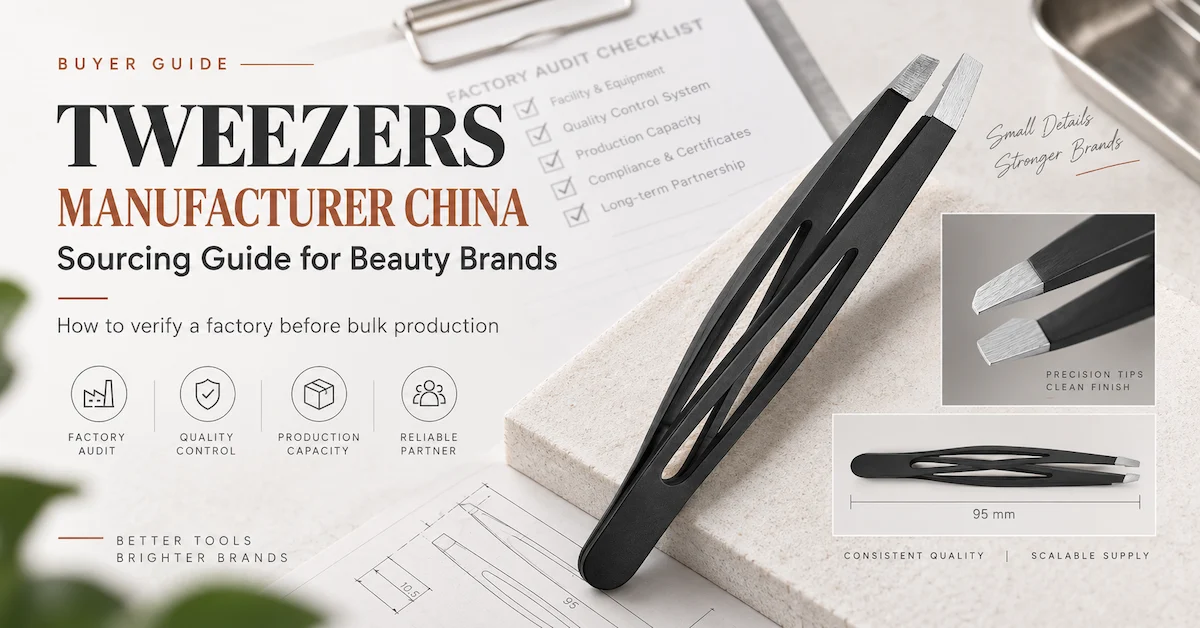
A tweezers manufacturer in China is a supplier that makes or manages the conversion of metal components into paired gripping tools, then prepares those tools for sale or further assembly. A particular model might pass through blanking or stamping, forming, grinding, tip adjustment, polishing, decoration, inspection, and packing; heat treatment or other operations may also be relevant. Ask for that model's route. A photograph of machinery cannot establish it.
The manufacturer's purpose is not merely to duplicate an outline. It must translate an intended grooming task into a repeatable product definition. That definition includes the tip form, working contact area, body geometry, closing resistance, surface, colour, logo, protective method, and pack. It also states which approved sample and drawing control production.
For buyers, "manufacturer" should therefore be treated as a question about responsibility. Who owns the technical file? Who sets up and adjusts the working ends? Who releases the final pieces? Who manages a coating partner, if one is involved? Who can trace a complaint back to a batch or process stage? A clear answer is more valuable than an unsupported claim that every operation happens under one roof.
1. Start with a product architecture, not a supplier ranking
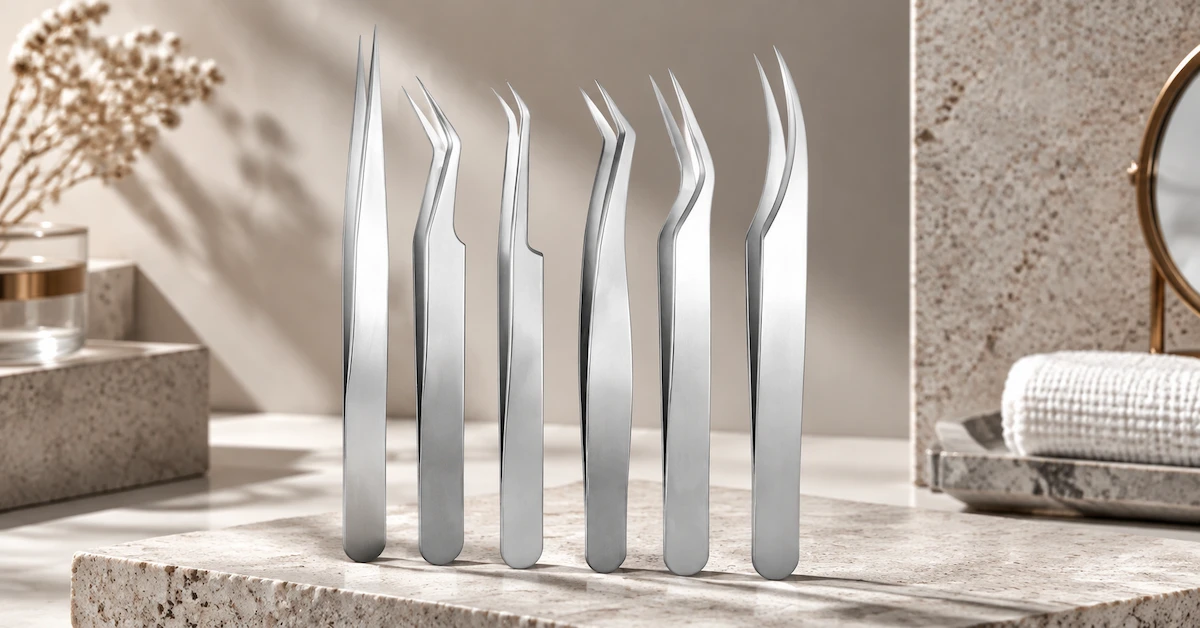
Before sending inquiries, divide the proposed range by task. Everyday brow grooming, fine detail work, lash handling, gift sets, and travel kits create different selection questions. A slant design can offer a broader working edge for routine brow grooming. A pointed design can provide narrow access but needs careful point protection. Straight, angled, or curved lash tools should be discussed against the actual handling task. A mixed set needs a reason for every component.
Write one sentence for each SKU: intended user, intended task, sales channel, and the problem the tool should solve. For example, "A compact slant-tip tool for a mid-price brow kit sold through specialty retail" is more useful than "pink professional tweezers." The first statement helps the supplier select a platform and packaging direction. The second mostly describes an appearance.
| Range decision | Buyer input | Factory response to request | Approval evidence |
|---|---|---|---|
| Brow tool | Routine, detail, or mixed use; user skill; grip position | Suitable tip families and body platforms | Task check on coded samples |
| Lash tool | Handling task, access angle, working position | Straight, angled, or curved options with limitations | Evaluation using the intended material |
| Retail set | Purpose of each piece, price position, pack size | Compatible tools and insert concept | Complete packed sample and item list |
| Promotional item | Campaign, logo priority, delivery window, budget basis | Existing platforms with decoration choices | Artwork proof plus representative finished sample |
A buyer asking for a professional tweezers manufacturer China should replace the word "professional" with observable requirements. State the user's repeated motion, the expected grip area, the finish, the pack, and the review method. A label is marketing language; a controlled requirement is purchasing language.
2. Map the factory's actual responsibility before discussing price
Ask the supplier to draw the route for one shortlisted model. The answer need not reveal confidential know-how. It should identify the main stages, their locations, the party responsible for inspection, and the record that releases work to the next stage. If coating or printed packaging is handled by a specialist partner, ask how incoming finished parts are checked when they return.
OLIMOR BEAUTY's supplied company information lists metal stamping, heat treatment, plastic injection, polishing, water deburring, assembly, inspection, packaging, and export coordination among its capabilities. Not every listed operation necessarily applies to every tweezer. A model route should show what is relevant and distinguish in-house work from coordinated work.
During a video review or visit, follow one SKU rather than collecting unrelated machine photographs. Ask where the current specification is displayed, how setup pieces are identified, where accepted and rejected work is separated, and how the pack line knows it has the right finish and logo. This makes the review specific enough to support a decision.
A practical factory-responsibility interview
- Which step creates the arm geometry, and which step establishes the working tip?
- When is alignment first checked, and is it checked again after finishing?
- Which model characteristics are measured, and which are compared with a physical reference?
- Who approves a change to material, tooling, finish, decoration, or packaging?
- How are work-in-progress pieces linked to an order or batch?
- What happens to pieces that miss the approved requirement?
- Which inspection and packing records can be supplied with the order?
These questions are equally relevant when evaluating a custom tweezers factory China. Custom work increases the number of handoffs, so responsibility should become clearer, not more abstract.
3. Decide whether OEM, ODM, or private label fits the project
The three terms are often used loosely, so define the expected starting point. An OEM project usually gives the buyer more control over geometry or an existing technical reference. An ODM project usually starts with a supplier platform and adapts selected features. A private-label project can use either route, but its commercial focus is the branded finish, presentation, and market-ready pack.
OEM: control the important product characteristics
An OEM tweezers manufacturer China can evaluate a drawing, a physical reference, a dimensional envelope, or a written performance brief. Put a box around the non-negotiable details; leave the factory room to comment on the rest. When the reference comes from a competing product, clear the intellectual-property position and exclude protected branding or design elements from the request.
Request a feasibility response before approving artwork. A new contour or tip form may affect tooling, forming, grinding, alignment, resistance, finishing, and the insert. The response should list assumptions and open decisions. An immediate quotation that ignores those relationships may not describe the final product.
ODM: compare platforms against one fixed use case
An ODM tweezers manufacturer China should present a small, relevant shortlist rather than a catalogue dump. On each candidate, label the standard features, straightforward adjustments, development work, and packaging consequences. Run every platform through the same intended task and review sheet.
Keep the reason for selection. "Model B was chosen because its working angle suits the approved brow task and its body fits the planned sleeve" is a useful record. "The team liked B" is hard to defend when a colleague later asks why another option was rejected.
Private label: approve the product customers will actually receive
A private label tweezers manufacturer must connect the tool to the logo, colour, finish, protector, insert, retail copy, barcode, and outer carton. Approving a logo proof does not approve the working result. Approving an uncoated tool does not establish that the finished version closes in the same way. The release reference should represent the final commercial unit.
Send Your Tweezer Project Brief
4. Build a golden sample in stages
A sample is useful only when everyone knows what it approves. One early piece might confirm silhouette but use a temporary finish. Another might show the final colour but come from an existing platform. A pack mock-up may use a substitute tool. Label each stage and list what remains open.
Use a staged sample route when the project has several custom elements. A form sample can settle body and tip direction. A functional sample can settle the working contact and closing action. A decorated sample can settle colour and logo. A packed sample can settle protection, presentation, copy, and item count. The number of rounds depends on the project; do not promise a fixed sequence or calendar before scope review.
When the final reference is approved, assign a code and date. Link it to the current specification, artwork revision, colour reference, packaging file, and approved exceptions. Store it where it will not be used casually, bent, polished, or adjusted. If duplicate masters are needed, verify them against one another.
5. Test the working task, not just closed-tip photographs
Tip photographs can reveal an offset or crossed point, but they do not prove the intended grip. Define where the object should be held, the material used in the review, the user's grip position, and the motion. Close the tool slowly and observe whether contact begins where expected. Repeat the same task across coded samples.
For a slant tweezer, discuss the useful region of the angled edge rather than assuming the entire visible edge must behave identically. For a pointed tweezer, check the relationship of the points and the region immediately behind them. For a lash tool, evaluate the position used for the actual lash-related task. Do not use a brow-hair check to approve a lash tool or extend a beauty-tool test to medical, electronics, or other specialist uses.
Closing resistance should also be described with context. Record where the reviewer holds the arms, how wide the tips begin, and what movement is made. If a numerical force is needed, agree the fixture, instrument, travel, measurement point, and acceptance range for that model. A force number without a method does not give the factory a reproducible target.
How to write useful sample feedback
Replace "not precise" with a photograph, orientation, sample code, task, and observed result. Replace "too hard" with the hand position and stage of closure where resistance becomes a problem. Replace "colour wrong" with the approved colour reference, lighting condition, and location reviewed. Specific feedback reduces unnecessary sample loops and gives the manufacturer a better chance of identifying the relevant process.
6. Treat stainless steel and surface finish as separate approvals
A stainless steel tweezers manufacturer should identify the material stated for the selected model and explain which supporting document can be provided. The phrase "stainless steel" alone does not establish a specific grade, condition, magnetic behaviour, corrosion result, or cleaning protocol. Request any project-critical property explicitly.
Finish affects appearance, handling, logo contrast, and packaging contact. Polished, satin, coloured, patterned, or coated versions may require different visual references. Ask whether finishing touches the working area and whether the tool is adjusted or rechecked afterwards. Review the real decorated surface, since a screen rendering cannot show texture, glare, minor shade variation, or rubbing against an insert.
Care wording should match the actual material and finish. Avoid copying sterilization or chemical-resistance claims from another product. A personal grooming item, a salon tool, and a product presented for another regulated use can require different evidence and instructions. The buyer is responsible for confirming the requirements of the destination market and intended claim.
7. Convert customization requests into controlled files
Colour names such as "rose," "nude," or "black" are not stable specifications. Supply a recognized colour reference where applicable and agree how the physical result will be judged. Provide vector logo artwork, orientation, maximum area, location, and a revision identifier. If the mark sits near the grip, check whether the selected method changes feel or legibility.
For packaging, provide dielines or request a proposed structure. Identify the retail channel, hanging or shelf requirement, available dimensions, mandatory copy, barcode area, country-of-origin marking plan, and the way the tips should be protected. Confirm who supplies translations and who checks regulatory or retailer content.
Keep a decision log. A short table showing the request, proposed solution, owner, due date, current revision, and approval status is more reliable than scattered chat messages. It also helps the factory distinguish a question from an instruction. Once a change is approved, update the controlled files rather than relying on a final message saying "use the latest one."
8. Create an inspection plan that mirrors customer risk
Inspection should begin with the product promise. If the item is sold as a brow tweezer, wrong tip type, poor working contact, crossed tips, unsafe edges, damaged finish, wrong logo, and missing protection are plausible concerns. Define the defect descriptions in language an inspector can apply. Where visual judgement is involved, supply comparison photographs or a controlled reference.
Separate incoming, setup, in-process, final, and packed-unit checks. Not every feature must be checked at every stage. The plan should place a check where it can catch a problem before more value is added. For example, it is cheaper to identify a form or alignment issue before decoration and retail packing than after the order is boxed.
ISO 2859-1:2026 describes sampling procedures for inspection by attributes and can provide a vocabulary for a buyer and supplier discussing lot sampling. It does not automatically choose the correct inspection level, acceptance quality limit, defect class, or legal requirement for a project. Those decisions should be agreed by competent parties for the product and risk. See the official ISO 2859-1:2026 standard page for its scope and current edition information.
| Control stage | Example questions | Possible record | Buyer decision |
|---|---|---|---|
| Incoming material | Does the received material match the purchase and model requirement? | Receiving record and supplier document reference | Release, hold, or investigate |
| Setup / first piece | Does the form, tip relationship, and closing action match the current reference? | First-piece approval tied to model and revision | Start, adjust, or stop |
| In-process | Are key characteristics remaining stable during the run? | Patrol or process-inspection record | Continue, contain, or correct |
| Final product | Does the tool meet function, appearance, identity, and quantity requirements? | Final inspection report | Accept, rework, sort, or reject |
| Packed unit | Are the correct tool, protector, artwork, barcode, and components together? | Pack approval and shipment check | Release or correct packing |
Ask a precision tweezers supplier China candidate to explain how a missed requirement is contained and traced. Sorting can protect a shipment, but it does not by itself prevent recurrence. The useful discussion covers cause, affected work, correction, verification, and any update to the process or inspection instruction.
9. Audit packaging as part of product performance
A tweezer can leave final inspection correctly aligned and arrive with a damaged point if the pack lets tools collide or pushes against the working end. Review the journey from the packing table through export carton, warehouse, retail display, customer opening, and storage. Consider vibration, compression, loose components, and repeated removal where relevant.
The correct protector depends on geometry. A narrow point may need a cap or supported position. A set may need separate recesses so the tools do not rub. A sleeve that is too tight can drag over the tip or mark. An insert that grips the arms at the wrong place can hold them under stress. Open and repack the sample several times during evaluation and note any change.
Check that the pack names the included tip styles accurately. If the public listing promises a pointed, slant, flat, and pointed-slant assortment, the finished set and insert must match. Record item count, orientation, finish, logo, protector, instructions, barcode, and carton label. The complete packed sample should be part of the release package.
10. Compare wholesale quotations on one common specification
A wholesale tweezers manufacturer China may quote several models, quantity levels, finishes, and packs. Normalize the scope before comparing unit prices. A standard silver tool in a simple pouch is not commercially equivalent to a custom-colour set with logo application, individual protectors, printed insert, and retail box.
| Quotation line | Details to request | Why it changes comparison |
|---|---|---|
| Product | Model, tip type, dimensions or envelope, material statement, finish | Similar photographs may represent different platforms |
| Customization | Colour, logo method and location, tooling, setup, sample scope | One-time and recurring costs can be mixed |
| Packaging | Protector, pouch, insert, box, printed components, carton | Displayed packaging may not be included in the base price |
| Quality | Reference sample, inspection scope, reports, third-party inspection access | Different control assumptions create different risk |
| Commercial terms | Quantity basis, currency, trade term, validity, payment milestones | Headline prices can use different cost boundaries |
| Schedule | Open approvals, material trigger, sample gates, production and dispatch basis | A date is meaningless without its starting event |
There is no responsible universal MOQ, unit cost, or lead time for all custom tweezers. These depend on platform, tooling, material, finish, decoration, packaging, quantity, capacity, buyer response time, and shipping arrangement. Ask for the condition behind each figure and the period for which it remains valid.
For international delivery responsibilities, define the Incoterms rule and named place rather than writing only "FOB" or "DDP" in an informal message. The International Chamber of Commerce publishes Incoterms rules and official explanatory resources. The rule allocates specified costs, tasks, and risks; it does not replace a complete contract, product specification, or insurance review.
Request a Comparable Tweezer Quotation
11. Verify export readiness without assuming destination compliance
Ask who will prepare the commercial invoice, packing list, carton marks, customs information, and shipping instructions. Confirm the exporter and consignee details, the named place under the agreed trade term, and who reviews product descriptions. If the order is combined with other beauty tools, confirm how carton and document references keep the SKUs identifiable.
OLIMOR's supplied company material states that the business supports export coordination, self-declaration, consolidated loads, and full-container shipments. These are company-level capabilities, not a promise that every route, carrier, customs treatment, or delivery date is available. Confirm the exact shipment plan for the project.
Destination-market compliance remains model and claim specific. A company certificate does not automatically make every product compliant everywhere. Request current documents, check the legal holder, site, scope, validity, product identity, and test method, and have qualified parties review the requirements for the destination. Avoid putting unsupported terms such as "medical grade," "FDA approved," or "CE certified" into product copy.
12. Use a pilot order to test the management system
A pilot should test more than a handful of tools. It should test whether the specification, artwork, sample code, inspection method, packing instruction, and shipping references move together. Begin only when open decisions are visible and ownership is assigned.
Review the first completed tools and first packed units after relevant setup or process changes. Ask which events require renewed approval: a material source change, tooling repair, revised coating, new logo file, packaging substitution, or a long production gap may deserve a defined response. The trigger should be written before the buyer is under launch pressure.
At pilot close, document what differed from the first assumption. Perhaps a logo had to move away from the grip, the protector needed another shape, or the selected platform required a larger insert. These are useful project facts. Update the released files so the repeat order begins with the learned configuration, not with the original concept.
13. Protect repeat orders with change control
Keep a compact product file containing the current specification, drawing, model code, golden-sample reference, task method, material wording, finish reference, logo artwork, packaging files, inspection plan, accepted exceptions, and change history. The file should show which revision is active and who approved it.
Before a repeat order, ask whether any input or process has changed. Material source, arm forming, tip preparation, adjustment, coating, decoration, protector, insert, and carton can all affect the finished result. A change does not always require a complete redevelopment, but it should trigger a documented impact review.
Align the ecommerce listing with the released product. Images, model number, tip description, material wording, finish, set contents, care language, and packaging should agree. Consistent entity and product facts help buyers, search engines, and answer engines understand what is actually offered. Contradictory data weakens both trust and AI visibility.
14. A 12-point supplier scorecard for purchasing teams
Use a scorecard to make the decision visible. Weight the factors according to the program; do not let a generic template decide the purchase. Record evidence and unresolved risks beside each score.
- Application fit: proposed models match the stated brow, lash, or retail task.
- Process transparency: the supplier explains the route and ownership for the chosen model.
- Tip control: sample criteria describe the working region and failure conditions.
- Material clarity: the model's material statement and requested evidence are defined.
- Finish control: colour, texture, logo, and reinspection after finishing are addressed.
- Development discipline: sample rounds, open points, revisions, and approvals are traceable.
- Quality planning: checks occur at sensible stages and connect to current references.
- Packaging protection: the completed pack protects the working end and matches the listing.
- Quotation clarity: product, customization, packaging, quality, and trade assumptions are separated.
- Change control: the supplier identifies changes and defines reapproval triggers.
- Export execution: document and shipment responsibilities are assigned for the actual route.
- Communication quality: answers distinguish facts, assumptions, options, and unresolved decisions.
Price belongs in the scorecard, but it should be the price of the same approved scope. A low number attached to a different material statement, plain finish, weaker pack, or undefined inspection plan is not a saving until those differences are understood.
15. What should buyers send in the first inquiry?
A useful inquiry makes it possible for the factory to ask better questions. Include your company and destination market, intended user, application, sales channel, reference link or drawing, tip preference, material request, finish, logo, pack concept, quantity range, target launch window, required evidence, and any retailer or market constraints.
State which points are fixed and which need recommendations. If you are unsure about tip geometry, request two or three platforms for one defined task. If the packaging is not designed, explain the protection and channel requirements. If a test method is still open, describe the risk you need to control and ask for a proposed verification approach.
Do not hide uncertainty behind arbitrary numbers. It is better to say "closing resistance must be compared on the agreed task and method" than to copy a force value from an unrelated tool. The inquiry should start a technical conversation, not merely trigger the fastest price reply.
Frequently Asked Questions
How do I verify a tweezers manufacturer in China?
Verify the supplier against one shortlisted SKU. Review its process route, in-house and coordinated steps, current work instructions, sample controls, inspection records, nonconforming-product handling, packaging line, and export responsibilities. Connect every claim to evidence relevant to the product you plan to buy.
Should I choose OEM or ODM tweezers?
Choose OEM when you need stronger control over a drawing, geometry, or proprietary reference. Choose ODM when a suitable existing platform can be adapted. Either route can support private label, and both require a final approved sample, specification, artwork, pack, and inspection plan.
What should be included in a tweezer golden sample?
The final reference should represent the approved body, working tip, closing action, material wording, finish, colour, logo, protector, and pack. Give it a code and connect it to the current files. If one sample cannot represent every controlled characteristic, document which reference governs each one.
How can buyers inspect tweezer tip quality?
Define the intended task, working position, test material, grip point, and observable pass or fail conditions. Check point or edge relationship, contact at the working region, closing action, recovery, and unsafe damage. Use the same method across coded samples and record any subjective observations separately.
Does stainless steel specify the exact material?
No. Stainless steel is a broad material description. If grade, condition, corrosion behaviour, magnetism, cleaning method, or supporting documentation matters, request it for the exact model and confirm the applicable test or record.
What is the MOQ for custom tweezers from China?
MOQ depends on the platform, material, finish, colour, logo method, tooling, packaging, and order configuration. Ask for the minimum associated with the complete written SKU. Do not assume one MOQ applies to every model or decoration route.
Why can two wholesale tweezer quotes differ so much?
One price may cover a standard silver tool in a pouch, while another includes a custom finish, logo, protector, printed box, sample work, and a broader inspection scope. Put the assumptions side by side first. Keep tooling and setup charges separate from costs that recur on every unit.
How long does an OEM tweezer order take?
Timing depends on feasibility review, tooling where required, sample rounds, buyer approvals, material and finishing readiness, production, inspection, packaging, and dispatch. Ask for project milestones and define the event that starts each period rather than relying on an unsupported universal lead time.
Can a China factory provide custom logos and packaging?
Many projects can include logo, colour, finish, protector, pouch, card, insert, box, and instructions, subject to model and process feasibility. Supply controlled artwork and approve a finished packed sample. Confirm quantity conditions and ownership of all final files.
Which documents should accompany a bulk order?
The required documents depend on the contract, destination, product, and claims. Common commercial records can include an invoice, packing list, shipping documents, and agreed quality records. Request model-specific material, test, or compliance evidence where applicable and have qualified parties review market requirements.
How should I compare two tweezer factories?
Send each supplier an identical brief and the same sample task. Keep decoration, packaging, inspection, quantity, and trade terms aligned. Then place supporting evidence beside the price, sample result, process ownership, communication record, change controls, and shipment preparation. The unresolved gaps should stay visible in the comparison.
Turn a catalogue option into a controlled supply program
A good China sourcing decision is not based on country, catalogue size, or unit price alone. It begins with a clear application, follows one product through the factory's real process, and converts appearance and function into controlled references. The final quotation, inspection plan, packaging, and shipping responsibilities should all describe the same item.
OLIMOR BEAUTY offers brow, pointed, slant, and lash-related tweezer references and supports OEM and ODM project discussions. Send the intended task, target market, reference model, customization needs, quantity range, and packaging direction. The team can then discuss feasible platforms, identify information needed for sampling, and prepare a model-specific quotation without relying on unsupported universal assumptions.