OEM Custom Tweezers: What Buyers Should Really Look For Before They Place an Order
OEM custom tweezers sit in that awkward but important corner of the beauty-tool market: small, simple in appearance, yet unforgiving in use. A tweezer that looks fine in a catalog can feel clumsy in a salon hand, miss fine eyebrow hairs, or present badly on a retail shelf. For buyers sourcing for salons, spas, private-label beauty lines, or gift sets, the decision is rarely just about color or packaging. It is about control over tip shape, finish, grip feel, and how the tool performs after repeated use.
That is why the best OEM custom tweezers programs are not treated like a minor accessory order. They are specification-driven product decisions. The goal is to match a tool to a use case: eyebrow shaping, stray-hair removal, detailed grooming, or a broader cosmetic kit. Once you start looking at it that way, the sourcing questions become much clearer.
Why Customization Matters in a Small Tool
A tweezer is a small part, but it carries more user feedback than many larger products. The tip geometry determines whether it grips a fine hair cleanly or slips. The finish affects both appearance and handling. Even the package matters, especially in retail, where a coordinated presentation can make a modest tool set look premium.
For beauty professionals, consistency matters most. A technician who uses the same style every day wants the jaws to close predictably and the handle to sit comfortably in the hand. For consumer retail, visual appeal often decides the sale at first glance. That is where personalized tweezers and precision tweezers OEM programs become useful: they let a buyer shape the product around real use, not just generic shelf appeal.
What the Product Picture Suggests About the Category
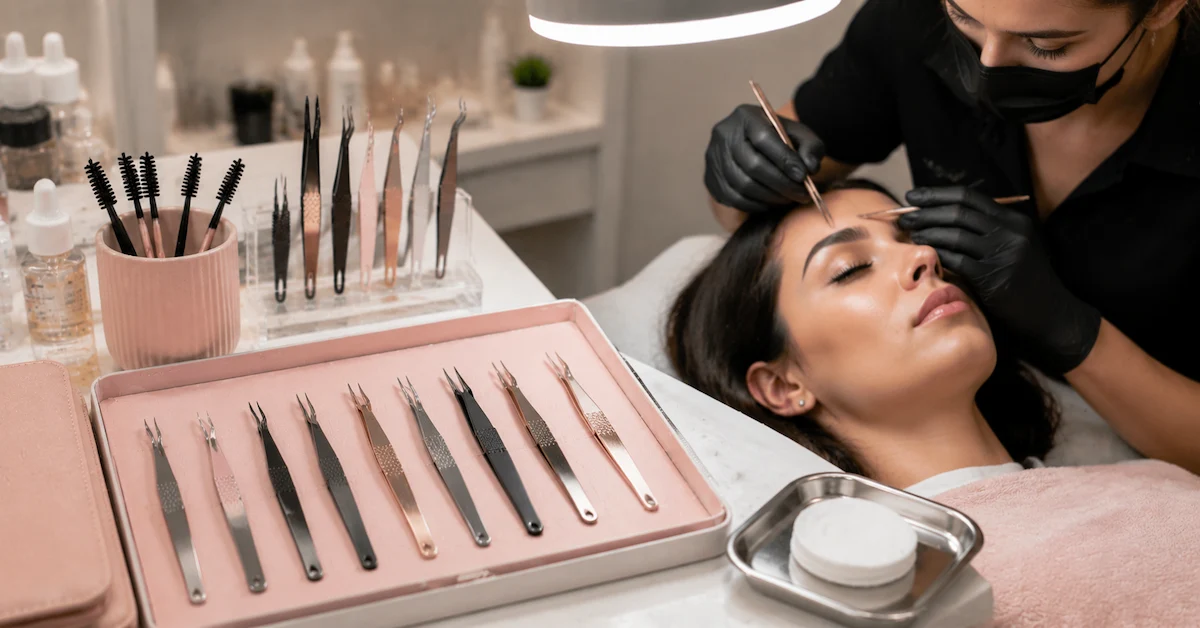
Based on the product information provided, the set appears to be a cosmetic or beauty tweezer assortment designed for eyebrow shaping and hair removal. The arrangement includes multiple tweezer types, likely including angled and straight profiles, with long narrow bodies and pointed tips. The visible finishes include silver, black, rose-gold, and possibly matte-coated versions. The tools are presented in a neat tray or case with a pink liner, which suggests a retail-ready or salon-display format.
That presentation tells you something practical: this is not just a single-purpose implement. It is closer to a curated grooming set. Buyers in salons, spas, and private-label retail often prefer that format because it gives them options. One tip style may be better for brows, another for fine facial hair, and another for more general grooming. A set also supports merchandising, since coordinated colorways and packaging can raise the perceived value without changing the core metal tool.
Common Tweezer Types and Where They Fit
Not every tweezer shape serves the same job, and that is where sourcing mistakes often start.
Angled tweezers
Angled or slanted tips are often the default for eyebrow work. They are easier to align with the brow line and can help technicians isolate a single hair. For salon use, this is usually the most versatile geometry.
Straight tweezers
Straight tips are less specialized but useful for broader gripping tasks. Some buyers include them in a kit for general-purpose hair removal or as part of a multi-piece set where the customer chooses the tool that feels easiest.
Pointed or precision tips
These are more targeted tools. They can be useful for fine detail work, but they also demand better control from the user. In practice, this means the tip finish and alignment need close attention. A pointed tweezer that is even slightly off can frustrate the user quickly.
Material and Finish: More Than Cosmetic Choices
The product data shows metal tweezers with polished or brushed reflective finishes. That is a common and sensible choice for beauty tools, but the buyer should still ask the right questions. The visible appearance tells you almost nothing about the steel grade, coating system, rust resistance, or whether the handle finish will wear smoothly or chip.
A polished silver look can read as clinical and clean. Black or rose-gold can make the tool feel more premium, especially in a retail set. Matte-coated variants may improve grip or reduce glare, although that depends on the actual coating system. Since the exact finish type is not confirmed here, it is better to verify than assume.
One practical caution: appearance and handling do not always move together. A very glossy tweezer may photograph beautifully but feel slippery in a wet salon environment. A matte surface may offer a better grip, yet show wear sooner if the coating is not durable. Buyers should request samples and use them under real working conditions, not just inspect them under showroom lighting.
What OEM Buyers Should Specify Up Front
When ordering OEM custom tweezers, the specification sheet should do more than name a color. It should define the tool’s purpose and the expected user experience.
Key points to clarify include:
- Tip style: angled, straight, pointed, or mixed set
- Body shape: slim, flat, or ergonomic profile
- Finish: polished, brushed, matte, coated, or mixed presentation
- Colorway: silver, black, rose-gold, or other brand palette options
- Packaging: tray, case, sleeve, gift box, or retail insert
- Intended user: salon professional, spa, personal grooming, or promotional set
The most useful custom tweezers programs are the ones that connect these choices to the buyer’s channel. A salon technician does not need the same packaging logic as a retail beauty brand. A promotional set may prioritize presentation and logo placement, while a professional kit may care more about grip and tip consistency.
Typical Use Cases for Cosmetic Tweezer Sets
The product format described here fits several downstream markets.
For eyebrow technicians, the main value is precision and variety. Different clients need different approaches, and a multi-piece set allows the technician to select the right tool without improvising.
For spas and salons, organized presentation matters almost as much as function. A tray or case keeps tools visible and easy to store, which supports both hygiene routines and professional appearance. The pink liner shown in the product information suggests that display has been considered, even if the exact material is not confirmed.
For retail beauty kits, coordinated color and packaging can help a set stand out among more generic tools. Buyers in this channel often want a product that feels giftable, not merely functional.
For private-label brands, OEM custom tweezers can be an accessible entry point because the tool is small, familiar, and relatively easy to position in a broader grooming line. That said, the category is crowded, so simple rebranding is usually not enough. Buyers should look for a clear product angle: professional precision, premium appearance, travel-ready packaging, or multi-tool versatility.
Selection Criteria That Matter in Practice
If you are comparing suppliers, the following factors are worth more than a glossy render:
- Tip alignment and closure consistency
- Grip feel in dry and slightly damp conditions
- Clean finish at the tip edges, with no visible burrs
- Packaging durability during shipping and shelf display
- Color consistency across a full set
- Ease of branding without compromising the tool surface
It also helps to think about the buyer’s end user. A salon owner may forgive a decorative finish if the tool performs well. A retail customer usually does the opposite. They judge the product first by appearance and second by whether it feels precise enough to keep using.
Common Mistakes When Sourcing Personalized Tweezers
The most common mistake is overemphasizing appearance. A nice rose-gold or black finish may help the set sell, but it will not rescue a poor tip alignment. Another frequent issue is failing to distinguish between a single-use consumer product and a professional tool. The demands are different, and so are the expectations for durability and handling.
Buyers also sometimes under-specify the packaging. In a category as small as tweezers, presentation can change the perceived value significantly. If the case is part of the offer, confirm whether it is standard or only a display element. The provided information suggests a presentation case or liner, but that should not be assumed without supplier confirmation.
A final warning: do not buy a full run based on one sample under perfect conditions. Test several pieces from the same sample batch if possible. Small alignment or finish differences are easy to miss at first and annoying later.
What Makes a Good Next-Step Conversation With a Supplier
If you are talking to an OEM or private-label supplier, a productive conversation usually starts with the use case, not the logo. Explain whether the tweezers are for brow shaping, facial hair removal, salon service, or retail kits. Then ask what tip styles and finishes they recommend for that job.
From there, ask for visual proofs and physical samples. If the product will be sold as a set, ask how the pieces are arranged and whether the packaging can be adapted to your brand colors. For personalized tweezers, branding method matters as much as layout, though the exact branding process is not provided here and should be verified directly.
FAQ: Quick Answers Buyers Usually Need
Are OEM custom tweezers mainly for salons?
Not only. They are used in salons and spas, but also in retail grooming kits and private-label beauty lines.
Should I choose angled or straight tips?
For brow work, angled tips are often the most versatile. Straight tips can be useful in a set for broader tasks, while pointed tips suit detail work.
Does finish affect performance?
Yes, at least indirectly. Finish affects grip, appearance, and how the tool feels in use. The exact impact depends on the coating or surface treatment.
Is a multi-piece set better than a single tweezer?
For retail and salon presentation, often yes. For a focused professional use case, one well-specified tweezer may be more effective than a mixed set.
A Practical Buying Rule
If the supplier cannot explain how the tip style, finish, and packaging fit the intended user, keep asking. The right OEM custom tweezers order should make sense on the workbench, on the retail shelf, and in the customer’s hand. That balance is what separates a commodity accessory from a product line with staying power.
For teams building a private-label beauty assortment, the next step is straightforward: define the use case, choose the tip geometry, confirm the finish and packaging, then request samples before committing to volume. In a category this small, the details are the product.