How to Choose Tweezers for Lash Extensions
Choosing the right tweezers for lash extensions is less about appearance than control. A lash technician must isolate natural lashes, pick up individual synthetic fibers, place extensions accurately, and sometimes form or handle small fans without disturbing neighboring lashes. The working tip, handle texture, curvature, closing action, and cleaning requirements all affect that process. This guide explains what buyers should inspect before selecting a tool for a salon, training environment, distributor range, or private-label beauty line.
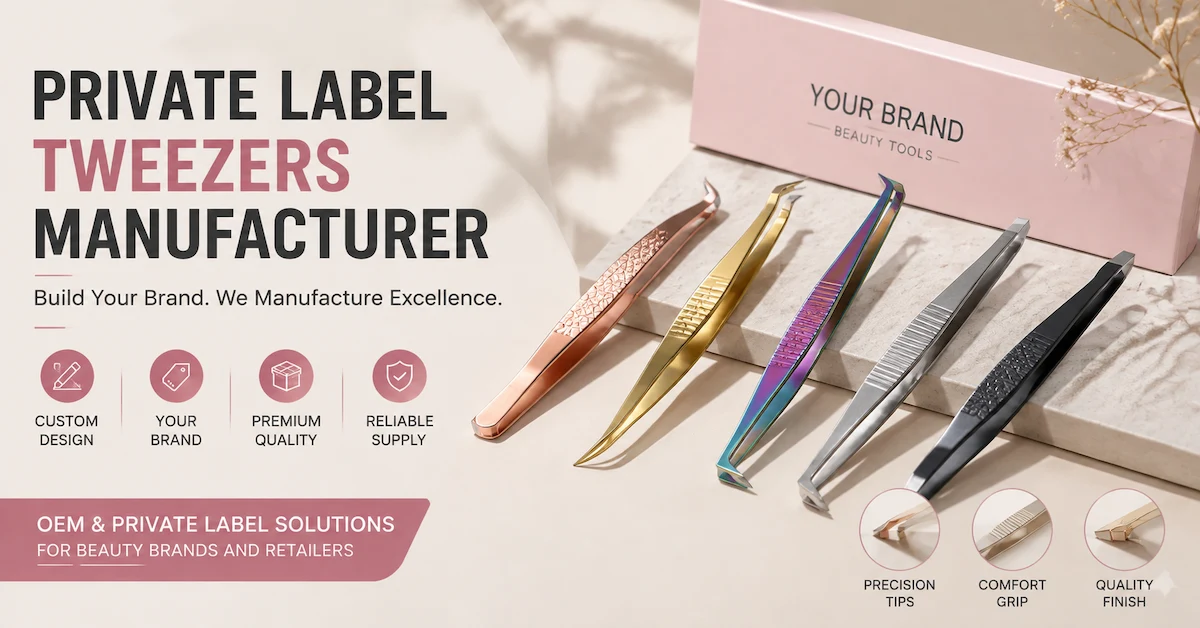
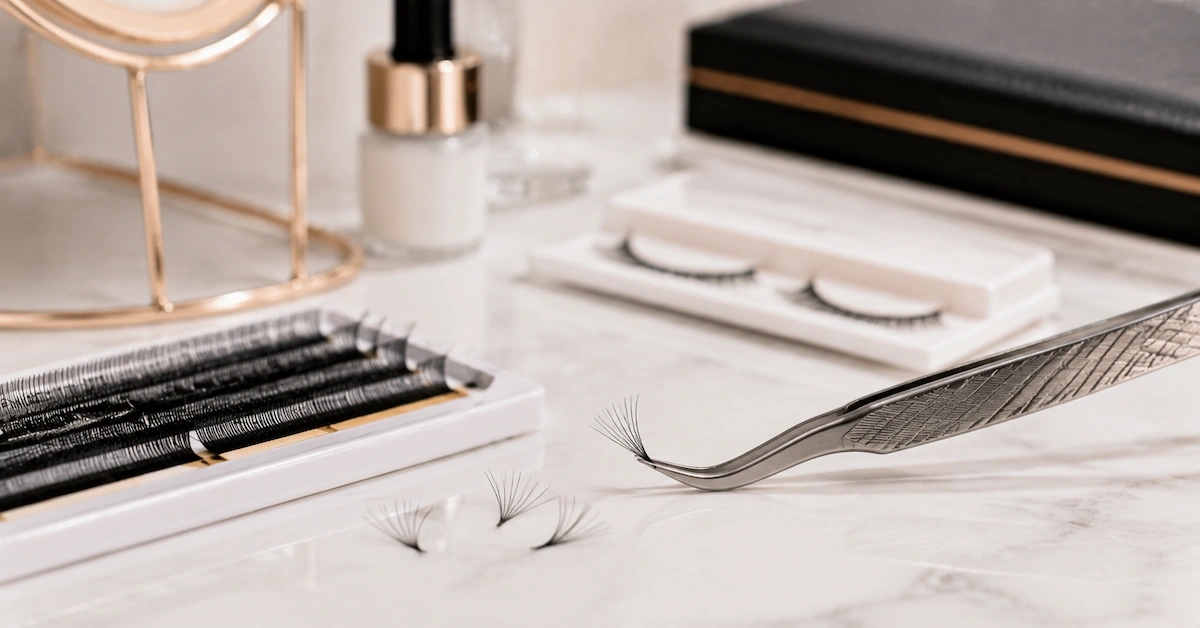
The product shown is a curved precision tweezer with a slim metal body, a pronounced angled working end, narrow tips, and a flat textured grip area. Its geometry appears suitable for detailed lash work, but several specifications remain unconfirmed. A responsible purchasing decision should therefore separate what can be observed from what must be verified with the supplier.
Quick assessment of the tool
| Feature | What is visible or reasonably indicated | What the buyer should confirm |
|---|---|---|
| Working shape | Curved or angled end with narrow meeting tips | Whether the tip is intended for isolation, placement, fan handling, or multiple techniques |
| Handle | Flat body section with crosshatched or textured finger contact area | Grip comfort, texture durability, and performance with gloves |
| Construction | Rigid metallic body with a polished or satin-metallic appearance | Exact alloy, corrosion resistance, finish specification, and cleaning compatibility |
| Manufacturing needs | Likely forming or machining followed by tip finishing and alignment | Tip alignment controls, inspection method, and batch consistency |
| Applications | Fine manipulation of synthetic lash fibers or small fans | Recommended use for classic, hybrid, or volume application |
Why geometry matters in lash application
Lash tweezers are small tools, but their geometry determines how much visual access and finger control a technician has near the eye. A curved tip can help the user approach the lash line from an angle rather than directly above it. That may be useful when isolating a natural lash, placing an extension, or working around an existing set.
The visible tool has a pronounced bend near the working end and narrow tips that appear designed to meet at the point. This arrangement is consistent with precision manipulation. It may suit technicians who prefer to approach the lash from the side and use the tip for controlled pickup or placement. However, a photograph cannot establish whether the tips close evenly, whether they meet only at the very end, or how much pressure is required to close them. Those details are not cosmetic. They influence fatigue, pickup reliability, and the risk of crushing or dropping a fine fiber.
Tip shape should be matched to the task rather than selected from a general category. A narrow pointed end may support isolation and detailed placement. A broader or more specialized end may be preferred for handling several fibers or a premade fan. Buyers should ask for a clear product drawing or sample evaluation instead of assuming that every curved tweezer performs the same way.
Precision lash tweezers: what to inspect
When evaluating precision lash tweezers, start with the two working tips. They should appear straight and clean, with no visible burrs, dents, or uneven edges. When closed, the tips should meet consistently rather than crossing, leaving a gap, or touching heavily on one side. Even a small alignment issue can make fine fibers difficult to pick up.
Next, examine the transition between the handle and the angled end. A smooth transition is generally easier to control than an abrupt, poorly finished bend. The tool shown has an elongated body, which may give the technician room to hold it away from the eye while maintaining a clear view of the working area. That is a practical advantage for some users, though the appropriate length and balance depend on individual technique.
The textured handle is another useful visible feature. Crosshatching, stamping, machining, or knurling can provide finger traction, especially during repetitive work. Still, texture is not automatically comfortable. A rough surface may create pressure points during long appointments, and a finish that feels secure with dry fingers may behave differently when the user wears gloves or works with product residue. A buyer-facing sample test should include a realistic session, not just a quick grip in a showroom.
Classic, hybrid, and volume work
Application technique should guide the buying specification. Classic work typically involves placing one extension on one natural lash, so isolation and accurate placement are central concerns. A curved, narrow tip can be useful where the technician needs to separate a natural lash and position an individual extension without disturbing adjacent fibers.
Hybrid work combines different extension effects and may require the technician to switch between individual fibers and fans. In that setting, versatility can matter more than a highly specialized tip. The buyer should confirm whether the supplier recommends the tool for both placement and fan handling, rather than relying on the shape alone.
For volume work, volume lash tweezers are often selected according to the technician’s preferred fan-making method and the size or style of fan being handled. A tool that works well for premade fans may not provide the same control for handmade fans. The product information available here indicates that the curved design may handle small lash fans, but that is a likely application, not a confirmed performance claim. Ask for technique-specific guidance and test samples before making a large order.
Material, finish, and cleaning questions
The tool has a metallic gray or silver appearance and seems to be made from a rigid metal, possibly stainless steel. The exact alloy cannot be confirmed from the image. That distinction matters because buyers may need to understand corrosion resistance, surface durability, compatibility with their cleaning process, and long-term appearance.
Do not treat a reflective finish as proof of a particular grade or treatment. The surface may be polished or satin-metallic, while the textured grip may be machined, stamped, etched, or knurled. These manufacturing details can affect how easily residue is removed and whether the grip remains consistent after repeated handling.
Any reusable beauty tool should be purchased with a documented cleaning and sterilization position from the supplier. The available information does not confirm the appropriate method for this tool, its corrosion resistance, or compatibility with a particular disinfectant or sterilization process. Those points should be verified before the product is introduced into a professional operating procedure. A protective cap is also not visible, so buyers should ask how tips are protected during shipment and storage.
Manufacturing controls that matter to professional buyers
From a manufacturing perspective, the tool likely involves metal forming or machining, tip grinding and alignment, surface finishing, and creation of the textured handle area. These processes are inferred from the visible geometry and should not be treated as confirmed supplier specifications.
For a salon or distributor, the most important quality question is not simply whether the tool looks polished. It is whether the working end remains consistent from piece to piece. Ask the manufacturer how tip alignment is checked, how damaged tips are rejected, and whether the closing action is inspected during production. If the tool is intended for private-label sales, request preproduction samples and compare several units rather than approving a single attractive sample.
Useful incoming checks can include visual inspection under magnification, checking that the tips meet evenly, confirming that the bend is consistent, and looking for surface defects. Buyers may also want to compare the feel of multiple tools in a realistic application simulation. Exact tolerances, closing force, weight, tip thickness, and overall length should not be assumed unless the supplier provides them.
Common purchasing mistakes
One common mistake is selecting a tweezer solely because the curve looks suitable. Shape is important, but tip alignment and closing behavior are just as significant. Another is assuming that a textured handle will suit every technician. Hand size, working posture, glove use, and appointment length all affect comfort.
Buyers also sometimes use the words precision and volume as if they were interchangeable performance specifications. They are not. A fine tip may be excellent for isolation but less suitable for a particular fan-making method. Conversely, a broader working end may offer better fan control but feel too intrusive for delicate isolation.
A final caution concerns cleaning claims. Metallic appearance does not establish sterilization compatibility. Obtain written care instructions and confirm whether the finish, grip texture, and tip alignment are expected to withstand the intended routine.
Practical buyer checklist
- Define whether the primary task is isolation, single-extension placement, premade fan handling, handmade fan work, or a combination.
- Request the exact metal grade and surface-finish description.
- Ask for overall length, tip dimensions, closing-force information, and any available dimensional drawing.
- Inspect several samples for consistent tip meeting and smooth opening and closing.
- Test the crosshatched grip with the gloves and working posture used by technicians.
- Confirm cleaning, disinfection, and sterilization guidance before treating the tool as reusable.
- Ask how tips are protected during packaging, transport, and storage.
- For private-label programs, approve a production sample and define the inspection points before placing a larger order.
Frequently asked questions
Are these tweezers suitable for all lash-extension techniques?
The curved, narrow-tip design appears suitable for detailed lash manipulation and may support classic, hybrid, or small-fan work. The available information does not confirm that it is optimized for every technique. Supplier guidance and hands-on testing are advisable.
Are they made from stainless steel?
They appear to be made from a rigid metal, possibly stainless steel, but the exact alloy is not confirmed. Request the material specification before making claims about corrosion resistance or sterilization compatibility.
Does the textured grip improve comfort?
It is visibly intended to improve finger traction. Comfort depends on the texture, hand position, glove material, and length of use, so a practical trial is more reliable than appearance alone.
Can they be used with premade lash fans?
The angled tip may be suitable for handling small lash fans, but this should be confirmed with the supplier or evaluated through a sample. Fan size, pickup technique, and tip contact area all affect performance.
Next step for buyers
Use the visible design as a starting point, not as a complete specification. For this curved metal tweezer, the strongest initial attractions are the angled working end, narrow tips, elongated body, and textured finger area. Before purchase, request material details, dimensional information, care instructions, and samples from multiple production units. A short technician trial can reveal more about tip control and hand fatigue than a product photograph ever will. That disciplined review helps salons, distributors, and private-label brands choose a tool that fits the actual application rather than merely matching the expected shape.