


Buyer answer: The best way to source beauty scissors wholesale China is to build a small, clearly differentiated assortment, compare samples against written functional standards, and calculate the cost of each retail-ready unit delivered to your warehouse—not merely the supplier's advertised product price. Importers should request model-specific specifications, tiered order quotations, pack-out data, shipment terms, and a documented repeat-order process before committing to volume.
China-based beauty-tool purchasing works best when purchasing, product management, quality assurance, and logistics agree on the same definition of the product. A seemingly inexpensive scissor can become a costly SKU if its tip geometry does not match the intended task, its retail pack fails during transport, or its reorder specification changes. Conversely, a well-chosen, moderately sized range can serve several buying channels without multiplying inventory risk.
This guide is written for beauty-product importers, regional distributors, retail chains, professional brow-tool suppliers, and e-commerce brands evaluating the OLIMOR BEAUTY scissors collection. It focuses on the commercial decisions that determine repeatable wholesale purchasing: assortment architecture, technical differences, sample tests, price comparability, shipping data, and reorder discipline.
1. Why a China Wholesale Order Needs More Than a Low Unit Price
A purchase order is not a retail strategy. Buyers can obtain competing quotations for a pair of beauty scissors while receiving products that differ in blade shape, material construction, dimensions, finish, packaging, and inspection scope. Unless those variables are controlled, the quoted prices are not directly comparable.

For an importer, the objective is to acquire products that sell through predictably, meet the channel's expectations, arrive in usable condition, and can be replenished without surprising changes. This means the sourcing decision should be reviewed from three angles: product fit, delivered economics, and operational repeatability.
Product fit asks whether each pair of scissors has a defined purpose. A pointed compact brow scissor, a curved brow scissor, and a larger hair-cutting scissor should not automatically share one retail description. Different geometries can serve different users and create different expectations.
Delivered economics asks how the product performs after packaging, export handling, freight, duty or other import charges, receiving, and applicable selling expenses are considered. A low product price can lose its advantage when shipping or return-related costs are high.
Operational repeatability asks whether the same model, material, finish, artwork, pack count, and performance can be identified for a second and third purchase order. A supplier's ability to maintain approved details matters to distributors who need consistent listings and shelf presentation.
These are procurement decisions rather than generic claims that every China-based supplier provides the same capability. Establish them in writing for the particular supplier and SKU.
2. Which Buyers Benefit from China-Based Beauty Scissors Wholesale?
The phrase beauty scissors supplier China covers several distinct buyer groups. Treating them as one audience can lead to the wrong product mix or packaging investment.
| Buyer | Typical purchase objective | Critical approval point | Commercial risk to manage |
|---|---|---|---|
| Importer and regional distributor | Stock a dependable multi-SKU range | Consistent model identity and carton data | Slow-moving inventory and reorder changes |
| Retail and drugstore chain | Offer clear grooming choices on shelf | Retail-ready packaging and accurate claims | Shelf confusion, returns and barcode errors |
| Professional brow supplier | Supply detail-trimming tools to specialists | Cutting performance, tip alignment and handling | Disappointing professional-user experience |
| Salon group or training program | Equip many workstations or students | Uniform function, safe storage and replacement flow | Different feel across batches |
| E-commerce and marketplace seller | Sell compact, differentiated products | Accurate images, package protection and dimensions | Damage claims and listing mismatch |
| Gift or grooming-set assembler | Combine tools into organized kits | Component fit, case protection and pack completeness | Missing pieces and assembly errors |
An importer evaluating many wholesale beauty scissors should group products by buyer need rather than selecting every visually attractive listing. A professional studio may prioritize operation and tool handling. A retailer may prioritize understandable packaging and margin. An e-commerce brand may need a compact, well-protected shipment unit. The selection and inspection plan should reflect those differences.
3. Build a Three-Tier SKU Assortment Instead of Buying Random Styles
The most useful first-order assortment is often a three-tier structure. It is a planning tool, not a fixed sales formula: the final proportions should depend on customer demand, price position, and verified sell-through data.
Tier A: Core everyday grooming scissors
This tier addresses a clear, familiar use such as simple eyebrow trimming or home grooming. Choose a model with an understandable shape, reliable basic cutting performance, and packaging that can be described accurately without exaggerated claims. Retail buyers often benefit from fewer decisions, so the front of pack should communicate the application immediately.
A core product's strength is not that it is the cheapest. It is that buyers can recognize what it does, inspect it easily, and reorder the exact same specification. For first orders, avoid unnecessary custom coatings and multiple near-identical sizes until the sell-through pattern is known.
Tier B: Precision or differentiated brow scissors
This tier serves customers who appreciate a particular blade geometry or handling design. Straight, pointed and curved profiles may deserve separate SKU codes when they produce a meaningful use difference. A distinguished finish or mixed-material grip can also differentiate a product, provided its function is verified first.
Ask whether a consumer could tell the difference between Tier A and Tier B from the product page, package, and intended task. If the answer is no, an additional SKU may create stock complexity rather than meaningful choice.
Tier C: Coordinated retail sets and channel-specific packs
The third tier converts a tool into a defined purchasing solution. Examples include a brow grooming kit combining scissors with tweezers, or a travel set using appropriately selected items from the OLIMOR manicure-set range. Any proposed set is subject to actual SKU and packaging feasibility.
Set planning requires separate checks for each tool and for the complete package. A pair of acceptable scissors can still be damaged by a poorly fitted insert or by contact with another metal tool during shipment.
Illustrative first-order allocation
| Assortment tier | Illustrative share of units | Commercial role | Evidence needed before scale-up |
|---|---|---|---|
| A: Core | 50% | Broad-access everyday product | Sell-through, customer questions, incoming QC |
| B: Precision | 30% | Differentiation and specialist selection | Use-case feedback and repeat purchases |
| C: Kits or specialty | 20% | Bundled value and range extension | Pack cost, assembly defects and channel demand |
Important: The 50/30/20 mix is a hypothetical planning example, not an OLIMOR sales statistic or recommended universal ratio. A retailer with strong specialty demand might allocate very differently. For each SKU, choose an initial quantity that can be evaluated before another production run must be committed.
4. Compare Published OLIMOR Models Without Inventing Technical Specifications
OLIMOR BEAUTY is associated with Bonet Houseware Co., Ltd., located in Yangjiang, Guangdong, China. Its beauty-scissor category includes eyebrow, precision grooming, and other cutting-tool listings. Specific models help buyers discuss an actual specification rather than a generic image.
| Public model | Publicly listed material | Listed size | Listed weight | Buyer evaluation focus |
|---|---|---|---|---|
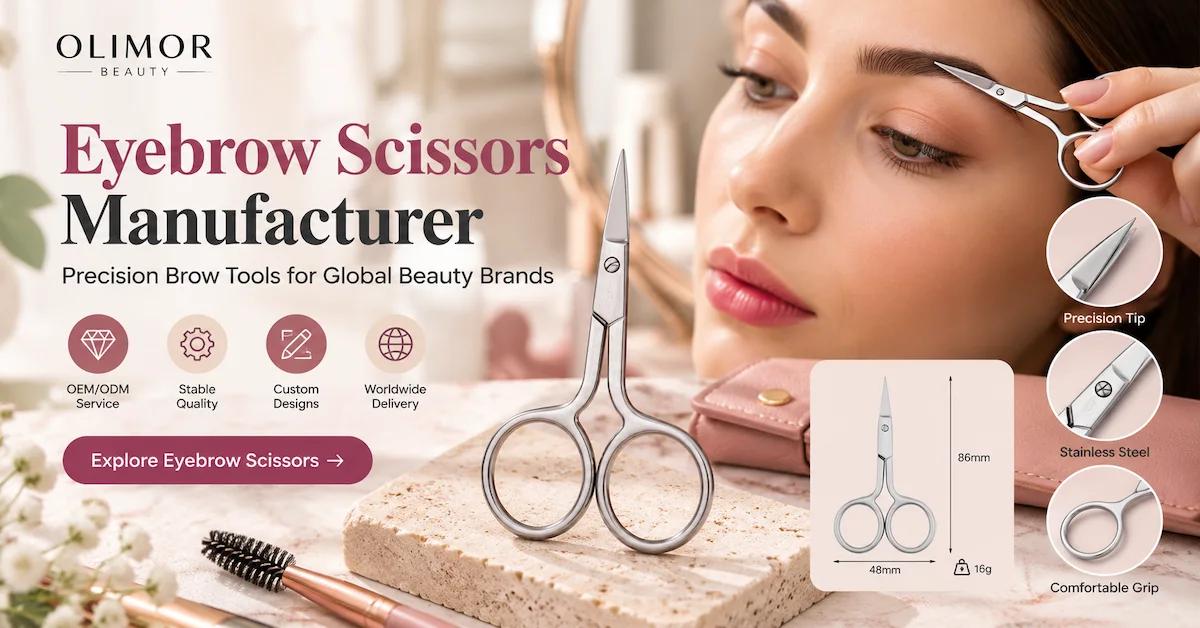
| SCB3057 | Stainless steel | 4.8 × 8.6 cm | 16 g | Compact pointed-blade brow-tool candidate |
| SCB3058 | Stainless steel + plastic | 4.7 × 9.8 cm | 16 g | Mixed-material handle and alternative grip presentation |
| SXS5005 | Stainless steel | 9.1 × 4.3 cm | 14 g | Curved-blade brow-tool candidate |
These are product-page values, not independent laboratory measurements. Size axes are reproduced in the order listed; purchasers should verify the orientation and drawing before using them in packaging artwork or fulfillment systems. The public listings do not establish an exact stainless-steel grade, blade hardness, production tolerance, certification, MOQ, or wholesale contract price.
How to interpret the comparison
SCB3057 may be a useful reference where a buyer seeks a compact, pointed-blade design. The key questions are whether the tips align, whether the intended grooming medium is cut cleanly, and whether the loop dimensions suit expected users.
SCB3058 introduces plastic alongside stainless steel. An importer should therefore request a material-by-component description instead of claiming that every visible part is stainless steel. Inspect the handle, blade assembly and connection points as a complete product.
SXS5005 is described with curved blades. It should be tested for the intended brow-trimming approach rather than presumed superior to a straight-blade design. Curvature is a product choice, not a standalone quality grade.
The published product pages and category listing may display different prices. Such storefront figures are not a substitute for a written bulk quotation specifying quantity, material, packaging, customization, Incoterm and quote validity. Request a project-specific offer before using any price in an importer budget.
5. Technical Requirements That Actually Change Wholesale Value
Precise product language matters because a scissors order is sensitive to geometry and assembly. Broad phrases such as premium quality or salon grade do not give inspectors a repeatable acceptance method.
Blade shape and usable cutting zone
Ask whether the tool is designed for pointed detail work, curved eyebrow trimming, or a different declared task. Record blade geometry, usable cutting length, tip condition and approved reference images. A clean cut near the pivot does not necessarily prove equivalent performance near the tips.
Pivot movement and blade contact
The joint should support controlled opening and closing with appropriate blade interaction. A pivot that is excessively loose or stiff may affect comfort and cutting. Evaluate multiple samples under the same method and establish what constitutes acceptable movement or contact.
Material, finishing and corrosion-related claims
A listing that says stainless steel does not identify the alloy or provide measured corrosion performance. Request the grade or material specification if important to the application. Surface polishing, coating and decoration need separately approved appearance criteria. Avoid rust-proof, sterile, medical grade, or similarly absolute claims without appropriate evidence.
Handling and safety of exposed edges
Finger loops, handles, blade tips and non-working edges should be examined for burrs or defects. Check the intended user, care instructions and protective packaging. Ordinary cosmetic scissors should not be advertised for medical or surgical applications merely because they have pointed metal blades.
Product-specific technical checklist
| Specification field | Buyer should request | Why it affects wholesale buying |
|---|---|---|
| Application | Defined grooming task and intended user | Prevents selling the wrong type under a generic name |
| Model and revision | Permanent identifier and approved version | Supports consistent repeat orders |
| Material by part | Blades, handle components, pivot and decoration | Avoids inaccurate material claims |
| Dimensions and mass | Drawing, tolerance if necessary, verified pack dimensions | Supports product listing and shipping data |
| Blade geometry | Straight/curved profile, tip and usable cutting range | Determines functional suitability |
| Pivot acceptance | Agreed handling and movement criteria | Reduces batch variation |
| Cutting test | Relevant test medium and acceptance method | Converts “sharp” into observable performance |
| Surface and logo | Finish reference, approved artwork and location | Prevents cosmetic disputes |
| Packaging | Protection, insert, barcode and set contents | Reduces transit and retail errors |
A model cannot be compared fairly when one supplier quotes an existing standard tool and another quotes a custom-finished, individually packaged version with additional inspection. Normalize the scope before deciding who offers better value.
6. Use a Supplier Scorecard Rather Than Choosing the Cheapest Quotation
A procurement scorecard reduces the risk of informal, inconsistent supplier selection. It is most effective when evidence is required for each criterion.
Consider evaluating a China beauty scissors supplier across five areas: verified product fit, traceable specification, sample performance, commercial clarity, and logistics readiness. Those factors address different failure modes, so a high score in one should not erase a critical failure in another.
| Evaluation area | Suggested weight | Evidence to request |
|---|---|---|
| Product and intended-use fit | 25% | Models, dimensions, samples, product scope |
| Functional sample and QC | 25% | Cutting test method, accepted sample, inspection record |
| Price and commercial transparency | 20% | Line-item quotation, MOQ, trade terms and validity |
| Packaging and export readiness | 15% | Pack-out sample, carton list, net/gross weights, dimensions |
| Reorder and change control | 15% | Revision system, approval route, notification arrangement |
Weights are a suggested buyer framework, not an independently validated industry benchmark. A buyer may change them based on channel risk. For example, a professional brow distributor might weight cutting performance more highly, while a chain retailer may allocate more attention to packaging and SKU administration.
More importantly, define non-negotiable failures. An unsafe burr, wrong component, materially inaccurate product description or missing required import document should not be offset by a low price. Record the reason for approval or rejection, not just a total score.
7. Calculate Landed Cost per Retail-Ready Unit
To compare wholesale beauty scissors from China, buyers need the cost of usable units arriving at the destination—not just a web-page number. Landed-cost calculations depend on the agreed trade term, shipping method, importer obligations and destination market.
A practical formula is:
Landed cost per usable unit = (product + agreed customization + retail packaging + export-origin charges attributable to buyer + freight + insurance + import charges + receiving costs) ÷ usable received units.
Avoid counting an expense twice. For example, freight and insurance responsibilities differ under an EXW, FCA, FOB, CIF or DAP quotation. The named place and the applicable Incoterms edition should be confirmed on the contract, and destination customs treatment should be checked with a qualified customs broker.
Hypothetical calculation only
The following is a teaching illustration, not an OLIMOR quote, market benchmark, or estimated real freight rate.
| Illustrative component | Hypothetical cost per unit (USD) |
|---|---|
| Product price | $2.10 |
| Approved logo and decoration | $0.28 |
| Retail packaging | $0.14 |
| Buyer-borne origin and freight allocation | $0.24 |
| Duty and import-related allocation | $0.20 |
| Receiving and inspection allocation | $0.09 |
| Illustrative landed cost | $3.05 |
If the product sells to a retailer for a hypothetical $5.00, the gross spread before selling, storage, finance, returns, overhead and tax would be $1.95 per unit. This is not net profit and does not establish a realistic selling price. The purpose is to force every buyer to use the same comparison basis.
Account for saleable yield
Shipment quantity and saleable quantity may differ if units are damaged, defective, incorrectly packed or otherwise unusable. If a buyer budgets costs against ordered quantity but sells fewer usable units, the effective cost per saleable unit rises.
Track whether defects are found at pre-shipment inspection, warehouse receiving or after customer sale. Those stages carry different commercial consequences. An apparently small defect rate may matter disproportionately when products are inexpensive and reverse logistics are costly.
8. Carton Engineering: The Often-Missed Source of Cost and Damage
Scissors are compact, but sharp tips, exposed blades and metal surfaces can create packaging challenges. The product must stay in position through ordinary handling and shipment. It should not scratch another tool, pierce the pack or arrive with its cutting end damaged.
For every shortlisted SKU, request the product's packed dimensions, inner quantity, master-carton quantity, carton dimensions, net weight, gross weight and method of internal protection. Those are operational data, not decorative marketing details.
Freight forwarders may use volumetric or actual weight depending on mode and service. Cargo volume should be calculated from the confirmed outer-carton dimensions, not from the unboxed scissors. Buyers should validate carrier-specific calculation rules rather than relying on an invented universal factor.
Packaging options and trade-offs
| Pack format | Potential advantage | Buyer should verify |
|---|---|---|
| Simple protective sleeve | Low visual complexity and compact handling | Tip protection, pack integrity, labeling |
| Hang card or blister-style retail pack | Shelf presentation and product visibility | Retention, sharp-end clearance, pack durability |
| Printed folding carton | Branding and information space | Inner fixation, crush resistance, dimensions |
| Pouch or case | Reusable storage and gift presentation | Metal-to-metal contact, zipper clearance, cleanliness |
| Multi-tool grooming set | Higher assortment relevance for certain channels | Every component, insert fit and accurate set contents |
A retail pack should also be approved for the actual product orientation. A photograph of an attractive empty box is not evidence that the scissors will stay protected. Validate filled-package samples and appropriate handling tests before using a new pack for a large order.
9. Build Quality Inspection Around Risks, Not Generic Promises
Wholesale orders magnify small consistency problems. A single sample may demonstrate basic feasibility, but it cannot prove that every pair in a production lot behaves identically.
Create a written inspection plan before manufacturing. Identify critical, major and minor defects based on the intended use and applicable buyer requirements. Agree on the sampling method, functional test material, inspection responsibilities and disposition process.
Recommended incoming-inspection matrix
| QC point | Method or evidence | Example unacceptable condition |
|---|---|---|
| Identity | Compare model, artwork, pack and purchase order | Wrong SKU or revision |
| Blade function | Agreed use-relevant cutting test | Snagging, folding or incomplete cutting outside acceptance |
| Tip and blade alignment | Inspect reference zones and sample comparison | Contact inconsistent with approved reference |
| Pivot movement | Repeated controlled opening and closing | Excessive looseness, grinding or stiffness |
| Exposed edges | Visual and tactile check under safe handling | Unexpected burr or unsafe defect |
| Finish and logo | Compare approved boundary sample/artwork | Unapproved color, blemish or placement |
| Retail pack | Examine filled pack and protective insert | Tip exposure, movement or damaged contents |
| Carton and quantity | Count and compare shipping marks | Wrong quantity or mixed products without approval |
Where a recognized sampling standard such as ISO 2859-1 is used, the plan must specify the relevant sampling and acceptance details. Writing “AQL inspected” alone does not describe the inspection, and it is not proof that a particular OLIMOR model has passed a certified test.
Buyers should retain signed reference samples, dated inspection results, carton photographs and any corrective-action records. These reduce ambiguity if a future delivery differs from the approved specification.
10. MOQ, Price Breaks and Customization: Ask for Comparable Tiers
A meaningful China sourcing quotation should distinguish standard product wholesale from logo, finish, packaging and custom-development options. Each can have different minimum quantities and setup requirements.
Rather than asking only “What is your MOQ?”, request a structured reply across two or three realistic purchase quantities. For each quantity, ask for the model, base unit price, available packaging, logo options, sample charges, production schedule, carton details, payment terms, quote validity and named Incoterm.
This creates a comparison that a procurement manager can audit. If one tier has a lower product price but imposes expensive printed packaging or a larger minimum production quantity, the budget implications become visible.
For a first test order, it may be better to use the supplier's standard version and protect cash for marketing, customer feedback and replenishment. Private labeling becomes more attractive when the brand has evidence that the product design and sales channel work. Customization should follow a commercial objective, not be treated as mandatory for every wholesale order.
OLIMOR's public information supports wholesale and private-label discussions, but it does not prove a single MOQ, lead time, steel grade or finishing option for every beauty-scissor model. Confirm those terms in the specific quotation.

11. Export Documents, Shipping Terms and Import Compliance
A warehouse-ready order requires information beyond the scissor itself. Importers should confirm the supplier's legal selling entity, commercial invoice details, packing list, country-of-origin declaration where required, shipment identification, applicable customs classification and any product-specific documents needed by the destination market.
Customs classification depends on the actual article and applicable tariff rules. A buyer should not copy an HS code from a different grooming product without verification. Likewise, labeling obligations, product safety expectations and retail packaging requirements vary by country, intended use and sales channel.
Clarify who acts as exporter and importer of record, who arranges freight and insurance, which party handles customs clearance, and which costs belong to whom under the chosen trade term. These obligations should align with the contract and shipping documents.
Where inspections, testing or certificates are requested, identify the exact requirement and the organization or laboratory providing evidence. Do not assume that generic descriptions such as CE certified, medical grade or FDA approved apply to ordinary cosmetic scissors without determining whether those statements are relevant and verifiable.
A practical importer should have logistics and compliance review the purchase specification before approving packaging artwork and the production order, not after goods are finished.
12. Use a 90-Day Reorder Framework to Prevent Stockouts and Dead Stock
Inventory planning is where wholesale strategy becomes measurable. A useful 90-day framework is built around controlled trials, observed sell-through and verified replenishment lead times—not an arbitrary promise that every order can be made and shipped in 90 days.
Days 1–30: Confirm assumptions and launch a disciplined trial
Establish the opening SKU assortment, customer segment, reference samples, packaging and inspection checklist. Record the amount committed to each SKU, expected selling price, landed-cost assumptions and reorder triggers. When the first stock is received, capture actual cartons, damage, count accuracy and early customer feedback.
Days 31–60: Read real demand instead of anecdotes
Compare sales velocity, returns, customer questions and inventory by SKU. A product that looks strong in photographs may receive weak demand, while a simple everyday scissor may move consistently. Evaluate each tier's contribution rather than treating the whole assortment as a single result.
Investigate recurring complaints before buying more stock. If buyers report poor cutting, awkward handling or damaged packaging, a reorder without corrective action may repeat the problem. Check whether the issue relates to the product, pack, sales copy or fulfillment.
Days 61–90: Replenish proven winners and revise the range
Review safety stock against actual purchase-to-receipt lead time, not just the supplier's factory production estimate. Request the next quote with the previous approved model, revision, packaging and inspection requirements attached.
Retain slow-moving stock only when there is a clear channel or positioning solution. Avoid adding new colors and designs solely to create an appearance of choice. A smaller, well-documented range can be easier to operate and more profitable than a large collection of undifferentiated styles.
Reorder control sheet
| Field | Why it must be recorded |
|---|---|
| Model, SKU and specification revision | Prevents silent substitution |
| Approved golden sample and inspection method | Protects functional consistency |
| Prior purchase and landed costs | Supports accurate margin comparison |
| Units sold, returned and remaining | Separates sales demand from initial order assumptions |
| Lead time, safety stock and reorder point | Supports inventory availability |
| Packaging artwork and carton configuration | Reduces relabeling and freight surprises |
| Supplier change notifications | Identifies materials, tooling or process changes |
There is no universal reorder quantity. Calculate it from demand variability, the verified replenishment timeline, cash constraints and the cost of stockouts. This principle holds whether the business supplies one salon or many retail outlets.
13. Where OLIMOR Fits in a China Beauty-Scissors Supply Program
OLIMOR BEAUTY is a China-based beauty and personal-care tools brand associated with Bonet Houseware Co., Ltd. in Yangjiang, Guangdong. Its public site shows beauty scissors and related product groups including tweezers, eyebrow razors, nail clippers, and manicure sets. The company describes support for product selection, sample discussion, quality checks and brand-oriented sourcing projects.
For an importer exploring beauty scissors wholesale China, the actionable first step is to identify two or three specific models and define the intended channel. Referencing SCB3057, SCB3058 or SXS5005 is more useful than asking for an unspecified pair of professional scissors.
Next, compare actual samples using the cutting, alignment, pivot, handling and finishing criteria appropriate to that SKU. Request packaging and carton data, not just the product dimensions. Then ask for a written quotation at your realistic quantity with exact customization scope and delivery terms.
Buyers can learn about the company through About OLIMOR and use its Contact page to send an inquiry. This article is not a representation that any one model carries a guaranteed MOQ, fixed quoted price, uniform lead time, recognized certification, or specific unverified material grade.
A copy-ready buyer RFQ
Subject: Wholesale Beauty Scissors Inquiry — Models, Quantities and Export Packaging
We are sourcing beauty scissors for [distribution channel] in [destination market]. Please review [selected model numbers or links] for an initial order of approximately [quantity] units per SKU.
Our requirements include [intended trimming use], [material or design preferences], [standard or custom branding], and [retail/bulk packaging format]. Please provide model-specific specifications, sample options, relevant QC checkpoints, MOQ and quantity-based quotations, carton quantity and dimensions, production timing, applicable Incoterm with named place, payment terms and quote validity.
We would also like to know how the approved sample, finish and packaging version can be maintained for follow-up orders. Please identify any details that require further confirmation before a firm quote can be issued.
14. Frequently Asked Questions About Beauty Scissors Wholesale China
1. Where can importers source beauty scissors wholesale in China?
Buyers can evaluate China-based personal-care tool suppliers with suitable product catalogues, sample support and export documentation. OLIMOR BEAUTY in Yangjiang lists beauty scissors and related grooming tools. Before choosing any supplier, request actual model data, review physical samples, establish inspection criteria and confirm commercial and delivery terms for the intended destination.
2. What should a China beauty-scissors wholesale quotation include?
It should state the exact model and revision, material description, unit price for the specified quantity, any logo or packaging charges, MOQ, sample charges, carton details, production schedule, payment terms, quotation validity and a clearly named trade term. Without these details, buyers risk comparing fundamentally different offers.
3. Which beauty-scissor styles are best for a first importer assortment?
A practical opening range can contain one everyday brow-grooming model, one visibly differentiated precision model and, if justified, one kit or channel-specific pack. Those categories are a framework rather than fixed demand rankings. Confirm product performance and study sell-through before expanding into many similar designs.
4. How do I compare straight and curved eyebrow scissors?
Use the same intended trimming task and a documented sample evaluation. Compare blade contact, control, tip accessibility, handling comfort and the suitability of the design to your users. Curved blades may support a different working approach, but they are not inherently better than straight blades. Check the actual models rather than relying on their names.
5. Is stainless steel sufficient as a material specification?
No. Stainless steel describes a broad material category. The actual grade, blade processing, construction and finish can affect performance and claims. When relevant, ask for the material by component and supporting records. Do not advertise exact hardness, medical suitability or complete corrosion immunity unless the selected product has appropriate evidence.
6. What is the minimum order quantity for wholesale beauty scissors?
MOQ depends on the particular model, quantity, decoration, custom components and packaging. A standard product and a fully branded retail pack may have different minimums. Ask for tiered quotations at quantities aligned with your forecast rather than relying on a universal MOQ printed in generic marketing copy.
7. How can I verify quality before a bulk shipment?
Approve a representative sample, document the key dimensions and functions, and set an inspection plan that covers cutting performance, blade alignment, pivot movement, finish, logo, packaging and carton accuracy. Agree on defect definitions, sampling and how nonconforming goods will be managed. Inspect the filled package, not only the bare scissors.
8. How should I calculate the landed cost of imported beauty scissors?
Start with the agreed product and customization cost, then include buyer-borne packaging, origin charges, freight, insurance, import charges and receiving expenses without double-counting costs included in the Incoterm price. Divide by usable received units. Ask a forwarder and customs specialist to verify actual logistics and tariff treatment for your shipment.
9. Can I combine beauty scissors with other grooming tools in one wholesale range?
Yes, a buyer can discuss a broader assortment containing scissors, tweezers, eyebrow razors, nail tools or grooming sets where commercially and technically feasible. Every tool needs its own functional checks, while combined packs require additional inspections for protection, completeness, artwork and carton packing.
10. How can I request an OLIMOR beauty-scissors wholesale quotation?
Select models from the OLIMOR Beauty Scissor category, then submit their links or item numbers, estimated quantity, target market, application, branding requirements and packaging needs using the OLIMOR inquiry page. Ask for written model-specific specifications, sample arrangements, wholesale terms, carton details and expected delivery planning information.
Turn your shortlist into a comparable wholesale quotation.
Send OLIMOR the models, quantities, destination, carton and packaging requirements you want reviewed.
Get a Model-Specific Quote →Conclusion
Sourcing beauty scissors wholesale China is most effective when importers treat the purchase as an assortment, quality and landed-cost decision—not a search for the smallest number on a supplier page. A focused three-tier SKU strategy can clarify each product's role, while written specifications and use-relevant sample tests help prevent poorly matched or inconsistent stock.
The strongest purchasing plan connects actual scissors models with intended users, documented blade and pivot performance, appropriate retail protection, transparent quotation terms and realistic shipping assumptions. It also prepares for the second order before the first arrives: the approved version, inspection findings, packaging and carton data must be preserved so that replenishment can be controlled.
OLIMOR BEAUTY provides a starting selection of China-based grooming and precision beauty scissors for B2B enquiries. Importers, distributors and beauty retailers can explore the scissors catalogue and contact OLIMOR with model preferences, quantity forecasts and packaging requirements to discuss a tailored wholesale purchasing project.
Tag:
Related articles
- Beauty Tools Sourcing Guide
- OEM & Private Label
Eyebrow Scissors Manufacturer: Building Retail-Ready Brow Tools That Customers Understand

- Beauty Tools Sourcing Guide
- OEM & Private Label
Beauty Scissors Manufacturer China: How to Qualify Brow Scissor Designs for OEM Retail Programs
- Beauty Tools Sourcing Guide
- Manicure & Nail Tools