

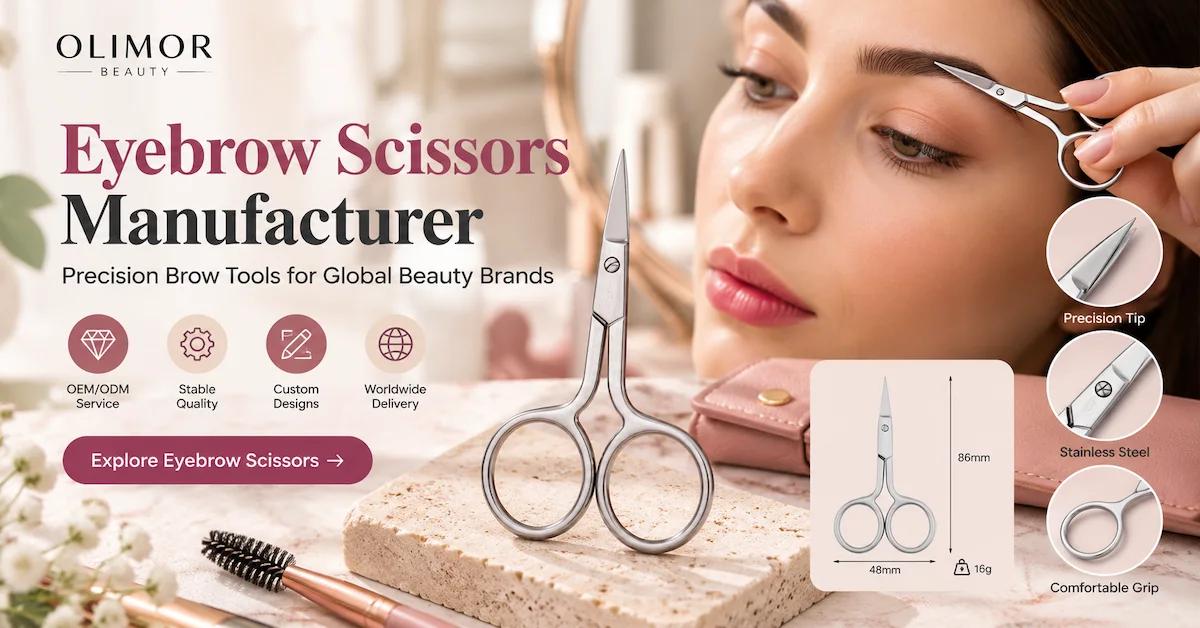
A beauty brand can find many compact eyebrow scissors with attractive finishes, pointed blades, curved edges, and comfortable-looking handles. The real difficulty is deciding which scissors customers will understand, use appropriately, and want to purchase.
For an importer choosing an eyebrow scissors manufacturer, the decision extends beyond factory prices and the appearance of metal cutting tools. A commercially successful product must match the intended grooming task, carry accurate product information, arrive with protected working tips, and remain recognizable when the brand places a repeat order.
Many avoidable customer complaints begin before manufacturing. A retailer may describe curved eyebrow scissors as general-purpose hair shears. A marketplace listing may show a protective case that is not included. A package may promise salon-quality results without explaining the intended use or the difference between trimming and shaping.
Even when the manufactured scissors conform to their approved design, customers can become dissatisfied if the product is marketed for the wrong purpose.
Quick Answer: Beauty brands should evaluate an eyebrow scissors manufacturer using both product-level and retail-level requirements. Confirm the intended user and trimming task, select an appropriate existing model, verify its materials and working geometry, approve physical samples, and develop accurate instructions, product images, protective packaging, and SKU records. Before bulk production, approve the complete finished retail unit rather than the loose scissors alone. Maintain that approved configuration through shipment and future reorders.
This guide helps private-label brands, cosmetic accessory importers, retail chains, ecommerce teams, and professional brow suppliers organize a retail-ready eyebrow scissors project.
It includes model-specific examples from the OLIMOR Beauty Scissor collection , product positioning frameworks, packaging and listing checklists, supplier approval procedures, customer complaint analysis, and an actionable manufacturer RFQ.
1. What Does an Eyebrow Scissors Manufacturer Supply?
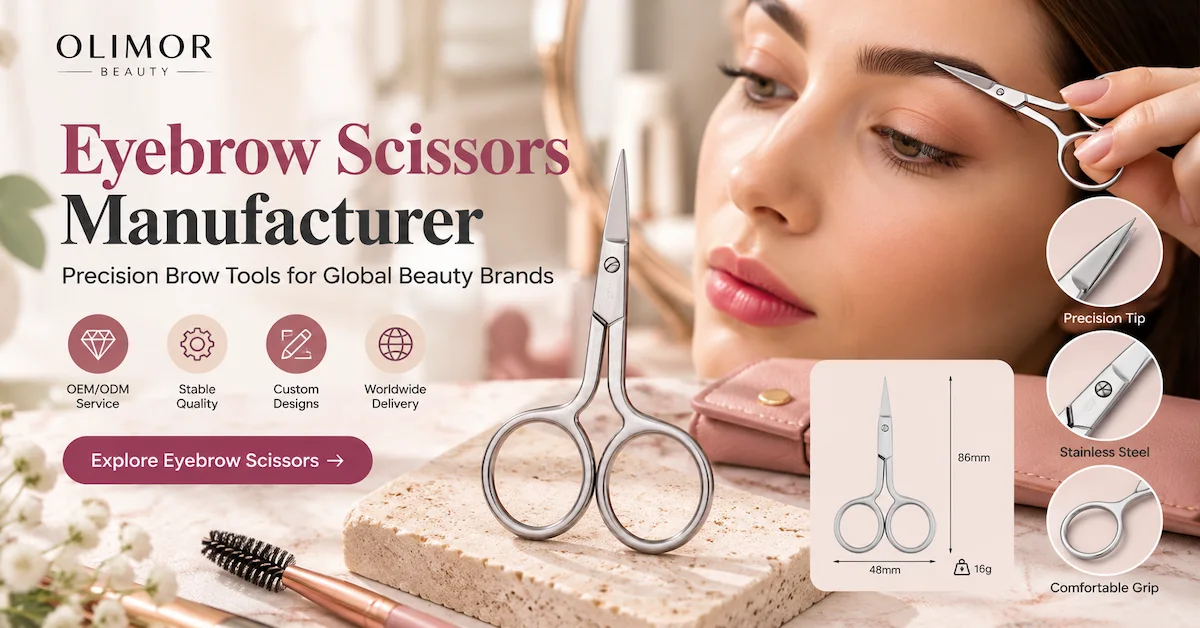
An eyebrow scissors manufacturer produces or coordinates the production of compact scissors intended for controlled eyebrow grooming and related precision beauty applications.
Unlike a general household scissor, an eyebrow scissor is usually selected for compact handling, working-tip visibility, and controlled cutting near a small facial grooming area.
Specific models may use straight or curved blades, different finger loops, metal or mixed-material handles, and distinct surface finishes. The available configurations depend on the manufacturer and product.
For a B2B purchasing project, the physical scissors are only one part of the deliverable. The buyer may also require approved retail packaging, printed instructions, artwork, branding, item identification, shipping cartons, and product documentation.
These additional elements determine whether the product can be introduced into the intended sales channel without extensive rework.
OLIMOR BEAUTY, associated with Bonet Houseware Co., Ltd. in Yangjiang, Guangdong, China, publishes eyebrow scissors and other personal-care tools. The company also discusses OEM, ODM, and private-label beauty-tool projects.
However, the availability of particular customizations, exact material grades, minimum order quantities, and production lead times must be confirmed for the selected model and order.
The manufacturer's role should be agreed in writing. A packaging-only branding project is not the same as developing a new cutting mechanism or custom handle.
2. Begin with the Customer's Brow Grooming Task
A common product development mistake is selecting an attractive pair of scissors before defining why the customer will buy it.
Eyebrow trimming is a specific grooming task. The user wants to shorten selected brow hairs without accidentally removing too much of the visible shape.
The scissors support that task, but the quality of the result also depends on the user's technique, lighting, and understanding of the product.
A manufacturer's quotation cannot solve an unclear product promise.
Before sourcing, write a short statement describing the intended customer, expected use, and essential selling proposition.
A compact eyebrow trimming scissor for adult beauty retail customers who want controlled routine brow maintenance, supplied with clear instructions and protective storage.
This is an illustrative product brief, not a claim about an already approved OLIMOR SKU.
The statement immediately creates practical questions for the buyer. Is the selected scissor appropriate for the expected user experience? Does it require a brow brush or spoolie to explain the routine? Is the tool compact enough for the chosen retail package?
It also places boundaries around marketing. The product should not be advertised as a substitute for professional training or as a guarantee of perfect results.
The better the product brief, the easier it is to reject unnecessary design changes and compare manufacturer proposals.
3. Understand the Different Commercial Buyers
Eyebrow scissors are sold through multiple beauty channels. Each channel influences product selection, packaging, customer expectations, and replenishment.
| Buyer Group | Main Requirement | Potential Problem | Recommended Focus |
|---|---|---|---|
| Beauty Retail Brands | Clear function and strong visual identity | Customers misunderstand the intended use | Packaging copy and product education |
| Ecommerce Sellers | Accurate listing content and parcel protection | Incorrect size expectations, damage, or misleading images | Product photography, dimensions, and delivery-unit inspection |
| Brow Studios | Suitable handling and documented product characteristics | Mismatched technique or unsupported hygiene claims | Professional trial and verified care guidance |
| Private Label Startups | Manageable launch costs and brand differentiation | Over-customization before product demand is known | Existing models and controlled sample approval |
| Beauty Distributors | Reliable SKU identification and repeat-order consistency | Model substitutions and inconsistent packaging | Product records and change-control procedures |
A retailer may want a simple, approachable grooming product. A brow studio may prioritize a particular handling characteristic based on its service workflow.
These needs can lead to different model choices even when the products share the same category name.
A private-label supplier should therefore be evaluated against the buyer's actual market. Large product catalogs are useful, but they do not eliminate the need for accurate selection.
4. Compare Real OLIMOR Eyebrow Scissors Models
Product evaluation becomes more reliable when the buyer starts with identifiable models and documented specifications.
OLIMOR publishes several beauty scissors suitable for further discussion about eyebrow grooming product development.
Three public references are SCB3057, SCB3058, and SXS5005. These products have different published dimensions, weights, material descriptions, and visible configurations.
| Model | Published Material | Published Dimensions | Published Weight | Buyer Evaluation Focus |
|---|---|---|---|---|
| SCB3057 | Stainless Steel | 4.8 × 8.6 cm | 16 g | Compact format, finger-loop handling, tip protection, and retail packaging |
| SCB3058 | Stainless Steel + Plastic | 4.7 × 9.8 cm | 16 g | Curved-blade format, grip components, material identification, and brand presentation |
| SXS5005 | Stainless Steel | 9.1 × 4.3 cm | 14 g | Curved working geometry, appearance, grip, and sample comparison |
These values are taken from the published OLIMOR product listings and should be confirmed against current specifications before approving an order.
The figures do not establish verified alloy grades, hardness, cutting-cycle life, or other performance results.
SCB3058 is particularly relevant for buyers evaluating a mixed-material configuration because the listing identifies both stainless steel and plastic.
A buyer should clarify which parts use each material, what appearance is available, and whether branding can be applied without altering the approved grip.
The published size of a tool also does not establish how every user will experience it. Finger size, grip position, blade geometry, and the intended task affect handling.
This is why a comparative sample trial is more valuable than choosing a model on weight or dimensions alone.
5. Define Retail Product Roles Before Creating Too Many SKUs
A private-label brand may be tempted to release several scissors that differ only in handle color or finish.
That approach can increase inventory complexity without providing customers with a meaningful reason to choose one model over another.
Instead, assign every planned product a commercial role.
Everyday Brow Trimming SKU
This product should be easy to describe to customers unfamiliar with specialized beauty tools.
Its intended use, dimensions, included accessories, and care instructions should be understandable without exaggerated terminology.
Precision Brow Grooming SKU
This version may be intended for buyers who already use dedicated brow tools and want a particular blade or handling configuration.
The differentiating feature should be real and verifiable, not simply a premium-sounding product name.
Gift or Travel SKU
A compact scissor can be considered for grooming kits or travel accessories when the intended design and packaging support that use.
A protective sleeve or case may be commercially important, especially where pointed working ends are exposed.
Travel positioning should not imply permission to carry scissors through every airport or transport-security checkpoint. Customers must follow the applicable carrier and security restrictions.
Brands should launch additional versions when customer research demonstrates a genuine need, rather than assuming that more variants automatically produce more sales.
6. Make the Product Promise Accurate and Easy to Understand
A strong retail product promise explains the function of the scissors without promising results the product alone cannot guarantee.
A statement such as "compact eyebrow trimming scissors for controlled maintenance" describes an understandable use.
By contrast, claims such as "perfect brows every time," "completely safe for everyone," or "guaranteed painless trimming" require evidence that may not be available and can mislead customers.
Product instructions should explain what the scissors are intended to cut. Avoid suggesting that a delicate brow-trimming tool is equally suitable for thick craft materials, general household cutting, or unrelated applications.
Using precision grooming scissors outside their intended purpose may affect the working edge.
For professional channels, the description should also distinguish normal cleaning from any claimed disinfection or sterilization compatibility.
These are different technical concepts and should not be used interchangeably.
Good product positioning is valuable because it helps customers select the correct product before they place an order.
Looking for an Eyebrow Scissors Model for Your Brand?
Explore OLIMOR's current beauty scissor products and discuss your intended users, packaging direction, estimated quantities, and product requirements.
Compare Eyebrow Scissors →7. Develop Clear Customer Instructions Before Production
Eyebrow scissors are used close to sensitive facial areas, making product instructions important for both customer understanding and responsible retail communication.
Instructions should be developed around the intended consumer and reviewed for the specific finished product.
A basic consumer-facing explanation may describe the general grooming sequence: prepare the brow area, brush hairs into position, identify excess length, trim conservatively, and check the result.
However, the manufacturer should not assume a single instruction template is suitable for every blade or tip configuration.
Explain the Difference Between Trimming and Shaping
Trimming shortens individual eyebrow hairs. It is not the same as removing hair from the root or using a razor to redefine the visible brow outline.
Retail copy that confuses these processes may cause customers to buy the wrong tool for their expectations.
Use Short, Understandable Steps
Instructions should avoid complicated technical language when the intended customer is an everyday retail user.
A sequence of simple actions supported by clear imagery is generally easier to follow than a long paragraph of marketing copy.
Include Appropriate Safety Information
Sharp scissors require careful handling. Final instructions should address risks associated with pointed cutting tools, the intended age group, and use near the eye.
The precise warnings should reflect the finished design and applicable requirements. Buyers should not copy warnings blindly from unrelated grooming products.
Describe Cleaning and Storage Accurately
Basic care instructions should reflect the tool's confirmed materials, construction, and finish.
If the product includes plastic grip components, adhesives, decorative coatings, or other mixed materials, cleaning advice should account for those components.
Do not promise compatibility with specific chemical, heat-based, or professional reprocessing methods without supporting evidence.
8. Turn Instructions into Better Retail Product Images
Customers purchasing eyebrow scissors online cannot hold the product before ordering. Product images therefore influence expectations.
A photograph showing only a beautiful pair of scissors on a decorative background may not explain their size, intended use, included components, or working shape.
A retail-ready image set should help answer the questions customers normally ask before purchasing.
| Image Type | Information to Show | Buyer Benefit |
|---|---|---|
| Main Product Image | Actual scissor, color, handle, blade shape | Correct product recognition |
| Dimension Image | Verified product length and width | More accurate size expectations |
| Blade Detail Image | Working tip and blade configuration | Supports model comparison |
| Application Image | Appropriate brow-grooming context | Explains intended use |
| Package Contents | Everything included in the selling unit | Reduces accessory confusion |
| Care and Safety Graphic | Product-specific handling and care information | Improves customer understanding |
A dimension graphic should reflect the specific SKU. Do not reuse the measurement image of another model simply because the tools look similar.
If the promotional image shows a brow comb, spoolie, pouch, or protective case, the listing must clarify whether it is included.
This is particularly important for marketplace listings, where shoppers may interpret every visible accessory as part of the purchase.
Photography should accurately represent the delivered color and finish. Any decorative enhancements should not create a misleading impression of material or function.
Accurate images support conversion by answering questions, not by exaggerating performance.
9. Choose Packaging That Protects Precision Scissor Tips
Small beauty scissors can be vulnerable to damage when the working tips are not adequately restrained during packing, transport, and retail handling.
A protective packaging concept should therefore be selected alongside the physical tool.
The correct package depends on the blade configuration, product size, retail channel, and distribution environment.
Individual Protective Sleeve
A sleeve may help separate the working tool from other items and reduce unnecessary contact.
Its suitability depends on the selected scissor's geometry and whether it restrains the product appropriately.
Retail Card or Hanging Package
Card packaging can support retail display and product identification when designed for the finished item.
However, the package must hold the scissors securely, protect exposed tips, and display required consumer information.
Rigid Retail Box
A rigid box can provide a different presentation for premium positioning or gift-oriented products.
Buyers should assess the internal restraint, package size, assembly complexity, and cost before selecting this route.
Grooming Set or Travel Pouch
Scissors included with other grooming tools need careful separation so that their working ends do not damage neighboring components during transport.
A visually appealing pouch is not necessarily adequate protection for every pointed scissor.
The final packed unit should be tested against the expected distribution and handling conditions.
10. Compare Packaging Options Before Approving Artwork
| Packaging Format | Potential Advantage | Main Limitation | Approval Focus |
|---|---|---|---|
| Protective Sleeve | Compact individual protection | May provide limited retail presentation | Tip restraint and fit |
| Retail Hanging Card | Shelf display and product visibility | Exposure or movement if poorly designed | Security, label, barcode, visibility |
| Rigid Retail Box | More structured presentation | Additional packaging and assembly cost | Internal fit, shipping protection |
| Multi-Tool Case | Supports a coordinated grooming collection | More components to inspect | Complete BOM, retention, case function |
The packaging decision should be based on the selected customer and commercial channel, not merely the most attractive mock-up.
Once the package is chosen, approve the actual physical retail unit with the intended scissors inside.
Check whether the tool can shift, contact the packaging wall, or damage another component.
Also verify the artwork, printed instructions, barcode, product name, and any required warnings.
A package design becomes production-ready only when the complete finished unit matches the agreed specification.
Develop Eyebrow Scissors with Your Own Brand Identity
Contact OLIMOR to discuss selected scissors, possible branding methods, packaging concepts, sample requirements, and model-specific order terms.
Discuss Private Label Packaging →11. How Should an Eyebrow Scissors Manufacturer Support OEM?
OEM eyebrow scissors projects can range from adopting an existing product with custom branding to discussing more substantial design requirements.
The scope affects development time, sampling, pricing, and technical review.
Existing Model Selection
The buyer selects a current product that already matches the intended application and required configuration.
The manufacturer and buyer then confirm the current material description, dimensions, appearance, and other relevant features.
Branding and Appearance
Logo placement, color, finish, and packaging can be discussed for appropriate product models.
Availability must be confirmed rather than assumed from the general term OEM.
Functional or Structural Changes
Changes to blade geometry, handle construction, finger-loop dimensions, or pivot configuration may require additional design and manufacturing evaluation.
The buyer should identify which modifications are essential and which are simply preferences.
Design Ownership and Approval
Where customer drawings or new tooling are involved, the parties should address ownership, approved versions, and authorized changes.
A development arrangement should not rely only on informal email descriptions.
OLIMOR presents OEM and private-label support in its company information . Actual capabilities and commercial conditions require confirmation for the specific project.
12. Create a Retail-Ready Eyebrow Scissors Specification
A retail-ready specification should cover the physical product and the information customers will receive.
Buyers often document metal dimensions but overlook the listing description, warning language, packaging revision, or included components.
This creates problems because manufacturing and retail teams may approve different versions of the same product.
| Specification Area | What to Record | Approval Reason |
|---|---|---|
| Product Identity | Supplier model, buyer SKU, revision | Accurate production and repeat orders |
| Intended User | Consumer segment, task, channel | Consistent positioning |
| Physical Tool | Dimensions, blade configuration, materials, grip, finish | Functional and appearance control |
| Sample Acceptance | Cutting trial, pivot check, tip and surface inspection | Product approval |
| Retail Package | Pack BOM, dimensions, protection, barcode | Distribution readiness |
| Customer Information | Intended use, care guidance, warnings, contents | Accurate customer expectations |
| Branding | Logo artwork, placement, finish references | Visual consistency |
| Approved Records | Golden sample, artwork version, approval date | Reorder control |
The specification should be detailed enough for the manufacturer and importer to interpret it consistently.
However, do not invent numerical tolerances, material grades, or performance thresholds simply to make the document appear technical.
Product-critical requirements should be defined according to the actual design and confirmed inspection method.
13. Approve Samples Based on Real Customer Expectations
Physical sample approval remains essential even when the project focuses mainly on retail presentation.
A visually attractive scissor can still perform poorly if the blades do not operate as intended.
Before approving production, evaluate representative samples of the selected model.
Working-End Condition
Inspect the cutting edges and tips for unintended damage, deformation, and unacceptable defects.
The intended tip design should match the approved product reference.
Opening and Closing Motion
Operate the scissors repeatedly under an appropriate evaluation method and note abnormal friction, instability, or unwanted resistance.
Cutting Function
Test with an agreed medium suited to the intended application.
A generic paper-cutting demonstration may not fully represent fine brow-hair trimming.
Handle and Grip
Check finger-loop dimensions, exposed edges, grip stability, and the condition of any plastic inserts.
Retail Pack Inspection
Finally, review the actual packaged unit and confirm that the product is properly identified, protected, and complete.
Record the accepted sample as the reference for the approved order.
These checks support manufacturing quality, but they should also inform customer-facing product information.
For example, a particular curved-blade configuration should be described accurately in the listing. It should not be presented as identical to a straight scissor simply because the brand uses the same packaging template.
14. Use Pilot Retail Reviews Before Large-Scale Launches
A manufacturer sample demonstrates that the proposed product can be physically evaluated. It does not automatically prove that the product listing, instructions, package, and customer positioning work together.
A buyer can conduct a structured pilot review before committing to a larger commercial program.
Confirm the Product
Verify the model, configuration, dimensions, materials, and agreed functional characteristics.
Review the Retail Listing
Compare every image and description with the actual product and package contents.
Check Customer Instructions
Have suitable reviewers assess whether the intended use, basic handling guidance, and care information are understandable.
Evaluate Packaging
Inspect the completely packed unit for tip protection, secure positioning, correct labels, and accurate item identification.
Record Approval Decisions
Document accepted changes, remaining issues, and the final version that will control production.
The review should involve people who understand the intended sales channel.
A packaging designer may notice that the logo looks attractive, while a retail buyer may identify an unclear product function or missing barcode.
Both perspectives matter before a bulk order becomes commercially final.
15. Prevent Common Causes of Retail Returns and Complaints
A return does not always mean that the manufacturer produced a defective tool.
Customers may return a product because it arrived damaged, differed from the listing, was unsuitable for the intended task, or lacked understandable instructions.
These causes require different corrective actions. Treating every return as a manufacturing defect can hide problems in marketing and product selection.
| Customer Complaint | Possible Cause | Recommended Investigation | Potential Corrective Action |
|---|---|---|---|
| "Smaller than expected" | Inaccurate or unclear size presentation | Compare listing images with actual measurements | Improve dimensional photography and copy |
| "Cannot trim properly" | Product mismatch or cutting defect | Evaluate sample function and intended use | Correct selection, listing, or production issue |
| "Tips arrived bent" | Handling damage or inadequate pack protection | Inspect shipping evidence and packaged samples | Improve restraint and transport packaging |
| "Wrong color or handle" | SKU or image mismatch | Review artwork, model records, and pick lists | Correct identification and SKU controls |
| "Expected a brow brush" | Accessory shown but not included | Compare images with approved packaging BOM | Clarify contents and imagery |
| "Difficult to understand" | Insufficient product guidance | Review instructions with representative users | Improve packaging copy and educational material |
The best corrective action depends on verified evidence. A reported cutting problem may require a physical product examination before its cause can be determined.
Retailers should organize complaints by SKU, order, issue type, and where possible the relevant production lot.
This helps distinguish isolated damage from repeated design, manufacturing, or communication problems.
A carefully managed feedback process can improve both product development and purchasing, although it cannot guarantee a particular return rate.
16. Coordinate Eyebrow Scissors with Other Brow Tools
Eyebrow scissors can be sold as a standalone product or considered alongside complementary grooming accessories.
For example, a brow tool collection may include scissors for trimming, tweezers for selective hair removal, and appropriate grooming brushes.
These tools have different functions and require separate product evaluation.
OLIMOR publishes related product categories including Tweezers and Eyebrow Razors .
A brand developing a coordinated assortment should define the role of each product rather than adding unrelated accessories to increase the perceived piece count.
Different tools should not automatically inherit the same material claims, use instructions, or cleaning requirements.
If several products are packaged together, approve the complete bundle and protect each working end.
A cohesive brand presentation can support product recognition, but the physical products must still satisfy their individual specifications.
17. Calculate the Commercial Cost of a Retail-Ready Scissor
Retail-ready eyebrow scissors have costs beyond the loose metal tool supplied by the manufacturer.
The buyer may need custom artwork, packaging, instructions, product photography, inspection, freight, and other commercial services.
A meaningful quotation should separate recurring product costs from nonrecurring development costs.
Relevant cost elements may include:
- Selected scissors model and approved configuration
- Branding, finish, or decoration processes
- Retail package, protective insert, and printed instructions
- Product samples and any required development charges
- Agreed inspection and quality procedures
- Freight, import duties, and applicable handling
- Listing development, warehouse activities, and return-related costs
A lower factory price is not always the lower total commercial cost.
For example, an inadequately protected scissor may generate additional expenses through damaged merchandise and corrective shipments.
Buyers should estimate the landed cost of the actual finished selling unit.
Estimated landed unit cost = applicable product, packaging, logistics, import, and quality costs divided by the number of commercially acceptable units received.
Nonrecurring costs should be tracked separately or allocated according to the buyer's accounting policy.
This framework helps buyers compare different packaging and manufacturing proposals.
Actual selling margin also depends on the retail price, channel expenses, taxes, promotions, and returns.
A supplier quotation cannot guarantee a specific conversion rate or profit.
18. Control Product Revisions and Reorders
A successful initial shipment does not automatically ensure that later orders will match.
Handle finishes, material components, packaging artwork, instructions, and product presentation can all change.
If those changes are not recorded and approved, a retailer may receive a product that no longer matches its listing or previous customer expectations.
Buyers should maintain a controlled SKU record containing the selected supplier model, approved product specification, sample reference, artwork, packaging BOM, and relevant revision.
Changes to working geometry, pivot assembly, grip components, or materials may require functional re-evaluation.
Changes to packaging can also affect shipping protection, barcode validity, retail presentation, and customer instructions.
For repeat orders, the manufacturer and buyer should agree on how proposed changes will be communicated and approved.
A clear revision system can reduce the risk of inadvertent substitutions and improve collaboration between purchasing, marketing, and quality teams.
19. Create a Supplier-Ready Eyebrow Scissors RFQ
A strong request for quotation helps a manufacturer understand both the product and the intended retail project.
Instead of asking only for a price, provide enough detail to identify the desired model and the commercial scope.
Recommended RFQ information includes:
- Target market and retail sales channel
- Intended customer and eyebrow grooming task
- Selected supplier model or reference photograph
- Expected initial order quantity
- Material and finish requirements
- Logo and private-label branding preferences
- Retail packaging and protective storage needs
- Customer instruction and language requirements
- Sample evaluation and quality criteria
- Delivery destination and preferred trade terms
- Reorder expectations and change-control requirements
We are developing a private-label eyebrow grooming product for our retail and ecommerce customers.
We would like to compare OLIMOR beauty scissors models SCB3057, SCB3058, and SXS5005 for our intended market.
Please confirm the current specifications, available configurations, sample requirements, material information, minimum quantities, and quotation terms.
We also require information about logo customization, protective packaging, retail instructions, and finished-unit approval.
Our target market, proposed order quantity, branding artwork, and packaging requirements can be supplied for a detailed project discussion.
Please identify any separate development charges and the assumptions affecting production timing or repeat orders.
This type of RFQ allows suppliers to respond with more useful commercial information than a generic catalog price.
It also helps the purchasing team distinguish confirmed specifications from items that still require review.
Start Your Eyebrow Scissors Product Development Project
Share your target customers, preferred models, order quantity, branding requirements, and packaging plans with OLIMOR.
Request an Eyebrow Scissors OEM Quote →20. A Practical Retail Launch Approval Checklist
A retail-ready product should pass several connected approval decisions before the purchasing team releases the first order.
These checkpoints can be adapted to the complexity of the project.
| Approval Stage | Required Review | Decision Owner |
|---|---|---|
| Product Concept | Customer, task, channel, commercial role | Brand / Product Manager |
| Product Sample | Actual configuration, function, dimensions, appearance | Product / Quality Team |
| Retail Communication | Claims, images, instructions, warnings | Brand / Compliance Review |
| Finished Packaging | Product restraint, labeling, barcode, pack contents | Packaging / Quality Team |
| Commercial Approval | MOQ, quote, freight, costs, delivery assumptions | Purchasing / Finance |
| Production Release | Approved revisions, golden sample, inspection agreement | Authorized Buyer |
The manufacturer should receive the same approved information that controls the retailer's product listing.
If marketing changes the advertised contents or product configuration, the physical product and packaging approvals may also need review.
The goal is to prevent different teams from approving inconsistent versions of the same SKU.
21. How OLIMOR Fits into an Eyebrow Scissors Retail Development Program
OLIMOR BEAUTY supplies a published range of beauty scissors and related personal-care tools.
International buyers can begin by reviewing its Beauty Scissor collection and selecting product references for further sample evaluation.
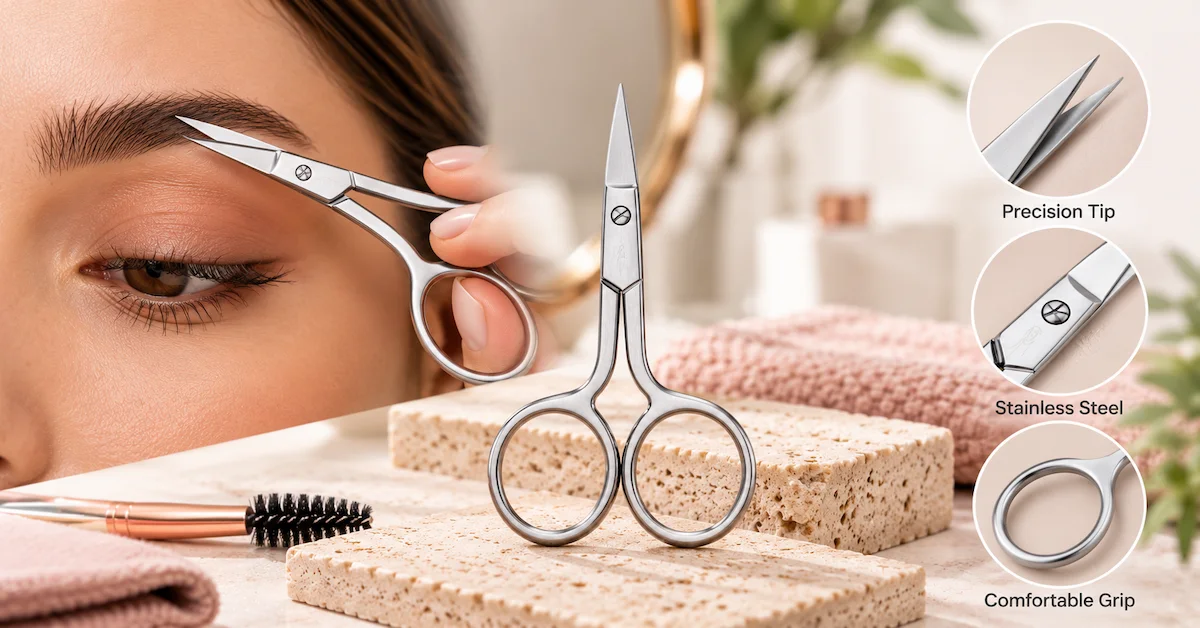
Models SCB3057, SCB3058, and SXS5005 provide identifiable examples for discussions about compact eyebrow grooming products, blade configurations, and retail presentation.
Buyers may also explore complementary Tweezers and Eyebrow Razors when considering a broader brow-care assortment.
These catalog references do not guarantee that every customization is offered for every product.
Material specifications, branding methods, MOQ, production schedules, and inspection evidence should be confirmed directly for the selected project.
A useful supplier discussion should conclude with a documented next step: identified models, sample requirements, unresolved technical questions, and commercial information needed before quotation.
Frequently Asked Questions About Eyebrow Scissors Manufacturers
1. What does an eyebrow scissors manufacturer do?
An eyebrow scissors manufacturer produces or coordinates the production of compact grooming scissors for specific applications. Depending on the project, the manufacturer may discuss existing models, product specifications, samples, custom branding, packaging, and bulk supply. The actual scope must be confirmed with the supplier.
2. What should a beauty brand check before ordering private-label eyebrow scissors?
Confirm the intended customer, model, blade configuration, materials, dimensions, cutting function, packaging, and approved retail instructions. Evaluate physical samples and the complete packed unit. Establish a written specification that can control bulk production and later repeat orders.
3. Are curved eyebrow scissors better than straight scissors?
Neither design is universally better. Curved and straight blades offer different working geometries and handling characteristics. Their suitability depends on the intended task, user experience, and actual product design. Buyers should compare representative samples before selecting a model.
4. Can OLIMOR provide OEM eyebrow scissors?
OLIMOR presents OEM and private-label services for beauty tools. Buyers can discuss existing scissors, branding, packaging, and relevant product requirements. Available changes, costs, samples, minimum quantities, and timing should be confirmed for the exact selected model.
5. Why does retail packaging matter for eyebrow scissors?
Packaging protects the tool, communicates its intended use, and identifies the item being purchased. Precision cutting tips require suitable protection during handling and shipment. Buyers should approve the fully assembled retail package rather than only its graphic design.
6. What information should appear in an eyebrow scissors product listing?
A useful listing identifies the actual product, intended purpose, blade configuration, verified dimensions, material description, and package contents. It should use accurate images and avoid unsupported safety or performance claims. Applicable warnings and care information should reflect the destination market.
7. What is the MOQ for private-label eyebrow scissors?
MOQ can depend on the selected model, finish, logo process, packaging, and development scope. A universal minimum cannot be established for all OLIMOR scissors from public product descriptions alone. Submit model-specific requirements for a current commercial quotation.
8. How can importers reduce customer complaints about eyebrow scissors?
Begin with appropriate product selection, functional sample approval, accurate listing information, understandable instructions, and protective packaging. Record customer complaints by SKU and issue type. Investigate whether each problem involves function, transit damage, unclear marketing, or incorrect customer expectations.
9. Can eyebrow scissors be included in a private-label grooming kit?
Eyebrow scissors may be included alongside suitable grooming accessories when the buyer confirms the intended use and product fit. Each tool requires its own evaluation. The completed kit must also be approved for component completeness, protection, labeling, and packaging accuracy.
10. How do I request an eyebrow scissors quotation from OLIMOR?
Select candidate scissors from the OLIMOR Beauty Scissor collection and prepare your target market, intended use, estimated quantity, model preferences, branding requirements, and packaging brief. Submit these details through OLIMOR Contact Us to discuss current product and order options.
Professional Reference Notes
International Organization for Standardization: ISO 2859-1, Sampling Procedures for Inspection by Attributes. Relevant when establishing appropriate lot sampling plans.
European Union: Regulation (EU) 2023/988 on General Product Safety, where applicable to the product and the relevant economic operators.
United States Federal Trade Commission: general principles on truthful and substantiated advertising claims.
GS1: GTIN Management Standard, where trade-item identification and packaging changes require review.
These references provide general sourcing and compliance context. They do not establish that any individual OLIMOR product carries a particular certification or has passed a specific performance test.
Conclusion
Choosing an eyebrow scissors manufacturer involves more than finding an attractive metal tool at a competitive price. Beauty brands and importers need a clear connection between the intended customer, product function, retail information, physical packaging, and supplier approval process.
A retail-ready eyebrow scissors program should begin with an accurately defined grooming task and a suitable product model. From there, buyers should approve functional samples, create understandable product information, protect the working tips, and preserve complete SKU records for future orders.
Customer complaints should also be analyzed carefully. A damaged scissor, unclear instruction, and incorrect listing image require different solutions. Separating these problems helps brands improve their purchasing and retail processes.
OLIMOR BEAUTY publishes several beauty scissors models and related eyebrow grooming tools that international buyers can evaluate as potential sourcing references.
Explore the OLIMOR Beauty Scissor collection and identify the products that fit your target customers and sales channels. Confirm current specifications, available customization, samples, and commercial terms before approving production.
Build Your Own Retail-Ready Eyebrow Scissors Collection
Contact OLIMOR BEAUTY with your preferred scissor models, target market, estimated quantities, branding artwork, and packaging requirements. Discuss suitable product options, sample approval, and a project-specific quotation.
Request a Custom Eyebrow Scissors Quote →Tag:
Related articles
- Beauty Tools Sourcing Guide
- OEM & Private Label
Beauty Scissors Manufacturer China: How to Qualify Brow Scissor Designs for OEM Retail Programs
- Beauty Tools Sourcing Guide
- Manicure & Nail Tools
Cuticle Nipper Wholesale: How Importers Plan Mixed-SKU Lots, Case Packs and Reorders
- Beauty Tools Sourcing Guide
- Manicure & Nail Tools