

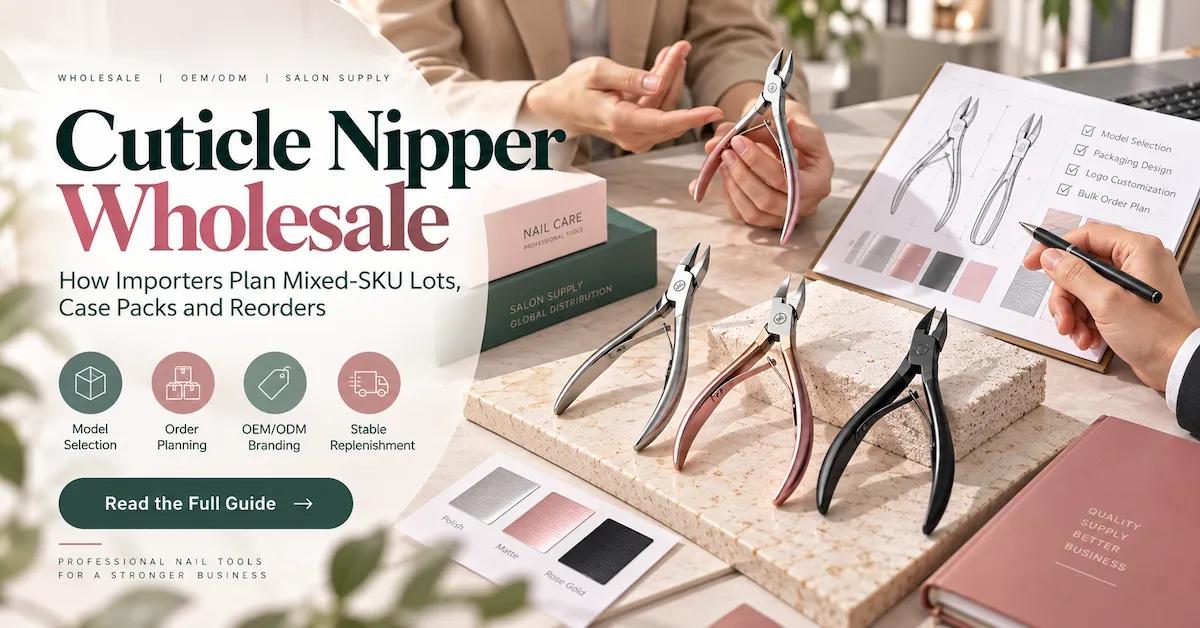
For distributors and beauty importers, cuticle nipper wholesale purchasing is not simply a negotiation over the lowest price per piece. The real commercial challenge is buying the right models in the right quantities, ensuring every unit meets agreed requirements, controlling the retail and shipping package, and maintaining a product range that can be replenished without confusion.
A distributor might purchase a basic stainless steel cuticle nipper for general nail-care retail, a differently configured model for professional salon supply, and a private-label version for its own branded collection.
Although all three products belong to the same category, they may have different dimensions, handling characteristics, packaging requirements, pricing structures, sales velocity, and inventory risks.
Buying too many variations can tie up working capital. Buying too few options may leave important customers without a suitable product. Ordering a large quantity before approving the final retail package can create avoidable repacking costs.
Quick Answer: A successful cuticle nipper wholesale program starts with a clearly defined customer group, a small assortment of verified models, and a complete unit specification. Buyers should compare supplier quotations on the same product and packaging basis, verify samples before placing bulk orders, identify pack and carton quantities, and calculate replenishment requirements using actual demand and confirmed lead times. The goal is not the lowest possible quoted price, but a commercially repeatable supply arrangement.
This guide is written for beauty importers, salon supply distributors, retailers, nail-care brands, procurement managers, and businesses developing private-label manicure accessories.
It uses real model references published by OLIMOR BEAUTY and explains how to structure a wholesale purchasing decision around product selection, order economics, quality release, packaging, and inventory.
1. What Does Cuticle Nipper Wholesale Mean for B2B Buyers?
Cuticle nipper wholesale refers to purchasing cuticle trimming tools in commercial quantities for resale, professional distribution, retail programs, or branded product lines. The purchasing arrangement may involve existing products, customized packaging, or more extensive OEM development.
A cuticle nipper is a manually operated precision tool used for appropriate trimming around the nail area. Its main functional components commonly include opposing cutting jaws, a hinge or pivot, handles, and a spring or return mechanism where applicable.
These features distinguish it from a conventional nail clipper, which generally uses a different cutting mechanism and is intended for trimming the nail plate.
Wholesale buyers must understand this distinction because products with different functions should not be marketed as direct substitutes.
In a commercial context, the product also includes its agreed identity, finish, protective packaging, labeling, order unit, carton structure, and inspection requirements.
A supplier quotation describing only "stainless steel cuticle nippers" does not fully identify the product that a distributor intends to sell.
Buyers should specify the exact model, intended customer, physical configuration, branding, packaging, and quantity. That information forms the foundation for evaluating wholesale prices and comparing competing suppliers.
2. Identify Your Customer Before Selecting Wholesale Cuticle Nippers
Different buyers need different cuticle nipper assortments. A salon distributor may prioritize consistent handling and clear professional-use information, while a retail chain may focus on product identification, shelf presentation, and consumer packaging.
The first procurement decision is therefore identifying the customer and intended sales channel.
| Buyer Segment | Main Purchasing Need | Typical Commercial Risk | Recommended Focus |
|---|---|---|---|
| Salon Distributors | Suitable professional tools and consistent replenishment | Different handling between batches | Approved models and technician trials |
| Beauty Retail Chains | Clear product presentation and reliable unit packaging | Unclear variants, labeling, and shelf identification | Retail packaging and SKU control |
| Private Label Brands | Branded product identity and coordinated appearance | Customization costs and inconsistent repeat orders | Golden samples, artwork, and BOM |
| E-commerce Sellers | Accurate listings and protected delivery units | Shipping damage and returns | Parcel packaging and clear specifications |
| International Importers | Complete quotations, documentation, and lot control | Unexpected charges and unapproved product changes | Commercial records and inspection plans |
A distributor serving multiple channels does not necessarily need a separate physical tool for every customer group. It may be possible to use one approved model in different selling programs, provided the product specifications and packaging arrangements are suitable for those channels.
However, changing the brand, package, or unit quantity can affect item codes, trade-item identification, labeling, and inventory management. Buyers should control those differences rather than treating them as informal marketing adjustments.
3. Compare Real OLIMOR Cuticle Nipper Models Before Building a Wholesale Assortment
A good assortment begins with actual product references. Product photographs alone do not explain material requirements, dimensions, weight, spring configuration, or the differences that matter to the intended user.
OLIMOR's public Nipper collection contains multiple cuticle nipper designs, providing buyers with a starting point for comparing product formats.
Three published examples are models BNS1020, BNB3044, and BNS1017. Their listed dimensions and weights differ, making them useful candidates for sample evaluation.
| OLIMOR Model | Published Material | Published Dimensions | Published Weight | Buyer Evaluation |
|---|---|---|---|---|
| BNS1020 | Stainless Steel | 4.7 × 11.2 cm | 39 g | Evaluate the stated format, grip, jaw operation, and preferred retail presentation |
| BNB3044 | Stainless Steel | 11.3 × 4.4 cm | 47 g | Compare handling, working-end geometry, appearance, and packaging requirements |
| BNS1017 | Stainless Steel | 4.5 × 12.5 cm | 53 g | Assess the larger published format and its suitability for the intended customers |
These measurements come from individual product listings. They should not be interpreted as verified jaw dimensions, cutting performance results, or a ranking of product quality.
A heavier tool is not automatically better. A lighter tool is not necessarily more comfortable. Handling preferences depend on geometry, balance, mechanism, intended use, and the operator.
For wholesale assortment planning, request actual samples and compare them under the same conditions. Identify which model offers a meaningful difference for the target customer before assigning each one a commercial role.
Also confirm the current model specification and order availability. Public website prices should not be treated as a confirmed bulk quotation.
4. Build a Focused Wholesale Assortment Instead of Ordering Every Available Model
One common sourcing mistake is selecting too many similar cuticle nippers simply because a manufacturer offers a broad range.
Each additional SKU creates purchasing, labeling, storage, photography, forecasting, and replenishment work.
A more practical approach is to begin with clearly differentiated product roles.
Core Volume SKU
The core SKU should match the largest relevant customer group in the distributor's actual market.
It needs a clear product identity, stable specification, appropriate packaging, and repeatable commercial terms.
The core model is not necessarily the cheapest product. It should be the product that best fits the main customer demand and approved quality requirements.
Alternative Handling SKU
A second model may serve customers who prefer a different handle format, working-end geometry, or product balance.
Its purpose should be functional differentiation rather than another decorative color without a clear sales case.
If sales data does not support the additional variation, a distributor may be better served by maintaining one consistent core model.
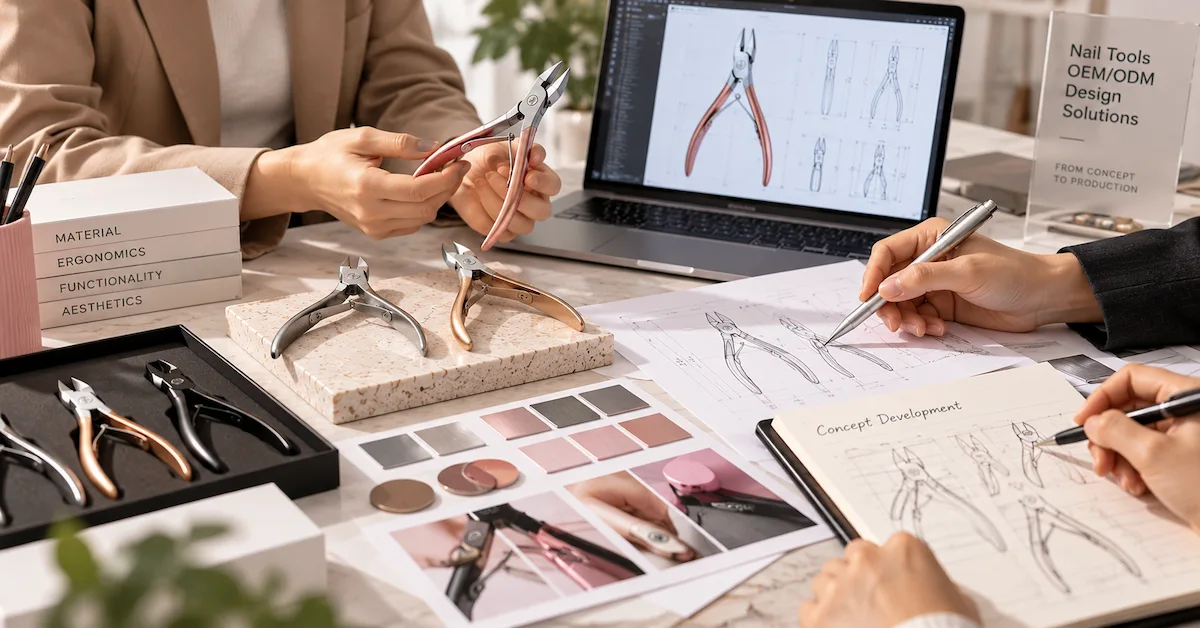
Private Label or Retail Premium SKU
A branded product may require a different packaging concept, coordinated surface appearance, or customized retail identity.
Such changes can influence the MOQ, cost, and approval requirements.
The buyer should separate product performance from branding decisions and approve both before ordering.
In practice, a small initial assortment often provides better information than a large untested collection. Sales and customer feedback can then support further range expansion.
5. How Should Importers Plan a Mixed-SKU Cuticle Nipper Order?
A mixed-SKU order contains more than one distinct cuticle nipper configuration. The configurations may differ by model, finish, brand, packaging, or another commercially relevant feature.
A mixed order can help a distributor test customer preferences without placing a large quantity against one unproven variation.
However, suppliers may apply minimum production or packaging quantities to each configuration.
A buyer should therefore distinguish between the total purchase quantity and the quantity assigned to each SKU.
| Planning Variable | What the Buyer Should Define | Supplier Question |
|---|---|---|
| Total Order Quantity | Expected combined quantity across the purchase order | Does total volume affect the quoted price? |
| Quantity per Model | Units allocated to each product configuration | Is there a separate MOQ per model? |
| Finish and Branding | Standard or customized decoration for each SKU | Does the finish require a separate production batch? |
| Retail Packaging | Individual pouch, card, box, or approved packaging | Are packaging minimums different from tool minimums? |
| Carton Configuration | Units per inner pack and shipping carton | Can different SKUs be consolidated for shipment? |
| Delivery Schedule | Required delivery window and receiving location | Which approved milestone starts the lead time? |
Mixed-SKU purchasing can be a useful commercial strategy, but it should never be presented as a guaranteed supplier service without project-specific confirmation.
For example, a supplier may permit shipment consolidation while still requiring separate minimum quantities for decorated products.
Another supplier may quote a favorable tool price but require a larger packaging print run.
The importer should request a quotation that exposes these conditions clearly. That makes the decision measurable rather than dependent on assumptions.
Compare Cuticle Nipper Models for Your Market
Send your target customer group, preferred models, estimated quantities, branding requirements, and packaging needs to discuss the appropriate sourcing options.
Request Wholesale Product Options →6. Understand MOQ Before Negotiating Bulk Prices
Minimum order quantity, or MOQ, describes the minimum commercial quantity a supplier will accept under defined conditions.
It is not always a single number applying to an entire product category.
A standard cuticle nipper may have different minimum quantity conditions from a custom-color model, a logo-decorated version, or a specially printed retail package.
For buyers planning a new product range, the most useful question is not simply "What is your MOQ?"
Instead, ask: "What is the MOQ for this exact model, with this finish, branding, packaging, and delivery arrangement?"
Request separate answers for the physical tool, surface customization, printed packaging, and any development or tooling requirements.
This distinction helps buyers avoid misunderstandings. A supplier may be able to produce a standard tool but require a larger order for a unique packaging component.
Buyers should also ask whether future orders must meet the same minimum or whether commercial conditions change after initial development.
OLIMOR's publicly available product listings do not establish one universal wholesale MOQ for every nipper. Current conditions should be confirmed through a model-specific inquiry.
7. Compare Wholesale Quotations on the Same Commercial Basis
A low unit price does not necessarily represent the lowest overall purchasing cost.
Two supplier quotations may describe different product configurations, packaging scopes, inspection arrangements, or shipment responsibilities.
A distributor comparing those quotations without correcting the differences may select an apparently inexpensive offer that creates unexpected charges.
Product Configuration
Confirm the exact supplier model, material description, finish, dimensions, and intended function.
A quotation for a standard product should not be compared directly with a customized version unless the differences are identified.
Branding and Packaging
Logo application, printed retail cards, protective covers, pouches, and customized cartons may affect cost.
The buyer should determine which elements are included in the quoted unit price.
Sampling and Development
New tooling, additional samples, decoration setup, or packaging development may involve separate charges.
Nonrecurring expenses should be distinguished from ongoing production costs.
Inspection and Delivery
Quality inspection, freight, insurance, import duties, and destination handling may also affect the final cost.
Confirm the applicable Incoterms rule, named place, and the responsibilities agreed between the buyer and supplier.
Incoterms 2020, published by the International Chamber of Commerce, provides recognized trade-term rules.
Those rules do not replace the product specification or a quality agreement.
8. Calculate Landed Cost Before Setting Distributor Prices
Landed cost is the total cost attributable to bringing the product into the buyer's intended receiving location, using a clearly defined accounting basis.
It helps importers compare purchasing options and evaluate whether a product can support their target selling price.
Depending on the buyer's accounting and trade arrangements, relevant components may include the product, packaging, freight, insurance, duties, import fees, and allocated inspection charges.
Estimated landed cost per unit = total applicable landed costs divided by the number of commercially acceptable units received.
Track nonrecurring development costs separately or allocate them according to the buyer's chosen accounting policy.
The number of acceptable units matters. If goods arrive with missing parts, damaged packaging, or unacceptable functional defects, a distributor may incur costs beyond the original invoice.
Buyers should also account for channel-specific expenses such as marketplace fees, warehouse handling, promotional allowances, and customer returns when calculating commercial margin.
A supplier quotation alone cannot establish a guaranteed distributor profit.
For a new SKU, buyers can model conservative, expected, and stronger-sales scenarios using their own assumptions.
The result helps determine whether the initial order should be small, whether packaging needs simplification, or whether the proposed retail price is realistic.
9. Why Case-Pack Design Matters in Cuticle Nipper Wholesale
A wholesale nipper is usually handled through several packaging stages before reaching its end customer.
The individual product may be protected by a sleeve, pouch, card, or box. Multiple units may then be placed in an inner pack and a shipping carton.
Buyers should define each packaging level and its contents.
A carton containing one SKU is easier to count and identify than a poorly documented mixture of visually similar tools.
However, some distributors benefit from mixed assortments when the contents are clearly defined and the fulfillment process supports them.
Individual Product Protection
Protect the cutting end and exposed working surfaces as required by the approved design.
The package should reduce foreseeable contact damage during handling and transportation.
Inner Pack
An inner pack can help simplify warehouse counting and order preparation.
Its quantity, identification, and contents should be stated in the packing specification.
Master Shipping Carton
Confirm carton dimensions, gross and net weights, quantity, markings, and any handling requirements.
Carton construction should suit the intended distribution route.
A product that arrives in perfect condition as an unpacked sample may still suffer damage when insufficiently restrained inside its retail packaging.
Review a fully packed sample before releasing the wholesale order.
10. Manage Barcodes, SKUs, and Packaging Hierarchies
A distributor should distinguish the supplier's product model from its own commercial SKU and any applicable trade-item identifier.
The supplier model identifies the underlying product. The distributor SKU identifies the version being purchased, stored, and sold.
Packaging and branding decisions may require distinct product records even when the physical tool is similar.
GS1's Global Data Model documentation describes trade-item hierarchies in which individual items, packs, and cases can be represented by their own GTINs where applicable.
The applicable GS1 GTIN Management Standard should be consulted when assigning or changing identifiers.
Do not assume that one barcode automatically identifies every packaging configuration.
| Record Level | What to Identify | Why It Matters |
|---|---|---|
| Supplier Model | Product number, configuration, specification revision | Prevents model substitution |
| Retail SKU | Brand, product, color, packaging version | Supports selling and stock control |
| Inner Pack | Contents, quantity, pack identification | Supports warehouse counting |
| Shipping Carton | Contained SKU, quantities, carton details | Supports receiving and shipment checks |
| Production Lot | Supplier lot or agreed traceability reference | Supports defect investigation |
These records become particularly important when a private-label buyer sells different product versions into several markets.
Maintaining accurate SKU data can reduce mis-picks, incorrect reorders, and product-listing inconsistencies.
11. Approve a Pilot Wholesale Lot Before Scaling the Order
A pilot lot allows a buyer to evaluate the complete product and supply process before committing to a larger commercial program.
The purpose is not merely to receive another attractive sample.
The pilot should test whether the agreed product specification, actual packaging, shipment documentation, and quality requirements work together.
Confirm the Approved Product
Record the selected supplier model, configuration, material description, appearance, functional criteria, and packaging specification.
The supplier should know which reference governs production.
Inspect the Cutting Mechanism
Cuticle nippers should be checked according to their intended cutting application.
Relevant areas may include jaw alignment, working-edge condition, hinge movement, spring response, and handling surfaces.
A functional test should use an agreed method and a documented acceptance criterion.
Check the Finished Pack
Verify that the correct model, labeling, instructions, logo, quantity, and protective materials are present.
A product that passes individual functional inspection can still fail the commercial order if the wrong retail packaging is applied.
Review Pilot Findings
Identify any nonconformities, their causes, and the required corrective actions before approving the next order.
The pilot should produce useful evidence: what was accepted, what was changed, and what must remain stable.
12. Create a Practical Cuticle Nipper Quality Release Plan
A wholesale quality agreement should define the characteristics that determine whether a lot can be accepted.
The criteria need to be specific enough that the buyer and supplier can apply them consistently.
"Premium quality" is a marketing expression, not an inspection method.
| Inspection Area | Potential Problem | Recommended Evidence |
|---|---|---|
| Jaw Alignment | Incorrect edge contact or unintended gap | Approved sample and defined visual/functional check |
| Spring Action | Irregular return, displacement, abnormal stiffness | Movement inspection method and recorded observations |
| Handle Condition | Burrs, rough surfaces, damaged finish | Surface inspection and boundary samples |
| Product Identity | Wrong model, finish, or revision | Product code and approved specification |
| Retail Package | Missing protector, incorrect artwork, inadequate restraint | Packed golden sample and packaging BOM |
| Shipping Carton | Wrong unit quantity or labeling | Packing list and carton inspection record |
Sampling plans can help manage lot acceptance, but the selected method must fit the actual product, risk, and contract.
ISO 2859-1 is a relevant international reference for acceptance sampling by attributes.
It does not define the cutting performance of a cuticle nipper or certify the manufacturer.
Buyers should establish their own appropriate defect definitions, inspection levels, and acceptance rules.
Serious safety-related defects require separate consideration and should not be dismissed solely because a sampled lot falls within a statistical acceptance threshold.
13. Review Material and Professional-Use Claims Carefully
Many cuticle nippers are described as stainless steel, but the term does not identify a specific alloy grade.
Material properties and maintenance compatibility can differ between product constructions.
If the distributor needs a particular grade, finish, hardness, or corrosion-resistance requirement, it should be included in the specification and supported by suitable evidence.
This becomes particularly important for products marketed to professional salons.
The ability to clean a tool does not necessarily prove that it can be processed using every disinfectant or sterilization method.
OSHA's published nail salon biological-hazards guidance discusses cleaning and disinfecting reusable tools in accordance with relevant state cosmetology requirements and disinfectant instructions.
Those recommendations do not establish compatibility for any particular OLIMOR product.
Buyers should confirm the exact product construction, intended use, cleaning instructions, and relevant destination-market rules before making professional hygiene claims.
Avoid unsupported phrases such as "medical grade," "sterile," "rust-proof," or "suitable for every disinfection method."
14. Develop Private Label Cuticle Nippers Without Losing Commercial Control
Private-label cuticle nippers can help beauty retailers and salon distributors establish a recognizable product identity.
A private-label program may involve an existing product with approved branding or packaging changes.
More extensive customization can require different development arrangements.
The buyer should specify which features are essential and which remain open for supplier proposals.
Logo and Branding
Confirm the proposed logo position, size, method, and appearance on the actual product.
A logo should not interfere with gripping or the working mechanism.
Finish and Appearance
Define the approved appearance using physical samples or suitable references.
If the finish includes a special coating, request relevant product-level information.
Private Label Packaging
Agree on the exact retail pack components, labels, artwork, protective features, and instructions.
A mock-up is useful during development, but approval should include the actual packed product.
Commercial Terms
Confirm the model-specific MOQ, setup charges, packaging minimums, sample costs, and planned production schedule.
Buyers should also address artwork ownership, any relevant tooling ownership, and change authorization.
OLIMOR presents OEM and private-label beauty-tool services through its company information and product content.
Actual customization feasibility depends on the selected model and commercial project.
Create a Branded Cuticle Nipper Line
Share your target market, model reference, preferred finish, logo artwork, packaging concept, and estimated quantities for project-specific sourcing discussions.
Discuss Private Label Cuticle Nippers →15. Calculate Reorder Points from Actual Distributor Demand
After the first wholesale shipment reaches the market, the distributor should monitor demand by individual SKU.
Reorder planning becomes more accurate when it uses actual sales and delivery information.
A simple inventory framework considers expected demand during replenishment lead time and an appropriate safety-stock allowance.
Reorder Point = Forecast Demand During Replenishment Lead Time + Safety Stock
The forecast and safety stock should reflect actual sales patterns, demand variability, supply variability, and the desired service level.
This formula is a planning tool rather than a guarantee of stock availability.
A new SKU with little sales history may require conservative forecasts and closer inventory monitoring.
Once several orders have been completed, the distributor can use measured sales and supplier delivery performance to refine the replenishment plan.
Reorder quantity should also consider MOQ, case-pack multiples, warehouse capacity, and working-capital limits.
A larger order may reduce certain purchasing costs per unit, but it can increase exposure to slow-moving inventory.
The right balance depends on the distributor's actual market, not a universal industry percentage.
16. Prevent Unapproved Changes in Repeat Wholesale Orders
Consistency becomes especially important when salons and retailers reorder familiar nipper models.
A product that looks similar may not feel identical if its hinge, spring, cutting geometry, or handle finish has changed.
Buyers should preserve the approved product definition for each SKU.
This includes relevant drawings, material information, finish references, functional criteria, logo artwork, packaging records, and golden samples.
When the supplier proposes a meaningful change, the buyer should determine whether another sample approval is necessary.
A minor visual change may still affect customer expectations or retail product identification.
A modification to the spring or jaw can affect the actual function.
Clear change control reduces the risk that an apparently routine replenishment order becomes an unexpected new product.
17. What Should a Wholesale Cuticle Nipper RFQ Include?
A professional request for quotation should give the supplier enough information to identify the required product and commercial conditions.
A vague message requesting a "best price" often creates additional questions and quotations that cannot be compared fairly.
Include the following information where available:
- Target country, sales channel, and customer group
- Exact model numbers or product references
- Intended application and important working features
- Estimated first-order quantity for each SKU
- Forecast replenishment quantities where available
- Material and finish requirements
- Logo and retail packaging specifications
- Inner-pack and shipping-carton requirements
- Sample approval and inspection expectations
- Destination and requested trade terms
- Requested commercial schedule and documentation
We are a beauty tools distributor serving salon and retail customers in our target market.
We would like to evaluate OLIMOR cuticle nipper models BNS1020, BNB3044, and BNS1017 as potential products for our wholesale range.
Please confirm current model specifications, sample availability, material descriptions, packaging options, minimum order quantities, and quotation terms for each model.
We are also considering a branded version and would like to understand the available logo, finish, and retail packaging options.
Our proposed initial quantities, destination, and packaging requirements can be provided for a detailed quotation.
Please identify any separate setup charges, approval requirements, and conditions for future replenishment.
This format allows the supplier to answer model-specific questions without inventing a universal price or MOQ.
It also provides a written record that can support later negotiations and purchase approvals.
18. Evaluate the Supplier's Wholesale Service Capabilities
A distributor should assess whether the supplier can support the complete commercial relationship, not only provide samples.
Ask whether the supplier can explain the selected models, provide relevant product documentation, identify packaging options, and communicate changes.
Discuss how quality issues are identified, recorded, and resolved.
Confirm the process for approving changes between the first shipment and later repeat orders.
Buyers may also request evidence relevant to factory operations or quality management where necessary.
A company profile alone does not establish specific production capacity, certification, or consistent product performance.
OLIMOR BEAUTY publishes relevant nail-care and beauty-tool categories, including cuticle nippers , nail clippers , and manicure sets .
For buyers expanding beyond cuticle nippers, these collections may help identify related products for a broader manicure assortment.
Each additional product should retain its own approved specification and relevant quality requirements.
Frequently Asked Questions About Cuticle Nipper Wholesale
1. Where can I source cuticle nippers wholesale?
Buyers can source cuticle nippers through beauty tool manufacturers, specialized suppliers, or wholesale distributors. Evaluate the exact models, materials, functional samples, packaging, quality requirements, and commercial terms before ordering. OLIMOR publishes a cuticle nipper product collection that can be used to identify potential sourcing references.
2. What is the MOQ for wholesale cuticle nippers?
MOQ depends on the selected product, finish, logo requirements, packaging, and order configuration. Different SKUs may have different minimum quantities. A specific OLIMOR wholesale MOQ should be confirmed through a project-based quotation rather than assumed from catalog information.
3. How much do bulk cuticle nippers cost?
The wholesale price depends on product construction, material, finish, order quantity, packaging, customization, and commercial terms. Website-displayed prices do not necessarily represent bulk offers. Request an itemized quotation for the same finished product configuration before comparing suppliers.
4. Can I order different cuticle nipper models together?
A mixed-SKU purchase order can be proposed, but its feasibility depends on the supplier's model-specific minimums, production arrangements, packaging quantities, and shipment conditions. Confirm whether different models can be consolidated into one shipment and whether each variation must satisfy a separate minimum quantity.
5. Which cuticle nipper model is best for salons?
There is no universal best model. Suitability depends on intended use, jaw geometry, handle balance, spring response, operator preferences, and applicable professional requirements. Compare physical samples of candidate models with trained users and approve the configuration that best matches your customer group.
6. Can OLIMOR provide private label cuticle nippers?
OLIMOR presents OEM and private-label beauty-tool services. Buyers can discuss selected nipper models, branding, finish, and packaging requirements. Available customization methods, minimum quantities, prices, and schedules should be confirmed for the specific project.
7. How should importers inspect a wholesale nipper lot?
Use an approved product specification, functional reference samples, relevant inspection procedures, and defined acceptance criteria. Check the cutting mechanism, hinge, spring, surface condition, product identity, and packed unit. The sampling and release plan should be chosen according to product risk and the purchasing agreement.
8. Are stainless steel cuticle nippers automatically suitable for salon disinfection?
No. A stainless steel material description does not establish compatibility with every cleaning chemical, disinfection process, or sterilization procedure. Review the finished product's construction and verified maintenance information, along with the relevant destination-market rules.
9. How do distributors reduce stock shortages?
Track real demand by SKU, confirm replenishment lead times, define reorder points, and allow for demand and supply variability. Keep approved product versions and packaging records available for repeat orders. Avoid relying on a fixed production schedule that has not been confirmed by the supplier.
10. What information should I send for a wholesale quote?
Provide your selected models, target market, buyer type, estimated quantities per SKU, branding preferences, packaging requirements, destination, and desired delivery conditions. Include any required material documentation or inspection criteria. Submit these details through OLIMOR Contact Us for a model-specific discussion.
Conclusion
Successful cuticle nipper wholesale purchasing depends on accurate model selection, clearly defined order quantities, complete cost comparison, protective packaging, documented inspection, and dependable replenishment planning.
Importers and salon distributors should begin with a focused assortment based on actual customer requirements rather than purchasing every available variation.
Buyers should then confirm the commercial specification for each SKU, approve physical samples and packed units, and agree on inspection and change-control procedures before bulk production.
A disciplined purchasing process can improve communication, reduce avoidable ordering mistakes, and provide a stronger foundation for repeat business.
OLIMOR BEAUTY offers a cuticle nipper collection that includes multiple product references for international buyers to evaluate.
If you are planning a wholesale or private-label nail-care range, identify your preferred models, quantities, target market, and packaging requirements before requesting a quote.
Start Your Cuticle Nipper Wholesale Sourcing Project
Contact OLIMOR with your target market, selected nipper models, order quantities, branding requirements, and packaging plans. Discuss product options, sampling, and current wholesale quotation terms.
Get a Custom Cuticle Nipper Wholesale Quote →Tag:
Related articles
- Beauty Tools Sourcing Guide
- OEM & Private Label
Eyebrow Scissors Manufacturer: Building Retail-Ready Brow Tools That Customers Understand
- Beauty Tools Sourcing Guide
- OEM & Private Label
Beauty Scissors Manufacturer China: How to Qualify Brow Scissor Designs for OEM Retail Programs
- Beauty Tools Sourcing Guide
- Manicure & Nail Tools