

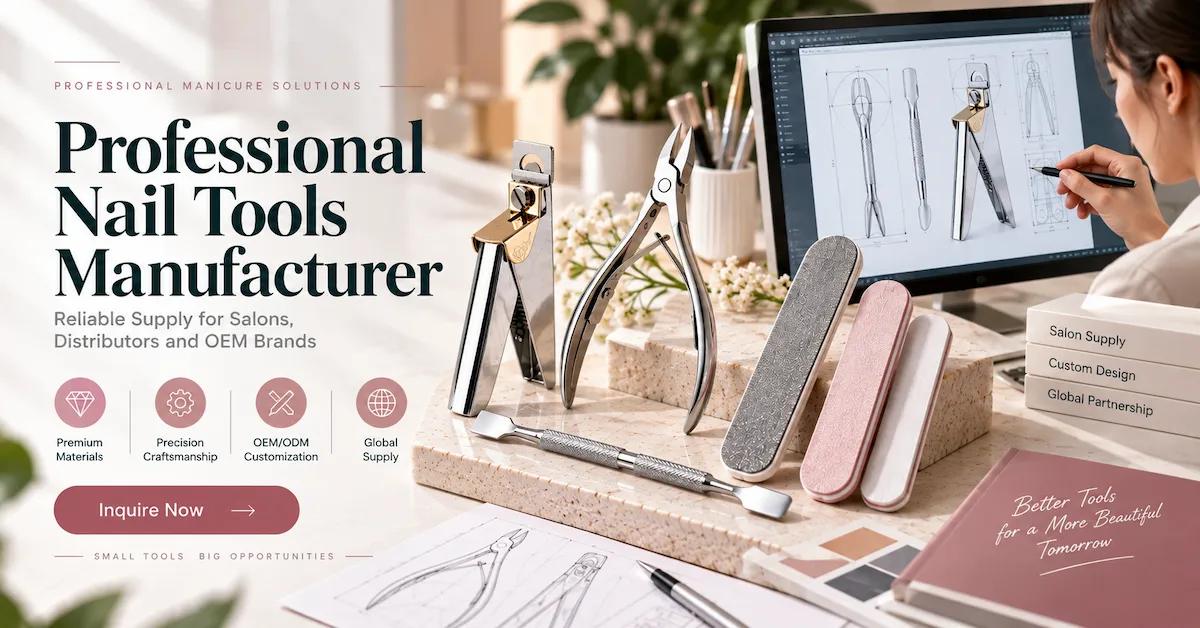
A salon distributor has a different buying problem from someone purchasing a single manicure tool for home use. The distributor must supply tools that match repeated professional workflows, provide accurate product information, support the hygiene rules of the destination market, and remain commercially available when salon customers need replacements.
Choosing a professional nail tools manufacturer therefore involves more than comparing stainless steel cuticle nippers, nail clippers, and manicure kits. It requires a sourcing program that connects product selection, professional-use requirements, sample trials, technical documentation, packaging, inventory management, and communication with the manufacturing supplier.
These decisions become especially important when a distributor supplies multiple salons or a brand introduces its own range of professional manicure accessories. An inconsistent replacement tool can interrupt staff training, create confusion at the workstation, and cause avoidable customer complaints.
Direct Answer: The best way to evaluate a professional nail tools manufacturer is to assess the entire salon supply program. Confirm which tools are appropriate for each service, which products can be reused under the applicable cleaning and disinfection rules, how functional samples are approved, how replacement SKUs are identified, and how changes are controlled between manufacturing batches. Product quality, hygiene compatibility, and replenishment reliability should be assessed separately rather than assumed from a polished appearance or a general "professional grade" claim.
This guide is designed for salon-supply distributors, professional beauty brands, international importers, nail salon chains, training academies, and OEM purchasing teams. It explains how to turn individual manicure tools into a structured, commercially manageable supply program.
The product examples refer to categories and selected items published by OLIMOR BEAUTY . Product-specific material properties, suitability for particular cleaning methods, order quantities, and manufacturing lead times must be confirmed for each selected model.
1. What Makes Professional Nail Tool Procurement Different from Retail Buying?
Retail customers typically compare a product's appearance, stated function, price, and ease of purchase. Professional salons also need tools to function predictably within a repeated service process.
A salon technician may prepare nails, shape the free edge, work around the cuticle area, apply cosmetic products, and clean the workstation between clients. Each step involves particular instruments, handling requirements, and hygiene procedures.
Buying tools independently without considering these steps can create unnecessary variation. Two cuticle nippers may look almost identical, yet differ in jaw shape, handle movement, spring configuration, or grip.
Those differences may require technicians to adjust their technique or may cause the salon to prefer one configuration over another. For the distributor, inconsistency also complicates replacement orders and product identification.
Professional sourcing should therefore answer four questions before the buyer requests a quotation.
- Which service task must this particular product support?
- Which functional characteristics matter to the technician?
- What cleaning, disinfection, handling, and storage conditions apply in the destination market?
- Can the same approved configuration be identified and sourced again?
The fourth question is frequently overlooked. A distributor needs not only an acceptable first delivery but also a controlled way to replenish the product later.
For that reason, professional nail tool sourcing is best treated as both a product engineering decision and a supply-chain decision.
2. Identify the Buyers and Their Professional Supply Requirements
Not every professional beauty customer needs the same purchasing arrangement. A nail academy buying training kits has different priorities from a distributor supplying hundreds of independent salon accounts.
| Buyer Type | Primary Requirement | Common Procurement Risk | Recommended Approach |
|---|---|---|---|
| Salon Supply Distributor | Standardized SKUs and recurring availability | Unannounced model changes or inconsistent batches | Approved samples, item codes, reorder specifications |
| Nail Salon Chain | Consistent tools across branches | Different handling experiences and inadequate hygiene documentation | Technician trials, care review, centralized purchasing standards |
| Private Label Brand | Branded professional product range | Attractive design without proven professional-use suitability | Product trials, packaging, approved claims |
| Nail Training Academy | Consistent educational tool sets | Missing tools or unsuitable equipment for teaching | Training BOM, safety guidance, replacement parts |
| Beauty Importer | Traceability and documented supply terms | Unclear materials, compliance responsibilities, or delivery scope | Supplier documentation, product identification, written commercial terms |
A distributor may also serve several of these customer types simultaneously. In that situation, one general-purpose product line may not be ideal.
A practical approach is to maintain a core assortment with clearly identified professional-use products and separate optional products for specialized services.
The manufacturer should be able to discuss the selected models against the customer's intended use and agreed specifications. Buyers should not infer that a broad catalog automatically means every product is suitable for every professional workflow.
3. Build a Salon-Ready Product Architecture
The most efficient professional nail tool programs start with the service menu, not the number of products available in a supplier catalog.
Divide the collection according to the task performed at the salon. The goal is to create an assortment that technicians understand and purchasing teams can manage.
Preparation and Cuticle Care Tools
Cuticle pushers and related preparation tools have working ends designed for controlled contact near the nail. Important buying considerations include end shape, surface condition, handling balance, and the intended application described by the manufacturer.
A professional distributor should compare the approved contact geometry rather than choosing a tool solely because its handle has a fashionable finish.
OLIMOR lists examples within its Nail Care Tools collection , including cuticle-related accessories and other nail-preparation tools.
Precision Trimming Tools
Cuticle nippers are relevant where trained professionals perform appropriate trimming as part of permitted services.
Buyers should examine jaw geometry, cutting-edge condition, spring response, and handle movement.
These characteristics should be evaluated against a specific approved product sample and the intended application.
The OLIMOR Nipper collection provides a starting point for model comparison.
Nail Trimming and Shaping Tools
Nail clippers and nail files have different functions. Clippers use a cutting mechanism, while files depend on a textured working surface.
They should not share one generic functional inspection checklist.
Buyers can compare the Nail Clipper range and Nail File collection to identify appropriate candidate models.
Complete Professional Manicure Kits
Manicure kits are useful for training, branded retail, travel, or certain organized tool programs.
However, a decorative carrying case does not automatically function as a compliant clean-tool storage container in a salon.
The complete kit should be evaluated by component, packaging configuration, intended users, and maintenance requirements.
OLIMOR also publishes a Manicure Set category for buyers considering multi-tool assortments.
4. Match Each Tool to a Professional Salon Workflow
An effective supplier discussion should move beyond the statement "These are professional nail tools."
Instead, determine how each tool will be used, what the operator needs to control, and which failure would make the tool unacceptable.
| Tool Family | Professional Function | Important Product Attributes | Buyer Verification |
|---|---|---|---|
| Cuticle Pusher | Controlled nail-area preparation | Working-end shape, surface finish, grip | Inspect contact geometry, burrs, handling |
| Cuticle Nipper | Appropriate precision trimming | Jaw geometry, hinge, spring, grip | Trial movement and check cutting-end condition |
| Nail Clipper | Nail trimming | Blade alignment, lever, pivot | Evaluate the intended cutting action |
| Nail File | Nail shaping and edge refinement | Working texture, shape, perimeter | Verify filing characteristics, surface condition, and use category |
| Manicure Kit | Organized collection of tools | Tool composition, case, component protection | Inspect individual tools and complete-set BOM |
This matrix is a recommended purchasing framework. It is not a substitute for product-specific technical specifications or applicable safety rules.
A professional supplier should be able to identify which characteristics matter for the selected model.
For example, a nail file's working surface needs a different evaluation method from a nipper's cutting jaws.
Similarly, a cuticle pusher should not be described as "sharper is always better." The correct working-end geometry depends on the intended operation.
By linking tool selection to actual service tasks, distributors can build product descriptions that help salon clients choose compatible products rather than purchase based on appearance alone.
5. Reusable and Single-Use Nail Tools: Why the Difference Matters
One of the most consequential questions in professional nail-tool sourcing is whether a product can be used again after appropriate processing or must be discarded after one client.
A metallic appearance does not automatically establish that the complete tool is reusable under a salon's required cleaning and disinfection procedures.
Reuse suitability depends on the actual materials, construction, intended use, verified care instructions, and jurisdiction-specific requirements.
Reusable Non-Electrical Tools
Certain metal cuticle nippers, pushers, clippers, and files may be intended for reuse where the product design and required processing methods permit it.
However, importers must confirm compatibility with the particular cleaning and disinfection procedures required in their market.
Claims such as "reusable," "disinfectable," and "sterilizable" are not equivalent statements.
A tool may tolerate one cleaning method without tolerating another process involving chemicals or heat.
Single-Use Supplies
Some abrasive products, emery boards, buffers, and similar supplies are intended or required to be discarded after a single client.
For example, California's Board of Barbering and Cosmetology identifies tools and supplies that cannot be disinfected, including emery boards, as single-use items under its applicable rules.
This is important for salon distributors because single-use supplies may require a different inventory and replenishment strategy from durable reusable metal tools.
Do Not Treat Sterilization as a Marketing Synonym
Cleaning removes visible debris and other unwanted material through an appropriate process.
Disinfection and sterilization are distinct processes with different technical meanings and requirements.
A distributor should not describe a tool as "sterilized" simply because it has been cleaned, disinfected, polished, or placed in a UV storage cabinet.
6. Cleaning, Disinfection, and Salon Hygiene Requirements
Professional nail salons must consider hygiene throughout the service workflow. The purchasing team should therefore understand how products interact with the applicable salon cleaning and disinfection system.
In the United States, the Occupational Safety and Health Administration publishes guidance addressing biological hazards in nail salons.
OSHA explains that nail salon workers may be exposed to biological hazards from contact with clients, contaminated tools, and potentially infectious materials.
Its guidance emphasizes cleaning and disinfecting reusable tools according to relevant state cosmetology-board policies.
Buyers should consult the original guidance, applicable local rules, and instructions for the disinfectant being used.
Understand the Required Workflow
California's Board of Barbering and Cosmetology provides an instructive example of a regulated professional setting.
Its Title 16, Section 979 establishes a sequence for disinfecting applicable non-electrical instruments.
The process includes removing visible debris, cleaning, drying, and using an appropriate EPA-registered disinfectant according to its manufacturer's instructions.
It also addresses the handling and storage of used and processed tools.
These are jurisdiction-specific requirements, not proof that every nail-care product can tolerate the required procedure.
Check the Product's Material Compatibility
Metal composition, joint design, coatings, adhesives, handle materials, and surface treatments may influence compatibility with a particular processing method.
The exact finished product should be reviewed rather than assuming every stainless steel-looking instrument behaves identically.
A manufacturer may need to provide material information or appropriate evidence for a specific compatibility statement.
Consider Clean and Used Tool Storage
Professional-use product selection should also account for how items will be stored before and after service.
A retail presentation pouch is not necessarily suitable for storing disinfected instruments in a salon environment.
Distributors should avoid promoting an ordinary manicure case as a compliant hygiene storage system unless that use has been appropriately established.
This is a key reason to separate retail packaging features from professional hygiene claims.
Discuss Nail Tool Specifications for Your Salon Supply Market
Identify your target country, intended salon applications, preferred tool designs, material requirements, and expected order quantities. OLIMOR can be contacted to discuss selected models and available project options.
Contact OLIMOR for Product Details →7. Evaluate Tool Handling Under Realistic Salon Conditions
Professional nail tools are repeatedly handled during detail work. Product selection should therefore include a structured trial by appropriate professional users.
A sample can appear satisfactory when examined on a desk but reveal handling issues when used for its intended task.
The trial should take place under safe, appropriate conditions with trained operators.
Cuticle Nipper Handling
Nipper evaluation should include the interaction between handle geometry, hinge movement, cutting-jaw position, and spring response.
An overly stiff or inconsistent mechanism may make fine control more difficult.
The manufacturer should explain which model configuration is being supplied and how the approved sample is identified.
Cuticle Pusher Grip
Pushers may use textured metal handles or other grip configurations.
Buyers should assess whether the selected handle allows suitable positioning and whether its contact areas are appropriately finished.
A product that looks attractive in a photograph should still be evaluated for its actual handling characteristics.
Nail File Control
Filing products should be assessed according to their intended working surface and application.
The appropriate degree of abrasiveness depends on the tool design and the material or task for which it is intended.
A file intended for one application should not automatically be recommended for every nail type.
Document the Trial Instead of Relying on Opinions
Ask trial users to evaluate defined characteristics using the same criteria.
Useful fields include handling control, comfort observations, functional consistency, surface condition, ease of identification, and suitability for the intended task.
Record the model and trial conditions. This information helps purchasing teams separate personal preference from recurring product issues.
8. How to Compare a Professional Nail Tools Manufacturer
A reliable sourcing decision should examine more than whether the supplier lists the requested products.
Buyers need evidence that the selected tools can be specified, sampled, produced, inspected, and reordered against an agreed product definition.
Ask whether the supplier can identify the relevant manufacturing stages and quality checkpoints for the specific SKU.
For example, forming, grinding, polishing, assembly, finishing, and packaging may be relevant to different manicure instruments.
Not every product necessarily passes through every process. Nor should buyers assume all operations are performed in-house.
Review Product Documentation
Request model numbers, dimensions, component material information, finish descriptions, packaging specifications, and any required functional criteria.
Where a defined alloy grade, hardness, or surface performance is commercially essential, it should be specified and supported by appropriate evidence.
Review Quality Control Responsibilities
Ask how the supplier identifies nonconforming products and how relevant production changes are handled.
A factory tour or attractive equipment photograph does not replace documented quality acceptance requirements.
Review OEM and Private Label Scope
Some buyers need only a selected existing tool with a logo or custom packaging.
Others need specific dimensions, a revised mechanism, or a new product design.
The latter projects may involve additional development, samples, engineering work, or tooling.
Buyers should confirm the commercial scope of each customization before approving an order.
Review Business Communication
A supplier should provide clear answers about product identity, availability, minimum quantities, quotations, sampling, and change authorization.
Unsupported commitments about zero defects, unlimited customization, or guaranteed delivery should be treated with caution.
OLIMOR publishes company and product background through its About Us page and product catalog .
Model-specific manufacturing, compliance, and commercial statements should be verified during the actual supplier inquiry.
9. Build a Controlled Sample Trial Before the First Bulk Order
A professional distributor should not select a long-term salon tool solely from a product photograph or one unstructured demonstration.
A more dependable approach is to run a controlled sample qualification process.
Step 1 — Identify the Exact Model. Record the supplier SKU, buyer item code, intended application, materials, and relevant configuration.
Step 2 — Check Product Condition. Inspect dimensions, working surfaces, edges, mechanisms, finish, and other relevant characteristics.
Step 3 — Conduct a Professional Trial. Have suitable trained users evaluate the tool under an agreed, safe procedure.
Step 4 — Review Care and Market Requirements. Confirm intended use, product-specific maintenance guidance, and any required regulatory documentation.
Step 5 — Approve the Selling Unit. Review branding, packaging, labels, barcode, product instructions, and shipment protection.
Step 6 — Create a Golden Sample. Preserve the accepted product and connect it to the approved specification, artwork, and revision.
A golden sample is particularly valuable when the buyer intends to place repeated orders under a private-label program.
Without a controlled reference, seemingly small differences in working geometry, finish, or packaging can become difficult to resolve later.
A good sample trial should also document rejection reasons.
If a model is unsuitable, record whether the problem involves function, materials, handling, care instructions, appearance, or commercial positioning.
This evidence helps the buyer choose an alternative model without repeating the same mistake.
10. Plan Inventory Around Professional Replenishment
Replenishment is what turns a successful initial purchase into an ongoing distributor program.
A salon supplier should distinguish between consumable items, replacement reusable tools, and less frequently purchased complete kits.
These groups often have different demand patterns and purchasing requirements.
Single-Use Products
Where a product is required to be discarded after one client, demand may relate to service volume.
A distributor can estimate usage from the number of services and the quantity consumed per service.
The estimate must reflect the applicable rules and the actual product.
Reusable Metal Tools
Reusable tools are not necessarily replaced after every appointment.
Replacement demand can arise from wear, damage, loss, product retirement, or changes to salon operations.
Do not invent a fixed replacement lifetime without appropriate data.
A manufacturer should not promise that a nipper will remain suitable for a particular number of services unless the claim is supported by relevant evidence.
Calculate a Practical Reorder Point
A simple inventory planning model uses expected consumption during replenishment lead time plus an appropriate safety-stock allowance.
Reorder point = expected demand during replenishment lead time + safety stock.
Safety stock depends on real demand variation, actual delivery performance, and the distributor's chosen service level.
This is a planning method, not a statement that OLIMOR guarantees a particular production schedule.
The buyer should use supplier-confirmed timing and actual sales data before deciding on a minimum inventory level.
11. Standardize SKU Identification Across Salon Accounts
SKU management becomes more important as a distributor adds product types, handle styles, finishes, and branded variants.
A single supplier model may be sold under several customer-specific configurations.
The purchasing team needs a consistent way to distinguish those versions.
| Record | Information to Preserve | Commercial Purpose |
|---|---|---|
| Product Identity | Supplier model, buyer SKU, revision number | Prevent incorrect replacement shipments |
| Functional Specification | Tool geometry, important components, approved sample | Maintain consistent user expectations |
| Material Record | Component materials and verified claims | Support correct product information |
| Maintenance Information | Approved care and use limitations | Avoid incorrect professional-use claims |
| Packaging Version | Artwork, barcode, labels, pack BOM | Maintain channel and order consistency |
| Commercial Record | Quoted quantity, trade terms, agreed lead time | Plan purchasing and replenishment |
A disciplined SKU system helps the manufacturer and distributor discuss the same physical product.
This also improves communication with salon customers who request a familiar replacement model.
The SKU code does not need to be complicated. It simply needs to identify the important differences without ambiguity.
12. OEM and Private Label Options for Salon Distributors
Professional salon distributors may want to sell tools under their own brand name.
Private-label branding can support consistent product identification, coordinated packaging, and stronger recognition across a distributor's assortment.
The appropriate customization approach depends on the product platform and buyer requirements.
Private Label on Existing Products
The buyer selects an established model and discusses branding or packaging changes.
Possible options may include logo placement, packaging artwork, selected finishes, or assortment packaging.
Availability must be confirmed for each selected SKU.
OEM Product Development
OEM projects may begin with buyer-provided drawings, samples, dimensions, or functional requirements.
A structural change can affect engineering evaluation, sampling, production processes, and cost.
The buyer should not assume that every alteration is commercially feasible at every quantity.
ODM Product Development
ODM discussions may involve supplier-assisted design decisions based on the buyer's goals.
The parties should define the scope of development, design approvals, potential tooling, and ownership terms.
Branding Must Not Override Function
Professional tools should retain their intended handling and functional characteristics.
A decorative surface finish or logo placement should be reviewed if it affects grip, working areas, or product identification.
The finished branded sample should be approved before bulk manufacturing.
Develop a Branded Salon Tool Range
Explore selected OLIMOR nail tools, discuss your target market and branding preferences, and request a project-specific assessment of samples, packaging, and quotation terms.
Start Your Private Label Inquiry →13. Manage Commercial Costs Beyond the Factory Unit Price
A professional distribution program should evaluate its full commercial cost rather than focusing exclusively on the initial purchase price.
Two apparently identical tool quotations may include different scopes of supply.
One may include only a loose unbranded instrument, while another includes retail packaging and specific inspection arrangements.
The buyer should compare equivalent configurations.
Product and Manufacturing Cost
The product price depends on the actual tool design, materials, production requirements, and order quantity.
A particular steel grade or finishing process should only be included in the quotation when it is specified and agreed.
Branding and Packaging Cost
Logo decoration, custom cartons, labels, protective sleeves, or branded cases may add cost.
Development and setup charges should be distinguished from recurring unit costs.
Quality and Logistics Cost
Sampling, agreed inspections, corrective action, transportation, import charges, and warehouse handling can affect landed cost.
The quotation should identify applicable trade terms and responsibilities.
Replenishment Cost
Reorder quantities, inventory holding, product variations, and supplier timing affect working capital.
A tool with a low initial unit price can become commercially unattractive if it creates high inventory complexity or frequent returns.
Distributor profitability should therefore be assessed using actual landed costs, channel expenses, and replacement demand.
14. Control Product Changes Between Manufacturing Batches
A stable replenishment program requires manufacturers and buyers to control changes that affect the approved product.
Potential changes include material substitution, handle geometry, finishing method, spring design, cutting-edge preparation, artwork, or packaging components.
Some changes may be cosmetic, while others can affect handling, function, cleaning compatibility, or regulatory claims.
The buyer should define which changes require notification and reapproval.
Preserve the Golden Sample
Store an approved physical product together with its specification, photographs, packaging artwork, and revision record.
The sample should be identifiable by both parties.
Require Change Notifications
The supplier should know when a proposed change requires prior buyer approval under the purchasing agreement.
If the change could affect an important functional or safety characteristic, additional evaluation may be necessary.
Review Returned Goods and Complaints
Distributors should organize complaints into meaningful categories.
These may include handling dissatisfaction, functional defects, surface damage, incorrect product identification, packaging problems, or unsupported customer expectations.
This approach helps determine whether corrective action should focus on manufacturing, labeling, selection, or customer instructions.
15. What Should a Professional Salon Tool RFQ Include?
An effective request for quotation should allow the supplier to identify the exact product and its intended professional market.
The buyer should provide enough information to separate ordinary existing-product sourcing from custom development.
- Product family and selected model reference
- Target country and distribution channel
- Intended professional application
- Material and functional requirements
- Proposed order quantity per SKU
- Logo and packaging requirements
- Product care and use claims needing evidence
- Sample and inspection requirements
- Requested quotation and delivery terms
- Replenishment expectations and change-control needs
We are developing a professional nail tool supply program for salon distributors in our target market.
We are interested in selected cuticle nippers, cuticle pushers, nail clippers, and nail files.
Please provide relevant model references, available specifications, product materials, sample options, OEM or private-label possibilities, packaging configurations, MOQ, current lead-time estimates, and quotation terms.
We would also like to discuss product-specific maintenance information, quality acceptance criteria, and repeat-order consistency.
The wording can be adapted to the buyer's actual program.
Clear information at the RFQ stage makes subsequent supplier comparisons more meaningful.
Buyers can reference the OLIMOR product catalog when identifying models of interest.
16. Common Mistakes When Sourcing Professional Nail Tools
Mistake 1: Selecting on Appearance Alone
A polished surface and an attractive photograph do not prove that a tool fits the intended salon application.
Inspect the working geometry and perform appropriate sample trials.
Mistake 2: Assuming Every Metal Tool Is Disinfectable
Materials, assemblies, coatings, and joints may influence compatibility with cleaning and disinfection procedures.
Confirm the actual finished product's maintenance suitability before making claims.
Mistake 3: Purchasing Large Sets Without a Service Plan
A manicure kit containing many pieces is not necessarily better suited to a professional salon than a carefully selected smaller assortment.
Choose tools according to the actual service menu.
Mistake 4: Ignoring Replacement Availability
A product that works well initially may create customer frustration if the distributor cannot obtain the same configuration for replenishment.
Discuss model identification and future sourcing arrangements before launching the line.
Mistake 5: Failing to Preserve Approved Samples
Without a clear approved reference, disputes about finishing, components, or packaging become difficult to resolve.
Maintain a documented sample and revision system.
Mistake 6: Using Unverified Professional Claims
Terms such as "surgical grade," "medical grade," "sterilizable," or "guaranteed infection-free" require appropriate evidence and regulatory review.
They should not be used as generic advertising language.
17. How OLIMOR Can Fit into a Professional Nail Tool Sourcing Project
OLIMOR BEAUTY publishes a range of beauty and personal-care accessories, including products relevant to professional manicure purchasing.
The publicly available catalog provides several starting points for discussions about selected models and product programs.
Importers seeking manicure preparation accessories can review the Nail Care Tools category .
Buyers seeking precision trimming instruments can examine the Cuticle Nipper collection .
The catalog also contains Nail Clippers , Nail Files , and Manicure Sets .
One published OLIMOR example is the Stainless Steel Cuticle Nippers product listing, which identifies model BNS1020.
A further catalog example is the Nail Care Tools: Elevate Your Manicure Routine listing, identified as model BNT0001.
These references should be treated as starting points for model-specific evaluation.
Their public product descriptions do not establish every possible hygiene compatibility, professional-use certification, minimum order quantity, or replenishment term.
A serious buyer should confirm the relevant details before commercial approval.
Build a Professional Nail Tool Supply Program
Share your salon market, preferred nail-care tools, estimated quantities, customization requirements, and documentation expectations. Discuss appropriate OLIMOR product options and the next stage of sourcing.
Request a Professional Nail Tools Quote →Frequently Asked Questions About Professional Nail Tools Manufacturers
1. What should salon distributors look for in a professional nail tools manufacturer?
Look for clear product identification, appropriate functional specifications, sample approval arrangements, credible material information, accurate care instructions, and documented commercial terms. A supplier should also be willing to discuss repeat-order consistency and product changes.
2. Are stainless steel manicure tools automatically reusable?
No. Reuse suitability depends on the complete product, intended application, actual construction, validated maintenance compatibility, and applicable local hygiene requirements. A stainless steel description alone does not prove compatibility with every disinfectant or sterilization method.
3. What is the difference between cleaning, disinfection, and sterilization?
These terms describe different procedures and outcomes. Cleaning removes unwanted material through an appropriate process. Disinfection addresses specified microorganisms, while sterilization has a distinct and more demanding technical meaning. Salon operators must follow applicable regulations and product instructions.
4. What professional nail tools should a distributor stock first?
Begin with the service needs of your actual customers. Suitable candidate categories may include cuticle pushers, cuticle nippers, nail clippers, and nail files. Choose individual models only after confirming their intended use, sample performance, maintenance requirements, and sales-channel fit.
5. Can OLIMOR support OEM or private-label nail tools?
OLIMOR publicly presents OEM and private-label beauty-tool support. Buyers can discuss selected products, branding, and packaging needs. The feasibility, order quantity, development cost, and timeline depend on the exact project and require confirmation.
6. How do buyers check cuticle nipper quality before ordering?
Review the jaws, cutting-edge condition, hinge movement, spring response, handle finish, and approved product geometry. Use documented sample comparisons and relevant functional inspection methods. Do not rely solely on appearance.
7. How should distributors plan nail tool reorders?
Track actual sales and replacement demand, identify approved SKUs, preserve golden samples, and confirm supplier replenishment terms. A reorder-point calculation can use expected demand during lead time plus appropriate safety stock. Replace planning assumptions with real sales and delivery data.
8. Can the supplier guarantee a fixed replacement lifetime for salon tools?
A lifetime or usage-cycle guarantee requires suitable supporting evidence for the specific product. Durability can depend on product design, use, maintenance, handling, and storage. Buyers should request verified performance information rather than assume a universal replacement interval.
9. What MOQ and delivery time does OLIMOR offer?
A single MOQ or production lead time cannot be established for all products and custom projects from the catalog alone. Provide exact models, quantities, branding, packaging, and destination information to request current commercial terms.
10. How can I request wholesale professional nail tools from OLIMOR?
Review the OLIMOR product catalog , select relevant models, and submit your requirements through the Contact Us page . Include your market, proposed quantities, intended professional application, and customization requirements.
Conclusion
Choosing a professional nail tools manufacturer is not merely a search for attractive manicure instruments at competitive prices.
A successful salon supply program requires products that suit the intended services, clear professional-use information, reliable identification, controlled samples, appropriate quality requirements, and a practical replenishment strategy.
Importers and distributors should distinguish reusable instruments from single-use supplies, verify applicable care and hygiene requirements, and avoid unsupported performance or sterilization claims.
They should also evaluate each supplier's ability to document the chosen models, agree on important product characteristics, manage branding and packaging, and communicate changes before repeat production.
OLIMOR BEAUTY offers a public catalog covering relevant manicure tool categories, including cuticle nippers, nail clippers, nail files, nail-care accessories, and manicure sets.
These categories provide useful starting points for professional sourcing discussions. Actual product suitability and commercial terms must be confirmed for the selected model and market.
If your business supplies nail salons, beauty distributors, training academies, or professional manicure brands, begin by defining your intended service applications and product requirements.
Then request suitable models, samples, packaging options, and project-specific quotation details from the supplier.
Start Your Professional Nail Tools Sourcing Project
Contact OLIMOR BEAUTY with your target market, selected products, expected quantities, branding requirements, and professional-use specifications.
Discuss sample evaluation, suitable product options, private-label packaging, and the next steps toward a defined purchasing program.
Get a Custom Nail Tools Quote →Tag:
Related articles
- Beauty Tools Sourcing Guide
- Materials & Quality Control
Nail Care Tools Manufacturer: A Cross-Tool QC Matrix for Importers and OEM Brands
- Beauty Tools Sourcing Guide
- OEM & Private Label
Private Label Foot Care Tools: How to Launch a 3-SKU Retail Range Without Costly QC or Packaging Mistakes
- Beauty Tools Sourcing Guide
- OEM & Private Label