

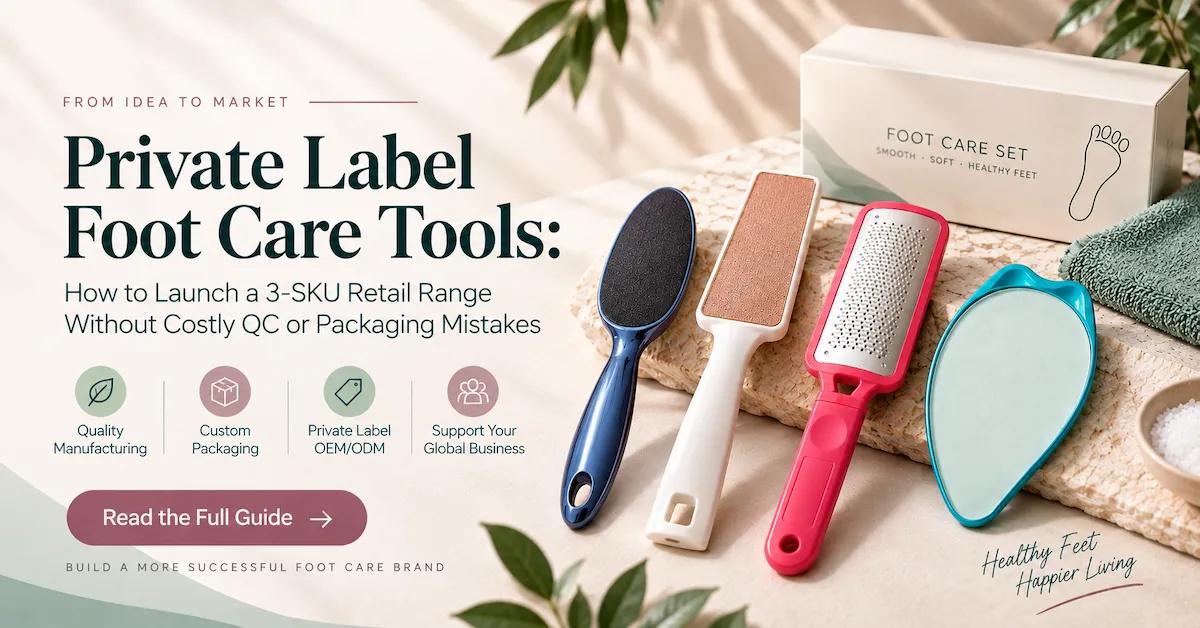
For an importer or beauty brand, launching private label foot care tools is not simply a matter of putting a logo on a foot file. The commercial challenge is to choose distinct products for a defined customer, agree on how each tool should perform, protect those characteristics through sampling and production, and present the range clearly enough for shoppers and distributors to reorder it.
The practical answer: begin with one core foot file, one differentiated alternative, and one complementary foot-care or pedicure option. Create an individual specification and approved sample for each SKU; validate the complete retail pack; and agree on functional, visual, documentation, and shipment checks before authorizing bulk production. This buyer-focused approach is more useful than launching ten similar-looking files with no clear reason to exist.
This guide is intended for private-label beauty founders, international importers, retail category managers, e-commerce teams, salon supply distributors, and professional pedicure buyers. It combines product-range planning with quality gates, packaging decisions, an RFQ framework, and model-specific examples from the OLIMOR Foot File collection. Where a performance limit, test result, minimum order, or custom option is not publicly confirmed, it is treated as a requirement to discuss and verify rather than a promise.
1. Start with a commercial problem, not a product catalog
A new foot-care range can fail despite attractive product photography. One brand lists several products that perform nearly identical jobs. Another selects a dramatic metallic rasp but gives the customer no clear use instructions. A distributor receives the correct tools but finds inconsistent cartons, different handle colors, or missing barcodes. These are not merely manufacturing issues. They are failures to connect product decisions with the way the range will be sold, used, inspected, and replenished.
The first question for a buyer is therefore not, “How many foot-care products can this supplier offer?” It is, “Which customer problem does each proposed SKU solve, and what evidence will show that the product is ready for our channel?” A salon-oriented range may prioritize handling and validated cleaning instructions. A gift-oriented retail set may prioritize a compact shape, protective storage, and consistent appearance. Online sellers need clear dimensions, accurate listing photographs, package resilience, and a comprehensible distinction between products.
Write a one-sentence customer promise before requesting samples. For example: “An uncomplicated home pedicure range with an easy-grip daily-care file, a second filing option, and a compact companion tool.” That is a planning statement, not a performance claim. It can guide assortment decisions without promising medical benefits or “instant” results that have not been established.
A strong launch brief should describe the buyer, destination market, sales channel, intended use, target price position, acceptable package size, proposed order quantity, and product characteristics that are non-negotiable. These inputs also help the supplier identify which changes are simple branding changes and which may require a new development cycle.
2. What counts as private label foot care tools?
Private-label foot-care tools are manual foot-grooming and related pedicure accessories sold under a retailer's or brand owner's name. The label owner typically controls the retail positioning, branding, artwork, and approved commercial specification. Depending on the underlying product, a program might use an existing tool with customized packaging or a broader development route involving dimensions, components, surface finish, or other functional attributes.
The distinction matters because private label, OEM, and ODM are not interchangeable quotations. A packaging-only project may preserve a proven product structure while changing the brand presentation. OEM can start from a buyer-defined drawing or reference with specific production requirements. ODM may involve a supplier-proposed design solution adapted to the customer's brief. None of these terms automatically establishes tooling ownership, exclusivity, a low MOQ, or a particular lead time; those terms belong in the project agreement.
For OLIMOR, the verified starting points include the Foot File category, Manicure Sets, Nail Clippers, and Nail Files. These are distinct catalog groups, not a claim that every item can automatically be combined in one custom kit. A responsible RFQ confirms compatibility, pack dimensions, materials, and availability for the particular items being considered.
3. Segment the audience before you decide on the assortment
| Buyer or sales channel | What customers need to understand | Key selection risk | Best starting conversation |
|---|---|---|---|
| Private-label e-commerce brand | What the tool does and how it differs from alternatives | Vague listings, damage in parcels, returns | Product photos, handling demonstration, pack protection |
| Beauty retail chain | A clear shelf hierarchy and repeatable replenishment | Look-alike SKUs and mismatched shelf labels | Range map, pack dimensions, barcode and carton data |
| Salon-supply distributor | Appropriate tools for its professional clientele | Unsupported cleaning or performance claims | Use conditions, materials, maintenance instructions |
| Spa retail program | A take-home product that complements services | Confusing professional claims and inconsistent quality | Staff instructions, customer-use boundaries, approved samples |
| Gift-set buyer | A coherent, presentable set | Tool movement, scratches, incomplete packs | Set BOM, protective inserts, assembly inspection |
| International importer | Predictable product identification and documentation | Changes between samples, cartons, and reorders | Specification control, labeling, QC and shipping documentation |
Do not design one supposedly universal product for all six channels. Their purchase quantities, packaging constraints, languages, and end-user expectations differ. A premium-feel file may be visually appropriate for a spa gift box but may not meet a value retailer's landed-cost plan. A more aggressive rasp configuration may be unnecessary for a basic home-care assortment and may demand more restrictive use instructions.
This is also a useful way to qualify leads. When a prospective customer says only “send me your foot-care catalog,” ask which channel the buyer serves and whether the first order is intended as a test or a replenishment program. Those two answers will usually narrow the range more effectively than another page of generic product descriptions.
4. Design a three-SKU assortment with a job for every item
Instead of launching many variants at once, a buyer can start with a three-SKU architecture. Three is an illustrative planning framework, not an industry-mandated assortment size. The point is to give each item a separate commercial purpose and a measurable approval path.
| Assortment role | Illustrative product direction | Why it earns shelf space | What to verify before approval |
|---|---|---|---|
| SKU A — Everyday hero | Handled nano-style foot file for routine cosmetic care | Simple explanation, recognizable use, main brand photograph | Working surface, grip, finished edges, verified care instructions |
| SKU B — Differentiated option | Double-sided file or a distinct surface/handle configuration | Gives customers a meaningful alternative rather than another color | Face identification, side consistency, size, packaging differentiation |
| SKU C — Companion or specialist | A separate pedicure accessory, compact option, or cautiously selected rasp | Creates a bundle or second purchase occasion | Intended user, safe handling, material record, pack fit, suitability for channel |
SKU A: make the hero easy to understand. The product should be recognizable in one image and its intended use explainable in one sentence. A foot file intended for gentle cosmetic maintenance should not be marketed with unsupported claims that it removes every callus or works for every skin condition. Confirm the actual working surface, usable length, handle geometry, care instructions, and condition at delivery. If a proposed logo interferes with the grip or product information, move it to the pack instead.
SKU B: differentiate by function or experience. A double-sided file is a candidate when the two faces have a verified, understandable difference. Merely describing a product as “dual action” is not enough. The specification should identify each face, any meaningful texture distinction, how the faces will be shown on the package, and what the approved sample demonstrates. If the two sides cannot be explained accurately, consider a different size or format instead of inventing a benefit.
SKU C: extend the routine without duplicating it. A travel format, complementary pedicure accessory, or carefully selected rasp may support a second price point or a distinct use case. Be particularly cautious with aggressive surfaces or sharp-edged implements: determine the intended use, audience, instructions, and applicable safety requirements before including them. Some designs may not be suitable for a mass-market consumer kit. Do not substitute “professional grade” for an actual evaluation.
A three-item family also makes packaging efficient to manage: common brand typography, a restrained finish palette, shared warning style, and a consistent SKU numbering format can be reused while each tool retains its individual specifications. If SKU B or C fails functional assessment, launch the approved hero SKU first rather than forcing a weak product into the range.
5. Use real catalog references, not invented factory specifications
OLIMOR's public foot-file range includes products marketed as a nano glass foot file, a double-sided nano glass manual foot file, and a nano glass pedicure foot file. The category also includes a callus remover grater rasp and other foot-care formats.
These are useful selection references, not proof that each version uses an identical glass composition, textured coating, adhesive, handle resin, or qualification method. A product title such as “nano glass” describes how the item is marketed; the buyer should still confirm construction, the exact working surface, and the materials of any other components. Likewise, “spray-painted” in a title does not establish coating durability or suitability for a particular cleaning chemical.
The publicly displayed product pages do not establish bulk quotation terms, unique private-label order minimums, verified abrasion test values, or market-specific compliance for every configuration. Some catalog examples may have different stock statuses, so a buyer should confirm the present status of each exact product rather than assuming the category listing guarantees immediate availability.
This distinction is valuable in sales content. The most convincing supplier page is not necessarily the one making the strongest absolute promises; it is the one that makes the item easy to identify and the next verification step easy to complete. For a private-label foot-care line, use the catalog to choose candidate forms, then request a version-controlled product specification and actual approval samples.
6. Specify the filing system as carefully as the handle
A foot file is a functional surface attached to or integrated with a body that the user holds. Both parts determine the experience. Buyers sometimes focus on a polished handle and treat the filing face as a decorative detail. That reverses the engineering priorities: a striking finish cannot compensate for loose abrasive material, a poorly bounded working face, or unexpected sharp edges.
For each candidate, identify the working-face construction first. Is the functional area integral to a glass-like body, formed in metal, bonded to a substrate, or created by another process? How does its texture vary across the face? Is there a transition zone between the working area and the non-working edge? What would constitute an unacceptable chip, protrusion, bare area, loose insert, or uneven texture? These questions can be converted into photographs and inspection criteria during sampling.
Next review handling geometry. Record overall length, head width, handle thickness, grip texture, center of balance, and the way the user's hand approaches the filing surface. A laboratory measure of grip force is not always necessary for initial selection; repeated structured handling observations with the intended user group can reveal slippery finishes, awkward wrist positions, or uncomfortable edges. Any numeric targets should be agreed for the chosen product and validated against an approved method.
Then review interfaces and retention. On a product with separate pieces, inspect the joint between the head and handle, potential movement during normal handling, and resistance to expected packaging and shipping conditions. On a one-piece product, check transitions, corners, and the consistency of the finished perimeter. Avoid describing any construction as “unbreakable,” “lifetime,” or “medical grade” without evidence suited to the exact finished item.
Finally, address care and storage. A reusable tool needs instructions appropriate to its actual materials and finish. Do not assume that all coated, glued, glass-like, metal, or plastic tools tolerate the same cleaning agents, immersion, heat, or salon disinfection process. The agreed maintenance statement should reflect material compatibility evidence and destination-market requirements, not generic wording copied from another product.
7. Build a specification sheet that survives a reorder
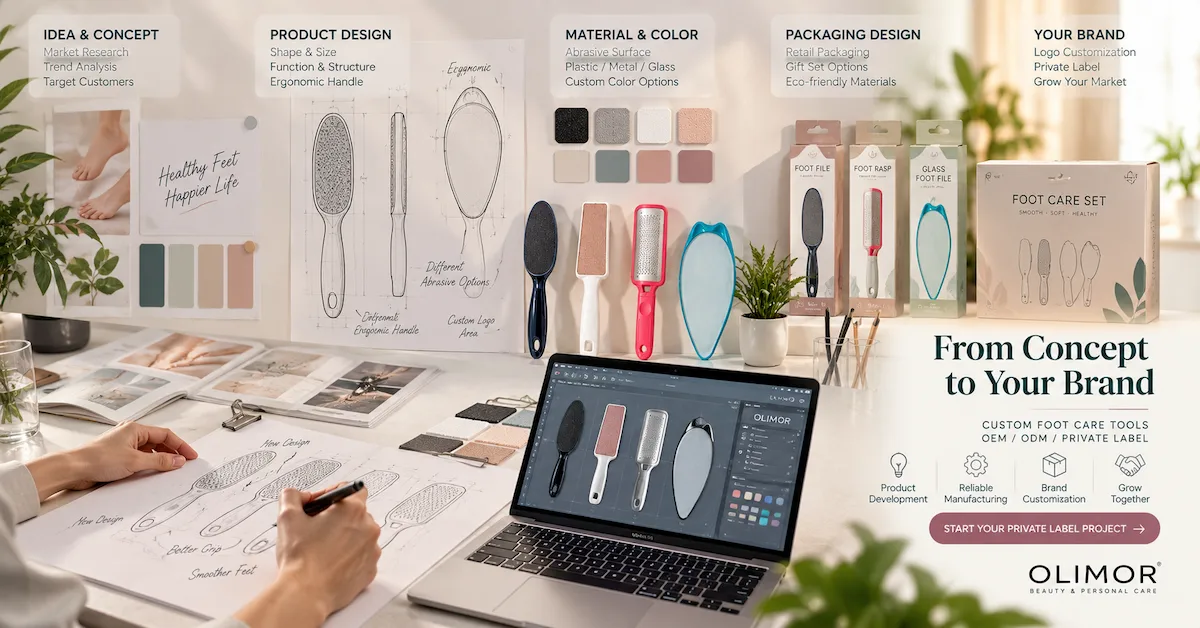
A complete private-label specification must identify more than a reference photograph. Two foot files can look identical in a social-media post but differ in working-face feel, part retention, package protection, or how the coating ages after handling. A photographic sample helps, yet production needs an agreed record of what the photo cannot show.
| Specification field | Information the buyer should record | Why it matters |
|---|---|---|
| Unique product ID | Buyer SKU, supplier model, version/revision | Prevents substitution and confusing reorders |
| Product description | Intended use, primary customer and sales channel | Keeps design and marketing aligned |
| Dimensions | Approved tolerances for relevant dimensions | Supports function, inserts, cartons and listing accuracy |
| Component materials | Material identity by component, with supporting evidence where needed | Avoids treating a mixed-material product as one material |
| Working surface | Construction, face layout, agreed visual/function criteria | Controls the product's central purpose |
| Handle and finish | Shape, texture, color reference and finish requirements | Controls user feel and range appearance |
| Branding | Logo artwork, location, size and method | Avoids inconsistent retail units |
| Packaging BOM | Inner protection, retail pack, leaflet, labels, master carton | Prevents incomplete or damaged deliveries |
| Claims and instructions | Approved wording, language, use limitations, cleaning guidance | Reduces safety, regulatory and review risks |
| Quality plan | Critical defects, sample method, inspection records | Creates consistent release decisions |
| Approval record | Golden sample ID, artwork revision, sign-off date | Makes the next order reproducible |
Do not fill the tolerance column with numbers copied from unrelated tools. If the supplier provides a drawing, review which dimensions are truly functional, which affect packaging, and which are cosmetic. The cost of tight tolerances may not be justified for every external dimension, while a small change to head positioning may alter handling enough to matter.
A useful internal practice is to label every image, drawing, PDF, and physical reference with one shared version code. When a buyer approves a new logo placement but leaves the working surface unchanged, the record should make clear exactly which element changed. This prevents the next order from being based on an email attachment that superseded only part of the earlier approval.
8. Run five quality gates before releasing a purchase order
Quality control is more effective when buyers specify when a decision is made and what evidence supports that decision. A final inspection alone cannot repair unclear product selection, incorrect claims, or a package that was never tested with the real tool. Use five approval gates that cover both the individual item and the commercial product sold to customers.
| Gate | Required evidence | Who should approve it | Hold the project if... |
|---|---|---|---|
| 1 — Concept and SKU | Customer profile, assortment map, intended use, preliminary specification | Buyer/product manager | Two SKUs have no meaningful distinction or intended use is unclear |
| 2 — Functional sample | Physical samples, dimensions, filing-face and handle observations, defect photographs | Product and quality teams | Surface, edge, grip or construction is inconsistent |
| 3 — Branding and claims | Artwork proof, logo sample, material and claim substantiation plan, care text | Brand and compliance reviewers | A label promises an unverified material, result or cleaning method |
| 4 — Complete retail pack | Packaged golden sample, barcode, instructions, transit-protection review, carton details | Buyer, packaging and quality teams | Tool rubs against pack, barcode fails, or finished set differs from BOM |
| 5 — Production release | Approved revision, supplier inspection plan, finished-lot evidence, agreed disposition process | Authorized buyer representative | Production differs from the signed sample or a critical issue remains open |
Gate 1 is a business decision. If three products cannot be differentiated, reduce the proposed assortment. Confirm that each item has a unique identity even when it shares the same colors or brand language. The outcome is an approved range map—not merely a list of catalog photographs.
Gate 2 is a functional decision. Inspect multiple candidate samples against the same conditions, not one attractive specimen selected by the supplier. Compare contact edges, working-face consistency, surface boundaries, handle condition, and stability. Keep photographs of unacceptable examples as well as the approved result. For tactile characteristics that are difficult to quantify, record a simple repeatable comparison procedure and the people who approved it.
Gate 3 is a communication decision. A product may be physically acceptable but commercially unsuitable if it requires promises that cannot be substantiated. Make sure the brand team knows the confirmed material details and limitations. Claims about hygienic use, environmental benefits, specific treatment outcomes, or suitability for professional multi-client use warrant particular attention.
Gate 4 is the retail-system decision. Review one completely packed sales unit—not a loose file beside a box mock-up. Shake or handle a packaged sample using an agreed screening method, then check for rubbed finishes, broken inserts, scratched surfaces, damaged corners, and loss of tool retention. Package testing should be proportionate to the actual distribution route, and any formal transit standard must be identified before it is claimed.
Gate 5 is the order decision. Translate sample approval into production-ready documents. A buyer should not release a bulk order because the package “looks about right” over a video call. Identify remaining open items, assign responsibility, and obtain written confirmation of the inspection and change-control process. None of these gates is a claim that OLIMOR uses this exact five-gate SOP; they are a recommended buyer-control framework.
9. Write acceptance criteria before you argue about defects
“Good quality” is not an actionable specification. Buyers need to distinguish conditions that make a tool unsuitable for its intended use from cosmetic variations that can be assessed against the approved sample. Start by listing plausible defects. Examples include loose or displaced filing material, unintended sharp edges, handle cracks, visible chips, incorrect parts, wrong colors, inconsistent logo location, missing instructions, or a barcode that cannot be scanned.
Choose the critical characteristics according to the exact design. For a bonded or inserted working surface, retention may be critical. For a one-piece glass-like file, damage to the edge or working surface may deserve attention. For a double-sided item, each surface must be identified and reviewed separately. If an item includes a sharp rasp structure, conduct an appropriate product safety review before proposing it for general consumer use.
A practical acceptance sheet contains the criterion, method, sample quantity, equipment or visual reference, responsible inspector, and pass/fail rule. For instance, “no visible unintended protruding sharp edge at the specified perimeter” can be illustrated with an approved photograph and defined inspection area. If a dimensional limit is essential, state the actual tolerance and measuring method. Do not rely on phrases such as “excellent workmanship” without an interpretation the supplier and buyer can both apply.
An AQL sampling plan, where appropriate, is only part of the decision. It does not replace product safety judgment, a confirmed specification, or critical defect escalation. Buyers should choose sampling and acceptance rules suited to the lot, distribution agreement, and applicable standard; they should not assume that one default AQL level makes every foot-care tool acceptable.
Finally, record how nonconforming goods will be handled. Is an affected lot quarantined? Does a defect require rework, replacement, sorting, or redesign? Who authorizes the disposition? The answers matter to importers because a cheap product with expensive corrective logistics is not cheap in practice.
10. Design packaging around protection, communication and the channel
The retail package is a functional component of the product offer. It protects a worked surface, communicates what the tool is intended to do, and lets a warehouse identify the correct SKU. Packaging should therefore be approved only after the physical tool and the initial claim language are stable. A box with impressive artwork is not retail-ready if the file can slide inside and mark its own coating.
For e-commerce, prioritize resistance to parcel movement, clear product identification, dimensional accuracy, and photographs that show the actual working face. For brick-and-mortar retail, focus on shelf size, hanging or standing orientation, visibility, legible instructions, barcode placement, and consistency among adjacent SKUs. For gift sets, assess presentation alongside assembly efficiency and whether different surfaces can damage one another in the case.
A useful rule is to separate universal brand assets from SKU-specific copy. Keep the same brand mark, color family, type hierarchy, and photography style across the line. Change the product name, working-surface description, care instructions, safety warnings, and model number when the underlying tool differs. Do not allow a convenient template to make all three SKUs claim identical materials or use conditions.
Ask for a packaging bill of materials that names the retail unit, protective sleeve or holder, label, leaflet, inner carton where relevant, and shipping carton. Add an artwork version and specify who approves translations. A barcode is not finished because it appears in the designer's mock-up; check its final size, contrast, location, and scannability on the actual packaging material.
Packaging sustainability claims also require restraint. “Recyclable,” “eco-friendly,” and “plastic-free” are not interchangeable statements. A package may contain several materials, and local recycling availability differs. Where the US Federal Trade Commission's Green Guides apply, broad unqualified environmental benefit claims can be misleading. Obtain specific evidence before turning a packaging preference into a marketing promise.
11. Handle hygiene, intended use and destination-market compliance accurately
Foot-care products are used near skin, so brands need careful instructions and credible safety review. That does not mean every manual foot file is a medical product, or that every salon can reuse every tool in the same way. The classification and requirements depend on product construction, intended use, marketing claims, and where it is sold.
For home-use products, avoid encouraging aggressive scraping or use on damaged skin. Clear, appropriately reviewed instructions should describe the intended area of use and the tool's actual limitations. Claims that a file treats a disease, eliminates infection, guarantees pain-free use, or is suitable for every skin condition can create medical or regulatory implications beyond an ordinary grooming accessory. Buyers should have claims reviewed for their destination market rather than relying on the supplier's marketing headline.
For salon distribution, distinguish cleanability from validated reprocessing. The United States Occupational Safety and Health Administration (OSHA) provides nail-salon hygiene information that includes cleaning and disinfecting reusable tools and following the relevant state cosmetology board rules. That guidance is not proof that a specific foot file can withstand any chosen disinfectant. Verify the actual product's material compatibility and any applicable professional-use restrictions before making a reusable or disinfectable claim.
For European Union consumer sales, review the applicable obligations under Regulation (EU) 2023/988, the General Product Safety Regulation, including product risk assessment, traceability, identification, warnings where relevant, and information required in online or distance-selling offers. Responsibilities depend on the economic operator and product circumstances; do not print a certification symbol or declare EU conformity solely because a supplier markets a tool as “premium.”
For United States retail, assess the applicable consumer product rules and truthfulness of labeling and advertising. Environmental claims should follow relevant FTC guidance, while professional service operators must also consider local sanitation requirements. Other destinations may impose different languages, traceability, chemical restrictions, or sales-channel requirements. These are buyer review topics, not claims that any individual OLIMOR SKU has already passed a named regulation or test.
A helpful claims matrix is simple: proposed statement / supporting evidence / applicable market / reviewer / approved final wording. Use it for material descriptions, “double-sided” functionality, finish claims, cleaning statements, sustainability statements, and any before-and-after imagery. A claim with no evidence should remain unpublished until verified.
12. Compare quotations on landed commercial cost, not unit price alone
Buyers frequently request the lowest piece price before deciding what will be sold. That is backward. A branded foot file has several linked cost elements: tool, possible branding process, retail package, insert, case or sleeve, sample and development charges, inspection, transport, duties, taxes where applicable, storage, returns, and the cost of maintaining several similar SKUs.
Build a landed-cost model for the actual selling unit. If SKU A is sold individually and SKU C is sold inside a two-piece gift pack, comparing their bare-tool factory prices will produce a misleading decision. Also separate nonrecurring charges from costs that repeat for each order. Custom molds, unique finishing processes, and specialized packaging may change the economics; ask the supplier which charges apply before using the term “low MOQ.”
| Cost or planning input | Confirm with supplier or service provider | Buyer decision supported |
|---|---|---|
| Tool cost by model and quantity | Exact item, revision, quantity break, trade term | Base gross margin potential |
| Custom logo or finish | Method, setup charge, yield considerations | Differentiation versus added complexity |
| Retail packaging | Unit BOM, artwork, printing setup, assembly | Channel readiness and price position |
| Samples or tooling | Scope, ownership, revisions and payment terms | Upfront investment and timeline |
| Inspection and freight | Inspection arrangement, cartons, dimensions, route | Landed-cost estimate |
| Duties and other charges | Destination-specific classification and import advice | True import economics |
| Reorder and change control | Minimum repeat quantity, approved version, replacement arrangements | Working capital and continuity |
The relevant arithmetic is straightforward: landed unit cost = recurring product and packaging costs + allocated logistics and import costs + appropriate recurring quality costs, with nonrecurring development costs tracked separately or amortized according to the brand's accounting policy. The retail margin then depends on actual selling price, channel fees, promotional allowances, fulfillment, tax treatment, and returns. No margin outcome can be guaranteed from a catalog price.
A buyer should also measure the inventory consequence of adding variants. An additional color may seem cheap, but it can require another carton label, image set, listing, stock position, and reorder forecast. Make the SKU earn its place by demonstrating a distinct customer reason to purchase it.
13. Send an RFQ that a manufacturer can answer precisely
A useful request for quotation is not a long wish list. It is a set of decisions already made, the questions still open, and the evidence needed to choose a production route. For foot-care tools, attach a compact matrix that gives the potential supplier enough information to quote realistic versions side by side.
Recommended RFQ brief: “We are planning a three-SKU private-label foot-care range for [target market] through [retail/e-commerce/salon distribution]. We need one everyday hero foot file, one differentiated double-sided or alternative-face option, and one companion tool to be agreed after sample review. Please propose specific OLIMOR model references, construction and component material information, available colors and logo methods, proposed retail packaging, dimensions, care instructions, sample plan, inspection points, estimated quantities by SKU, applicable MOQ, indicative timetable, and quotation terms. Please identify all items requiring separate development or compliance review.”
The placeholders are deliberate. A quotation without destination market, channel, quantity, and product specification can only be preliminary. Buyers should specify which attributes are mandatory, which are flexible, and which depend on sample performance. If the preferred model is unavailable, the supplier should propose an alternative by name rather than silently substituting it.
Request a quotation comparison format with one line per actual SKU, one line for each charge that is not included in the unit price, and clear assumptions. For example, if artwork preparation or a new insert must be paid separately, the buyer should be able to see it. If the proposed material differs from a reference image, state the proposed construction explicitly rather than treating “similar” as an adequate material declaration.
Always ask how changes are authorized. A change to working surface, handle resin, pack insert or cleaning statement can affect performance or compliance even if the visible design remains attractive. Retaining a record of signed-off revisions supports later inspections, customer service, and a reliable replenishment plan.
14. Evaluate the supplier beyond its catalog and marketing language
A supplier assessment should measure the ability to communicate, document, sample, and repeat the agreed configuration. A large catalog is helpful for discovery but does not by itself demonstrate control of the exact SKU you intend to buy. Ask who maintains drawings and artwork revisions, where critical inspections occur, what the buyer may review, and how problems in a finished lot are handled.
For a foot-file project, practical evidence may include a component list; close-up working-face photographs; an identified physical reference sample; inspection examples; a product-specific care statement; packaging mock-ups; and a documented explanation of possible customization routes. Where factory size, production capacity, certificate status, or testing claims matter, request current documents supporting the exact assertion. Avoid inferring these capabilities from unrelated company blog posts.
OLIMOR's public range and OEM/private-label content provide starting information about its beauty-tool categories and customization discussions. You can review the OLIMOR company information and its product catalog. However, buyer-specific quantities, production timing, material certifications, and private-label feasibility should be confirmed in a commercial exchange for the selected products.
A good supplier discussion should end with a decision log: accepted model, open engineering questions, sample owner, packaging owner, commercial assumptions, and next milestone. That is more valuable than a vague assurance that everything can be customized at any volume.
15. Plan the second order before the first product is launched
The first shipment proves that one version of a product can reach market. Replenishment tests whether the supplier and brand can recreate that version when materials, staff, suppliers, or packaging inventories have changed. Private label foot care tools become more commercially useful when the range supports a straightforward reorder process.
Archive the golden sample and a digital approval pack: latest drawings, photographs, component specifications, logo file, print-ready packaging artwork, barcode, instructions, carton data, inspection criteria, and final release record. A buyer should be able to say “reorder version 1.2 of SKU A” and have both teams understand which product is being ordered. The revision number is an illustrative control convention, not a claim about an existing OLIMOR system.
Use after-sales feedback as a structured input. Categorize comments: grip discomfort, unclear instructions, unexpectedly abrasive surface, packaging damage, shipping dents, incorrect set contents, or simply mismatched customer expectations. Not every negative review is a factory defect. If a buyer expected a gentle daily file but ordered an aggressive rasp, product positioning may be the root problem. If the surface loosens in normal use, functional quality requires investigation.
Changes should move through a miniature approval cycle. Do not switch adhesive, coating, handle geometry, or protective insert based only on an apparently equivalent material label. Determine whether the revision could affect functional performance, claims, storage or distribution. Then approve the actual revised sample before changing the reorder specification.
For a small new brand, a staged rollout can reduce complexity: validate the hero, introduce one distinct alternative after initial market feedback, and add a companion set only when customer demand and the supplier's confirmed production terms support it. This is a commercial planning recommendation, not a promise of a particular launch schedule or revenue level.
16. Common mistakes that damage a foot-care private-label launch
Buying near-duplicate products. Three finishes of the same form do not necessarily create three meaningful consumer choices. Write the benefit and target user for each item before committing inventory.
Assuming the catalog title is a technical specification. Terms such as “nano,” “professional,” and “stainless steel” may require component-level clarification. Record what the finished product actually contains and what has been tested.
Approving a loose tool but not the sales unit. The real customer receives a packaged product. Inspect the assembled retail presentation, not just the unpacked sample on a table.
Using one QC checklist for every foot-care design. Surface type, head attachment, finish and intended use alter the failure modes. A double-sided design should be reviewed as two working faces; a rasp requires a specific safety evaluation.
Copying treatment or sanitation claims. Cosmetic maintenance is not the same as medical treatment. Cleanability is not automatically validated disinfection or sterilization. Approve any such wording only against evidence and local rules.
Treating displayed web prices as wholesale quotations. Website price labels do not establish an OEM MOQ, packaging charge, trade term, stock allocation or production lead time. Request a project-specific quote.
Losing control of revisions. If the approved sample, artwork, and inspection specification carry different versions, a later mismatch becomes difficult to resolve. Use one shared approval record and require explicit change authorization.
Frequently Asked Questions About Private Label Foot Care Tools
1. What is the fastest way to start a private-label foot-care range?
Start with an established product form that fits your customer and request a model-specific sample, current specification, and packaging options. Confirm whether the required logo or packaging changes are available for that exact item. A packaging-led launch may involve fewer changes than a new working surface or handle mold, but availability, minimum quantity, cost, and timing must still be quoted for the project. Do not skip functional sample approval simply because the underlying design already exists.
2. Can we put our logo on a nano glass foot file?
Branding options depend on the surface, logo area, production method, order quantity, and durability requirements. A small or textured handle may be better branded on the packaging than on the tool. Ask for an actual decorated sample and check placement, legibility, finish condition, and any interference with the grip. You can use the OLIMOR Foot File selection to identify candidate shapes before asking about available customization.
3. What should we inspect on a double-sided foot file?
Review both working faces independently. Confirm that each side matches the approved reference, that any claimed difference between them is understandable and substantiated, and that the perimeter has no unintended rough or sharp defects. Check head attachment, grip condition, surface uniformity, and the way the retail package identifies and protects each face. If the sides have different intended uses, the approved instructions should distinguish them clearly.
4. Are metal foot rasps and nano glass foot files interchangeable?
No. They can differ in surface construction, handling, degree of abrasion, intended user, care limitations, and safety considerations. A more aggressive metal rasp may not be a suitable substitute for a gentle home-maintenance product. Select based on the end user and verified product configuration rather than price alone. For any rasp with pronounced edges, review product safety, suitability for the sales channel, and instructions before approval.
5. What MOQ and production lead time does OLIMOR offer for private-label foot-care tools?
A single confirmed MOQ or lead time cannot be established from the public category pages for every foot file and custom package. These terms depend on the selected SKU, branding route, packaging, quantity, component availability, and agreed order conditions. Send your intended quantities by item, destination, artwork requirements, and target date through OLIMOR's contact page to request a project-specific proposal instead of relying on a displayed retail price.
6. What is the most important quality check before bulk production?
There is no universal single check, but the approved functional sample and a written acceptance specification form the essential baseline. For a foot file, investigate the working surface, finished perimeter, handle condition, and any attachment point. Then verify that branding, instructions, and packaging agree with the same approved version. Conduct proportionate finished-lot inspection before shipment; do not assume a cosmetically attractive sample demonstrates long-term durability or compliance.
7. Can a branded foot-care tool be described as salon-safe or sterilizable?
Only when that claim is supported for the exact finished product and its intended use. A tool that can be rinsed or wiped is not necessarily compatible with a salon's required disinfection method. Materials, coatings, adhesives, local salon rules, and the manufacturer's verified care instructions all matter. Avoid “sterile,” “medical grade,” and equivalent claims unless the product and process genuinely support them. Professional buyers should review the applicable hygiene requirements before purchasing for multi-client use.
8. What information should a brand send to obtain a useful quotation?
Provide the target market, sales channel, desired product roles, candidate model links or images, estimated quantities per SKU, preferred appearance, logo artwork, packaging concept, planned retail positioning, safety and language requirements, and sample approval expectations. Ask for component-specific material identification, available customization options, a proposed inspection plan, separate setup charges, and any information still needed for a firm quote. A complete brief shortens unnecessary revisions and makes supplier comparisons much more meaningful.
Conclusion
Successful private label foot care tools programs begin with a disciplined retail decision, not the broadest available catalog. Select a hero file with a clear purpose, add only genuinely differentiated options, then control the working surface, handle, branding, instructions, packaged unit, and reorder revision as one connected product system. A brand that records these decisions is better positioned to compare suppliers, evaluate samples, communicate accurately with customers, and reduce avoidable production disputes.
OLIMOR BEAUTY's public catalog offers several foot-file styles and related manicure and pedicure categories as starting points. The next step is to identify the exact models that fit your market and verify the customization, materials, packaging, quality checks, and commercial terms for those items. If you are preparing a branded collection for retail, e-commerce, or salon distribution, contact OLIMOR with your product list and market brief to discuss a practical sample and quotation plan.
Tell us your target market, desired models, quantities, branding preferences and packaging requirements. Our team can discuss suitable product options and the next steps for your project.
Request a Custom Foot Care Quote →Tag:
Related articles
- Beauty Tools Sourcing Guide
- Materials & Quality Control
Nail Care Tools Manufacturer: A Cross-Tool QC Matrix for Importers and OEM Brands

- Beauty Tools Sourcing Guide
- OEM & Private Label
Private Label Grooming Kit Manufacturer: How Brands Build Custom Personal Care Sets
- Beauty Tools Sourcing Guide
- Lash & Brow Tools