

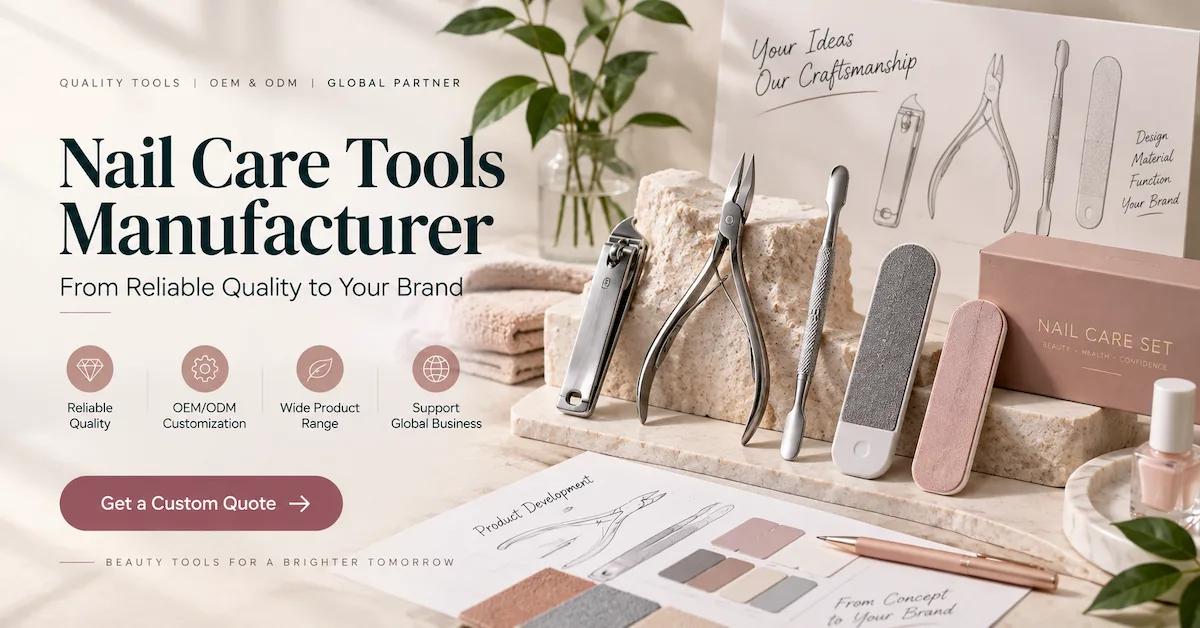
Two suppliers can offer an identical-looking nail clipper and quote different prices. Both may describe their products as stainless steel and display attractive product photographs. Yet neither fact tells a retail buyer whether the cutting edges meet correctly, whether an artificial-nail clipper suits natural nails, or whether a manicure set will contain the same components when the next shipment arrives.
The real challenge when choosing a nail care tools manufacturer is establishing a connection between a tool's intended function, its manufacturing details, and the characteristics an importer can inspect before approving a bulk order.
Quick Answer: A reliable nail care tools manufacturer should be evaluated with different functional inspection criteria for nail clippers, cuticle nippers, cuticle pushers, nail files, and manicure sets. Buyers should also require confirmed product specifications, approved physical samples, appropriate material documentation, packaging verification, and clear production change controls. The strongest supplier decision is based on documented product quality and commercial terms rather than a catalog photograph or an unsupported quality claim.
This guide explains how overseas beauty brands, importers, distributors, professional salon suppliers, and retail purchasing teams can compare manicure tool manufacturers through a practical quality control framework.
It examines cutting mechanisms, metal finishing, supplier evaluation, sample approval, OEM and ODM customization, defect classification, inspection planning, packaging, procurement costs, and repeat-order management.
The examples are connected to actual product categories published by OLIMOR BEAUTY . Product-specific quality targets, available customization options, minimum quantities, and lead times must still be confirmed for each selected model and order.
Why One Quality Checklist Is Not Enough for Every Nail Care Tool
A nail care collection often includes products with very different mechanical functions. The tools may share similar packaging, visual finishes, and materials, but the characteristics that determine their performance are not identical.
A conventional nail clipper relies on a lever mechanism and opposed cutting edges. A cuticle nipper depends on jaw geometry, hinge movement, and spring response. A cuticle pusher depends on the shape and finish of its working end.
A nail file has an abrasive or textured working surface rather than a conventional cutting mechanism. A manicure kit adds an entirely different concern: every component must match the approved product list and remain protected inside its case.
Consider a buyer who writes the same acceptance requirement for all products: "All tools must be sharp, smooth, and comfortable."
This statement is impossible to apply consistently. A file is intended to abrade rather than cut. A pusher requires an appropriately finished contact edge, not a knife-like cutting edge. A nipper needs a controlled cutting interface and predictable handle movement.
The solution is to create two inspection layers.
First, establish common requirements. These include item identity, finish, permitted surface defects, branding accuracy, product information, packaging condition, and shipment traceability.
Second, establish functional requirements for each tool family. These criteria should reflect how the specific product works and which failures matter most to its intended customer.
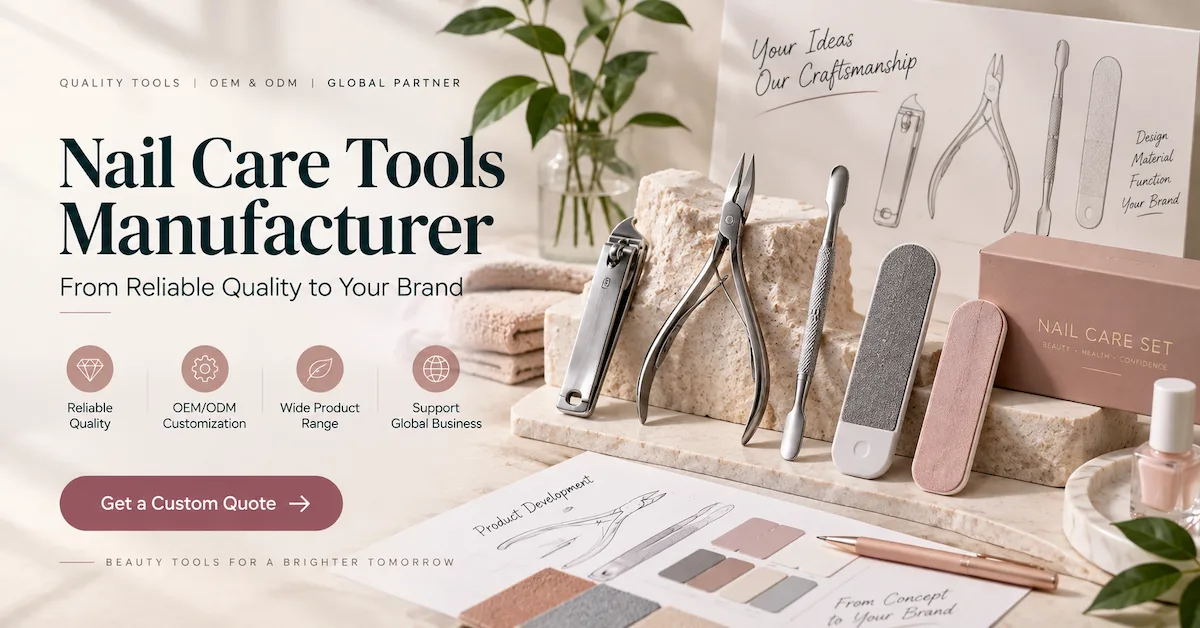
OLIMOR's current product catalog includes Nail Care Tools , Nail Clippers , Nippers , Nail Files , and Manicure Sets . These product categories provide a useful starting point for building a sourcing shortlist.
Which Buyers Need a Professional Nail Care Tools Manufacturer?
The term "nail care tools manufacturer" is frequently used by buyers with different commercial objectives. Understanding these objectives makes supplier selection considerably more effective.
Beauty Brands and Private Label Companies
Beauty brands need products that represent a consistent visual and functional identity. They may want coordinated nail clippers, cuticle tools, nail files, and manicure sets carrying the same logo and packaging design.
For these buyers, product consistency matters as much as visual customization. A beautifully branded nail clipper can still damage the reputation of a new collection if its cutting performance differs between batches.
Importers and Wholesale Distributors
Importers usually evaluate a manufacturer against purchasing requirements that include competitive pricing, reliable identification of products, inspection arrangements, shipping documentation, and availability for future orders.
Their biggest challenge is often controlling several product types and packaging configurations within one supply relationship.
A supplier capable of discussing the functional differences between products can support a more accurate sourcing conversation than a company offering only a generic price list.
Professional Nail Salons and Salon Suppliers
Professional nail technicians may use manicure tools frequently throughout the working day. Their purchasing decisions can be influenced by grip comfort, cutting control, tool movement, cleaning requirements, and consistency among replacement items.
However, a product described as professional is not automatically suitable for every salon hygiene procedure. The exact construction, intended use, and verified maintenance guidance must be reviewed.
Retail Chains and E-Commerce Sellers
Retail buyers must evaluate both product performance and the complete selling unit. Product naming, barcode placement, packaging protection, instructions, shelf dimensions, and listing accuracy can influence returns and consumer satisfaction.
A retailer selling a manicure kit should not approve the individual tools without checking how they are assembled and protected inside the finished package.
A Cross-Tool Quality Control Matrix for Nail Care Manufacturing
A useful inspection plan begins with the specific failure modes associated with the tool's working mechanism.
The following matrix provides an actionable starting point for importers. It represents recommended procurement checks, not published test results or a universal OLIMOR production standard.
| Product | Functional QC | Potential Defects | Evidence to Request |
|---|---|---|---|
| Nail Clipper | Blade contact, cutting action, lever movement, pivot stability | Uneven blade contact, damaged edge, loose lever, unintended burrs | Working sample, blade photographs, functional inspection method |
| Cuticle Nipper | Jaw alignment, cutting edges, hinge movement, spring response | Jaw offset, irregular movement, unstable spring, rough handle | Jaw close-ups, movement checks, approved physical sample |
| Cuticle Pusher | Working-end shape, edge finish, handle grip | Burrs, irregular contact profile, rough surface, incorrect dimensions | Profile drawing, sample, surface-finish references |
| Nail File | Filing-surface consistency, working area, perimeter finish | Uneven texture, loose abrasive material, damaged edge | Working-surface specification, sample comparison, defect limits |
| Manicure Set | Individual tool function, component completeness, case operation | Missing tools, incorrect model, poor packaging fit, scratches | Approved BOM, individual samples, packed golden sample |
This matrix gives buyers a practical way to discuss manufacturing requirements. Each checkpoint should ultimately connect to an agreed inspection method and acceptance criterion.
A supplier's claim of "precision quality" becomes much more useful when the buyer can identify exactly what precision means for the product being purchased.
Nail Clipper Manufacturing: Blade Alignment and Mechanical Performance
Nail clippers are among the most familiar manicure accessories, but their apparent simplicity hides several important mechanical relationships.
The cutting edges must approach each other in a controlled manner. The lever must transfer force predictably, while the pivot and body should remain stable during normal operation.
When assessing a nail clipper manufacturer, buyers should begin with the product's intended application.
A clipper for normal natural-nail grooming may differ from a product intended for thicker nails or artificial nail materials. These applications should not be assumed interchangeable.
Cutting-Edge Alignment
Cutting-edge alignment influences how the clipper performs its primary task. Uneven contact can result in incomplete cutting or an undesirable nail-edge finish.
Buyers should examine a physical sample under suitable lighting and compare the working edges against an approved reference.
The inspection method should identify unwanted gaps, visible deformation, irregular contact, chipped edges, or other conditions relevant to the design.
Lever and Pivot Stability
A nail clipper also needs predictable movement. Excessive looseness, abnormal resistance, or unstable pivot behavior can affect the user experience.
A structured inspection should include closing and opening behavior, lever stability, unwanted movement, and any interference between components.
Material and Surface Condition
Material selection influences manufacturing and finishing, but the word "stainless steel" does not identify a specific alloy grade or prove a particular hardness.
If the buyer needs a defined material, surface treatment, or performance result, those requirements should be included in the model-specific specification.
Buyers can review the OLIMOR Nail Clipper collection to identify candidate product formats before requesting current specifications and bulk quotations.
Cuticle Nipper Manufacturing: Jaw Precision, Spring Action, and Handling
Cuticle nippers require a different inspection approach because their cutting performance depends on the relationship between the jaws, hinge, and spring mechanism.
A nipper may have an attractive polished appearance but still perform inconsistently if its jaws meet incorrectly or its spring response is unstable.
Jaw Contact and Cutting Geometry
Jaw alignment should be examined against the approved product design. Inspectors should observe symmetry, intended contact, working-edge condition, and how the cutting tips move toward one another.
Different nipper designs may use different cutting geometries. Buyers should therefore avoid imposing one universal visual-gap requirement without first confirming the intended function.
Spring and Hinge Performance
The spring influences the way the tool opens and how the handles feel during use. Inconsistent spring behavior can make repeated operation uncomfortable or unpredictable.
During sampling, evaluate movement under the same conditions across representative units. Check for unusual rubbing, stiff points, spring displacement, and inconsistent return action.
A durability claim involving a specified number of cycles should only be made after an appropriate test has been performed and documented.
Working-End and Handle Finishing
Nippers are used close to sensitive areas of the body. Unintended sharp protrusions, rough corners, loose fragments, or damaged working edges deserve explicit inspection attention.
OLIMOR publishes a product identified as BNS1020 in its Stainless Steel Cuticle Nippers listing. Buyers should confirm the current configuration and applicable specifications before treating that model as a production reference.
FOR WHOLESALE AND OEM BUYERS
Need a Specific Nail Tool Configuration?
Share your product references, intended application, order quantities, and functional requirements with OLIMOR. Discuss available models, sampling, branding, and quotation details.
Request Product Details and Pricing →Cuticle Pushers and False Nail Clippers: Why Product Identification Matters
Nail-care catalog categories can include tools with very different working functions. Cuticle pushers and false-nail clippers provide a useful example.
A cuticle pusher normally relies on the geometry and surface finish of its working end. A false-nail clipper relies on a cutting mechanism and must be matched to its intended artificial-nail application.
Inspecting Cuticle Pushers
For a cuticle pusher, the working-end profile should be clearly defined. Buyers should check its intended shape, edge condition, dimensions, and the relationship between the working end and the handle.
Rough contact edges, unexpected burrs, or an incorrectly shaped tip may make a product unsuitable for its intended use.
Double-ended tools should be evaluated at both working ends. A well-finished handle does not compensate for an unacceptable contact surface.
OLIMOR lists products described as Stainless Steel Cuticle Pushers . Current product availability and customization options should be confirmed directly before placing an order.
Inspecting False Nail Clippers
False-nail clippers should be evaluated according to the artificial-nail materials and shapes they are designed to cut.
Buyers should verify the cutting action, working-edge condition, mechanism, grip, and protective packaging.
The tool should not be promoted as universally suitable for natural nails unless that additional application has been properly established.
An example is OLIMOR's False Nail Clipper product listing.
The important procurement lesson is that similar catalog classifications do not eliminate the need for model-specific product specifications.
Nail File Manufacturing: Abrasive Surface, Shape, and Edge Quality
Nail files are different from cutting tools because their primary function depends on a textured or abrasive working surface.
Depending on the design, the functional area may be created through metal texturing, bonded abrasive material, glass-like construction, or another manufacturing method.
The buyer should identify the actual material and construction of the selected SKU rather than making assumptions based on a generic product name.
Working-Surface Consistency
Inspect the filing surface for inconsistent texture, missing areas, damaged sections, loose material, or defects that could affect normal operation.
If a supplier specifies grit, surface roughness, or an expected filing characteristic, the buyer should request the associated definition and verification method.
Perimeter and Grip Finishing
The working surface should not conceal unintended sharp edges or rough handling areas.
Inspectors should examine the transition between the working face and the product's smooth perimeter or handle.
Packaging Protection
Files supplied individually or inside manicure sets should be restrained appropriately to prevent abrasion damage during handling and transportation.
Buyers can explore the OLIMOR Nail File category when comparing suitable formats.
Manicure Set Manufacturing: Inspect Every Component and the Complete Kit
A manicure set introduces quality considerations that do not exist for a standalone nail tool.
The retailer sells one complete product, but that product can contain several distinct mechanical tools, packaging materials, and accessories.
Each component needs its own functional acceptance criteria. The complete set must then be evaluated as an assembled retail unit.
Create an Accurate Bill of Materials
The bill of materials, or BOM, should identify every component included in the set.
Record the model, quantity, approved finish, component location, packaging material, and relevant revision.
This protects the buyer against missing tools, incorrect substitutions, packaging changes, and problems with repeat production.
Evaluate the Case and Internal Protection
Inspect the way each tool fits inside its intended pocket, holder, elastic loop, tray, or protective sleeve.
Tools should not move excessively or damage one another during foreseeable transportation and handling conditions.
Closures, hinges, or zippers should be evaluated when they form part of the finished product.
Check Product and Packaging Consistency
A premium-looking case cannot compensate for missing components or poor individual tool performance.
Buyers should approve the actual packed sample, including artwork, labels, inserts, product orientation, and protective materials.
OLIMOR offers a Manicure Set collection that can be explored when building private-label or wholesale grooming assortments.
Critical, Major, and Minor Defects: How Importers Should Classify Quality Problems
A useful quality plan distinguishes between defects that create safety concerns, defects affecting the agreed function, and limited cosmetic deviations.
However, no universal defect category should be assigned without considering the actual design, its intended use, applicable requirements, and the purchase agreement.
| Defect Priority | Illustrative Examples | Recommended Buyer Response |
|---|---|---|
| Critical / Safety-Related | Dangerous unintended sharp protrusion, unsecured fragment presenting a foreseeable injury risk, or a serious safety-label issue | Hold affected release, investigate the issue, and follow the agreed safety and regulatory review procedure |
| Major / Functional | Nail clipper failing its agreed cutting demonstration, badly misaligned nipper jaws, missing essential kit component | Assess the lot against the agreed acceptance criteria and determine rework, replacement, sorting, or other contractual action |
| Minor / Cosmetic | Limited permitted appearance variation that does not affect the tool's intended function or safety | Apply documented cosmetic acceptance limits and record inspection findings |
For example, a small mark on a concealed surface may be cosmetic for one product. A similar-looking defect on a working cutting edge may require a more serious investigation.
The classification depends on the actual function and risk rather than the apparent size of the defect.
For acceptance sampling, buyers may refer to ISO 2859-1:2026, published by the International Organization for Standardization.
This standard provides sampling procedures for inspection by attributes, including AQL-indexed lot-by-lot inspection plans.
It does not define the acceptable cutting performance of a nail clipper, establish a manufacturer certification, or automatically prove product safety.
Qualified quality personnel should determine the appropriate sampling arrangement, defect definitions, acceptance rules, and disposition procedures for the actual product and purchasing contract.
How to Approve Nail Care Tool Samples Before Bulk Manufacturing
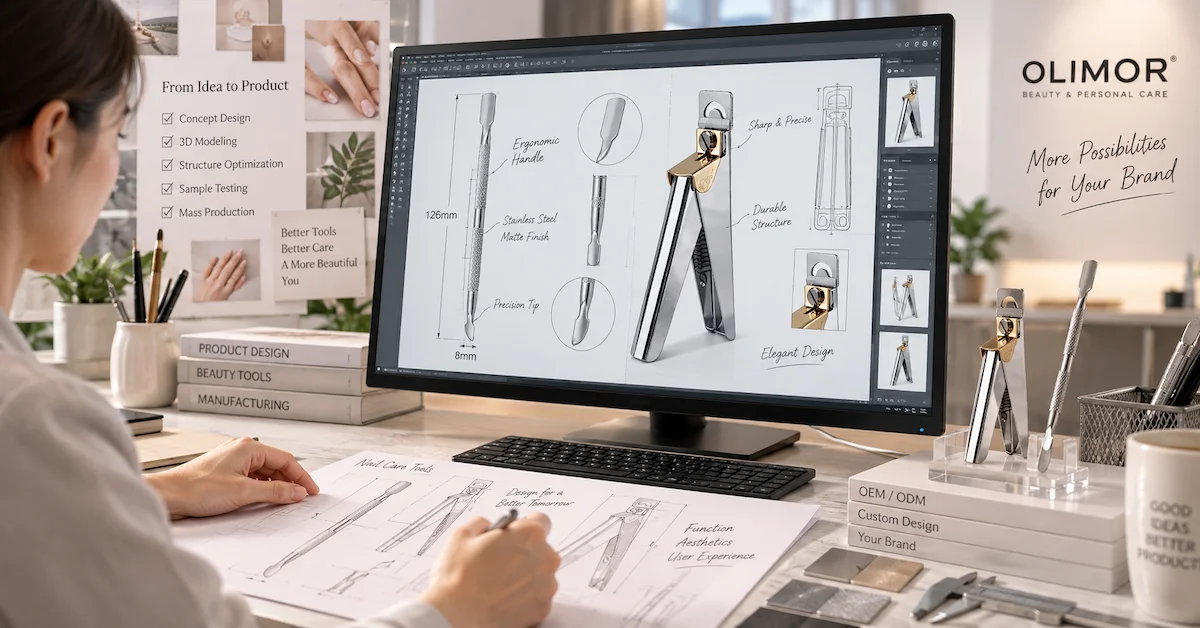
Sample approval should establish a documented reference for what the supplier is expected to manufacture and deliver.
A single attractive product photograph is not sufficient because it cannot demonstrate cutting performance, spring behavior, surface quality, or packaging fit.
Step 1: Confirm Product Identity
Record the supplier model number, buyer SKU, intended application, selected configuration, and current specification revision.
Step 2: Inspect Functional Performance
Apply the relevant inspection method for the actual product.
Nail clippers require cutting and lever checks. Nippers require jaw and spring evaluation. Pushers and files require examination of their working surfaces and contact areas.
Step 3: Evaluate Materials and Finishing
Confirm any required material designation, finish, coating, or component construction.
Do not rely on an unsupported claim of universal stainless-steel grade, corrosion resistance, or sterilization compatibility.
Step 4: Approve Branding and Packaging
Verify the actual logo appearance, artwork, color, dimensions, product information, and protective packaging.
For a manicure set, approve a fully assembled retail unit with all included components.
Step 5: Establish a Golden Sample
The golden sample should be traceable to the latest accepted drawings, product requirements, finish references, and packaging specifications.
Both buyer and supplier should understand which approved version controls the order.
Step 6: Document Changes
A change to the cutting edge, spring, alloy, handle, coating, or packaging can influence the finished product.
Agree on which modifications require notification, additional evaluation, and formal sample reapproval.
OEM / PRIVATE LABEL DEVELOPMENT
Turn Your Nail Care Concept into a Defined Product Brief
Discuss product selection, suitable existing models, sample requirements, logo placement, packaging options, and model-specific quality checkpoints.
Discuss Your OEM Project →Nail Care Tools Manufacturing Processes: What Buyers Should Verify
Nail-care products can involve multiple manufacturing operations depending on their design and component materials.
These may include metal forming, machining, grinding, heat treatment, polishing, assembly, coating, and packaging.
A buyer should not assume that every nail-care tool goes through every operation or that one supplier performs each process in-house.
Instead, request the manufacturing route relevant to the selected product and identify the characteristics controlled at each important stage.
Metal Forming and Cutting Geometry
Forming operations influence component shape and dimensional consistency.
For nail clippers and nippers, the relationship between formed components and later finishing work can affect the alignment of their working surfaces.
Grinding and Precision Finishing
Grinding or related finishing processes may be used to develop specified working edges and component geometry.
The correct process depends on the design and should be verified rather than assumed.
Heat Treatment and Material Condition
Some metal-tool designs may require heat treatment or other material-processing steps.
If a specific hardness or performance requirement matters, the purchaser should define it and request supporting product-level documentation.
Polishing and Surface Preparation
Surface finishing can influence visual appearance, touch, and the condition of exposed working and handling areas.
Inspect for scratches, unintended burrs, inconsistent appearance, and areas where finishing may affect the intended function.
Mechanical Assembly
Products with pivots, levers, springs, or removable components require assembly controls.
The relevant acceptance criteria should reflect the actual mechanism rather than a generic instruction to check whether the tool moves.
Buyers interested in OLIMOR's business background can review the About OLIMOR page.
Specific manufacturing equipment, capacity, testing data, and material properties should be confirmed through suitable company documentation.
OEM, ODM, and Private Label Nail Tools: Which Sourcing Model Fits Your Brand?
Different purchasing models create different development responsibilities.
A retailer may want an established product with branded packaging. An established nail-care brand may need a new handle shape or an updated tool mechanism.
The appropriate manufacturing arrangement depends on the actual project.
| Sourcing Model | Typical Requirement | Main Approval Focus |
|---|---|---|
| Ready-Made Wholesale | Existing product configuration | Model, specification, condition, packaging, availability |
| Private Label | Existing product with agreed logo, finish, or packaging changes | Decorated sample, artwork, materials, retail packaging |
| OEM | Buyer-defined drawings, dimensions, or functional design | Engineering specification, prototype, quality plan, change control |
| ODM | Supplier-assisted product development based on a brief | Design approval, prototype evaluation, commercial and ownership terms |
Custom branding may include product logos, coordinated appearances, individual packaging, branded cases, or printed inserts.
However, the feasibility of each customization depends on the selected product, surface material, production method, and quantity.
A deeper structural modification may require additional tooling, samples, engineering review, or functional verification.
For new beauty brands, an existing suitable model with carefully approved branding and packaging can be a practical starting point.
Buyers should also clarify intellectual-property ownership, exclusivity, drawing control, and tooling ownership whenever those issues are relevant.
How to Compare Nail Care Tools Manufacturing Quotations
The lowest quoted unit price is not necessarily the lowest commercial cost.
A quotation must identify what is actually included. One supplier may quote only a loose tool, while another includes branding, protective packaging, and agreed final inspection arrangements.
Comparing these prices without correcting for scope produces a misleading purchasing decision.
Confirm the Exact Tool Configuration
Check the model number, material requirements, functional specification, surface finish, and quantity.
Different products should not be treated as equivalent simply because their photographs look similar.
Identify Customization Charges
Additional charges may arise from tooling, special finishing, logo processes, packaging development, or sampling.
Separate one-time charges from recurring product costs.
Include Packaging and Inspection
A retail-ready manicure tool has costs beyond its manufactured components.
Protective inserts, branded cases, printed cartons, instructions, and inspection requirements should be included where appropriate.
Evaluate International Delivery Terms
Shipping arrangements, destination, carton dimensions, import charges, and agreed Incoterms can affect landed cost.
The International Chamber of Commerce's Incoterms 2020 rules describe agreed delivery responsibilities, costs, and risk allocation.
These trade terms do not determine the functional quality of the purchased tools.
Consider the Cost of Quality Problems
A low initial quotation can become expensive if products require sorting, rework, relabeling, replacement, or customer returns.
Buyers should evaluate the supplier's willingness to define inspection and corrective-action arrangements before confirming a large order.
Packaging and Labeling Requirements for International Nail Tool Buyers
Packaging should be treated as part of the finished commercial product rather than an optional decoration.
A retail box must protect the tool, identify it correctly, and communicate its intended use without making unsupported claims.
Sharp or delicate working ends may need appropriate restraint or protection.
Mixed-tool kits require special attention because components can contact and damage one another during transportation.
Buyers should approve the actual finished retail pack, including the tool, insert, label, instructions, barcode, and exterior packaging.
For e-commerce distribution, protective packaging should reflect the expected parcel handling environment.
For retail shelves, packaging dimensions, display orientation, product identification, and barcode readability may require additional review.
Instructions and safety information should also correspond to the intended users and destination markets.
A claim that a tool is sterilizable, medical grade, or compatible with a specific cleaning process requires appropriate product-level verification.
Product Safety and International Compliance Considerations
International buyers should evaluate the regulatory obligations associated with their products and markets.
For European consumer products, Regulation (EU) 2023/988, the General Product Safety Regulation, may establish relevant safety, traceability, and economic-operator obligations.
The exact obligations depend on the product, the operator's role, the intended use, and applicable legislation.
For United States retail, buyers should assess relevant consumer-product rules and ensure advertising and labeling claims are truthful and substantiated.
For salon-related applications, additional local hygiene and professional-use requirements may be relevant.
A manufacturer's quality-system certificate should not be confused with a product-specific performance certificate.
If a certificate is necessary, request the current document, verify its legal-entity holder, scope, issuer, and validity, and determine whether it actually supports the claim being made.
Buyers should not infer that every OLIMOR nail tool carries the same certification or has passed the same tests.
Preparing a Professional OEM Nail Care Tools RFQ
A well-prepared request for quotation allows buyers to compare manufacturers more accurately.
It also reduces delays caused by unclear product descriptions, changing artwork, or incomplete specifications.
A practical RFQ should identify the following:
- Product categories and specific model references
- Target market and intended sales channel
- Estimated quantity for each SKU
- Required product function and application
- Material and dimensional requirements
- Preferred surface finish and branding method
- Sample approval requirements
- Functional and cosmetic quality criteria
- Retail packaging and labeling details
- Delivery destination and intended trade terms
- Quotation assumptions and additional charges
- Requirements for repeat-order consistency
We are sourcing a private-label nail-care collection for distribution in our target market. We would like to compare suitable models of nail clippers, cuticle nippers, cuticle pushers, and nail files.
Please provide current product references, available materials and finishes, branding and packaging options, estimated MOQ, sample requirements, quotation terms, and indicative production timing.
We also require confirmation of the functional inspection points for each model and an approved product sample before bulk production.
When sending a project inquiry, buyers can include links to the relevant items from the OLIMOR product catalog to help identify the intended product designs.
START YOUR SOURCING PROJECT
Request a Model-Specific Nail Care Tools Manufacturing Quotation
Tell OLIMOR which nail-care products you need, your target market, estimated order quantities, logo requirements, packaging needs, and critical quality expectations.
Send Your Nail Care Tools RFQ →How to Maintain Consistent Quality Across Repeat Orders
The first shipment demonstrates whether one approved configuration can be produced and delivered. Repeat orders reveal how well a supplier can preserve the same product specification over time.
For importers and private-label brands, quality consistency should be managed through documentation rather than assumptions.
Preserve the approved product model, relevant drawings, functional acceptance criteria, finish reference, branding artwork, packaging specification, and inspection records.
If the supplier proposes a material substitution, different spring, altered handle finish, modified working edge, or new packaging insert, determine whether reapproval is required.
A visually minor change can sometimes affect product function or customer perception.
For example, replacing a spring may alter nipper handling. Changing an insert may allow tools to contact one another. Moving a logo may affect grip comfort.
Buyers should therefore maintain a clear change-control process and identify the person authorized to approve deviations from the original specification.
Customer feedback can also provide useful information after the product reaches market.
Categorize complaints according to actual product defects, packaging problems, instruction issues, and mismatched customer expectations.
This allows quality improvements to target the underlying cause rather than relying on vague demands for better quality.
Frequently Asked Questions About Nail Care Tools Manufacturers
What does a nail care tools manufacturer produce?
A nail care tools manufacturer produces or coordinates the production of products such as nail clippers, cuticle nippers, cuticle pushers, nail files, and manicure sets.
Product categories, manufacturing methods, quality controls, and customization options vary between manufacturers. Buyers should evaluate the actual models and services being offered.
How can I identify a reliable nail care tools manufacturer?
Start by checking product category experience, model-specific specifications, functional sample quality, material documentation, and quality inspection arrangements.
Then examine branding options, packaging capability, quotations, corrective-action procedures, and repeat-order management.
A reliable supplier discussion should produce clear answers to these questions rather than relying solely on marketing claims.
What quality checks are most important for nail clippers?
Important checks include cutting-edge condition, intended blade contact, cutting action, lever movement, pivot stability, and surface finishing.
Inspectors should use an approved model-specific method instead of assuming the same performance requirements apply to every clipper design.
How should importers evaluate cuticle nipper quality?
Importers should review jaw geometry, cutting-edge condition, hinge movement, spring response, handle finishing, and any unintended sharp surfaces.
An approved physical sample and clear defect examples provide better inspection references than a generic promise of precision.
Can OLIMOR provide custom branding for nail-care tools?
OLIMOR presents OEM and private-label support for beauty tools.
Buyers can discuss branding, packaging, and product selection for relevant models. The available processes, minimum quantities, costs, and timelines should be confirmed for the exact products being considered.
What is the difference between OEM and private label nail tools?
Private label generally involves selling a selected product under the buyer's brand, potentially with customized appearance or packaging.
OEM manufacturing may involve buyer-defined drawings, components, dimensions, or functional specifications.
The actual scope must be agreed between the parties because the commercial terms and development work can differ significantly.
Does ISO 2859-1 certification guarantee nail tool quality?
No. ISO 2859-1:2026 is a sampling standard used for inspection by attributes.
It does not certify the product or manufacturer, prescribe universal nail tool performance requirements, or replace a product-specific safety assessment.
How much do wholesale nail care tools cost?
Wholesale prices depend on the product model, materials, quantity, finish, packaging, branding, and agreed commercial conditions.
Buyers should compare quotations based on identical specifications rather than treating displayed catalog prices as fixed bulk prices.
What MOQ and lead time does OLIMOR offer?
One universal minimum order quantity or production lead time cannot be established for every model and customization project.
Buyers should send their selected products, estimated quantities, packaging requirements, and destination through OLIMOR Contact Us to request current project-specific terms.
How can a brand reduce quality problems in repeat orders?
Preserve approved golden samples, model numbers, materials, functional inspection criteria, finish references, packaging versions, and artwork records.
Require authorization for meaningful changes and use documented inspection arrangements to compare new lots against the agreed production specification.
Conclusion
Selecting a nail care tools manufacturer involves more than comparing product photographs, catalog descriptions, or unit prices.
The strongest purchasing decisions connect the specific function of each tool with clear inspection requirements and an approved manufacturing specification.
Nail clippers require suitable cutting-edge and mechanical checks. Cuticle nippers depend on controlled jaw geometry, spring response, and handle movement.
Cuticle pushers need appropriately finished working ends. Nail files require consistent functional surfaces, while manicure sets need component-level quality and complete-kit inspection.
For international importers, salon distributors, and private-label brands, the practical next steps are to select exact models, define acceptance criteria, approve samples, confirm packaging, compare complete quotations, and establish effective repeat-order controls.
OLIMOR BEAUTY offers relevant product categories for nail-care accessories , nail clippers , cuticle nippers , nail files , and manicure sets .
If you are preparing a wholesale or OEM nail-care collection, send your desired models, estimated quantities, target market, customization requirements, and quality expectations to discuss the most appropriate next steps.
OLIMOR BEAUTY / B2B NAIL CARE SOURCING
Start Your Custom Nail Care Tools Manufacturing Project
Share your nail tool models, target market, quantities, branding preferences, and required QC checkpoints with the OLIMOR team. Discuss product options, sample preparation, packaging, and current commercial terms.
Request a Nail Care Tools Quote →Tag:
Related articles
- Beauty Tools Sourcing Guide
- Manicure & Nail Tools
Professional Nail Tools Manufacturer: Building a Salon-Ready Supply and Reorder Program for Distributors
- Beauty Tools Sourcing Guide
- OEM & Private Label
Private Label Foot Care Tools: How to Launch a 3-SKU Retail Range Without Costly QC or Packaging Mistakes
- Beauty Tools Sourcing Guide
- OEM & Private Label