

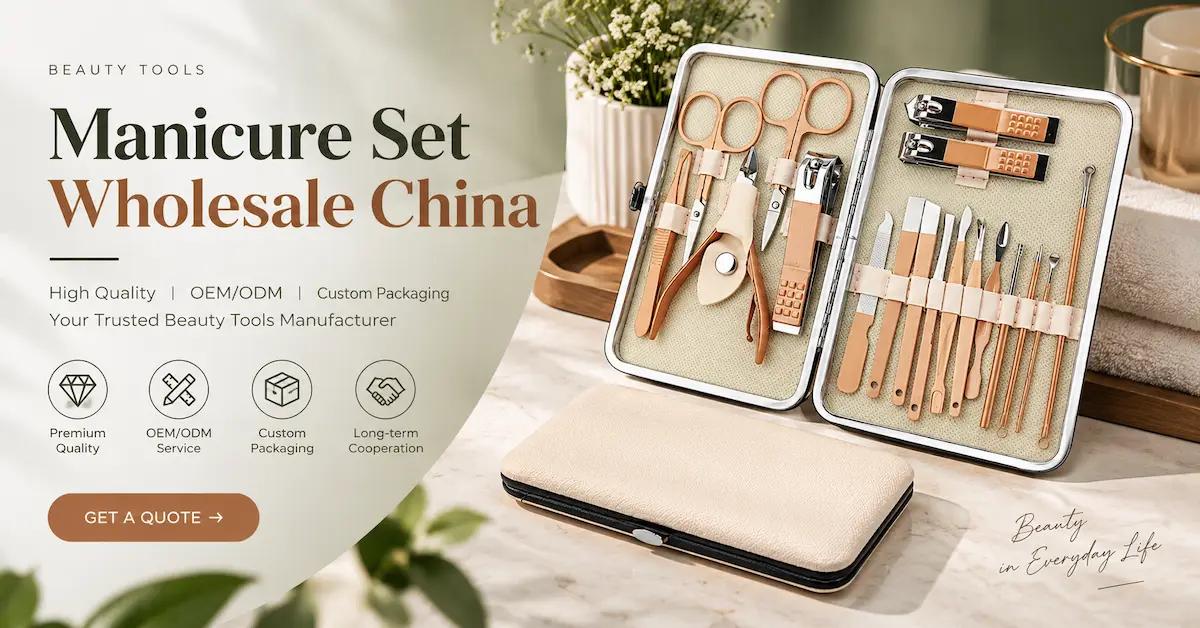
Buyers searching for manicure set wholesale China usually need more than a catalog of attractive grooming kits. They need a dependable way to compare products that may contain different tools, cases, finishes, packaging, and quality standards—and to understand what those differences will cost when the goods reach their warehouse. The most useful wholesale quotation is not simply the one with the smallest unit price. It is the one tied to an approved kit specification, a realistic quantity, a clear shipping term, and a repeatable inspection plan.
A manicure set is sold as one SKU, yet it may contain several items with different production histories and failure modes. The clipper must cut cleanly, the scissors must open and close properly, the file must have a consistent working surface, and the case must hold every component without scratching it. A shipment with a missing tweezer or obsolete retail sleeve is commercially wrong even when the remaining tools look excellent.
For importers, distributors, retailers, and e-commerce brands, the safer approach is to make assortment, inspection, quotation scope, landed cost, and replenishment part of the same purchasing decision. Begin with the intended sales channel, select an appropriately sized kit, test a complete packed sample, and ask suppliers to quote precisely the same configuration. OLIMOR's manicure set collection provides product references for this process; any final material, minimum order, packaging, price, or production schedule should be confirmed for the selected model.
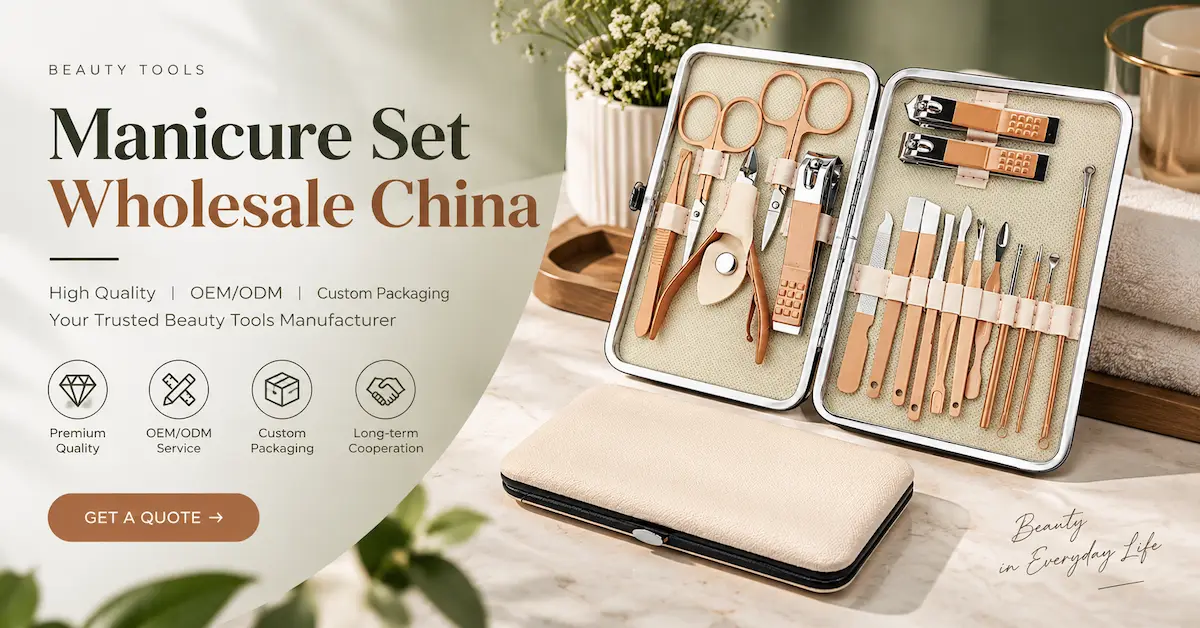
What Does “Manicure Set Wholesale China” Mean in Practice?
The phrase covers several purchasing models that should not be treated as interchangeable. A wholesaler might buy an existing set in a standard pack. A chain retailer might use the same tools but require a barcode, translated retail information, and a custom sleeve. A private-label brand might select an established case, change the tool assortment, and add coordinated branding. A buyer developing an exclusive kit might need a deeper OEM or ODM project.
These arrangements have different approval requirements. A stock-style order may be relatively straightforward if the complete configuration is already defined. A branded order introduces artwork and packaging approval. A modified set may require new samples, case-fit checks, and component procurement. A new design may introduce tooling and more complex quality controls.
Ask the supplier to label its proposal as available configuration, private-label adaptation, or new-development work. Then ask which parts of the quoted price and timeline depend on that choice. This simple distinction prevents a common sourcing problem: comparing a low standard-stock quote with a quotation for a genuinely customized retail product.
If your first priority is learning how the factory develops and controls the product itself, OLIMOR's manicure set manufacturer buyer guide covers that complementary subject. The focus here is the wholesale purchasing decision: how to buy the right assortment, at a verifiable total cost, without losing quality or supply continuity.
Select the Kit for Your Customer, Not the Highest Piece Count
A larger number printed on the package can attract attention, but it is not a measure of usefulness. Buyers should first define the routine the customer expects to complete. A compact travel set, a family grooming kit, and a premium gift set need not contain the same tools.
| Sales channel | Buying priority | Sensible product direction | Risk to check before ordering |
|---|---|---|---|
| Supermarket or pharmacy | Clear everyday use, recognizable tools, consistent replenishment | Familiar nail-care essentials in a simple retail pack | Poor pack labeling, inconsistent finishes |
| E-commerce / DTC | Accurate photographs, attractive unboxing, lower return risk | Visually cohesive set with secure retention | Tool movement and surface damage in delivery |
| Importer / distributor | Stable product identity across customers and shipments | Several defined SKUs at distinct price positions | Mixed versions, unclear carton quantities |
| Travel and hospitality | Small footprint, compact storage, controlled cost | Selected essentials in a lightweight pouch or compact case | Bulky accessories, loose tools, unsuitable claims |
| Gift and promotional trade | Presentation and repeatable artwork | Coordinated tools with fitted gift packaging | Missing items, decoration and color variation |
| Professional beauty channel | Practical tool function, ergonomics and consistent handling | Task-specific assortment rather than maximum count | Decorative claims without functional evidence |
A useful approach is to divide the tools into core, supporting, and optional roles. Core components perform the main tasks promised by the package, such as nail trimming or filing. Supporting tools extend the routine. Optional tools should exist only when they fit the target customer. If you must simplify a kit to meet a price target, remove a low-value optional item before weakening the main clipper or its working edge.
That decision also improves search and conversion performance in an online store. A product called “travel manicure essentials” should show a compact assortment that really supports travel grooming. It should not force shoppers to decode several unrelated accessories from a small hero image.
Three Wholesale Product Tiers to Discuss With Suppliers
Instead of asking every supplier to quote its cheapest manicure set, issue briefs for a small number of clearly differentiated offers. The following are illustrative merchandising strategies, not fixed OLIMOR SKUs, standard piece counts, or promised price bands.
Entry-level everyday set
Choose a limited assortment with the most recognizable nail-care functions, straightforward storage, and minimal decoration. Buyers should favor an established product format, a clean tool list, and an economical protective package. Cost control should come from simplifying the assortment and packaging rather than compromising cutting performance.
Mid-range travel or retail set
The mid-range proposal can add a more organized case, a distinct finish, useful supporting tools, and improved packaging for retail or e-commerce. At this level, inspect every retention loop or pocket and confirm that the packaging represents the actual contents. The unit may carry a higher factory price but could offer a clearer consumer proposition.
Premium gift or branded collection
A premium concept may justify a coordinated finish, more refined presentation case, custom packaging, and deliberate brand details. Cost increases should be explained through specific components, production steps, and packaging—not vague words such as “luxury quality.” A premium pack also requires stricter cosmetic and assembly review because small inconsistencies are more visible.
The goal is a good–better–best product ladder with distinct reasons to exist, rather than three nearly identical sets sold at arbitrary price differences. Importers should validate demand and replenishment potential for each tier before building excessive initial inventory.
Make Every Supplier Quote the Same Complete Kit
A quotation is not comparable until the products are comparable. Suppliers may describe different materials, quantities, case constructions, and printing requirements using the same term, “manicure set.” One quotation might include a printed sleeve and fitted insert; another may cover only the tools in a plain pouch.
A buyer's comparison sheet should record all the following before comparing price:
| Quotation field | Questions the buyer should ask |
|---|---|
| Tool list and piece count | Which exact tools and component codes are included? How is a piece counted? |
| Material | Which material is confirmed for each metal tool and non-metal component? |
| Tool dimensions and finish | Are size, surface and functional designs identical across quotes? |
| Case construction | Is it sewn, molded, rigid or soft? What lining, closure and retention are included? |
| Decoration | Does the quotation cover product logo, case logo, printed sleeve and artwork setup? |
| Retail package | Is the box, insert, barcode, label and instruction material included? |
| Unit packing | How many complete sets per inner and export carton? |
| Inspection | What functional, completeness and finished-pack checks are included? |
| Quantity basis | Is MOQ per SKU, color, logo artwork or overall order? |
| Trade term | Which named Incoterms® rule and place apply, and what costs are excluded? |
| Development charges | Are tooling, samples, mold changes or printing setup separately charged? |
| Timing | Does the quoted lead time begin after all approvals and materials are ready? |
If a supplier cannot identify the complete kit configuration, ask for a revised quotation. Purchasing teams should keep one controlled RFQ sheet and send the same version to all shortlisted vendors. Then note every proposed deviation in a separate column instead of silently accepting a “similar” alternative.
Calculate Landed Cost Instead of Comparing Factory Price Alone
The unit price is an input, not the final cost of a sellable kit. A wholesale buyer should estimate landed cost per accepted set, using actual quotations and market-specific charges. A practical calculation is:
Estimated landed cost per accepted set = (product and packaging cost + agreed export-side charges + freight + cargo insurance + import duties and taxes where applicable + customs clearance + destination handling + necessary inspection or rework costs) ÷ accepted sellable quantity.
Include only costs that truly apply to your transaction and avoid double-counting amounts already covered by the agreed shipping term. Recoverable taxes should be handled according to the buyer's accounting circumstances rather than automatically treated as final product cost.
Think about the denominator as well as the numerator. If sets arrive with missing items, damaged cases, or unusable retail packaging, the buyer may not have the full invoiced quantity available for sale. A small factory-price saving may disappear when additional sorting and repacking are needed.
Consider a hypothetical, not market-priced, comparison of two identical-looking proposals. Quote A has the lower factory price but excludes printing, a protective insert, and final kit completeness checks. Quote B is higher per unit but includes those services. Only after adding the missing services and logistics can the buyer determine which offer is commercially preferable. The figures should come from the suppliers' written quotations, not from an illustrative blog example.
For a sound gross-margin estimate, also budget for the channel's selling fees, storage, advertising, expected returns, and currency exposure. These may not be part of customs landed cost, but they affect whether the product can support the target retail price. Do not confuse an apparently low import cost with a healthy consumer-product margin.
EXW, FOB, and Other Trade Terms: Ask Exactly What Is Included
An overseas buyer should not treat “FOB price,” “factory price,” and “delivered price” as interchangeable. Request the precise Incoterms® 2020 rule and named place, plus a written statement of what the quotation includes. Incoterms® rules are published by the International Chamber of Commerce (ICC); buyers should check the official definitions rather than rely on informal trade shorthand. The division of costs, risk, customs tasks, and transport responsibility differs between arrangements.
An EXW-style quotation generally places substantially more pickup and export-handling responsibility on the buyer; an FOB arrangement is used for appropriate sea or inland-waterway shipments and has a different delivery and risk point. A carrier-based shipment may be better discussed using terms intended for multimodal transport. The correct rule depends on the actual movement and should be confirmed with the freight forwarder and contracting parties.
For procurement comparison, list any origin trucking, terminal charges, export clearance, ocean or air freight, insurance, destination port or terminal fees, customs brokerage, duties, taxes, and local delivery separately. Do not assume “shipping included” means duties or final delivery are included, and do not rely on an online retail checkout price as an indication of wholesale logistics cost.
The contract, packing list, invoice, and freight plan should use consistent unit quantities and product descriptions. When the goods are a mixed manicure assortment, detailed descriptions can also help the importer or customs broker evaluate classification and documentation requirements for the destination market. The World Customs Organization maintains the international Harmonized System framework; the importing country’s tariff schedule and applicable rules determine the actual treatment.
Carton Dimensions and Packing Density Can Change the Winning Quote
A manicure kit's retail case often determines shipping efficiency more than the metal tools inside it. A thick gift box, empty decorative space, oversized protective foam, and low carton packing density can raise freight and storage costs even when the metal components are inexpensive.
Request the individual retail-pack dimensions and weight, the inner and master-carton quantity, and the master-carton length, width, height, gross weight, and net weight. These fields allow a forwarder to review actual transport options.
Carton volume can be expressed as:
Carton volume (m³) = length (m) × width (m) × height (m).
For illustration only, a carton measuring 0.50 × 0.40 × 0.30 meters occupies 0.06 cubic meters before any load-planning allowances. One hundred such cartons have a nominal combined volume of 6.0 cubic meters. This is not a container-loading guarantee: palletization, usable space, stacking restrictions, weight and carrier rules still matter.
Ask for photographs of a fully packed export carton and its inside arrangement. Check whether retail cases shift, whether metal tools press against case linings, and whether stacked cartons compress the decorative packaging. An effective pack-out plan protects the product without filling the shipment with unnecessary volume.
Sample Approval Must Cover the Complete Sellable Unit
Sample approval for a wholesale set cannot stop at opening a pouch and counting tools. The approved reference should represent the exact product the customer will buy, including its case, contents, logos, printed pack, labels, and protections.
Approve in three passes. First, test each tool for its intended function. Second, inspect the complete set for count, finish coordination, correct positions, retention, and case closure. Third, inspect the retail and export packaging for print accuracy, product identification, movement, and protection.
Take an open-case photograph with each component visible. Add a numbered component legend and store it with the BOM and artwork version. This makes it easier for a production inspector to identify a missing or substituted item later. A product page photograph may help sales, but it does not replace a signed-off technical reference.
If samples arrive from different production rounds, do not accidentally combine them into one imaginary approved version. Create a complete final sample or documented master configuration that matches the production release. When a component changes, record which approval is affected before placing the purchase order.
Build a QC Plan That Catches Both Tool Defects and Kit Defects
A manicure set presents two different quality problems: individual tools can fail, and perfectly acceptable tools can be assembled into an incorrect kit. A practical control plan must address both. The following checks are examples to adapt to the actual product; they are not universal acceptance limits or a statement that every OLIMOR SKU uses the same test.
| Tool or process | Functional or identity check | Example failure to prevent |
|---|---|---|
| Nail clipper | Cutting-edge contact, cutting action, lever movement, assembly | Incomplete cut or loose lever |
| Cuticle nipper | Jaw alignment, joint movement, spring response, edge finish | Uneven jaw contact or unstable spring |
| Tweezers | Tip alignment, tip contact, gripping response | Tips fail to grip consistently |
| Beauty scissors | Blade alignment, pivot action and cutting behavior | Poor cutting or stiff opening |
| Nail file | Working-surface uniformity and exposed-edge quality | Uneven filing surface or rough edge |
| Pusher or cleaning tool | Working-end shape, smoothness and grip | Incorrect or poorly finished tip |
| Case or pouch | Fit, closure, retention, tool access | Tools shift, touch or become hard to remove |
| Kit assembly | Correct component codes, finish and quantities | Missing, duplicated or substituted tool |
| Printed pack and carton | Artwork, barcode, language, identity and count | Wrong sleeve, mixed SKU or incorrect carton |
Control points should be located at sensible stages: incoming materials or components, first-piece approval, in-process checks, tool completion, kit loading, and final carton inspection. A supplier that discovers a wrong case insert only after thousands of filled boxes are sealed may need expensive sorting and rework.
An agreed inspection plan should define which defects are unacceptable, how samples are selected, what happens when a defect is found, and who decides whether corrected goods can be released. Terms such as “100% inspection” or “AQL inspection” are not complete technical plans by themselves. Test methods, defect severity, sampling and acceptance decisions need to be specific to the product, buyer, and market.
Prevent Missing Pieces, Mixed SKUs, and Unapproved Substitutions
Wholesale manicure sets are particularly vulnerable to packing mistakes because some tools look similar. A short file may be mistaken for a slightly longer one. Two clippers can have similar finishes but different cutting heads. Cases for two SKUs may share an outside color while using different internal layouts.
The first defense is a controlled BOM, with one component code per tool and separate codes for case, insert, artwork, and retail pack. The second is a visual loading standard showing where each tool belongs. The third is a completeness check before the case and carton are closed. These controls should be simple enough for packing staff to use consistently.
Where two SKUs share a production line, make it easy to identify the running product and any changed components. The final invoice and packing list should reflect the same item codes and quantities. If an approved clipper becomes temporarily unavailable, the supplier should propose a documented replacement for buyer approval, not silently insert a similar-looking product.
A substitution may change how the set is marketed, what material can truthfully be claimed, how a tool fits its elastic loop, or which close-up product photo belongs on the listing. That makes change approval both a manufacturing and a commercial responsibility.
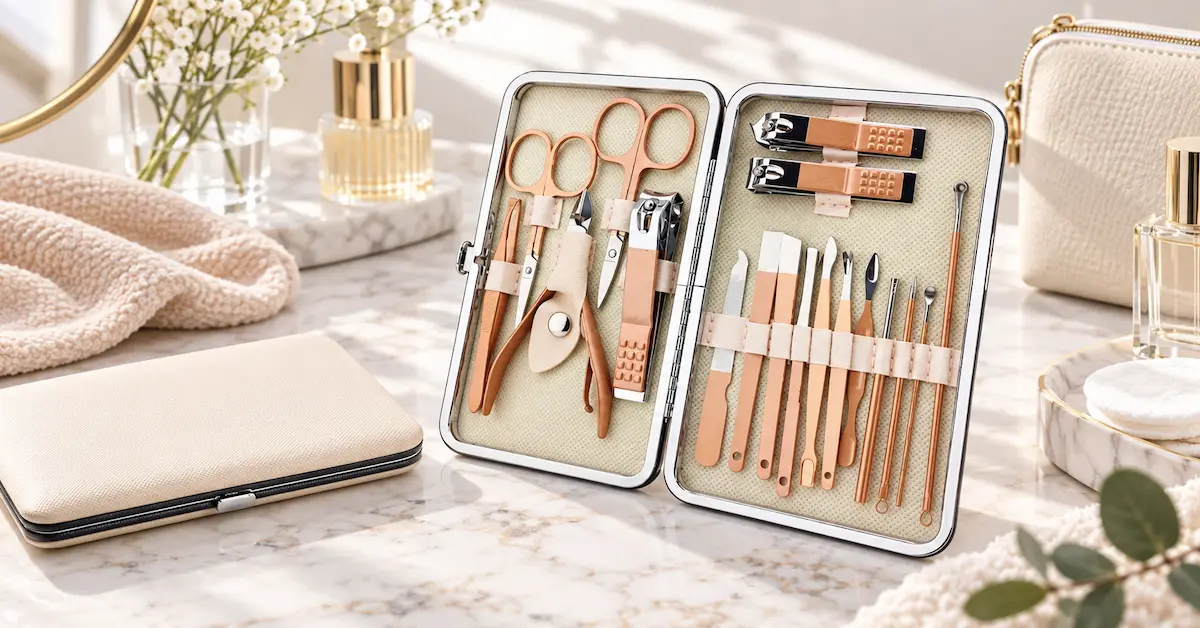
Confirm Materials by Component, Not by the Set Name
A wholesale product described as a “stainless steel manicure set” may include tools made from different materials and a case made from plastic, textile, PU, or other materials. Avoid turning a broad category description into a claim that every component shares one grade or treatment.
Ask the supplier to identify, for each model-specific tool, the material or construction needed for your market and product claims. Obtain additional evidence where relevant to the claim and destination. Evaluate actual surface finishing too: polished metal, matte coating, a colored handle, and a reflective logo all behave differently during handling and packaging.
For a collection, compare the tools together under ordinary light. Two silver finishes that look acceptable separately may feel mismatched inside one case. Color and finish approval should use physical references, especially for decorative or gift-oriented sets.
Likewise, evaluate how components are cleaned and maintained in the intended use. Do not imply that an ordinary grooming kit is sterile, medical-grade, or suitable for clinical procedures unless the specific product and market claims are appropriately supported. Accurate descriptions reduce importer risk and help retailers set realistic customer expectations.
Packaging Requirements Change Across Wholesale Channels
Packaging is both a marketing asset and a transport protection system. The same kit may be commercially suitable for several channels, but each has a different presentation and fulfillment requirement.
For retail chains
Check front-of-pack product identity, legible tool count, shelf or hook format, barcode location, required consumer information, pack dimensions, and visual consistency across reorders. A package with a beautiful open-case image can still fail at retail if its barcode is badly placed or its component list does not match the final product.
For e-commerce brands
Test the actual parcel-ready unit. Does a clipper rub against a file in transit? Does a rigid case press against the gift box? Does the outer pack protect polished and coated surfaces? High-resolution listing photography should correspond to the released assortment, not an early sample that has since changed.
For distributors and local repackers
Neutral or standard packs may be attractive where the importer will apply market-specific labels or pack the goods locally. If so, define which party is responsible for final retail information, barcode allocation, and completeness checks after repacking. The factory quote and the importer cost model must reflect that work accurately.
For gift and promotional buyers
A more elaborate case can support premium presentation, but custom printing and decoration create separate approvals. Verify that a logo is reproduced consistently on the case and outer carton where required. Plan seasonal deadlines conservatively, since a single late printed component can delay the entire kit.
OLIMOR's broader beauty-tool catalog can also help buyers consider complementary products for seasonal collections rather than relying on a single set format.
Is Private Label Worth the Extra Wholesale Cost?
For some channels, an unbranded standard kit is the correct commercial product. For others, private label supports consistent product identity, brand recall, and a more defensible retail assortment. The decision should be based on the customer's purchase reason and the brand's ability to sell the difference—not just on whether custom packaging is technically possible.
Private-label changes can include a case mark, decorated tools, coordinated surface finishes, printed sleeves, custom boxes, labels, or a selected assortment. The most efficient starting point is often an established product platform with controlled branding and packaging. More extensive changes may require new sample rounds or tooling.
Ask for separate quotes for a standard version and the proposed branded version, using the same base tool quality. Compare the incremental cost of decoration, printing, assembly and any revised packing. This reveals whether private label is worth its additional inventory and launch commitments.
If your project requires more than a logo, review OLIMOR's private-label manicure set guide alongside the product pages. Final options still need to be confirmed for the chosen model rather than generalized across the entire category.
Check MOQ by SKU, Finish, Case, and Artwork
A supplier may give a low minimum for an existing kit in standard packing, then a higher threshold for a unique case color or printed sleeve. This is not necessarily contradictory: different components can have separate production or purchasing minimums.
Ask whether the MOQ applies to the whole purchase order or to each combination of assortment, color, surface finish, logo, and packaging artwork. If the first order contains four different retail designs, one quoted minimum may not cover all four.
The same issue affects mixed-SKU cartons and consolidated shipments. Combining multiple products into one shipment does not automatically combine their manufacturing minimums. A distributor should state its target volume by individual SKU, plus the total shipment volume and likely reorder cadence.
Do not infer current MOQ or wholesale terms from historic online prices. For OLIMOR, the appropriate route is a model-specific inquiry including the component list, quantity, decoration and packaging plan.
Plan Lead Time Around the Slowest Approved Component
A manicure set cannot be packed until the metal tools, case, insert, printed materials, and any branded accessories are present and approved. The longest path through these dependencies determines the earliest realistic shipment—not just how fast one clipper can be produced.
Separate the timeline into product selection, sample preparation, functional approval, case-fit approval, artwork approval, materials or component readiness, mass production, kit assembly, inspection, and shipment. Ask which stages can run in parallel and which require the previous stage to be signed off.
For repeat orders, check whether the case material, insert, printed sleeve, and accessory suppliers are unchanged. A reprint with a new barcode or language version may need separate approval even if the tools have not changed.
Importers should leave room for transport variability and destination clearance rather than promising retailers a shelf date based solely on the factory's planned completion date. An accurate schedule identifies responsibility for each milestone and shows what happens if a late change is requested.
Evaluate Chinese Suppliers With Evidence, Not a Factory Label
A buyer may strongly prefer a manufacturer over a trading company, but the legal business label does not tell the whole operational story. What matters is who controls component sources, samples, inspection, assembly, changes, complaints, and repeat orders.
Ask shortlisted suppliers to explain which processes they perform, which they coordinate externally, and how they verify subcontracted components. A factory with machinery but no organized kit-loading standard can create a different risk from a supplier that manages several specialized sources under controlled specifications.
A useful supplier review should request a current company profile, relevant product examples, complete sample, manufacturing and packing flow, inspection checkpoints, and a clear contact for quality issues. If certification or market documentation is important, request the actual document and confirm its scope and validity instead of assuming that a general company-level claim covers each SKU.
OLIMOR describes its international beauty-tool business, product development and checks against approved samples in its About Us information. Those statements provide a starting point for supplier discussion; they do not establish a particular capacity, material grade, test value, or delivery promise for the specific manicure set you plan to order.
A Supplier Scorecard for a Wholesale Manicure Set Order
A structured review prevents the unit quote from overwhelming all other considerations. The weights below are illustrative, and purchasing teams should adjust them to their channel and risk tolerance.
| Area | Example weight | Evidence that matters |
|---|---|---|
| Assortment fit and market relevance | 15% | User-oriented tool list, accurate pack claims |
| Tool function and component quality | 20% | Functional samples, component-specific QC criteria |
| Case, insert and pack protection | 15% | Packed sample and handling review |
| Kit completeness and revision control | 15% | BOM, loading standard, master reference |
| Commercial transparency | 15% | Itemized quote, named trade term, clear MOQ |
| Delivery and replenishment planning | 10% | Component critical path and reorder procedure |
| Communication and corrective action | 10% | Clear answers, change records and escalation process |
Score suppliers only after they have quoted the same intended configuration. Add a separate column for unresolved issues. A slightly higher score with two critical unanswered questions may be less convincing than a transparent supplier whose evidence can be independently checked.
Do not give points for slogans such as “strict quality,” “best price,” or “professional service.” Ask for the procedure or sample that would make each statement meaningful for this purchase order.
Begin With a Controlled Trial, Then Design Reorders
A trial order is most useful when it tests the full purchasing system: quotation clarity, component delivery, sample fidelity, kit loading, printing, carton integrity, shipping documents, and buyer inspection. It is not only a way to obtain a smaller quantity at a low price.
Before releasing the first bulk order, freeze the approved BOM and master sample. Confirm the current packaging artwork, case layout, label version, carton packing quantity and inspection expectations. If a first-piece review is part of the arrangement, inspect the earliest complete packed kits before the remaining quantity is finished.
After the first shipment, record actual results: visible finish variation, case fit, packaging damage, missing tools, sorting effort, retailer feedback, returns, and sell-through by SKU. Keep those observations linked to the product revision rather than mixing complaints across several versions.
For replenishment planning, a simple starting formula is reorder point = expected demand during replenishment lead time + safety stock. Both terms need evidence from sales data, factory capacity and logistics conditions. A new brand should not invent a precise stock buffer based on one week of early orders.
A repeat order should explicitly reference the approved component list, sample code, case and artwork revisions. Ask the supplier to notify you before substituting a tool or changing a finish, case, insert, label or production process that could affect the released product.
Example: Two Buyers Can Need Different China Wholesale Strategies
Consider two hypothetical buyers. These examples illustrate purchasing decisions, not actual OLIMOR customers, prices or performance results.
Buyer A: a regional beauty retailer. The retailer needs recognizable nail-care essentials in shelf-ready packaging and expects quarterly replenishment. A sensible procurement plan may emphasize a stable core assortment, clear barcode space, repeatable case design, and conservative color variants. It should avoid excessive customization that creates new artwork and inventory commitments for every store promotion.
Buyer B: a premium direct-to-consumer brand. This brand wants one coordinated manicure set to complement existing nail-care products. It may benefit from a distinctive case, refined finishes, better product photography, and a controlled unboxing experience. Its risk exposure may center on cosmetic variation, parcel damage and the gap between the photographed sample and delivered production.
Both buyers can source from China, and both need reliable function and documentation. But the lowest-risk specifications are different. The retailer may prioritize replenishment and shelf clarity; the DTC brand may accept greater packaging cost to protect presentation and customer reviews.
The lesson is not that one strategy is superior. It is that a wholesale assortment must be judged against the business model that will sell it.
Common Mistakes in Manicure Set Wholesale Purchasing
Buying by piece count alone. Twelve tools do not guarantee twelve useful functions. Ask what each item does, then check if the set title and marketing copy describe the assortment accurately.
Assuming all tools have the same material. Verify material and construction by component, including the case, insert and finished surfaces. Do not put an unsupported material claim on the box.
Comparing prices under different terms. Align the exact kit, packing, service scope, quantity and named shipping term before choosing a supplier.
Approving an empty case mockup. Test the finished case with the real approved tools. Check whether the closure works, tools stay in place and decorated surfaces remain protected.
Ignoring assembly completeness. A missing inexpensive accessory can make a whole retail unit unacceptable. Build a visible part-by-part packing and final-verification process.
Treating MOQ as one company-wide number. Confirm the minimum for each actual SKU, finish, logo and printed package configuration.
Forgetting replenishment. A first order may sell well, but success is difficult to sustain without a retained master sample, controlled revisions and realistic lead-time planning.
OLIMOR Manicure Set References for Wholesale Buyers
For initial benchmarking, OLIMOR's website presents several different manicure set formats. These are product references, not evidence that every customization, material, MOQ or piece count is available across the whole collection.
The MSB2061 travel manicure kit illustrates a compact creamy-white presentation. It can prompt questions about travel-size assortment selection, case dimensions and retail-pack efficiency. Its product-specific published information should be verified against the current sample and quotation.
The MSC1001 gift-oriented manicure set illustrates a coordinated, more presentation-focused direction. Buyers can use it to discuss case quality, surface harmony, premium packaging and the additional inspection work that such a position may require.
A compact black-pouch grooming set provides another way to compare storage, portability, and mixed grooming tools. Because a grooming assortment may include items beyond strictly nail-care tools, review the actual component list before using “manicure essentials” or similar wording in a retail listing.
The full manicure set category is the most efficient place to start the shortlist. If your brand is building a coordinated collection, related nail clippers, cuticle nippers and nail-care tools can also inform the assortment conversation.
What to Send for a Useful Wholesale Manicure Set Quote
An effective RFQ should allow a supplier to answer your actual purchasing problem rather than guess what you mean by “good quality manicure kit.” Send:
- Buyer and channel: importer, wholesaler, retailer, DTC brand, salon supplier or gift business.
- Destination market: country or markets of sale, required languages and retailer-specific constraints.
- End user and target range: travel, everyday, family grooming, premium gift or other clear use case.
- Kit reference: product page, photographs, physical sample or a proposed item list.
- Required tools: which items are essential, which can be substituted, and which are optional.
- Case and packaging: materials, preferred format, barcode, artwork and protective requirements.
- Branding: neutral pack, private label, logo method or a more extensive ODM/OEM request.
- Quantity by SKU: trial volume, desired variants and realistic replenishment forecast.
- Quality criteria: functional tests, surface acceptance, completeness checks and market documentation.
- Trade and delivery information: destination, required timing, preferred Incoterms® rule if known, and freight responsibilities.
- Approval procedure: who approves samples, artwork, substitutions and pre-production sets.
- Requested commercial breakdown: product and package, tooling/setup, MOQ, quantity tiers, carton data and lead-time assumptions.
You can phrase the request concisely: “We are sourcing retail-ready manicure sets for distribution in [market]. Our first order may include two assortments: an everyday set and a travel set. Please recommend available models and quote each complete packed SKU separately, showing component lists, case and packaging options, sample requirements, MOQ, carton dimensions, inspection approach and the named shipping term.”
For a project-specific proposal, send the information through OLIMOR's contact page. The team can then review product selection, samples, private-label needs and order details against the actual requested configuration.
Frequently Asked Questions About Manicure Set Wholesale China
Is it better to buy ready-made manicure sets or custom sets from China?
Ready-made configurations can be suitable when the assortment and packaging already meet your market's needs. Custom or private-label sets become more relevant when branding, case design, tool selection or differentiation creates commercial value. Compare the complete cost, sample work, MOQ and replenishment implications of both routes before choosing.
How do I compare manicure set suppliers fairly?
Send every supplier the same defined tool list, case specification, finish, packaging requirements, quantity and destination. Ask for a line-by-line configuration summary beside the price and identify deviations. Compare functional sample quality, completeness controls, freight assumptions and repeat-order procedures as well as unit price.
How many tools should a wholesale manicure set contain?
There is no ideal number that works for every channel. Choose tools around the customer's intended grooming routine. A compact travel set may need fewer tools than a broader gift set. The key is that each item has a purpose and that the final package states the actual contents accurately.
Are wholesale manicure sets made entirely of stainless steel?
Not necessarily. Individual metal tools can have different materials, and cases, linings, coatings and packaging have their own compositions. Request component-level confirmation before advertising an all-stainless-steel or other material claim. The final wording should reflect the approved BOM and supporting documentation.
What is the MOQ for manicure set wholesale orders from China?
MOQ depends on the selected configuration, component sources, finish, case, branding, printed packaging and production planning. Ask whether the minimum applies per SKU, finish, artwork or entire purchase order. The final quantity must be confirmed by the supplier for the actual project rather than inferred from a generic category page.
How can I check the quality of bulk manicure sets?
Inspect core tools for their intended function, then verify the complete set for correct components, case retention, closure, finish, logo, printed pack and carton identity. Keep an approved packed master sample and an agreed defect-classification and inspection plan. A count alone is not sufficient, but a good tool sample alone is not sufficient either.
Does FOB pricing include delivery to my warehouse?
No. FOB is a specific trade term, not a promise of all-in destination delivery. The final cost and risk split depend on the named Incoterms® rule, transport plan and contract. Ask your freight forwarder to identify freight, import clearance, duties, destination charges and local delivery that remain outside the supplier's quote.
How do I calculate shipping volume for manicure sets?
Request master-carton dimensions, gross weight, net weight and quantity per carton. The nominal cubic volume is carton length × width × height using meters. Forwarders will also consider transport mode, dimensional-weight rules, pallets, loading restrictions and actual cargo configuration; a volume calculation by itself is not a freight quote.
Can a China supplier provide my logo and custom retail packaging?
Depending on the selected product, private-label work may include a logo on the tool or case, custom sleeve or box, labels, barcode and coordinated finish. Confirm method, placement, artwork version, proof approval and applicable MOQ. Test decoration on the physical sample and confirm that the packed product matches the customer-facing images.
What documents should an importer request before shipment?
The documents depend on the destination and agreed transaction, but buyers commonly coordinate a commercial invoice, packing list, transport documents, product descriptions, country-of-origin information where required, and any market-specific supporting records. A customs broker or qualified compliance adviser should confirm classification, duties, product claims and market requirements for the actual order.
How long does it take to reorder wholesale manicure sets?
Replenishment timing depends on component availability, artwork version, case and packaging supply, production scheduling, inspection and logistics. Ask the supplier for a repeat-order plan with approval milestones. Do not assume that the timing of a previous order applies automatically after a component, label or case revision.
Can I combine manicure sets with other beauty tools in one sourcing program?
Potentially, yes. Coordinated orders may include separate nail clippers, cuticle tools, tweezers and related grooming products where appropriate for the buyer's market. Each SKU still needs its own specification, MOQ, packaging and inspection requirements. Browse OLIMOR's wider product collection for relevant categories before discussing combined procurement.
Conclusion
Sourcing manicure set wholesale China orders successfully means comparing complete sellable kits—not just attractive photos or low factory prices. Define the tool list and packing standard, approve a fully assembled sample, compare landed costs under the same trade assumptions, and secure a repeat-order specification. These steps help protect quality, margins and replenishment. If you are planning a bulk, retail or private-label manicure set order, share your target assortment, quantity, destination and packaging needs with OLIMOR for a model-specific discussion.
Tag:
Related articles
- OEM & Private Label
- Nail Care Tools Guide
anicure Pedicure Set Manufacturer: How to Source Complete Hand and Foot Care Kits for Retail and Salons
- OEM & Private Label
- Nail Care Tools Guide
OEM Manicure Set Manufacturer: How Beauty Brands Move from Drawings to Approved Mass Production
- OEM & Private Label
- Nail Care Tools Guide