Short answer: The right manicure set manufacturer does more than place assorted tools in a case. It helps a buyer define who the kit serves, select tools that have distinct jobs, align their finish and hand feel, engineer the case around those tools, document the approved sample, and reproduce the full configuration on a later order. Evaluate the set as one product system. A good clipper cannot rescue a weak file, a loose insert, confusing product copy, or an untraceable sample revision.
If you buy for a beauty label, a shop, an online store, a distributor, a hotel program, a promotion, or a salon channel, the awkward decisions in this guide will probably feel familiar. We will begin before the first quotation, stay with the project through sample rounds and a pilot run, and finish at the point where the second order has to match the first. Along the way, the familiar search terms - OEM, ODM, private label, professional, wholesale, stainless steel, and China factory - are translated into questions that belong in a real sourcing file.
Two dates appear in the company profile OLIMOR BEAUTY supplied for this project. The business date is 2011; the factory date is 2017. The profile describes a site of about 6,000 square metres and a team of roughly 200 people. It reports yearly output capacity in two separate groups: around 5 million metal sets and around 2.5 million injection-moulded pieces. Its process notes cover stamping and heat treatment, injection work, polishing and water deburring, then assembly, inspection, packing, and export coordination. These are background facts about the operation. They do not lock in the contents, material, minimum, price, calendar, pack, test method, or paperwork for the kit on your desk.
1. A piece count is not a product idea
Four pieces. Seven pieces. Twelve pieces. Those numbers are handy on a retail box, so they tend to dominate early conversations about manicure kits. They tell the development team almost nothing about the person opening the case. Begin with that person and the routine instead. A frequent traveller may value a compact clipper, file, tweezer, and protective case. A home user may expect separate clippers for fingernails and toenails. In a professional channel, controlled handling and quick tool identification may matter more than another accessory.
Write the use case in one sentence before browsing designs. A travel brief could call for four essentials in a pouch small enough for a weekend bag. A pharmacy brief could call for a coordinated home-grooming set whose contents are recognizable without a paragraph of instructions. Once that sentence feels right, it becomes surprisingly easy to remove a tool that has no job.
A buyer should also define the commercial setting. Products displayed on an open retail shelf need immediate visual clarity. Ecommerce products need photographs that explain the contents at a glance. A corporate gift can prioritize presentation, while a hotel amenity may prioritize compactness and controlled unit cost. The same collection of tools will not be optimal for every setting.
| Target channel | Likely assortment priority | Package question | Evidence to request |
|---|---|---|---|
| Ecommerce | Clear tool roles, visual distinction, and a strong main image | Can every item be shown without removing it from the case? | Open-case and closed-case samples plus carton dimensions |
| Beauty retail | Recognizable essentials and consistent finish | Does the front panel explain the set within seconds? | Printed mock-up, shelf view, and barcode area |
| Travel | Compact size, secure storage, and limited duplication | Will tools move, rub, or open during transport? | Packed handling review and insert-retention check |
| Gift program | Presentation, unboxing order, and coordinated appearance | Does the case feel intentional after repeated opening? | Finished case sample and decoration proof |
| Professional channel | Task coverage, handling control, and clear specifications | Can tools be identified and removed efficiently? | Tool-level function sheet and final-set inspection plan |
2. Build a set architecture that customers can understand
Think of set architecture as the reason the assortment exists. What does the kit let someone do? Which item handles each part of that routine? What would the customer lose if one piece disappeared? Two near-identical tools often add confusion rather than value. On the other hand, a crowded case still feels incomplete when it skips the one job its buyer expected.
Sketch the routine on paper before naming the tools. Perhaps the customer shortens a fingernail, deals with a tougher toenail, smooths one rough edge, tidies around the nail, and reaches for tweezers. Now assign an item in the case to each action. Read the resulting tool names and pack copy through the eyes of someone in the destination market. A neat layout may look convincing, but it cannot support claims about safety, medical use, or professional performance. Evidence has to do that work.
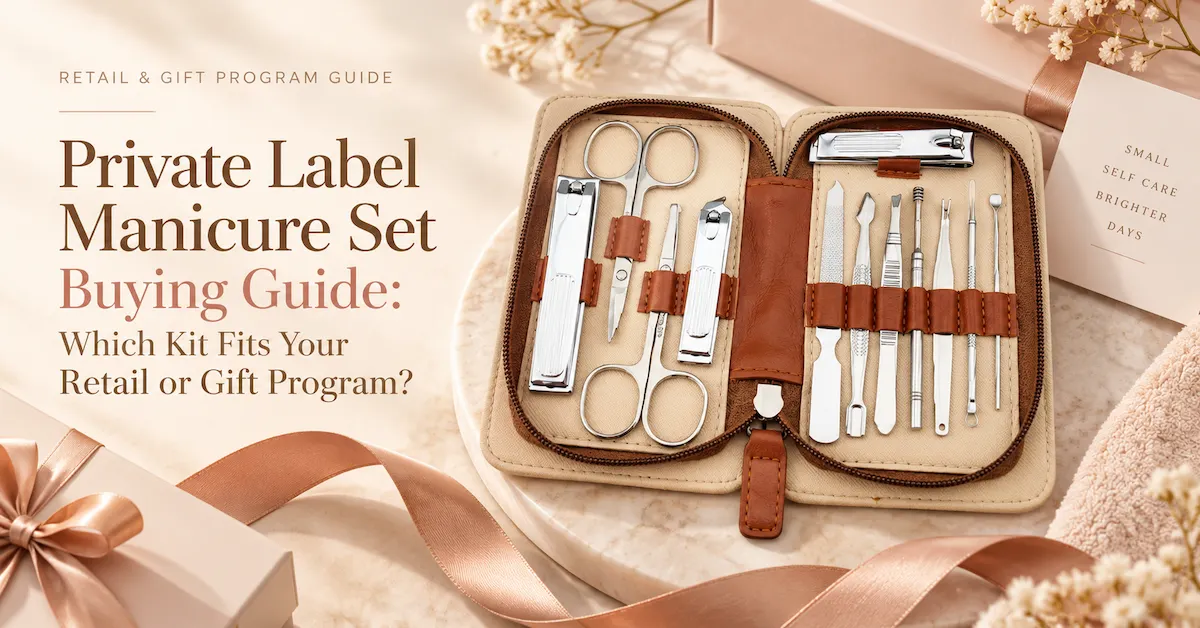
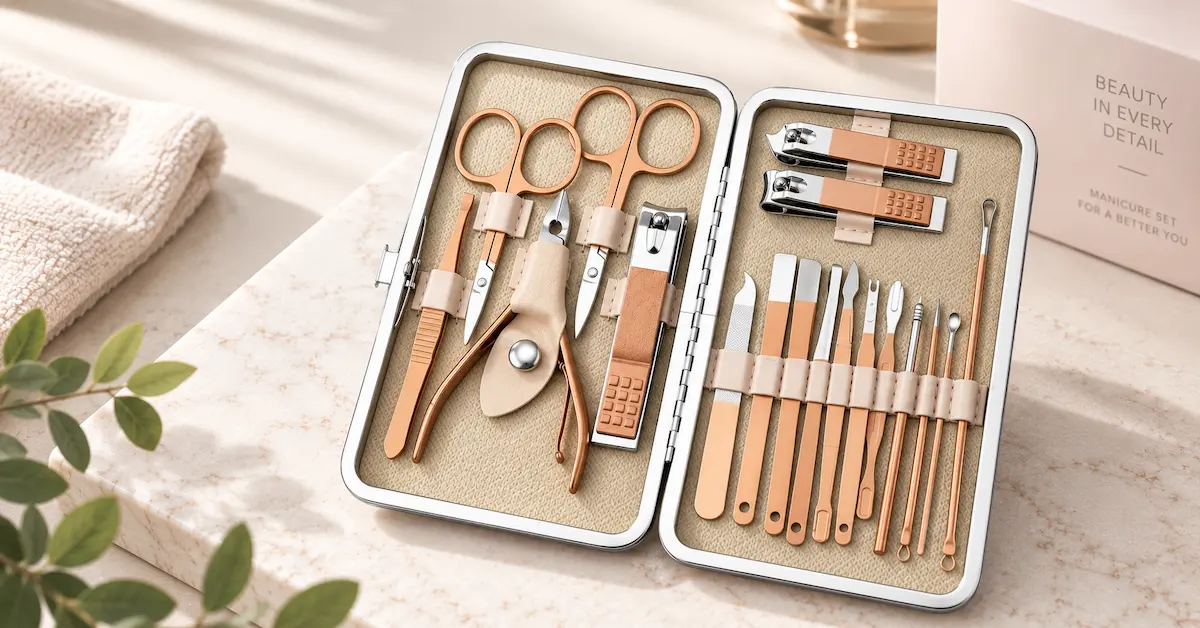
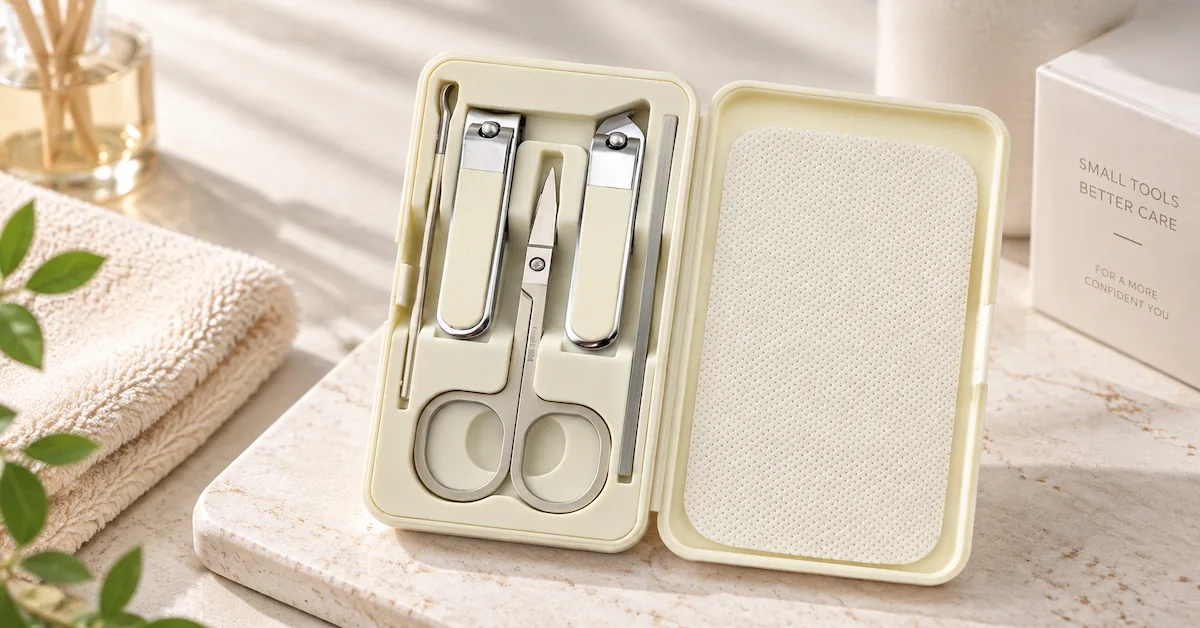
OLIMOR's official product pages show several useful reference directions. Model MSX1027 is presented as a compact four-tool set in a black pouch. Model MSC1001 is presented as a larger rose-gold set with a PU case. Model MSB2061 is presented as a creamy-white travel kit. These examples show how tool count, case format, finish, and market position can change together. Treat the published specifications as model-specific references and confirm the current configuration in the quotation and sample.
Use a core, support, and optional structure
Place the most frequently understood items in a core layer. Support tools should extend the routine rather than repeat it. Optional tools should be justified by a specific audience or market. This framework gives purchasing teams a clean way to discuss cost reductions: remove or substitute an optional item before compromising the core tool that carries the product promise.
A buyer seeking a professional manicure set manufacturer should unpack the word "professional." Does it refer to the sales channel, the way an item is held, the combination in the case, the paperwork, or simply the finish? An inspector cannot test the adjective. Give the factory the intended user, the actual tasks, and the results the sample must demonstrate.
3. Choose OEM, ODM, or private label before requesting prices
OEM, ODM, and private label describe different starting points. They can overlap, but a buyer should state which decisions are already made. Without that clarity, one supplier may quote a standard set while another assumes new tooling, a custom finish, and a printed case. The prices will look comparable even though the projects are not.
OEM: buyer-controlled requirements
An OEM manicure set manufacturer is appropriate when the buyer brings a drawing, a physical reference, controlled dimensions, a defined tool combination, or detailed appearance requirements. The factory reviews feasibility and proposes a route for samples and production. Mark every requirement as fixed, preferred, or open. This allows the supplier to suggest alternatives without silently changing a critical feature.
When a supplier platform is the sensible starting point
Working with an ODM manicure set manufacturer makes sense when a proven platform is more useful than a blank drawing. The team can compare existing set formats, then change the assortment, finish, case, or branding where it earns its place. Ask for three markings on the proposal: already available, adjustable, and new work. That small legend exposes a new case mould, insert, handle, coating, or tool combination before it quietly turns into another sample round.
Private label: brand-ready configuration
A private label manicure set commonly starts with an established set or tool platform and adds a controlled brand presentation. That may include logo position, surface finish, case colour, insert, printed sleeve, instruction card, barcode, and carton marks. Private label should still be approved as a complete packed SKU. A logo proof on a screen cannot confirm tool function, physical colour, print alignment, or insert retention.
| Development route | Buyer brings | Factory clarifies | Approval focus |
|---|---|---|---|
| OEM | Drawing, reference, dimensions, mechanism, or controlled appearance | Feasibility, tooling, process route, sample stages, and cost assumptions | Conformance to the buyer-controlled specification |
| ODM | Target user, price position, channel, and desired differentiation | Platform options, configurable features, and new-development boundaries | Chosen platform plus every approved adaptation |
| Private label | Brand identity, logo, colours, pack information, and sales requirements | Decoration method, case options, artwork needs, and quantity conditions | Finished tools, branding, packaging, and carton as one SKU |
4. Write one tool-level specification for every component
A manicure set is only as traceable as its component list. Give each tool an item number or temporary project code. Record its task, material, finish, colour, key dimensions, logo requirement, and functional check. The case and insert need their own entries. When a factory substitutes a file, tweezer, or clipper, the change should be visible in the component list rather than discovered in a shipment photograph.
For cutting tools, describe the intended action and the relationship of the working edges. For tweezers, describe the intended gripping task and tip contact. For files, identify the format and the finish expected after use. For pushers or cleaners, define the tip form and intended non-medical grooming task. Avoid copying a universal dimension, hardness value, or material grade across different models unless the supplier has confirmed it for each item.
The specification should distinguish product language from inspection language. "Elegant" may guide visual design, but it cannot be an acceptance criterion. "No visible coating gap at the logo under the agreed viewing condition" is closer to something that a team can inspect. This translation reduces subjective arguments during sample approval.
5. Coordinate material, finish, and colour across the set
Customers judge a manicure kit as a collection. Tools that use slightly different silver tones, surface textures, or logo positions can make the set feel assembled from unrelated stock. Ask the factory how the finish will be controlled across components that may follow different manufacturing routes.
A buyer searching for a stainless steel manicure set supplier should request material confirmation by component. The phrase "stainless steel set" may not explain the construction of the case, insert, coating, pivot, handle, or every accessory. Keep public-facing material claims aligned with the final bill of materials and supporting documents for that SKU.
Colour decisions need physical references. A screen rendering cannot reliably represent a rose-gold coating, creamy plastic case, textile lining, or printed paper sleeve. Agree which physical master, colour chip, or approved sample will control production. Review the tools inside the final case because surrounding colours alter perception.
Surface choice also affects function and handling. A polished lever can show marks differently from a brushed body. A coating around a joint may require clearance review. A textured grip can change how the tool sits in a narrow elastic loop. Ask whether the proposed finish changes assembly, inspection, packaging protection, or care instructions.
6. Engineer the case around actual tools
The case is not an accessory added after the product is complete. It controls movement, tool removal, first impression, and pack dimensions. Build the insert using the approved component geometry. Check that each tool can be removed without forcing a sharp edge against the lining and returned without guessing its position.
Open and close the case repeatedly during sample review. Watch for tools touching each other, elastic loops stretching, pockets hiding sharp points, hinge or zipper interference, and pressure marks on coated surfaces. Then review the closed case: does it remain flat, does the closure align, and does the outside recover after normal handling?
For ecommerce, take an open-case image and ask whether a shopper can identify the tool mix on a phone screen. For retail, place the proposed sleeve or box around the real case and check whether the set name, piece count, barcode, and key information remain legible. For gift programs, review the order in which the customer sees the brand, case, and tools.
Discuss Your Manicure Set Configuration
7. Evaluate the factory through the set's production map
A manicure kit factory China inquiry should follow the selected set through the building rather than stop at a machine list. One metal item may be stamped and formed before edge work, finishing, and assembly. A moulded handle or case takes a different route. Decoration and packing bring those streams back together. Ask where each component travels, where it waits, and at which handoff a mismatch is most likely to appear.
In OLIMOR's supplied capability list, metal work sits alongside plastic and finishing work: stamping, heat treatment, injection, polishing, water deburring, assembly, inspection, packing, and export coordination are all named. That list is a useful door into the conversation. It does not tell you that every operation belongs to your set. Ask the team to draw the actual route for your model and show the supplying site, outside handoffs, inspection gates, and the source of the case and printed pack.
Pay attention to synchronization. A set cannot be packed until every component and the case are available in the approved version. One late file, off-colour insert, or revised sleeve can delay the entire SKU. Ask the project team how component status is tracked and who releases the complete kit.
8. Design a sample plan that isolates decisions
A single sample round often tries to answer too many questions. A cleaner plan gives each round a purpose. The first round can confirm tool mix, scale, case format, and broad hand feel. The second can confirm material, finish, logo placement, and component function. A later pre-production sample can confirm printed packaging, final insert, barcode area, and the exact packed configuration.
Record feedback in a table with the component code, observation, requested action, owner, due date, and evidence needed for closure. Use photographs to locate a mark or alignment issue, but keep dimensions and test requirements in the written specification. Give the revised sample a new code. Never approve a collection by combining one tool from sample A, another from sample B, and a case from sample C without recording the resulting master configuration.
A custom manicure set manufacturer may propose alternatives after seeing the brief. Evaluate the alternatives against the original shelf role. A less expensive tool is not equivalent if it changes the customer task, finish harmony, pack size, or product claim. Conversely, a simpler component may be the right choice when it removes duplication and makes the set easier to explain.
9. Create quality checks at three levels
Manicure-set quality operates at component, assortment, and packed-SKU levels. A component check asks whether each clipper, tweezer, file, scissors, or pusher meets its own specification. An assortment check asks whether the correct items, finishes, and orientations appear together. A packed-SKU check asks whether branding, insert, case, printed material, barcode, and carton match the released configuration.
| Quality level | Typical questions | Record |
|---|---|---|
| Component | Does the item perform its intended task? Are working surfaces, movement, finish, and logo acceptable? | Component inspection result linked to its code |
| Assortment | Are all correct tools present? Do finish, colour, logo position, and visual hierarchy coordinate? | Open-set comparison with the approved master |
| Package | Are tools retained, protected, countable, and paired with the correct printed information? | Packed-sample approval and final inspection record |
| Carton | Are quantity, marks, orientation, dimensions, and shipping protection correct? | Carton specification and shipment release |
Define the acceptance method before the pilot order. The phrase "function test" is too vague if two inspectors perform different tasks. State how the tool is handled, what is observed, and what constitutes a failure. Critical, major, and minor defect classes should reflect the actual customer and product risk, not a generic list copied from another beauty tool.
OLIMOR's supplied information mentions inspection and equipment relating to torque and hardness. Ask how those capabilities connect to the components in the chosen kit, which values apply, how instruments are controlled, and which records can be provided. Do not advertise a test value until it has been confirmed for the specific model.
10. Use a pilot order to test the system
A pilot order is not merely a smaller commercial shipment. It tests whether the full system can move from approved sample to packed product without losing information. Before release, freeze the bill of materials, tool codes, case, insert, finish, logo file, artwork, carton data, inspection plan, and approved deviations.
Ask for first-piece or setup confirmation where it matters. Review the first completed tools and the first packed sets against the current reference. If a colour, movement, logo, or insert position is wrong, correct the setup before the remaining quantity is completed. The cost of early clarification is usually easier to manage than sorting a finished mixed assortment.
During pilot review, note problems that originate outside the tool itself. Does the zipper pull catch the sleeve? Does the barcode curve around an edge? Do small tools fall behind the insert? Does the outer carton compress the gift box? Write these apparently small discoveries down. The same note that saves the pilot carton can stop the problem from returning six months later.
11. Put quotes side by side only after the details match
Before comparing numbers, check that each quotation describes the same kit. Put the component list, material wording, finish, decoration, case, insert, printed pack, quantity, inspection owner, trade term, destination assumption, and validity date at the top of the comparison. Put development and tooling on their own lines; they should not be buried inside a recurring unit or packaging cost.
A wholesale manicure set supplier may return several quantity breaks, a choice of cases, and more than one standard assortment. Do not rush to circle the smallest number. A compact case might lower carton volume; an established finish could make reordering easier; a genuinely custom item may distinguish the range but need another approval cycle. Read each option against the product position and the volume you can reasonably sell.
There is no reliable universal MOQ or lead time for every manicure set. Conditions vary with component availability, tooling, finish, colour, case, printed packaging, order quantity, and production schedule. Request model-specific milestones for feasibility, sample preparation, artwork approval, material readiness, production, inspection, and shipment.
12. Prepare an inquiry that can be quoted accurately
A useful request for quotation should contain enough information to expose open decisions without pretending that the product is already finished. Send:
- Your company type, destination market, channel, and proposed launch period.
- The target customer and the one-sentence use case for the kit.
- The desired task list and tentative component list.
- Reference products, annotated photographs, drawings, or physical samples.
- Material preferences by component, with unknown items marked as open.
- Finish, colour, texture, and physical reference requirements.
- Logo files, decoration position, size, colour, and orientation.
- Case format, insert method, printed package, languages, and barcode needs.
- First-order and estimated annual quantity ranges.
- Required market documents, inspection expectations, and shipment destination.
- A target commercial position, with fixed requirements separated from preferences.
- Questions about platform availability, tooling, sample stages, MOQ, and milestones.
Ask the supplier to return a configuration summary beside the price. The summary should identify the model or component codes, set count, material wording, finish, case, branding, package, and quantity basis. This single step makes later comparisons much more reliable.
Request a Model-Specific Manicure Set Quote
13. Leave a clear trail for the person placing the next order
A kit gives small changes many places to hide. Leave the next buyer one release folder that tells the whole story: the component list and individual specifications, the approved sample code, physical finish and colour references, logo proofs, case drawing, insert layout, print artwork, carton details, inspection sheet, accepted deviations, and shipment record. It should be possible to identify the set without relying on someone's memory or an old marketplace photograph.
Before reordering, ask whether any component source, tool, finish, coating, case material, insert, package vendor, artwork, barcode, or destination requirement changed. A seemingly small substitution can affect fit, colour harmony, pack dimensions, or customer instructions. Record the reason, affected quantity, reviewer, and whether a new sample is required.
Replenishment planning also helps content accuracy. Ecommerce images, product descriptions, piece counts, materials, and dimensions should match the current released set. When a component changes, update customer-facing content only after the new configuration is approved.
14. A practical manufacturer scorecard
Use a weighted scorecard after the suppliers have reviewed the same brief. Adjust the weights to your program, but score evidence rather than sales language.
| Area | What strong evidence looks like | Example weight |
|---|---|---|
| Assortment understanding | The supplier can explain why each tool belongs in the intended routine. | 15% |
| Component capability | Tool-level routes, samples, and inspection points match the selected items. | 20% |
| Set integration | Finish, case, insert, branding, and printed package work together. | 20% |
| Quality control | Component, assortment, packed-set, and carton checks are defined. | 20% |
| Commercial clarity | MOQ, one-time costs, unit costs, milestones, and assumptions are visible. | 15% |
| Change control | Sample revisions, approvals, substitutions, and repeat orders are traceable. | 10% |
A scorecard will not make the decision for you, and that is fine. Its value is that another colleague can see why the decision was made. Put unresolved questions in the margin beside the score. An unanswered question often reappears later as extra cost, lost time, or a market-document problem.
15. Questions buyers usually ask before sending the brief
What does a manicure set manufacturer produce?
The scope may run from clippers, files, tweezers, cuticle tools, scissors, and pushers to cases, inserts, decoration, printed packs, inspection, and export preparation. Some steps may be performed at the quoted factory and others may be coordinated. Ask for the boundary to be marked on the route for your set.
How many tools should a manicure set contain?
There is no magic number. Follow the user's routine and make every component earn its slot. For a traveller, four well-chosen tools may tell a cleaner story than a crowded case full of items the buyer cannot name.
Where does OEM end and ODM begin?
OEM usually begins with more buyer-controlled requirements, such as drawings, dimensions, references, or a defined component list. ODM typically begins with a supplier platform that is selected and adapted. Both routes require a final specification and approved packed sample.
Can I create a private label manicure set with my logo?
Logo customization may be possible on selected tools, cases, inserts, cards, sleeves, and boxes. Feasibility depends on surface, size, finish, decoration method, and quantity. Approve the mark on the actual finished component and printed package.
Does every tool need to use stainless steel?
Not automatically. Material selection depends on the component, task, finish, care, cost, and market requirements. Request material confirmation by component and ensure public claims match the final bill of materials.
What should be checked on a manicure set sample?
Review every component's intended function and appearance, then review the collection for correct count, coordinated finish, logo alignment, tool retention, case operation, printed information, barcode position, and carton protection.
What is the MOQ for a custom manicure set?
MOQ varies with the selected tools, material, finish, decoration, case, insert, printed packaging, tooling, and order configuration. Ask for the minimum tied to a written SKU summary rather than a generic product category.
How long does manicure-set development take?
The timeline depends on platform selection, tooling, component samples, finish approval, logo proof, case and insert work, printed artwork, production scheduling, inspection, and shipment. Request project-specific milestones and identify what starts each stage.
How do I compare two manicure set suppliers?
Give both suppliers the same brief and compare tool-level evidence, sample results, case integration, quality plan, commercial assumptions, communication, and change control. Do not compare bare unit prices for different configurations.
Turn a collection of tools into one controlled SKU
The commercial value of a manicure set comes from coordination. The tools should cover a recognizable routine, feel visually related, fit the case, survive handling, carry accurate product information, and remain reproducible. Begin with the user and channel. Build a task-based assortment. Select the right OEM, ODM, or private-label route. Specify every component. Approve material and finish physically. Test the case with real tools. Use a pilot order to validate the whole system, then retain the release file for replenishment.
OLIMOR BEAUTY's confirmed product range includes manicure sets and related nail-care tools. Its supplied profile also identifies metal and plastic processing, assembly, inspection, packaging, OEM/ODM development, and export coordination. A productive first conversation should focus on one proposed set: the target customer, task list, reference models, desired finish, branding, case, quantity range, destination, and launch window.