

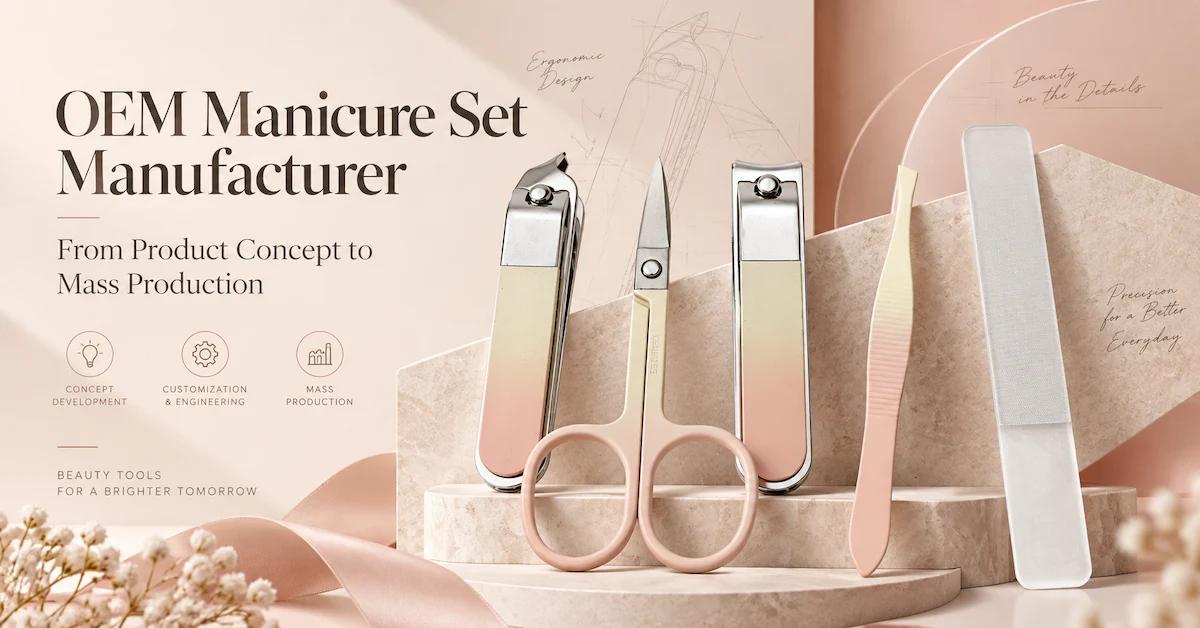
An OEM manicure set manufacturer is the right partner when a beauty brand needs its own product requirements carried through engineering, sampling, production, inspection, and repeat orders. The manufacturer's real task is not to fill a case with attractive tools. It is to make sure that a buyer's approved specifications—tool geometry, function, finish, assembly, case fit, branding, and packaging—can be produced and verified consistently.
The difference becomes obvious when something changes. A brand may approve a nail clipper with a particular lever feel, then discover that the next sample uses a different pivot assembly. A new case lining may make the approved scissors difficult to remove. A replacement file may fit in the pocket but have a different working surface. None of these problems is solved by saying that the set still contains the correct number of pieces. They are specification and change-control problems.
This article is for brand product managers, OEM buyers, importers, distributors, and retail teams preparing a genuine manufacturing project. It concentrates on the handoff between the buyer's design intent and the factory's production evidence. Buyers looking for available starting formats can review OLIMOR's manicure set collection; buyers with an existing drawing or reference sample can use the steps below to prepare a much more useful technical discussion.
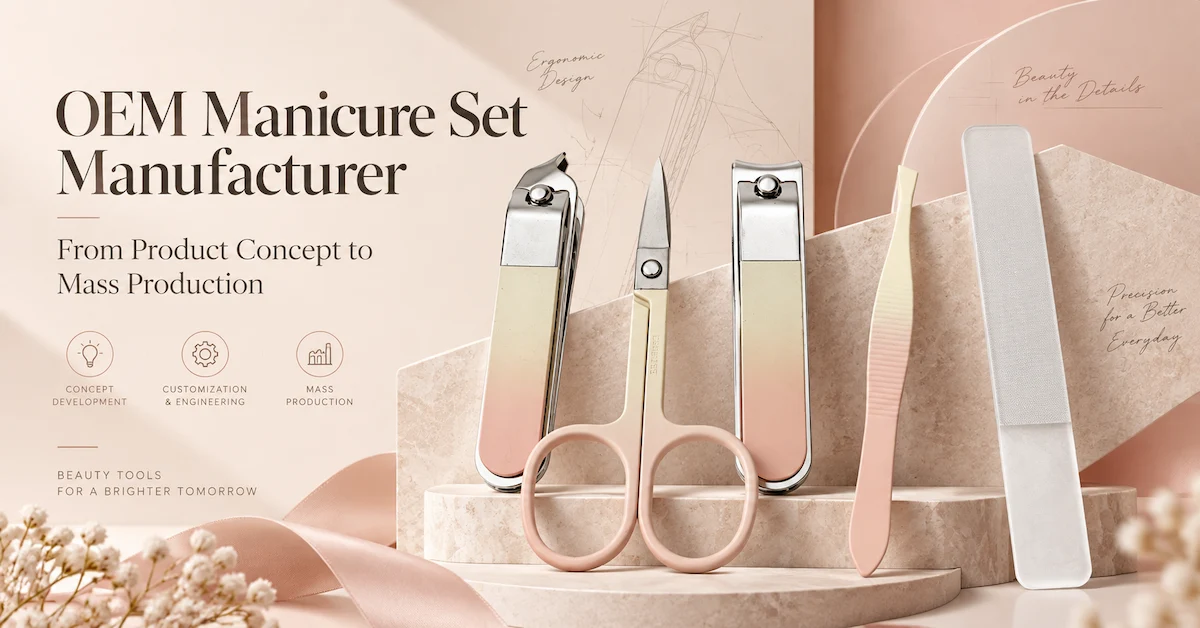
What Is an OEM Manicure Set Manufacturer—and When Do You Need One?
OEM, or original equipment manufacturing, is most useful when the buyer controls meaningful elements of the product definition. Those elements may include a physical reference sample, dimensioned drawings, specified components, unique tool geometry, a defined assortment, a custom case architecture, or documented functional and appearance criteria. The manufacturing partner evaluates the design, proposes an achievable process, develops confirmation samples, and produces against the released requirements.
This is different from simply selecting an existing case and printing a new brand name. Logo-only private label may be entirely appropriate for a fast retail launch; it just does not carry the same engineering burden as an OEM project. ODM may sit between the two when the supplier's existing platform is adapted to the buyer's goals.
Before paying for new tooling, ask a less glamorous question: Which feature must actually be unique? If the difference is packaging, start with established tools and a revised presentation. If the distinguishing feature is a new lever, working tip, grip, or case structure, a more extensive OEM feasibility review may be justified. New geometry can affect both manufacturing and inspection, not only appearance.
OEM work is not the best option for every business. A retailer testing an uncertain category, or an importer needing a very small immediate order, may benefit more from a stock platform. Where a brand owns a developed concept and expects repeat orders, controlled OEM production can provide a stronger foundation—provided the buyer is prepared to approve engineering details, not just the final photographs.
Start With the Design Inputs, Not a Price Request
A serious OEM quotation begins with a usable information package. An image of an open manicure case is helpful, but it cannot tell the factory which dimensions are fixed, how each tool should behave, who owns the design, or what defects will be unacceptable. The information supplied at the beginning determines how much the supplier must assume.
Create a project brief with the end user, market, price positioning, intended sales channel, expected volume, target delivery window, and core functional promise. Then attach the technical inputs that already exist: drawings, physical samples, dimensional envelopes, tool list, visual references, or test expectations. Mark missing fields as open questions rather than filling them with guesses.
Use three requirement levels. Mandatory means that changing the feature would alter the product or buyer commitment. Preferred describes a target for which the supplier may propose a workable alternative. To be developed indicates that the factory should offer an engineering recommendation. This prevents a supplier suggestion from silently replacing a brand-controlled decision.
For an OEM nail-care set, the tool list should also state whether the word manicure describes the whole kit accurately. Some broader grooming sets contain accessories beyond nail care. A brand should not require the factory to assemble one thing while marketing an incompatible product description.
The OEM Design-Input Matrix Buyers Can Send Today
The following matrix is a practical buyer-prepared template, not a standard OLIMOR form or a claim that every project requires identical documents.
| Input | What to supply | What the supplier should return | Common failure if omitted |
|---|---|---|---|
| User and sales channel | Target customer, market, use case, retail position | Proposed suitable format and unresolved questions | Wrong assortment or inappropriate package |
| Component list | Tool name, intended function, quantity, candidate model | Draft itemized BOM with alternatives flagged | Silent replacement or counting errors |
| Mechanical reference | Dimensions, drawings, physical sample, critical geometry | Feasibility comments and tolerance questions | Tool fits in image but not in real case |
| Functional target | How clipper, nipper, file, scissors, or tweezer should work | Proposed verification method and sample plan | Subjective disputes about “sharp” or “premium” |
| Appearance | Finish references, logo files, placement, color direction | Actual decorated sample and method limitations | Inconsistent metal finish or illegible mark |
| Case and insert | Footprint, opening, closure, tool positions, protection | Loaded prototype and pack-out plan | Bulging case, tool abrasion, poor access |
| Commercial scope | Quantity by SKU, launch milestones, destination | Itemized estimate, MOQ basis, lead-time assumptions | Prices that cover different projects |
| Ownership and change rules | Drawing custodian, approval contacts, permitted substitutions | Revision and deviation workflow | Unapproved changes in later batches |
A supplier who asks detailed questions in response is doing useful work. The goal is not an instant “yes” to every request; it is a list of what can be manufactured, what needs testing, and what remains undecided.
Convert Product Requirements Into Critical-to-Quality Features
Not every dimension deserves the same inspection effort. A professional OEM project identifies critical-to-quality (CTQ) features: characteristics that directly affect performance, safe handling, kit completeness, or an essential brand commitment. The buyer and supplier should agree on these before drawings and samples are released.
For a nail clipper, cutting-edge meeting and lever movement are more important than an arbitrary cosmetic dimension. For a nipper, jaw relationship, spring response, and joint movement matter. For tweezers, tip contact and grip tension are central. A file needs the intended working surface. For a case, closure and retention become critical; a beautiful case that opens accidentally or permits tools to scrape each other is not acceptable.
| Component | Candidate CTQ | Possible inspection evidence | What still needs agreement |
|---|---|---|---|
| Nail clipper | Cutting contact and actuation | Approved functional sample and repeatable cutting trial | Test medium, acceptance limits |
| Cuticle nipper | Jaw alignment, joint and spring action | Reference geometry and operation check | Exact jaw design and intended use |
| Tweezers | Tip geometry, closure contact and tension | Tip comparison and intended gripping test | Style, pressure expectations |
| Nail file | Filing surface and exposed edges | Surface inspection and functional reference | Abrasive specification or file type |
| Beauty scissors | Blade/pivot behavior and handling | Functional trial and appearance check | Tool geometry and test method |
| Case / insert | Retention, closure, surface protection | Packed prototype and handling test | Handling conditions and defect criteria |
| Finished kit | Correct contents and revision | BOM-to-slot check and approved packed sample | Sampling and rejection rules |
A useful CTQ plan names the responsible person, inspection stage, evidence retained, and response to failure. It does not need to be overly complicated; it needs to be concrete. Avoid presenting a suggested test table as proof of any factory's current procedure without confirming it for the actual order.
How Design for Manufacturing Changes a Manicure Set
Design for manufacturing (DFM) asks whether the approved design can be made repeatedly by the intended processes. Design for assembly (DFA) asks whether its components can be assembled without avoidable errors. Design for inspection asks whether the important requirements can be verified. Together, these reviews expose problems that styling illustrations cannot show.
Consider a clipper with a redesigned lever. The brand may care about a distinctive profile, but the supplier must also evaluate how the lever interacts with the pivot, how it is formed or finished, and whether its movement remains stable. A modified nipper handle may change the spring arrangement. An elongated nail file may require a different insert and case dimension. Each change should be traced to all affected components.
For the case, DFM can involve material availability, wall thickness or seam allowance where relevant, insert geometry, closure, and how finishes withstand pack-out. DFA may reveal that an overly complex arrangement causes packing errors. A simpler, repeatable loading sequence is often better than a visually dramatic layout that takes excessive manipulation.
Ask the manufacturer to return a DFM comment log, not only a new drawing. Every proposed alteration should show the reason, affected requirements, trade-off, cost or timing impact, and approval status. The brand should keep control over which deviations are acceptable. Engineering collaboration is most useful when decisions remain traceable.
Which Parts Need Tooling, and Who Controls It?
An OEM inquiry may involve an existing metal-tool platform, a modified component, a new case insert, or genuinely new tooling. These paths do not have the same commercial implications. Ask which item requires new tooling and why; do not assume that adding a logo requires a new mold, or that every new-looking case can be produced from an established tool.
The tooling discussion should distinguish prototype tools, production fixtures, forming or stamping tooling, molds where applicable, assembly fixtures, and inspection gauges. A buyer should ask whether the quotation includes development, adjustment, trial samples, ownership, maintenance, and future replacement. Some tools may be reusable only for one design; others may rely on supplier-owned platforms.
Make the commercial ownership conditions explicit. Who paid for the tooling? Who holds it? What happens if the design changes? Can the buyer request transfer, subject to an agreement? Who approves repair or replacement? These are contractual questions, not automatic rights created by the word OEM.
More tooling does not automatically mean a better product. An available platform with appropriate function and controlled decoration may be preferable where structural uniqueness is not valuable to the buyer. Conversely, when the differentiator truly depends on a unique mechanism or case, avoiding necessary engineering can create larger problems during assembly and repeat orders.
Engineering Samples, Cosmetic Samples, and Golden Samples Are Different
Samples serve different purposes and should not be merged into a single informal approval. An engineering sample proves whether the proposed design functions and fits. A cosmetic sample proves a finish, color, or logo result. A packed pre-production reference shows the full sellable product. A retained approved or golden sample gives production and inspectors a common comparison point.
During engineering review, focus on tool behavior and dimensions. For example, test the actual clipper and nipper rather than confirming that they look similar to the reference. For cosmetic review, inspect real finishes under suitable light and confirm branding on the actual substrate. For case review, load the final components into the real insert; compare closed-case thickness, access, and contact between metal surfaces.
The final sample should be versioned. State which drawings, component list, finishes, decoration artwork, packaging dielines, and labels it represents. If a component changes after approval, update the relevant sample record and decide which tests must be repeated.
It is especially risky to approve one tool from Sample A, a case from Sample B, and a box from Sample C without constructing one final integrated reference. The three elements may be individually attractive but incompatible. A complete pre-production kit is the bridge between separate approvals and one sellable SKU.
The OEM Sample Approval and Production-Release Timeline
A defined approval sequence keeps suppliers from treating an email saying “looks good” as authorization for everything. The following milestone structure is an illustrative project-control model, not a fixed OLIMOR production schedule.
| Gate | Buyer approves | Evidence to retain | What blocks the next step |
|---|---|---|---|
| 0 — Requirement baseline | User, market, critical functions, reference | Signed brief and open-question list | Ambiguous scope |
| 1 — Engineering feasibility | DFM recommendations and proposed routes | DFM log, preliminary BOM, updated drawings | Unresolved critical technical risk |
| 2 — Tool / component samples | Individual functional performance | Tagged samples and CTQ results | Cutting, grip or fit failure |
| 3 — Case and layout | Retention, closure, protection, ergonomics | Loaded-case sample and layout file | Tool interference or damage |
| 4 — Finish and artwork | Decoration, branding, retail information | Physical proof and controlled artwork | Inconsistent or inaccurate presentation |
| 5 — Complete pre-production kit | Entire sellable SKU and pack-out | Master packed sample and BOM revision | Missing part or unresolved change |
| 6 — Pilot / first-piece | Early-run conformity and process stability | First-piece/pilot records and deviations | Critical defect or uncontrolled process |
| 7 — Bulk and shipment release | Accepted production and correct cartons | Inspection and packing records | Failed agreed criteria |
The buyer should designate one approval authority for each gate. Marketing can approve visual branding, but engineering and quality staff should review function and technical specifications. A single project manager should maintain the release record so that all approvals refer to the same current revision.
Validate the Case as a Mechanical System, Not Just Packaging
A manicure case often looks like packaging, but it behaves like a small assembly. Its insert restrains parts, distributes pressure, organizes removal, and controls contact between tools. That makes case engineering particularly important in OEM development.
Start with the dimensions of finished—not idealized—components. Test whether elastic loops are secure without requiring excessive force to remove a tool. Check whether the case closes with the thickest permitted combination of components. Identify any tool that can turn, shift, or rub against a neighboring polished surface during handling.
A buyer may request a specific case footprint for shelf space or parcel cost. Treat that envelope as a real engineering constraint. If the requested footprint is incompatible with the required tools, the supplier should provide choices: change the arrangement, choose a different retention method, select another tool format, or revise the case dimensions. The wrong response is to force the tools into a sample that only works when displayed open.
For retail and e-commerce, inspect the full customer experience. Does the product image match the tools actually inside? Is the set easy to repack after use? Does the protective insert permit a clean unboxing? Case fit, brand presentation, and damage prevention all become repeatable criteria rather than subjective preferences.
OLIMOR's custom packaged manicure set guide explores the packaging side in more detail; for an OEM project, connect those decisions back to the drawing and BOM revisions.
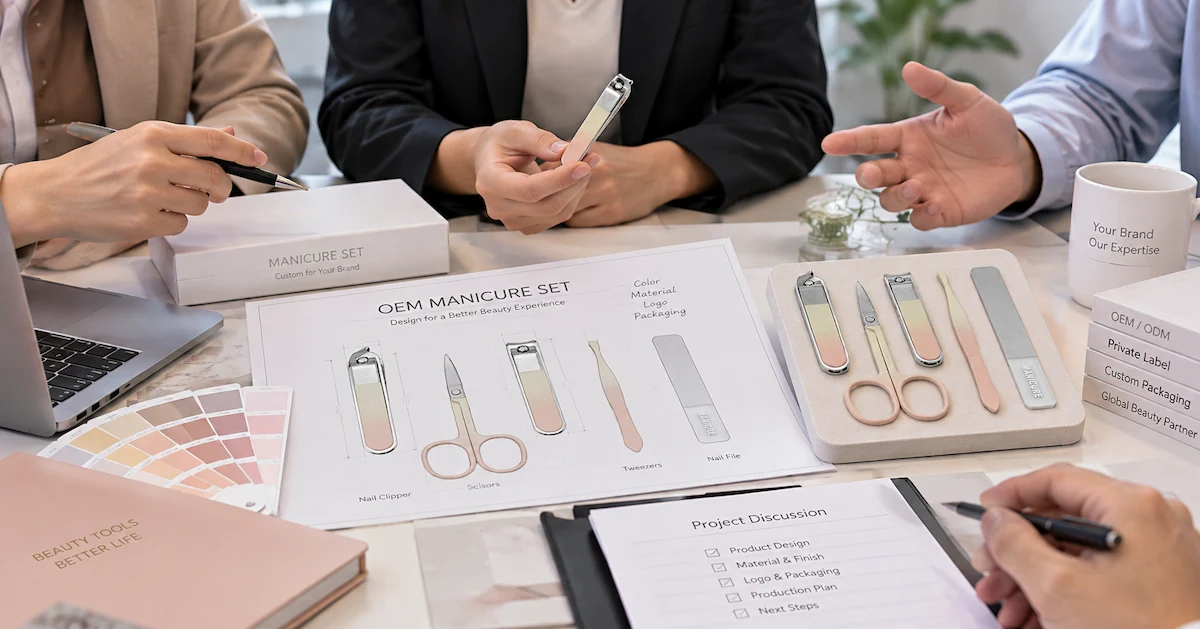
Control Materials and Finishes at the Component Level
A manicure set can contain metal tools with different constructions alongside polymer, textile, PU-style, elastic, abrasive, or printed components. The words “stainless steel manicure set” should not imply that every part uses one grade. Ask for model-specific material information and make sure retail claims match the approved components.
A change in steel specification, coating, file surface, case lining, or spring may affect function and durability, even when the finished appearance seems unchanged. That is why the material list and permitted substitution rules are part of OEM control. The supplier should not replace one material with another solely because they look similar.
Surface finish should be evaluated as a group. A mirror-polished file next to a satin clipper might be commercially appropriate, but it should be a deliberate brand decision rather than unplanned variation. Confirm how logos appear on the actual finish, whether tool-to-tool contact marks a surface, and what cosmetic defects will cause rejection.
If the buyer needs a particular material grade, hardness range, corrosion requirement, or other technical property, those requirements must be confirmed and supported for the selected components before publication or production. Do not infer test results from a general company capability statement or a catalog adjective such as “premium.”
Turn the BOM Into an Assembly and Traceability Record
An OEM bill of materials should do more than list the visible tools. It needs component codes, quantities, versions, accepted sources where applicable, finish or decoration, and case or packaging items. Add the file, clipper, nipper, scissors, tweezers, pusher, case, insert, printed sleeve, labels, and export carton where they form part of the actual SKU.
Give each component a clear position in the kit. A slot-by-slot loading instruction can connect the BOM to the assembly worker's task. If two products have similar appearances, use distinct identification methods so they cannot be mixed without detection. A complete set should be checked before the case is closed, not only after sealing the retail box.
A key distinction: component completeness and component conformity are separate. A set can have the correct number of items while containing the wrong tweezers. It can have every correct item but a defective zipper. Inspection must confirm both the identity of each component and the overall product state.
For traceability, agree on practical records that the supplier can maintain: current BOM revision, product sample IDs, approved artwork, packing instructions, inspection results, carton identification, and any deviations. The level of detail should be appropriate to the product and order, but the system needs to answer what was manufactured, how it was checked, and what changed.
How to Prepare a Pilot Run Before Full-Scale Production
The transition from samples to production is a critical OEM stage. A pilot or first-piece exercise tests whether the proposed manufacturing and assembly sequence reproduces the approved result using the intended materials, workers, tooling, and instructions. A demonstration sample built by a technician does not automatically prove that the normal production process will yield the same result.
Before a pilot, confirm material readiness, current drawings, correct gauges or functional checks, logo files, case inserts, and packing instructions. At the start, compare early units with the master sample, including both individual tools and complete packed sets. Note variation in cutting feel, spring response, finish, tool retention, printing, and completeness.
If a problem appears, document the cause and correction before continuing. Does the tool require a fixture adjustment? Is the elastic placement wrong? Does the inspection instruction fail to explain a critical feature? A pilot has value only if these findings result in a controlled change.
Do not invent a universal pilot quantity. The appropriate number and acceptance method depend on project complexity, production maturity, and the agreed buyer-supplier plan. A buyer with a new mechanism or newly developed case may require more evaluation than one using established tools and a revised logo, but the final approach must be chosen for the project.
Product-Specific Quality Control: The Evidence to Ask For
Quality statements should identify a feature, a method, and a decision. “All products receive strict quality inspection” is too vague for a buyer trying to approve a particular kit. A more useful instruction is “inspect clipper cutting contact against the approved functional reference,” followed by an agreed test and response to failures.
The quality plan can be organized into incoming, first-piece, in-process, finished-tool, kit assembly, packed-unit, and shipment checks. Not every stage needs the same intensity, but defects should be detected at a point where correction is still manageable. Poor fit identified before packing is far less disruptive than the same issue found after thousands of retail boxes are sealed.
Different tools require different tests. A tweezer is evaluated for tip contact, a nipper for jaw action, a file for its working surface, and a clipper for cutting and lever movement. At finished-kit level, the correct contents, case closure, protective arrangement, logo, artwork, barcode where required, and carton quantities matter.
For an inspection sampling plan, the buyer and supplier should agree on the applicable method, defect classes, and acceptance decision in writing. A mention of AQL or an ISO standard on a marketing page does not establish a specific lot-acceptance plan, product certification, or guaranteed defect rate. Any requested independent inspection should verify the actual contract, not a generic factory brochure.
Engineering Change Control Protects the Second Order
An OEM product is not finished when the first shipment leaves. Its real commercial test comes when a later order must match the original approved design. The manufacturer and buyer need a rule for handling changes to materials, geometry, surface treatment, component sources, case construction, logos, inserts, and packaging.
A simple engineering change process can contain five steps: identify the proposed change, describe the reason, list affected documents and CTQs, decide which approvals or tests must be repeated, and release the updated revision only after authorization. Where a temporary deviation is requested, record its quantity and duration instead of silently modifying the permanent specification.
For example, a supplier may propose a replacement file that looks similar. The buyer should compare its size, working surface, finish, case fit, and product description against the released BOM. If those differences matter, the change needs a new approval. A new retail box with a revised barcode may not affect cutting performance, but it does require artwork and pack identity checks.
Keep the current master sample, sample history, approval contacts, and change decisions accessible to the people preparing the next purchase order. “Same as last time” is not a controlled instruction if the last order contained unrecorded substitutions.
What Should an OEM Manicure Set Quotation Include?
A useful OEM quotation should make its assumptions visible. It should specify the exact configuration under consideration, scope of engineering work, existing versus new components, material and finish assumptions, decoration, case or insert work, packaging, testing, inspection, tooling, quantity basis, and shipment term. Items awaiting technical approval should be labeled provisional.
| Quote line | What to clarify before comparing suppliers |
|---|---|
| Engineering / DFM | Included design review and number or scope of revisions |
| Samples | Functional, cosmetic, case, pre-production and pilot sample arrangements |
| Tooling / fixtures | Whether required, cost, ownership and adjustment terms |
| Production components | Approved model, material, finish, construction and source assumptions |
| Case and inserts | Material, design, retention, closures and tool-fit approval |
| Branding | Marking methods, locations, artwork setup and print specifications |
| Retail / export packaging | Dieline, inserts, labels, carton count and protection |
| QC / documents | Inspection scope, records and buyer-specific requirements |
| Quantity and timeline | MOQ by SKU/variant and milestone assumptions |
| Shipment | Named trade term, location and excluded charges |
MOQ can vary by selected model, new tooling, case color, printing, component sourcing, or order mix. Lead time should be divided into sample approval, component readiness, bulk manufacture, packing, inspection, and shipping. Neither a universal MOQ nor a universal production timeline should be inferred from the company profile.
The lowest quote is not necessarily the best route if it excludes case engineering, decoration proofs, or the verification needed to keep the kit consistent. Comparing quotes is meaningful only when the underlying product and service scopes match.
Common OEM Failure Modes and Who Should Own the Fix
The table below presents illustrative engineering risks, not recorded defects or project data from OLIMOR. It is useful as a preliminary project risk register.
| Risk | Observable consequence | Corrective owner and likely response |
|---|---|---|
| Buyer drawing lacks a critical dimension | Tools differ while both suppliers claim conformance | Buyer engineering + supplier DFM: define reference and tolerances |
| Modified clipper lever changes actuation | Approved appearance but inconsistent clipping feel | Tool engineering/QA: retest mechanism before release |
| New lining causes metal-to-metal contact | Scratches after shipping | Case/packaging engineering: revise retention and repeat handling check |
| Uncontrolled color or coating substitution | Mixed finish appearance within one kit | Buyer brand approval + supplier purchasing: block unapproved material |
| Wrong or missing component in pack-out | Unsellable or misleading retail set | Assembly/QA: use slot map, component IDs and completeness control |
| Old barcode or piece count remains on box | Retail compliance and inventory problem | Artwork owner + pack inspector: revision match before printing |
| Tooling adjustment is not documented | Later batch differs from golden sample | Production engineering: log change and repeat affected approval |
A strong project team does not merely identify a potential defect. It names the evidence needed to close the issue and the person authorized to release the revised design. That reduces disagreement between design, purchasing, manufacturing, and brand teams.
OEM Versus ODM and Private Label: Compare the Actual Control You Need
An OEM-focused buyer often wants to retain control over product geometry or functional requirements. An ODM buyer may prefer a supplier-owned platform that can be adapted within available limits. A private-label buyer may be content with an established set plus branding and packaging. These categories overlap in practice; what matters is which documents and approvals control the finished product.
| Development route | Typical buyer input | Main supplier task | Risk to manage |
|---|---|---|---|
| OEM | Buyer drawing, reference, CTQs, specified component or case | Manufacture to released buyer requirements | Engineering feasibility, revision control, tooling |
| ODM | Target market, product goals, platform changes | Propose and refine an existing design platform | What can change without new development |
| Private label | Selected product, logo, colors, retail artwork | Decorate and pack an approved configuration | Branding, packaging fit, product identity |
Do not choose OEM because it sounds more advanced. Choose it when the unique requirements justify engineering ownership and additional control. In many cases, an established platform with thoughtful private-label packaging is a more efficient commercial decision.
For a broader comparison of brand-side development choices, OLIMOR's private label manicure set guide provides additional context. The present article concentrates on production-control evidence after the OEM route is selected.
Which OLIMOR Products Can Serve as OEM Reference Samples?
An existing product can clarify the starting point even when the final OEM project will change its configuration. OLIMOR's current manicure set category includes formats suitable for comparing compact, gift-oriented, and practical everyday assortments. These are references, not proof that a particular change or tooling option is available for every SKU.
The MSB2061 travel manicure kit provides a compact case example for discussing travel-focused dimensions and set layout. Its published model-specific details should be checked against the current product sample and quotation, including the material description of each component.
The Luxurious Nail Grooming Set provides a different presentation direction for brands considering a gift-oriented case and coordinated tool appearance. The exact product composition and possible changes need confirmation for the proposed order.
A portable professional manicure set provides another product reference for discussing assortment and storage rather than starting with a blank case drawing. The individual tool specifications, material and decoration choices should still be reviewed with the project team.
OLIMOR BEAUTY's current About Us page states that it develops and manufactures beauty tools for international distributors, retailers and private-label partners, with an OEM development workflow and checks against approved samples, material requirements, and export specifications. These are company-level statements. For a particular kit, buyers should request the current project-specific manufacturing route, sample approvals, inspection criteria, and quote rather than assuming that every company capability applies to every tool.
What to Put in an OEM Manicure Set RFQ
An RFQ should help the supplier decide what is feasible, what is unclear, and what must be priced. Buyers will get more useful answers by sharing the following information than by asking for a generic “OEM set price.”
- Project purpose: brand, target buyer, intended use and sales channel.
- Target market: destination region, retail requirements and market-specific questions needing verification.
- Design maturity: sketch, dimensional drawing, CAD if available, physical sample, or approved reference product.
- Tool list: exact intended functions and quantity of each component, with alternatives clearly identified.
- Critical requirements: cutting, gripping, filing, lever or joint behavior; any controlled dimensions or finishes.
- Case design: size constraints, retention, material direction, closure, insert and pack protection.
- Branding: logo files, placement, artwork version, target appearance and packaging information.
- Quantity: estimated first order by SKU/variant and realistic annual forecast if known.
- Sample and approval plan: buyer contacts, intended review stages and requested release evidence.
- Commercial details: target date, shipment destination, desired quotation breakdown and trade terms.
- IP and changes: design ownership questions, acceptable substitutions and formal change-approval process.
- Known risks: failure issues from a previous supplier or a current reference sample, if any.
A practical first message could be: “We are developing an OEM manicure set for a beauty retail brand. We have reference drawings and a target case footprint. The cutting tools and tool-to-case fit are critical to our program. Please review the attached component list, identify existing versus new-development items, advise DFM questions, sample stages, any tooling requirements, model-specific MOQ, inspection approach and a milestone-based quote. We will approve function, appearance and the final packed kit separately.”
When the supplier responds, ask for a feasibility summary and open-question list, not just a number. That conversation will reveal much more about engineering readiness than a quick promise of “best price.”
Frequently Asked Questions About OEM Manicure Set Manufacturing
1. What does an OEM manicure set manufacturer do?
An OEM manicure set manufacturer evaluates buyer-controlled drawings, physical references, component requirements, and quality criteria, then helps develop samples and a production route for the finished kit. The work can include engineering review, tool and case manufacture or sourcing coordination, decoration, kit assembly, inspection and repeat-order control. The precise scope must be agreed for the project; not every OEM inquiry requires new tooling.
2. Do I need finished CAD drawings to start an OEM inquiry?
No. A clear physical reference, sketches, dimensions, component list and functional brief can support an initial feasibility discussion. More complete drawings may be necessary before production release, especially if geometry or tolerances are critical. The important step is to identify what is already controlled by the buyer and what the supplier must develop and validate.
3. Which manicure tools can be included in an OEM set?
Depending on the target use, a kit may include nail clippers, files, cuticle-care tools, tweezers, scissors and other suitable grooming accessories. The buyer should select tools by intended tasks, not by an arbitrary piece count. Each proposed component needs its own specification and test, and the complete assortment must fit and be represented accurately in the package.
4. How is OEM different from private label?
OEM usually involves greater buyer control of the product specification, geometry or functionality. Private label often begins with an existing approved platform and focuses on logos, finishes, packaging or coordinated assortment choices. ODM may adapt a supplier's own platform. The boundaries can overlap, so clarify who owns each design decision and what will be newly developed.
5. What should an OEM manicure kit sample approval include?
Review individual tool functions first, followed by case and insert fit, physical finish and logo proofs, complete packed retail presentation, and early production conformity where agreed. Keep a versioned BOM, reference samples, drawings, artwork and acceptance criteria. A digital photograph or one attractive sample should not substitute for a full release package.
6. What quality checks are important for a manicure set?
Inspect clippers for cutting-edge meeting and lever behavior, nippers for jaw and joint response, tweezers for tip contact, files for working-surface consistency, and scissors for blade and pivot action. At kit level, verify correct components, retention, case closure, protective packing, branding, artwork and carton identity. Exact tests and sampling limits should be agreed for the chosen SKU.
7. Does OEM always require a new mold or new tooling?
No. Some projects use approved existing tools and require only a new case, insert, finish, or controlled assortment. Other projects may involve new forming tools, molds, fixtures or gauges. A DFM review should identify which elements are standard, which can be modified, and which require genuinely new development, with separate cost and ownership terms.
8. What is the MOQ for OEM manicure sets?
There is no universal MOQ. Minimums can depend on the chosen tools, new components, custom finishes, case construction, printed packaging, artwork versions and production planning. Request a model-specific quotation that explains the minimum by finished SKU and any separate component or packaging thresholds. Do not infer MOQ from an online retail product price.
9. How can I keep my OEM design consistent across repeat orders?
Maintain a controlled master sample, final drawings, BOM revision, approved finishes, artwork, case and insert files, packing specification and inspection plan. Require notification and written approval before important materials, components, tooling, supplier sources or processes change. Repeat orders should reference the released product version rather than a vague instruction to make it “the same.”
10. How should I approach an OEM manicure set manufacturer in China?
Send the target buyer and market, design references, intended tool list, functional priorities, case direction, branding files, estimated quantity and deadline. Ask for a feasibility review, sample and tooling plan, QC approach and a scope-aligned quotation. For OLIMOR, start with the manicure set range or submit an OEM inquiry describing your selected reference or new design.
Conclusion
A reliable OEM manicure set manufacturer should be judged by how clearly it connects buyer drawings and samples to approved production—not simply by its catalog or first quote. Define critical tool functions, complete a DFM review, approve the packed kit, and preserve the released BOM and master sample for future orders. These controls help brands avoid substitutions and inconsistent reorders. To discuss an OEM nail-care project, send your drawings, tool list, case requirements and target quantity to OLIMOR for a model-specific feasibility review.
Tag:
Related articles
- OEM & Private Label
- Nail Care Tools Guide
anicure Pedicure Set Manufacturer: How to Source Complete Hand and Foot Care Kits for Retail and Salons
- OEM & Private Label
- Nail Care Tools Guide
Custom Manicure Set Manufacturer: From Brand Brief to Retail-Ready OEM Production
- OEM & Private Label
- Nail Care Tools Guide