Quick Answer
Choose a private label manicure set by the job it needs to do: a travel essential, an everyday retail kit, or a branded gift. Compare working samples before deciding on piece count or decoration. Request the material of each tool, the factory's role in making it, the proposed case and logo treatment, and the checks used before shipment. Your purchase decision should rest on a complete packed sample and an itemized offer, with quantity, market documents, and reorder changes settled in writing.
Introduction: Why the set needs a buying strategy
For a beauty brand or retail buyer, a manicure set looks simple on a product page. Several small tools sit in a case, the colours appear coordinated, and the package promises convenience. The commercial risk is hidden in the spaces between those elements. A clipper may come from one process route, a file from another, and the case from a separate supplier. A logo can be approved on artwork while the finished surface has not been checked. A printed sleeve can fit the empty case but press against a tool when the kit is full.
Imagine receiving the first carton and discovering that the clipper is correct but the case colour belongs to an earlier sample. Or imagine photographing the approved kit, then receiving a reorder with a different file. Neither problem is solved by a low unit price. When comparing a private label manicure set manufacturer, ask what prevents those mismatches. The answer should point to a record, an owner, and an approval step you can inspect.
In the information OLIMOR BEAUTY supplied, the business and factory have separate starting dates: 2011 and 2017 respectively. The profile puts the site at about 6,000 square metres and the team at roughly 200 people. Capacity is reported in two groups, around 5 million metal sets a year and around 2.5 million injection-moulded pieces. Its capability notes name stamping, heat treatment, injection work, polishing and water deburring, followed by assembly, inspection, packing, and export coordination. Use the profile to prepare your questions. It cannot tell you the material, minimum order, available production slot, paperwork, or price of the set you have not yet specified.
What Is a Private Label Manicure Set?
A private label manicure set is a collection of nail-care tools supplied for sale under the buyer's own brand. The buyer selects or adapts the contents, decoration, and packaging rather than simply reselling the supplier's retail identity. Development may start with an existing platform or with a more detailed buyer specification. To the customer, the result is one product: the tools, their storage case, the instructions, and the name on the front all belong together.
Inside the case, a customer might find a clipper and file for basic nail maintenance, then tweezers, scissors, or a cuticle tool for a wider routine. Pushers, cleaners, and buffers are other possible components. The case, retention system, and printed pack complete the physical product. Do not treat that list as a requirement to include everything. Choose only the tasks you want the kit to cover, then check whether the size and price still fit the intended channel.
Try opening a sample as someone encountering the brand for the first time. Can you name the tools? Does each item come out easily and return to its slot? Is the brand mark readable, and does the finish look deliberate rather than mixed? Those questions test the customer's experience. Now ask the supplier which exact references will reproduce that experience on the next run, and who will notify you if a reference has to change.
What belongs to the brand, and what can vary?
For a hypothetical brand selling both travel and gift kits, decide which features should remain recognizable across the range. A logo orientation, tool finish, naming convention, and instruction style could remain fixed, while case size and the number of tools vary. That gives the supplier a brief for a collection, not merely two unrelated requests.
Keep a second list of features that must not change without approval. It might include the clipper platform, the material wording, the position of a logo, or the closure on the case. A feature that looks minor to the supplier may be central to your listing images or brand identity. Discuss the two lists before artwork is prepared, then link them to the released samples.
1. Choose the application before the assortment
A kit for a travel aisle has a different job from a kit for a salon distributor. An ecommerce customer needs to understand the contents from a product image. A gift buyer may care about the case, colour story, and opening sequence. A pharmacy or everyday-care brand may prefer a concise set with clear instructions and familiar tools. A corporate gift program may need a branded surface and a reliable package more than a large number of accessories.
Write one application sentence before reviewing product photos. Examples include: "A compact kit for travellers who want essential nail maintenance in one pouch," or "A coordinated home-care set for a pharmacy private label with easy-to-identify tools." The sentence gives the supplier a reason for every component and helps your team reject an attractive item that does not serve the customer.
| Application | Useful set emphasis | Common risk |
|---|---|---|
| Travel | Compact case, essential tools, secure retention, low visual clutter | Tools move or rub inside the pouch |
| Retail shelf | Fast recognition, coordinated finish, readable front panel | Piece count is clear but tool purpose is not |
| Ecommerce | Strong open-case image, simple naming, useful feature hierarchy | Listing copy does not match the shipped assortment |
| Salon or professional channel | Task coverage, handling control, specifications, replacement logic | "Professional" is used without a defined requirement |
| Gift program | Case presentation, decoration, unboxing, seasonal flexibility | Package looks premium but does not protect the tools |
2. Build an assortment customers can explain
Start with tasks, then assign tools. A basic routine may need clipping and smoothing. A more detailed routine may add gripping, cuticle care, cleaning, and finishing. The number of pieces should follow the task map rather than lead it. When a customer cannot tell why two tools are different, the extra item may add cost and confusion without adding value.
Use a core, support, and optional structure. Core tools perform the jobs that define the product. Support tools improve completeness or detail. Optional tools serve a specific audience, seasonal collection, or channel. This structure also helps when a buyer needs to reduce cost: remove an optional item before weakening the core tool that makes the kit useful.
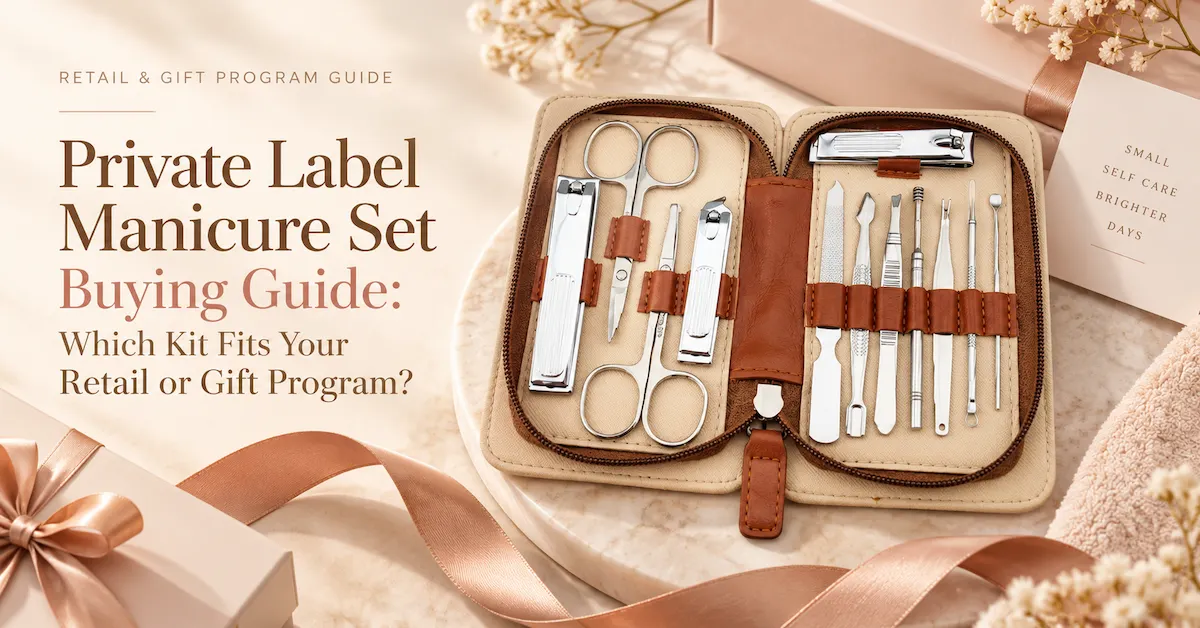
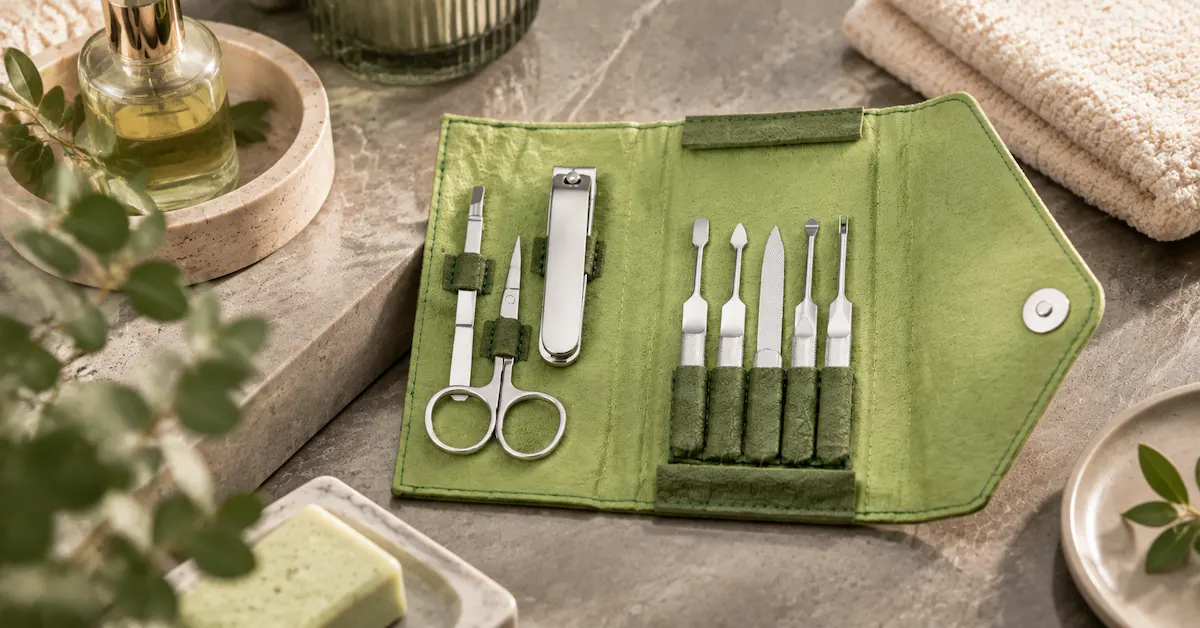
Review the reference products on OLIMOR's website as examples of different set positions. The MSX1027 page presents a compact four-tool manicure set in a black pouch. The MSC1001 page presents a larger rose-gold set with a PU case. The MSB2061 page presents a creamy-white travel kit. These are useful reference directions, not a universal promise for every private-label configuration. Confirm current component identity and specifications against the sample and quotation.
For brands comparing a professional manicure set manufacturer, define the word "professional" in measurable terms. It may describe a sales channel, a tool combination, a handling expectation, a finish, or a document requirement. State the user, the task, and the evidence needed. A label alone is not a quality test.
3. Decide which customization route fits the brand
OEM private label manicure set
An OEM private label manicure set project begins with stronger buyer control. Your team may provide a drawing, physical reference, component list, dimensional envelope, mechanism requirement, or detailed appearance concept. The supplier's job is to review feasibility, identify process implications, make samples, and manufacture to the released specification.
Before sampling, mark each requirement as fixed, preferred, or open. A fixed item might be the number of tools or the case footprint. A preferred item might be a satin finish or a particular insert material. An open item might be the decoration method. This simple classification lets the supplier suggest options without silently changing the product promise.
ODM manicure set manufacturer
An ODM manicure set manufacturer can help when your team wants to select an existing platform and adapt it. Ask the supplier to label each feature as standard, configurable, or new development. A new case, tool combination, coating, handle, insert, or printed pack can change sample rounds and cost even when the platform looks familiar.
Compare ODM options by putting the cases next to each other and walking through the intended routine. A smaller case could suit the travel brief but hide the file in a deep pocket. A larger layout might photograph well but exceed the package size you planned. Another finish could sit comfortably beside an existing collection. Explain why you prefer one option, including the compromise you accept. That explanation is more useful than telling the supplier to choose its most popular kit.
Private label manicure kit supplier
A private label manicure kit supplier may combine catalogue tools, selected finishes, a branded case, and printed packaging. The supplier should still provide a complete configuration summary. Logo, colour, case, insert, tool count, and printed information must be approved together. A standard kit becomes a private-label product only when the final branded version is controlled.
4. Evaluate the supplier's real capability
A factory presentation often begins with categories and capacity. An audit-worthy conversation begins with your proposed kit. Give the supplier a temporary project code and ask who owns each component. The answer should show whether the tools are made in-house, coordinated through a qualified partner, or selected from existing inventory.
Outside sourcing is not automatically a problem. A case, printed box, specialty file, or accessory may come from a partner. The important questions are: who approves the incoming item, which sample controls it, how is a change communicated, and how is the component connected to the final inspection? Hidden handoffs create more risk than visible, controlled coordination.
Ask for the route of one real set. It may include metal forming, heat treatment where applicable, grinding or edge work, polishing, water deburring, decoration, assembly, inspection, case loading, packing, and export coordination. The route should show where the selected model is identified and where a failure is recorded.
| Capability question | Evidence that helps | Why it matters |
|---|---|---|
| Can the team name every component source? | Bill of materials and source or process owner | Prevents a missing item from appearing late |
| Can the team trace the current version? | Sample code, drawing revision, artwork revision | Stops old and new samples being mixed |
| Can inspectors demonstrate a critical check? | Method, instrument, record, and reaction plan | Connects equipment to product risk |
| Can packaging be checked as a loaded set? | Packed sample and count or retention check | Finds case and insert problems before shipping |
| Can changes be communicated? | Change log, approval owner, and new sample rule | Protects later replenishment |
5. Specify material by component, not by slogan
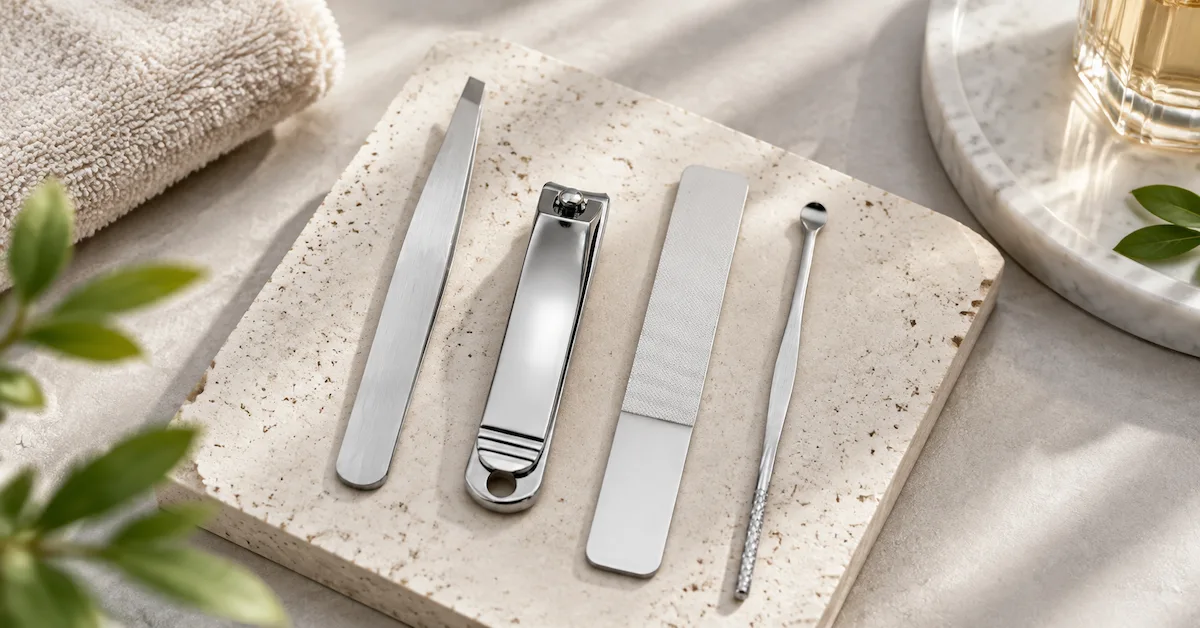
"Stainless steel" is a useful starting preference, but it is not a complete set specification. A buyer working with a stainless steel private label manicure set should ask which parts use stainless steel and which do not. Body, lever, pin, spring, file, pusher, case hardware, insert, and accessory parts may have different constructions.
Connect each material to function, finish, care, and documentation. A polished metal tool gives a different visual message from a satin or coated tool. A coloured coating may affect logo contrast, handling marks, joint clearance, and the protection needed inside the case. A plastic handle or case needs its own review for colour, texture, flash, fit, and alignment.
A material label does not support every claim a copywriter might want to make. If corrosion resistance, hardness, safety, medical use, or professional performance matters to the offer, request evidence relevant to the actual item and destination. Read the quotation, artwork, listing, and inspection sheet together. If they describe the same material differently, settle the wording before anyone approves the pack.
6. Make custom logo work part of product approval
A custom logo manicure kit needs more than a vector file. Provide the logo position, maximum size, orientation, colour, method, and revision. Ask the supplier whether the surface is curved, polished, textured, coated, or likely to touch the case lining. The decoration proof should be checked on the finished tool or case, not only on a screen.
Review the mark next to the other tools. A logo may look balanced on one item and crowded on another. Check line clarity, contrast, placement, and handling wear. Then inspect the printed sleeve, case, insert, instruction card, and carton. Consistent branding is a system of controlled files and physical references.
Keep decoration approval separate from function approval. A beautiful logo cannot correct a tool that binds, a file that does not match the description, or an insert that scratches the finish. The release record should show the current product sample, logo proof, artwork, and package together.
7. Engineer the case and insert around the filled kit
The case determines how the customer sees, stores, and uses the collection. Use the approved tools to design or adapt the insert. Check that every item has a known position, that working edges are protected, and that removal does not force a hand toward a sharp point. A case that looks organized while empty may fail after all tools are loaded.
Open and close the case repeatedly. Watch for elastic stretching, pockets hiding small tools, zipper interference, pressure marks, loose items, and contact between coated surfaces. Ask someone who did not design the layout to remove and replace each tool. Their hesitation can reveal an instruction or retention problem that a design team has stopped noticing.
Packaging also affects logistics. Confirm the packed dimensions, unit count per carton, carton marks, barcode position, and protection during movement. A slightly thicker case or revised insert can change the carton plan. Include those changes in the commercial and quality records.
Discuss Your Private Label Manicure Set
8. Create a sample plan with decision gates
Sample development is easier to manage when each round answers a limited group of questions. The first round can confirm the platform, user fit, tool mix, and case direction. The next can confirm materials, finish, logo, and component function. A pre-production sample can confirm the final insert, printed packaging, barcode, case loading, and packed appearance.
Use a review sheet with the component code, observation, requested change, owner, due date, and evidence needed to close the point. Give every revision a new sample code. Do not create a master by combining a clipper from one round, a case from another, and artwork from a third without recording the exact combination.
When the project is a custom manicure set manufacturer inquiry, ask the supplier to identify which change affects tooling, which affects only decoration, and which affects the case or carton. That response helps the buyer choose a sensible sequence rather than asking every department to revise everything at once.
9. Set quality controls at component, set, and package level
A private-label kit needs three different quality views. Component inspection checks whether an individual clipper, file, tweezer, scissors, pusher, or buffer performs its intended task. Set inspection checks whether the correct items, finishes, colours, and logo positions appear together. Package inspection checks whether the loaded case, printed information, barcode, carton, and shipment count match the approved SKU.
| Quality level | Example checks | Release record |
|---|---|---|
| Component | Function, movement, edge relationship, tip contact, surface, burrs, logo | Tool-level inspection linked to code or lot |
| Set | Correct count, tool identity, finish harmony, case layout, accessory presence | Open-set comparison with approved master |
| Package | Retention, closure, printed copy, barcode, carton marks, protection | Packed sample and final release check |
Define acceptance language before the pilot run. "Good quality" is not a method. State what the inspector does, what the inspector observes, and what happens when the result is outside the agreed range. A failed cutting action, a missing tool, a wrong logo, a visible scratch, and a slightly shifted insert may not carry the same commercial risk, so classify them before inspection.
OLIMOR's supplied information mentions inspection and equipment related to torque and hardness. Ask how those capabilities connect to the selected components, what model-specific values apply, and what records can be retained. Avoid putting a generic test number into public copy until it is confirmed for the exact SKU.
10. Compare quotes on the complete private-label configuration
A quote for a standard case is not comparable with a quote for a custom case, logo, insert, and printed box. Ask each supplier to repeat the project code, component list, material by item, finish, decoration, case, insert, pack, quantity band, inspection responsibility, trade term, destination basis, milestone assumptions, and validity date beside the price.
Separate one-time and recurring charges. Tooling, colour trials, artwork setup, sample development, fixtures, printing plates, and special tests may be stage-specific. Unit tools, cases, inserts, retail packs, cartons, agreed inspection, and logistics support may recur. Ask which cost returns if the design or packaging changes.
A wholesale private label manicure sets inquiry should also state the quantity bands you are evaluating. There is no universal MOQ for every set. The minimum can change with the tool mix, material, finish, logo method, case, insert, printed package, tooling, and order configuration. Request the MOQ for the complete written SKU, not only the product category.
Request a Model-Specific Manicure Set Quote
11. Use a pilot order to test the supply system
A pilot order is a controlled rehearsal. Freeze the component list, sample code, material wording, finish and colour references, logo file, case drawing, insert layout, printed artwork, carton data, and inspection plan. Give the release a date and revision so purchasing, quality, packaging, and the supplier can identify the same master.
Request first-piece checks after the relevant setup or changeover. Compare the first finished tools and first packed kits with the released references. If a working edge, movement, colour, logo, count, or insert position misses the target, correct the cause before the balance of the order is packed.
Use the pilot to observe handoffs that are invisible in a catalogue. Which component arrived last? Did the insert fit the actual case? Did the barcode remain readable after the sleeve was folded? Did an accessory disappear behind a pocket? These observations turn the first production run into evidence for the next one.
12. Protect consistency on repeat orders
Private-label value is built over repeated shipments. Keep a release folder containing the component map, individual tool specifications, approved sample images and code, material statements, finish and colour masters, decoration proofs, case and insert files, packaging artwork, carton information, inspection criteria, approved deviations, complaint notes, and change history.
Before a reorder, ask what changed in component sources, tooling, coatings, case materials, inserts, artwork, barcode, destination, or document requirements. A substitute tweezer, lining, elastic loop, or printed card can change the customer experience even when the set name remains unchanged. Record the reason, affected quantity, impact, reviewer, and whether a new sample is needed.
Keep the online product page synchronized with the released set. Images, tool count, material wording, dimensions, case colour, and package description should not be updated from an old photograph after a physical change. Accurate content supports both customer trust and AI systems that extract product facts.
13. What should a buyer send in the first inquiry?
A supplier can answer faster when the first message contains the decisions that affect the kit. Include:
- Company type, destination market, sales channel, and launch period.
- Target customer and one-sentence application for the set.
- Desired tasks and tentative tool list.
- Reference products, photographs, drawings, or physical samples.
- Material preference by component, with unknown items marked open.
- Finish, colour, texture, logo, and decoration requirements.
- Case format, insert, printed pack, languages, barcode, and carton needs.
- Sample quantity, first-order range, and estimated annual volume.
- Inspection expectations and destination-market documents.
- Questions about platform availability, tooling, sample stages, MOQ, and milestones.
Ask the supplier to return the same information beside the quotation. This creates a shared reference for purchasing, design, quality, and logistics. It also makes it easier to compare two sources without accidentally comparing different tool counts or packaging assumptions.
14. Common sourcing mistakes and corrections
Choosing by piece count
Risk: the kit looks full but the customer cannot explain the tools. Correction: start with the routine and assign a job to every component.
Approving the logo before the surface
Risk: the mark loses detail or contrast on the actual metal, plastic, or coated area. Correction: approve decoration on the finished substrate and review it in the loaded case.
Calling a kit stainless steel without a component list
Risk: the public claim is broader than the documented construction. Correction: specify material by item and align the wording across the bill of materials, pack, and product page.
Comparing a bare unit price
Risk: tooling, pack, logo setup, or inspection appears later as an extra cost. Correction: compare the complete configuration and separate one-time charges.
Using an old sample for replenishment
Risk: a source, coating, insert, or artwork change is missed. Correction: keep one release folder and request a change declaration before every repeat order.
Frequently Asked Questions
What is a private label manicure set?
It is a nail-care tool collection sold under a buyer's brand, usually with a selected or adapted assortment, branded decoration, and a case or package for a defined market. The finished SKU should identify tools, materials, finish, logo, case, packaging, and quality requirements.
How do I choose a private label manicure set manufacturer?
Send the same brief to shortlisted suppliers and compare component capability, process ownership, sample evidence, logo and packaging control, inspection records, quantity assumptions, quotation clarity, and repeat-order communication. A broad catalogue is only a starting point.
What is the difference between OEM and ODM for manicure sets?
OEM usually begins with more buyer-controlled input such as a drawing, reference, dimensions, or component list. ODM begins with a supplier platform that the buyer selects and adapts. Both routes require a final written configuration and approved packed sample.
Can I order a custom logo manicure kit?
Logo customization may be available on selected tools, cases, inserts, sleeves, boxes, or cards. Feasibility depends on the surface, decoration method, size, finish, quantity, and package. Approve the mark on the actual finished component.
Should every tool be stainless steel?
Not automatically. Material should follow the component's task, finish, care, cost, and market requirements. Ask for material confirmation by item and keep public wording aligned with the documented SKU.
What is the MOQ for wholesale private label manicure sets?
MOQ varies with tool mix, material, finish, decoration, case, insert, printed package, tooling, and quantity configuration. Request the minimum for the complete written set rather than a general category estimate.
How should I review a manicure set sample?
Perform the intended tasks, check movement and working surfaces, compare the finish and logo with the approved references, inspect the tool count and case retention, read the printed pack, and record the result by sample code.
What documents should a manufacturer provide?
The project may need a specification, bill of materials, sample record, artwork proof, packaging drawing, inspection plan, shipment record, and market-specific documents. Match each document to the legal entity, site, model, material, destination, and claim.
Make the kit easy to buy, approve, and reorder
A private label manicure set becomes a reliable commercial product when the assortment has a reason, the tools have clear jobs, the finish and case work together, the branding is approved on physical samples, and the supplier can reproduce the same configuration. The buyer's work is to make those decisions visible before the order is released.
Use OLIMOR BEAUTY's product pages as references for set formats, then send one focused brief containing the customer, application, tools, case, material preference, logo, package, quantity range, destination, and launch timing. Ask for a model-specific response and keep the approved result in a release file.
Start Your Private Label Manicure Set Project
A clear inquiry gives the manufacturing team a fair basis for recommending a platform, explaining customization, planning samples, defining inspection gates, and preparing a quotation that your purchasing team can defend.