

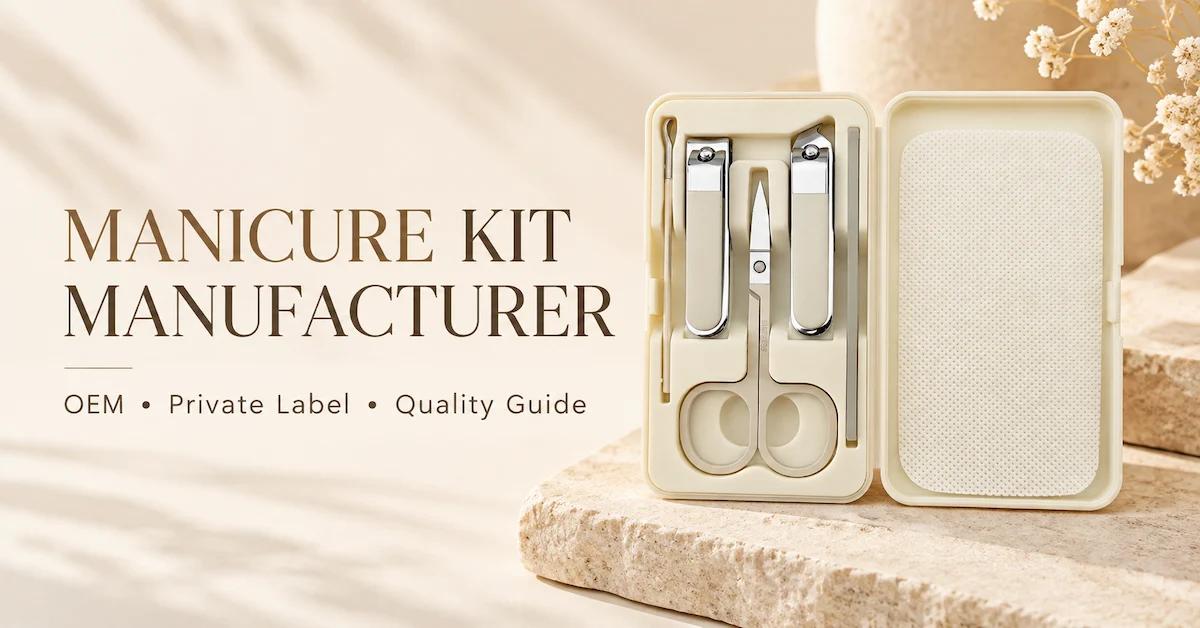
A reliable manicure kit manufacturer does more than place a selection of nail-care tools into a pouch. The manufacturer must help a buyer turn a clear customer need into a controlled bill of materials, a working set of tools, a case that protects and organizes them, a retail-ready package, and a repeatable order specification. A clipper that cuts well cannot compensate for a missing file, poorly fitted insert, inconsistent surface finish, or packaging that allows sharp tools to rub against each other.
For beauty brands, importers, retailers, distributors, and e-commerce sellers, the practical sourcing question is: Can this supplier deliver the same complete kit—not just a convincing first sample—every time? That requires agreement on the function and identity of every component, the material and finish of each tool, tool retention and case closure, logo and artwork revisions, assembly checks, inspection criteria, and the process for approving substitutions.
The most efficient development path starts with the target user and sales channel. Choose the tools that serve that person, approve them individually, build the case around their actual dimensions, and then test the packed set as one finished product. Buyers can explore the existing OLIMOR manicure set collection as a starting point, but the exact configuration, customization scope, minimum order, and lead time must be confirmed for the selected project.
What Does a Manicure Kit Manufacturer Actually Supply?
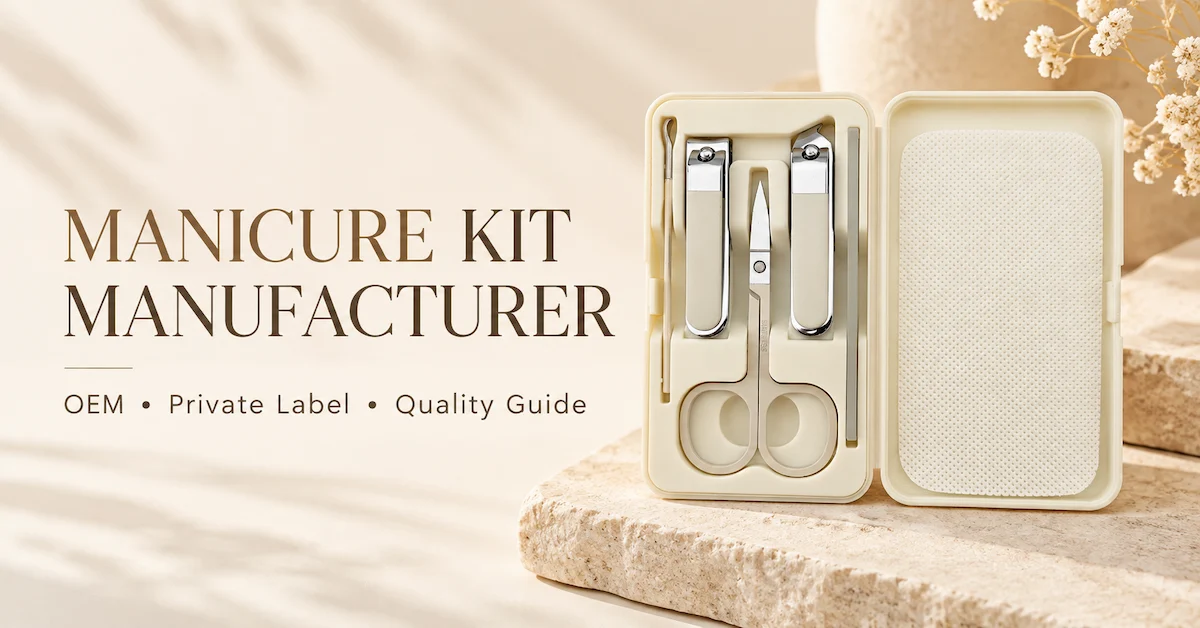
A manicure kit looks like a single product on a retail shelf. Behind the packaging, however, it may involve several different metal tools, moving joints, abrasive surfaces, molded or sewn parts, elastic retainers, printed sleeves, cartons, and labels. These elements may follow different manufacturing processes and inspection methods before they meet at final kit assembly.
The supplier's role is therefore broader than manufacturing any single tool. A capable partner should clarify product selection, component-level specifications, sampling, decoration, package construction, assembly sequence, finished-set inspection, and shipment preparation. Buyers should also ask which operations are carried out internally and which are coordinated through specialist partners. A supplier can manage external processes effectively, but its responsibility for quality and revision control must remain clear.
A useful quotation identifies the finished kit as a defined SKU. It should not merely say “12-piece manicure set, stainless steel, customized logo” without listing what the twelve pieces are, what material applies to each, and what is included in the case and outer packaging. The same piece count can describe very different commercial products.
Define the Buyer Before Choosing the Number of Tools
A kit is useful when its contents match a real routine. Adding more pieces can raise apparent value, but unnecessary tools also increase cost, assembly work, package size, and the chance of a packing error. The better starting point is a sentence describing the intended user and task.
A travel buyer might need compact tools for ordinary nail trimming and basic grooming. A beauty retailer may prefer a recognizable home-care selection that is easy to explain on the front of a box. A premium gift brand may prioritize a coordinated finish and a case that looks intentional when opened. Professional nail-care buyers may place greater weight on accurate working ends, grip, and ease of identifying and removing tools.
| Target buyer or channel | Primary kit requirement | Packaging priority | Purchasing risk to control |
|---|---|---|---|
| DTC / e-commerce beauty brand | Useful tools that are easy to demonstrate visually | Secure insert and attractive open-case photography | Inaccurate listing, damage in transit, inconsistent batches |
| Chain retailer / store brand | Familiar functions and a clear price position | Shelf presentation, barcode, accurate piece count | Packaging mismatch and unreliable replenishment |
| Importer / distributor | A repeatable assortment that fits several channels | Carton efficiency and consistent SKU identification | Mixed versions, late components, incomplete sets |
| Travel / hospitality program | Compact essentials with controlled storage | Lightweight, secure pouch or case | Unnecessary pieces, loose tools, bulky packaging |
| Premium gift program | Coordinated appearance and unboxing experience | Gift box, fitted case, finish harmony | Scratches, color differences, weak case closure |
| Professional channel | Tool handling and function for defined tasks | Quick identification and secure access | Unverified “professional” claims or imprecise tools |
A supplier should be able to explain who the kit is not for, too. A lightweight travel set should not automatically be promoted as a complete professional salon kit. A premium gift assortment may not suit a cost-sensitive hotel amenity program. Clear audience boundaries prevent confusing product claims and wasteful customization.
Design the Tool Assortment Around Actual Tasks
The first engineering document should be a task map, not a photograph of an attractive open case. List the grooming steps the end user expects to complete, then assign one appropriate tool to each task. Avoid adding multiple near-identical tools unless their different functions are understandable.
Core tools: protect the main product promise
For a basic nail-care kit, possible core functions include trimming nails, smoothing an edge, and tidying suitable areas around the nail. Depending on the product design, these tasks may be served by a nail clipper, a nail file, and a selected cuticle-care tool. The exact mix should reflect whether the product is intended for everyday home use, travel, retail, or professional customers.
The core tools should receive the strongest functional attention. A well-designed outer case will not rescue a nail clipper whose edges fail to meet, or a file with an inconsistent abrasive surface.
Support tools: increase usefulness without duplication
Tweezers, small beauty scissors, or additional nail-care implements may make sense when they extend the advertised routine. Each addition should earn its place. If the front of the package says “everyday nail-care essentials,” the buyer should be able to explain what every item contributes to that promise.
Optional accessories: justify them by audience
A larger grooming set may contain items beyond strictly nail-care tools. That can be appropriate for a broad personal-grooming program, but the packaging should describe the assortment accurately. Do not present unrelated accessories as essential manicure tools simply to advertise a larger piece count. This distinction helps both retail messaging and compliance review.
A useful cost-reduction rule follows from this hierarchy: remove or substitute a low-value optional accessory before compromising the functional quality of a core tool. Buyers often achieve a better product by simplifying the kit rather than squeezing every component to its lowest price.
Make a Bill of Materials for Every Manicure Kit SKU
The bill of materials, or BOM, is the most important document in a multi-component kit. It identifies exactly what the buyer is ordering and what the packer must put into each case. The BOM should include the case, insert, pouch, printed materials, and carton components—not just the metal tools.
Below is an illustrative specification structure, not an OLIMOR standard model or a promise of included components:
| Component code | Example role | Specification and approval fields | QC focus |
|---|---|---|---|
| KIT-01 | Fingernail clipper | Model, dimensions, material, finish, logo, approved sample | Cutting alignment, lever action, assembly |
| KIT-02 | Nail file | Length, surface type, body material, finish | Abrasive consistency, exposed edges |
| KIT-03 | Tweezers | Tip shape, length, material, finish | Tip contact, tension, gripping action |
| KIT-04 | Cuticle-care tool | Working-end geometry, handle, finish | Tip shape, edge finish, handling |
| KIT-05 | Case or pouch | Material, dimensions, closure, color | Fit, opening and closing, surface protection |
| KIT-06 | Insert / retention | Elastic, pocket, molded tray or other design | Retention, accessibility, rubbing |
| KIT-07 | Retail packaging | Box, sleeve, artwork, label, barcode | Print accuracy, SKU identity, pack integrity |
| KIT-08 | Export pack | Carton, inner quantity, protection, shipping marks | Quantity, carton condition, traceability |
For each item, include supplier or production source where relevant, revision, approved appearance reference, and inspection requirement. A “silver nail file” is not a sufficient BOM entry if multiple files of different lengths or surfaces are available.
The BOM is also the basis for change control. If the clipper in a second order is replaced by a similar-looking variant, that change should appear in the component record and trigger a review—not be discovered by a retailer comparing deliveries.
Inspect Each Tool for the Function It Must Perform
A good manicure kit cannot be inspected only by checking its appearance and counting the pieces. Each tool requires a functional test appropriate to its working mechanism. Buyers should agree on the test method and acceptance standard for the actual model rather than applying one generic inspection statement to the entire set.
Nail clippers
Check contact between the cutting edges, cutting action on an agreed test material, lever travel, pivot stability, general assembly, and surface finish. If a kit includes two differently sized clippers, approve the function of each separately. The larger tool should not pass simply because the smaller one passed.
OLIMOR lists different nail clipper designs in its nail clipper category. These can inform the initial assortment discussion, but exact size and materials must be confirmed for the selected model.
Cuticle nippers
Check jaw alignment, the relationship between cutting edges, spring response, joint action, exposed edges, and grip comfort. A nipper is not interchangeable with a clipper: it requires its own sample and inspection criteria. If included, packaging should accurately describe its intended non-medical grooming use.
Tweezers
Check tip shape, contact when closed, spring tension, grip, finish, and whether the tweezer performs the intended gripping task. Different tip styles are appropriate for different uses. Buyers selecting a companion tool can review OLIMOR's tweezer products instead of assuming all tweezers are functionally equivalent.
Beauty scissors
Review blade alignment, pivot movement, cutting behavior, handles, and tip finish. Scissors included in a compact kit need adequate room for safe removal and storage. They should not be forced into an undersized elastic loop solely to preserve a desired case dimension.
Nail files and cuticle tools
A file's performance depends on its working surface and edge finish. A pusher or cleaner depends on its working-end geometry, surface smoothness, and handling. The supplier should define the applicable product specification rather than claiming that “stainless steel” alone guarantees the function.
The result is a component-level quality plan. That plan can be reused when the assortment expands and can help prevent disputes during later orders.
Material and Finish Claims Must Be Accurate for the Whole Kit
It is common for manicure kit marketing to say “stainless steel manicure set.” In a finished kit, however, different metal tools may use different materials or constructions, and the pouch, case, elastic, lining, zipper, label, and printing will not be stainless steel. A product-level claim should match the final component list.
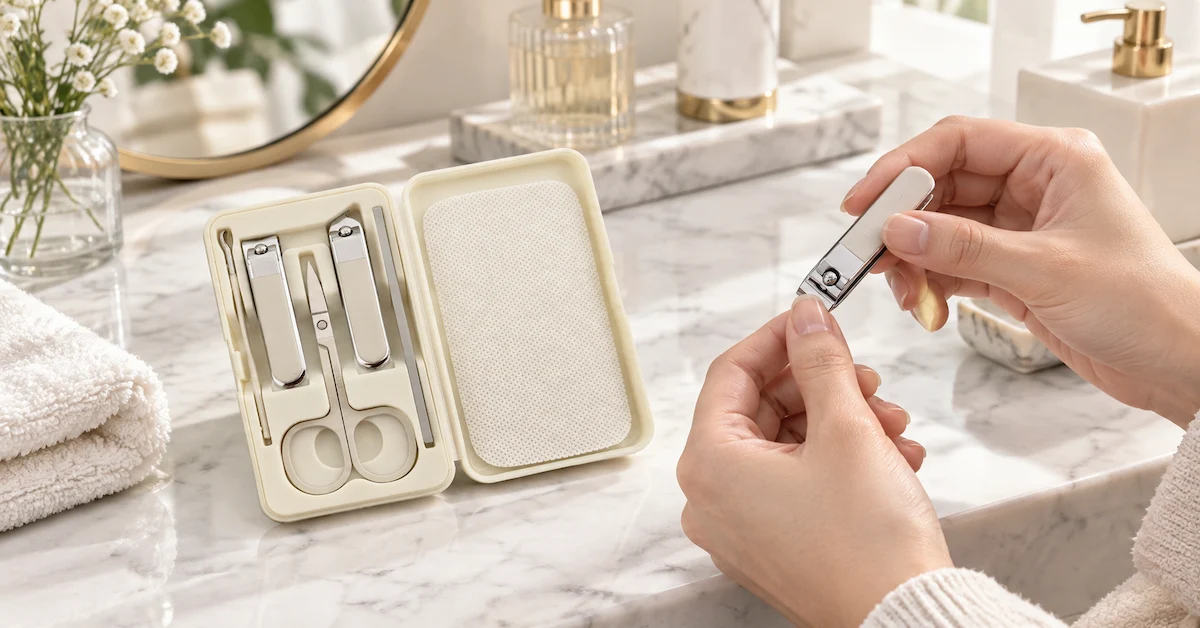
For instance, an OLIMOR travel manicure kit reference, MSB2061, has been presented with a creamy-white case and a model-specific material description. Buyers should request component-by-component confirmation rather than treating one catalog field as a complete material declaration for every item in the kit.
Finish consistency also matters. Two tools may both be described as silver but differ in reflectivity, visible polish lines, or tone. A rose-gold-coated tweezer may look different beside a similarly named clipper. Physical finish references and decorated samples provide more useful control than screen images alone.
Ask the supplier which parts are polished, coated, plated, printed, molded, or assembled. For each component, confirm whether the proposed finish affects moving joints, tool grip, case fit, marking durability, cleaning instructions, or inspection. These practical details make a branded collection look and function like one deliberate product.
Engineer the Case Around Approved Tools
The case is part of the product. It determines how the user opens the kit, identifies tools, removes them, returns them, and stores them after use. It also affects the pack size, shipping density, appearance, and damage risk.
Start with the actual finished dimensions of every approved tool. Then check the internal geometry, retention points, and clearance in both the open and closed positions. A case designed around early mockups may fail after a clipper lever or file length changes.
Retention and movement
Tools should remain in their intended positions during representative handling. At the same time, consumers should be able to remove them without excessive force, bending a tool, or dragging a sharp edge across the lining. Examine elastic loops, fabric pockets, molded trays, and any other retention system for the specific assortment.
Case closure
Close the filled case repeatedly during sampling. Check whether components press against one another, whether the case bulges, whether the hinge or zipper moves smoothly, and whether the exterior returns to the intended shape. If a case looks attractive only when empty, it is not yet production-ready.
Contact between metal tools
Polished components can be scratched by adjacent tools in transit. Evaluate direct contact, loose movement, and pressure points around logos or coated surfaces. A small change to an insert can sometimes prevent damage more effectively than changing the metal finish.
Usability and product photography
For e-commerce, photograph the open set at mobile-screen size. Can a shopper identify what is inside? Are the tools presented in a logical order? Does an essential item disappear under an overlapping accessory? A well-organized case supports both actual use and accurate product listings.
OLIMOR's rose-gold nail grooming set reference, MSC1001, illustrates a different presentation direction from a minimal travel pouch. It should be treated as a model reference, with current materials and contents verified against the quotation and sample.
Choose OEM, ODM, or Private Label Before Asking for a Price
The three development routes can overlap, but the buyer should explain which parts of the project are fixed and which are open to supplier proposals.
Private label commonly starts with an existing kit or tool platform. The project may focus on a logo, case color, finish, retail sleeve, insert card, barcode, or gift packaging. This can be suitable when the product function already meets the buyer's needs and differentiation comes mainly through branding and presentation.
ODM is useful when an existing supplier platform provides the starting point, but the buyer needs changes to the assortment, case, component selection, appearance, or packaging architecture. An ODM brief should distinguish existing options from adjustments that require sampling or tooling.
OEM becomes more relevant when the buyer supplies specific drawings, physical reference samples, controlled component specifications, or an engineered case concept. The manufacturer then reviews feasibility, development stages, production methods, tooling where applicable, and inspection requirements.
| Route | Typical starting point | Main questions before quotation | Approval priority |
|---|---|---|---|
| Private label | Established components and case | Which logo, finish and pack choices are available? | Finished brand appearance and packed sample |
| ODM | Existing platform with modifications | What is adjustable and what is new development? | Modified components, fit and complete kit |
| OEM | Buyer-defined design or controlled sample | Which drawings, tooling and performance criteria govern production? | Conformance to detailed specification |
A useful supplier reply should identify “available as shown,” “requires modification,” and “requires new development.” This prevents a standard product quote from being confused with a new-manufacture quotation. OLIMOR's custom manicure set sourcing guide provides additional context on branding and development choices.
Manufacturing Control: Follow the Components Through Assembly
A manicure kit manufacturer may have access to metal stamping and forming, grinding, heat treatment where applicable, polishing, plastic processing, assembly, inspection, and packing. But the relevant question is not whether a company lists those capabilities. It is which operations apply to your selected components and who verifies the result at each handoff.
Ask the supplier to map one proposed SKU from material and component sourcing to final packed carton. A clipper and a nail file may take different production routes. The case may come from a separate sewing or molding process. Printing may be arranged through another specialist. These streams must meet at a controlled kit-assembly step.
That creates a scheduling risk: the whole kit may be delayed because a single accessory, insert, zipper, printed sleeve, or barcode label is missing or at the wrong revision. Ask how component readiness is tracked and who authorizes the start of pack-out.
For buyer due diligence, useful evidence includes a component list, a documented production flow, first-piece or pre-production approval, examples of tool-level inspection, an assembly checklist, and a finished-carton reference. Do not mistake a photograph of machinery for proof that a specific kit's parts are controlled.
Build a Quality Plan at Three Different Levels
A kit needs component QC, assembly QC, and finished-product QC. The checkpoints should be distinct, because the same defect can enter at different stages.
| Stage | What it verifies | Typical failure it helps reveal |
|---|---|---|
| Incoming / component inspection | Identity, material or part specification, functional features, cosmetic appearance | Wrong tool version, imperfect cutting edge, scratched coating |
| First-piece / in-process checks | Output remains aligned with approved reference | Tool dimension drift, finishing variation, changed logo position |
| Kit assembly inspection | Every required item is present in the correct position | Missing file, duplicate clipper, swapped accessory, reversed placement |
| Finished-case inspection | Case closes, retains tools and protects finishes | Bulging case, loose tool, rubbing, broken closure |
| Retail and export-pack inspection | Correct SKU, artwork, barcode, quantity and carton identity | Mixed cartons, obsolete artwork, wrong piece-count claim |
Distinguish critical, major, and minor defects in the buyer's own acceptance plan, with definitions appropriate to the product and market. For example, an unsafe unintended sharp area or a serious cutting malfunction may require a different response from a small cosmetic mark. The classifications, sampling plan, and acceptance limits must be agreed; do not assume that one generic AQL value or inspection rule is universally appropriate.
This approach also makes corrective action more precise. If a customer reports that a file was absent, the investigation should focus on BOM identity, parts replenishment, kit assembly, and final count—not only on the metalworking process.
Sample Approval: Five Gates Before Bulk Production
Many kit projects run into trouble because the buyer approves a visually attractive arrangement without approving its parts and packaging as a stable configuration. Divide the process into separate gates.
Gate 1 — Concept and assortment
Approve the buyer, use case, tool roles, approximate dimensions, case direction, and target retail positioning. Confirm that every advertised function has a corresponding tool. Record the intended piece count and how it will be counted.
Gate 2 — Individual tools
Review tool function, geometry, material information, surface finish, and handling. Keep approved references for each tool. If a component fails, revise that component without confusing it with the case artwork review.
Gate 3 — Case and insert
Load the approved tools into the proposed case. Check fit, removal, retention, closure, contact points, and basic handling. Approve the case only when it works with the real set contents.
Gate 4 — Branding and retail packaging
Approve logos, marking location, case appearance, box or sleeve design, instructions, barcode, and pack identity. Inspect printing and physical color on real samples; a digital image alone is not a final cosmetic reference.
Gate 5 — Complete pre-production set
Approve one fully packed master SKU representing the order: correct tools, case, inserts, labels, printed package and carton reference. Tie that master to the BOM and drawing revisions. The factory should not build future orders from a mix of superseded sample versions.
A straightforward feedback record contains the sample ID, affected component, defect or requested change, responsible party, action, revision, and evidence needed for approval. This makes remote development more manageable for importers and overseas brand teams.
Retail Packaging, E-Commerce Protection, and Gift Presentation
Packaging must serve two purposes at once: help the product sell and protect the assembled set until use. The best format depends on the sales channel.
Shelf-ready retail
A physical-store package should explain the product quickly. Confirm that the stated piece count matches the defined kit, that product imagery shows the actual assortment, and that required barcode or market-specific information has an appropriate position. If a shopper cannot identify the contents without opening the pack, the design may need a clearer front or back panel.
Online and direct-to-consumer
For e-commerce, compare real product photography with the complete packed sample. Check the parcel-ready configuration, tools touching the case interior, accessory movement, printed finish, and surface protection. A beautiful box that allows metal tools to scratch one another can damage brand perception before the customer even uses the kit.
Gift and corporate programs
A gift product may justify a presentation case, custom color, coordinated finish, or message card. But added decoration creates new artwork and quality checks. A brand should not promise a specific luxury material or durability level without evidence for the actual selected case.
Travel and hospitality
Portability, compact size, simple identification, and retention may matter more than a high piece count. Do not claim a kit is permitted in every airline cabin or travel jurisdiction: restrictions can depend on tool type, dimensions, carrier, and location.
Where buyers want a compact direction, OLIMOR's travel manicure kit product offers an example to evaluate, with the final components and case to be checked against the current specification.
How MOQ, Lead Time, and Unit Cost Really Work
There is no defensible universal MOQ for all manicure kits. A set based on established tools with a standard pouch may have very different commercial requirements from a custom case, new finish, revised tool shape, and printed gift box.
A complete quotation should itemize the cost drivers sufficiently to make comparisons meaningful:
-
metal tools and any purchased components;
-
case, lining, zipper, elastic or molded insert;
-
logo, finish, or other decoration;
-
retail box, sleeve, printed insert, labels and barcode;
-
case loading, kit assembly and inspection;
-
any tooling, prototype or setup charges;
-
order quantity, carton configuration, and shipment terms.
The total cost per sellable kit is not simply the sum of the cheapest tool prices. A lower-cost file that damages a neighboring polished clipper, or a loose case that creates returns, can erase a small factory-price saving. Evaluate cost alongside function, customer perception, shipping protection, and replenishment reliability.
Lead-time discussions should distinguish component sourcing, tool samples, case samples, artwork and print approval, pre-production assembly, mass production, final inspection, and shipment. One late customized part can hold the entire finished SKU. Ask the supplier to explain the critical path—the approval or component that determines the earliest feasible release date.
Compliance and Claims: Do Not Let Packaging Outrun Evidence
Product claims should reflect the confirmed components and the market in which the kit will be sold. “Stainless steel manicure kit” may be imprecise when case material and individual tool constructions differ. “Professional,” “hypoallergenic,” “sterile,” “medical grade,” or universal safety claims should not be applied without relevant evidence.
Before approving artwork, identify the destination market and the buyer's labeling or testing requirements. Check product identity, country-of-origin information where required, warnings or care guidance where relevant, and any retailer-specific standards. A general company certificate should not be presented as a certification of every component in the set.
If a kit includes sharp tools, assess package protection and the accuracy of use descriptions. Avoid promoting ordinary manicure accessories as medical or therapeutic equipment without a verified regulatory basis. The sourcing team should request relevant documentation for the actual order rather than accepting unrelated certificates from a sales presentation.
How to Compare Manicure Kit Manufacturers Objectively
Use the same specification and complete kit for every quotation. A supplier offering twelve pieces should not automatically score better than one offering seven carefully selected tools. Begin by checking equivalence, then compare management capability.
| Evaluation dimension | Suggested weight | Evidence to request |
|---|---|---|
| Function of core tools | 20% | Working samples and tool-specific inspection criteria |
| BOM and revision control | 15% | Complete component list and approved versions |
| Case engineering and protection | 15% | Loaded sample, fit and closure checks |
| QC and assembly control | 15% | Inspection map and packing checklist |
| Customization and presentation | 10% | Actual logo, finish and package proofs |
| Communication and problem solving | 10% | Written response to technical and sample feedback |
| Repeat-order reliability | 10% | Master samples, change notification procedure |
| Commercial fit | 5% | Comparable itemized quote, MOQ, schedule |
These weights are an illustrative buyer scorecard, not a formally certified supplier-rating standard. Adjust them for your business. A promotional program may place more weight on presentation and cost; a professional beauty channel may prioritize tool handling and performance.
Give suppliers the same questions. Who controls each tool? How do they prevent substitution? How is a missing piece detected? What is inspected before sealing a case? What happens when the approved pouch material becomes unavailable? How will the next order reproduce the correct configuration? Specific answers are more valuable than repeated “high quality” promises.
Prevent Missing Tools, Substitutions, and Incorrect Reorders
Kitting adds risks that individual-product manufacturing does not have. A worker can assemble a technically acceptable set with the wrong file, a duplicate tweezer, one missing tool, or obsolete printed packaging. The finished case can look complete at a glance while failing the purchase order.
To reduce this risk, make the case-loading sequence explicit. Match each slot to a component code. Use a visual packing standard showing the correct orientation of every item. Define how completed sets are counted or verified and how incomplete sets are segregated. Where the assortment is similar across multiple SKUs, make version identification easy for the assembly team.
For reorders, preserve a single controlled product record: BOM revision, approved tool samples, case and insert reference, artwork version, product photographs, carton quantity, inspection criteria, and customer approval history. Any proposed replacement should be compared against its functional task and physical fit, not accepted merely because it looks similar.
A simple question exposes the strength of a supplier's system: “If I reorder this kit six months later, how will you prove that the contents, finish, case and packaging match my approved version?” The answer should point to records and samples, not individual memory.
OLIMOR Manicure Set References for Different Product Positions
OLIMOR provides several product directions that buyers can use for initial benchmarking. The following are individual reference products, not universal customization or material guarantees.
Compact grooming format: The compact black-pouch manicure set illustrates a small assortment in a portable case. Its published description includes grooming accessories beyond strictly nail-care tools, so buyers designing a manicure-only product should define the contents carefully.
Travel-oriented format: The MSB2061 travel manicure kit illustrates a compact creamy-white presentation. Buyers should confirm the material and specification of each included tool, not infer them from a single general catalog field.
Gift-oriented format: The MSC1001 nail grooming set illustrates a coordinated rose-gold direction with a PU case described in the product information. Sample and quotation should confirm the current model's component list, case construction, finish and decoration options.
These references make it easier to discuss the visual and functional direction with a manufacturing team. Buyers wanting a broader collection can also explore OLIMOR's nail-care tools, nippers, and beauty scissors to identify candidate components.
OLIMOR BEAUTY states that it develops and manufactures beauty tools for international distributors, retailers, and private-label partners. Its current company profile describes product-development support, quality checks against approved samples, and global B2B activity. The appropriate next step is still to evaluate the chosen kit and confirm its model-specific process, material, inspection scope, quantity, and delivery conditions.
A Better RFQ Template for a Private Label Manicure Kit
A manufacturer can respond much more accurately when it receives a complete brief. Include the following items in your inquiry:
-
Target customer and market: retailer, DTC brand, importer, salon supplier, travel or gift buyer, and the intended destination.
-
Product concept: target routine, ideal piece count, essential functions and any unwanted accessories.
-
Component references: photos, measurements, preferred tools, current samples or drawings.
-
Case direction: material, approximate dimensions, pouch or hard case, closure and insert expectations.
-
Branding: logo, finish, color direction, print requirements and approved artwork files.
-
Packaging: sleeve, box, barcode, language, labels, instruction card and shipping protection.
-
Quantity: first-order estimate and realistic reorder forecast.
-
Quality priorities: functional standards, case fit, appearance, completeness and documentation requirements.
-
Timeline: sample deadline, launch date and destination logistics.
-
Approval process: who will review the tools, case, graphics and final pre-production sample.
An effective message might read: “We are developing a private-label home manicure kit for online retail. The core assortment should support clipping, shaping and basic cuticle care. We prefer a compact case with secure retention and coordinated metallic finishes. Please propose available tool platforms, an itemized BOM, case options, sample stages, decoration options, model-specific MOQ and the earliest realistic schedule after sample approval.”
This is a better starting point than “Please quote your best 12-piece manicure set.” It gives the supplier a reason to recommend or remove components, a way to identify new tooling, and a basis for comparing quotes on equivalent scope. To discuss a project with OLIMOR, send your kit reference, target market and quantity to the team.
Frequently Asked Questions About Manicure Kit Manufacturing
What should I look for in a manicure kit manufacturer?
Look for a supplier that can manage an itemized component list, tool-specific quality checks, case and insert development, physical sample approvals, kit assembly, packaging identity, and repeat-order revisions. Ask the supplier to show how each component is confirmed and how a complete finished set is inspected before shipment.
Is a manicure kit the same as a manicure set?
The terms overlap in normal buying language. In commercial sourcing, either may mean a grouped assortment of nail-care or wider grooming tools, usually stored in a pouch or case. The words alone do not define the contents. Always specify the exact tool list, piece-count rules, case, packaging and intended use for the selected SKU.
Can a manufacturer produce OEM or private label manicure kits?
Depending on its capabilities and the selected product, a supplier may offer existing sets with branded packaging, modifications to an existing assortment or case, or deeper OEM development based on buyer-defined specifications. Request a clear division between available choices, adjustable features and work requiring new development. Never assume that every listed model supports every customization.
What tools belong in a useful manicure kit?
Start with the customer's routine. Nail clippers, a file and suitable cuticle-care tools may cover core nail-care functions; tweezers, scissors or additional grooming items may be appropriate for a broader set. Each accessory should have a clearly explained job. More pieces are not automatically better if the additional tools duplicate one another or complicate the case.
Are all tools in a stainless steel manicure kit made of stainless steel?
Not necessarily. Materials may differ by tool and component, and a kit can also contain non-metal cases, linings, elastics, coatings and packaging. Ask for material information and construction by component. Public-facing descriptions should match the final approved BOM and relevant supporting information for the actual product.
How do I inspect a finished manicure kit?
Inspect the critical function and finish of each tool, then check that the correct components are present in the correct positions. Test case closure, retention, surface contact, printed packaging, SKU identity and carton quantity. Use an agreed master sample and inspection plan; do not rely only on a visual check that the case appears full.
What is the MOQ for custom manicure kits?
There is no universal MOQ. The quantity requirement can depend on tool availability, material and finish, logo method, case construction, printing, new tooling and production planning. Provide the proposed BOM, quantity, branding and package specification so the supplier can confirm the minimum for that exact configuration.
How long does it take to develop an OEM manicure kit?
Development time depends on whether existing tools and cases can be used, how many sample rounds are required, whether molds or components must change, printing approval, order quantity and inspection planning. Ask for separate milestone dates for tools, case, decoration, fully packed pre-production sample, production and shipping.
How can a brand prevent missing tools in bulk manicure sets?
Use an itemized BOM, slot-by-slot assembly reference, controlled kit-loading procedure, completeness checks and finished-set verification. Distinct SKU and revision identification is important when similar assortments are packed in the same facility. Define how incomplete or mixed kits are segregated and corrected before cartons are sealed.
Can I combine manicure kits with other beauty tool products under one private label?
A coordinated line can include standalone nail clippers, tweezers, nippers, scissors and related grooming tools if they suit the audience. Approve each item's function and branding separately, then coordinate finish and packaging at collection level. The OLIMOR product catalog provides reference categories for planning such an assortment.
Conclusion
A dependable manicure kit manufacturer must control more than individual tools. The strongest sourcing programs define the end user, approve a complete BOM, verify each tool's function, engineer the case around real components, and inspect the finished pack for completeness and consistency. These records also protect later orders from unnoticed substitutions. For an OEM, ODM or private-label manicure kit, share your tool list, case reference, branding needs and target quantity with OLIMOR to discuss a model-specific development and quotation plan.
Tag:
Related articles
- OEM & Private Label
- Nail Care Tools Guide
anicure Pedicure Set Manufacturer: How to Source Complete Hand and Foot Care Kits for Retail and Salons
- OEM & Private Label
- Nail Care Tools Guide
OEM Manicure Set Manufacturer: How Beauty Brands Move from Drawings to Approved Mass Production
- OEM & Private Label
- Nail Care Tools Guide