











Why the right beauty-school toolkit matters more than it first appears
When people search for hairdressing school tools, they are often really asking a broader question: what should a training kit include so students can practice confidently without wasting money on the wrong equipment? In cosmetology classrooms, the answer is rarely just “buy the cheapest set.” A good starter kit has to support repetition, hygiene, portability, and the specific skills a student is expected to learn. That may sound obvious, but it is exactly where many buyers get tripped up.
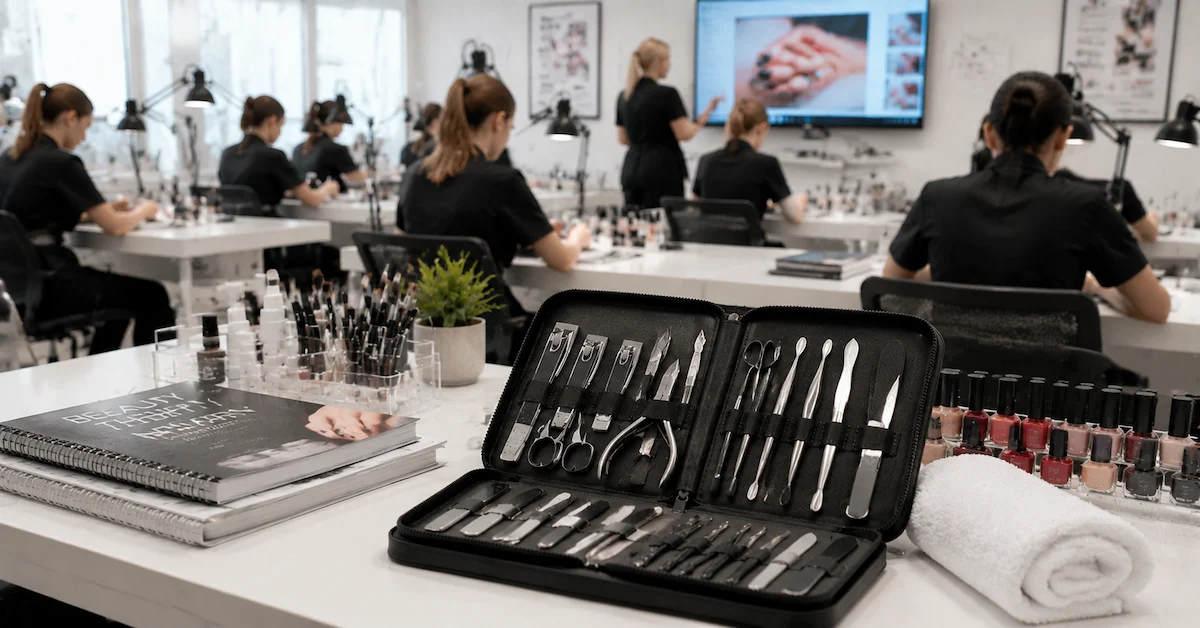
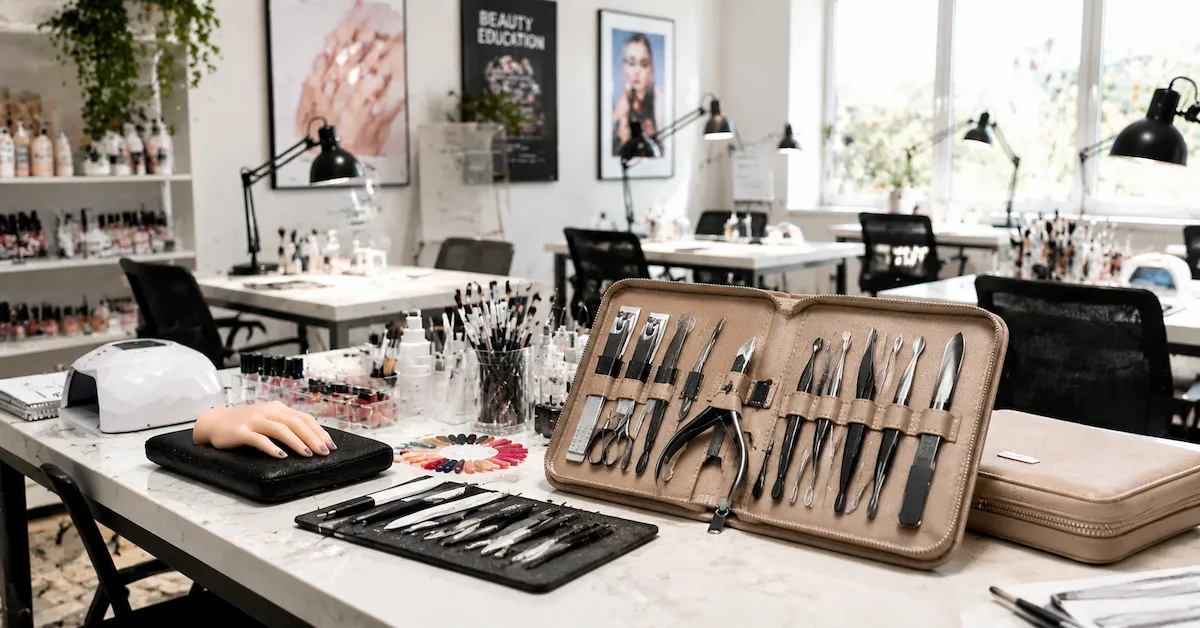
The visible product here is a compact manicure/pedicure tool kit, the kind commonly found in beauty-school workstations or starter sets for nail training. It sits beside polish bottles and appears designed for organized, hands-on practice. While it is not a full salon system, it points to a larger procurement issue: schools and training centers need tools that are practical for repeated student use, easy to store, and straightforward to inspect. For sourcing managers, that means looking beyond appearance and asking what the kit actually helps a learner do.
This matters because beauty education is built around muscle memory. Students do not learn nail prep, shaping, or cuticle care by watching alone. They need tools that feel balanced in the hand, arrive in a usable case, and support clean workflow habits from day one. A kit that is poorly organized, incomplete, or awkward to carry slows training and tends to disappear into drawers. That is bad for learning and bad for inventory control.
What a practical training kit usually needs to cover
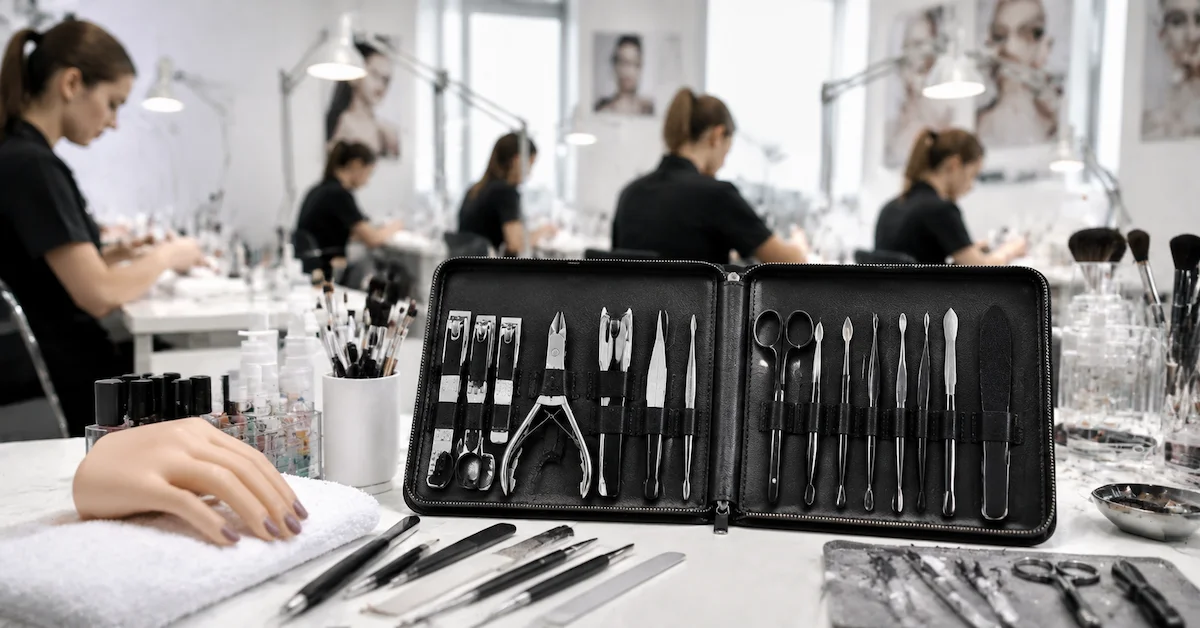
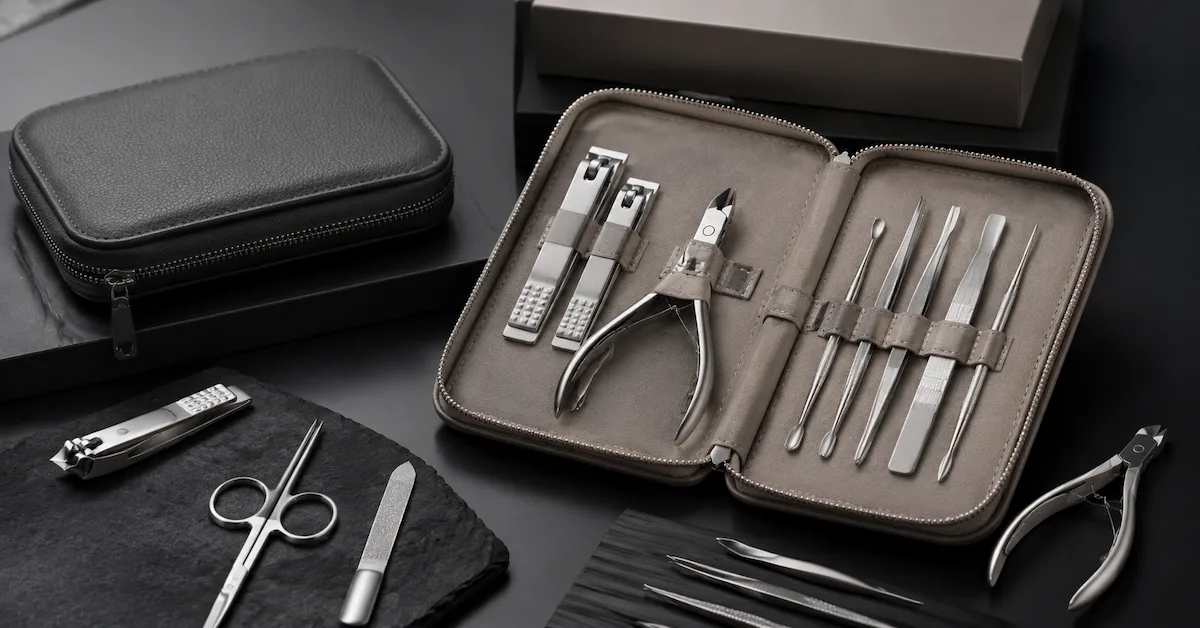
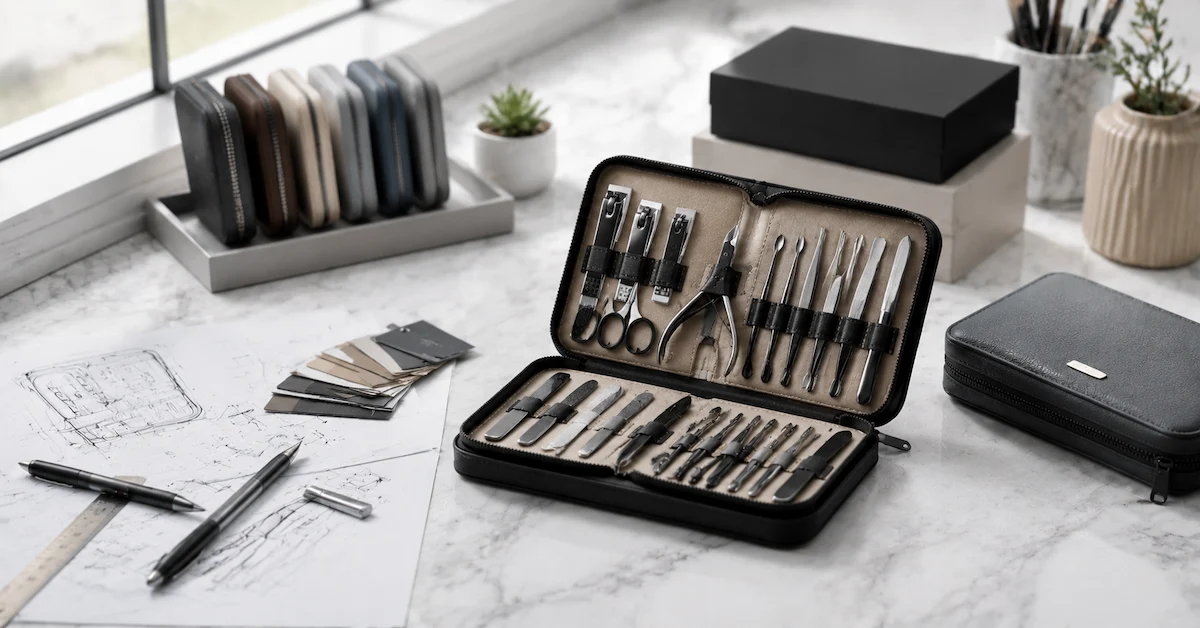
In a classroom setting, a manicure/pedicure kit is less about luxury and more about coverage. The visible set includes nail clippers, cuticle nippers, scissors, tweezers, spatula or pusher-style implements, and several small metal files or picks. That mix is useful because it mirrors common nail-care tasks: trimming length, refining shape, lifting and pushing cuticle areas with care, and doing detail work around the nail plate.
For a school buyer, the important point is not whether every item looks fancy. It is whether the kit gives students enough variety to practice the sequence of a basic service. A learner who only has one clamp-like tool and a file can practice less; a learner with a fuller kit can move through prep, shaping, cleanup, and finishing steps in the same session. That is a real difference when the curriculum is paced tightly.
A quick-reference way to think about kit contents
Some kits are built for demonstration only. Others are closer to student-use kits that can support repeated bench work. The pictured case suggests the second type: a portable, organized set with multiple precision tools stored in fitted slots. That kind of layout is useful in shared classrooms because missing items are easier to spot at a glance.
By contrast, loose tools in a pouch may be cheaper, but they are harder to count and easier to damage. For schools, that small logistical detail can become a recurring problem. It is one of those procurement realities people only appreciate after a semester of missing tools and mixed-up drawers.
Material and construction: what buyers can infer, and what they should not assume
The visible tools appear to be mainly metal, likely stainless steel or a similar polished steel, with some black accents or handles. That is standard for nail and grooming tools because metal tools are durable, hold their shape, and can be made with fine working edges. The case itself looks like a black synthetic zippered or clamshell-style holder, designed to keep tools separated and portable.
That said, buyers should be cautious about assuming too much from appearance. The image does not confirm the steel grade, heat treatment, blade sharpness, or sterilization compatibility. Those details matter in professional settings, especially for schools that expect students to follow hygiene protocols closely. A polished surface looks clean, but surface finish alone is not a guarantee of long-term performance. It is only one indicator.
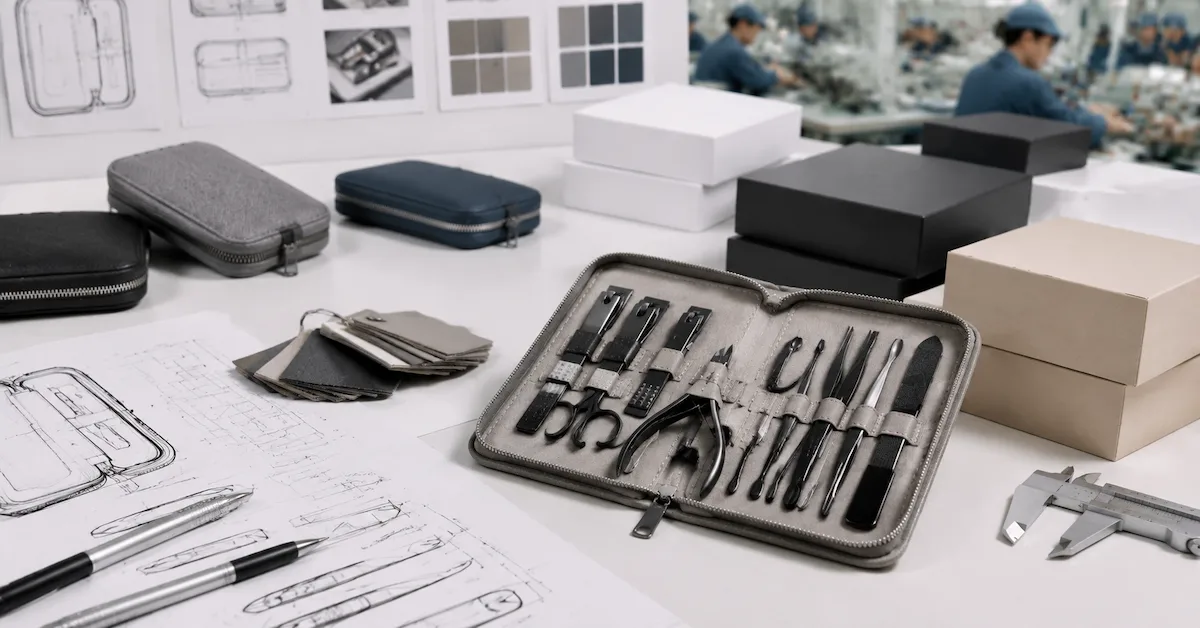
For products like these, the manufacturing path is usually straightforward: forged or stamped metal hand tools, ground and finished for the working edges, then assembled into a kit with a sewn or molded synthetic case. That is a common pattern in the beauty-tools market. It keeps the set compact and makes it easier to distribute as a bundle rather than as loose pieces.
How this differs from general salon equipment
Beauty training buyers sometimes lump everything together under one purchase order, but there is a useful distinction between classroom learning aids and salon-ready consumables. Hairdressing school tools, makeup school tools, and nail technician tools all support skill-building, but the physical demands are not the same. Makeup kits often emphasize brushes, palettes, and application surfaces. Hairdressing kits lean toward sectioning, cutting, combing, and heat-control accessories. Nail training kits, by contrast, need precision hand tools and a tidy way to store them.
That difference matters because procurement mistakes often happen when a school chooses kits by department name instead of by task. A cosmetology program may need overlap between categories, but nail prep requires more than generic grooming items. Likewise, a hairdressing student can learn sectioning with a comb and clips, but not with nail tools. It sounds basic, yet catalog listings sometimes blur those boundaries.
Selection criteria that actually help in a purchasing decision
If you are selecting school kits, start with the workflow, not the packaging. Ask whether the set supports the service steps students will practice most often. A kit like the one shown is useful when a program wants a portable, all-in-one nail-care set for classroom stations, kit assignments, or starter practice at home.
Next, look at organization. A fitted case is more valuable than it first seems because students can learn tool discipline. Every item has a place, and that is a quiet but real advantage in training. It also helps instructors check completeness quickly. In a busy class, that saves time.
Then consider durability and maintenance. Metal hand tools should tolerate repeated use and cleaning procedures appropriate to the school’s standards. The case should protect the edges from banging together in transit. If the kit is meant for heavy rotation, a fragile zipper or thin liner will be a weak point long before the tools themselves wear out.
Common mistakes schools and buyers make
The first mistake is overbuying features students will not use in the early stages. Training programs sometimes pay for elaborate kits when a well-selected basic set would teach the same fundamentals more clearly. There is no prize for complexity if the students are still learning controlled grip and simple nail prep.
The second mistake is ignoring replacement planning. In a shared classroom, small tools go missing. That is just reality. Buyers should think in terms of kit consistency and replenishment, not one-time purchase excitement. A neat case is helpful, but if a single missing implement makes the set unusable for a lab session, the kit has already become a problem.
The third mistake is assuming all metal tools are interchangeable. They are not. Edges, curvature, spring tension, and grip shape can change the user experience dramatically. Instructors usually notice this fast, but purchasing teams sometimes do not see it until student feedback starts coming in.
Practical advice for training programs and salon starters
If you are buying for a cosmetology school, the best approach is to separate “instructional minimums” from “professional expansion.” A student kit should cover core techniques and be easy to carry. Later, the same learner may upgrade to better-finished or more specialized nail technician tools for advanced services. That staged path is healthier than asking one kit to do everything.
For salon starters, the question shifts slightly. A portable kit can be useful for mobile services, demos, or backup stations, but it should be judged alongside sanitation workflow and storage discipline. A pretty case is not enough. The kit needs to fit the service model.
One small but important caution: when buying for education, ask how the kit will be used between classes. Shared equipment sees more handling than personal equipment. Even a well-made tool can feel different after dozens of students have used it. If the supplier does not offer a clear parts list or a straightforward way to reorder pieces, that can become a hidden cost.
What this product picture tells a buyer at a glance
From the image alone, the strongest selling points are easy to see: multiple tool types in one compact case, an organized slot layout, reusable zippered storage, and polished metal surfaces that suit a classroom or workstation. It is the kind of set that looks intended for practical use rather than display. That is worth something. In training environments, usefulness usually beats spectacle.
At the same time, the image does not answer every procurement question. Buyers still need to confirm the exact contents, tool count, cleaning guidance, and whether the kit is positioned for student use, professional service, or both. Those details decide whether the set becomes a dependable classroom staple or just another item that looks good in a catalog.
FAQ for buyers comparing beauty training kits
Is a nail kit relevant when shopping for hairdressing school tools?
Yes, if the program covers broader cosmetology skills or if you are comparing starter kits across departments. The useful lesson is how schools choose tools for training, storage, and student handling.
Should schools prioritize tool count or tool quality?
Neither alone is enough. A kit needs enough variety to support instruction, but the tools also have to feel stable and usable. A crowded set of weak tools is not a good purchase.
Why does the case matter so much?
Because organization affects training speed, inventory control, and tool protection. In a classroom, a structured case can save more time than people expect.
Final buying thought
If you are sourcing hairdressing school tools, makeup school tools, or nail technician tools, the smartest move is to match the kit to the learning step, not the marketing copy. This manicure/pedicure set is a good example of a practical, portable training format: compact, organized, and focused on real hand-tool tasks. For schools and starter buyers, that kind of simplicity is often the right place to begin.
For the next step, compare the included tools against your curriculum, ask for the missing technical details that are not visible in the product image, and check whether the supplier can support replenishment. That is usually where a decent-looking kit becomes a reliable program purchase.