Why an ODM cuticle nipper matters in the personal-care supply chain
An ODM cuticle nipper may look like a small, familiar hand tool, but for sourcing teams it sits in a category where appearance is only the starting point. The real questions are about consistency, edge quality, grip comfort, assembly reliability, and whether the tool can be adapted into a private-label line without creating headaches later. That is especially true for nail care products, where salons and retail buyers notice dull cutting, loose pivots, or awkward handle geometry very quickly.
For engineers and product teams, the decision is not just “can this trim cuticles?” It is “can this design be made repeatably, packaged cleanly, and positioned for the right channel?” A cuticle nipper may be a basic manicure item, but a poor version can damage a brand’s reputation faster than a more complex product because users expect it to work precisely on the first pass.
What you are actually buying with an ODM approach
ODM is often confused with simple sourcing, but the distinction matters. A cuticle nipper ODM manufacturer typically offers a pre-developed base product that can be adapted to a buyer’s brand, packaging, handle styling, finish, or minor structural details. That can shorten development time compared with fully custom tooling, while still giving enough room for differentiation.
In practical terms, the buyer is usually working from a proven stainless-steel cuticle nipper platform: plier-style body, spring-assisted opening, pivot joint, and short angled jaws for precision trimming. The opportunity is to tune the product for a target market rather than reinvent the whole tool. For a salon-focused line, that may mean a more polished look and smoother grip action. For a mass-market beauty SKU, it may mean a simpler structure that supports cost control and consistent assembly.
Why this matters for sourcing teams
The value of ODM is speed with a degree of control. You do not want to spend months defining a hand tool that already has a mature industrial format, unless the category requires a major change. At the same time, a generic item with no brand differentiation is hard to defend in a crowded beauty aisle. The middle ground is usually where the business case works.
Key features that influence buyer acceptance
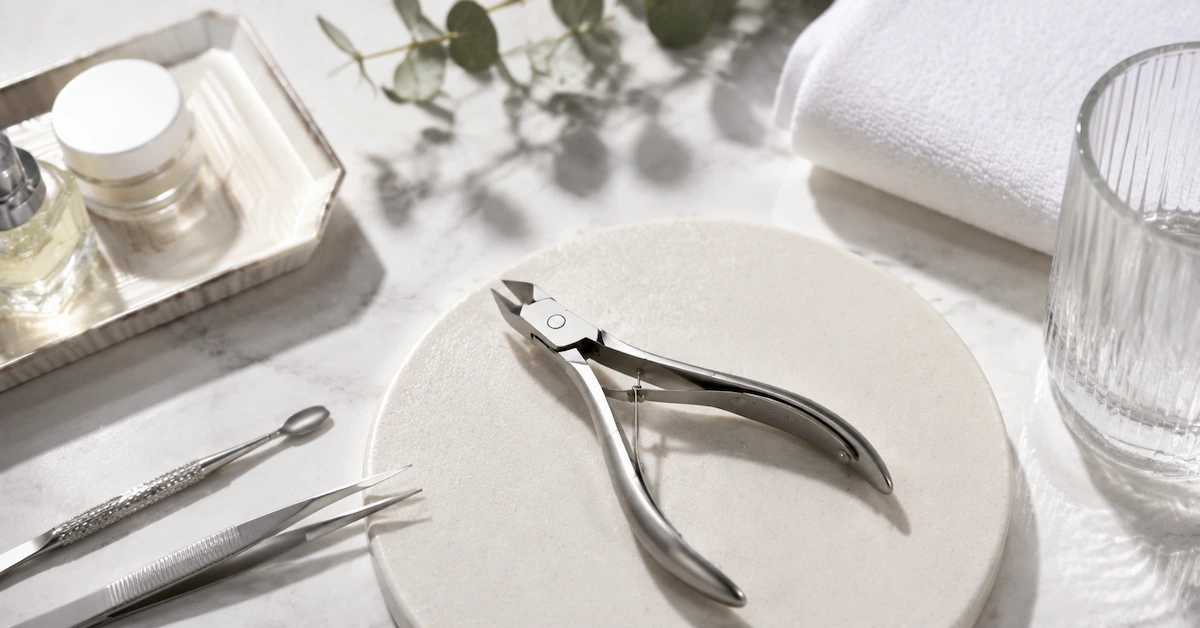
The visible structure of a cuticle nipper tells you quite a bit about how it will behave in use. The tool described here has the classic compact plier-style body, curved handles, a pivot near the jaws, and a spring-loaded opening mechanism. Those elements matter because manicure work depends on controlled, repetitive motion. If the return spring feels sluggish or the handle contour is uncomfortable, fatigue sets in quickly.
The polished stainless-metal appearance also matters for perception. In nail care, a reflective silver finish is often associated with cleanliness and professional use, even before performance is tested. That said, finish alone is not a substitute for functional quality. A shiny tool with poor blade alignment is still a poor tool.
For buyers, the most important visible traits are:
- Compact hand-held size for precision work
- Spring-assisted opening for repeated use
- Angled cutting jaws for trimming small pieces of dead skin
- Polished metal finish that suits salon and retail presentation
- Simple metal body that is easier to position in a product line or kit
Where custom cuticle nipper projects tend to go wrong
A custom cuticle nipper is not difficult to sketch on paper, but it is easy to get the details wrong in production. The most common problem is over-focusing on cosmetics and under-focusing on geometry. Handles can look attractive while the jaw alignment is off by a small but critical amount. In a trimming tool, that kind of defect shows up immediately in use.
Another common issue is assuming that all stainless-steel tools are equally suitable for the same market. That is not a safe assumption. Different buyers may care about corrosion behavior, sterilization workflow, or cleaning practice, but those claims should never be assumed unless the manufacturer has provided documentation. If you are evaluating a private-label personal care tool, ask for the exact specifications rather than filling in the blanks from appearance.
One practical caution: the best-looking sample is not always the best production reference. For hand tools, buyers should pay attention to pivot feel, blade closure, handle symmetry, and the repeatability of the cutting edge. Those are the details that show whether the manufacturing process is stable.
Typical manufacturing steps behind the tool
While the exact process for a given model cannot be confirmed without supplier data, stainless-steel cuticle nippers are commonly associated with metal forming, forging or stamping, followed by grinding, sharpening, polishing, and assembly. The jaws need precision finishing, and the pivot and spring need to be fitted so the tool opens smoothly without wobble.
That sequence may sound straightforward, but it is where many cost targets are won or lost. If the grinding or sharpening stage is inconsistent, the nipper may cut unevenly. If the pivot assembly is too loose, the tool can feel cheap even when the metal finish is good. If the spring tension is wrong, the user either fights the tool or loses control.
For buyers comparing suppliers, it helps to ask about process control in plain language:
Questions worth asking a supplier
What is the base material used for the body and jaws? How is the cutting edge finished? How is the pivot assembled and tested? Are samples representative of production, or are they hand-selected? Those questions are more useful than broad marketing claims, especially when sourcing for salon distribution or branded grooming kits.
Selection criteria for salon, retail, and OEM programs
A nail care tool used in a professional salon is judged differently from one sold as a home-grooming accessory. Salon buyers tend to care more about handling feel, precision, and appearance in use. Retail and OEM buyers often care more about packaging, shelf presentation, and how easily the product can be built into a broader assortment.
If you are planning an OEM or private-label program, the evaluation should usually include:
- Handle ergonomics and control in a normal trimming grip
- Jaw alignment and the clean closing action of the blades
- Visual finish and how it supports your brand position
- Compatibility with blister packs, boxes, or manicure sets
- How much customization is practical without disrupting the core tool geometry
That last point is important. In many cases, buyers ask for too much customization on a small hand tool and end up driving cost or complexity without much market benefit. A better approach is to modify the elements customers actually see and feel: finish, packaging, branding, and perhaps minor handle shaping.
How an ODM cuticle nipper compares with fully custom development
The choice between an ODM platform and a fully custom tool comes down to risk and timeline. ODM usually reduces development effort because the geometry is already established. That can be useful when launching a new beauty line or filling a gap in a manicure-pedicure kit assortment.
A fully custom approach makes more sense when the product needs a very specific handle style, distinctive proportions, or a unique user experience. But for most nail care buyers, the market does not reward novelty for its own sake. It rewards a tool that cuts cleanly, feels stable, and arrives in consistent condition.
In that sense, the ODM route is often a sensible compromise. It gives sourcing managers a known foundation and allows product teams to focus on branding and market fit instead of solving the basic mechanical design from scratch.
Common buyer mistakes to avoid
One mistake is buying on finish alone. A bright, polished metal surface is nice, but it says little about long-term usability. Another is treating all manicure tools as interchangeable because they share the same category name. Cuticle nippers vary in feel, jaw shape, and the quality of assembly more than many buyers expect.
A third mistake is not defining the intended channel before asking for samples. A tool meant for salon professionals may not need the same packaging or merchandising treatment as a mass-market personal care SKU. If that distinction is unclear, the supplier may quote the wrong configuration and the project can drift.
A final caution: do not assume performance details that are not visible. Exact steel grade, corrosion resistance, sterilization compatibility, hardness, and country of origin all require confirmation. That may sound obvious, but it is one of the easiest places for a buyer to get caught by optimistic assumptions.
FAQ for sourcing and product teams
Is an ODM cuticle nipper suitable for private label?
Often yes, especially if the supplier already has a stable base design. Private label programs typically benefit from proven geometry and a clear path to branding and packaging customization.
What should I inspect on a sample first?
Check the jaw alignment, spring action, pivot feel, handle symmetry, and overall finish. Those are the first signs of whether the tool is ready for production evaluation.
Can I use the same design for salons and retail?
Sometimes, but the presentation may need to change. Salon buyers may value function and feel more heavily, while retail buyers may expect stronger shelf appeal and clearer branding.
What should I not assume from a product photo?
Do not assume the steel grade, sterilization compatibility, exact hardness, or professional-use suitability unless the supplier has stated it clearly.
What to ask before moving to quotation
If you are preparing an RFQ for an ODM cuticle nipper, keep the brief practical. Define the target market, intended use case, packaging format, and any visible customization you need. Then ask the supplier to confirm what can be changed without disturbing the core design.
That is usually the cleanest way to keep a small hand tool project on track. The category is simple in appearance, but in sourcing terms it rewards discipline. A well-made cuticle nipper can sit quietly inside a manicure kit for years; a poorly made one becomes a complaint almost immediately. The difference is rarely dramatic on paper. It is usually found in the details.
If you are comparing a cuticle nipper ODM manufacturer for a new grooming line, start with the sample in hand, not the catalog page. The tool will tell you more than the brochure does.