

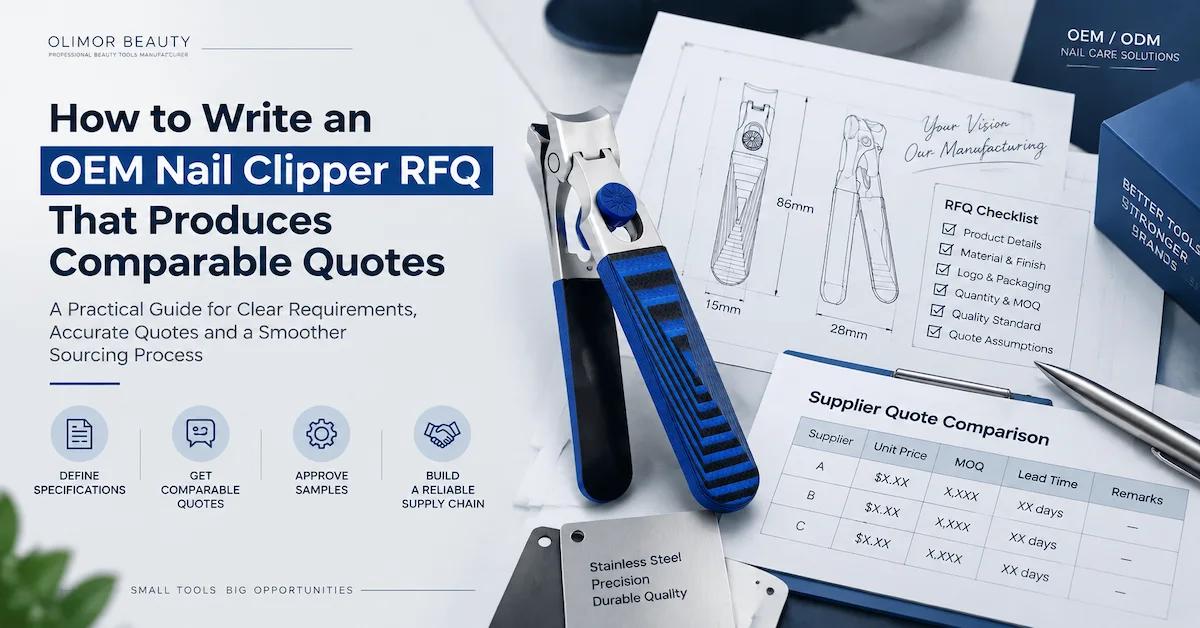
Search intent: commercial investigation and RFQ intent. This guide is written for beauty brands, importers, distributors, retail sourcing teams and private-label program managers who need a supplier to quote a defined nail clipper rather than send a broad catalogue price. It explains what to put in the brief, what evidence to request, how to compare offers and how to turn a selected sample into a repeatable order.
A nail clipper is physically small, but an incomplete buying brief can hide a surprising number of decisions. Two products can look alike in a thumbnail while differing in blade geometry, body construction, lever movement, surface treatment, decoration, packaging and inspection. When suppliers make different assumptions, a spreadsheet of unit prices does not show which offer is actually cheaper. It shows several different products under one label.
The purpose of an RFQ is therefore not to collect the lowest number as quickly as possible. Its purpose is to make the commercial comparison valid. A well-built RFQ also gives the factory enough context to recommend a suitable existing platform, identify new-development work, flag conflicting requirements and create a sample plan. The result is a better question, a more useful answer and fewer unpriced changes after the project has started.
OLIMOR BEAUTY serves brands, importers, distributors and retail projects.
Nail clippers and related beauty and personal-care tools with OEM/ODM support.
Office and manufacturing operations are reported in Yangjiang, Guangdong, China.
Drawings, samples, appearance concepts and structural requirements can start development.
Why Does a Nail Clipper RFQ Fail Even When It Looks Detailed?
Many RFQs are long but still leave the important decisions open. A buyer may list a target price, order quantity, logo and delivery date yet describe the product only as a stainless steel clipper. That phrase does not identify the body, lever, pin, file, catcher, handle or any other component. It does not define blade meeting, opening, leverage, surface finish, package protection or the inspection evidence required before shipment.
Another failure occurs when the buyer sends a competitor photograph without explaining which features matter. The factory may match the visible shape but choose a different construction. It may interpret the request as an existing private-label platform while the buyer expects a new mechanism. A reference image is valuable evidence of intent, but it is not a complete drawing and it does not reveal material, tolerance, hardness, finish process or the way the tool should perform.
A third problem is internal disagreement. Purchasing may prioritize the quoted unit cost, product development may expect a structural change, marketing may expect a specific colour and packaging may still be designing the retail box. The factory receives these decisions at different times and revises the quote repeatedly. The solution is not more email. It is one version-controlled brief that labels each item as fixed, preferred or open.
Finally, buyers sometimes ask every factory for its normal standard. That makes comparison difficult because each factory may use different materials, inspection plans and package assumptions. Ask suppliers to explain their standard option, but also give them one common project specification. A supplier can then quote the requested route and separately suggest a value-engineered alternative without mixing the two.
What Is an OEM Nail Clipper Manufacturer in a Real Buying Project?
An OEM nail clipper manufacturer produces a nail clipper to buyer-defined requirements. The input may be a drawing, physical sample, dimensional envelope, functional requirement, component concept, finish target or controlled combination of these. The supplier reviews feasibility, identifies processes and tooling, prepares samples, manufactures the approved configuration, inspects it and coordinates packaging and shipment.
Private label and ODM routes can overlap with OEM work, but they begin at different points. Private label nail clippers commonly use an existing platform with a selected finish, logo and package. An ODM nail clipper manufacturer may propose an existing design or development direction that the buyer adapts. OEM generally gives the buyer more control over the product requirement. The terminology matters less than a written list of what is standard, what is configurable and what requires new development.
OLIMOR's supplied company information states that OEM and ODM are supported and that development can start from drawings, samples, appearance concepts and structural requirements. Listed capabilities include metal stamping, heat treatment, injection moulding, polishing, water deburring, assembly and packaging, together with in-process and final inspection. These facts describe capability, not a promise that every process applies to every model. The RFQ should ask which route applies to the selected clipper.
The same discipline applies to company scale. OLIMOR's client-confirmed profile reports a company founded in 2011, a factory founded in 2017, approximately 6,000 square metres and roughly 200 employees. It reports annual capacity in two broad groups: about five million hardware sets and about 2.5 million injection-moulded pieces. Those figures help a buyer frame capacity questions; they do not replace a model-specific capacity and delivery confirmation.
Start With the Customer Job, Not the Catalogue Model
Before choosing a clipper, write one sentence about the customer and the job. A compact travel clipper, a larger grooming tool, a baby-oriented product, a manicure-set component and a gift item do not share the same priorities. The intended use influences size, jaw profile, leverage, grip, accessories, finish, packaging and the claims that the brand can responsibly make.
A retail buyer might write: "A compact everyday clipper for an entry-price pharmacy grooming range, packed on a hanging card and easy to identify in a crowded aisle." An ecommerce brand might write: "A differentiated clipper with a comfortable grip and protective case, designed for clear product photography and parcel delivery." A distributor might need a family of sizes with one recognizable design language and reliable reorder control.
This short use statement gives every later decision a reason. If a decorative handle increases size but the product must fit a compact travel case, the conflict becomes visible. If the package requires a large window but the product needs movement protection, the team can solve both constraints before artwork. If the target buyer expects a simple value item, costly surface treatments may not support the commercial position.
| Application | What the RFQ should emphasize | Common hidden risk |
|---|---|---|
| Single retail clipper | Fast recognition, finish, logo, hanging or shelf package, barcode area | Artwork approved before the final product and insert |
| Travel grooming item | Compact size, edge protection, secure closure, portability | Lever pressure or surface rubbing inside the case |
| Manicure set component | Fit in insert, finish coordination, tool identity and set consistency | Clipper revision changes while the case remains unchanged |
| Premium brand line | Material statement, tactile control, finish uniformity, decoration detail | Visual language is precise but functional acceptance is vague |
| Distributor assortment | Size architecture, shared components, pack variants and reorder coding | Similar models are confused during replenishment |
Create a Nail Clipper Configuration Sheet Before Requesting Price
The configuration sheet is the centre of the RFQ. It should describe the physical product in a way that purchasing, quality, packaging and the supplier can all understand. Give the project and each model a temporary code. Put the revision and date on every page. If a value is not decided, write "open for supplier proposal" rather than leaving the cell blank.
Begin with the clipper type and size position. State whether the tool is a standard lever clipper, a design with a catcher, a long-handle model, a decorative handle configuration, a baby-oriented version or another defined structure. Include a drawing or annotated image showing the dimensions that affect use and packaging. Do not copy a dimension from another SKU simply because the silhouette looks similar.
Describe the blade or cutting-head requirement in functional language. Ask the supplier to explain edge geometry, meeting condition and the method used to confirm the approved result. If a wider jaw, angled edge or other special form is important, identify the use case and sample evidence required. Avoid asking for maximum sharpness without defining safe, controlled performance for the intended user.
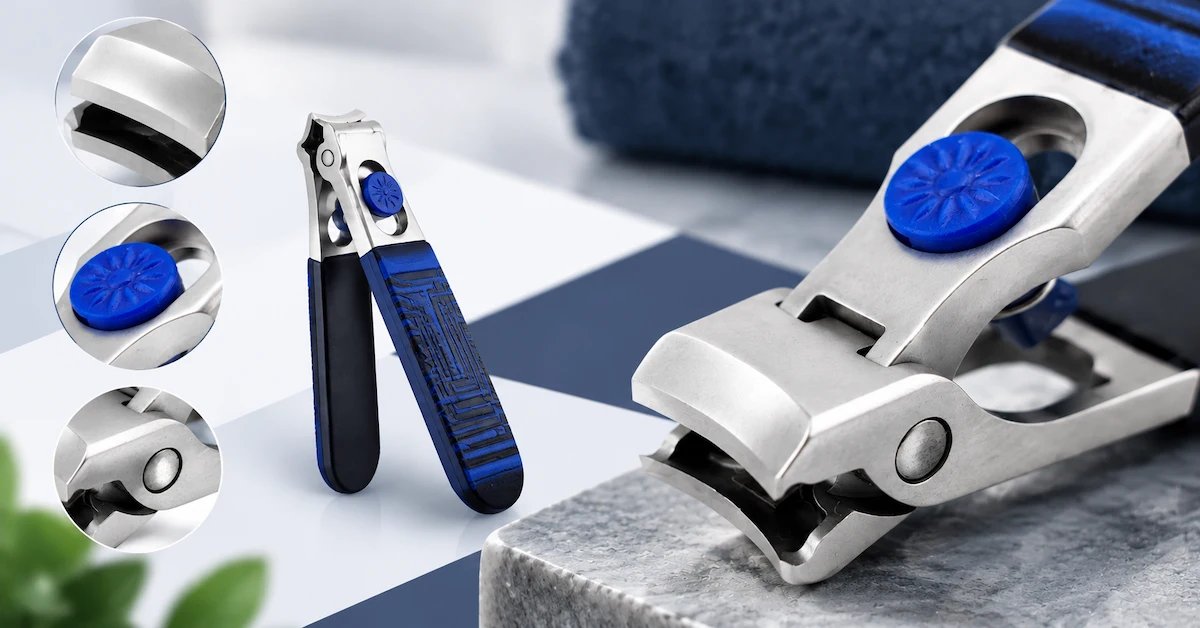
Define the lever, pivot and opening. The buyer should state the expected user experience and ask how the factory controls the relationship between parts. A long lever may change the feel, package height and visual balance. A decorative handle or plastic component may add grip and differentiation but introduces colour, fit and moulding questions. Every visible feature should connect to a physical component and a control point.
| Specification field | Buyer input | Supplier response required |
|---|---|---|
| Model and application | User, channel, clipper type, set or single item | Recommended platform and development classification |
| Dimensions | Controlled dimensions, references and open values | Drawing, tolerance proposal and measurement method |
| Cutting system | Intended nail-care task and sample expectation | Edge route, meeting check and functional approval method |
| Lever and joint | Handling preference and any fixed geometry | Construction, assembly controls and inspection points |
| Material | Preference by component, plus required documentation | Exact proposed material statement for each relevant part |
| Finish and colour | Visual target, reference and wear considerations | Available process, sample route and colour-control method |
| Branding | Artwork, position, scale, orientation and colour | Decoration method, proof and physical sample |
| Packaging | Format, insert, artwork, language, barcode and carton need | Dieline, packed sample, pack count and carton proposal |
Specify Material by Component, Not With One Marketing Phrase
The phrase "stainless steel nail clipper" may be commercially useful, but it is not a bill of materials. Ask which material applies to the body, cutting portion, lever, pin, spring, file, catcher, handle and decorative components. The answer may vary by model. It must match the wording planned for packaging, listings, declarations and quality documents.
A stainless steel nail clipper supplier should be able to state the proposed material for the quoted SKU and explain which evidence can support that statement. A buyer should not turn a broad material preference into an unsupported claim about corrosion, medical use, hardness or lifetime. Connect every requested property to a suitable requirement, method and document for the destination market.
If heat treatment is relevant, ask which component receives it and what product requirement it supports. OLIMOR's supplied factory information lists heat-treatment equipment and hardness testing capability, but a responsible RFQ still asks whether those processes apply to the selected model and what approval value will be used. Do not import a hardness number from another product or treat equipment ownership as a test result.
Plastic, rubberized or zinc-alloy handle elements require a separate line in the specification. Define colour, texture, fit, flash expectations, visible parting lines and the way the handle connects to the metal body. Ask how a physical colour reference will be retained. The material choice may also affect logo method, package contact, temperature sensitivity and recycling information.
Use the quote to expose material ambiguity. Ask the supplier to repeat the material description beside the unit price, not only in a distant technical attachment. When two suppliers use different material language, resolve the difference before calling their offers comparable.
Turn "Good Cutting" Into an Approve-or-Reject Method
Quality language should describe what an inspector does. "Sharp," "smooth" and "high quality" are not methods. The RFQ should ask the supplier to propose a functional check suited to the selected clipper and intended use. The buyer and supplier then confirm the test medium, preparation, operation, observations, frequency and reaction to failure.
Blade meeting is one part of the decision. Inspect the closed relationship across the intended contact area, look for visible offset and compare it with the approved reference. Functional cutting is another part. It should show whether the clipper performs the agreed task without excessive force or an unacceptable result. The exact acceptance criteria need product-owner confirmation; this article deliberately does not invent universal values.
Lever movement, pivot stability and opening condition should be reviewed separately. A clipper may cut during one demonstration yet feel unstable, bind during repeated operation or arrive with inconsistent lever assembly. Ask the factory where these characteristics are checked: first piece, in process, final inspection or all three. Link each check to a record and a person responsible for reaction.
Appearance checks should cover burrs, rough areas, polish or coating uniformity, scratches, contamination, colour difference and visible assembly damage. The defect definitions should use reference photographs or samples where possible. A minor surface mark and a functional edge failure should not automatically receive the same classification.
Choose the Right Customization Route
A custom nail clipper manufacturer project can range from a logo on an existing model to a new structural design. The RFQ should classify every requested change. This prevents the buyer from expecting new-development work at a catalogue price and prevents the factory from treating a critical product requirement as a decoration request.
Route 1: Existing model with private label
This route usually offers the clearest starting point. The buyer selects an existing platform, confirms its current specification, chooses an available finish and adds branding and packaging. It still needs a physical approval sample. The buyer should confirm whether the model, components or finish are shared with other orders and how later changes will be communicated.
Route 2: Configured model
The product may combine an existing body with a different handle, finish, colour, logo, file, catcher, accessory or package. Ask which combinations have existing tooling and which need validation. A combination of familiar components can still create a new fit, movement, scratching or packing issue.
Route 3: Buyer-led OEM development
The buyer supplies a drawing, reference sample or controlled requirement that affects structure. The factory should review feasibility, tooling, tolerances, process route, sample stages, quality controls and intellectual-property responsibilities. The RFQ should distinguish functional objectives from features that must match the reference exactly.
Route 4: Supplier-led ODM direction
The supplier proposes a design direction or platform and the buyer adapts it for the market. Ask what part of the design is established, what can change, what rights apply and what documentation will control the final version. A good ODM proposal should shorten uncertainty, not hide it.
Define Custom Logo Nail Clippers on the Final Surface
Custom logo nail clippers need artwork control and physical proof. Supply vector artwork, a revision identifier, permitted colours, maximum dimensions, position, orientation and a reference showing which side faces the customer. Ask the factory to recommend a decoration method for the selected substrate and finish.
A polished, coated, textured or curved surface can change line clarity and contrast. Check the mark on the actual product, not only on a PDF. Inspect boundaries, fill, alignment, orientation and visible change around the decoration. Handle and pack the sample, then inspect it again for rubbing or transfer.
Keep the product and package artwork linked. The logo on the clipper, case, card, instruction and master carton may use different production files, but the release package should identify the current revision of each. A change to the brand mark, legal line, barcode or language panel can affect both sample timing and packaging inventory.
Do not let logo approval substitute for product approval. A clean logo does not prove the blades meet, the lever moves correctly or the package protects the edge. Sign function, appearance, decoration and packing as separate decisions before the final release.
Build Packaging Into the RFQ From the Beginning
Packaging is both a retail surface and a physical restraint. It protects the cutting head, limits movement, presents the product and determines how many units fit in a carton. A late package change can alter unit cost, tooling, artwork timing, carton dimensions, freight assumptions and the way the product survives distribution.
Give the supplier a package brief that names the sales channel, hanging or shelf requirement, opening experience, visibility, material preference, language, barcode, warnings, instruction, insert and carton needs. Mark which claims are approved and which still require evidence. Do not copy another market's package language without a compliance review.
Approve the package with the final clipper inside it. Check orientation, movement, pressure on the lever, edge contact, surface rubbing, closure, tamper features where applicable, opening, replacement of the tool, barcode readability and visible print. If the product belongs to a set, check every item and the closed case after handling.
Ask for a Model-Specific MOQ and Schedule
There is no responsible universal MOQ for an entire nail clipper category. MOQ depends on the platform, material, finish, colour, logo process, packaging, tooling, component sourcing and order mix. Ask for the minimum attached to the exact configuration and identify which feature creates each quantity threshold.
A private-label platform with a standard finish and simple package may have a different starting point from a new body, custom handle, special coating and printed gift box. If the preferred configuration exceeds the launch quantity, ask the supplier to separate the constraints. The team may keep the functional platform, simplify one decoration or use a shorter-run package without weakening the core product.
Ask for a milestone schedule, not one unsupported delivery promise. Useful stages include feasibility review, tooling where needed, first sample, buyer feedback, revised sample, package artwork, packed sample, material preparation, production, inspection and dispatch. State what starts each stage and how quickly the buyer will review submissions.
OLIMOR's confirmed source material does not provide a universal MOQ, sampling time or production lead time. These values must be confirmed for each model and customization scope. This limitation belongs in a trustworthy article because it prevents a buyer from planning around a number that may describe a different product.
Require an Itemized Quotation
An itemized quotation is easier to compare and easier to revise. Ask for the model code, drawing or sample revision, material description, finish, decoration, unit package, pack count, quantity band, unit price, tooling, sampling, logo setup, printing setup, insert or case, testing, inspection, carton and any other charged item. State currency, Incoterm, destination basis and quote validity.
Separate one-time and recurring cost. Tooling, fixtures, colour trials, artwork preparation and printing plates may be paid once or reused under conditions. Product, packaging, inspection and carton costs recur. Ask who owns tooling, where it is stored, how maintenance is handled and what happens when a tool reaches the end of its useful condition.
Ask every supplier to list exclusions. One offer may include retail packaging while another assumes bulk bags. One may include outgoing inspection while another prices an external inspection separately. One may quote an existing finish while another includes a custom colour. Exclusions are not automatically negative; hidden exclusions are.
Total landed cost also depends on pack density, carton dimensions, weight, trade term, inspection, duty, handling and the buyer's own quality work. The factory cannot calculate every destination cost without inputs, but it should provide the packed information and commercial basis needed by the buyer's logistics team.
| Cost line | One-time or recurring? | Question to ask |
|---|---|---|
| Tooling and fixtures | Usually project-specific; conditions vary | Who owns, stores, maintains and approves modification? |
| Sample development | Usually stage-specific | How many samples and which features are included? |
| Product unit | Recurring | Which revision, material, finish and quantity band? |
| Logo or decoration | Setup plus recurring may apply | Which method, colours, position and proof? |
| Retail packaging | Recurring; tooling/setup may apply | Which material, dieline, insert, artwork and pack count? |
| Inspection or testing | Project-dependent | Who performs it, to which plan, and what evidence is delivered? |
| Carton and shipment | Recurring | What Incoterm, carton basis and destination assumptions? |
Use a Supplier Comparison Matrix That Rewards Evidence
A supplier scorecard should reflect project risk. Product fit, sample result and quality evidence usually deserve more weight than catalogue size. Commercial clarity matters because an incomplete price creates change orders. Communication matters because development depends on decisions, but response speed should not outweigh technical accuracy.
Score the evidence that exists. A marked drawing is evidence. A physical sample with a revision is evidence. An inspection record that names the feature and result is evidence. A factory photograph or machine list can support a capability discussion, but it does not prove the selected model passed a test. Ask a nail clipper factory China candidate to connect equipment, people and records to the proposed product route.
Keep an open-issues column beside the score. A supplier may perform well while one material document, package test or capacity question remains unresolved. Do not convert missing information into a high or low score; identify it as uncertainty with an owner and due date.
| Evaluation area | Evidence to review | Suggested weight |
|---|---|---|
| Product and application fit | Use statement, platform rationale, configuration response | 20% |
| Technical and process fit | Drawing, material, process route, tooling and feasibility notes | 20% |
| Sample result | Function, geometry, finish, logo and packed sample | 20% |
| Quality evidence | Critical checks, inspection plan, records and reaction route | 20% |
| Commercial clarity | Itemized price, MOQ, milestones, exclusions and trade terms | 15% |
| Project communication | Revision control, issue tracking and decision ownership | 5% |
Connect International Rules to the Destination Market
A nail clipper sold as an ordinary consumer product still needs a market-specific compliance review. The European Union's General Product Safety Regulation (EU) 2023/988 establishes general safety responsibilities for consumer products placed on the EU market. Buyers should determine the applicable economic-operator, traceability, risk-assessment, technical-documentation, labelling and incident obligations for their exact product and sales route.
For the United States, the U.S. Consumer Product Safety Commission business guidance is a starting point for identifying product-safety responsibilities. Requirements can change with product design, age grading, claims, packaging and jurisdiction. A general grooming tool should not be marketed with medical claims unless the regulatory route has been established.
ISO 9001 provides a quality-management framework that helps buyers ask how requirements, revisions, records, nonconformities and corrective actions are controlled. It does not certify the quality of a particular nail clipper by itself. Ask for current certification details and verify the holder, address, scope and validity against the entity supplying the order.
ISO 2859-1 provides sampling procedures indexed by acceptance quality limit. If the buyer and supplier use an AQL-based plan, they still need to define the lot, inspection level, defect classes and acceptance values for the exact product. A critical functional failure should not be hidden inside a cosmetic defect category.
Compliance note: This article is a sourcing guide, not legal advice. Confirm current destination-market requirements with qualified compliance professionals and request documents for the exact product, supplying entity and shipment.
Build the Golden Sample and Production Release Package
The approved sample is valuable only when it can be identified. Give it a code, revision, date and approval record. Photograph critical views and record any approved deviation. Keep one controlled supplier sample and one buyer sample when practical. Protect them from handling damage and make replacement rules clear.
The release package should contain the specification, drawing, bill of materials or material statement, finish and colour reference, logo proof, package dieline, current artwork, packed sample, carton information, quality plan, quantity, commercial assumptions and approved deviations. The documents should refer to the same product revision.
Use a first-piece check after production setup and after a meaningful change. Compare completed pieces with the released reference before the full quantity proceeds. If an issue appears, record containment, correction and re-approval. The purpose is not to create paperwork for its own sake; it is to stop a small misunderstanding from becoming a full-lot problem.
When production is complete, the final inspection should verify the agreed functional, dimensional, appearance, decoration, packaging, quantity and carton points. The exact sampling plan belongs in the purchase and quality agreement. Ask what evidence will accompany shipment and how nonconforming pieces are handled.
Design the RFQ for Repeat Orders, Not Only the First Launch
A strong RFQ anticipates replenishment. Ask the supplier to state which materials, components, tooling, finish processes, packaging suppliers and inspection methods are expected to remain stable. Define which changes require notice and approval. A change that seems minor to production may affect the buyer's listing images, material claim, colour system or package fit.
Retain the latest specification, samples, artwork, test or inspection records, approved deviations, complaint history and change log. Before each reorder, ask whether the material source, components, tool condition, finish, colour, decoration, package, barcode, carton or compliance requirement has changed. Reference the prior release if nothing changed; create a controlled revision if something did.
This discipline is especially important for a wholesale nail clipper supplier relationship that serves multiple markets or channels. One product may use several packages, languages or carton configurations. Model, market and package codes should prevent one variation from being shipped against another order.
Measure supplier performance with project facts: sample rounds, open issues, defect findings, corrective-action closure, delivery against confirmed milestones and response to approved changes. Do not invent public performance percentages. Internal measurements should use a defined period and comparable order scope.
RFQ Checklist for Buyers
- Write the intended user, grooming task, channel, destination and product position.
- Assign a model code, revision and date to the brief.
- Identify an existing, configured, OEM or ODM development route.
- Provide a drawing, annotated image or physical reference and explain what matters.
- Define dimensions, cutting system, lever, pivot, opening and accessories.
- Request material by relevant component and evidence for planned claims.
- Define finish, colour, texture, reference and visible defect expectations.
- Provide logo artwork, method preference, position, scale, orientation and revision.
- Describe primary package, insert, artwork, languages, barcode, pack count and carton.
- State first-order and annual quantity ranges without assuming a universal MOQ.
- Request sample stages, approval owners and milestone dates.
- Define critical inspections, sampling responsibility, records and failure response.
- Ask for an itemized quotation, trade term, validity, exclusions and payment assumptions.
- Request relevant company, quality and market documents for the exact supplying entity.
- Require change notification and a repeat-order release process.
Frequently Asked Questions
What should I send an OEM nail clipper manufacturer first?
Send a one-page application brief, annotated reference or drawing, target dimensions, material and finish preferences, logo and packaging needs, quantity range, destination market, launch window and required documents. Mark fixed, preferred and open items. This gives the supplier enough information to classify the development route and identify missing decisions.
Can a professional OEM nail clipper manufacturer recommend a model?
Yes. A professional OEM nail clipper manufacturer can compare the application with available platforms and explain what is standard, configurable or new. Ask for the reasoning, current specification and sample evidence rather than accepting a generic best-seller label.
What is the difference between OEM and private label nail clippers?
Private label usually begins with an existing product platform and adds branding, finish or packaging changes. OEM often includes more buyer-defined product requirements and may need structural development or tooling. The written scope matters more than the label.
What is the MOQ for custom nail clippers?
MOQ depends on the selected model, material, finish, colour, logo method, package, components and tooling. Ask for the MOQ attached to the exact quoted configuration and identify which feature drives the threshold.
How much does OEM nail clipper development cost?
The total can include tooling, fixtures, sample work, colour trials, logo setup, artwork, package tooling, inspection and recurring product and packaging cost. Request separate lines and do not compare bare unit prices until the same scope and trade terms are used.
How long does sampling and production take?
Timing depends on the platform, structural change, tooling, sample rounds, finish, decoration, artwork, material preparation, production and inspection. Ask for model-specific milestones and state how quickly your team will review each submission.
How do I verify a custom logo before mass production?
Approve it on the final product surface and packed sample. Check artwork revision, method, size, position, orientation, clarity, contrast and handling. Keep the signed proof with the functional sample and packaging release.
What quality evidence should be requested?
Request a model-specific specification, approved sample, critical inspection points, first-piece record, in-process controls, final inspection plan and reaction route. If certificates or reports are relevant, verify holder, scope, date and connection to the exact product and supplier.
Can an OEM project use stainless steel?
It can, depending on the selected construction. Ask which component uses which material and align that answer with the planned package and listing language. Do not assume one material statement applies to every part or every catalogue model.
Why does the packed sample matter?
The packed sample reveals movement, scratching, lever pressure, edge contact, closure, print and barcode issues that a loose product cannot show. It also establishes the presentation and pack configuration used for the quotation and shipment.
Send a Brief That Can Become a Production Record
The best RFQ is not a sales message. It is the first controlled version of the product. It tells the factory who will use the clipper, what the tool must do, which decisions are fixed, what can be proposed, how the product will be inspected and what the quotation must include. It leaves room for manufacturing expertise without leaving commercial assumptions invisible.
OLIMOR BEAUTY supports nail clipper and related beauty-tool discussions for OEM, ODM and private-label projects. Its supplied company information covers product development from drawings and samples, metal and plastic processing, assembly, inspection, packaging and export coordination. Buyers should still confirm the exact model, MOQ, schedule, material, process, test and documentation for each project.
To receive a focused response, send OLIMOR your reference, target customer, destination, product route, material and finish preferences, logo, packaging, quantity range and timing. Ask the team to repeat the quoted configuration and open questions beside the commercial offer.
Tag: