Quick answer: A private-label nail clipper program succeeds when the brand treats the clipper as a complete retail product rather than a blank item waiting for a logo. Start with the user's grooming routine, select a suitable platform, define what must change, approve a working sample, test the packed presentation, and keep one controlled specification for replenishment. This approach gives an importer or brand owner a clearer conversation with a private label nail clipper manufacturer and produces a quotation that can actually be compared.
Private label nail clippers sit at the intersection of personal care, small metal goods and branded packaging. The tool has to feel dependable in the hand, cut as intended, look consistent with the rest of the range and survive a route from factory to shelf or parcel. Those requirements are connected. A coating can change the grip. A new lever can alter the box insert. A thicker card can add freight volume. A logo placed too close to a moving joint can wear during use.
This guide is written for a beauty brand, pharmacy chain, retailer, distributor, subscription box, hotel amenity program or ecommerce seller planning a branded nail-care SKU. It explains how to turn a concept into a controlled brief, how to choose between catalogue adaptation and custom development, and how to ask OLIMOR BEAUTY for evidence that relates to the exact model. It does not promise a universal MOQ, price, lead time or certification. Those details belong to the agreed configuration and destination market.
1. Define the shelf role before you choose the clipper
A private-label project becomes easier when the first decision is commercial, not cosmetic. Decide where the product will be discovered and why a shopper should add it to a basket. A compact single clipper may suit a travel or checkout display. A larger handle can support a comfort-led story. A clipper placed in a manicure kit has to share space with files, pushers and a case. A gift set needs a different visual rhythm from a value multipack.
Write a short shelf statement before requesting a sample: "A compact silver clipper for a minimalist travel-care range," or "A sturdy clipper included in a seven-piece home manicure set." The sentence gives the supplier a use case, a price position and a collection context. It also prevents an endless discussion about colours before the product role is settled.
| Retail role | Product questions | Brand and pack questions |
|---|---|---|
| Travel essential | Can the tool be protected, stored and handled with one hand? | Will the pack stay slim and resist movement in a suitcase? |
| Everyday bathroom tool | Does the grip and lever feel familiar for repeated use? | Can the front panel explain the function without overclaiming? |
| Manicure-set component | Does the size and finish coordinate with the other tools? | Can the insert hold every item without edge contact? |
| Gift or seasonal item | Is the finish and silhouette distinctive enough for gifting? | Does the box create a clear unboxing sequence? |
| Professional channel | What cleaning, handling and replacement expectations apply? | Which documents and pack information does the buyer require? |
2. Turn the brand idea into a product brief
The brief should separate decisions that are fixed from decisions that are still open. Fixed items might include the intended user, the sales market, the number of tools in a set, or the need for a protective case. Open items might include the exact coating, the handle colour or the final card stock. This distinction helps a nail clipper factory China team respond with useful alternatives instead of guessing which detail matters most.
Describe function in observable language. Replace "premium cut" with "the two cutting edges meet evenly across the intended contact area." Replace "smooth operation" with "the lever opens and returns without binding during the agreed hand test." Replace "luxury silver" with the surface appearance, texture and colour reference you want to approve. A supplier can quote and inspect a defined result; it cannot inspect a mood board adjective.
Include a simple identity block for every SKU: project name, model code, version, target market, channel, quantity band and sample date. If several sizes are under review, give each one its own code. This small discipline prevents the common mistake of approving a logo on one size and a function sample on another.
3. Decide whether the project is adaptation or new development
Most private-label nail clippers begin with one of three routes. A catalogue adaptation uses an existing body and mechanism with changes to branding, colour, finish or package. A guided ODM route starts with a supplier platform and asks the development team to recommend a combination. A fully specified OEM route begins with buyer-controlled geometry, drawings, samples or mechanism requirements.
Catalogue adaptation
This route can reduce design uncertainty, but it is not a logo-only shortcut. Ask which parts are unchanged and which parts are being requalified. A new coating may affect the lever fit. A custom catcher may require an insert change. A different box can alter how the tool is restrained. The right question is not "Can you add our logo?" but "What is the complete approved configuration after the logo, finish and package changes?"
ODM platform selection
When you work with an ODM nail clipper manufacturer, ask for two or three platform options and a written explanation of the trade-offs. One may be compact, another may offer a wider handle, and another may coordinate better with a manicure set. Request a comparison of standard features, configurable features, new tooling, sample scope and documentation. The final choice should follow the brand role, not only the lowest starting price.
OEM specification
An OEM nail clipper manufacturer is appropriate when your team owns a drawing, reference sample, dimensional envelope or functional concept. Provide the information in a way that leaves no doubt about what is critical. Identify the edge relationship, lever position, handle contour, surface finish, logo area and package interface. Ask the supplier to return the quotation with the same model code and revision number.
4. Choose the material story carefully
Many buyers begin with a request for "stainless steel," but that phrase can describe the whole tool, selected components or a marketing preference. A stainless steel nail clippers supplier should be asked to state the material by part in the project specification. Body, lever, pin, spring, file and catcher may not share the same construction. The final wording should match what is documented for the selected model.
Material is also a design decision. A bright polished surface communicates a different product position from a satin finish. A coated handle may improve visual differentiation but needs a review for scratch resistance, edge clearance and logo contrast. If a plastic component is used, agree on colour control, texture, flash and fit. Ask whether the colour is checked against a physical master, a chip or another approved reference.
Do not turn a material preference into a universal performance or corrosion promise without model-specific evidence. Ask for care guidance that is appropriate to the product and destination. Keep any market claim tied to a document, test or approved specification that your team can retain.
5. Review the hand feel and cutting action
The first sample should be reviewed with a repeatable hand test. Use the same type of task, the same sequence and the same notes for every candidate. Observe how the clipper opens, how much pressure is needed, where the lever returns, and whether the edges meet consistently. Check for burrs, visible distortion, loose pins, sharp corners outside the cutting zone and marks that were not present in the reference.
A custom nail clippers project may change the handle or lever while retaining a familiar body. That change can alter leverage and the user's thumb position. Ask the factory to explain which dimension controls the movement and where it will be checked. If the clipper includes a file or catcher, inspect the interaction between those parts and the main tool rather than reviewing them as isolated accessories.
Record the test by sample code. A useful approval note says what was tried, what was observed, which changes are requested and what remains open. "Looks good" is not a reliable release instruction when multiple departments or later replenishment orders are involved.
6. Build the visual identity on the actual product
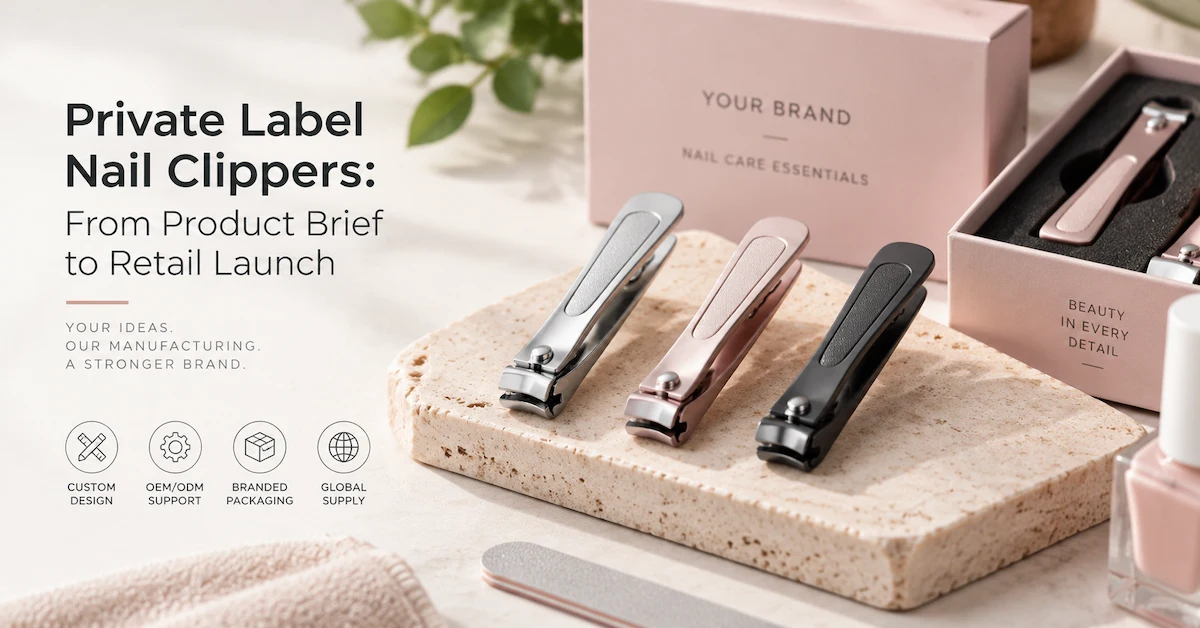
For custom logo nail clippers, provide vector artwork, position, orientation, maximum size, colour reference and revision. Ask which decoration methods are suitable for the selected surface. A small mark can lose detail on a curved lever, while a bright mark can disappear against a polished body. The proof should be reviewed on the final substrate and finish.
Keep the product mark and package identity in the same approval set. Compare the logo on the tool, the front panel, the insert and the outer carton. Check line clarity, contrast, alignment and the way the mark appears after the product has been handled. A decoration proof does not replace the functional sample; it is one part of a complete release.
7. Design packaging around protection and conversion
Packaging has two jobs: protect the working edge and help the shopper understand the product. The pack must keep the lever from moving, prevent metal-to-metal rubbing and hold the tool in a predictable orientation. It also needs a readable product name, concise use information, brand identity, barcode area and any required market text.
Ask a nail care tools manufacturer to review the package as part of the product, not as a file sent after manufacturing. Provide the pack count, insert material, closure type, language list, barcode position and outer-carton marks. Request a physical packed sample and handle it like a shopper, warehouse operator and parcel carrier. Look for movement, scratches, crushed corners, difficult opening and an insert that places pressure on the lever.
| Packaging gate | What to inspect | Release evidence |
|---|---|---|
| Product fit | Tool sits in the intended orientation and the edge is protected. | Packed sample with model code and photos. |
| Brand presentation | Logo, colour, copy and hierarchy match the approved artwork. | Signed artwork proof and final printed sample. |
| Handling | Closure, insert, barcode and opening sequence work as intended. | Handling notes and barcode check. |
| Shipping | Carton count, marks, dimensions and restraint survive movement. | Carton specification and dispatch sample. |
Discuss Your Private Label Nail Clipper Project
8. Ask what a China factory really does in-house
The supplied OLIMOR BEAUTY profile records a business founded in 2011 and a factory established in 2017. It describes approximately 6,000 square metres, about 200 employees, reported annual capacity of roughly 5 million metal sets and 2.5 million injection-moulded pieces, and capabilities including metal stamping, heat treatment, plastic injection, polishing, water deburring, assembly, inspection, packaging and export coordination.
Those facts are useful context for a buyer comparing a nail clipper manufacturer China option. They do not answer every SKU question. Ask which operations are performed at the quoted site, which are coordinated, where the bottleneck lies and how the team controls handoffs. A clear route diagram is more useful than a generic list of machines.
Capacity should also be read with scheduling in mind. A factory may have substantial installed capability while a particular polishing line, mould, package supplier or inspection team is committed elsewhere. Ask for project milestones and the event that starts each milestone. Avoid copying a lead-time promise from another model or another season.
9. Create a private-label quality gate
Quality for private label nail clippers is not a single visual inspection at the end. It is a sequence of decisions that starts with the reference sample and ends with a packed lot. Agree the critical features, check method, record and response before production. The exact acceptance values must be confirmed for the model; do not borrow an unexplained number from a different tool.
- Reference gate: identify the current drawing, sample code, material description, finish and artwork revision.
- Setup gate: compare first completed pieces with the current reference after tooling or machine setup.
- Function gate: review edge meeting, cutting action, lever movement, return and any set interaction.
- Appearance gate: check polish, coating, colour, burrs, scratches, logo clarity and alignment.
- Pack gate: verify item count, insert position, barcode, carton marks and protection.
- Release gate: retain the inspection record, approved deviations, quantity and dispatch documents.
The company information also records ISO and BSCI as confirmed certifications. Match the certificate holder, site, scope and validity to the actual project before using those records in customer-facing copy. A management-system certificate does not by itself prove that every clipper meets a specific cutting or material requirement.
10. Compare quotations on an equal configuration
A quote comparison becomes misleading when one supplier prices a standard tool and another prices a custom finish with a printed box. Ask every nail clipper supplier China to repeat the model code, material by part, finish, logo method, package, quantity band, trade term, destination assumption and quote validity.
Request separate lines for one-time development, tooling, sample work, colour matching, logo setup, packaging components, unit price, inspection and carton. There is no universal MOQ for private label nail clippers. The minimum depends on the exact combination of model, material, finish, colour, decoration, packaging and order quantity. Ask for the MOQ attached to your configuration.
When a team searches for wholesale private label nail clippers, the right commercial question is not simply "What is your wholesale price?" It is "What configuration, quantity band and replenishment assumption does this price describe?" That wording makes the first order and the repeat order easier to compare.
11. Plan the sample rounds
Give each sample round a purpose. Round one can confirm platform, size and hand feel. Round two can confirm the selected material, finish, logo and accessories. Round three can confirm the printed package and packed protection. If every round tries to solve every issue at once, the team may lose track of which change improved the product and which introduced a new risk.
Use a review sheet with four columns: approved, change requested, evidence needed and owner. Add photos with a ruler only when dimensions matter, and mark the view or feature being discussed. Ask the supplier to return a revised sample code so the old and new versions cannot be confused in email or artwork folders.
12. Build the inquiry before you build the order
A concise inquiry helps a factory answer faster and gives the brand an internal checklist. Include:
- Brand category, destination market, sales channel and launch window.
- Retail role, intended user, product story and target set composition.
- Reference model, photograph, drawing or physical sample.
- Material preference by part, finish, colour, lever and edge expectations.
- Logo artwork, decoration position, size, colour and revision.
- Package type, insert, languages, barcode area and carton requirement.
- Sample quantity, first-order quantity range and expected annual volume.
- Inspection expectations, required documents and destination-market questions.
- Target commercial position, with fixed, preferred and open decisions separated.
- Questions about feasibility, tooling, MOQ, milestones and quotation validity.
Send the same brief to each shortlisted supplier. A standard format reduces the chance that a quotation omits a package component or assumes a different finish. It also creates a useful record when the purchasing team explains why one sample was selected over another.
Request a Model-Specific Private Label Quote
13. Protect the repeat order
Private label value appears over several orders, not only at launch. Keep the current specification, approved sample images, material wording, finish and colour reference, logo proof, package artwork, carton details, inspection checklist and approved deviations together. Before a repeat order, ask what changed in materials, components, tooling, finish, packaging, artwork, barcode or destination requirements.
If a change is needed, state the impact and decide whether a new sample is required. A substitute insert may alter the package fit. A new coating supplier may alter colour or surface feel. A revised carton may change the quantity per case. Treat each change as a controlled decision, not an informal message hidden in a shipping thread.
14. Common private-label mistakes and practical fixes
Starting with the logo
Problem: the brand artwork is approved before the mechanism, surface and package are fixed. Fix: approve the product platform and function first, then place the mark on the final substrate.
Using "stainless steel" as the whole specification
Problem: the phrase does not identify which parts or finish are included. Fix: list material by part and connect it to the model-specific document set.
Comparing a unit price without the pack
Problem: one quote excludes tooling, logo setup or the printed insert. Fix: use an itemized configuration and request the same assumptions from every supplier.
Approving digital artwork only
Problem: the printed result or logo contrast differs on the actual metal or plastic. Fix: review a physical product and packed sample before release.
Forgetting the next order
Problem: the second order relies on an old photograph and memory. Fix: keep one release file with revision, sample code, inspection record and approved deviations.
Frequently asked questions
What is a private label nail clipper?
It is a nail clipper sold under the buyer's brand, usually with an existing or adapted product platform and a customized combination of logo, colour, finish, accessories and packaging. The exact scope should be written into the SKU specification.
How do I choose a private label nail clipper manufacturer?
Compare the supplier's model-specific process route, sample evidence, decoration and packaging capability, quality records, commercial assumptions and communication discipline. Company size alone does not prove product fit.
Can I request custom nail clippers in a new shape?
Possibly, but a new shape can affect tooling, edge geometry, lever movement, material use, package fit, sample rounds and cost. Mark which features are fixed and ask for a feasibility review before committing to artwork.
Is an ODM nail clipper manufacturer different from an OEM supplier?
ODM usually starts with a supplier platform or recommendation that the buyer adapts. OEM generally uses more buyer-controlled input such as a drawing, sample, dimensions or mechanism brief. A project can combine both routes at different stages.
What should I ask a stainless steel nail clippers supplier?
Ask which components use stainless steel, what finish is applied, how the material wording is documented, how the surface is checked and whether the selected specification supports the requirements of your destination market.
What is the MOQ for wholesale private label nail clippers?
MOQ depends on the exact model, material, finish, decoration, packaging, tooling and quantity configuration. Request the minimum for the complete SKU rather than relying on a general catalogue statement.
How should I test a sample?
Use the intended grooming task, observe edge meeting and lever movement, inspect the surface and logo, compare the geometry with the reference, and review the packed sample for movement, scratches and opening issues. Record the result by sample code.
Make the private-label launch easy to repeat
The strongest private-label program is not the one with the most decorative options. It is the one where a shopper receives a tool that feels deliberate, a retailer receives a clear product story, and the next order can be placed against the same approved reference. Define the shelf role, brief the function, choose the right development route, confirm material by part, approve the logo on the finished product, test the package, set quality gates and preserve the release file.
OLIMOR BEAUTY's supplied company information provides a starting point for a conversation about metal and plastic processing, assembly, inspection, packaging, OEM/ODM development and export coordination. The useful next step is a model-specific inquiry containing your product role, reference, finish, logo, pack, quantity range, destination and launch window.