

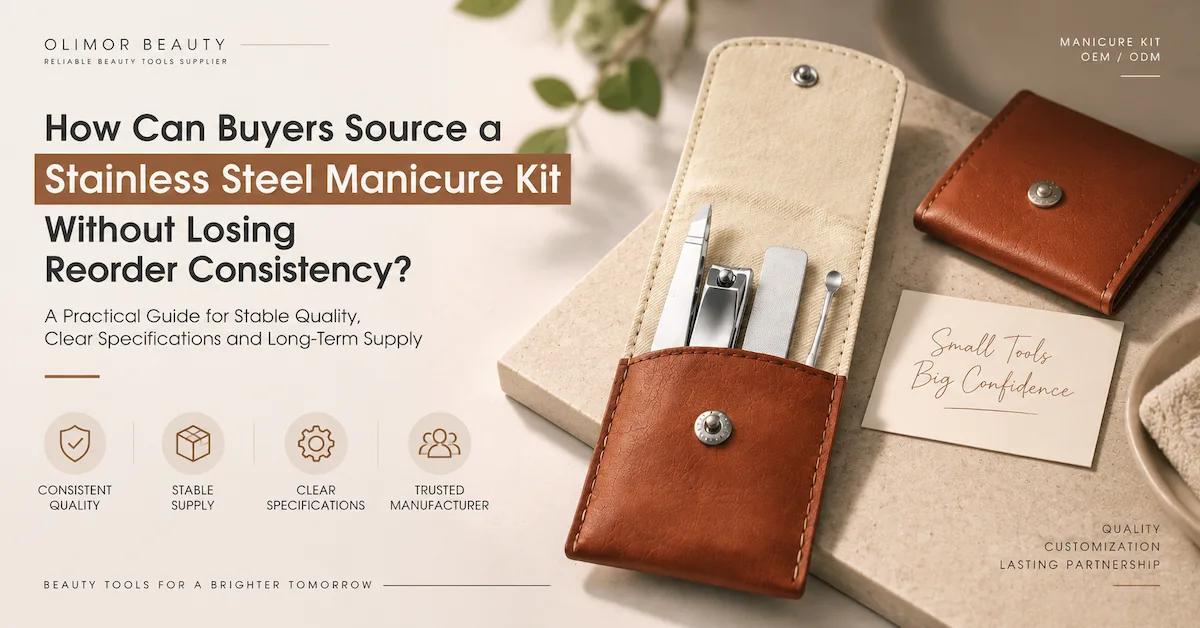
Quick answer: To source a stainless-tool manicure kit, specify the kit as one retail unit and each tool as a separate component. A buyer should verify the contents, material description by component, functional samples, case retention, artwork, carton and reorder revision before comparing quotations. A stainless steel beauty tools manufacturer may make or coordinate several parts, but “stainless kit” does not mean the case, insert and every tool share one alloy. OLIMOR BEAUTY offers a real manicure-set reference and reports metal-tool, assembly, inspection and packaging capabilities in Yangjiang, China; current kit contents, MOQ, lead time and material evidence must be confirmed for the quoted version.
A kit is a bill of materials, not a product photo
A buyer can approve a case photograph and still receive a different commercial product. A manicure kit consists of the case, closures, loops or insert, individual grooming tools, protective covers where needed, printed materials, retail carton and shipping carton. Each element needs an identity and an owner. A tool can be made to a good standard yet be placed in the wrong slot or supplied in the wrong count. A case can look correct while its retention loops allow a cutting edge to strike another component. The entire packed unit is therefore the object of approval.
Start with a component list. Give each tool a temporary code, quantity and intended task. Add the material claim only to the component for which the supplier can provide a designation or record. Ask whether a file or buffer is metal, abrasive, coated or made from another material; do not label it stainless merely because it sits beside metal tools. Describe the case material separately. If the range will have two variants, maintain separate component lists and package artwork. A shared product family name does not make their contents interchangeable.
The linked OLIMOR set gives a concrete starting point. The client knowledge base lists manicure sets among the company’s product categories and identifies OEM/ODM development, metal processing, polishing, deburring, assembly, inspection and packaging capabilities. It does not provide a currently approved component-level BOM, alloy list, case specification or MOQ for this product page. The buyer should ask OLIMOR to identify the offered version and then compare it with the intended kit brief. Company capability is a reason to inquire, not a substitute for a SKU release package.
Use the real product reference to frame the inquiry
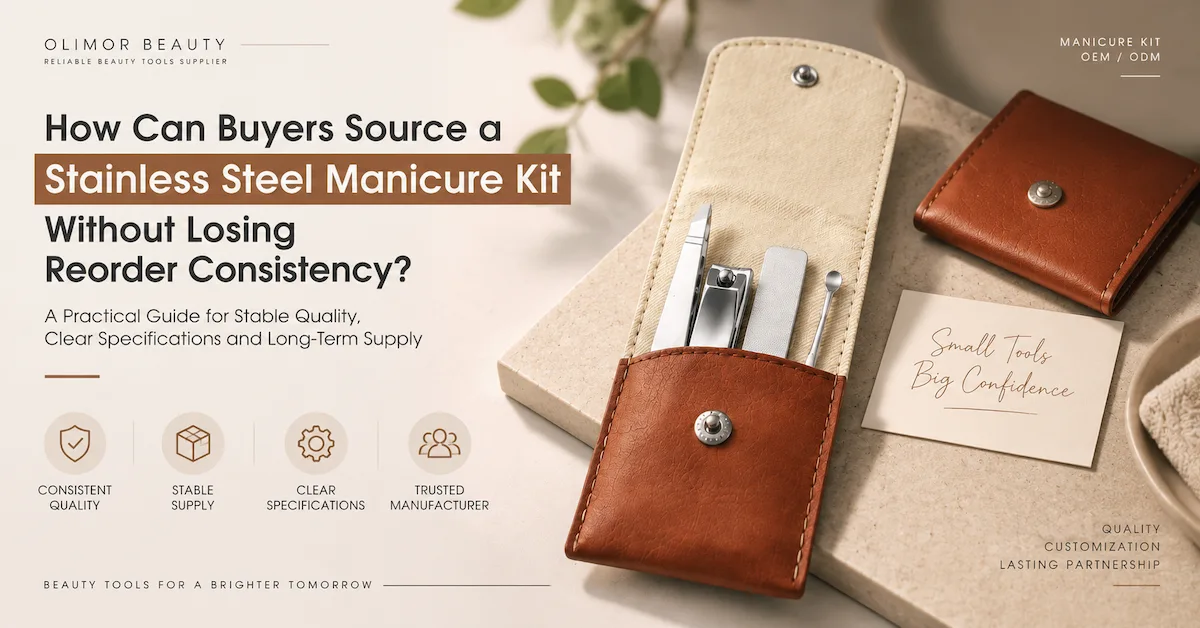
When a buyer shares this image, ask the supplier to name the exact configuration currently sold and whether the picture shows the whole unit of sale. Does the customer receive a case, an insert, a printed sleeve or a carton? Are the apparent tools fixed, or are alternative contents available? Which item is the core product, and which is an optional substitution? A photograph cannot answer those questions reliably. The supplier should provide a current item list and packed sample before the buyer approves a marketplace listing.
If a new set is being assembled from existing products, keep each component linked to its own product reference. For example, an OLIMOR stainless tweezers page may help define a candidate tweezer, while the set page anchors the retail unit. The inclusion of a linked standalone product in the article does not claim it is inside the pictured kit. The buyer must confirm the actual proposed component. Likewise, a cuticle-nipper product page is a candidate range reference, not proof that the case can accommodate it safely.
Ask for an open-case photograph, a closed-case photograph, a component layout and a carton view under neutral light. These support identity and retail presentation. Follow with a physical packed sample to evaluate retention, closure and damage risk. If a sample contains substitute tools while the final components are being developed, mark it “layout only.” A buyer who signs “approved” on such a sample may later disagree with a supplier about what was actually released.
Specify every component at the level needed for its task
Not all kit components need the same depth of technical file, but each needs enough detail to prevent a wrong substitution. A clipper may require blade meeting and lever action. A tweezer requires tip contact and arm movement. Scissors require their own cutting and pivot checks. A file requires its working surface, edge condition and protective handling to be defined. The case requires dimensions, closure, retention and surface finish. A common visual color can make a range cohesive; it cannot replace function-specific acceptance.
A component sheet can have columns for code, name, quantity, intended use, current image, material question, approved sample, finish, inspection characteristic and pack position. For an existing model, the product URL is useful but should not be the only identifier because a page can change over time. Date the reference and obtain a version or code from the supplier. For a new part, attach the drawing and its revision. Use a separate row for a substitute rather than overwriting the original. The sheet becomes the buyer’s comparison and reorder baseline.
Do not let “stainless steel manicure tools manufacturer” become a blanket statement about a whole mixed-material kit. The British Stainless Steel Association’s overview explains stainless steel as a material family, not a universal performance grade. Ask for the selected metal component’s designation and the record available for that component. A polished tool can look like a different alloy or coating in a photograph. A soft case, elastomer loop or paper insert has its own material and performance questions.
| Component | Buyer-defined requirement | Sample check | Document question |
|---|---|---|---|
| Clipper | Intended nail-care task, size and finish | Blade meeting and lever action | Which model and metal record? |
| Tweezers | Tip form and handling context | Contact and grip on agreed task | Which component designation? |
| Scissors or nipper | Working-end purpose and safety positioning | Movement, alignment and edge protection | Which sample controls production? |
| File or accessory | Surface, shape and storage | Working area and unwanted burrs | Is it metal, coated or another material? |
| Case and insert | Closure, retention, appearance | Open/close and transit handling | What materials and artwork are specified? |
Why mixed materials change the sourcing route
A kit can contain metal bodies, a plastic or synthetic case element, elastic retention, decorative coating and printed paper. Ask what OLIMOR makes in-house for the proposed version and what it sources or coordinates. Its client material lists both metal stamping and plastic injection capabilities, but this does not mean every case and component in a pictured set comes from the same workshop. The practical question is how the parts are specified, approved, assembled and inspected together.
If a buyer changes the case but retains standard metal tools, the route may be a hybrid project. The case may need new tooling or a new retention design while the tools remain existing models. If the buyer changes only branding and printed packaging, private label may suffice. If it supplies a controlled layout and component drawings, OEM may be appropriate. If it provides a user problem and asks the supplier to propose set composition and case, ODM may fit. Ask the supplier to quote the changed elements separately so “custom kit” does not hide which minimum and charge belongs to which part.
An OEM stainless steel beauty tools manufacturer inquiry should identify the buyer-controlled component files and the assembly specification. An ODM stainless steel beauty tools manufacturer conversation should identify the supplier’s existing platforms and newly proposed outputs. In either route, the packed unit and its contents must be versioned together. Ownership of brand artwork, case design, tooling and component drawings should be written before development work begins.
Case retention is a quality characteristic, not decoration
A compact case is attractive partly because it organizes several tools. If a loop is too tight, the user may need to pull on a sharp end to remove a component. If it is too loose, a tool can shift in transit and scratch another part or the case. If the case closes against a metal edge, the finish may be damaged before purchase. Review each position with the actual approved component, not a placeholder of approximately the same size. Test the opening and closing experience and look for contact points after a realistic handling exercise agreed by buyer and supplier.
Consider how the unit will be displayed and returned to the case. A retailer may hang it, stack it or ship it individually. A distributor may consolidate cartons. Ecommerce fulfillment may expose the case to repeated drops or compression. The necessary protection is a tradeoff among bulk, presentation and damage risk. A pack can be elegant and still require a simple protective insert. Ask for the packed sample and outer carton assumptions before comparing unit costs.
Never infer transit performance from a posed photograph. Agree on a handling or transport validation approach appropriate to the channel and evaluate the actual proposed carton. If a test is requested, identify the procedure and pass criteria in advance; this article does not claim OLIMOR has passed a particular test for this kit. Record any change to retention loops or inserts as a pack revision, because it can alter component fit even when the visible case exterior remains the same.
How to build a kit-level inspection plan
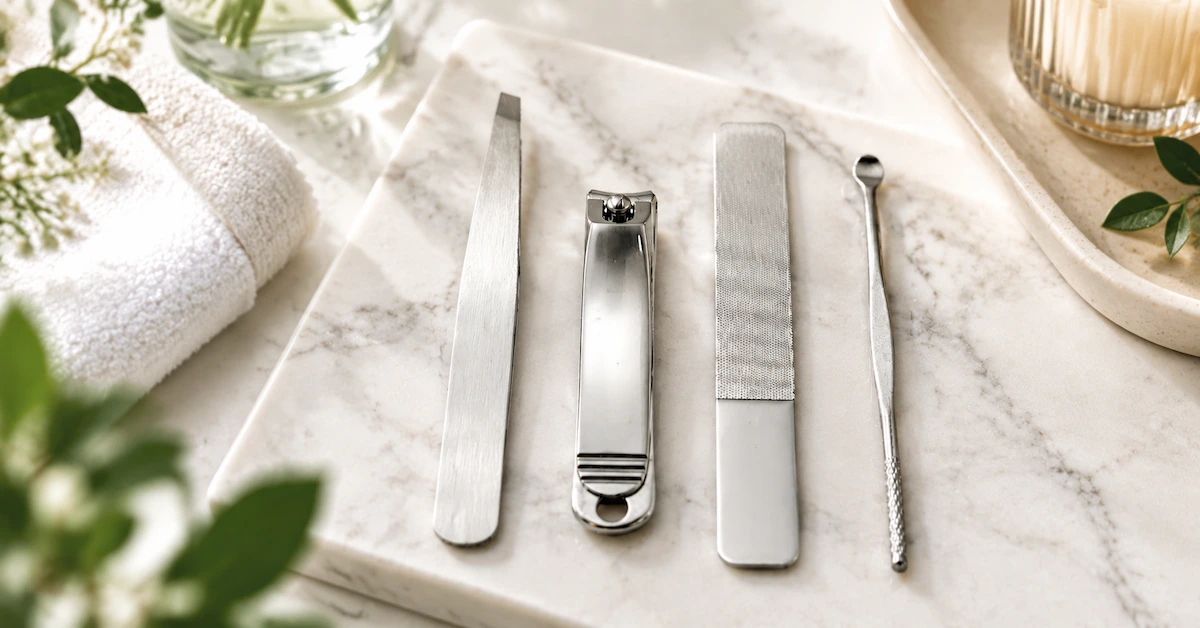
Inspection has two layers. Component checks ask whether each tool meets its own function and appearance standard. Assembly checks ask whether the correct components and quantities are present, seated in the right places, protected, correctly branded and packed into the right retail and shipping cartons. A kit can pass one layer and fail the other. Define both in the purchase specification and agree on the sampling approach. The client facts confirm OLIMOR in-process and finished/outgoing inspection, but do not publish an AQL level, sample size or results for this set.
Start with a master packed unit. Label the revision and list the components. For every item, name a critical characteristic and a cosmetic reference. Then define the kit-level count, case closure, retention, logo, insert, copy and barcode checks. Where inspection is visual, provide a photograph of an acceptable and unacceptable condition if possible. Where it is functional, identify the task and method. The team should know whether a missing component, loose tool, unreadable barcode or small surface mark has the same or different disposition.
If a supplier proposes a substitution because a component is unavailable, do not let an assembler make the choice silently. Compare the substitute against the item’s function, dimension, finish, logo position and case fit. Update the component list and physical master after approval. A substituted tool may be excellent in isolation but too long for the insert or unsuitable for the kit’s intended user. Written approval protects both the buyer’s listing and the factory’s assembly line.
| Inspection layer | Question | Evidence or reference |
|---|---|---|
| Incoming component | Is this the approved model and revision? | Component code, material record as applicable |
| Function | Does the tool perform its defined task? | Physical master and agreed check |
| Finish | Is the customer-facing surface acceptable? | Visual reference and lighting condition |
| Assembly | Are count and positions correct? | Approved BOM and layout photo |
| Packed unit | Does it close and protect each tool? | Packed master and handling review |
| Shipment | Do carton and label match the order? | Carton plan and packing list |
Package claims should follow component evidence
“Stainless steel manicure set” is a convenient product name, but it can imply more than the documentation supports. A careful listing identifies which components are stainless and what materials the case and other accessories use. If a brand wants to state a particular grade or cleaning method, request model-linked evidence and review market rules before printing. Avoid using “medical grade” or “rustproof” as generic selling language. A material family is not a blanket guarantee against all environments or handling.
The World Stainless Association’s material overview offers general context, not verification of an OLIMOR kit. A buyer should review the actual tool material by component and the finished-product care instructions. A tool may have a decorative finish or a joint requiring specific handling. A case may react differently to water or cleaners from a metal component. One care paragraph for the whole set can be misleading if it ignores these differences.
Market-specific copy may require importer details, language, country-of-origin information, warnings or disposal guidance. The buyer’s compliance reviewer should own those claims and ask the supplier for supporting data. A printable artwork file, proof at actual size and packed sample are needed before release. For ecommerce, compare the approved pack with the listing image and component count. A listing that shows a different assortment is a commercial defect even if the physical kit itself is well assembled.
How should a mixed-SKU wholesale quote be structured?
Wholesalers rarely buy one isolated SKU forever. They may want a compact kit, a larger kit and individual add-on tools. Ask whether MOQ applies to the metal component, case, color, printed package or total order. A mixed shipment does not automatically combine all component minimums. Quote the exact unit of sale for each variant and identify shared elements. A shared case may simplify the family, but its insert still must fit every proposed component arrangement. A printed carton may have a different economic minimum from a standard tool.
Use a range matrix: core kit, variant kit and standalone replenishment items. Give each a separate code and quantity range. Identify whether tools are interchangeable across packs and whether a substitution would change photography or instructions. A wholesale stainless steel beauty tools supplier should be asked to state prices and one-time charges by SKU, rather than giving one blended figure that cannot support margin planning.
Compare suppliers using the same content list and pack. A quotation for a case with three tools cannot be compared with one for four tools simply by dividing price by unit. Include sample costs, tooling, branding, print, inspection, carton, shipping term and validity. Ask when the schedule begins. No fixed MOQ or production lead time for this OLIMOR set has been confirmed in the client knowledge base. The RFQ should explicitly ask for those current terms, not insert a guessed number into the blog.
Reorder consistency requires more than the original purchase order
A purchase order captures quantity and price, but a repeatable kit needs a release package. Keep the current BOM, product and component codes, approved physical tools, finish references, case and insert sample, artwork revision, packed master, carton plan, inspection characteristics and accepted deviations. State which components may be substituted only with approval. If the buyer launches a variant, assign it a new SKU and BOM rather than relying on an informal description such as “the same set, but pink.”
Before a reorder, review what changed: destination market, sales channel, packaging language, tool material availability, branding, quantity and carton configuration. A new destination may require different labels. A new carton may alter fit. A larger quantity may justify a different process, but it should not silently change the master. Ask for reconfirmation of MOQ, schedule and quote validity. One version-controlled file makes this conversation faster and reduces the burden on both buyer and supplier.
At goods receipt, compare a sample of units with the packed master. Count tools, check model identity and retention, inspect carton labels and photograph any differences. A complaint should name the affected SKU, lot and component. “The manicure set is wrong” is less useful than “the tweezer in SKU B differs from master revision 03 and does not seat in slot two.” The latter directs an investigation to the correct component and assembly stage. This is a proposed buyer workflow, not a claim about a real OLIMOR customer incident.
What information should the buyer send for a serious RFQ?
Start with company type, destination, sales channel and expected retail unit. Link the OLIMOR set page and say whether it is a required model or a visual reference. Attach a draft component list with quantities, preferred tool models and unresolved choices. State the first-order and potential reorder ranges by variant. Specify the case, logo, finish, retail packaging, language and barcode requirements. Ask for component-level material descriptions and available evidence, sample stages, inspection proposal, MOQ drivers, tooling or setup charges, milestone schedule, shipment term and documents needed for the destination.
For a stainless steel manicure tools manufacturer comparison, the RFQ should also identify which tool is the commercial reason for the set. Is the clipper the hero, or is the kit positioned around brow and nail care? The answer changes which component needs the most attention in sampling and content. A general grooming assortment may prompt a related stainless steel grooming tools manufacturer question, but the kit should not absorb unrelated items just to use more search terms.
An effective request might say: “We import manicure kits for [market] and plan a [channel] launch. The linked OLIMOR product is our starting reference. We want [component list] in a [case type], with [logo and retail pack]. Please identify your current base version, provide component materials and sample options, quote [quantity range] per SKU, and separate tool, case, decoration, print and one-time costs. We need a packed sample and proposed component- and kit-level inspection points before final approval.” Brackets are buyer inputs, not current OLIMOR specifications.
How to compare supplier responses fairly
Score application fit, component identity, material evidence, function-specific sampling, case retention, artwork readiness, MOQ explanation, timing assumptions and change control. “Not stated” should remain visible. A supplier that asks a precise question about an ambiguous component may be more valuable than one that quotes instantly but silently changes the kit. Ask whether the metal tools, case and package are all included in the unit price. If not, calculate the retail-ready unit cost before comparing options.
Check company credentials separately from product evidence. OLIMOR’s client facts mention ISO and BSCI documents, but the verified knowledge base does not contain their exact standard number, legal entity, certification scope or validity. A buyer may request current copies. Even a valid management-system or social assessment credential does not establish the material or functional result of a particular tool. Keep the question “Can this supplier serve our project?” separate from “Does this version meet our approved specification?” Both matter.
Beware of a lowest-price response that omits a protective insert or substitutes a thinner case. The initial price may look attractive while returns, relabeling or rework erase the saving. That is a general procurement risk, not a forecast or customer outcome. A good quote reveals assumptions, alternatives and change costs, enabling the buyer to make an informed tradeoff. The purpose of this article is to support that conversation and earn a relevant inquiry, not to claim a guaranteed Google ranking.
Design a kit family without multiplying accidental variants
A retailer may want one everyday kit, a travel version and a gift edition. Before asking for three quotations, decide which components truly change. The everyday kit might define the common tool and case standard. The travel version may use a smaller case and fewer items. The gift edition may keep the tool mix but change packaging. These are illustrative configurations, not existing OLIMOR offerings. A variant map should show shared and unique components, the effect on photos and copy, and which master sample controls each product.
Give every combination a SKU. A color variation may need its own finish reference even if the tool geometry is unchanged. A case-size change needs a new packed sample because retention and closure may change. A different tool mix needs a separate BOM, carton label and barcode. Avoid allowing a buyer, sales team or packing line to improvise a variant by substituting whatever is available. If the brand decides that two tools can be interchangeable, name both approved models and state the substitution rule explicitly in the file.
Family-level standardization is valuable when it is intentional. A common logo size, care-copy structure or outer-carton labeling method can reduce errors. The same inspection form can include shared administrative fields while carrying different functional checks for each component. The important distinction is between common brand architecture and common technical specification. Scissors, nippers, clippers and tweezers should not receive the same generic “sharp and smooth” line because they perform different tasks and present different handling risks.
What changes when the buyer sells in several markets?
A multi-market kit may need different language, importer information, barcode or package claims. Build a master product specification and then a market-specific artwork and document layer. Do not let a new destination silently change the physical kit; if the content is unchanged, retain the same BOM and identify the market variant in the pack code. If local requirements demand a physical or labeling change, make it a controlled variant with its own approval. The buyer should consult its market specialists for applicable rules rather than relying on a broad statement that the supplier “exports globally.”
OLIMOR’s client information lists export markets including Japan, the United States, France, Germany, Australia, Brazil, Argentina, India, Southeast Asia and the Middle East. That is company-level context, not evidence that this manicure kit meets a particular jurisdiction’s requirements. Ask which documents are available for the selected model, which legal entity issues them and whether the country-of-origin and care wording are appropriate for the intended sale. A certificate covering one facility or product category may not cover every set or destination.
Translation is part of product accuracy. If the English kit list says “tweezers” but another language suggests a medical instrument, the package may communicate a different intended use. Keep a bilingual component list and have a qualified market reviewer approve it. Use the same item codes in the artwork, purchase order and inspection sheet. When the package is revised, update online listings at the same time so buyers do not receive a version that conflicts with the product detail page.
Separate unit price from the economics of the first order
For a new kit, first-order economics may include sample work, new case tooling, artwork, print setup, special finishes, inspection and inbound freight. Some costs recur per unit; some are one-time; some may recur only when a print or component batch changes. Ask OLIMOR to separate them in the proposal. A low unit price based on a standard case is not comparable with a quote for a new custom case. A larger order may spread setup cost over more units, but the buyer should not order excess stock merely to make a spreadsheet’s unit price look better.
Use a cost sheet with rows for each metal component, case, insert, printed package, assembly, inspection and carton. Request the supplier’s commercial grouping rather than assuming it will reveal proprietary manufacturing cost. The buyer’s objective is comparability, not a forced open-book negotiation. Add the buyer’s own landed costs, duties and fulfillment assumptions outside the supplier quote. If one supplier quotes FOB and another quotes a different trade term, normalize them before making a sourcing decision. A price comparison that omits shipment scope can favor the wrong option.
Ask how the quote changes with quantity and range mix. If the outer carton is shared across variants but the insert differs, the print minimum may be common while the insert minimum is not. If metal tools are standard but the case color is custom, the case may control MOQ. Ask for written validity and dependencies. The knowledge base confirms flexible order discussion but not a universal minimum or price; publishing a guessed MOQ would mislead buyers and undermine trust.
Run a packed-unit trial before final artwork release
A pre-production packed-unit trial should use the intended components and case rather than placeholders. Open and close the case repeatedly under an agreed method. Remove and replace each tool in a realistic order. Look for collisions, loose retention, scuffing, excessive force and difficult access. The buyer should also examine the package in the orientation it will occupy on a shelf or in a parcel. A label that reads well laid flat may be obscured by a hanging fold or shipping sticker. Record observations, decide which are defects and which are design preferences, then revise the actual reference.
The trial should include a straightforward receiving exercise. Ask someone who did not assemble the kit to check the contents against the proposed component list and package copy. If a trained employee cannot distinguish two similar files or tools, the line may also confuse them. Improve the code, shape reference or insert marking rather than depending on memory. Do not turn an illustrative trial into a claim about OLIMOR’s existing SOP; request their actual proposed assembly and final-inspection plan for the quoted version.
Only after the physical unit is stable should the buyer lock photography and marketing copy. A late change to a tool, case or insert can make the listing inaccurate. If the supplier needs to change an element after artwork release, the change request should assess function, appearance, images, packaging, regulatory text, inventory and schedule. This is less glamorous than a launch photo, but it prevents a brand from paying to print and ship a product it cannot describe consistently.
Ask who is responsible when a component fails
A kit may include items made or supplied through different operations. The buyer should have one accountable supplier contact for the retail unit while understanding which process owner will investigate a problem. If a clipper lever fails, the root cause may differ from a case snap that breaks or a tweezer tip that bends in its slot. The response should identify affected lots, segregate stock if necessary, compare the approved reference and examine the relevant process. A blanket replacement may satisfy an urgent customer but does not explain how the next order will improve.
Request a complaint pathway before an incident. What information should the buyer send: SKU, lot, photo, number of units, use condition and carton state? Who acknowledges it, and who decides whether stock may be shipped while an investigation proceeds? Which corrective record is retained? The precise contractual remedies depend on the agreement. This article does not invent an OLIMOR case or promise a response time; it shows the questions a serious importer should settle while the project is calm.
If the issue is only in a market listing, the corrective action may be a content update rather than a production change. If the case damages the tools, both component and packing teams may need to act. If material evidence does not support a package claim, the buyer may need to relabel or stop using the claim. Keeping these routes distinct avoids pressuring the factory to “fix” a product that matches its approved sample while leaving the actual communication error untouched.
Where do the remaining keyword routes fit?
A buyer searching for private label stainless steel beauty tools may need only an established kit with approved brand artwork. A request to a custom stainless steel beauty tools supplier may involve a changed case, tool mix or component design. A search for a stainless steel beauty tools factory China may emphasize production mapping and export execution. These terms identify different commercial questions; they do not prove the same kit can satisfy every route without a new sample or quote.
The useful next step is to identify your route in the RFQ and make the proposed kit visible. State whether the buyer controls the BOM, whether the supplier should propose a set, and whether only branding changes. Link the actual product page, give the market and quantity range, and request the evidence that matches the route. That is more likely to elicit a useful response than scattering eight keyword phrases through a message with no component list.
FAQ: stainless manicure-kit purchasing
Does “stainless steel manicure kit” mean every component is stainless?
No. The case, insert and some accessories may use other materials. Request a component-level BOM and material description before writing a package claim.
Can I change the tool mix inside the pictured case?
Ask OLIMOR whether the case and retention points fit the proposed mix, and whether a new insert, packed sample or MOQ applies. The picture alone does not prove configurability.
What is the first sample to request?
Ask for the current base kit with a written component list. Then request a packed sample of your proposed configuration before approving artwork or production.
How should I check a clipper and tweezers in one set?
Use different function-specific checks: blade and lever behavior for the clipper, tip contact and arm movement for tweezers. Add a separate kit-level count and retention check.
Does OLIMOR have a published MOQ for this configuration?
No model-specific MOQ is confirmed in the local client knowledge used here. Ask for a quotation by component, case, finish, package and quantity.
Can a shared case reduce minimums?
It may simplify a range, but insert fit and packaging print minimums still require confirmation. Do not assume a shared exterior means every variant has the same cost.
What should a private-label approval cover?
The underlying product and component list, logo placement, case, artwork, pack proof, functional samples and the final retail unit.
Should I request a certification?
Request current credentials with legal entity, scope and validity if needed for your procurement process. Do not treat them as a substitute for product-specific evidence.
What prevents a later order from drifting?
A revision-controlled BOM, retained packed master, component samples, artwork, inspection plan and written substitution approval.
Where can I request a kit quotation?
Use the OLIMOR contact page with the product link, target market, proposed contents and quantity ranges.
Tag: