

This guide addresses a real purchasing problem: How can a wholesaler build a low-MOQ beauty-tools assortment that is easy to test, replenish and quote? The intended readers are beauty brands, importers, retailers, distributors and ecommerce teams that need a manageable first order without losing control of product identity, quality evidence or repeat supply.
OLIMOR BEAUTY describes itself as a beauty and personal-care tools company supporting global brand, import, distribution and retail projects. Its provided company information confirms OEM and ODM support, development from drawings, physical samples, appearance concepts and structural requirements, plus listed capabilities in metal stamping, heat treatment, plastic injection, polishing, deburring, assembly, inspection and packaging. These capabilities are a starting point for an inquiry, not a substitute for model-specific confirmation.
The company information also confirms a China manufacturing and export context, with the factory located in Yangjiang, Guangdong, and export markets including Japan, the United States, France, Germany, Australia, Brazil, Argentina, India, Southeast Asia and the Middle East. Exact material, MOQ, lead time, certificate scope and test results remain project questions.
Buyer terminology used in this guide
Buyers may describe the project as a low MOQ beauty tools supplier search, a small batch beauty tools manufacturer inquiry, custom beauty tools low MOQ sourcing, an OEM beauty tools manufacturer low MOQ program, an ODM beauty tools manufacturer low MOQ program, private label beauty tools low MOQ development, a beauty tools factory China low MOQ request, or a wholesale beauty tools supplier low MOQ comparison. These phrases overlap, but the RFQ must still define the selected model, change scope, packaging and quantity assumptions.
1. Start with a channel-specific assortment brief
Treat the 'start with a channel-specific assortment brief' review as a decision gate, not a box to tick. For a wholesaler building a low-MOQ beauty-tools assortment, the buyer should state the commercial reason for the requirement, the person who approves it and the evidence that will close the question. That turns an open-ended request into a manageable supplier response.
Start the review with the linked product identity and then mark every requested change. Separate decoration, packaging, component changes and new development because each can affect sampling, minimums and schedule differently. Ask the supplier to show those effects instead of combining them in one unexplained price.
Close this gate with a named record: an approved sample, artwork proof, specification, inspection point or written commercial assumption. If the answer depends on the selected model, retain it as an RFQ question. Do not convert a conditional supplier response into a public product claim.
2. Choose the hero SKU and add-ons
The purpose of the 'choose the hero sku and add-ons' review is to prevent two teams from discussing different products. For a wholesaler building a low-MOQ beauty-tools assortment, write the requirement in buyer language first, then ask the supplier to translate it into product, process and packaging terms. Ambiguous adjectives such as premium, strong or high quality need an observable acceptance point.
A useful working file shows what is fixed, what is preferred and what remains open. Fixed items may include the application and destination; preferred items may include finish or package; open items may include the practical route or quantity band. This gives the supplier room to propose an option without quietly changing the buyer's objective.
The evidence should match the claim. A photograph supports appearance, not hardness or material grade. A product link supports model identity, not current stock or lead time. A test record supports only the tested sample and stated method. Keep this distinction visible in the approval notes.
3. Define the unit of sale
Use the 'define the unit of sale' step to make the quotation comparable. For a wholesaler building a low-MOQ beauty-tools assortment, send every candidate supplier the same product reference, unit of sale, destination, quantity range and customization list. Otherwise, a lower quote may simply omit decoration, retail packaging, inspection or a required component.
Ask for one-time charges and recurring charges to be shown separately. Sample, tooling, artwork or setup costs affect the launch, while product, packaging and inspection assumptions affect repeat orders. This separation matters when a small first order is intended to become a regular program.
Before approving the commercial answer, check its validity period, exclusions and dependencies. A schedule should state what starts the clock. An MOQ should state the controlling model, finish, component or package. A material statement should identify the applicable part and supporting record.
4. Plan mixed-model quantity bands
A disciplined 'plan mixed-model quantity bands' review reduces rework after sampling. For a wholesaler building a low-MOQ beauty-tools assortment, identify the earliest stage at which a mistake can be seen and corrected. An artwork issue can be found in a digital proof; a fit issue may require a physical sample; a carton assumption may need a packed-unit review.
Assign an owner on both sides. The buyer owns the market brief, mandatory claims and approval decision. The supplier explains feasibility, applicable processes and model-level evidence. When a third-party laboratory, packaging vendor or logistics provider is involved, record exactly which question that party answers.
Use dated revisions rather than screenshots scattered across messages. The current file should identify the product, option, artwork, package, inspection notes and accepted deviations. A clean record protects the first order and makes the next inquiry much faster.
5. Use shared packaging carefully
The commercial value of the 'use shared packaging carefully' step appears at reorder time. For a wholesaler building a low-MOQ beauty-tools assortment, decide which details must remain identical and which may be reconfirmed. Product geometry, approved appearance and brand placement may be controlled references, while quantity, shipping term and destination documents may change with each order.
Ask the supplier how a requested change is classified. A different logo position is not the same as a new working end; a new carton is not the same as a new component. Classification helps the buyer understand whether a new sample, minimum, setup or approval step is needed.
Keep the release package concise enough to use. Include the current product link or code, approved physical reference, artwork revision, pack proof, inspection requirements and commercial assumptions. Archive obsolete versions so they cannot return accidentally during replenishment.
6. Separate case and tool requirements
Review the 'separate case and tool requirements' question from the end user's context, not only from the factory's production view. For a wholesaler building a low-MOQ beauty-tools assortment, describe where the product is sold, how it is handled, what the package must communicate and which failure would create the greatest commercial harm. That context helps the supplier prioritize meaningful controls.
Translate the context into independent questions. Ask about the selected component, the relevant surface, the applicable operation and the evidence retained for release. Do not ask a broad question such as 'Is quality good?' when the real concern is alignment, count, finish, protection or artwork readability.
A strong supplier response will distinguish confirmed capability from project assumptions. OLIMOR-provided information can establish company-level OEM, ODM, production, inspection and packaging capabilities, while the RFQ must still confirm the SKU-specific material, MOQ, timing, certificate scope and test result.
7. Track component counts
Treat the 'track component counts' review as a decision gate, not a box to tick. For a wholesaler building a low-MOQ beauty-tools assortment, the buyer should state the commercial reason for the requirement, the person who approves it and the evidence that will close the question. That turns an open-ended request into a manageable supplier response.
Start the review with the linked product identity and then mark every requested change. Separate decoration, packaging, component changes and new development because each can affect sampling, minimums and schedule differently. Ask the supplier to show those effects instead of combining them in one unexplained price.
Close this gate with a named record: an approved sample, artwork proof, specification, inspection point or written commercial assumption. If the answer depends on the selected model, retain it as an RFQ question. Do not convert a conditional supplier response into a public product claim.
8. Review destination-market copy
The purpose of the 'review destination-market copy' review is to prevent two teams from discussing different products. For a wholesaler building a low-MOQ beauty-tools assortment, write the requirement in buyer language first, then ask the supplier to translate it into product, process and packaging terms. Ambiguous adjectives such as premium, strong or high quality need an observable acceptance point.
A useful working file shows what is fixed, what is preferred and what remains open. Fixed items may include the application and destination; preferred items may include finish or package; open items may include the practical route or quantity band. This gives the supplier room to propose an option without quietly changing the buyer's objective.
The evidence should match the claim. A photograph supports appearance, not hardness or material grade. A product link supports model identity, not current stock or lead time. A test record supports only the tested sample and stated method. Keep this distinction visible in the approval notes.
9. Build a wholesale margin worksheet
Use the 'build a wholesale margin worksheet' step to make the quotation comparable. For a wholesaler building a low-MOQ beauty-tools assortment, send every candidate supplier the same product reference, unit of sale, destination, quantity range and customization list. Otherwise, a lower quote may simply omit decoration, retail packaging, inspection or a required component.
Ask for one-time charges and recurring charges to be shown separately. Sample, tooling, artwork or setup costs affect the launch, while product, packaging and inspection assumptions affect repeat orders. This separation matters when a small first order is intended to become a regular program.
Before approving the commercial answer, check its validity period, exclusions and dependencies. A schedule should state what starts the clock. An MOQ should state the controlling model, finish, component or package. A material statement should identify the applicable part and supporting record.
10. Ask for carton-level assumptions
A disciplined 'ask for carton-level assumptions' review reduces rework after sampling. For a wholesaler building a low-MOQ beauty-tools assortment, identify the earliest stage at which a mistake can be seen and corrected. An artwork issue can be found in a digital proof; a fit issue may require a physical sample; a carton assumption may need a packed-unit review.
Assign an owner on both sides. The buyer owns the market brief, mandatory claims and approval decision. The supplier explains feasibility, applicable processes and model-level evidence. When a third-party laboratory, packaging vendor or logistics provider is involved, record exactly which question that party answers.
Use dated revisions rather than screenshots scattered across messages. The current file should identify the product, option, artwork, package, inspection notes and accepted deviations. A clean record protects the first order and makes the next inquiry much faster.
11. Create a replenishment trigger
The commercial value of the 'create a replenishment trigger' step appears at reorder time. For a wholesaler building a low-MOQ beauty-tools assortment, decide which details must remain identical and which may be reconfirmed. Product geometry, approved appearance and brand placement may be controlled references, while quantity, shipping term and destination documents may change with each order.
Ask the supplier how a requested change is classified. A different logo position is not the same as a new working end; a new carton is not the same as a new component. Classification helps the buyer understand whether a new sample, minimum, setup or approval step is needed.
Keep the release package concise enough to use. Include the current product link or code, approved physical reference, artwork revision, pack proof, inspection requirements and commercial assumptions. Archive obsolete versions so they cannot return accidentally during replenishment.
12. Protect the master sample
Review the 'protect the master sample' question from the end user's context, not only from the factory's production view. For a wholesaler building a low-MOQ beauty-tools assortment, describe where the product is sold, how it is handled, what the package must communicate and which failure would create the greatest commercial harm. That context helps the supplier prioritize meaningful controls.
Translate the context into independent questions. Ask about the selected component, the relevant surface, the applicable operation and the evidence retained for release. Do not ask a broad question such as 'Is quality good?' when the real concern is alignment, count, finish, protection or artwork readability.
A strong supplier response will distinguish confirmed capability from project assumptions. OLIMOR-provided information can establish company-level OEM, ODM, production, inspection and packaging capabilities, while the RFQ must still confirm the SKU-specific material, MOQ, timing, certificate scope and test result.
13. Keep artwork versions aligned
Treat the 'keep artwork versions aligned' review as a decision gate, not a box to tick. For a wholesaler building a low-MOQ beauty-tools assortment, the buyer should state the commercial reason for the requirement, the person who approves it and the evidence that will close the question. That turns an open-ended request into a manageable supplier response.
Start the review with the linked product identity and then mark every requested change. Separate decoration, packaging, component changes and new development because each can affect sampling, minimums and schedule differently. Ask the supplier to show those effects instead of combining them in one unexplained price.
Close this gate with a named record: an approved sample, artwork proof, specification, inspection point or written commercial assumption. If the answer depends on the selected model, retain it as an RFQ question. Do not convert a conditional supplier response into a public product claim.
14. Compare supplier response depth
The purpose of the 'compare supplier response depth' review is to prevent two teams from discussing different products. For a wholesaler building a low-MOQ beauty-tools assortment, write the requirement in buyer language first, then ask the supplier to translate it into product, process and packaging terms. Ambiguous adjectives such as premium, strong or high quality need an observable acceptance point.
A useful working file shows what is fixed, what is preferred and what remains open. Fixed items may include the application and destination; preferred items may include finish or package; open items may include the practical route or quantity band. This gives the supplier room to propose an option without quietly changing the buyer's objective.
The evidence should match the claim. A photograph supports appearance, not hardness or material grade. A product link supports model identity, not current stock or lead time. A test record supports only the tested sample and stated method. Keep this distinction visible in the approval notes.
15. Plan seasonal variations
Use the 'plan seasonal variations' step to make the quotation comparable. For a wholesaler building a low-MOQ beauty-tools assortment, send every candidate supplier the same product reference, unit of sale, destination, quantity range and customization list. Otherwise, a lower quote may simply omit decoration, retail packaging, inspection or a required component.
Ask for one-time charges and recurring charges to be shown separately. Sample, tooling, artwork or setup costs affect the launch, while product, packaging and inspection assumptions affect repeat orders. This separation matters when a small first order is intended to become a regular program.
Before approving the commercial answer, check its validity period, exclusions and dependencies. A schedule should state what starts the clock. An MOQ should state the controlling model, finish, component or package. A material statement should identify the applicable part and supporting record.
16. Handle low-volume exceptions
A disciplined 'handle low-volume exceptions' review reduces rework after sampling. For a wholesaler building a low-MOQ beauty-tools assortment, identify the earliest stage at which a mistake can be seen and corrected. An artwork issue can be found in a digital proof; a fit issue may require a physical sample; a carton assumption may need a packed-unit review.
Assign an owner on both sides. The buyer owns the market brief, mandatory claims and approval decision. The supplier explains feasibility, applicable processes and model-level evidence. When a third-party laboratory, packaging vendor or logistics provider is involved, record exactly which question that party answers.
Use dated revisions rather than screenshots scattered across messages. The current file should identify the product, option, artwork, package, inspection notes and accepted deviations. A clean record protects the first order and makes the next inquiry much faster.
17. Build a retailer-ready evidence pack
The commercial value of the 'build a retailer-ready evidence pack' step appears at reorder time. For a wholesaler building a low-MOQ beauty-tools assortment, decide which details must remain identical and which may be reconfirmed. Product geometry, approved appearance and brand placement may be controlled references, while quantity, shipping term and destination documents may change with each order.
Ask the supplier how a requested change is classified. A different logo position is not the same as a new working end; a new carton is not the same as a new component. Classification helps the buyer understand whether a new sample, minimum, setup or approval step is needed.
Keep the release package concise enough to use. Include the current product link or code, approved physical reference, artwork revision, pack proof, inspection requirements and commercial assumptions. Archive obsolete versions so they cannot return accidentally during replenishment.
18. Prepare a reorder RFQ
Review the 'prepare a reorder rfq' question from the end user's context, not only from the factory's production view. For a wholesaler building a low-MOQ beauty-tools assortment, describe where the product is sold, how it is handled, what the package must communicate and which failure would create the greatest commercial harm. That context helps the supplier prioritize meaningful controls.
Translate the context into independent questions. Ask about the selected component, the relevant surface, the applicable operation and the evidence retained for release. Do not ask a broad question such as 'Is quality good?' when the real concern is alignment, count, finish, protection or artwork readability.
A strong supplier response will distinguish confirmed capability from project assumptions. OLIMOR-provided information can establish company-level OEM, ODM, production, inspection and packaging capabilities, while the RFQ must still confirm the SKU-specific material, MOQ, timing, certificate scope and test result.
19. Review shipment deviations
Treat the 'review shipment deviations' review as a decision gate, not a box to tick. For a wholesaler building a low-MOQ beauty-tools assortment, the buyer should state the commercial reason for the requirement, the person who approves it and the evidence that will close the question. That turns an open-ended request into a manageable supplier response.
Start the review with the linked product identity and then mark every requested change. Separate decoration, packaging, component changes and new development because each can affect sampling, minimums and schedule differently. Ask the supplier to show those effects instead of combining them in one unexplained price.
Close this gate with a named record: an approved sample, artwork proof, specification, inspection point or written commercial assumption. If the answer depends on the selected model, retain it as an RFQ question. Do not convert a conditional supplier response into a public product claim.
20. Turn the first order into a system
The purpose of the 'turn the first order into a system' review is to prevent two teams from discussing different products. For a wholesaler building a low-MOQ beauty-tools assortment, write the requirement in buyer language first, then ask the supplier to translate it into product, process and packaging terms. Ambiguous adjectives such as premium, strong or high quality need an observable acceptance point.
A useful working file shows what is fixed, what is preferred and what remains open. Fixed items may include the application and destination; preferred items may include finish or package; open items may include the practical route or quantity band. This gives the supplier room to propose an option without quietly changing the buyer's objective.
The evidence should match the claim. A photograph supports appearance, not hardness or material grade. A product link supports model identity, not current stock or lead time. A test record supports only the tested sample and stated method. Keep this distinction visible in the approval notes.
1. Wholesale and RFQ intent: manage the assortment, not only the unit
The primary intent is RFQ Intent and Supplier Comparison. A wholesaler is balancing several SKUs, a first order, retail packaging, replenishment and destination-market review. The useful supplier is the one that can explain how a small assortment is configured, inspected, packed and reordered.
| Wholesale decision | What to define | What to request |
|---|---|---|
| Assortment | Core SKU, add-on SKU and seasonal option | Product list and model URLs |
| Quantity | First order and reorder ranges | Model-specific MOQ explanation |
| Packaging | Shared family or separate retail units | Pack options and carton data |
| Quality | Common and model-specific checks | Inspection plan and master samples |
| Reorder | Files, samples and revisions | Repeat-order release package |
2. Use the OLIMOR ear-picker kit as the product anchor
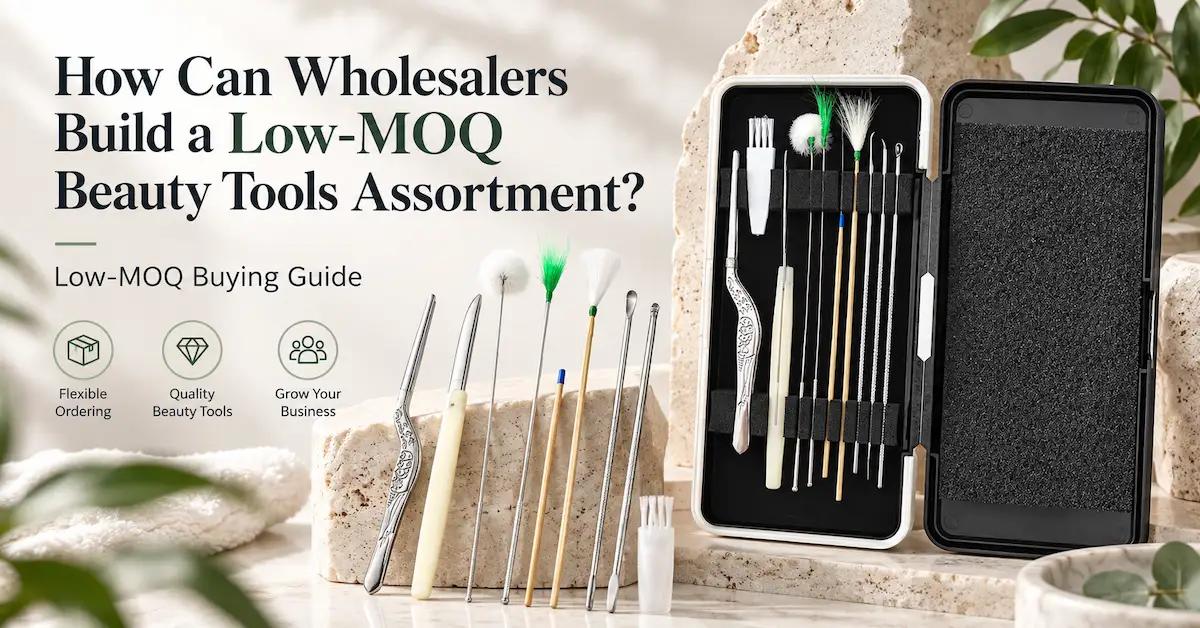
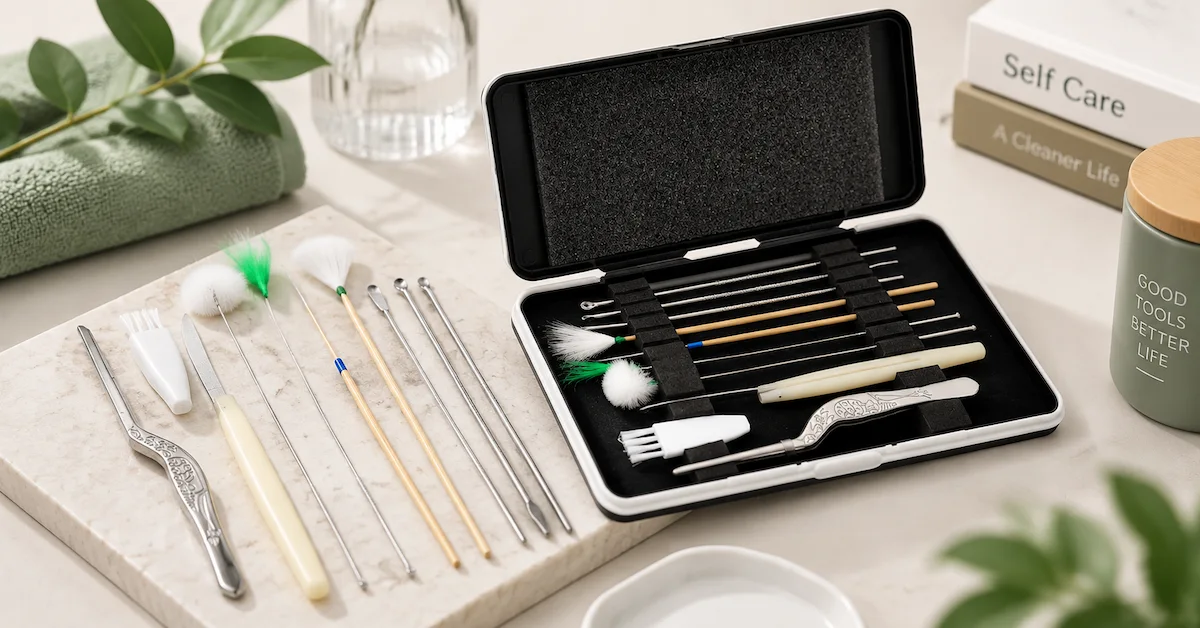
The linked OLIMOR ear picker kit gives a wholesaler a visible assortment to discuss. The public image shows a case with multiple tools, brushes and organized compartments. Use it to ask about component count, case configuration, working ends, package protection, logo placement and the unit of sale. Do not treat the image as proof of a fixed material list, test result, MOQ or market authorization.
A kit is a useful low-MOQ anchor because the buyer can separate the assortment into core and optional components. The core set may be retained across markets, while an add-on or package can change for a particular channel. This creates a conversation about shared packaging, shared artwork and repeat supply without inventing a quantity promise.
3. Plan the range before requesting a low-MOQ quote
A wholesale beauty tools supplier low MOQ quote should show how the range is organized. Name the core SKU, optional SKU, pack format, target market, first-order range and expected reorder. Ask whether the same case, insert or carton logic can support more than one item. Shared components may reduce complexity, but the effect on MOQ must be confirmed by the supplier.
The phrase wholesale beauty tools supplier low MOQ should not be used as a substitute for a range brief. A wholesaler needs to explain whether the order will be mixed across models, whether each model needs a separate print run, and whether the quote assumes loose tools, a kit or a retail-ready unit.
4. Build a small-batch assortment matrix
| SKU role | Product question | Pack question | Reorder question |
|---|---|---|---|
| Core | Which tool solves the main user task? | Can it use the family pack? | Will it remain a regular SKU? |
| Add-on | Does it expand the range or duplicate it? | Can it share artwork? | Is it replenished separately? |
| Gift or set | What is the complete unit of sale? | Does the case protect every part? | Which master sample controls it? |
| Market variant | What changes by destination? | Which copy or barcode changes? | Does the revision stay traceable? |
A low MOQ beauty tools manufacturer should be asked to quote the matrix rather than a vague assortment. This helps the buyer decide whether a small test needs every SKU or whether two core items can prove the channel first. It also gives the supplier a clearer basis for packaging, inspection and shipment planning.
5. Materials, processes and component ownership
The product page is the starting point, not the complete technical file. Ask which kit components are metal, plastic, brush, case or insert; which parts are produced in-house; and which are coordinated or assembled. OLIMOR-provided information lists metal stamping, heat treatment, plastic injection, polishing, deburring, assembly, inspection and packaging capabilities, but each SKU still needs mapping.
A stainless steel beauty tools supplier should state the model-specific material description when the kit includes metal tools. If a brush, case or plastic part is included, do not use one material word for the complete set. Record each component separately so product copy, packing and destination-market review are based on the actual assortment.
| Component | Buyer asks | Supplier evidence |
|---|---|---|
| Metal tool | Material description, finish and working end | Model record and sample |
| Plastic part | Colour, fit and component identity | Drawing or approved component |
| Brush or insert | Purpose, count and pack position | Set list and packed sample |
| Case | Retention, closure and logo area | Case sample and pack proof |
| Carton | Copy, barcode and carton marks | Current artwork and carton plan |
6. Low MOQ does not remove QC
The company information confirms production-process inspection and finished-goods shipment inspection. For a kit, ask whether the check covers component count, tool identity, surface, assembly, case retention, logo, insert and carton. A small order still needs a reference because a wholesaler must know what to reorder and what to report if a shipment differs.
Do not copy a generic inspection list from a nail clipper or scissors article. A kit has both component-level and packed-unit risks. The buyer should name the characteristics that matter to the channel: count, order, protection, readability, closure and any model-specific functional check.
7. Quote mixed quantities and packaging honestly
Wholesalers often need a mixed order. Ask whether MOQ applies per model, per finish, per package or to the total order. Ask whether the supplier can combine models in a carton, and what that changes in packaging, inspection and shipping. Do not assume that a flexible order statement means every combination is available at the same cost.
A beauty tools factory China low MOQ request should include the shipping destination and preferred trade term. OLIMOR’s provided information describes export coordination and support for mixed or full-container shipment contexts; the actual shipment plan must be confirmed for the buyer’s order.
| RFQ field | Mixed-order question | Evidence |
|---|---|---|
| Model mix | Can core and add-on SKUs be combined? | Written quote by model |
| Finish mix | Does colour or finish change minimum? | Finish table and sample |
| Pack mix | Can shared cartons or inserts be used? | Carton and pack plan |
| Inspection | Which checks are common and which are SKU-specific? | Inspection matrix |
| Shipment | How are cartons labelled and documented? | Packing list assumptions |
8. Private label and custom logo across a range
Private label beauty tools low MOQ programs need a brand system that works across several tools and packages. Define the master logo, clear space, placement, finish, artwork revision and package hierarchy. A core kit may carry the main mark while an add-on uses a smaller mark or only the package. Decide this before sampling.
Custom beauty tools low MOQ can refer to a range-level change rather than a new tool. Examples include a shared case, a new insert, a coordinated finish, or a different set composition. Ask the supplier to classify each request as decoration, configuration, component change or new development.
9. OEM and ODM options for a wholesale range
OEM beauty tools manufacturer low MOQ is useful when the wholesaler controls a specification or sample. ODM beauty tools manufacturer low MOQ is useful when the wholesaler wants the supplier to propose a coordinated assortment. In both cases, ask for a model-level scope and a shared-file strategy.
An ODM proposal should state which design input belongs to the supplier and which output the buyer approves. An OEM proposal should identify the buyer-controlled drawing, sample or requirement. A hybrid proposal can retain existing tools while developing a case, insert or assortment architecture.
| Route | Wholesale use case | Risk | Control |
|---|---|---|---|
| OEM | Buyer has a controlled assortment brief | Drawing misses pack reality | Feasibility and packed sample |
| ODM | Supplier proposes range architecture | Concept is not repeatable | Sample, file and master record |
| Private label | Existing set needs brand and pack | Each SKU drifts visually | Brand placement sheet |
| Hybrid | Standard tools plus new case or insert | Quote mixes scopes | Component-level RFQ |
10. RFQ checklist for high-quality inquiries
- Company, market, sales channel and destination.
- Core and optional product URLs or temporary SKU codes.
- First-order and reorder quantity ranges.
- Material, finish, logo and packaging preferences.
- Required sample stages and approval owners.
- Model-specific MOQ question for every changed element.
- Inspection evidence, carton data and destination documents.
- IP, artwork, tooling and revision-control questions.
This checklist gives a wholesale beauty tools supplier enough context to answer with a useful proposal. It also lets the buyer compare multiple suppliers without silently changing the unit of sale or the pack scope between quotes.
11. Reorder planning and inventory discipline
The first small order should create a replenishment record. Keep the approved master sample, set list, component count, product links, packaging artwork, carton data, inspection plan and deviation history. When a wholesaler returns, the manufacturer can quote the same configuration and identify what must be reconfirmed.
The reorder file should state what is fixed and what may change. A new colour, carton, insert or destination may affect MOQ and schedule. Ask for a written reconfirmation rather than assuming the first order conditions still apply.
12. FAQ for wholesale low-MOQ beauty tools
Can a wholesaler mix models for a low-MOQ order?
It may be possible, but MOQ can apply by model, finish, packaging or order configuration. Ask for the exact mixed-order rule.
What is the best core SKU strategy?
Start with a clear user task and a small number of complementary items. Use product evidence and channel demand to decide add-ons.
Can a kit share packaging?
Shared packaging can reduce visual complexity, but component fit, count, artwork and print minimums must be confirmed.
Does OLIMOR support OEM and ODM?
OLIMOR-provided information confirms OEM and ODM support. Confirm model-level scope and commercial terms.
What should be in a wholesale quote?
Model, quantity, unit of sale, finish, logo, packaging, MOQ driver, one-time cost, recurring cost, inspection, shipping and validity.
How should a material claim be checked?
Request component-level material information and supporting documents relevant to the selected SKU and destination.
How can a small range remain consistent?
Use a master logo, shared finish references, placement sheets, approved samples and revision control.
Are low MOQ and fast delivery the same promise?
No. Sampling and production schedules depend on development scope and order details. Request milestones.
What evidence should be kept for reorder?
Approved sample, set list, artwork, pack proof, inspection plan, carton data and deviations.
Are the workflow diagrams real factory images?
No. They are editorial visualizations for procurement explanation.
Tag: