

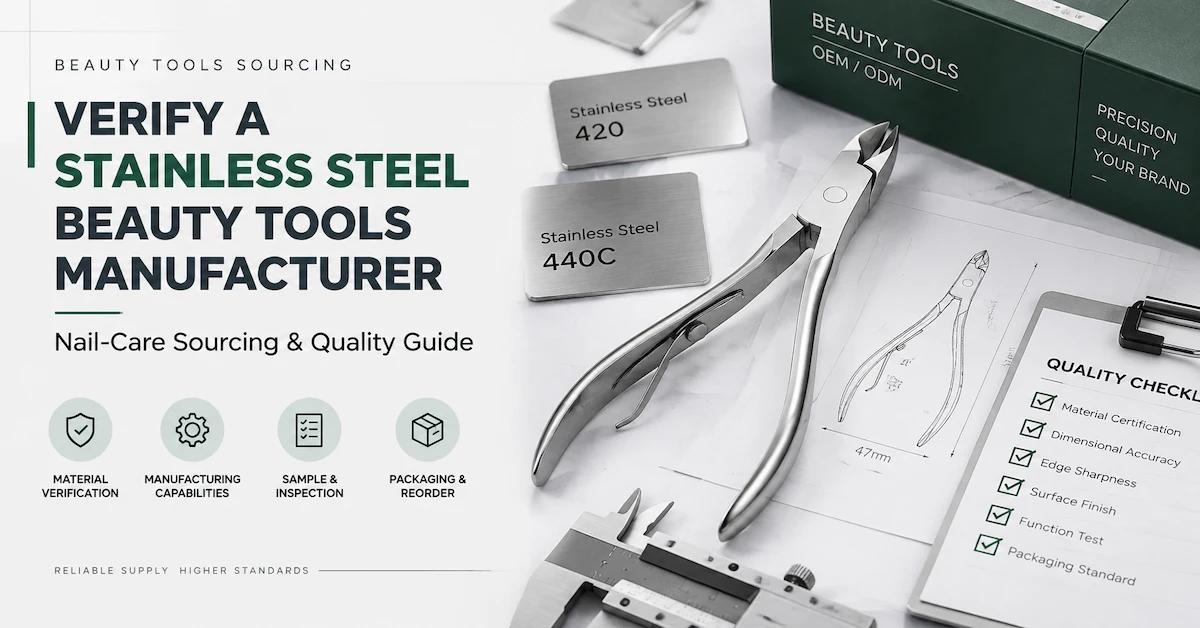
Quick answer: A buyer should not select a stainless steel beauty tools manufacturer from a photograph or an unqualified “stainless” claim. For a nail-care tool, identify the exact model and component, request its material designation and supporting record, approve the working edge and finish on a physical sample, agree on the applicable inspection method, and protect that configuration through packing and reorder controls. OLIMOR BEAUTY lists OEM/ODM, metal processing, inspection and packaging capabilities in Yangjiang, China; the grade, MOQ, schedule and test outcome for a selected nipper must still be confirmed in the quotation.
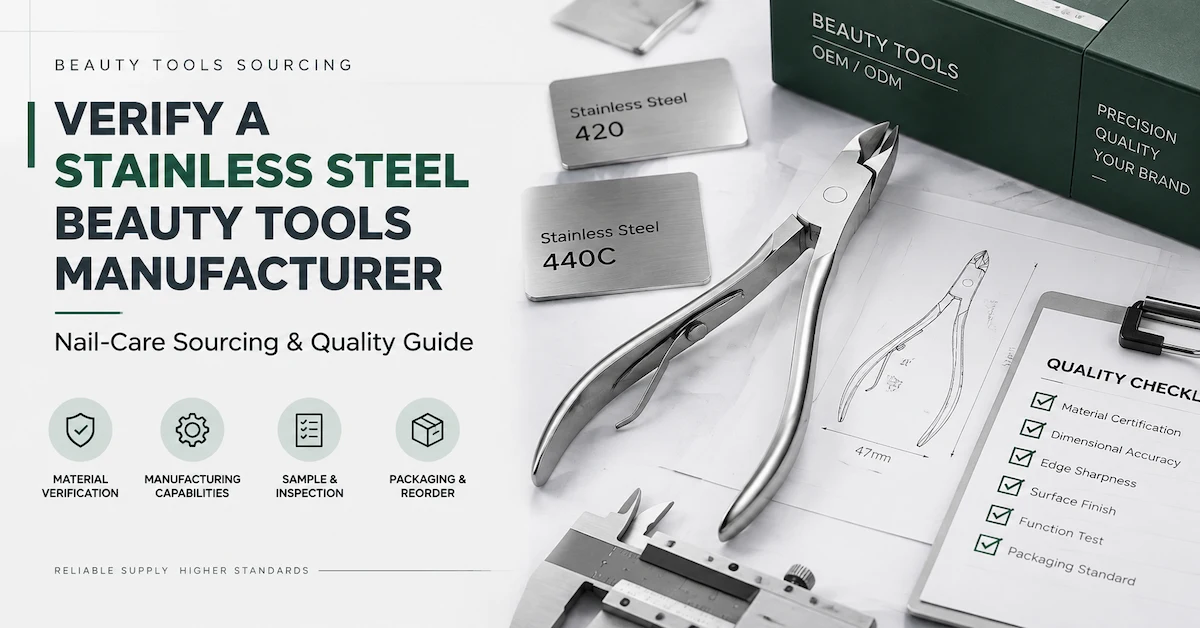
What does “stainless steel beauty tools manufacturer” mean in a purchasing brief?
The term can describe a factory that forms and finishes metal components, an OEM partner that works from a buyer drawing, or a supplier that assembles a retail-ready range. Those are different scopes. In a cuticle nipper, the working jaws, pivot, spring, handles, coating and protective pack can have different material or processing requirements. The word “stainless” on a category page does not describe every part, and a metallic color does not identify a grade. Ask the supplier to name the exact component to which each material statement applies.
OLIMOR BEAUTY is a beauty and personal-care tools brand with client-provided information identifying a factory in Yangjiang, Guangdong, China. That information lists metal stamping, heat treatment, polishing, deburring, assembly, in-process inspection, final inspection and packaging among its capabilities, along with development from drawings, samples, appearance concepts and structural requirements. It also lists torque and hardness equipment. These are company-level capabilities, not a published process route or test result for this nipper. A responsible article should say exactly that. The buyer’s task is to connect a specific tool, material record and inspection point to the supplier’s actual production response.
The application matters. A consumer retail nipper, a professional salon item and a manicure-kit component may share a broad product name yet differ in expected handling, protective packaging, surface presentation and destination labeling. A brand should state the intended user, channel and market in the brief. That context lets the supplier propose relevant sample checks without inventing one universal specification for the category.
Begin with a product identity that both sides can point to
When an RFQ begins with “a nipper like this,” the supplier may quote a different working end, spring or package from the one the buyer imagined. Save the product URL, current screenshot date and any available model code. Then describe what may change. If the buyer wants the pictured geometry and only a logo on a standard pack, say so. If the jaw profile, handle form, finish or spring is to change, identify that as a development question. A change to the working end is not merely a color option; it can change sampling and acceptance work.
Photographs are particularly unreliable for small metal tools. Glare can hide burrs. A closed nipper in a thumbnail cannot show whether the working edges meet evenly under light pressure or whether the spring returns smoothly. A crop can remove the package that protects the edge in transit. Request multiple views and a physical sample before defining “same as picture.” The approved physical unit should be identified, dated and stored as a master reference. If a quotation refers to a different model, the difference belongs in writing rather than being inferred from similar images.
Some buyers arrive through broader category searches. A stainless steel manicure tools manufacturer inquiry might lead to a multi-tool case, while a stainless steel grooming tools manufacturer inquiry may concern a standalone tweezer. A wholesale stainless steel beauty tools supplier request may cover both. These are related commercial paths, but they are not interchangeable specifications. The nipper in this guide has its own working-end, material and pack questions. A buyer building a wider range can use the linked product pages as separate references and request a model-level response for each tool instead of applying the nipper’s acceptance sheet to every item.
| Brief field | What the buyer supplies | What the manufacturer should confirm |
|---|---|---|
| Product identity | URL, model or reference sample, intended use | Quoted model and revision |
| Working end | Expected cutting task and unacceptable behavior | Geometry, sample and inspection method |
| Material | Requirement by component or destination market | Designation and available traceability record |
| Finish | Appearance reference and handling condition | Applicable finish process and visual limits |
| Pack | Unit of sale and sales channel | Protection, artwork, carton and pack minimum |
How should a buyer verify the steel rather than repeat a grade claim?
Stainless steels are a family of alloys, not a single quality level. The British Stainless Steel Association’s introduction to stainless steel explains the role of chromium and the protective surface film. That general material principle helps frame procurement questions, but it does not establish which alloy is used in the OLIMOR product. Some buyer briefs demand a familiar grade before explaining why; others accept “stainless steel” without any component record. Both approaches can miss the real performance requirement.
For a cutting tool, discuss the balance among working-edge behavior, corrosion environment, forming, heat treatment and finish. Ask the supplier for the material designation of the jaw or body in the proposed version, whether different components use different materials, and what form of record can connect the delivered lot to the agreed designation. A certificate, incoming record or supplier declaration must be checked for the correct material, batch and scope. A report for a different product or a past order is not evidence for the proposed SKU.
Ask a second, more useful question: what property is the buyer trying to protect? If the concern is staining during wet bathroom storage, identify exposure and cleaning assumptions. If it is cutting performance, define a repeatable sample test on the intended material or task. If it is a retailer’s material claim, identify the exact words intended for the package and the documentation the retailer will accept. This prevents a material designation from becoming a substitute for a functional specification.
Do not publish “304,” “420,” “medical grade,” “rustproof,” or a particular hardness for this model unless OLIMOR supplies a current, model-linked record and the claim is approved. A grade alone does not prove a finished tool’s performance. Conversely, a polished photograph does not prove a grade. This article deliberately leaves the grade blank because the client knowledge base has not confirmed it for the referenced SKU. The blank is an actionable RFQ field, not a missing marketing flourish.
Which process stages matter for a cuticle nipper?
A useful supplier conversation follows the physical tool. First, the metal stock must be suitable for the proposed geometry. Forming or machining creates the rough shape. If heat treatment is applicable, the buyer should ask what characteristic is controlled and where it is checked. Grinding and finishing define the working edges and feel of the tool. Deburring removes unwanted sharpness away from the intended cutting edge. Assembly governs pivot movement and spring action. Inspection and packaging preserve the approved result before dispatch. This is a buyer-facing process map, not a claim that every listed step occurs on the exact OLIMOR model.
Each operation creates a different question. At forming, ask where the dimensional reference comes from. At heat treatment, request the applicable method and evidence rather than a generic machine photograph. At grinding, compare jaw meeting and the cutting task on a reference sample. At polishing, inspect the surfaces a user holds and the areas where moisture or residue may remain. At assembly, evaluate smooth motion, alignment, return and looseness. At packing, check that a working edge cannot contact another metal item or the carton wall in ordinary shipment handling.
OLIMOR’s client-provided material confirms that the company has listed metal stamping, heat treatment, polishing, water deburring, assembly and inspection capabilities. It does not provide a public process sheet or tolerance for the cuticle nipper in the linked photo. When evaluating an OEM stainless steel beauty tools manufacturer, ask for a model-level route and identify which operations are performed by the factory and which, if any, are coordinated externally. This matters to corrective action: a defect found in final inspection is easier to solve when the relevant process owner and record are known.

Define the working-edge approval before discussing price
The working end is the nipper’s reason to exist. A buyer should describe the intended use carefully and avoid encouraging unsafe skin-cutting claims in consumer copy. For sample approval, the team can examine visual alignment, controlled closing, spring return, handle comfort, unwanted burrs and a functional exercise agreed with the supplier. The exercise should specify the test medium, method, evaluator and what counts as acceptance. “Cuts well” is not a record. A short video may demonstrate movement, but a physical sample lets the buyer compare touch, effort and control.
Review more than one sample when a brand expects repeat supply. Ask whether the sample was produced by the intended process or is a hand-finished development piece. A perfect hand-finished prototype can mislead a buyer if production tooling or routine inspection is still undefined. Record the sample stage: visual concept, functional prototype, pre-production approval or packed production reference. State what each stage proves and what it does not. If a sample reveals a snag, uneven meeting or stiff pivot, document it with a location and revision, then ask how a correction will be verified.
There is no universal cuticle-nipper test value supplied in the knowledge base. The right threshold depends on the model and the buyer’s intended claim. A buyer may set a visual limit for finish, a functional accept/reject description for jaw meeting and a packaging check for damage. If the supplier suggests a numeric dimension or hardness requirement, the two parties should agree on measurement method and sampling before adding it to a purchase order. Do not convert an illustrative checklist into a factory guarantee.
Corrosion risk is a product-and-package question
The World Stainless Association’s stainless-steel overview is a useful general reference for the material family. Corrosion behavior in a finished beauty tool also depends on grade, surface condition, manufacturing residues, exposure and care. A buyer who sees a dark point near a joint after storage should investigate the component and environment, not assume that every stainless part has failed or that all discoloration is the same phenomenon.
Translate the intended use into a test plan. Will a tool be kept in a bathroom, in a salon drawer, inside a closed travel case or in a humid distribution warehouse? Will it be cleaned with water, alcohol or another product, and who supplies care instructions? Are there dissimilar materials at the joint? Does the package trap moisture? These questions define the exposure scenario. A supplier can then propose appropriate checks for that SKU. If a neutral salt-spray test is discussed, agree on method, duration, sample preparation and pass criteria rather than citing the name of a standard as though it were proof of a result.
Packaging belongs in this discussion because a nipper that leaves final inspection clean can arrive stained or damaged if it is packed wet, unprotected or against abrasive material. Ask for a packed master sample, carton specification and handling assumptions. The pack should protect the jaw and spring while remaining practical for the sales channel. A reusable pouch may change moisture and retail presentation; a clear sleeve may reveal the tool but offer different protection. Those are design tradeoffs to test, not reasons to claim one universal solution.
What should an actual quality evidence request contain?
Ask for a small evidence packet tied to the quoted model. It can include the current specification, component material description, approved sample identifier, visual reference, inspection characteristics, applicable method, packaging proof and a record of final disposition. OLIMOR’s company information confirms in-process and finished-goods/outgoing inspection, but it does not disclose an AQL level, inspection frequency or this model’s results. The buyer should request the exact plan and ask whether critical, major and cosmetic issues are treated differently.
Evidence should be traceable enough to answer a complaint. If a customer reports a loose joint, can the supplier identify the affected model and lot? Was the inspected characteristic recorded? If the surface has a mark, is there an approved visual standard showing what was permitted? Does the carton code connect the shipped unit to the approved revision? These are practical questions for any stainless steel beauty tools factory China discussion, not claims that the OLIMOR page already provides every record.
| Potential issue | Evidence to request | Decision before release |
|---|---|---|
| Unclear alloy claim | Component designation and applicable incoming record | Approve the package wording only after matching the record |
| Jaw mismatch | Approved sample and agreed closing/functional check | Define reject condition and disposition |
| Rough finish | Visual reference for handle, pivot and working end | Separate intentional edge from unintended burr |
| Spring or pivot variation | Movement check and current assembly reference | Agree on sample stage and repeat check |
| Transit damage | Packed sample, carton assumptions and receiving photos | Revise protection before shipment |
How do OEM, ODM and private label change the material conversation?
In an OEM project, the buyer often supplies a drawing, reference sample or explicit requirements. The factory should comment on feasibility and identify where material, geometry or process assumptions conflict. In an ODM project, the buyer may describe the user and channel while the supplier proposes a platform or configuration. Private label often starts from an existing product and changes the logo or pack. These routes are not quality grades. Each can be appropriate if its responsibilities and evidence are clear.
An ODM stainless steel beauty tools manufacturer inquiry should ask who owns the base design, who owns any new drawing or tooling, and which version the buyer may reorder. An OEM drawing should state revision and allowable substitutions. A private-label order should identify the underlying product and what can change without a new sample. The buyer should not assume that a branded sleeve turns an unverified material into a verified claim.
If the request is for private label stainless steel beauty tools, prepare packaging language early. The product title and steel claim may appear on a carton, ecommerce page and distributor data sheet. Align those words with the model-specific material record and market requirements. A blank package proof is not enough when the sales channel needs warnings, care instructions, barcodes or importer details. The brand remains responsible for the claims it publishes, even when the supplier proposes them.
Finish and logo decisions require a visible master
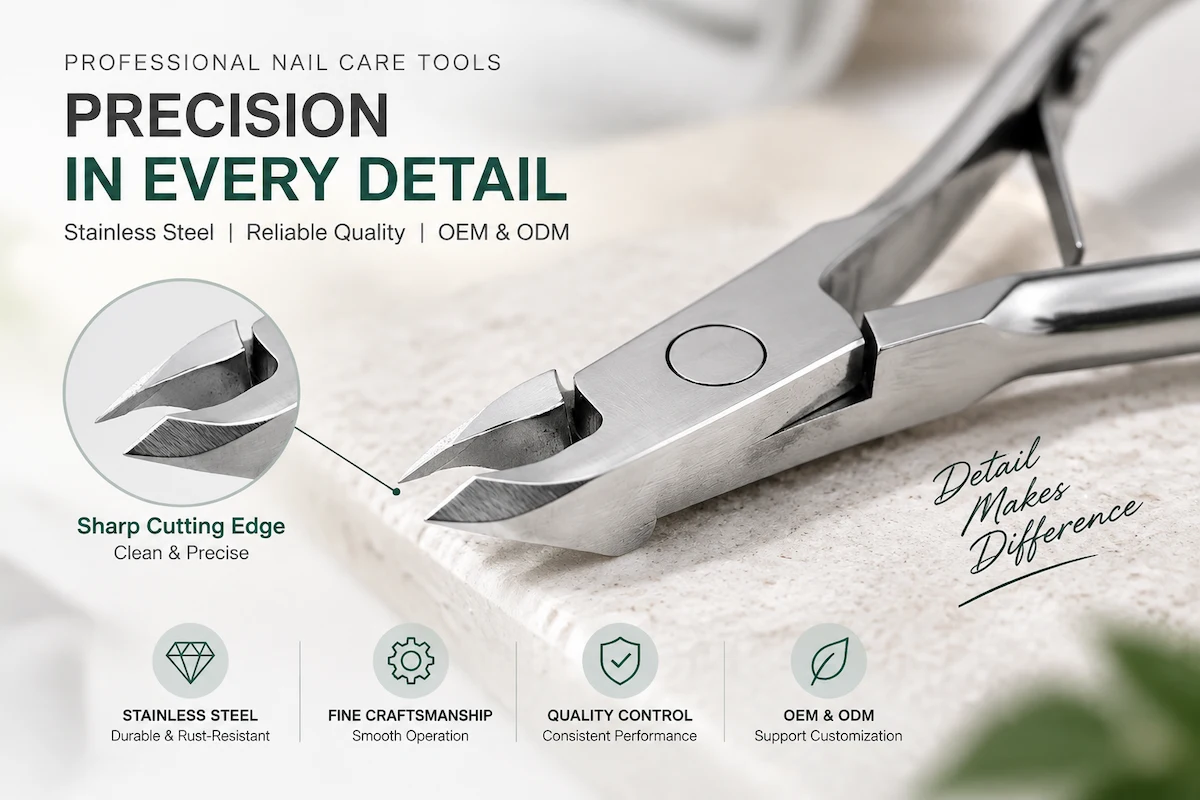
A polished, brushed or coated surface changes more than appearance. It can alter glare in product photos, touch at the handle, wear behavior, legibility of a mark and the way small scratches are seen under retail lighting. Ask for a physical finish reference alongside a digital rendering. Specify which areas may vary and which are customer-facing. When a design uses a logo, confirm the method, placement, size and contrast on the actual part. A crisp mockup can look poor once placed near a curved pivot or finger-contact area.
A custom stainless steel beauty tools supplier may propose several finish or decoration routes across categories. Do not approve a nipper finish because a tweezer sample looks good. The material, geometry and polishing access can differ. Ask for a nipper sample in the intended finish and pack, and document its revision. If a second tool is added later, use a shared brand palette but separate technical acceptance criteria.
For photographs, request one neutral product view, a working-end detail and a packed-unit view. Store them with the current master sample. These images support identity and the buyer’s listing workflow; they do not replace material or performance evidence. If a finish change is made after photography, update the product content. A mismatch between photographed finish and delivered finish creates avoidable returns even when both are technically acceptable.

How should MOQ and lead time be quoted without vague promises?
MOQ is not a property of the word “stainless.” It may be driven by the selected model, metal stock, finish, logo process, packaging print run or order configuration. Ask for a quantity ladder that separates an unmodified product, a decorated product and a changed working-end product. The supplier can explain which element controls the minimum for each option. Do not publish a universal low-MOQ number for OLIMOR when no current SKU-specific number has been provided.
Sampling and production schedules should be expressed as milestones and dependencies. Ask when the clock begins: after a drawing is approved, after a deposit, after a material confirmation, or after final artwork? If a buyer asks for a hard delivery date before the product, package and testing scope are frozen, the quote may conceal rework. Keep one-time development charges separate from repeat unit cost. Confirm whether sample freight, tooling, packaging setup, inspection or destination documentation is included.
A small pilot can be valuable even when its unit price is higher, because it may expose functional or channel issues before a larger order. That is an analytical example, not an OLIMOR customer case or price claim. Define what the pilot must learn: response to the product, rate of returned units, packaging feedback and actual replenishment cadence. The second order should be a repeat of a known configuration or an explicitly revised one, not a guess based on a photo.
Build a supplier-comparison matrix that does not reward omissions
Comparing three price-per-piece figures is tempting but often misleading. Normalize the unit of sale, material description, working end, finish, logo, sample stage, package, inspection scope, shipment term and documents. Mark “not stated” rather than silently treating it as “included.” Ask each supplier the same questions and keep their answers next to the same product reference. If one quote includes a tested packed sample and another includes a loose tool only, the difference is commercially meaningful.
Also compare the quality of the response. Does the supplier identify an uncertainty, propose a feasible alternative and explain its effect on MOQ or timing? Is a test report matched to the exact model and current revision? Does the team distinguish a general company certification from a product claim? A supplier willing to say “we need to confirm this SKU” may be more useful than one promising every grade, test and schedule without documentation. The scorecard should favor clarity and evidence, not just breadth of claims.
| Comparison row | Supplier A | Supplier B | Buyer action |
|---|---|---|---|
| Exact product / revision | Record quoted version | Record quoted version | Resolve any mismatch before price comparison |
| Material by component | Designation and record scope | Designation and record scope | Check the intended package claim |
| Functional sample | Stage and approval method | Stage and approval method | Use the same acceptance exercise |
| Finish and branding | Method, position and proof | Method, position and proof | Compare equivalent scope |
| Pack and shipping | Retail unit and carton | Retail unit and carton | Normalize landed-cost assumptions |
What should a high-quality cuticle-nipper RFQ say?
Begin with your company, destination market and sales channel. Link the exact OLIMOR product page and state whether it is a reference or a required base model. Describe the user task and expected retail unit. List first-order and forecast reorder quantity ranges, not an arbitrary “best price” request. Specify what is fixed, preferred and open: jaw form, handle, finish, logo and packaging. Ask for the material description by component and the evidence available for that description. Ask for sample stages, quality checks, MOQ drivers, milestone dates and a quote with one-time and recurring costs separated.
Make the inquiry answerable. A useful email might say: “We are a nail-care brand selling in [market]. We are considering the linked nipper as our reference. Our first order is [range] units, with a potential repeat order if the pilot passes. We need the current material specification for the jaws and body, an undecorated functional sample and a proposed retail pack. Please identify which of our requested changes affect MOQ, sampling or lead time, and which inspection records are available for this version.” Square brackets are fields for the buyer, not assertions about OLIMOR.
Preserve the answer after the first shipment
Once the project is approved, keep a compact release file. It should identify the model and revision, current product image, component material statements, approved physical sample, finish reference, logo artwork, retail pack, inspection plan, carton assumptions and signed deviations. The file does not need to be bureaucratic. Its purpose is to let a new buyer or factory contact understand what “same as last time” actually means. If a later order changes destination or packaging, state that change explicitly and request reconfirmation of MOQ, schedule and relevant compliance documents.
Receiving inspection closes the loop. Compare cartons and units to the approved pack and sample. Photograph any issue consistently, record quantity and lot, and describe the characteristic rather than only saying “poor quality.” A functional complaint about the jaw should not be merged with a cosmetic complaint about a carton. Ask for a corrective explanation connected to the responsible operation. The result is a better next order and a more defensible supplier relationship.
This guide is intentionally not a claim that any one supplier can guarantee a first-page ranking or a particular buyer outcome. It is a practical way to publish verifiable answers and invite a serious purchasing conversation. The more specific the buyer’s application, the more useful OLIMOR’s model-level response can be.
Five questions to ask during a remote factory review
Not every buyer can visit Yangjiang before placing a pilot order. A remote review can still be useful if it is organized around evidence rather than a showroom tour. First, ask the contact to identify the exact nipper version and show how the reference sample is labeled. Second, ask which operation creates the working end and what an operator checks before the part moves on. Third, ask what happens to a unit that fails that check: is it separated, reworked, scrapped or escalated? Fourth, ask what record connects the approved sample to the packed order. Fifth, ask who can answer a material or inspection question after a change of salesperson.
A video call can show equipment, but it cannot establish a current calibration status or a material batch by itself. Request a redacted example of the relevant form if disclosure is possible. If the supplier cannot share proprietary details, an explanation of the fields and responsibility can still reveal whether the system is defined. For the torque and hardness equipment listed in OLIMOR’s client material, ask which models use those checks and what the buyer may see for this project. Do not infer that the presence of equipment means every unit or product has been tested by it.
Record the answers with date and speaker. A buyer comparing suppliers should distinguish “demonstrated for the selected SKU,” “company-level capability,” “proposed for this project” and “not yet confirmed.” This four-column status is more honest than a yes/no checklist. It also gives the supplier a precise opportunity to provide the missing document during quotation rather than forcing the buyer to reject a capable partner because of an incomplete first email.
How to handle an unexpected substitution
Small metal tools sometimes face a proposed change in steel, finish, spring or packaging component. The buyer should require written notice before the substitution enters production, even when the new part is described as equivalent. Equivalence must be defined against the properties the buyer actually approved: material statement, working-edge behavior, visual finish, logo position, care information and pack protection. A change to one of these may also alter photographs, labels and marketplace listings.
Use a change request with four parts. Identify the current and proposed item by revision. State the reason for change and the affected orders. List the evidence needed, such as a material record, comparative sample, functional check and packed-unit proof. Finally, name the buyer who can approve it and the date after which it applies. An email saying “same quality” without a sample and effect analysis is not enough. Conversely, not every substitution requires a complete redesign; a documented review can show that some changes are administrative or visually immaterial.
If a substitution is discovered after shipment, segregate the affected inventory while the facts are established. Decide what can still be sold under the existing claim, what needs relabeling, and what requires replacement or customer notice. Those decisions belong to the buyer and supplier under the applicable contract and market rules. This is a process example, not an account of an OLIMOR incident. It illustrates why a modest amount of revision control protects a brand far beyond the first purchase.
Packaging copy and care instructions are part of technical approval
A package may say “stainless steel,” “professional,” “reusable,” or “easy to clean.” Each phrase has a different evidentiary burden and may be read differently across markets. Ask the brand’s regulatory or legal reviewer to approve claims against the exact product configuration. The manufacturer can supply component information and proposed care instructions, but the buyer should confirm suitability for the destination. Avoid suggesting that a tool can be sterilized by a particular method merely because it is metal; case materials, coatings, joints and intended use may limit the claim.
Care instructions should be practical and consistent with the proposed material and finish. How should a user dry the joint? Should the tool be stored closed or in a protective sleeve? Is a particular cleaning chemical compatible with decorative treatment? If the supplier cannot support a claim, omit it pending evidence. The point is not to fill a leaflet with warnings. It is to prevent a marketing promise from contradicting a maintenance requirement, especially when the product will be sold through multiple retail channels.
Review the barcode, legal importer information, country-of-origin wording and language requirements separately from the product’s physical quality. Those fields are market- and buyer-specific. A correct tool in an incorrect carton can be commercially unusable. Ask for an artwork proof at actual size, a printed sample if color or legibility matters, and a packed-unit check. The person approving the nipper’s function need not be the same person approving the destination-market label, but both approvals should precede release.
Make post-shipment feedback useful to the manufacturer
Retail complaints are often expressed as stories: “the nipper feels different,” “there is a spot,” or “the tip catches.” Turn each story into a reproducible observation. Capture the product and carton identifiers, the number of units inspected, the location of the issue, photographs in neutral light and the conditions under which it appeared. Compare an affected item with the retained master. If the problem is intermittent, avoid selecting only the worst-looking unit without documenting the broader sample. This helps distinguish handling damage from a systematic production change.
For a functional complaint, describe the action that failed without instructing unsafe use. For a surface complaint, note whether the mark is present on arrival or appears after storage or cleaning. For packaging damage, record the inner protection and outer carton condition. Ask the supplier to identify a plausible cause, the scope of affected stock and the verification step for a proposed correction. A replacement alone may satisfy a short-term customer, but it does not protect the next order unless the cause and revision are captured.
Close the feedback loop in the RFQ file. Update the inspection characteristic, package proof or care copy if the evidence warrants it. If the result is still disputed, mark it unresolved rather than inventing a cause. A transparent supplier relationship can accommodate uncertainty; a marketing article cannot responsibly convert uncertainty into a claimed success story. This is precisely where original factory evidence, once OLIMOR can share it for a model, would make future versions of this guide more useful.
FAQ: stainless beauty-tool material and nipper sourcing
Is “stainless steel” enough to specify a cuticle nipper?
No. Name the selected model and component, ask for the material designation and record, then approve function, finish and packaging. “Stainless” alone does not define the working edge or the complete retail unit.
Can the product photo prove the steel grade?
No. A photo shows an appearance and helps identify a model. It cannot establish alloy chemistry, heat treatment, hardness or a finished-product test result.
Does OLIMOR publish an MOQ for this exact nipper here?
Not in the verified client knowledge used for this guide. Ask OLIMOR to quote MOQ by model, finish, logo and packaging scope.
What is the difference between a material record and a corrosion test?
A material record describes the material supplied or declared for a component. A corrosion test evaluates a sample under a defined method and exposure. Neither automatically proves the other.
Should I request a salt-spray result?
Only if the test is relevant to your use and claim. Agree on the method, duration, sample condition, pass criteria and correct model before interpreting a result. No result is claimed for the referenced OLIMOR nipper.
How should a buyer assess the working edge?
Use a physical sample and an agreed functional exercise, supplemented by a visual alignment and movement check. Record what constitutes a rejection and who approves the master sample.
Can a private-label carton state a specific grade?
Only after the exact component and current material evidence support that wording, and the destination-market review is complete. A design mockup is not evidence.
Does a factory certification prove the nipper’s performance?
No. System or social-compliance credentials have a different scope from a model-specific material, functional or corrosion test. Request certificate scope and product evidence separately.
What belongs in the reorder file?
Model, revision, approved sample, material statement, finish reference, artwork, pack proof, inspection characteristics, carton data and accepted deviations.
Where can I send an inquiry?
Use the OLIMOR contact page and include the product link, destination, quantities and technical questions. The inquiry button below goes to the same page.
Tag: