

If you are sourcing a manicure set manufacturer, the obvious question is not just who can put tools in a case. It is who can make a kit that feels dependable in the hand, holds up in transit, and looks presentable enough for retail, hospitality, or private label programs. A manicure set is a small product, but the buying decision carries outsized weight: it sits in someone’s bathroom drawer, travels in a suitcase, or gets handed out as a gift. If the clippers bind, the case wears quickly, or the layout is awkward, the customer notices immediately.
That is why buyers often end up comparing a manicure kit supplier and a nail care set factory on more than price alone. Tool quality, case construction, presentation, and assembly consistency all affect whether the set feels like a commodity or a product worth keeping. For engineers and sourcing teams, the real job is to separate visible finish from actual manufacturing discipline.
What this type of manicure set is designed to do
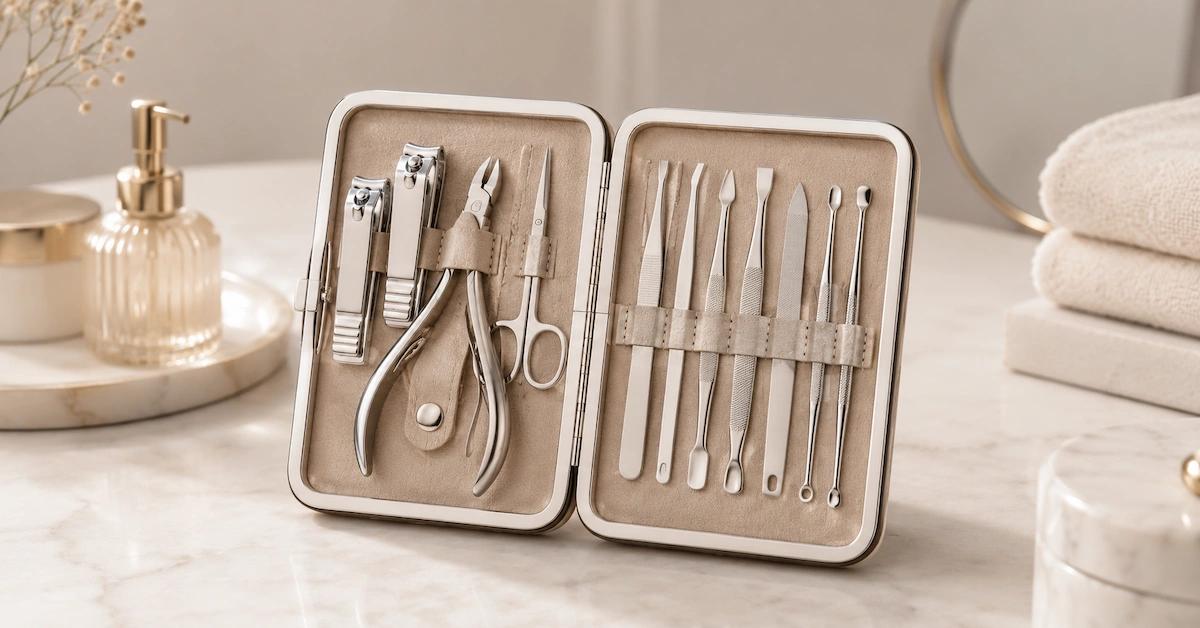
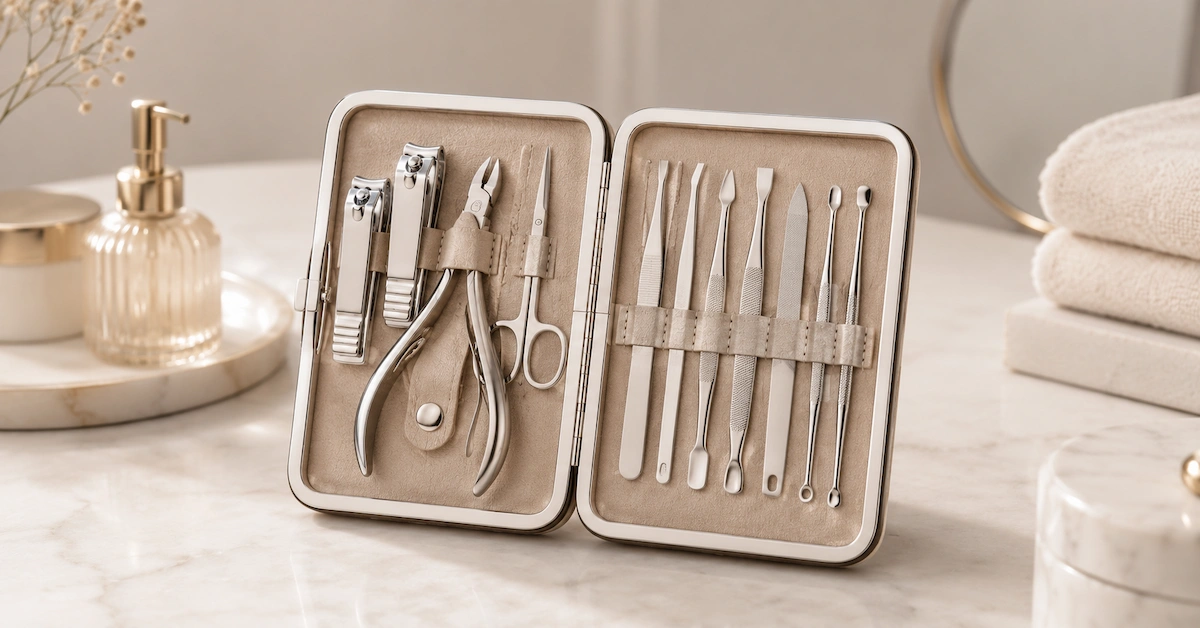
The product category here is a compact grooming set in a clamshell travel case. The visible layout suggests a multi-piece kit for nail trimming, cuticle care, tweezing, and general hand and foot grooming. The tools are arranged in elastic loops inside two hinged panels that open flat, which is a practical format for both storage and presentation.
From a buyer’s point of view, that format solves three problems at once. It keeps the tools organized, it reduces the chance of pieces rattling loose in transit, and it makes the set easy to sell as a complete system rather than a loose bundle of implements. That is useful in home-use retail, salon resale, hotel amenity programs, and OEM/private-label gifting.
Quick reference: what is typically inside and why it matters
The visible kit appears to include several stainless-steel hand tools, likely around 10 pieces or more, though the exact count is not confirmed. The lineup includes nail clippers, a cuticle nipper, scissors, tweezers, a nail file, and scraper or spatula-style manicure tools. Some tools show brushed and polished finishes, and a few have knurled or textured grips for better handling.
That combination tells you something about the target use case. This is not a bare-bones nail clipper pack. It is a broader grooming set intended to cover routine maintenance without forcing the user to buy separate accessories. In retail terms, the broader the functional spread, the easier it is to position the product as a value kit. In sourcing terms, though, more pieces mean more opportunities for dimensional mismatch, finish variation, or loose fit in the case.
Manufacturing perspective: where the quality usually shows up
Most of the value in a manicure set lives in the small details. The tools are likely made from stainless steel or a similar corrosion-resistant metal, then stamped, formed, ground, polished, and assembled into the case. That sounds simple, but the practical results depend on blade alignment, hinge feel, edge consistency, and surface finishing.
A well-made clipper should close cleanly and cut without chewing the nail. A cuticle nipper should have controlled jaw alignment, not a sloppy bite. Tweezers should meet evenly at the tip. Scissors should open smoothly without wobble. These are basic expectations, but buyers know they are not always met in commodity production.
The case adds another layer. The visible interior uses a soft beige or khaki lining with sewn elastic retention straps. That is a familiar construction for travel kits because it balances presentation and function. The outer shell appears light-colored with a rounded rectangular metal frame, though the exact shell material is not visible. It may be faux leather or another sewn covering over a rigid base; that is worth confirming during sourcing rather than assuming from photos alone.
Case design: portable, but not all portable cases age the same
The clamshell layout is popular because it is compact and easy to merchandise. It opens flat, presents the tools neatly, and closes into a slim form factor that fits a drawer, bag, or travel case. The rounded corners also make the set feel less clinical and more giftable, which matters in consumer channels.
Still, compact is not the same as durable. Buyers should pay attention to the hinges, the frame integrity, and how well the elastic loops hold up after repeated opening and closing. If the loops are too tight, tools are hard to remove. If they are too loose, tools shift and the interior starts to look untidy. That kind of wear is common in lower-grade kits and can undermine an otherwise decent product.
How buyers should evaluate a manicure kit supplier
When comparing suppliers, it helps to think in terms of function, presentation, and repeatability.
1. Tool function first
Check whether each tool performs a distinct task without overlap that feels decorative. If a kit includes multiple scraper-style tools, ask what each is meant to do. A buyer does not need unnecessary variety; a user needs tools that are recognizable and useful. Overstuffed kits often look impressive in photos but underperform in daily use.
2. Finish consistency second
Polished silver-colored metal is common, but consistency matters more than shine. Tool surfaces should match across the set, edges should be clean, and no piece should arrive with scratches, burrs, or obvious plating irregularities if a coating is used. A mixed finish can be acceptable when it is intentional; it looks careless when it is not.
3. Case assembly and fit third
The tools must sit correctly in their elastic loops, and the case should close without pressure points. If a supplier cannot keep the layout stable from sample to sample, mass production will be a headache. For private-label buyers, this is often where a promising sample becomes a frustrating order.
Common mistakes when sourcing these products
One common mistake is assuming all manicure sets are interchangeable. They are not. A set intended for hotel amenity use may need different positioning than a premium retail gift set. A hotel buyer may care more about cost, compactness, and quick visual appeal. A retail buyer may care more about tool feel, case aesthetics, and shelf presence.
Another mistake is ignoring tool ergonomics because the kit is small. Even in a travel format, the clippers, tweezers, and scissors still need sensible grip geometry. Small tools are especially unforgiving; poor shaping becomes obvious in use. That is true whether the product is aimed at home users or professionals who keep a backup kit in a bag.
A third mistake is over-specifying features that do not improve user experience. Buyers sometimes ask for more pieces when they actually need better selection. A clean set of essential tools can sell better than a crowded set with questionable utility.
What this product format is good for
This type of nail care set factory output fits several channels. For personal grooming, it offers a complete, portable solution. For beauty retailers, it can be bundled as an entry-level or mid-market set. For hotels, it works as an amenity product if the case style and price point match the brand. For gift sets, the enclosed presentation is a practical advantage because it looks organized without needing additional packaging.
It is also a reasonable base for OEM or private-label customization, provided the supplier can control logo placement, case color, tool mix, and packaging. Buyers should be cautious here: customization is only worthwhile if the underlying tool quality is stable. A branded bad product is still a bad product.
Questions to ask before placing an order
If you are evaluating a manicure set manufacturer, ask for clarity on the exact tool list, the metal material used for each implement, the case construction, and the available customization options. Confirm whether the case is genuine leather, synthetic, or another material, because appearance alone can be misleading. Also ask how the tools are secured during transit and whether the set can be packed in retail-ready packaging or bulk cartons.
For sourcing teams, it is worth requesting close-up photos of each tool, the hinge area, and the interior loop arrangement. Those images reveal more than a polished hero shot. They show whether the assembly logic is clean and whether the supplier understands repeatable production rather than one-off sample making.
FAQ: practical buyer questions
Is a larger tool count always better?
Not necessarily. More tools can add value if each one has a clear purpose. Otherwise, the set can feel cluttered and harder to use.
Can this type of kit work for travel?
Yes. The compact hinged case and organized layout make it suitable for travel, provided the closure is secure and the tools do not shift during movement.
What should I check first in a sample?
Start with clipper action, tweezer alignment, scissor feel, and the way the case closes. Those four checks usually reveal more than the packaging does.
Does the visible finish tell me everything about quality?
No. Shine is easy to see, but edge work, tool alignment, and case durability are more important indicators of a dependable product.
What a good sourcing decision looks like
The best decision is rarely the cheapest sample or the flashiest photo. It is the set that balances tool usefulness, stable assembly, and a case that protects the contents without feeling bulky. If you are sourcing from a manicure kit supplier, the real objective is to buy a product that looks orderly on day one and still feels solid after normal use.
For buyers building a private-label assortment, that means focusing on consistency before decoration. For product teams, it means confirming which pieces are essential and which are simply there to make the set look fuller. And for any nail care set factory conversation, it means asking questions early, before the order is tied to a sample that was never really production-ready.
If you are shortlisting manufacturers, compare sample sets side by side, open and close the case repeatedly, and inspect the alignment of each tool. That simple routine usually separates a workable program from a costly mistake.
Tag: