

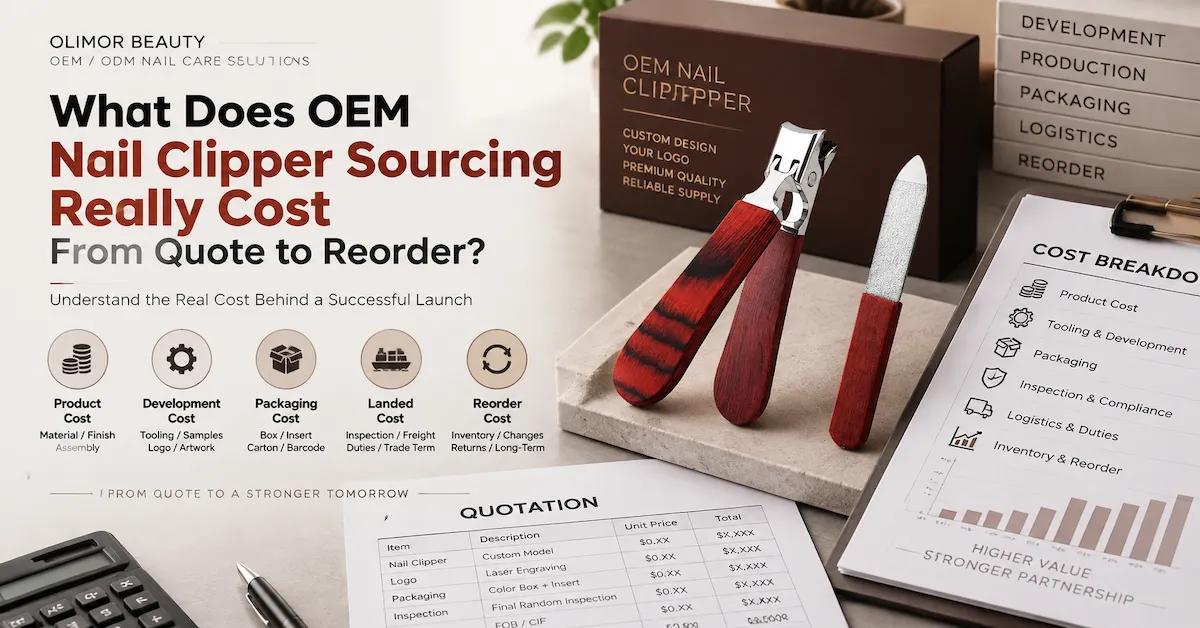
Search intent: commercial investigation, supplier comparison and RFQ intent. This guide is for beauty brands, retailers, distributors, importers and sourcing teams that need to understand why two nail clipper quotations differ and which cost decisions affect a launch after the first purchase order. It does not publish a universal price because no responsible price exists without a defined model, material, finish, package, quantity and delivery basis.
A nail clipper can be quoted as a loose standard item, a branded retail product, a configured tool with a special handle or finish, or a newly developed OEM product. Each path carries a different cost structure. A low number in the unit-price column can exclude logo setup, insert, box, testing, inspection, tooling, sample work, inner pack, carton or a realistic destination basis. A higher number may include them. The first procurement task is therefore normalization.
The second task is to understand cost over time. A new project can pay more for development and less during stable reorders. A standard private-label route may launch quickly but offer less differentiation. A complicated package can improve presentation while increasing freight and replenishment risk. The right choice depends on margin, channel, volume, brand promise and the cost of failure.
Body, cutting system, lever, components, finish and assembly.
Tooling, samples, colour, logo, artwork, package and validation.
Pack density, carton, inspection, trade term, freight and destination charges.
Inventory, defects, changes, stockouts, rework, returns and reorder drift.
Why the Lowest Nail Clipper Unit Price Can Be the Most Expensive Offer
Unit price is meaningful only when it describes the same product under the same conditions. One supplier may quote a standard body in an existing finish with bulk packaging. Another may quote a buyer-selected material statement, custom handle, logo, retail box, insert, final inspection and export carton. Calling one cheaper without normalizing the scope is a category error.
Missing scope usually returns as a later charge or compromise. The buyer discovers that the preferred coating has a different minimum, the logo requires setup, the retail box was not included, the approved insert changes carton count or the desired material was assumed rather than specified. Each late decision consumes time and weakens negotiating clarity.
Quality failures create indirect cost. Uneven blade meeting, rough touch surfaces, unstable lever action, scratched finish or packaging movement can require sorting, rework, replacement, customer service and delayed launch. Even when the factory pays for part of a correction, the buyer absorbs internal labour, inventory uncertainty and channel risk.
Reorder drift also has a cost. A component or finish changes without clear approval, forcing new photography, listing edits or complaint handling. A brand may hold packaging that no longer fits the product. The control system built during the first order is an economic asset because it reduces ambiguity later.
Define the Cost Object Before Comparing Suppliers
A cost object is the exact configuration being priced. Assign a model code and revision. State the intended user, channel, dimensions, cutting system, lever, material by component, finish, colour, logo, accessories, package, insert, language, barcode, pack count, carton, quantity range, inspection responsibility, trade term and destination basis.
Mark decisions as fixed, preferred or open. Fixed items must appear in the quotation. Preferred items can receive an alternative with the difference explained. Open items invite the supplier to propose a cost-effective route. This structure encourages useful value engineering without allowing a supplier to change a critical feature silently.
Give all shortlisted suppliers the same source package. If one receives a physical sample and another sees only a small photograph, their quotes will carry different uncertainty. Answer questions through a shared clarification log and issue a new RFQ revision when a decision changes.
Ask each supplier to repeat the quoted configuration in its offer. A product code without a description is not enough. The quotation should identify the revision, material, finish, logo, package, quantity band, inspection assumption and Incoterm. This lets the buyer audit the comparison without reconstructing weeks of messages.
| Cost object field | Why it changes cost | What must appear in the quote |
|---|---|---|
| Product platform | Existing, configured or new development requires different work | Model, drawing or sample revision and development class |
| Material by component | Body, lever, pin, handle and accessories may differ | Proposed material wording for relevant parts |
| Finish and colour | Process, batch size, setup and handling vary | Finish route, colour reference and included setup |
| Logo | Method, colours, position and fixtures affect setup and cycle | Decoration method, location and charge basis |
| Packaging | Material, print, insert, tooling and quantity affect cost | Primary pack, insert, artwork scope and pack count |
| Inspection | Method, sampling, reporting and third-party work add scope | Who inspects, to which plan, with which deliverables |
| Trade basis | Transport, export and destination responsibilities differ | Incoterm, named place, currency and validity |
Choose OEM, ODM or Private Label by Business Case
Private-label route
Private label nail clippers commonly start from an existing model. The buyer selects a platform, available finish, logo and package. Development risk and tooling may be lower, but the brand has less structural exclusivity. This route can suit market validation, retail programs with clear price limits or a coordinated collection built around proven platforms.
ODM route
An ODM nail clipper manufacturer may offer an established design direction or propose a product solution based on the buyer's market brief. Cost depends on which features are standard and which require adaptation. Clarify ownership, exclusivity, tooling, allowed changes and the documents that define the buyer's final version.
OEM route
OEM work begins with stronger buyer-defined input, such as a drawing, physical reference, dimensional envelope, cutting requirement or structure. It can create meaningful differentiation but may need engineering, tooling, more sample rounds and new inspection methods. The business case should consider expected volume, margin, time to market, channel value and how long the design will remain useful.
Do not choose a route by prestige. A new design is not automatically better than a well-selected platform. The best route creates enough market value to justify its development and supply complexity. Ask a custom nail clipper manufacturer to show a base option, a configured option and a genuinely new-development option where appropriate, with scope and cost separated.
Understand What Drives the Product Cost
Product cost begins with construction. Size, body geometry, edge or jaw form, lever, pin, file, catcher, handle and accessories affect material use, process time, tooling and assembly. A visually dramatic handle can add moulded or purchased components, colour control, fit checks and package volume. A simple metal clipper can still require close control of geometry and finishing.
Material should be specified by component. The phrase "stainless steel" is not a complete construction. A stainless steel nail clipper supplier should state which parts use which material and whether the selected model needs heat treatment or another process. Material wording should match the package, listing and buyer documentation.
Finish influences both appearance and handling cost. Polishing, plating, coating, colour and texture can create different batch conditions, setup, protection and inspection. Dark or coloured surfaces may make scratches or contact marks more visible. A finish that needs extra protection can change bags, inserts, handling and carton packing.
Assembly cost reflects component count, fit and checking. A catcher, handle, file or decorative component adds operations and possible failure points. Ask whether assembly uses fixtures and which features are checked during setup. A lower piece price that depends on manual adjustment may not support stable scaling.
Ask What Actually Drives MOQ
MOQ is not one factory-wide truth. It can be driven by metal or component purchase, coating batch, colour preparation, moulding, logo method, printed packaging, insert conversion, carton quantity or production setup. The highest threshold may come from the package rather than the clipper.
Request an MOQ breakdown. Ask for the product minimum, finish or colour minimum, logo minimum and packaging minimum. If one element exceeds the launch quantity, discuss an alternative that preserves the customer value. A standard finish with a short-run printed sleeve may be more sensible than weakening the cutting system to reach a target number.
Use first-order and annual volume ranges. A factory can plan differently when it understands that the first order validates demand and the program expects replenishment. Do not promise future volume to obtain a price unless the forecast is credible. Ask how the quote changes at transparent quantity bands.
OLIMOR's confirmed materials describe flexible order adaptation but do not provide a universal numeric MOQ. Therefore, every RFQ should request the minimum for the exact model, finish, packaging and order mix. Publishing a single number would be misleading.
Separate Tooling and Development Charges
Tooling can include forming tools, moulds, fixtures, gauges, decoration fixtures, insert tooling or package dies. Ask what each tool does, whether it is new or modified, who owns it, where it is stored, how it is maintained and how long the quoted conditions remain valid. A buyer-funded tool should have a clear ownership and access agreement.
Sample development may include engineering review, prototype or trial parts, finish trials, colour matching, logo setup, package mock-ups and shipment. Ask how many pieces and iterations are included. A sample fee without scope creates disagreement when the first round reveals necessary changes.
Keep one-time charges separate from recurring cost. A one-time setup spread across the first order can make the unit price look artificially high and obscure the reorder economics. Conversely, a waived setup may be recovered through a higher unit cost or volume commitment. Compare the lifecycle on the same basis.
Do not treat tooling payment as proof that the design is exclusive or legally owned by the buyer. Intellectual-property, confidentiality and exclusivity terms need their own written agreement and appropriate legal review. The product brief should avoid using third-party designs without permission.
Calculate Packaging as Product, Protection and Freight
Packaging cost includes more than board or plastic. It includes structural design, dieline, artwork, print setup, colour, finishing, insert, assembly, product loading, protective material, inner pack, master carton and inspection. It can also change the number of units per shipment and the labour needed at the buyer's warehouse.
Compare package concepts against the channel. A hanging card offers visibility and retail display. A paper box offers print area and can protect the tool when paired with a suitable insert. A case may add reuse and perceived value while increasing size and component count. An ecommerce route may need less shelf theatre and more parcel protection.
Ask for packed dimensions, packed weight, units per inner and master carton, carton dimensions and carton weight. Your logistics team can then calculate freight and handling using the chosen trade term and route. A smaller unit-price difference may disappear when one package creates much lower pack density.
Approve packaging with the production-intent clipper. Check lever pressure, edge contact, surface rubbing, movement, print, barcode, opening and count. If a late product revision changes size or handle shape, repeat the package review before printing the full quantity.
Budget for Quality Control Before It Becomes a Failure Cost
Quality planning has direct cost: engineering time, reference samples, fixtures, inspection labour, instruments, reports and possible third-party work. These costs should be visible and proportionate to risk. Omitting them does not remove the need; it transfers cost to sorting, delay or customer complaints.
Define critical features for the selected nail clipper. They may include blade meeting, agreed cutting task, lever movement, pivot, controlled dimensions, burrs, finish, decoration, package and product identity. Specify first-piece, in-process and final controls. Ask which checks are included in the quote and which require an external service.
OLIMOR's client-supplied information lists torque and hardness equipment plus in-process inspection and final shipment inspection. The exact inspection method, frequency and acceptance value must be established for the selected model. Equipment availability is capability evidence, not a product result.
If the buyer uses lot sampling, define the defect classes and acceptance plan in advance. ISO 2859-1 provides a recognized framework for sampling by attributes, but it does not decide which defects are critical, major or minor for a nail clipper. A serious functional or safety issue may need separate treatment.
Include Compliance and Documentation in the Commercial Scope
Compliance cost depends on destination, product design, material, age grading, packaging, claims and sales route. It may include risk assessment, technical information, material or restricted-substance tests, traceability, labels, translations, responsible economic-operator information or marketplace documents. The buyer should identify requirements early enough to affect product and package decisions.
The European Union's General Product Safety Regulation (EU) 2023/988 sets general safety rules for consumer products made available on the EU market. Buyers need a product-specific review of obligations. The United States CPSC business guidance is a starting point for identifying federal product-safety responsibilities.
Ask which documents are included and which require additional testing or third-party fees. Name the product, model, material, supplier and destination in the request. A test report for a different material or SKU should not be assumed to cover the current order.
OLIMOR's client-confirmed profile states that ISO and BSCI are available, but the source used here does not contain the standard number, holder, scope and validity. Buyers should request current documents and match them to the legal entity and factory. Do not use certification as a substitute for product evidence.
Planning note: Regulatory and test requirements change by market and product. Obtain qualified advice before approving claims, labels or testing plans. This guide supports sourcing questions and does not provide legal conclusions.
Price the Timeline, Not Only the Product
Time carries cost through staff workload, launch opportunity, inventory commitments and freight decisions. Build a milestone plan covering feasibility, tooling, samples, buyer review, revised samples, artwork, packed sample, material preparation, production, inspection and dispatch. Assign an owner and trigger to each stage.
The buyer controls part of the schedule. Slow artwork approval, unclear sample feedback or changes after material purchase can create delay and waste. Set internal review times and gather decision-makers before samples arrive. A structured feedback sheet is faster than separate comments from marketing, quality and purchasing.
Ask how a change affects the critical path. A new logo position may need only a proof; a new handle may affect tooling, assembly and packaging. A new finish can affect material preparation, colour approval and protective packing. The supplier should update milestones instead of preserving an impossible date.
Do not publish or plan around a universal lead time. OLIMOR's confirmed source data does not include one. A credible schedule must be attached to the final model, customization, quantity, package and production slot.
Calculate Landed Cost With Real Pack Data
Landed cost combines the product and package with inspection, inland movement, export handling, main transport, insurance where applicable, duty, taxes, brokerage, destination handling and delivery. The exact components depend on the Incoterm and route. State the named place and version of the selected Incoterm in the commercial agreement.
Ask the supplier for net and gross weight, unit pack dimensions, inner and master carton quantities, carton dimensions and carton gross weight after the package is approved. Preliminary data can support early planning, but update the calculation when the packed sample changes.
Consider inventory cost and cash timing. A high MOQ, long development path or bulky package may tie up more cash and warehouse space. A smaller first order can reduce demand risk but carry a higher unit or freight cost. The correct balance depends on forecast confidence, margin and replenishment capability.
Do not force a product decision from freight alone. A package must still protect the clipper and communicate correctly. Use landed cost to compare valid packaging routes, then document the chosen trade-off.
Build a Reorder Cost Model
Reorders should be cheaper to manage because the product is already defined. Keep tooling status, golden sample, specification, artwork, package, inspection plan and commercial assumptions in one release file. Separate setup that will recur from setup that should not recur under unchanged conditions.
Before each purchase order, ask the supplier to confirm changes in material, component sources, tooling condition, finish process, colour, logo method, package supplier, artwork, carton and inspection. If nothing changed, reference the current revision. If something changed, estimate the technical, commercial and schedule impact before approval.
Build price-review rules that both sides can use. Identify cost elements that may change, the evidence required and the notice period expected. Avoid a promise that prices can never move. Aim for transparency about material, packaging, labour, currency or freight assumptions relevant to the quotation.
A wholesale nail clipper supplier may support several models and market packs. Use clear model, colour, finish, artwork and carton codes. The reorder document should make it difficult to combine the right tool with the wrong package.
Use a Total-Cost Comparison Instead of a Unit-Price Ranking
Create one row per cost or risk and one column per supplier option. Include the recurring unit and package cost, amortized or separate development charges, inspection, expected pack density, commercial terms, MOQ, milestone assumptions and unresolved risks. Do not assign invented monetary values to uncertainty; describe it and decide what evidence closes it.
Compare a base route and one alternative where useful. For example, route A may use an existing finish and short-run paper package. Route B may use a custom colour and formed case. Show how the alternatives affect differentiation, MOQ, development, unit cost, freight, timing and reorder complexity. This gives management a real decision rather than a price-only recommendation.
Include failure scenarios. What happens if the sample needs another round, package print is delayed, final inspection fails or the launch quantity changes? A supplier with a slightly higher quoted price may have a clearer correction route and lower schedule risk. A cheap option with unresolved material and package assumptions may need a contingency.
| Comparison area | Option A: existing platform | Option B: configured platform | Option C: new OEM |
|---|---|---|---|
| Differentiation | Mainly logo, finish and package | Selected components and appearance | Buyer-defined structure and product language |
| Development cost | Usually lower, subject to package and decoration | Moderate and feature-dependent | Potentially higher due to engineering and tooling |
| Sample scope | Function, finish, logo and packed sample | Fit, function, component combination and pack | Engineering, function, process, appearance and pack |
| MOQ drivers | Finish, logo and printed package | Components, colour, finish and package | Tooling, material, process, package and production setup |
| Reorder control | Confirm platform and package are unchanged | Control the approved combination | Maintain full release and change-control file |
Negotiate by Removing Ambiguity, Not Hidden Quality
Effective negotiation separates value from waste. Ask which features drive cost and whether they support the customer's reason to buy. A package layer may be removed if it adds no protection or communication. A complex colour may be simplified if the brand can use an existing finish. A redundant accessory may be removed before reducing the quality of the core cutting system.
Use open-book questions without demanding confidential supplier information. Ask what changes when quantity increases, which setup is shared across models, whether colours can be grouped, how carton density changes and which package route has the lowest minimum. Ask for technical consequences beside every saving proposal.
Do not ask the supplier to meet a target by silently substituting material or removing inspection. Mark the requirements that cannot change. If price remains above the business case, choose a different route or product position rather than pretending the gap does not exist.
Negotiate payment, tooling ownership, sample scope, approval milestones, warranty or remedy process and change notice in addition to price. These terms shape cash exposure and the cost of resolving problems.
Apply the Cost Model to Three Common Buying Scenarios
Scenario 1: A new ecommerce brand testing one hero SKU
The brand needs visible differentiation but has limited demand history. Its cost risk is not simply a higher unit price; it is committing cash to tooling, colour and packaging before the listing has proven demand. A sensible comparison can begin with an established clipper platform, a finish that already has a workable production route, a clear logo treatment and packaging designed for parcel protection and product photography.
The buyer should ask which decoration and package elements create the MOQ. If a custom case drives the highest threshold, compare a shorter-run paper box or sleeve while retaining the approved functional product. Keep the first package flexible enough for copy corrections, and retain the same model code and sample record for the next order. The business case should include photography, marketplace documentation, inspection and parcel packaging alongside the factory quote.
Scenario 2: A retailer building a store-brand nail-care range
The retailer may source several sizes or combine a clipper with a manicure set. Shared colour, finish, artwork architecture and carton labelling can reduce complexity, but the team should not assume every model can use identical material wording or functional checks. Establish a family design language, then issue a product-specific appendix for each clipper.
Cost analysis should compare the range rather than one SKU in isolation. A shared packaging system may reduce setup and simplify shelf presentation, yet an insert must still fit each product securely. Combining production or print quantities can create efficiency, but only if launch dates and inventory needs align. The retailer should also price market-specific artwork, translations, barcode management, receiving inspection and replenishment across stores or distribution centres.
Scenario 3: A distributor replacing an inconsistent incumbent source
The distributor already knows annual demand but may lack a reliable specification. The first task is to convert the current product and complaint history into controlled requirements. Do not ask a new supplier to copy visible defects or undocumented variation. Identify the intended blade meeting, lever feel, finish, logo, package and carton, then approve a clean reference.
Switching cost includes sample comparison, possible tooling, new packaging proof, inspection and overlap inventory while the new source is validated. The cheapest transition may be risky if old and new stock become mixed or customers receive a noticeable change without explanation. Use separate lot and model codes, plan a controlled cutover, and keep enough old and new retention pieces to investigate questions.
These scenarios show why no single cost formula fits every buyer. The ecommerce brand manages demand uncertainty, the retailer manages range and package complexity, and the distributor manages transition and continuity. The same supplier offer can be attractive in one case and unsuitable in another. State the business problem before negotiating the product.
Evaluate Factory Evidence Behind the Cost
A low quote from a supplier with unclear process ownership may carry more execution work for the buyer. Ask a nail clipper factory China candidate to map the selected model through material receipt, forming, applicable heat treatment, grinding, polishing, deburring, assembly, decoration, inspection, packaging and storage.
Review how the factory identifies the current revision, controls reference samples, checks first pieces, records in-process results, segregates nonconforming goods and approves rework. Follow one model rather than judging a general presentation. If a process or component is external, inspect the incoming and change-control logic.
OLIMOR's confirmed profile reports operations in Yangjiang, Guangdong, a factory founded in 2017, about 6,000 square metres, approximately 200 employees and broad annual hardware and injection capacity. It lists in-house metal and injection capabilities, quality inspection and export coordination. Buyers should verify current, project-relevant evidence during due diligence.
Capacity should be discussed at the model and production-window level. Annual company capacity does not automatically translate into a confirmed slot for a new product. Ask about tooling, bottleneck processes, component lead times, package readiness and contingency for the requested order.
Create a Commercially Useful RFQ Package
The RFQ should contain enough information for a supplier to return a structured offer. Include the company and destination, target user and channel, model or reference, dimensions, material preferences, finish and colour, logo, packaging, quantity ranges, required documents, inspection expectations, launch timing and trade basis.
Ask for three response blocks. The technical block confirms the proposed product and open questions. The commercial block itemizes development, tooling, product, decoration, package, inspection and shipment assumptions. The schedule block lists milestones and buyer dependencies.
When comparing an OEM nail clipper manufacturer, a private-label supplier and an ODM proposal, keep all three routes visible. Do not force them into one price row if they create different products. Present the trade-offs to management and select the route that supports the channel and lifecycle economics.
- Issue one controlled specification and clarification log.
- Request a base quote and clearly labelled alternatives.
- Separate one-time and recurring costs.
- State MOQ by product, finish, logo and packaging driver.
- Confirm sample scope and included revisions.
- List inspection, documentation and compliance assumptions.
- Require packed dimensions and carton data after approval.
- State Incoterm, named place, currency and validity.
- Define tooling ownership and change notification.
- Carry the approved release file into reorders.
How OLIMOR Fits an OEM Nail Clipper Cost Discussion
OLIMOR BEAUTY supports OEM and ODM beauty-tool development from drawings, samples, appearance concepts and structural requirements. Its reported capabilities include stamping, heat treatment, injection moulding, polishing, water deburring, assembly, packaging, quality inspection and export coordination. This combination allows buyers to discuss both metal tool and applicable plastic-handle or packaging needs in one project conversation.
The product portfolio includes nail clippers and related manicure and grooming tools. A brand can discuss a single item or a coordinated range, while keeping separate specifications for each SKU. Shared colours, finishes and packaging language may reduce complexity, but functional requirements should remain product-specific.
To obtain a useful quotation, send the intended application, selected platform or reference, material and finish preference, logo, packaging, first-order and annual volume range, destination, timing and inspection requirements. Ask OLIMOR to identify standard, configurable and new-development elements and to show the cost effect of each.
The team should confirm MOQ, sample timing, production milestones, material and documentation for the exact project. Broad company capability is a starting point; the signed quotation and release package control the commercial order.
Frequently Asked Questions
How much does an OEM nail clipper cost?
The price depends on platform, size, material, cutting and lever structure, handle or accessories, finish, logo, package, quantity, inspection, trade term and destination. Request an itemized model-specific quotation. A category-wide price cannot represent all those variables.
What creates the MOQ?
MOQ may be driven by product setup, components, coating or colour batch, logo process, printed package, insert and carton configuration. Ask the supplier to identify each threshold so the buyer can change a noncritical driver if necessary.
Is OEM always more expensive than private label?
OEM may require more development and tooling, while private label may use an existing platform. The business result depends on volume, differentiation, margin, package and how long the product is sold. Compare total lifecycle value rather than the launch invoice alone.
How can a brand reduce cost without reducing quality?
Remove ambiguity and features that do not support the customer job. Consider an existing platform, established finish, simpler colour, efficient package or smaller assortment. Keep the core function, product identity, inspection and required compliance intact.
Should tooling be included in the unit price?
It can be quoted separately or amortized, but the treatment should be visible. Ask who owns and stores the tooling, what quantity or time assumptions apply, how maintenance is handled and whether reorder prices exclude the original setup.
Why does packaging change landed cost?
Packaging changes material and labour as well as packed dimensions, weight, carton quantity, warehouse handling and freight. Compare the final packed product, not only the clipper and printed box price.
How should buyers compare Incoterms?
Use the same Incoterm rule, named place and route, then add costs and responsibilities outside that term. Ask a logistics professional to calculate the destination total. Do not compare an origin-only price with an offer that includes more transport responsibility.
What protects reorder price and consistency?
A controlled specification, golden sample, current artwork, package record, inspection plan, tooling status and change-notification process reduce ambiguity. Commercial terms can still change, but both parties can identify what product and scope the new price describes.
Can a low-volume buyer work with a manufacturer?
Possibly, depending on the model and customization. Share realistic first-order and annual ranges. Ask for routes that match the launch volume, such as an existing platform and efficient packaging. Do not assume one MOQ applies to every configuration.
What evidence should accompany a quotation?
Useful evidence can include a configuration response, drawing or marked reference, material statement, process explanation, sample plan, packaging route, inspection scope, company documents and milestone assumptions. Evidence should relate to the quoted SKU and supplying entity.
Buy the Controlled Product, Not the Cheapest Spreadsheet Cell
A strong sourcing decision connects commercial and technical scope. Define the product, select the right development route, identify MOQ drivers, separate tooling and recurring cost, approve the packed sample, establish inspection and calculate landed economics. Then retain the release for reorders.
This work gives a buyer a clearer comparison among a professional OEM nail clipper manufacturer, a custom nail clipper manufacturer, a private label nail clippers route, an ODM nail clipper manufacturer, a custom logo nail clippers project and a wholesale nail clipper supplier. The categories become comparable only when the quoted outputs are clear.
Send OLIMOR the reference, market, application, material and finish preference, logo, packaging, quantity ranges, destination and timing. Request a base configuration, itemized quotation, open-issue list and model-specific sample plan. This gives both sides a practical basis for a commercial decision.
Tag: