

Choosing a nail file manufacturer is not just about finding someone who can make an abrasive strip with a logo on it. For salons, beauty brands, and sourcing teams, the real question is whether the product will shape cleanly, hold up in daily use, feel comfortable in the hand, and fit the way the customer actually works. A nail file that looks fine in a product photo can still disappoint if the edges are rough, the abrasive surface sheds too quickly, or the shape is awkward for fast salon work.
That is why the buying decision usually comes down to a few practical things: material consistency, file geometry, finish quality, and whether the manufacturer can offer a range of sizes or formats for different users. In manicure tools, the small details matter. A rounded end, a slightly tapered body, or a softer backing can change how a file moves against the nail. Those details may not sound dramatic, but they are the difference between a tool that gets reordered and one that gets left out of the next purchase cycle.
What the visible product range suggests
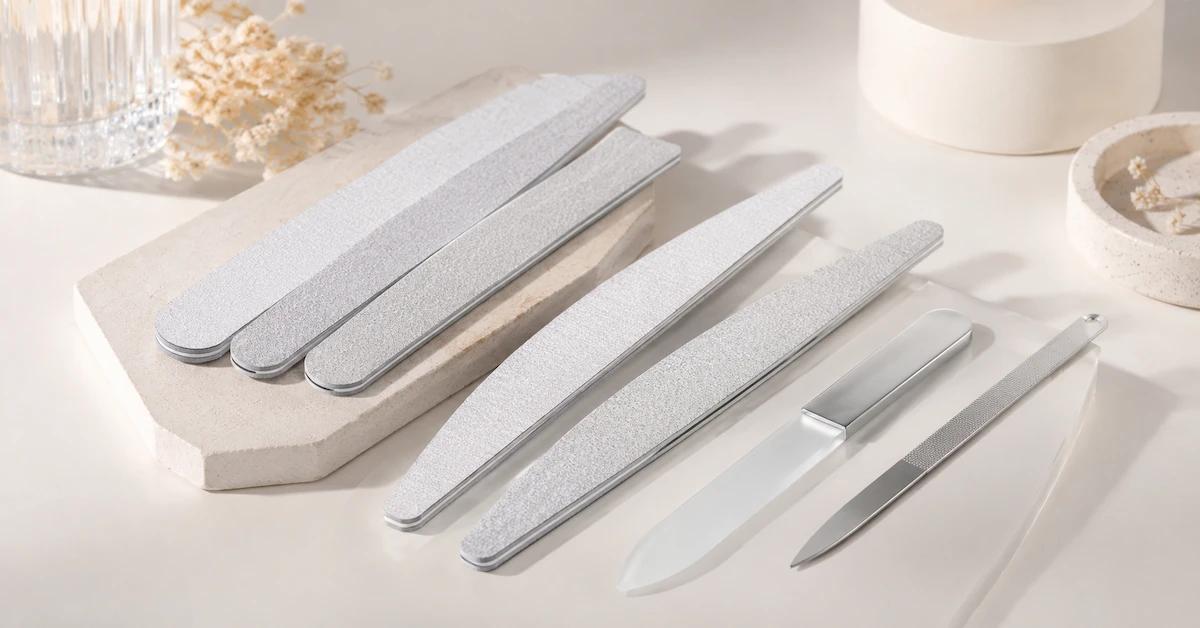
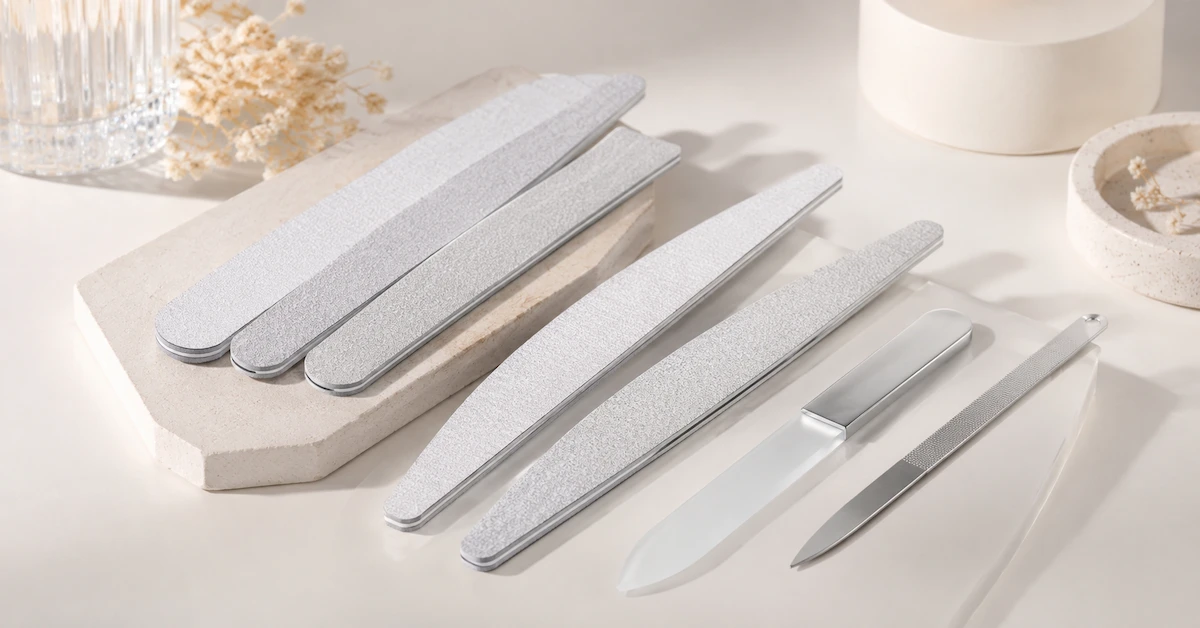
The assortment described here points to a straightforward manicure-tool lineup: elongated nail files in several lengths and widths, a smaller metal file or cuticle-style tool, and a translucent-handled grooming piece with a glossy finish. The main files appear slim and hand-held, with rounded ends and some slightly curved or banana-shaped profiles. That shape is not accidental. A gentler curve can help the user keep a comfortable angle while reaching along the nail edge, especially in fast-paced salon work or in a personal grooming kit where the tool needs to feel intuitive.
The abrasive surfaces are described as light gray or white with a matte, slightly speckled texture. The layered look of the edges suggests a laminated or foam-backed construction, though the exact substrate is not visible and should not be assumed. For a buyer, that matters because the backer changes stiffness, comfort, and perceived quality. A rigid file may give a more controlled cut, while a cushioned one can feel smoother on natural nails. The right choice depends on whether the product is aimed at salon technicians, retail beauty customers, or bundled kits.
The smaller metallic piece likely serves a different purpose from the main files. Even when a set looks unified on the shelf, the accessories often solve different problems: refining corners, cleaning edges, or helping with cuticle-adjacent grooming. The translucent-handled tool adds another signal: some buyers want a mixed set rather than a single-format file, because it supports a broader use case without raising the cost structure too much.
Why shape and finish matter more than buyers sometimes expect
In manicure tools, surface finish is not just visual. A smooth, uniform file edge reduces the chance of snagging skin or leaving a rough transition after shaping. Rounded ends and careful edge finishing are especially important if the product is meant for consumer use, where the user may not have salon-level technique. If a file feels sharp along the sides or tips, the customer often notices immediately, even if the abrasive itself performs well.
Shape matters too. Straight files are common and easy to stock, but curved or tapered bodies can improve handling. A slight banana shape, for example, can help the user work around nail contours without over-rotating the wrist. That is a small ergonomic detail, but in a salon setting it can reduce fatigue over a long day. For sourcing managers, it is one of those features worth asking about during sampling, because the most useful tool is not always the most obvious one on paper.
Typical manufacturing steps behind a manicure file
While the exact process depends on the construction, a nail file factory producing this kind of tool is usually working through a mix of abrasive application, lamination, die-cutting, shaping, and edge rounding. The visible layered construction suggests that a backing material may be bonded with an abrasive face, then cut into the final profile. After that, the edges are finished so the file feels clean in use and looks consistent across the batch.
That sequence sounds simple, but consistency is where many suppliers separate themselves. If the backing thickness varies too much, the feel of the tool changes from piece to piece. If the die-cutting is not clean, the ends can look uneven or the edges can fray. And if the surface coating is not uniform, the file can wear unpredictably. Buyers tend to care about this only after a bad shipment, which is why early sample review should pay attention to the small things: edge finish, symmetry, surface uniformity, and how the file feels after a few minutes of use.
How to compare a supplier before you place a real order
If you are evaluating a nail file supplier, start with the product range rather than the brochure language. Does the supplier offer multiple lengths and widths? Can they provide different handle or backing styles? Is there a clear distinction between salon-grade tools and retail-oriented versions? These are practical signs that the supplier understands different channels, not just one generic product type.
For buyers, a useful comparison often looks like this:
First, check material clarity. Even if the exact abrasive or core material is not disclosed at the early stage, the supplier should be able to explain the structure in plain terms. Second, inspect finishing quality. Rounded edges, consistent thickness, and a smooth transition at the ends tell you a lot about process control. Third, ask about packaging and set options. For a beauty brand, a compact handheld format may matter more than the last bit of abrasion aggressiveness. For a salon chain, reusability and grip comfort may matter more than retail presentation.
One practical caution: do not assume a heavier-feeling file is automatically better. Sometimes weight adds confidence; sometimes it just makes a tool tiring in daily use. The right balance depends on the end user, and that is why sample trials in real hands are more reliable than a specification sheet alone.
Common buying mistakes in nail file sourcing
The first mistake is buying on appearance alone. A neat photo can hide poor edge finishing or a backing that feels cheap in actual use. The second is over-specifying one feature while ignoring the rest. For example, a buyer may chase a particular shape but forget to check how the file behaves on natural nails versus artificial nail edges. Those are not the same job, and one universal tool rarely satisfies every user equally well.
A third mistake is assuming the same file will work across all channels. Nail salons often prefer tools that feel sturdy and predictable, while retail customers may care more about compact storage, simplicity, and a clean visual presentation. If the supplier can offer a set with several shapes, that may solve part of the problem, but only if each piece has a clear function. Mixed kits fail when the tools look varied but do not actually do different jobs.
Selection criteria that matter in real purchasing
1. Ergonomics
Look at the file profile, grip comfort, and how the tool sits in the hand. Rounded ends and gentle curves are not decorative details; they affect use.
2. Build consistency
Check whether each sample matches the next in thickness, finish, and edge quality. Small variation can become a big issue in retail or salon replenishment.
3. Application fit
Ask whether the file is intended for natural nails, gel edges, acrylic shaping, or general manicure prep. A product can be good and still be wrong for the job.
4. Set strategy
Some customers want a single premium tool; others want an assortment. The visible mix of sizes and shapes suggests a supplier may be able to support both, which is useful if you sell across multiple price points.
What salons and brands should watch for in use
For salon teams, the biggest issue is usually not initial sharpness but how the file ages. A tool that starts smooth and becomes patchy too quickly is a headache in service work. For brands selling through retail, the challenge is slightly different: the file has to be understandable at a glance. The customer should be able to tell why there are multiple shapes in the set and how each one contributes to the manicure process.
The visible compact format is a strength here. Hand-held files are easy to pack into manicure kits, gift sets, and beauty bundles. If the translucent-handled piece is indeed part of the same grooming system, it may broaden the product’s appeal, but only if its function is clearly communicated. Buyers should be careful with mixed kits that feel clever but are not self-explanatory. In beauty tools, clarity sells.
Questions worth asking before you commit
Ask the supplier what materials are used in the backing and surface construction, even if they cannot share every formulation detail. Ask how the files are cut and finished. Ask whether the line can be customized in size, shape, or packaging. If the product is intended for beauty retail, ask how the set is positioned: as a daily grooming item, a salon support tool, or a travel kit accessory.
If you are working with a new manufacturer, request samples from more than one batch when possible. It is a small request, but it reveals whether the product is stable enough for repeat orders. With abrasive manicure tools, that kind of repeatability is often more valuable than a flashy one-off sample.
FAQ for sourcing teams
Can one file cover natural nails and artificial nail finishing?
Sometimes, but not always well. The best result usually comes from choosing a structure and shape that matches the main application.
Are curved nail files just a style choice?
Not really. A slight curve can improve reach and control, especially around the nail edge.
Should buyers focus on abrasive appearance or backing material first?
Both matter, but backing and edge finish often reveal more about manufacturing quality than a quick visual glance at the abrasive face.
A practical next step
If you are evaluating a nail file manufacturer for salon supply, retail assortments, or manicure kits, start with samples and a short function test. Look closely at the shape, the edge finish, and how each piece feels in hand. Then compare the product set against the way your customers actually use it. That is usually where the real buying answer appears.
For sourcing teams, the best supplier is not simply the one with the broadest catalog. It is the one that can make the same small tool feel dependable, comfortable, and clear in purpose. In manicure products, that is a more demanding brief than it first appears.
Tag: