

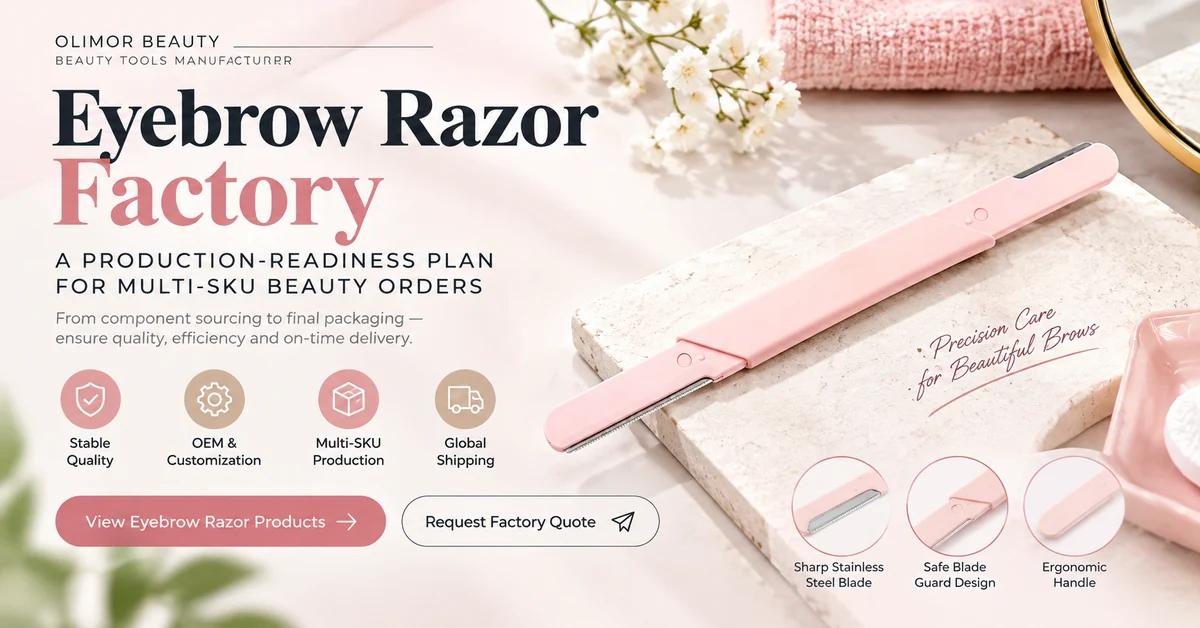
A small eyebrow razor may contain only a few visible parts, but an export program has many dependent decisions. The blade must match its holder and guard. The molded or formed handle must accept the correct assembly. The protective cover or folding mechanism must match the version promised to consumers. The finished tool must enter the correct retail pack, and the carton must reach the right warehouse with the right identity. A disruption in any of these steps can hold the entire order.
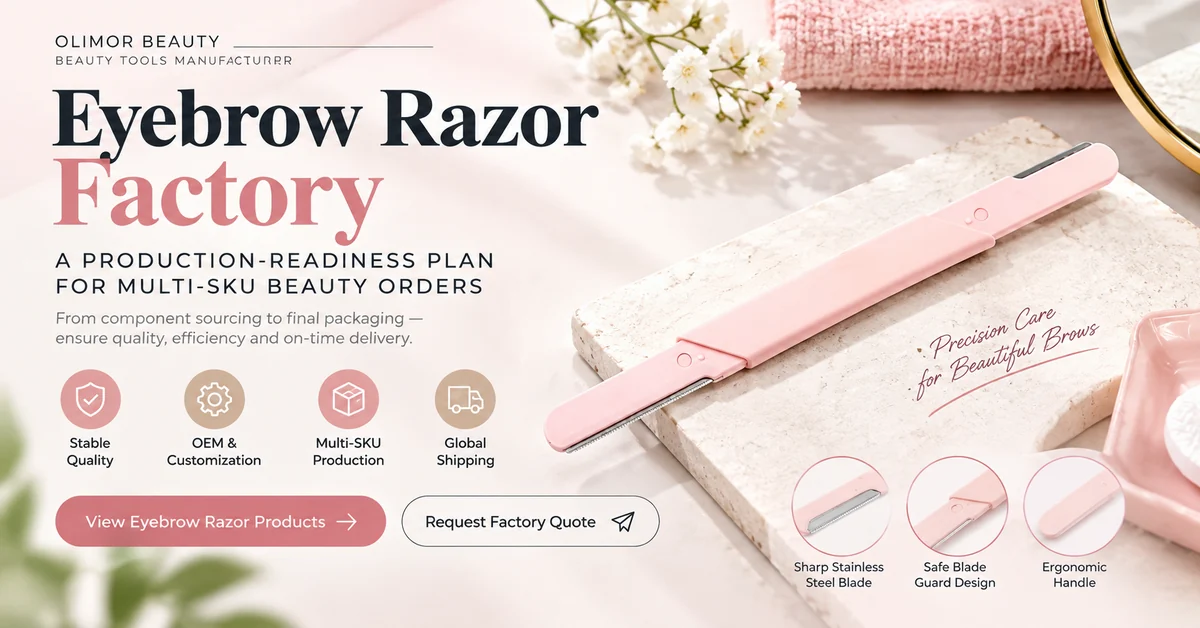
This guide is for purchasing managers, private-label beauty brands, retail-category teams, and importers evaluating a China-based production partner. It is deliberately different from a blade-to-box inspection checklist or a generic eyebrow razor manufacturer overview. Its central question is how to prove production readiness, coordinate mixed SKUs, and establish a repeatable supply program before increasing order volume. The factory workflows and planning examples below are buyer recommendations; they are not claims that any one OLIMOR facility currently uses every process or has achieved the illustrative output.
1. What Does an Eyebrow Razor Factory Need to Prove Before a Bulk Order?
An eyebrow razor factory or coordinated manufacturing operation should demonstrate that the quoted product can be made, assembled, verified, packed, and replenished according to an approved definition. That proof is more specific than a business license, a factory tour, or a claim of long industry experience. It connects the proposed purchase order to materials, a manufacturing route, a qualified sample, inspection requirements, and a realistic release schedule.
Start with four evidence questions. Product identity: Which exact model and revision will ship? Production responsibility: Which organization supplies the blade, makes or sources the handle, assembles the tool, and packs the retail unit? Process readiness: Have the intended components and working instructions been demonstrated under representative production conditions? Order continuity: If the buyer reorders in three months, what prevents unapproved changes to the blade, guard, cap, handle or printed package?
A factory does not need to perform every specialized step under one roof to be a suitable partner. Outside blade processors, molding vendors, packaging printers, and assembly sites may form a coordinated supply network. The buyer's requirement is visibility and accountability, including an agreed owner for each process and a way to resolve nonconforming parts.
A supplier who can identify the actual production path and explain its control points gives buyers more useful information than one who simply promises the lowest price. This is especially important when a retailer has multiple colors, private-label packages, or regular replenishment obligations.
2. Which Buyers Benefit Most From a Production-Readiness Review?
Not every customer needs a full production-readiness project. A small retailer purchasing a limited quantity of an established product may need confirmed samples, packing details, and a clear quotation. An importer supplying several national retail chains needs stronger SKU identification, change control, shipment documentation, and replenishment planning. The scope should match the commercial risk.
| Buyer type | Main purchasing need | Factory-readiness priority | Evidence worth requesting |
|---|---|---|---|
| Beauty brand launching a brow range | A consistent branded product | Approved components and finished retail pack | Signed sample, artwork revision, packing reference |
| Regional importer or distributor | Repeat orders across customers | Stable specifications and batch identity | Lot codes, production responsibility, change notices |
| Drugstore or chain retailer | Shelf-ready SKUs with predictable delivery | Multiple-item scheduling and barcode integrity | SKU matrix, carton standard, release schedule |
| Marketplace or e-commerce seller | Accurate goods matching online listings | Packaging and version consistency | Product photos, dimensions, contents verification |
| Professional brow-tool distributor | Controlled performance and replenishment | Blade/guard specification and assembly consistency | Defined functionality, sample comparisons, corrective-action path |
| Gift-set or travel-kit supplier | Complete sets delivered together | Component synchronization and packing capacity | Bill of materials, kit assembly plan, carton verification |
A useful buyer brief states the destination market, sales channel, intended cosmetic grooming task, expected first order, number of variants, required branding, packaging format, and target launch window. Mark unclear points as open for supplier review rather than inventing specifications. The more precisely the business problem is defined, the easier it is to distinguish a production constraint from an optional appearance preference.
3. Two OLIMOR Product References for an Actual Factory Discussion
OLIMOR BEAUTY, associated with Bonet Houseware Co., Ltd. in Yangjiang, Guangdong, China, lists eyebrow razors among its beauty and personal-care accessories. The Eyebrow Razor category includes different styles, while two item pages provide specific dimensions and broad material descriptions that buyers can use as references.
| Public reference | Listed material | Listed length | Listed weight | Buyer interpretation |
|---|---|---|---|---|
| ERF1030 Eyebrow Razor | Stainless steel + plastic | 104 mm | 4.1 g | Compact published reference for sample and pack discussion |
| ERF1020 Eyebrow Razors | Stainless steel + plastic | 137 mm | 7 g | Longer published reference for a different commercial configuration |
Both pages displayed out-of-stock information when reviewed. This status must be checked directly; it does not establish whether a new manufacturing order can or cannot be arranged. The listings also do not establish the blade steel grade, exact plastic resin, sharpening details, guard geometry, production capacity, existing tooling status, MOQ, or actual lead time. Those details belong in a model-specific quotation and specification.
The two references illustrate an important planning point: a 104 mm razor and a 137 mm razor should not automatically be treated as the same SKU family with only a cosmetic difference. Their tools, handle components, retail packs, carton quantities, and assembly conditions might differ. Buyers need to ask how the selected models are made before combining them into a single factory schedule.
The displayed single-item prices should not be treated as confirmed wholesale prices. An export quotation must include the approved model, packed-unit specification, order quantities, destination, and agreed delivery term.
4. Factory, Assembly Partner, and Trading Company: Map Responsibility Instead of Labels
“Factory direct” is a common sourcing phrase, but it does not disclose where every part of a sharp grooming accessory originates. Some suppliers make plastic components, some specialize in blades, and some coordinate final assembly and export. A trading company may add procurement expertise, while a vertically integrated producer may offer direct process communication. Neither business label alone guarantees quality or price.
Ask for the names and roles of the legal contracting company, physical assembly site, principal component suppliers or controlled subcontractors, final quality-release owner, and exporter of record. Sensitive commercial information may be handled through an appropriate confidentiality agreement; the buyer still needs sufficient traceability to manage product risk.
| Supply arrangement | What the buyer may gain | What needs clarification |
|---|---|---|
| Production site with in-house assembly | Direct access to assembly controls | Are blades, handles and packages externally sourced? |
| Coordinated manufacturer with subcontractors | Specialized component processes | Who qualifies parts and approves supplier changes? |
| Trading or sourcing company | Product range and logistics coordination | Who controls actual manufacturing and rejects? |
| Multi-location group | Capacity across defined operations | Which legal entity and site are responsible for the order? |
A useful audit follows one specific SKU rather than a generic factory presentation. Ask where that SKU's materials are received, where the blade is fitted, how finished units are identified, and how the packing team knows which artwork belongs to the order. These answers reveal the operational design of the program.
5. The Eight Production Handoffs to Review
A manufacturing handoff is the point at which responsibility, materials, or information moves from one team or supplier to another. Eyebrow razor projects can fail at handoffs even when the individual components are acceptable. Buyers should map a realistic route for the exact product instead of assuming that every razor follows the same factory process.
| Handoff | Information or material transferred | Evidence a buyer can ask for |
|---|---|---|
| 1. Purchase order to product engineering | Approved SKU and revision | Controlled specification and artwork version |
| 2. Supplier to incoming inventory | Blades, handles, guards, caps and packaging | Component identification and receiving record |
| 3. Material storage to assembly setup | Correct component kits by SKU | Work order and picking confirmation |
| 4. Setup to first-piece approval | Representative assembled unit | First-piece check with known reference |
| 5. Assembly to in-process review | Finished or partially finished razors | Workstation instructions and defect handling |
| 6. Assembly to retail packing | Accepted product and right packaging | Packed-unit sample and contents matrix |
| 7. Packing to shipment release | Correct carton and lot identity | Carton count and inspection/release record |
| 8. Shipment to replenishment record | Final accepted order information | Revision history and corrective-action log |
This map is a recommended planning framework, not a declaration of OLIMOR's actual factory layout. Its purpose is to help buyers ask targeted questions and avoid the vague requirement that a supplier simply “control quality.”
The highest-value handoff may differ by design. A folding razor needs attention to pivot assembly and storage position; a fixed-head guarded razor may emphasize blade holder and protective cap integration. A three-pack introduces more counting and package-matching risk than a single loose tool. The readiness review should reflect those realities.
6. Incoming Blade and Handle Supply: Prevent a Wrong-Part Production Run
A razor is only as consistent as the components entering assembly. The blade and any guard or cover must fit the approved holder, while the handle must match the correct version. Broad catalog wording such as “stainless steel + plastic” is not sufficient to define every component needed for repeat production.
For the selected model, identify the blade material specification, approved edge and guard configuration, blade-holder interface, plastic or other handle material, protective-cover geometry, and any fastening or folding parts. Where material certifications or tests are relevant, ask for the documents associated with the actual parts rather than assuming a standard based on the company name.
Incoming control is not necessarily complex. A work order can state the allowed component IDs, approved visual references, receiving checks, and response if a delivery is mixed or damaged. Important parts should not enter assembly under an ambiguous description such as “small blade for pink razor.”
A procurement team should also ask how the factory handles a component shortage. Can a different supplier be used? Does the buyer need to approve the substitute? Will the revised part fit the same guard and assembly? Any substitution that affects performance, safety, labeling, or regulated product information requires appropriate review before release.
7. Blade-Holder Assembly and Protective Storage: Protect the Intended Design
Assembly requirements depend on the actual architecture. A fixed-head razor may use a separate guard and cap. A folding razor adds moving parts and a closed-position requirement. A molded-handle razor may be assembled differently from a metal-bodied design. Therefore, a generic claim about automated machinery does not tell the buyer how the chosen product is controlled.
Ask for a documented method of securing the blade, checking holder alignment, confirming guard condition, and verifying protective storage. When a model uses a cap, the cap should be present and fit the approved head. When it folds, the closure should function according to the approved specification. Test methods must be agreed before production; do not use skin contact as an improvised factory acceptance test.
An unacceptable loose cutting component or hazardous exposed edge deserves immediate containment and technical disposition, not merely counting as an ordinary cosmetic defect. The inspection plan should distinguish such issues from small, approved appearance variation.
For an OEM program, avoid changing the guard, cap, or handle interface simply to obtain a new color or logo. If branding changes include new molding or an altered holder, the team should determine which functional assessments need to be repeated. Appearance approval and mechanical approval are related but distinct decisions.
8. Molded Handles, Tool Setup, and First-Piece Approval
Plastic handles can introduce production variables such as molded dimensions, surface finish, warpage, and component fit. The relevant manufacturing technique depends on the design, and the exact mold or tooling arrangement for an OLIMOR SKU should be confirmed rather than assumed.
A production-readiness review should cover whether an existing approved tool is being used, whether maintenance or changes are pending, which component dimensions are important to assembly, and how the first produced pieces are checked. If the buyer requests a new handle color, ask whether it changes material batch requirements, surface appearance, or the minimum run size.
First-piece approval is particularly valuable after a setup or component change. Before a full run begins, the line can compare a representative assembled unit against the current drawing, golden sample, and packaging identity. The record should identify the SKU, revision, responsible inspector, and release decision. A first piece that fails should trigger correction before production continues.
The buyer need not prescribe a factory's exact machine settings without technical justification. More useful is to agree on the output characteristics and the control evidence necessary to reproduce them. Process parameters are a matter for the qualified production team, while the buyer's contractual requirements focus on the accepted product.
9. Mixed-SKU Production: Why Changeovers Need a Written Plan
Multi-SKU orders are commercially attractive because distributors can buy related products together. They also create a specific factory problem: components, colors, blade versions, packaging artwork, and carton labels must remain synchronized while the production line changes from one SKU to another.
Imagine a buyer launching three versions: one established mint-green fixed-head razor, one alternative long-handle version, and one gift-pack configuration. This is an illustrative assortment, not a list of verified available OLIMOR variants. Each version may require different handles, covers, and packing materials. One mistaken packaging roll or mixed component tray can produce a lot that looks finished but does not match the order.
Use a changeover clearance before the next SKU starts. The line should remove or account for old materials, confirm the next work order, check component IDs, inspect the first assembled unit, and verify the carton and retail artwork. The approval record needs to be simple enough for operators to use consistently.
| Changeover risk | Possible symptom | Practical buyer requirement |
|---|---|---|
| Previous handle color remains on line | Mixed-color batch | SKU-specific material clearance |
| Wrong blade or guard variant is staged | Functional mismatch | Part ID confirmation at setup |
| Old retail artwork remains | Correct tool in wrong package | Approved artwork revision on work order |
| Spare protective cap is omitted | Incomplete retail unit | Pack contents verification |
| Carton label not updated | Warehouse receives wrong SKU | First-carton identification check |
Before the first mixed-SKU order, ask the supplier which operations can be shared and which need independent minimum batches. The answer affects MOQ, schedule and unit pricing more directly than a general promise of flexible production.
10. Pilot Runs: Prove Repeatability Before a Large Commitment
A prototype is not the same as a small production run. A handcrafted sample may show what the product should look like; a pilot run evaluates whether the intended materials, equipment, assembly instructions, and packing process can repeatedly produce the approved configuration.
For an established model with no engineering changes, an elaborate new-tooling pilot may not be necessary. For a changed guard, new handle, folding mechanism, custom package, or complex multi-SKU combination, representative initial production can reduce uncertainty. The exact scope depends on risk and mutual agreement.
A practical pilot review should establish: the SKU revision being run; component lots; sample count or trial quantity; assembly and packing method; critical functional checks; apparent defects and their causes; rework disposition; and the decision to proceed, revise, or hold. Do not present a single successful hand sample as proof of a consistent production lot.
Where problems occur, identify whether they arise from component specification, assembly setup, human instruction, packaging fit, or the design itself. That distinction determines whether the corrective action belongs in sourcing, tooling, production, or packaging.
Pilot acceptance is a gate, not a marketing badge. A supplier should not be described as having passed a particular qualification unless relevant evidence exists for the specific product and order conditions.
11. Product Traceability That Is Useful Without Overengineering
Traceability means being able to connect a finished product or lot to its approved specification, relevant components, production activity, and shipment. It does not necessarily require serial numbers on every low-cost grooming tool. The appropriate level depends on applicable requirements, batch risk, and the buyer's distribution network.
A practical lot scheme may connect the order number, SKU revision, key component receipt records, assembly date or period, retail-pack version, master-carton label, and final inspection result. If a problem is reported later, the importer can identify the likely affected goods and communicate accurately with the supplier.
For example, a protective-cap issue should lead to questions about which component batch and product lots received that cap, not a blind claim that every razor ever sold is defective. Similarly, a wrong-language insert should be traceable to the affected packaging revision and cartons.
Buyers should agree in advance on how long relevant records will be retained according to the market and contractual obligations, who can access them, and how supplier changes are communicated. A traceable process makes corrective action more efficient and supports responsible repeat purchasing.

12. Quality Sampling and Lot Release: Define the Rules Before Production
A shipment inspection is useful only when it has agreed criteria. For eyebrow razors, those criteria should cover the selected model, blade and holder configuration, protective guard or cap, handle condition, operation where applicable, correct branding, retail contents, and carton identity.
The International Organization for Standardization's ISO 2859-1:2026 describes acceptance-sampling schemes by attributes for lot-by-lot inspection. It can inform an appropriately designed sampling plan but does not certify an eyebrow razor, establish its safety by itself, or replace controls for hazards that need specific action. Define the defect categories, lot, sampling approach and disposition rules with qualified personnel.
| Release evidence | What it answers | Typical buyer use |
|---|---|---|
| Approved reference sample | What should the product look and function like? | Comparison during inspection |
| Lot and work-order identity | Which batch is being released? | Traceability and receiving |
| Functional inspection record | Were agreed working features checked? | Production acceptance |
| Packing verification | Are correct SKU, guard, instructions and artwork included? | Retail readiness |
| Carton report | Do carton counts and marks match the order? | Shipping and warehouse receiving |
| Deviation / corrective-action log | Were identified problems resolved? | Release decision and future prevention |
Do not use “100% QC” as a substitute for an identified inspection method. Likewise, do not assume that a high sample score allows the release of a product with an unresolved serious blade-retention problem. The disposition rules need to address the actual risk.
13. Production Capacity Is a Bottleneck Problem, Not a Brochure Number
When asking about capacity, importers often receive a single number such as “pieces per month.” That figure is not sufficient to plan a specific razor order if it mixes products with different component availability, assembly requirements, or packaging throughput.
Ask the factory to explain effective capacity for the quoted SKU, including the availability of critical components, line staffing or assembly arrangement, expected changeovers, quality checks, and packaging capacity. A production line capable of assembling a certain number of tools cannot necessarily pack the same number into a complex retail gift set during the same period.
A simple hypothetical example illustrates the need to locate bottlenecks. Suppose a planned batch contains 12,000 razors. A supplier estimates that a relevant assembly process can handle 2,400 units per working day, while retail packing can handle 1,500 units per working day. Ignoring downtime, changeovers and rework, assembly needs five working days and packing needs eight working days. Packing is the slower stage, so the shipment cannot be planned from assembly speed alone.
These values are illustrative mathematics, not OLIMOR production claims. The real schedule may differ significantly depending on shift hours, overlap, material readiness, downtime and multiple purchase orders. A credible quote explains its assumptions and states which factors may change the estimate.
Capacity discussions should also include a realistic contingency plan: What happens if a packaging supplier is late? Can approved stock be held securely before packing? How will the buyer be notified about a delay? These questions are directly related to delivered performance.
14. OEM and Private-Label Projects: Separate Existing-Mold Orders From New Development
An eyebrow razor factory may be asked to supply an existing model, make a branded variation, adapt a component, or develop a new design. These are different manufacturing scopes with different sample, tooling, ownership and schedule implications.
| Project scope | Typical work | Key commercial question | Approval focus |
|---|---|---|---|
| Standard existing SKU | Select and pack a current model | What is the actual MOQ and availability? | SKU and finished-unit acceptance |
| Private-label pack | Brand an approved existing product | What decoration and printing are feasible? | Logo, pack, product copy and barcode |
| Component modification | Alter handle, cap or approved feature | Are new tools or additional tests needed? | Functional sample and change assessment |
| New product development | Create an alternative structure | Who funds and controls development/tooling? | Drawings, prototypes, pilot and ownership terms |
| Multi-product brow kit | Assemble several approved tools | Who ensures kit contents and simultaneous supply? | Each tool plus finished-set packaging |
OLIMOR's website discusses product selection, sampling and private-label requirements, but buyers should confirm model-specific possibilities. There is no basis to claim every listed razor can be produced in every color, fitted with every blade type, or delivered under a universal low MOQ.
For newly developed components or tooling, clarify the scope, samples, ownership, confidentiality, change approval and corrective-action arrangements in the agreement. Paying for an initial sample does not automatically establish exclusive rights to all underlying design elements.
16. Product Safety and Destination-Market Information
Eyebrow razors are sharp cosmetic grooming products. Their packaging and instructions should accurately describe the intended use, product identity and protective storage. Do not claim that ordinary eyebrow razors treat skin diseases, are medical instruments, are sterile, or cannot cause nicks without appropriate product-specific substantiation.
For consumer goods offered in the European Union, Regulation (EU) 2023/988, the General Product Safety Regulation (GPSR), is a relevant general regulatory framework. It applies from December 13, 2024, but the exact responsibilities and required information depend on the product and economic operator's role. This regulation is not a special “eyebrow razor certificate.” Importers should obtain qualified market-specific advice before finalizing labeling and online listings.
Carefully review broad claims such as “hypoallergenic,” “medical grade,” “universally safe,” or “no cuts.” If the supporting tests, materials and scope are not established, use narrower accurate descriptions instead. The site product listing and final retail package should match the approved physical product.
A factory can help provide product information, but a brand or importer should not assume the supplier takes over every destination-market legal obligation. Confirm responsibilities in the commercial agreement and product documentation.
17. A 60-Day Production-Ramp Scenario for a Multi-SKU Program
A production-ramp plan sequences decisions before, during and after an initial order. The time periods below are buyer planning windows, not promised factory lead times. Real sample, material, manufacturing and freight schedules must be confirmed separately.
| Planning window | Buyer objective | Evidence required to proceed |
|---|---|---|
| Days 1–10: define | Confirm SKUs, retail formats and target volumes | SKU matrix, open issues and RFQ |
| Days 11–20: validate | Review samples, materials and line responsibility | Approved or pending specifications |
| Days 21–30: prepare | Confirm work orders, packaging and first-piece criteria | Material readiness and pilot plan |
| Days 31–45: produce/review | Conduct an agreed representative run, if appropriate | Pilot/first-piece results and corrections |
| Days 46–60: release/learn | Complete agreed inspection and shipment preparation | Lot release, carton data, replenishment file |
A buyer should not force an order into these dates if the product is not ready. For example, a changed blade guard may need another prototype, a printed carton may require new artwork approval, and a factory with a component shortage may need an updated schedule. The correct action is to identify the open gate and revise the plan transparently.
After the first shipment, compare actual receipt accuracy, customer feedback, defect patterns and replenishment demand. Keep a record of approved revisions. The next purchase order should be based on those records, not solely on the prior invoice or a photo of the original product.
18. Compare Supplier Quotes Using Total Program Cost
A quote for a loose standard razor should not be compared directly with a quote for a custom-printed three-pack with assembly checks and export carton markings. Separate one-time project expenses from per-unit costs and define the delivery basis.
A useful landed-cost structure is:
Estimated landed unit cost = product + customization + packaging + allocated inspection + freight/insurance + applicable import-related costs + other inbound allocations.
For illustration, assume an order of 8,000 finished retail units, with product and assembly at US$0.36 each, packaging at US$0.14, customization at US$0.06, freight and insurance allocation at US$0.13, inspection at US$0.04, and assumed import-related allocation at US$0.05. The illustrative total is US$0.78 per unit, or US$6,240 for 8,000 units before any omitted expenses. None of these figures are OLIMOR quotations, duty rates or shipping commitments.
The International Chamber of Commerce's Incoterms® 2020 rules help clarify delivery responsibilities, costs and risk transfer when a named term and place are agreed. They do not replace a complete purchase agreement covering product quality, tooling, intellectual property or remedies for defects.
A good commercial comparison also addresses mixed-SKU minimum quantities, packaging minimums, rejected or replacement components, sample fees, inspection responsibilities and the supplier's change-notification process. Lowest quoted price is only one aspect of total purchasing performance.
19. Production-Readiness Red Flags That Deserve a Follow-Up
Several warning signs are particularly relevant to a factory or coordinated supply chain handling sharp grooming accessories. They do not automatically prove misconduct, but they justify further investigation before releasing a large order.
Unclear production site: A supplier cannot explain who assembles the specific model or how component suppliers are qualified. No controlled product revision: The buyer's final specification depends on an undated reference photograph. Unapproved substitutions: A different blade, guard or cap may be used without formal review. No first-piece approval: A line changeover begins without demonstrating the next SKU. Inconsistent packing data: Carton quantities or retail contents differ between quotation and sample. Blanket capacity statements: A claimed monthly volume is not linked to actual materials or packaging resources.
Other red flags include refusal to clarify whether a quoted price includes the cap and retail pack, using another company's certificate without scope confirmation, and promising both immediate production and substantial new tooling without a feasible development plan.
The practical response is to ask for specific evidence. Request an assembly process outline, SKU matrix, representative approved sample, current quotation, first-piece or pilot plan where appropriate, and carton information. If the supplier cannot provide a required item, document the gap and decide whether the order can proceed with alternative controls or must be held.
20. A Factory-Ready RFQ Template for Importers
The best request for quotation enables the supplier to respond to the actual program, not a vague category name. Separate required features from optional changes, and ask which information remains unconfirmed.
| RFQ field | Buyer-supplied information or requested response |
|---|---|
| Buyer and destination | Company, target market and sales channel |
| SKU references | ERF1030, ERF1020 or other confirmed product links |
| User and use case | Adult cosmetic brow grooming; intended retail setting |
| Model specifications | Materials, blade/guard, handle, cover, dimensions |
| Assortment | Quantity and finish/pack requirements by SKU |
| Development scope | Existing model, private label, component change or new tooling |
| Proof required | Samples, first-piece plan, relevant inspection information |
| Packaging | Unit contents, artwork, barcode, carton details |
| Commercial terms | MOQ by SKU, itemized cost, quote validity, delivery basis |
| Scheduling | Sample, material, production, inspection and shipment estimates |
Sample inquiry:
We are preparing a multi-SKU eyebrow razor program for a beauty retail business and would like to discuss production readiness with OLIMOR. We are reviewing ERF1030 and ERF1020 as initial public references, subject to current availability and updated specifications. Please identify the assembly and sourcing responsibilities for the proposed items, available samples, blade/guard and handle details, retail-pack options, minimum quantities by SKU, and estimated stages of the order. We also request information on first-piece or pilot-run review, carton specifications, lot identification, and procedures for approved changes on repeat orders. Our destination market and estimated volumes can be provided for a tailored quote.
This is more actionable than “Please send your best factory price.” It helps the sales and manufacturing teams identify which requirements are already supported and which need feasibility review. Buyers can submit the project through OLIMOR's contact page.
21. Why OLIMOR Is a Relevant Starting Point for the Discussion
OLIMOR BEAUTY presents a range of beauty and grooming accessories associated with Bonet Houseware Co., Ltd. in Yangjiang, Guangdong, China. Its product categories include eyebrow razors, tweezers, beauty scissors, eyelash curlers, nail tools and related personal-care products. The website describes product-selection support, sampling and quality checks against approved requirements.
This makes OLIMOR a relevant contact for a brand comparing brow-grooming SKUs and exploring order requirements. However, a website listing does not establish the complete factory process, current equipment, certified manufacturing scope, exact MOQ or available monthly capacity. These must be verified for the selected order and model.
A practical first step is to review the Eyebrow Razor collection and identify specific items. Use the ERF1030 and ERF1020 pages as published references, then ask for updated production and quotation details. If a coordinated brow collection is planned, related tweezers and beauty scissors can be considered with their own separate specifications and approvals.
The value of a long-term supplier conversation lies in transparency: which product can be supplied, what the supplier can verify, what requires further development, and how the buyer and supplier will handle changes after the first shipment.
22. Frequently Asked Questions About Eyebrow Razor Factories
1. What should I verify before selecting an eyebrow razor factory?
Confirm the legal seller, actual production or assembly responsibilities, model specifications, blade and handle sourcing, representative sample, packaging scope, quality-release method and current quotation. For a mixed-SKU program, also ask how work orders and line changeovers prevent components and artwork from being mixed between versions.
2. Does an eyebrow razor factory have to manufacture every component in-house?
No. A coordinated operation may source blades, molded handles or printed packaging from qualified suppliers. What matters is transparency, accountable acceptance of incoming parts, approval of changes and traceability from relevant components to finished orders. Do not infer full vertical integration from the phrase “factory direct.”
3. What is the difference between ERF1030 and ERF1020?
Public OLIMOR listings show ERF1030 as stainless steel plus plastic, 104 mm and 4.1 g; ERF1020 is listed with the same broad material categories, 137 mm and 7 g. Those numbers do not establish identical blade geometry, material grade, tools or packaging. Actual differences and current production options require samples and supplier confirmation.
4. What is a first-piece approval in eyebrow razor production?
It is an agreed check of a representative initial unit after a setup or production change. The first piece should match the correct SKU and current specification, including relevant components, function and appearance. A failed first-piece check should prompt correction before wider production. The exact method is specific to the product and process.
5. When should buyers request a pilot run?
A representative pilot may be useful when the product has changed structurally, a new component or pack is introduced, or a mixed-SKU program has significant coordination risks. An established unchanged SKU may not need the same development sequence. The purpose is to confirm repeatability under intended production conditions, not merely to display one attractive prototype.
6. What is the MOQ for eyebrow razor factory orders?
No single verified MOQ applies to every OLIMOR razor and customization. Minimums may depend on the selected model, component suppliers, handle color, logo method, retail packaging and carton quantities. Ask for feasible minimums by SKU and request separate quotes for standard and custom options.
7. How do I compare a factory's claimed monthly capacity?
Ask for effective capacity for the specific product and order configuration, including critical component supply, setup/changeover time, assembly, inspection and retail packing. A general factory-wide number may not predict the delivery of a particular SKU. Require a dated schedule with explicit assumptions rather than relying on promotional figures.
8. Can ISO 2859-1:2026 certify an eyebrow razor factory or product?
No. ISO 2859-1:2026 provides acceptance-sampling methods indexed by AQL for lot-by-lot inspection. It is not an eyebrow-razor product certification, nor does it replace the buyer's responsibility to define safety-related defects and product-specific acceptance criteria. Any separate management-system certificate should be verified for holder, location and scope.
9. How can a buyer protect repeat orders against unapproved changes?
Maintain the approved SKU revision, blade/guard and handle specifications, finished reference sample, retail artwork, component IDs where appropriate, carton standard and inspection plan. Require notification before relevant changes to parts, process or pack and decide whether renewed sampling or testing is necessary. Keep issue records linked to actual lots.
10. How can I request an eyebrow razor factory quotation from OLIMOR?
Visit the OLIMOR Eyebrow Razor range, select reference products, and contact the team through Contact Us. Provide your destination, sales channel, estimated quantities by SKU, intended customization, required protection and packing details, and any pilot or traceability questions. Ask for updated sample availability, MOQ, production assumptions and delivery terms.
Conclusion
Selecting an eyebrow razor factory for long-term B2B supply is not simply a comparison of catalog photos or the smallest unit price. The strongest purchasing decision connects the approved product to real component sourcing, documented assembly, controlled SKU changeovers, appropriate first-piece or pilot checks, retail packaging and traceable shipment release.
For importers and beauty brands managing several products, the critical operational question is whether the supplier can reproduce the accepted item when order volumes, colors or packaging formats change. A clear production-responsibility map, realistic bottleneck-based schedule, and documented revision system are practical tools for reducing avoidable disruptions. Material and testing claims should remain specific to the actual product, and commercial commitments should be confirmed in a dated quotation rather than inferred from generic marketing language.
OLIMOR BEAUTY's Eyebrow Razor collection provides a starting point for discussing models including ERF1030 and ERF1020. To evaluate a multi-SKU program, contact OLIMOR with your reference models, order quantities, destination, intended branding and the production-readiness evidence you want to review. An accurate, shared plan before bulk production creates a stronger foundation for reliable replenishment and qualified B2B purchasing.
Tag:
Related articles
- Quality Control
- Beauty Tools Manufacturing
Eyebrow Razor Manufacturer China: 12 Quality Checks from Blade Guard to Export Carton
- OEM & Private Label
- Beauty Tools Manufacturing
OEM Beauty Scissors Project Guide: How Brands Control Samples, Quality, and Launch Risk
- Beauty Tools Manufacturing
- Men's Grooming Tools