

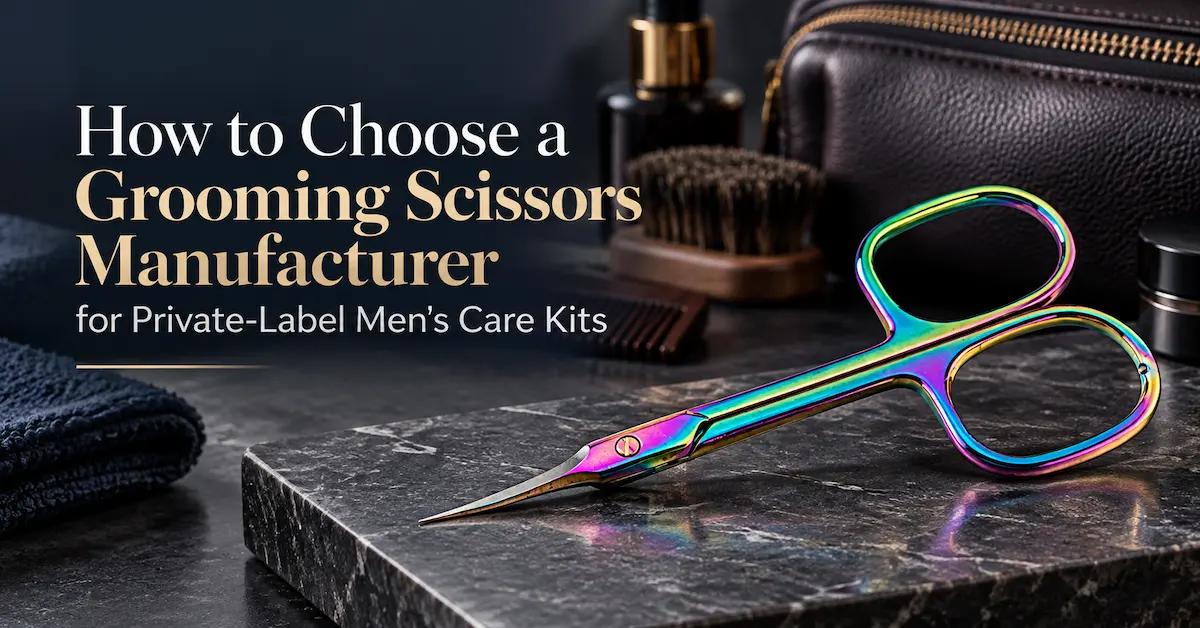
Introduction: the grooming tool is small, but the product promise is not
A pair of grooming scissors may be one of the smallest items in a men's care kit. It is also one of the most directly experienced. A user opens the tool, positions the tips near a brow or moustache, and expects the blades to move with control. If the tip hides the intended hair, the pivot catches, the blade pushes material away, or the finger loops create pressure, the complaint is directed at the brand printed on the handle. The customer does not see the separate decisions made by the blade shop, assembly line, finishing partner, packaging supplier, and purchasing team.
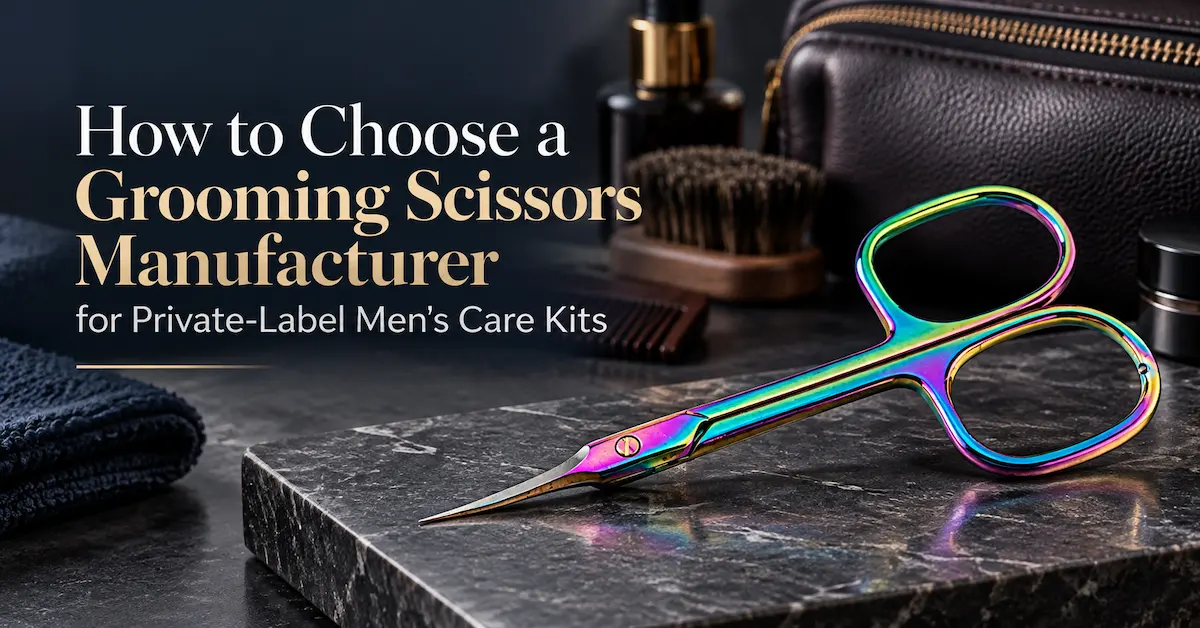
That is why a sourcing project needs a more precise question than “Who makes grooming scissors?” A suitable grooming scissors manufacturer should be able to understand the user and channel, convert the task into a repeatable product configuration, show how samples are assessed, protect the finished tool in its retail or travel package, and control changes when the buyer places a replenishment order.
Grooming scissors can serve several commercial environments. A men's grooming brand may need a compact moustache tool, a barbershop distributor may need a professional-looking kit component, a travel retailer may need protected tips and a small pack, and a general beauty importer may want one coordinated range that includes eyebrow, nail, and facial-care tools. These are related markets, but they do not necessarily need the same blade length, tip style, handle, claim, or package.
This article is designed for commercial investigation and RFQ intent. It gives buyers a practical route from use definition to supplier comparison, sample approval, inspection, packaging, commercial terms, pilot order, and repeat-order control. OLIMOR BEAUTY supports OEM and ODM beauty-tool projects from drawings, physical samples, appearance concepts, and structural requirements. The company operates in Yangjiang, Guangdong, China, and its confirmed product categories include beauty scissors, manicure sets, and broader nail-care tools.
What is a grooming scissors manufacturer?
A grooming scissors manufacturer develops, produces, assembles, inspects, brands, or packs compact scissors for a defined personal-care task. The tool is a system of two blades, a pivot, tips, handles, and finger loops. Depending on the design, it may also include a screw or rivet, plastic grip, protective cap, pouch, tray, box, or kit insert.
Manufacturing can include metal forming, heat treatment, grinding, polishing, water deburring, pivot assembly, adjustment, surface finishing, logo application, inspection, and packaging. Not every process applies to every model. A buyer should ask the supplier to map the route for the quoted SKU, identify which work is performed in-house, and name any partner-managed steps that can affect the released product.
OLIMOR BEAUTY reports that its company was founded in 2011 and its factory in 2017. Its operations are in Yangjiang, Guangdong, China, with approximately 200 employees. The confirmed capability record includes metal stamping, heat treatment, injection moulding, polishing, water deburring, assembly, packaging, production-process inspection, and finished outgoing inspection. These statements describe company-level capabilities; they do not replace model-specific drawings, material records, inspection methods, or test evidence.
For a buyer, the word manufacturer should answer four responsibility questions. Who owns the drawing and sample revision? Who controls the blade and pivot relationship? Who approves the decorated and packed unit? Who communicates a change before it reaches a repeat order? Clear answers are more useful than a broad factory profile.
1. Define the grooming job before choosing a model
Start with the intended hair or material, working area, user, frequency, storage method, and channel. Moustache detail, beard-edge touch-up, eyebrow trimming, sideburn shaping, and a loose thread in a grooming kit are not automatically the same task. A tool designed for controlled facial-hair detail may not be appropriate for trimming nails or cutting packaging. Separate personal grooming from craft or household use in the brief and in the customer-facing copy.
Write one sentence that a sampling team can test. For example: “Compact grooming scissors for occasional moustache and small facial-hair detail, sold in a men's travel kit with protected tips.” Another project may state: “Short-blade brow scissors for an adult beauty range, with visible tips and a branded retail card.” These sentences are stronger than “premium grooming scissors” because they guide geometry, grip, finish, packaging, warnings, and approval.
Identify whether the user is a consumer, a barber, a salon professional, a hotel guest, or a gift-set buyer. A professional user may evaluate repeated movement and access differently from a traveller who uses the tool occasionally. The same product photograph can support both audiences, but the product specification, care copy, and package may need to differ.
| Use case | Questions to define | Evidence for approval | Risk if left vague |
|---|---|---|---|
| Moustache detail | Can the user see a short cutting region and control the tips? | Coded samples reviewed in the normal facial-hair position | Choosing a long or poorly visible blade for a detail task |
| Beard-edge touch-up | What edge, length, and approach angle are expected? | Task method, sample comparison, and appropriate public wording | Overstating precision or promising a result the model was not designed to deliver |
| Brow grooming | How does the curve, point, and handle affect visibility? | Close-up handling review and tip-protection check | Assuming the same model works equally for facial-hair and brow users |
| Travel or gift kit | How is the tool stored and protected after use? | Complete packed-unit sample and removal/replacement test | Tip damage, blade movement, or an oversized package |
2. Match blade geometry to access, visibility, and control
Blade geometry affects the path the tool takes through the working area. A straight blade can offer a direct visual reference. A curved blade may follow a contour for some users. A short blade can feel controlled in detail work, while a longer blade can change the cutting path and package envelope. Pointed and rounded tips create different access and handling requirements.
Do not choose geometry from a flat catalogue image alone. Ask reviewers to hold the scissors in the same orientation used by the target customer. Observe whether the tip remains visible, whether the hand blocks the intended area, whether the wrist must rotate, and whether the blade reaches the task without excessive pressure. Record the position so another team can repeat the review.
For a coordinated range, use a naming system that explains the difference between models. “Short pointed moustache scissors” and “curved brow scissors” communicate more than “model A” and “model B.” The model code, drawing, product photograph, packaging copy, and web listing should all describe the same released tool.
OLIMOR's listed beauty scissor references can help buyers begin a discussion, but each specification remains model-specific. SXS5005 is a product reference for a curved beauty-scissor direction, while SCB3057 provides a pointed beauty-scissor direction. Buyers should approve the exact blade, handle, finish, logo, task, and package for the grooming project instead of transferring a description from one model to another.
3. Compare pointed and rounded tips with handling evidence
Pointed tips can reach a small area and may be useful for detail work. They also require clear handling instructions, a suitable protector, and a package that prevents contact during shipping. Rounded or guarded tips change the approach and may suit a different user or kit concept. Neither tip style should be presented as universally safe or suitable for a special population without product-specific evidence and qualified market review.
Inspect the tip while the blades are open and closed. Check whether both tips remain in the intended plane, whether one extends beyond the other, whether the outer edge has an unintended burr, and whether the protective cap contacts the point. Review several pieces under consistent lighting and retain photographs or notes for the released sample.
Tip alignment can be described visually or dimensionally. A word such as “precision” is not an acceptance method. If the buyer needs a numerical tolerance, the supplier and buyer should define measurement points, equipment, sample conditioning, and permitted variation for the selected model. Do not copy a tolerance from another scissor or assume that a catalogue drawing is a production record.
4. Watch the blade meeting through the full closing movement
Fully closed blades can look aligned and still behave inconsistently. Open the scissors, close them slowly, and observe where contact begins and how it travels. Look for gaps, crossing, sudden resistance, gritty movement, or a section where the relevant test material folds rather than separates. Repeat the method on several coded samples instead of approving one unusually well-adjusted presentation piece.
Use a material and method that match the stated grooming task. A paper cut demonstrates that an edge can cut paper; it does not establish performance on facial hair. A test with a thread does not prove suitability for nails or any other material. The acceptance method should identify the sample condition, material, cutting region, hand position, number of movements, and expected observation.
Describe failures precisely. “Not sharp” does not locate the cause. Record whether the material slips, bends, tears, pulls, catches, or requires repeated pressure. Add the model, sample code, blade region, pivot feel, and test position. This information helps distinguish edge condition, blade meeting, pivot setting, geometry, and application-fit issues.
Ask when final blade adjustment occurs in the production route. Polishing, coating, cleaning, decoration, or assembly can change the relationship between the edges. The functional sample should represent the intended manufacturing route, not an unfinished tool that will later receive an uncontrolled process.
5. Evaluate pivot movement and hand feel
The pivot keeps the blades in a working relationship. Excess looseness can create play at the tips, while excessive tightness can make opening and closing tiring. The correct setting depends on blade geometry, tool size, intended task, handle design, and user expectations.
Use the same grip to open and close each sample. Note free play, initial resistance, smoothness, stick points, sound, and whether the setting changes after repeated movements. Subjective words such as smooth or firm become useful when tied to a reference sample and a repeatable review method.
Ask whether the selected pivot is screwed, riveted, pinned, or made another way. Confirm whether it is intended to be user-adjustable. Do not promise adjustability or serviceability unless the design and customer instructions support it. A pivot that can be adjusted by a factory technician is not necessarily a consumer-service feature.
If the project requires numerical force or torque, agree the instrument, fixture, force point, opening angle, movement speed, conditioning, and acceptance range before production. A number without a method cannot reliably compare suppliers or lots. Avoid transferring values from nail clippers, beauty scissors, or another grooming model.
6. Review finger loops, handle balance, and repeated use
Finger-loop diameter, internal edge, spacing, surface texture, and handle angle affect control. A compact tool may fit a travel kit yet feel cramped to an adult user. A decorative handle can look distinctive while hiding the working tips. A plastic insert may improve colour or grip, but it also introduces a component, a moulding route, an assembly interface, and additional packaging questions.
Invite several reviewers who resemble the intended user group. Have them perform the defined grooming movement rather than simply hold the tool. Record pressure points, stability, visibility, reach, and whether the grip shifts. Keep subjective comfort notes separate from dimensional measurements. A small review group can reveal problems, but it cannot prove a universal ergonomic claim.
Check the outer edge of the loops and handle. Polishing and deburring should leave touch surfaces free from unwanted sharpness. Review the finished surface after coating or decoration because a process change may affect friction and feel. If the tool is stored with tweezers, nail clippers, or a razor in a case, verify that the handles do not rub neighbouring products.
Balance also affects use. A heavy decoration or long handle can change the feeling at the tip. Compare the approved sample with the intended package and companion tools. The final kit should not make the user struggle to remove the scissors or return them to storage.
7. Specify materials and finishes by component
“Stainless steel grooming scissors” is a broad category description, not a complete material record. Ask the supplier to state the material for blades, pivot hardware, handles, plastic inserts, protective caps, and relevant packaging components. If an exact grade matters to the claim or destination market, request documentation linked to the selected model or material batch.
Do not infer an alloy grade, hardness, heat-treatment condition, or corrosion result from the words stainless steel. Hardness is meaningful only when the method, test location, conditioning, equipment, and acceptance range are defined. This guide intentionally avoids publishing an unsupported grade or numerical value.
Finish is a separate decision. Polished, satin, coloured, patterned, plated, coated, or decorated surfaces create different questions about logo contrast, hand feel, cleaning, abrasion, and pack contact. Approve the finish under the lighting used for photography and merchandising. Check colour, gloss, texture, visible marks, residue, and contact with the insert or protector.
Care language should match the released tool. Avoid copying claims such as medical grade, sterile, sterilizable, corrosion proof, or chemical resistant from another product. If a market requires special evidence, define the test method and document owner before artwork is printed.
8. Choose OEM, ODM, or private label based on the project stage
OEM grooming scissors
An OEM route usually begins with buyer-controlled input such as a drawing, physical sample, dimensional envelope, blade concept, handle requirement, or performance brief. Mark which features are fixed and where the manufacturer may propose changes. New blade geometry, a new pivot, or a new handle may affect tooling, sampling, inspection, cost, and timing.
ODM grooming scissors
An ODM route begins with an existing supplier platform adapted to a defined user, finish, decoration, and package. Existing does not mean automatically suitable. Ask the supplier to label standard features, finish changes, tooling changes, and new functional reviews. A shortlist matched to one task is easier to evaluate than an unfiltered catalogue.
Private-label grooming scissors
Private label converts an approved platform into a brand-ready SKU. The project may include logo, colour, surface treatment, cap, pouch, card, tray, box, instructions, barcode, and carton marks. Approve the physical decorated and packed unit. A digital artwork proof does not verify logo legibility on a curved handle, and a plain metal sample does not approve a coloured production finish.
| Route | Starting input | Buyer responsibility | Approval gate |
|---|---|---|---|
| OEM | Drawing, reference sample, dimensions, structure, or performance requirements | Define fixed features, acceptable changes, and file ownership | Functional prototype and released specification |
| ODM | Target user, task, market, price position, and supplier platform | Verify the platform against the real use case | Coded platform sample and task review |
| Private label | Approved platform plus brand and packaging direction | Control logo, claims, artwork, pack contents, and channel presentation | Final decorated and packed golden sample |
9. Use a sample ladder and a golden sample
A form sample answers questions about overall size, blade curve, tip style, loops, and pack envelope. A functional sample answers cutting action, pivot movement, tip visibility, and hand position. A finish sample answers colour, texture, gloss, and logo contrast. A packed sample answers protection, printed content, model identity, item count, and retail presentation.
Label each sample with the model, revision, date, and purpose. State what it approves and what remains provisional. A functional sample may have a temporary finish; a colour sample may not be adjusted for final cutting performance. Without this distinction, a buyer can accidentally approve a display feature while believing the complete SKU is released.
Use coded samples for comparison. Reviewers should focus on the grooming task before a preferred logo or sales presentation influences the decision. Record the method, observations, open questions, and decision owner. A short sample record is more useful than a message saying “looks good.”
The golden sample should represent the saleable configuration. Connect it to the drawing, model code, material wording, finish master, logo artwork, packaging files, inspection plan, and accepted deviations. Protect it from casual adjustment. If a significant component changes, create a new revision and decide whether functional or packaging re-approval is needed.
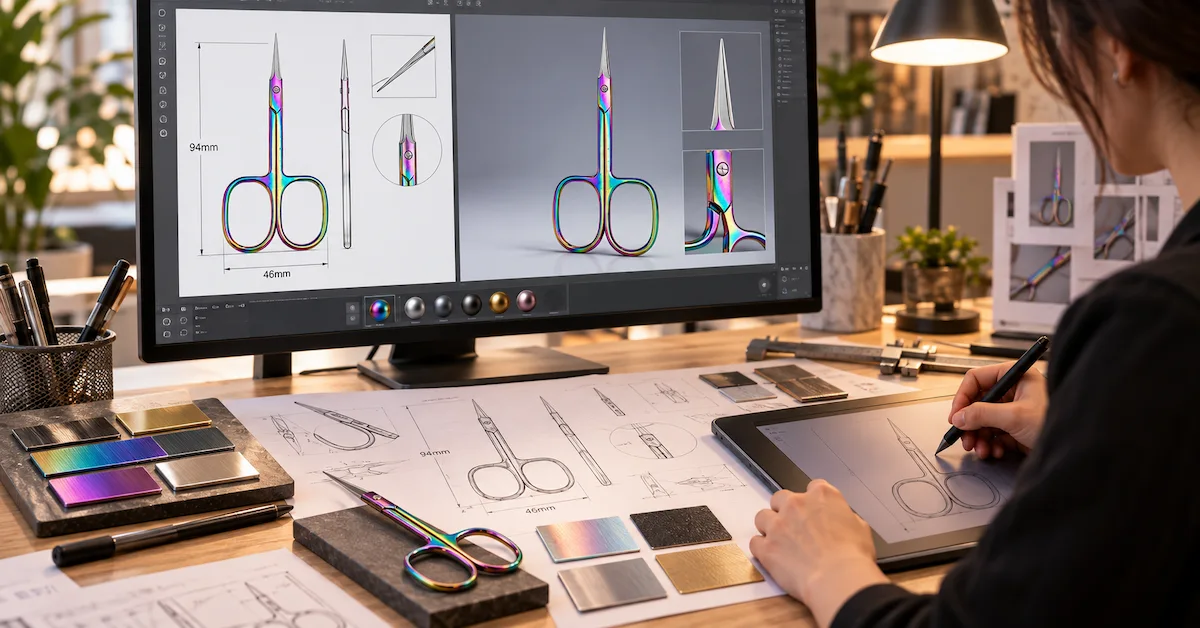
10. Ask the factory to map applicable production and QC steps
OLIMOR BEAUTY's confirmed capability record includes metal stamping, heat treatment, injection moulding, polishing, water deburring, assembly, packaging, production-process inspection, and finished outgoing inspection. A buyer should ask which steps apply to the selected grooming scissor, which are internal, which are partner-managed, and where the finished product is accepted.
Start quality planning with failures a customer can notice: a blade gap, inconsistent cutting, uneven tip meeting, rough pivot, unwanted sharpness on a handle edge, surface scratch, colour variation, wrong logo orientation, missing cap, wrong model, or unstable pack. Define each issue with a photograph, reference sample, or measurement method when practical.
Place checks where corrections are still efficient. Confirm formed or ground components before costly decoration. Approve the first assembled piece before the run continues. Use in-process checks to detect drift. Inspect the finished tool after surface treatment. Finally verify the complete packed unit, because a correct scissor can still be paired with the wrong protector, artwork, or carton.
Ask how nonconforming work is identified, separated, corrected, and rechecked. Sorting may contain a shipment, but change control and corrective action reduce recurrence in a repeat program. Buyers should request the records relevant to their project rather than asking for a generic “quality guarantee.”
| Control point | Question | Useful record |
|---|---|---|
| Incoming components | Do blades, pivot parts, handles, inserts, and protectors match the released identity? | Incoming check and component record |
| First piece | Do blade meeting, tips, pivot, loops, finish, and logo match the reference? | First-piece approval by model and revision |
| In process | Are functional feel and appearance stable during production? | Patrol inspection and disposition record |
| Final tool | Does the finished scissor meet the functional and visual criteria? | Finished-product inspection report |
| Packed unit | Are model, protector, artwork, instructions, count, and carton marks correct? | Pack release and outgoing inspection record |
11. Design packaging around the actual grooming scissor
Tips and blades can be damaged when a package allows the tool to open, strike a carton, or rub against another metal item. A cap designed for a straight model may press on a curved tip. An insert developed before the handle is frozen may permit movement. Packaging must be tested with the production-intent tool, not a generic product photograph.
Remove and replace the scissors several times. Check tip clearance, blade restraint, pivot pressure, finish contact, logo visibility, opening direction, and the user's ability to return the tool to storage. For a travel kit, test the closed case and the complete inner pack. For a retail card or box, check that the tool remains stable during handling and shipment.
Coordinate the tool with the rest of the range. A men's care kit may include a comb, razor, nail clipper, tweezers, or file. Each item needs a clear position and model identity. Metal parts should not rub unnecessarily, and the printed description should not suggest that one scissor performs every function in the kit.
Packaging copy should identify the intended use, material wording, finish, item count, care instructions, warnings, languages, barcode, and importer information required by the project. A correct physical product can still create a market issue if the printed claim, model name, or image describes a different version.
12. Compare grooming scissors suppliers with a shared scorecard
Send every candidate the same buyer brief. Include the target user, channel, market, grooming task, blade and tip direction, handle notes, material request, finish, logo, package, quantity range, required evidence, inspection expectations, destination, and launch window. Ask the supplier to mark assumptions and open items. This prevents one quotation from including a custom box while another quotes a plain unbranded pouch.
Score product fit, technical communication, sample discipline, process ownership, quality controls, packaging capability, document accuracy, change management, export execution, and total commercial scope. Weight the criteria according to the channel. A barbershop distributor may prioritize repeated hand movement and model consistency; a travel retailer may prioritize tip protection, size, and pack stability.
Do not use unit price as the first filter when configurations differ. Normalize the offer or request a revised quotation. A low figure may omit logo setup, coating, cap, inner pack, inspection, development, tooling, or export assumptions. A complete offer may look higher while reducing later surprises.
| Scorecard area | Evidence | Buyer question |
|---|---|---|
| Application fit | Coded samples tested for the stated grooming task | Does the model solve the primary job without an unsupported claim? |
| Process ownership | Applicable process route and internal/partner responsibilities | Who controls the features that affect blade, pivot, finish, and pack? |
| Quality control | First-piece, in-process, final, and packed-unit checks | How is the approved reference translated into order acceptance? |
| Development discipline | Revision log, drawing, artwork, golden sample | How are changes communicated and approved? |
| Commercial clarity | Configuration-specific quotation and assumptions | Are MOQ, fees, schedule, packaging, and trade terms tied to one SKU? |
13. Build an RFQ that produces comparable answers
Open the RFQ with project context: target market, sales channel, user, grooming task, and launch purpose. Then define the product: preferred model or reference, blade profile, tip direction, size envelope, handle direction, material request, finish, colour, branding, and packaging.
Attach controlled files. Use vector artwork, drawings, reference photographs, package dielines, and revision codes. Mark critical dimensions and features. If a physical reference is supplied, specify what must be copied, what may change, and whether it should be returned. Protect confidential design information under the appropriate commercial agreement.
Request the supplier's proposed material statement, applicable process route, sample stages, inspection approach, development charges, tooling ownership, packaging configuration, carton information, MOQ, unit-price bands, trade term, payment terms, schedule assumptions, documents, and quotation validity. Ask what event starts each schedule milestone.
MOQ, sampling time, and production schedule should be confirmed for the selected model, customization, packaging, quantity, and destination. There is no responsible universal figure for all grooming scissors. A standard platform, a coloured private-label version, and a new structural design can have different material, setup, tooling, decoration, and pack conditions.
14. Understand the drivers behind price, MOQ, and timing
MOQ may be influenced by the base model, component batching, finish or coating batch, logo process, plastic colour, packaging print run, number of variants, and order configuration. Ask whether the minimum applies per model, finish, colour, logo, package, or combined order. A flexible arrangement must still be confirmed in writing.
Price should be attached to a complete written configuration. Blade geometry, tool size, pivot construction, handle components, finish, decoration, packaging, inspection scope, quantity, trade terms, and destination assumptions can all affect the offer. Separate one-time development, artwork, tooling, plate, or sample charges from recurring unit cost.
Timing should be shown as milestones: feasibility review, tooling if applicable, prototype, functional approval, finish proof, packaging proof, material preparation, production, inspection, packing, and dispatch. Identify buyer approvals and explain how changes affect the calendar. Avoid a fixed lead-time claim that ignores development scope.
For international orders, state the Incoterms rule and named place in the RFQ. A trade term does not replace the product specification, quality agreement, insurance decision, packaging test, or destination-market review. Commercial clarity is part of product quality because an unclear quote creates space for silent substitutions.
15. Control product claims and market documents
Online and printed copy should describe the released SKU. Keep model name, code, intended task, blade style, tip direction, material wording, finish, dimensions, weight, package contents, and care wording synchronized. Do not generalize one model's specification across a complete category.
A company-level certification does not automatically certify every product, claim, or market. Where documents matter, verify the legal holder, site, scope, validity, product identity, method, and result. Do not publish medical-grade, sterile, sterilizable, FDA-approved, CE-certified, or corrosion-proof claims without current evidence for the exact product and qualified market review.
The buyer remains responsible for determining applicable safety, labelling, packaging, importer, and advertising obligations in the destination market. The supplier can provide product and process documents for that review, but a general company profile is not a substitute for product-specific compliance work.
16. Run a pilot order before a large range launch
A pilot should test the entire customer experience. Give packed samples to colleagues in purchasing, quality, merchandising, warehouse, and customer service. Ask them to identify the model, finish, logo, barcode, package contents, instructions, and carton reference without relying on factory messages. Confusion can reveal an identity or copy problem.
Observe unpacking and storage. Do the tips remain protected? Does the finish rub the insert? Does the scissor open unexpectedly? Can it return to the case without force? Does the package show the intended grooming task without an exaggerated claim? Does the outer carton support inner packs?
Close pilot findings by revision. If the cap needs clearance, update the packaging drawing. If the logo moves, update artwork. If the pivot setting changes, update the functional reference and inspection method. If a public description is too broad, correct it before launch. The release package should represent what the pilot taught the team.
17. Protect repeat orders from silent changes
Retain the current drawing, model code, golden sample, blade and pivot notes, material statement, finish master, logo artwork, packaging files, inspection plan, accepted deviations, and change history. Before a replenishment run, ask whether material source, forming tool, heat treatment, grinding, pivot component, plastic insert, finish, decoration, protector, carton, or cleaning method has changed.
Not every change requires full redevelopment, but each deserves an impact review. Decide whether the change could affect cutting action, hand feel, appearance, tip protection, public copy, or evidence. Define which events trigger a new functional sample, finish proof, packaging test, first-piece approval, or document review.
Keep the website product page aligned with the released SKU. Customers, procurement teams, search engines, and AI answer systems should encounter the same model identity and use statement. This is particularly important when a standard platform is offered in several colours, finishes, handles, or packages.
18. Practical approval checklist for a grooming scissors manufacturer
- Write one primary grooming-task statement and identify user, channel, market, and storage.
- Choose the blade curve, length direction, tip style, and working angle from task evidence.
- Review tip visibility, alignment, outer edges, and protection on several coded samples.
- Watch blade meeting through the closing movement using a repeatable task-relevant method.
- Check pivot play, resistance, smoothness, and stability after repeated movements.
- Assess finger loops, grip stability, balance, handle edges, and user comfort.
- Specify material by component and request evidence for claims that depend on it.
- Approve finish and logo on the physical model under relevant lighting.
- Choose OEM, ODM, or private label and document drawing, artwork, and tooling ownership.
- Use form, functional, finish, decorated, and packed sample stages.
- Map applicable production and QC steps for the selected SKU.
- Test cap, pouch, insert, box, and carton protection with the production-intent tool.
- Compare suppliers using one shared brief and an evidence-based scorecard.
- Tie MOQ, price, fees, schedule, packaging, and trade terms to the complete configuration.
- Retain the release package and require review before repeat-order changes.
Frequently Asked Questions
How do I choose a grooming scissors manufacturer?
Define the task, user, channel, blade and tip direction, handle, finish, branding, package, and evidence requirements. Compare coded samples for cutting action, blade meeting, pivot movement, hand feel, appearance, and protection. Then compare complete quotations for the same written configuration.
What are grooming scissors used for?
They can be designed for controlled trimming of facial hair, moustache detail, beard-edge touch-up, brows, or another defined personal-care task. The exact application should be confirmed for the model and stated accurately in product copy.
Are curved grooming scissors better than straight scissors?
Not universally. A curve may follow a contour for some users, while a straight blade provides another visual reference. Compare both in the intended hand position with the actual task and target user.
Should grooming scissors have pointed or rounded tips?
Choose based on access, visibility, handling context, user group, and packaging. Pointed tips may support fine access but need careful protection. Rounded tips change the approach and do not automatically prove suitability for a special population.
What should buyers test on a grooming scissors sample?
Test the defined grooming material or task, blade meeting, tip position, pivot feel, free play, loops, balance, finish, logo, dimensions, model identity, and final package. Review several coded pieces rather than one display sample.
What is the difference between OEM and ODM grooming scissors?
OEM generally begins with stronger buyer-controlled input such as a drawing or reference sample. ODM generally begins with an existing supplier platform. Both require a released specification, functional approval, quality criteria, and final packed reference.
Can a supplier add my logo and retail packaging?
Private-label projects may include logo, colour, surface treatment, cap, pouch, card, tray, box, instructions, and carton marks, subject to the selected model and quantity. Approve physical decoration and the complete packed unit.
What is the MOQ for private-label grooming scissors?
MOQ depends on model, geometry, material, finish, logo method, plastic components, packaging, variant count, and order configuration. Ask for a model-specific minimum and clarify whether it applies per colour, finish, logo, or package.
How much do wholesale grooming scissors cost?
Cost depends on blade and pivot design, material, finish, handle components, development, decoration, packaging, inspection, quantity, trade terms, and destination assumptions. Compare the same scope and separate setup charges from recurring unit cost.
How long does a custom grooming scissors project take?
Timing depends on feasibility, tooling if needed, sample rounds, buyer approvals, materials, finishing, branding, packaging, production, inspection, and dispatch. Request milestones and define the event that starts each period.
How should grooming scissors be protected during shipment?
Use a cap, sleeve, pouch, insert, tray, or box matched to the actual blade and tip geometry. Test opening restraint, tip clearance, finish contact, removal, replacement, inner-pack stability, and carton support.
What should an RFQ include?
Include target market, channel, user, grooming task, reference model or drawing, blade and tip preference, handle notes, material request, finish, logo, packaging, quantity range, launch window, destination, inspection expectations, and required evidence.
How do I keep repeat orders consistent?
Retain the released drawing, model code, golden sample, material and finish references, cutting method, artwork, packaging files, inspection plan, deviations, and change history. Require disclosure of proposed changes before replenishment.
Final decision: approve a controlled grooming SKU, not a generic adjective
A useful supplier decision starts with the grooming task and follows the complete product system. Select the blade and tip for access, observe how the edges meet, evaluate the pivot and handle, confirm component materials, approve finish and logo, protect the tool in its package, and connect inspection to a coded reference. Then make the commercial offer describe the same configuration that the buyer tested.
OLIMOR BEAUTY supports OEM and ODM beauty-tool development from drawings, samples, appearance concepts, and structural requirements. Buyers can review the OLIMOR BEAUTY company background, explore the beauty scissor category, and send a task-based brief through the contact page. Include the intended use, reference model, target market, finish, logo, packaging direction, quantity range, and destination so the supplier can discuss a model-specific route.
Tag:
Related articles
- OEM & Private Label
- Beauty Tools Manufacturing
OEM Beauty Scissors Project Guide: How Brands Control Samples, Quality, and Launch Risk
- Beauty Tools Manufacturing
- Nail Care Tools Guide
How to Choose a Manicure Scissors Manufacturer for Private-Label Nail Care Lines
- Beauty Tools Manufacturing
- ODM Beauty Tools Solutions