

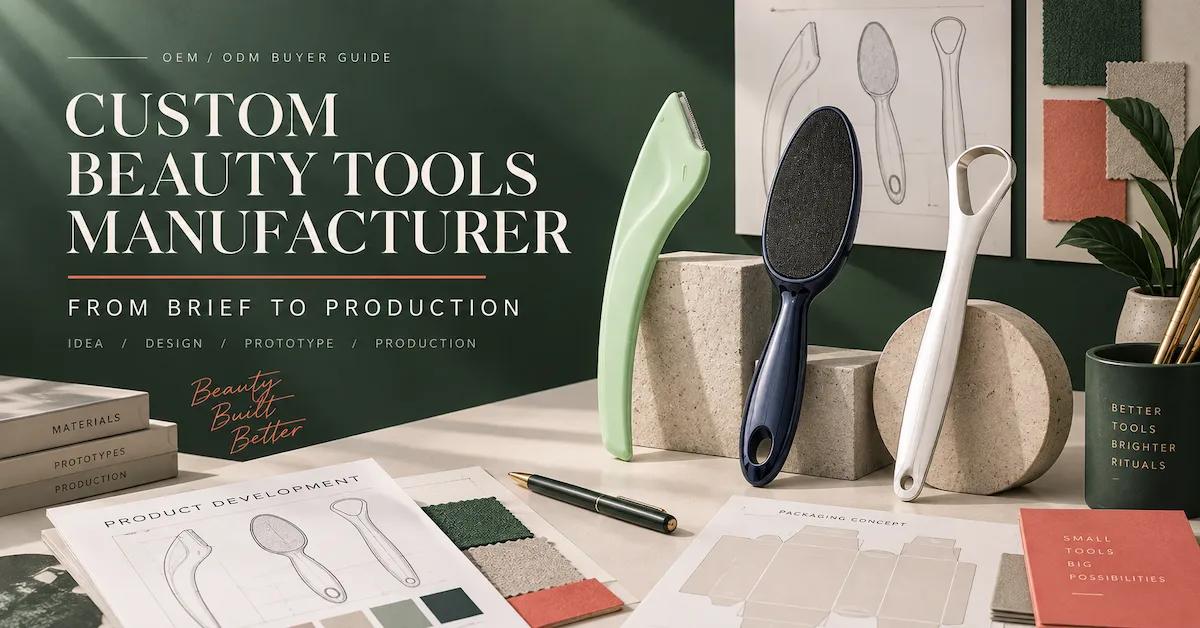
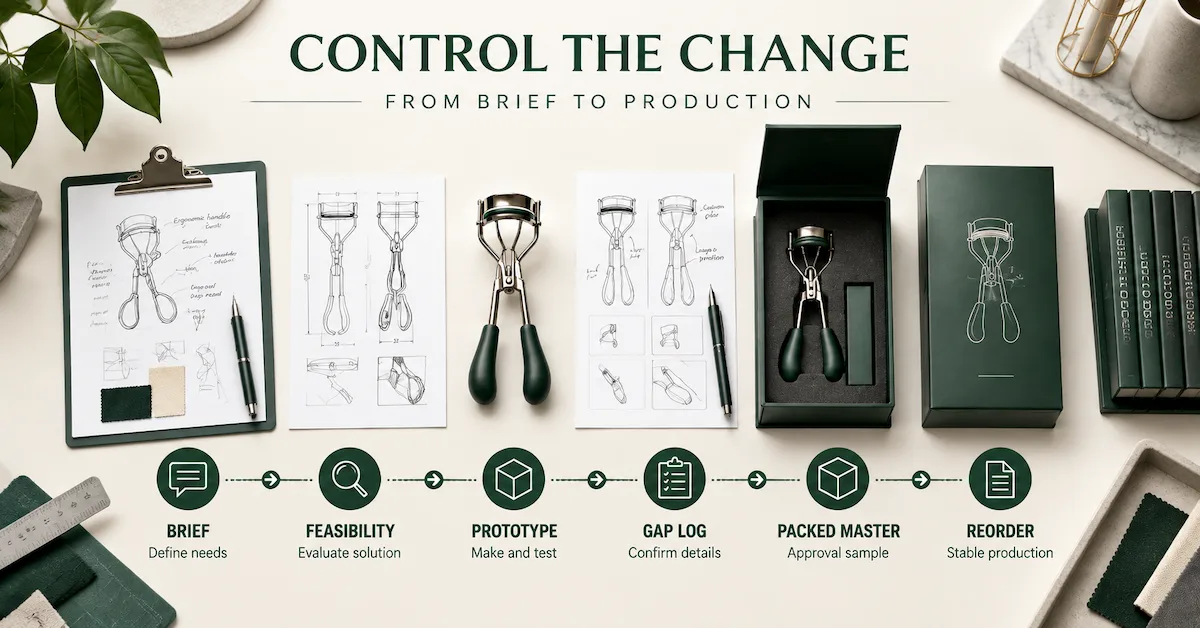
Quick Answer: A capable custom beauty tools manufacturer should translate a buyer's commercial idea into a controlled product definition. Before production, the buyer and supplier should agree on the target user, product geometry, materials by component, finish, logo, packaging, functional checks, sample revision, and inspection evidence. Separate standard features from configurable options and new development. Approve a packed master sample, record every accepted change, and use the same versioned specification for the quotation, purchase order, inspection, shipment, and reorder.
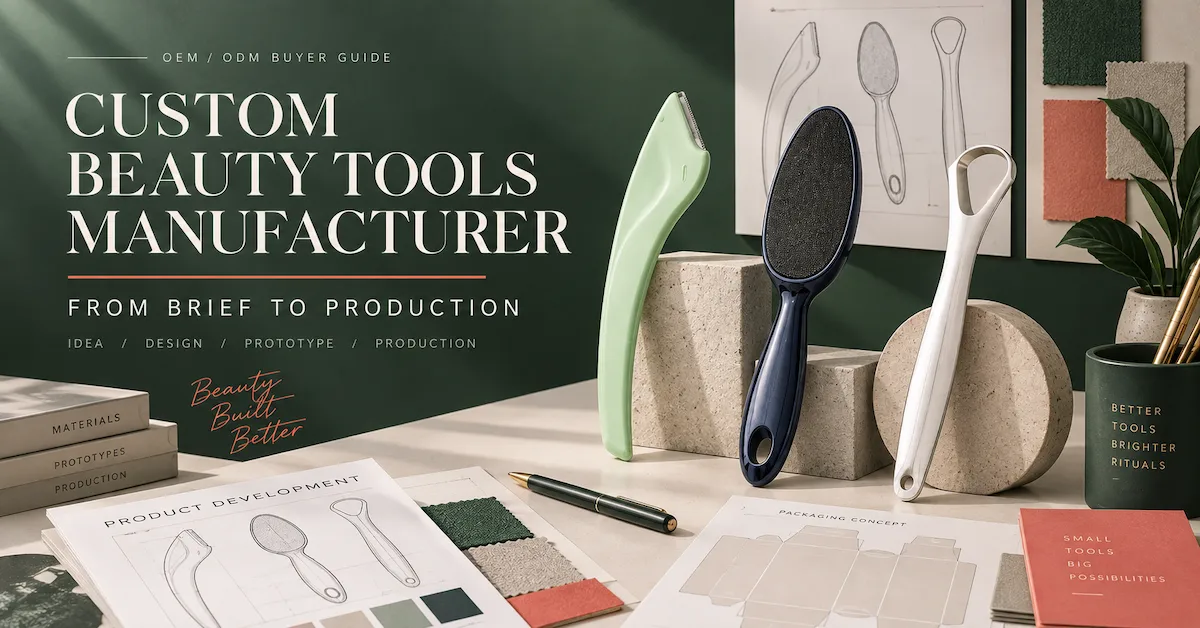
Introduction: A Custom Product Can Fail Before the First Sample
A retailer may begin with a simple sentence: "We want a brow tool in our color." A distributor may send a competitor sample and ask for something similar at a different price position. A beauty brand may have a sketch, a packaging mood board, and a launch date, but no mechanical drawing. Each request sounds clear in conversation. None is yet a production instruction.
The hidden risk is interpretation. Does "our color" apply to a plastic handle, a coated metal part, the carton, or all three? Does "similar" refer to the working geometry, hand feel, finish, size, or only the retail purpose? Is the reference sample a target to copy, a problem to improve, or merely a way to explain the category? Unless these questions are separated, a quotation can look precise while different teams are pricing different products.
This guide is for beauty brands, importers, ecommerce operators, salon suppliers, retail buyers, and distributors developing a tool under their own commercial specification. It explains how to turn an early idea into a production-ready technical package, how to review samples without losing decisions in chat messages, and how to compare quotations on the same basis. The method is useful whether the project involves a small appearance change, a branded package, a new tool configuration, or a broader multi-SKU range.
OLIMOR BEAUTY supports OEM and ODM beauty-tool projects, including development from drawings, physical samples, appearance concepts, and structural requirements. Company-provided capability information lists metal stamping, heat treatment, plastic injection, polishing, deburring, assembly, inspection, and packaging. Those capabilities should not be read as the manufacturing route for every SKU. The applicable operations, material, MOQ, schedule, and verification plan must be confirmed for the selected model and customization scope.
1. What Is a Custom Beauty Tools Manufacturer?
A custom beauty tools manufacturer converts buyer-defined requirements into a manufacturable and repeatable beauty tool. The work may start from an existing platform, an annotated product sample, a two-dimensional drawing, a three-dimensional file, an appearance direction, or a structural requirement. The defining feature is not the word "custom." It is the existence of controlled requirements that change the product, brand presentation, or packed retail unit.
The manufacturer may need to evaluate working geometry, component interaction, material selection, tooling, surface treatment, decoration, assembly, protection, and pack-out. The buyer remains responsible for explaining the target market, user, claims, channel, desired price position, order assumptions, and any market-specific documentation that the project requires. A productive relationship joins commercial intent to technical evidence.
This role differs from simple catalog purchasing. A catalog item can still require model confirmation and incoming inspection, but a custom project introduces change. Every change has an owner, cost, approval point, and possible effect on another part of the product. A thicker handle can alter mold work and package fit. A new finish can alter logo contrast. A sharper retail silhouette may need stronger protection in transit. The project succeeds when those dependencies are made visible early.
OEM, ODM, private label, and custom are work scopes
An OEM beauty tools manufacturer discussion usually starts with more buyer-controlled input, such as a drawing, dimensional requirement, reference sample, mechanism, or bill of materials. An ODM beauty tools manufacturer discussion may begin with a desired user problem and use supplier-supported platforms or development ideas. A private label beauty tools manufacturer project often adapts an existing model through an approved color, finish, logo, package, or set composition.
These terms are used differently across the market. Do not choose a route from the label alone. Ask what is existing, what can be configured, what requires a new process or tool, who supplies the design input, and what evidence will approve the result. Write those answers into the quotation. A one-line statement such as "OEM available" does not define the work.
2. Start With the User Task, Not the Decoration
The first page of a development brief should explain the customer and the task. A folding brow razor for a travel kit has a different use and storage context from a glass foot file for a spa assortment. A tongue scraper sold through an oral-care retailer needs a different information hierarchy from a tool included in a general grooming set. Without that context, the manufacturer can only react to surface choices.
Describe one primary user, one primary task, and one main sales channel. Add the expected unit of sale: loose tool, carded item, boxed product, pouch, or multi-piece set. State the target retail position in words or a buyer-controlled cost target, but separate the target from a confirmed quotation. Include destination markets because language, labeling, responsible-party information, safety warnings, and documentation may differ.
Then list observable success criteria. "Premium" is not observable. A defined surface appearance, approved color reference, legible logo, controlled hinge action, secure product restraint, and undamaged retail pack are. "Comfortable" is also incomplete. Describe the intended grip, use duration, hand position, relevant handle zones, and how the sample will be reviewed.
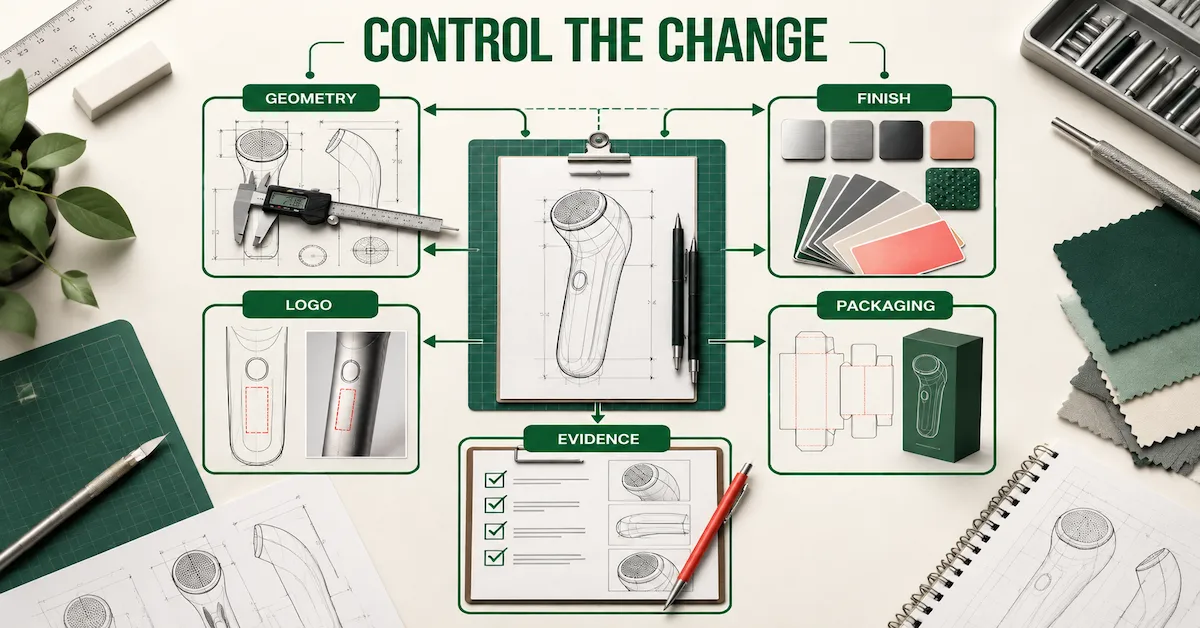
3. Divide Every Request Into Five Change Blocks
Custom development becomes easier to quote when the request is divided into geometry, finish, logo, packaging, and evidence. This prevents an appearance request from quietly becoming a structural redesign. It also gives the supplier a way to identify dependencies before sample work begins.
| Change block | Buyer should define | Manufacturer should clarify | Approval evidence |
|---|---|---|---|
| Geometry | Working end, handle, mechanism, dimensions, tolerances, and interaction with other parts | Existing platform, tooling effect, manufacturability, assembly effect, and critical dimensions | Drawing revision, measured sample, and functional review |
| Finish and color | Target appearance, gloss or texture, color reference, and acceptable variation | Substrate, preparation, suitable process, masking, and sample limitations | Physical finish sample under agreed viewing conditions |
| Logo | Vector file, size, position, orientation, color, and required contrast | Marking method, printable area, edge clearance, and effect on the surface | Artwork proof plus decorated product sample |
| Packaging | Structure, insert, copy, barcode, languages, display method, and carton needs | Product restraint, point or edge protection, rub risk, pack-out, and dieline | Assembled packed master sample |
| Evidence | Required inspection records, material documents, compliance files, photos, and retention samples | What can be provided, by which entity, for which model, and at what stage | Named document list tied to the order and destination |
This framework supports a cleaner quotation. If only the color and carton artwork change, the supplier can state that geometry remains standard. If the working head, handle, and package all change, the project can be treated as a development program with staged approvals. The point is not to make the project sound larger. It is to reveal the real work before price becomes the only topic.
4. Use DFM to Test the Brief Before Making the Sample
Design for manufacturing, or DFM, is a practical review of whether the requested product can be made, assembled, finished, inspected, packed, and repeated as intended. A DFM conversation should produce decisions rather than general reassurance. Mark each feature as accepted, revised, rejected, or awaiting evidence.
Begin with function. Which surfaces perform the grooming task? Which points, edges, jaws, loops, pads, abrasives, pivots, springs, or closures are critical? What happens if a dimension moves within the proposed tolerance? How will the factory check the characteristic during production? A characteristic that cannot be measured or compared needs a defined reference method before approval.
Next, examine interfaces. A plastic handle meets a metal blade. A file surface meets its frame. A tongue scraper loop joins a handle. A tool sits inside an insert, then the insert sits inside a carton. These interfaces often create more trouble than isolated parts. Record fit, movement, clearance, contact, and protection requirements.
Finally, review the visual system. A custom logo beauty tools program must account for the substrate and surface process, not only the logo file. The same artwork may need different size or placement on curved plastic, polished metal, a soft pouch, and printed paperboard. Approve the brand intent at range level, then approve the application on each model.
5. Three Product References Show Why One Custom Checklist Is Not Enough
Beauty tools may sit in one catalog, but they do not share one functional review. The three OLIMOR references below illustrate how custom questions change with the product. They are examples from current product pages, not promises that every shown option is available for every project. Confirm the model, specification, stock status, decoration route, MOQ, and schedule in the quotation.
Eyebrow razor ERF1113: control the blade-handle-package relationship
The OLIMOR eyebrow razor ERF1113 page shows a mint-colored curved handle and identifies the model as a stainless-steel-and-plastic product. For a custom project, the buyer should not stop at a handle color. The blade exposure, guard condition, attachment to the handle, grip geometry, overall appearance, and protective packaging work as one system.
A buyer changing the handle silhouette should ask whether the blade seat or assembly method changes. A buyer changing only color should approve the color on the production substrate, since screen values do not reproduce physical plastics. The retail package should protect the working edge, prevent loose movement, and communicate the intended use without adding unsupported safety or performance claims.
Nano glass foot file FFB3057: approve the working surface and the complete unit
The OLIMOR nano glass foot file FFB3057 page shows two dark blue handled forms with different visible proportions. This is a useful reminder that a family name is not a SKU definition. The order should identify the exact form, dimensions, working surface, handle, color, pack, and unit count.
For a foot file, review the consistency and boundary of the working surface, the edge around it, frame retention, handle condition, visible defects, and package contact points. If the tool is packed with other items, check whether hard surfaces can mark neighboring products. Instructions and cleaning statements should match the verified configuration and destination-market review.
Tongue scraper TSR1045: separate material appearance from confirmed specification
The OLIMOR tongue scraper TSR1045 page shows a single-piece metallic tool with a looped working end. For development, the buyer should define the loop profile, edge condition, handle geometry, surface appearance, hanging hole, logo zone, and protective presentation. The public image is a visual reference; the quotation should carry the confirmed material description and model data.
A buyer seeking a stainless steel beauty tools supplier should ask which component is stainless steel, which grade or specification applies to the selected model, and what supporting document is needed. Metallic appearance alone is not a material record. Material, surface finish, cleanability, and market compliance are separate subjects and should not be collapsed into one broad claim.
6. Build One Technical Package That Controls the Project
The technical package is the shared product memory. It should allow purchasing, product development, design, quality, the manufacturer, and a future reorder team to identify the same item without searching old messages. A good file does not need to be elaborate. It needs to be complete, versioned, and connected to evidence.
Start with identity: buyer SKU, supplier model, working product name, revision, date, and status. Add the intended user and task so later changes can be assessed against the product purpose. List components and material descriptions by part. Record dimensions and tolerances that affect function, assembly, package fit, or customer expectation. Mark critical characteristics instead of treating every dimension as equally important.
Add a finish and color block with a physical reference where possible. Include the artwork filename, revision, marking method, size, position, orientation, and contrast target. Attach the packaging dieline, approved copy, barcode data, insert or restraint instructions, inner-pack information, master-carton information, and carton marks. Link every approval sample and photograph to the same revision.
Do not allow the sales name to replace the model. "Green brow razor" is not a stable production identity. It may refer to several shapes, blades, colors, or packages. The buyer SKU and supplier model should appear on the quotation, sample label, purchase order, inspection file, carton record, and reorder confirmation.
7. Turn Sampling Into a Controlled Learning Cycle
When a courier carton lands on the buyer's desk, the project has not automatically moved forward. The useful question is narrower: what can this particular sample settle? Write that list before requesting it, along with the decisions that must remain open. An appearance mockup, for example, may say little about final material, tooling, finish, or production method. Call a sample production-representative only after the supplier has stated, feature by feature, what it actually represents.
Review each sample against the brief and current specification, not against memory. Photograph it in consistent views. Record the sample code, date, product revision, artwork revision, package revision, and reviewer. When a problem appears, describe the location, expected result, observed result, evidence, requested action, owner, and status.
| Gap-log field | Useful entry | Weak entry to avoid |
|---|---|---|
| Location | Logo on left side of handle, 18 mm from lower edge | Branding issue |
| Expected | Use artwork revision C at approved size and orientation | Make it better |
| Observed | Revision B used; mark rotated relative to approved proof | Looks wrong |
| Evidence | Annotated photo 03 and artwork proof dated by both teams | See chat |
| Action | Replace artwork file, issue new proof, then decorate one revised sample | Please fix |
| Closure | Accepted in sample S03 and transferred to specification revision D | Done |
The gap log earns its keep when samples begin to multiply. Imagine that S02 corrects a loose insert but accidentally brings back the old logo position: the earlier closure remains visible instead of vanishing into a message thread. The log also shows whether the supplier missed an agreed requirement or the buyer simply changed direction. Choosing a new color after reviewing S01 is a revised brief, not evidence that S01 was defective. Price, timing, package artwork, and approval status should then be reconsidered under the new choice.
8. Approve Logo and Packaging on the Actual Product
Logo approval has three layers. The digital proof confirms content, dimensions, and placement. The decorated sample confirms the method on the actual substrate and finish. The packed sample confirms that the mark remains visible and is not damaged by an insert, elastic, sleeve, or neighboring tool.
Packaging approval also has three layers. Structural review covers fit, movement, point or edge protection, opening, closing, and display. Graphic review covers artwork, color, typography, barcode, required business information, warnings, and languages. Logistics review covers unit count, inner pack, master carton, carton marks, and how the packed product handles normal distribution.
For products intended for the European Union, buyers should review the current General Product Safety Regulation requirements with qualified compliance support. The European Commission's GPSR business guidance identifies product identification and economic-operator contact information among the information areas that may need to appear on the physical product, packaging, accompanying material, or distance-sales offer depending on the role and situation. That is a reason to define the destination early; it is not a claim that one universal label suits every market.
Keep regulatory review separate from graphic taste. A packaging proof can look attractive and still omit required information. Conversely, adding a cluster of logos or claims does not create compliance. Identify the responsible reviewer, applicable market, evidence source, language version, and approval date.
9. Define Quality as Conformity to the Approved Requirement
"Good quality" is too foggy to release a shipment. A team needs to know which agreed requirement was met, how it was checked, and which record carries the result. The ISO 9000 family describes customer focus, process thinking, evidence-based decisions, and improvement among its management principles. A separate ISO supply-chain guide adds a particularly useful caution for purchasers: a quality-management system does not write the specification for the item being bought. Product expectations still have to be communicated through drawings, specifications, referenced standards, catalog details, or another suitable control document.
Apply that principle to the custom tool. Define incoming checks for materials or purchased parts where relevant. Define in-process checks at the operation that creates or can detect a critical characteristic. Define final checks for identity, quantity, appearance, function, logo, packaging, and shipment information. The exact inspection plan should match the model and risk.
Do not paste a generic AQL statement into the purchase order and assume the project is controlled. If sampling inspection is used, agree on the standard or method, lot definition, inspection level, defect classes, acceptance criteria, and what happens after a failed result. The buyer should also define any characteristics that require full checking or process control rather than relying only on a final sample.
OLIMOR's company-provided information confirms production-process inspection and finished-goods shipment inspection, with torque and hardness test equipment listed among available equipment. Those statements do not prove which test applies to the three examples in this article. Ask for the model-specific control plan, method, acceptance rule, and record before treating a capability as project evidence.
10. Compare Quotations by Assumption, Not by One Total
Two prices are comparable only when they describe the same product and service boundary. Ask every shortlisted supplier to quote the same revision and quantity scenario. Separate product price, tooling or development, sample charges, decoration, package components, testing or documentation, inspection, freight assumptions, and taxes or duties as applicable.
| Quotation area | Questions to resolve | Why a mismatch matters |
|---|---|---|
| Product identity | Which model, drawing revision, components, material, dimensions, and finish? | A similar photograph can hide a different construction |
| Customization | Which changes are included? Is new tooling, setup, or validation separate? | One quote may include development that another omits |
| Decoration | Which artwork, method, locations, colors, and proofs? | Logo quality and setup assumptions affect cost |
| Packaging | What is the unit pack, insert, printed material, pack count, and carton basis? | The cheapest tool price may exclude the retail-ready unit |
| MOQ | What drives it: model, material, finish, logo process, package print, or component? | A single headline MOQ may not apply to the requested configuration |
| Schedule | What starts each stage, and which approvals or files are dependencies? | A date without conditions cannot support launch planning |
| Quality evidence | Which checks, reports, photos, documents, and retained samples are included? | Inspection and compliance work may otherwise appear after ordering |
| Delivery basis | Which Incoterm, destination, freight mode, carton data, and validity? | Landed cost cannot be compared from unit price alone |
A wholesale custom beauty tools supplier should be able to state what quantity and package assumptions support the offer. MOQ can be driven by different elements of the project, so request the driver rather than pressing for an unsupported universal number. Sampling and production schedules likewise depend on development scope, material availability, approvals, and order configuration.
For the buyer, the best commercial comparison is a landed-cost scenario tied to the same specification. Include foreseeable development and quality costs, not only the first unit price. A slightly lower quote can become the expensive option if it leaves artwork, packaging, inspection, or change control undefined.
11. Evaluate the Manufacturer Through Its Questions
A professional beauty tools manufacturer should ask questions that reduce ambiguity. Look for discussion of the user task, critical characteristics, reference quality, tolerances, tooling effect, logo substrate, package interaction, inspection method, and revision control. Immediate agreement with every request may feel convenient, but it does not demonstrate that the dependencies have been examined.
If visiting or auditing a beauty tools factory China operation, trace one example through the system instead of touring only the showroom. Start with the approved specification and sample. Follow the model through applicable production steps, in-process checks, segregation of nonconforming items, final inspection, pack-out, and retained records. Ask how the team prevents an obsolete artwork or drawing from returning on reorder.
When a physical audit is not practical, request a structured remote evidence pack. It may include a live review of the selected model, dated photos of relevant operations, sample labels, a redacted inspection form, equipment identity, package trial, carton information, and a revision list. Agree what the evidence proves and what it does not. A polished factory video is not a model-specific control plan.
Read any capability list beside the proposed route for the chosen SKU. A long list of operations is relevant when the design crosses metals, plastics, finishes, and assembly, yet it does not reveal where this particular item will travel. Put four plain questions on the audit sheet: Which steps happen here? Which go to an outside processor? Who accepts returned components? Where are revisions and corrective actions recorded?
12. Freeze a Packed Master Before Production
The final pre-production approval should represent the unit the customer will receive as closely as agreed. The packed master combines the approved tool, finish, decoration, accessories, insert, printed copy, barcode, and retail package. Label it with SKU, supplier model, revision, date, and signatures or traceable approval.
Approval does not mean silently accepting every visible feature. List intentional differences between the packed master and production, such as a temporary sample material or hand-applied mark, and state how production will be verified. If the sample cannot represent a critical characteristic, create separate evidence for that characteristic.
Freeze the quotation and purchase order against the same revision. Attach or reference the specification, artwork, dieline, gap-log closure, inspection criteria, packing instruction, and shipment marks. State that proposed changes require review before implementation. This is especially important when a substitute material, process, component source, or package part could alter the customer experience.
13. Design the Reorder Record During the First Order
Reorder control begins before the first shipment. Keep the approved specification, physical or documented master, artwork files, color reference, packaging dieline, carton data, inspection record, deviation approvals, and final commercial configuration together. Record which version actually shipped.
At reorder, do not send only an old purchase-order number. Ask the supplier to confirm the current model, revision, material, finish, artwork, package, component sources where relevant, and proposed changes. Reconfirm MOQ, price, schedule, document needs, and delivery basis because commercial conditions can change even when the product does not.
If the first production revealed an issue, convert the resolution into the specification or control plan. A correction that lives only in an email is vulnerable to staff turnover. A controlled record allows both organizations to learn without relying on memory.
14. What to Send in the First RFQ
A useful request for quotation gives the supplier enough context to recommend a route and identify missing information. Send a concise pack rather than a long message thread:
- Company, target market, sales channel, and buyer contact.
- Target user and primary grooming or care task.
- Product link, supplier model, drawing, annotated sample, or concept reference.
- One numbered list of requested geometry, finish, color, logo, and package changes.
- Quantity scenarios and the exact unit of sale.
- Destination and delivery basis requested for comparison.
- Artwork status, language needs, barcode responsibility, and packaging format.
- Required sample stages, approval evidence, inspection needs, and documents.
- Desired timing, clearly labeled as a target until feasibility is confirmed.
- Questions about MOQ drivers, tooling, ownership, quotation validity, and change control.
Mark every assumption in plain sight. A material grade, test method, or package board that has not been selected should read "open," not look final because somebody placed it in a spreadsheet. The supplier can then price a named option or ask for a decision. Request a short exclusions section as well. The missing line item often explains a price difference faster than another round of discount requests.
Frequently Asked Questions
How do I choose a custom beauty tools manufacturer?
Choose against the real project. Review experience with the product category, ability to interpret drawings or samples, relevant production and supplier controls, DFM quality, sample discipline, model-specific inspection, packaging coordination, communication, and reorder control. Compare responses to the same brief and verify claims with suitable evidence.
What can usually be customized on beauty tools?
Possible areas include product geometry, components, finish, color, grip, logo, set composition, case, retail package, inserts, printed copy, and cartons. Availability depends on the selected model, material, process, quantity, tooling, and validation needs. Classify each request as standard, configurable, or new development before ordering.
What is the difference between OEM and ODM beauty tools?
OEM often follows buyer-controlled drawings, samples, dimensions, or construction requirements. ODM may use manufacturer-supported designs or platforms that are adapted to a buyer's market. In practice, definitions vary. The quotation should identify who provides the design input, what changes, who owns project files or tooling, and how the result will be approved.
Can I customize only the logo and packaging?
Yes, some projects use an existing product platform with buyer-approved decoration and packaging. The product model and functional sample still need confirmation. The logo should be approved on the actual surface, and the complete packed unit should be reviewed for fit, movement, rubbing, copy, and distribution needs.
How many samples should a buyer approve?
There is no universal number. The stages depend on what changes and what each sample can represent. A project may use an appearance model, functional prototype, decoration proof, package prototype, and packed pre-production master. Define the question for each sample and do not treat an early mockup as evidence of final production.
How are MOQ and lead time determined?
MOQ may depend on the model, material, tooling, finish, decoration method, printed packaging, component purchase, and order mix. Timing may depend on file readiness, DFM, tooling, samples, artwork, package proof, approvals, production, inspection, and shipment. Confirm both for the exact configuration and reconfirm after changes.
What should be checked before mass production?
Confirm the current product specification, drawing, materials by component, critical geometry, function, finish, color, artwork, decorated sample, package dieline, printed copy, packed master, inspection plan, document list, carton information, quotation, purchase order, and approved deviations. All should point to the same revision.
How can I protect consistency on reorders?
Maintain a versioned SKU record and packed master, retain approved artwork and finish references, record the version shipped, and require advance notice of changes. At every reorder, reconfirm the specification, commercial assumptions, quality evidence, package, and delivery basis.
Next Step: Convert One Idea Into a Reviewable Brief
Select one tool and write the user task in one sentence. Attach a current OLIMOR product link, an annotated reference, or your own drawing. Divide requested changes into geometry, finish, logo, packaging, and evidence. Then ask which elements are standard, configurable, or new development.
That first disciplined brief gives both teams a better starting point. It allows the manufacturer to identify feasibility questions, the buyer to compare a defined scope, and the sample process to close visible gaps. The final goal is not a sample that merely looks promising. It is a product definition that can be quoted, approved, inspected, shipped, and reordered without being reinterpreted each time.
Tag: