Searching for beauty tools factory China is only the first step in choosing a private-label supplier. Before comparing unit prices, connect each factory's claimed capability to the exact product you intend to buy: its materials, manufacturing steps, functional requirements, inspection criteria and packaging. A broad catalogue provides product ideas; it does not establish whether the supplier can consistently reproduce your approved specification.
OLIMOR BEAUTY's company information describes beauty and personal-care tool development, metal and plastic processing, assembly, inspection, packaging and export support, alongside OEM and ODM cooperation. These capabilities provide a starting point for evaluation, but the scope should still be confirmed for the selected model.
This guide is for private-label brands, importers, distributors and retail teams evaluating manufacturing fit. The central question is not simply whether a supplier sells the tool. It is whether the supplier can explain how that tool will be made, checked, approved and supplied again.
1. Look Beyond the Catalogue
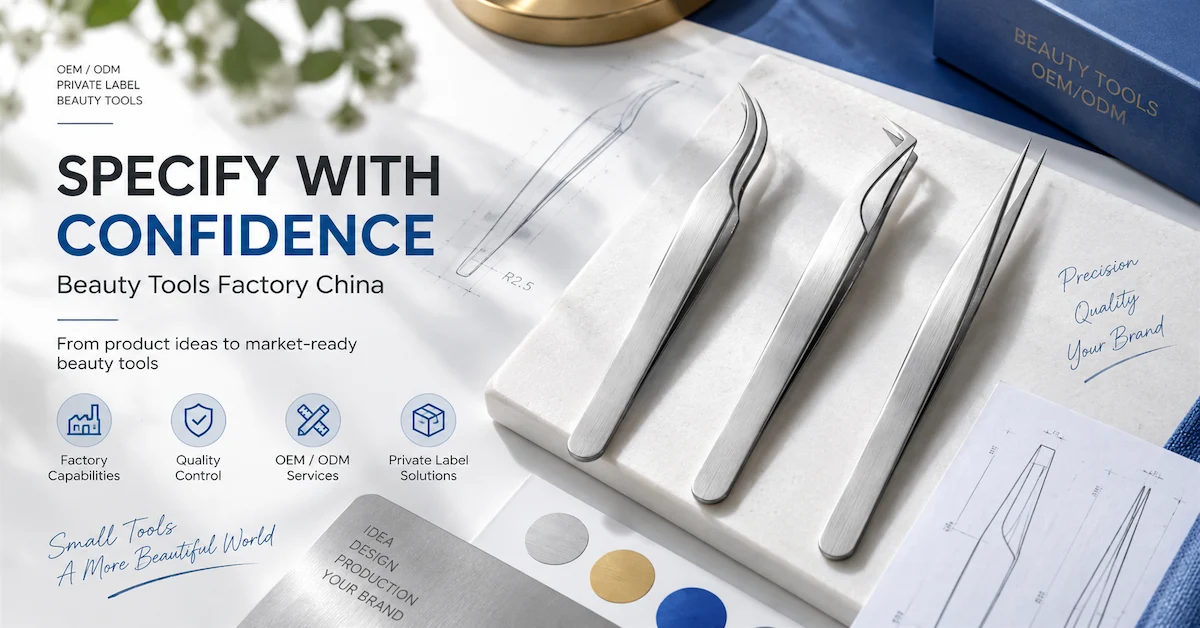
Two tweezers can look almost identical while differing in tip contact, spring tension and surface finish. Two nail clippers can share an outline while using different materials, heat-treatment conditions or lever assemblies. Product photography cannot settle those differences.
Ask the supplier to translate the selected model into a manufacturing process map: material, forming, finishing, assembly and inspection. An answer such as “we make many beauty tools” leaves the most important questions unresolved.
| What the catalogue shows | What the buyer still needs to verify |
|---|---|
| Product shape and colour | Material, dimensions, tolerances, finish and reference sample. |
| A wide product range | Which operations are completed in-house and which involve production partners. |
| OEM or ODM availability | Accepted development inputs, tooling requirements and approval steps. |
| Quality claims | Functional checks, acceptance criteria, sampling and handling of nonconforming pieces. |
| Packaging photographs | Actual dimensions, tool protection, artwork responsibilities and carton configuration. |
Use catalogue references to define the discussion, then ask for evidence tied to the product—not just the category.
2. Confirm the Factory Footprint and Operating Scope
OLIMOR's company information distinguishes the business establishment date, December 9, 2011, from the factory establishment date, December 22, 2017. Keep company history, factory history and the identity of the supplying entity separate when reviewing supplier information.
Factory area, employee numbers and annual output should be checked for their date, location and product coverage. More importantly, installed capacity is not the same as capacity available for your order. Ask which forming, polishing, assembly or packaging operations affect the proposed schedule and what assumptions support the delivery estimate.
The company profile lists export markets including Japan, the United States, France, Germany and Australia, among others. Export history is useful context, but it does not establish that every product meets every destination-market requirement. Confirm the documents, labelling and packaging applicable to your own order.
3. Map Each Product to Its Manufacturing Route
OLIMOR's capability information lists metal stamping, heat treatment, plastic injection moulding, polishing, water deburring, assembly and packaging. Not every product uses every operation. Ask which steps apply to the selected model and where they are performed.
Metal Tweezers
Review the relationship between the two working ends, not just the handle outline. Ask how tip alignment, closing contact and grip are checked against the approved reference. Where forming, edge shaping, joining or polishing is involved, confirm how those operations connect to the final inspection. A visible tip gap or uneven meeting point needs an agreed acceptance decision, not a general promise of precision.
Nail Clippers and Cuticle Nippers
Separate the relevant checks for each tool: blade meeting and lever action for a clipper; cutting-edge contact, joint movement and handle control for a nipper. Discuss material, heat treatment, hardness and finish where applicable. Any catcher or accessory should be included in the evaluation. One successful cutting demonstration does not define the performance expected across an order.
Plastic-Handled Tools and Moulded Components
For an injection-moulded handle or accessory, discuss colour, fit, texture, excess material at mould seams and assembly alignment. Where metal and plastic components join, ask how their positioning is checked. Confirm the colour reference and approval method. Do not assume that every handle, pad or accessory uses the same material or manufacturing process.
Eyelash Curlers
Review frame curvature, hinge movement, pad position and handle geometry together. Ask which dimensions and functional checks apply to the intended design, and how pad fit and movement are assessed before packing. A catalogue photograph should not replace sample evaluation of the complete frame-and-pad combination.
4. Turn Quality Control into a Product-Specific Plan
OLIMOR's company information lists production-process inspection, finished-product or shipment inspection, and torque and hardness testing equipment. These are capability statements; the buyer and supplier still need to identify which checks apply to the order.
Request a control plan that connects each inspection stage to an approved reference and an acceptance decision.
| Control stage | What to agree with the supplier |
|---|---|
| Incoming checks | Identification and condition of relevant materials, components and packaging. |
| First-piece approval | Checks after tooling, material or process changes, using the approved drawing or sample. |
| In-process inspection | Critical dimensions, alignment, fit, movement and finish to monitor during production. |
| Finished-product inspection | Functional performance, appearance, logo, colour, accessories and package contents. |
| Shipment inspection | Quantities, carton marks, packaging integrity and dispatch documents. |
“Visual inspection” is too broad to explain tweezer quality. Specify tip alignment and closing contact. For a clipper, identify blade meeting and lever movement; for a curler, identify frame, hinge and pad checks. Ask how unacceptable pieces are separated, reviewed, corrected and recorded.
5. Request Evidence Relevant to the Order
Keep document requests focused. Useful evidence can include a process-flow diagram, sample inspection form, material information for the chosen model, photographs of relevant equipment, packaging drawings and annotated sample images. The purpose is to understand repeatable production—not to demand unrelated confidential information.
Where certificates or audit documents are offered, confirm the document type, holder, supplying site, scope and date. A catalogue logo should not be treated as proof that a particular SKU passed a particular test. Ask what each document actually supports and which product-specific questions remain open.
This keeps the discussion collaborative while giving purchasing and quality teams something more useful than a general assurance.
6. Use Sampling to Test the Specification
Send a drawing, physical sample, annotated photograph or structural concept with the intended user, destination market, price position and packaging requirements. The sample should answer the questions raised in that brief.
Review it in three passes: functional performance; measurable and visible features; then the complete package and carton configuration. Compare samples from different suppliers against the same requirements rather than relying on whichever looks most attractive.
Record approvals precisely. “Tip alignment and finish approved; packaging insert pending” defines the decision better than “looks good.” Identify the sample, drawing and artwork version. If the coating, pad, logo or package changes, review whether the existing approval still applies and document the outcome.
7. Compare Suppliers with a Weighted Scorecard
Use a scorecard to compare candidates on your beauty tools factory China shortlist without allowing unit price to dominate the decision. A premium brow tool may place greater emphasis on tip performance and finish; a retail manicure set may place greater emphasis on assortment consistency and packaging.
| Evaluation area | Questions to assess | Suggested weight |
|---|---|---|
| Product fit | Does the supplier understand the function, geometry and intended user? | 20% |
| Process coverage | Are the relevant forming, finishing, assembly and packaging steps controlled? | 20% |
| Quality evidence | Are checkpoints, records and corrective actions explained? | 20% |
| Development support | Can the supplier translate the brief into a sample and record approvals? | 15% |
| Commercial clarity | Are MOQ, timing, tooling, packing and shipment assumptions visible? | 15% |
| Communication and export readiness | Can the team address documentation, market and logistics questions? | 10% |
These weights are a suggested buyer framework, not an official audit standard or a completed rating of OLIMOR. Record the evidence and unresolved questions beside each area. A polished presentation should not substitute for a missing process explanation or unapproved sample.
8. Separate MOQ, Lead Time and Cost Assumptions
Confirm the minimum order quantity, or MOQ, for the exact combination of model, material, finish, branding and packaging. A standard tweezer with a stock finish should not automatically share the commercial conditions of a revised tip with custom colour and printed packaging.
Ask suppliers to separate one-time development items from recurring costs. Tooling, colour matching, artwork preparation, sampling and packaging setup should be distinguishable from the production unit price.
Review delivery estimates in the same way. Ask which approvals, tooling steps and production operations the schedule assumes. Compare an existing platform, an ODM adaptation and an OEM design on their stated scope rather than treating all three as interchangeable quotations.
9. Evaluate Packaging as Part of Product Quality
Packaging must protect the approved product as well as present the brand. Check whether the proposed insert or restraint prevents unwanted movement, whether working ends are protected and whether a set remains in its intended arrangement. Ask what handling or transport checks are proposed rather than assuming the packaging has already passed them.
For an eyelash curler product reference, use the sample discussion to confirm pad protection, frame position and package fit. The photograph is a starting point, not evidence of transport performance.
Agree on the logo method, position, colour reference, artwork responsibility and approval steps. Include any required barcode area, language panel or buyer-approved warning text before approving the packed sample. Request final packed dimensions, carton quantity and outer-carton marks for the quoted configuration.
10. Send an RFQ That Produces Comparable Answers
A request for quotation, or RFQ, should identify the product category, reference model, intended use, target market, quantity range, material, finish, logo, packaging and launch window. Mark undecided items clearly.
Ask the supplier to address four connected areas in its reply:
Production scope: Which operations are in-house, which involve partners and which requested changes require tooling?
Product and quality: Which dimensions and functions are critical, what reference will be used, and how will conformity be checked?
Development and approval: What sample, drawing, artwork and packaging decisions are needed before production?
Commercial and documentary scope: What MOQ, timing, one-time costs, packing assumptions and applicable documents support the quotation?
Compare responses using the same specification. Where a supplier proposes an alternative, keep it separate from the original request so the price difference remains understandable.
11. Recognize Red Flags Without Rushing to Judgment
Pause when a supplier cannot identify the manufacturing route, avoids defining important tolerances, changes the specification without a record or provides a different sample after approval without explanation. Universal MOQ and lead-time promises also need clarification when the project involves different products or customization requirements.
A quotation showing only a unit price leaves packaging, logo setup, inspection and delivery assumptions unresolved. Request a complete explanation before treating it as comparable.
One unclear answer does not automatically disqualify a factory. The more useful test is whether the team follows up with a specific explanation and supporting record—or repeats the same broad claim.
12. Follow a Clear Buyer Decision Sequence
Begin with the intended user and product family, then send the reference and commercial brief. Review the proposed manufacturing route and critical checks before approving the sample, artwork and packaging.
Next, compare quotations for that same approved configuration, including MOQ, timing, documentation and shipment assumptions. Where appropriate, use a pilot order or controlled first run to evaluate consistency before expanding quantities.
Keep the specification, approval history and subsequent changes available for replenishment. This sequence connects the buying decision to a defined product rather than a series of disconnected photographs, messages and prices.
13. Check Repeatability Before Scaling
Ask how the approved reference will be identified during production and how operators will know which drawing, artwork and packaging version is current. This matters when several colours, tips or handles are being developed together.
Define the observable result: consistent tip contact, blade meeting, joint movement, surface appearance, component fit or set contents, as applicable. The buyer does not need to prescribe every internal manufacturing step, but should understand the agreed outcome and the record supporting it.
When reviewing a pilot quantity, agree on a sampling approach that covers relevant cartons or production periods rather than only the first pieces presented. Compare variations with the approved reference and classify them against the agreed criteria. This provides a basis for replenishment decisions without assuming a universal defect rate.
14. Distinguish Supplier Statements from Verified Evidence
A company profile, a model specification and an order commitment are different kinds of information. Keep those distinctions visible in the sourcing file.
| Information status | Example | How to handle it |
|---|---|---|
| Supplier-reported capability | The company states that it supports OEM and ODM. | Record the source and confirm the scope relevant to the project. |
| Model-specific evidence | A material or dimension appears in the agreed specification. | Attach the applicable document and revision; do not extend it to the whole range. |
| To confirm | MOQ, delivery timing, document scope or packaging availability. | Keep the question open until a relevant answer is received. |
| Buyer preference | A preferred colour, logo position, gift box or price position. | Present it as a requirement or proposal, not an existing factory capability. |
A stated employee count is supplier-reported information, not an independently verified fact merely because it appears in a document. Likewise, an expected shipping date is not an order commitment until its configuration and conditions are confirmed.
15. Keep Follow-Up Communication Actionable
After a quotation or sample review, send a concise decision summary: selected reference, requested material, preferred finish, logo position, packaging status, quantity range and unresolved items. This is easier to act on than a message history containing several contradictory versions.
Maintain a shared question log for purchasing, design, quality and logistics. Useful entries include which part receives heat treatment, how tip alignment is checked, what happens when a pad changes and which documents cover the supplying entity.
Close each question with the answer, supporting reference and approval status. The goal is a project record the supplier can use for both the first order and subsequent replenishment.
FAQ: Evaluating a Beauty Tools Factory in China
1. What Should I Ask a Potential Supplier First?
Start your beauty tools factory China evaluation with the selected product, in-house operations, development inputs and functional inspection requirements. Then confirm the information needed for a model-specific quotation.
2. Does a Large Catalogue Prove Manufacturing Capability?
No. A catalogue shows the range being presented. Manufacturing fit requires a connection between the selected model, materials, process route, inspection plan and approved sample.
3. Can OLIMOR Support Private-Label Beauty Tools?
OLIMOR's company information states that it supports OEM and ODM development using drawings, samples, appearance concepts and structural requirements. Confirm logo, finish, packaging and tooling options for the selected product.
4. How Should I Compare Two Factory Samples?
Apply the same checklist to function, geometry, hand feel, finish, branding and packaging. Compare each sample with the written brief, then review the inspection evidence and quotation assumptions behind it.
5. What Is the Right MOQ?
There is no universal figure in this guide. Request the minimum quantity for the exact model, finish, logo method, packaging and tooling configuration under discussion.
6. What Documents Should I Request?
Request relevant material information, inspection records, packaging files and documents covering the supplying entity and site. Check what each document supports instead of treating all supplier documents as product certification.
7. How Can I Reduce Quality Disputes?
Approve a clearly identified sample, specification and artwork package. Define functional checks, record changes and agree how nonconforming pieces will be isolated, reviewed and corrected.
8. Should I Visit the Factory?
A visit can support a strategic sourcing decision, while a structured remote review can still collect useful evidence. Either approach should examine the selected product's manufacturing route and records—not only the showroom.
9. How Should I Evaluate Production Capacity?
Ask which site and product families the stated output covers, then confirm capacity available for your configuration. Review scheduling assumptions and relevant production constraints rather than relying on a headline annual total.
10. Why Should Packaging Be Included in Sample Approval?
A loose tool cannot establish retail-pack fit, restraint, accessory position or carton configuration. Review the packed sample alongside the product so both parties approve the same deliverable.
Conclusion
The most useful result from a beauty tools factory China search is a supplier that can connect its claims to your actual product. Evaluate manufacturing scope, model-specific evidence, sample approval, packaging and repeatability before comparing the final commercial terms.
Explore OLIMOR BEAUTY's product range, then send a private-label or OEM inquiry with your target category, reference sample or image, material and finish preferences, branding, packaging, destination market and estimated quantity. Request a proposed manufacturing route, sample plan, quality-control outline and quotation with its assumptions clearly stated.