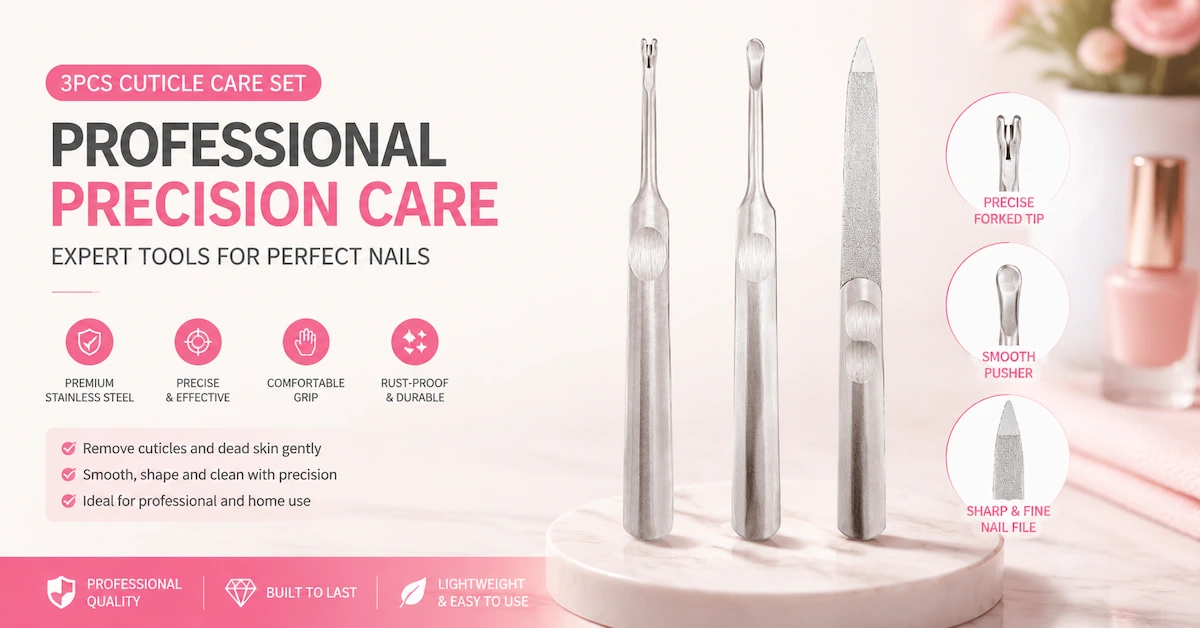
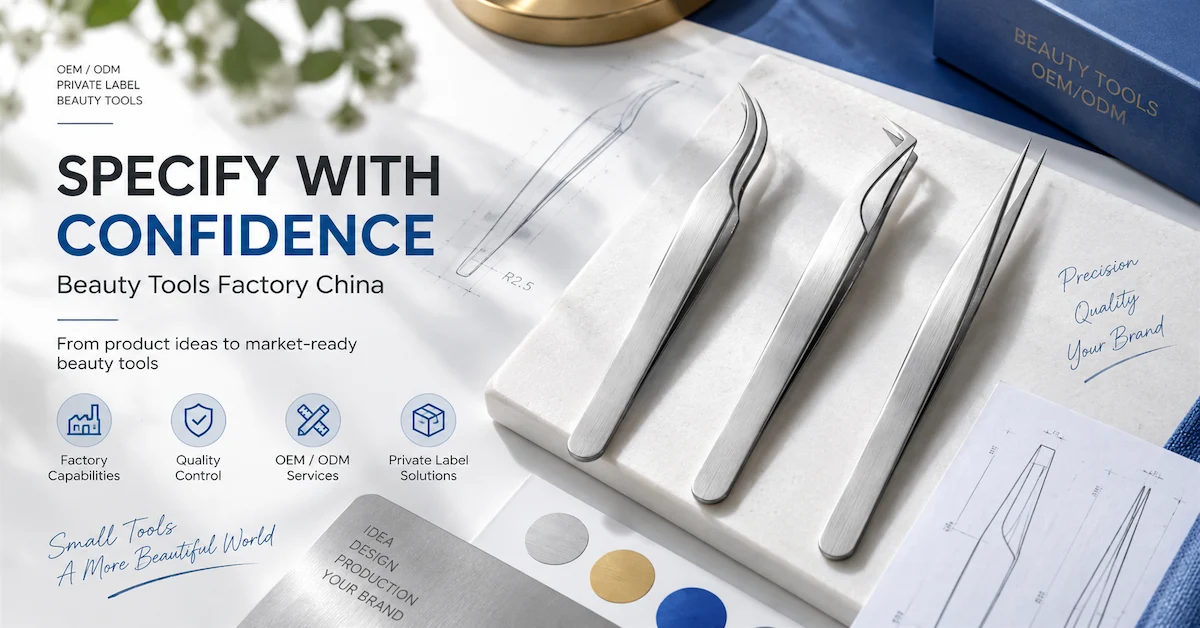
Buyers searching for beauty tools factory China should compare nail clippers, tweezers and eyelash curlers by function first: blade contact and lever action for clippers; tip geometry, alignment and grip for tweezers; and frame curvature, pad position and hinge movement for curlers. Materials, finish and packaging should then be assessed against the selected model, not a category-wide promise of quality.
OLIMOR BEAUTY lists all three categories in its product range and describes OEM and ODM development support. For private-label brands, importers, distributors and retailers, the purchasing task is to connect that range to a specific user, product specification and sales channel.
The three tools are not substitutes for one another. This comparison helps buyers decide which designs belong in their assortment and how to evaluate competing models within each category. Product photographs can establish a direction; sample evidence and a clear specification must support the final decision.
1. Start with the Shopper’s Task
Define the intended use before choosing a colour or logo. A compact manicure-set clipper, a catcher-style clipper and a baby-series product require separate reviews. Likewise, brow tweezers, professional lash tweezers and false-lash applicators should not be grouped under one undifferentiated specification.
Write the requirement in one sentence: “A compact clipper for a travel manicure set,” or “A brow tweezer with an approved slanted tip and protective retail card.” This gives the supplier a starting point for recommending a model and gives your team a reference for sample approval.
Include the sales channel. A product intended for a hanging retail display has different packaging questions from a tool included in a gift set or shipped through an online marketplace.
2. Compare the Three Categories Side by Side
Use the following matrix to review suppliers on your beauty tools factory China shortlist. Apply the same decision categories, but use product-specific checks. A satisfactory clipper inspection cannot establish whether a tweezer or curler is acceptable.
| Decision field | Nail clippers | Tweezers | Eyelash curlers |
|---|---|---|---|
| Main function | Controlled cutting for the intended grooming task. | Controlled grip for the specified brow, lash or grooming task. | Controlled curling with the selected frame-and-pad design. |
| Critical geometry | Blade profile, opening, lever and pivot. | Tip shape, contact area, alignment and body shape. | Frame curvature, opening, hinge and pad position. |
| Handling | Lever resistance, return and grip. | Closing pressure, spring response and tip control. | Handle comfort, opening control and hinge movement. |
| Material record | Identify cutting components, handle and any catcher separately. | Confirm the selected body’s material and surface treatment. | Identify frame, pad, handle and accessory materials separately. |
| Customization questions | Finish, logo, handle, catcher and set configuration. | Tip options, colour, pattern, texture, logo and packaging. | Frame options, colour, handle, pad and packaging. |
| Packaging priority | Protect cutting edges and secure the tool or set. | Restrain movement and protect the working tips. | Protect the frame, pad and included accessories. |
| Approval evidence | Blade contact, lever movement, finish and packed sample. | Tip contact, alignment, grip, finish and packed sample. | Frame, hinge, pad fit, handling and packed sample. |
These are comparison fields, not confirmed specifications for every OLIMOR model. Available configurations and acceptance criteria need model-level agreement.
3. Nail Clippers: Evaluate the Cutting Mechanism as a Whole
Blade Contact and Lever Movement
A clipper evaluation should examine how the cutting edges meet and how the lever operates together. Ask the supplier to identify the intended blade contact and opening, then agree on a functional check appropriate to the model’s stated use. A photograph of the cutting edge does not establish cutting performance.
Review opening, resistance and return during the agreed sample assessment. Record any looseness, uneven movement or unexpected change in feel. A demonstration on one sample should lead to defined acceptance criteria, not an assumption that every production piece will perform identically.
Materials, Finish and Additional Components
OLIMOR’s catalogue includes carbon-steel references and zinc-alloy handle series, alongside other metal clipper designs. These descriptions apply to particular products or components. A zinc-alloy handle description, for example, does not identify the cutting components’ material.
Confirm the selected model’s component materials, dimensions and surface treatment in one specification. Where hardness or heat-treatment information is relevant, request the applicable requirement and supporting check rather than assigning a universal value to the category.
A catcher, hanging feature or decorative component adds another item to inspect. Confirm fit, movement and its position inside the package.
Single Items, Sets and Intended Users
Decide whether the clipper will be sold alone, as a two-piece set or within a manicure kit. Approve the exact contents and packaging for that configuration. A sample supplied loose does not approve a boxed set, and an adult model’s specification should not be reused for a baby-series product without a separate review.
4. Tweezers: Put Tip Geometry Ahead of Decoration
Distinguish Brow, Lash and General Grooming Tasks
OLIMOR’s catalogue presents slanted, flat, pointed and lash-specific designs, together with colour and surface-finish variations. The useful comparison is between the proposed working end and the intended task, not simply between attractive handle shapes.
For brow tools, confirm the tip style and contact area. For professional lash tools, identify the specific operation and proposed working-end geometry. Keep false-lash applicators separate from precision extension tweezers. A broad “lash tool” description leaves too much unresolved for product selection and packaging copy.
Check Alignment, Contact and Closing Pressure
Review the tips together against the approved reference. Look for an unexpected gap, twist, rough edge or contact point. Assess grip and closing pressure using the agreed task and evaluation method. Visual symmetry alone does not settle whether the tool provides the required control.
Ask how these features will be checked during production. “Precision tips” should lead to an identifiable inspection point, not remain an unqualified marketing phrase.
Approve the Finish and Protective Package
Colour, polish, pattern and texture can help distinguish a private-label range. Confirm the selected finish and logo on the actual sample, including position and appearance. A digital mock-up is useful for design discussion but should not replace physical approval.
Use an OLIMOR tweezer product reference to identify the design under discussion. Then review whether the proposed package restrains movement and protects the working end. Blister cards, paper boxes and PET bags appear as catalogue options; their suitability still depends on the model and packaging design.
5. Eyelash Curlers: Evaluate Frame, Pad and Movement Together
Confirm the Frame Design
Ask how the proposed curvature and opening are defined in the drawing or sample. Different frame designs should not be treated as interchangeable, and a colour variation should not obscure a geometry change.
Keep separate approval references for different curves or frame types. Catalogue appearance alone cannot establish a universal fit, so avoid claims that a single model suits every eye shape without supporting evidence.
Review Pad Position and Hinge Action
Check that the pad sits in its intended position and that opening and closing movement match the approved reference. Confirm pad material, any replacement-pad arrangement and compatibility with the selected frame. Replacement parts should not be assumed interchangeable across the range.
Ask which checks are proposed for assembly and final inspection. A frame approved with one pad should be reviewed again if the pad specification changes.
Include Handling and Packaging in Approval
Record the agreed handle feel and movement alongside visible dimensions. Otherwise, a later sample may look similar while differing in the characteristics the buyer approved.
An OLIMOR eyelash curler product reference can start the discussion about frame, handles and finish. Complete it with a packed sample that shows how the frame, pad and accessories will be held and protected.
6. Keep Material Claims Specific to Each Model
For all three categories, ask four questions: What material is proposed? Which component uses it? What finish is included? What information supports that specification?
A material description for one tweezer does not establish the material of every tweezer. A metal curler frame does not identify its pad material. A clipper’s handle finish does not establish the composition or treatment of its cutting edges.
Record component-level information where relevant and identify unresolved choices. If the sample, quotation and artwork disagree, resolve the discrepancy before approval. Do not select whichever description sounds more marketable.
7. Connect Product Selection to the Manufacturing Route
OLIMOR’s company information lists metal stamping, heat treatment, polishing, water deburring, plastic injection, assembly and packaging, together with production-process and finished-product inspection. The relevant question is which operations apply to the selected model and where they are performed.
For a clipper, connect the proposed route to blade contact, lever assembly and any catcher. For tweezers, connect it to working-end shape, tip alignment and finish. For a curler, identify the frame, hinge, pad and assembly checks. Do not assume all three products follow one process.
Ask for an appropriate process outline and inspection record. Where certificates or audit documents are offered, confirm their holder, covered site, scope and date; do not use a catalogue logo as a substitute for product-specific evidence.
8. Match the Product and Package to the Sales Channel
The following scenarios are planning examples, not claims about which category will sell best. Use them to clarify packaging and product-information requirements before comparing quotations.
| Sales scenario | Questions to resolve |
|---|---|
| Single tool on a hanging display | Does the pack hang correctly, identify the intended use and restrain the tool? |
| Online marketplace | Do images and descriptions match the actual dimensions, materials, contents and packaging? |
| Gift or seasonal set | Are all tools held in place, correctly counted and visually coordinated? |
| Salon or professional channel | Are the selected model’s functional requirements, handling instructions and replacement parts clear? |
| Travel or compact assortment | Do confirmed dimensions, closure and protection support the intended portability? |
A shared colour can connect clippers, tweezers and curlers visually, but their inserts and protective features still need separate review. Approve the complete set where products are sold together, including its contents, layout and outer carton.
Confirm the final packed dimensions and carton quantity before comparing freight assumptions. An unpacked item and a retail-ready set are not equivalent quotation units.
9. Use One Sample-Approval Framework with Different Functional Checks
Compare competing samples within each category against the same brief. The review can follow a common sequence while preserving different acceptance points.
Function and geometry. Review blade contact and lever action for clippers, tip contact and grip for tweezers, and frame, hinge and pad position for curlers. Compare the applicable dimensions with the agreed reference.
Appearance and branding. Check colour, polish, coating, texture, decoration and logo placement. Ask which appearance or durability checks the supplier proposes and what records will be available; do not imply that unperformed tests have been completed.
Packaging and repeatability. Review restraint, protection, printed information, accessories and carton configuration. Ask how the approved result will be checked during production, not only during the first presentation.
Identify the sample, artwork and packaging version in the approval record. “Product finish approved; packaging insert pending” is more useful than “approved” without qualification. A changed tip, blade, pad, coating or package should trigger a review of the affected approval points.
10. Turn the Comparison into a Model-Specific RFQ
Turn a beauty tools factory China search into a comparable quotation by sending one specification per model, or a structured list for a set. A request for quotation, or RFQ, should distinguish fixed requirements, supplier proposals and open questions.
| Specification field | Information to include |
|---|---|
| Product identity | Category, reference model, intended task, user and sales channel. |
| Geometry | Confirmed or requested dimensions and critical blade, tip, frame, pad or handle features. |
| Materials and finish | Component materials, surface treatment, colour reference and unresolved choices. |
| Branding | Logo method, location, artwork version and approval responsibility. |
| Packaging | Format, insert, accessories, pack count and carton requirements. |
| Quality review | Functional checkpoints, approved reference and requested inspection records. |
| Commercial scope | Quantity range, destination, launch window, sample terms and development requirements. |
Request MOQ and lead time for that configuration. Ask the supplier to separate tooling, development, decoration, packaging and shipping assumptions from the recurring product price.
A standard platform with revised packaging and a newly developed blade, tip or frame are different projects. Neither should be quoted as simply “custom beauty tools” without defining the work involved.
11. Select the Final Model Using Evidence, Not Just Price
Review each finalist against function, geometry, finish, packaging, quality evidence and commercial fit. Record supporting observations and unresolved items rather than assigning a high score because a sample looks attractive.
Ask what would change the supplier’s recommendation. Would another intended task require a different tip? Would a different set composition require a revised insert? Would a pad change require another functional review? Specific answers help clarify the limits of the current proposal.
Before release, check the product page and packaging against the approved specification. Names, images, materials, dimensions and contents should describe the same item. Keep unconfirmed information in the internal project record rather than publishing guesses. Retain the approval history for replenishment orders.
FAQ: Comparing Nail Clippers, Tweezers and Eyelash Curlers
1. Which Product Should a Private-Label Brand Choose First?
Start with the target shopper and assortment: nail-care tools for a manicure range, task-specific tweezers for a brow or lash range, or curlers for a lash-focused collection. Confirm the relevant model and packaging rather than assuming one category is universally preferable.
2. Which Category Is Easiest to Customize?
The scope matters more than the category. An existing model with a different finish or package may involve less development than a new blade, tip, frame or hinge. Ask the supplier to identify standard options and new development separately.
3. Can OLIMOR Supply All Three Categories?
OLIMOR lists nail clippers, tweezers and eyelash curlers in its range and describes OEM and ODM support. Confirm the available models, component materials, production route and packaging for the proposed order.
4. What Is the Main Sample Check for Nail Clippers?
Evaluate blade contact and lever action together, then review opening, handling, finish and any catcher or accessory. Agree on a check appropriate to the model’s intended use and record the acceptance criteria.
5. Can One Tweezer Design Cover Every Brow and Lash Task?
Do not assume so. Tip shape, contact area, alignment and handling need to match the intended task. Keep brow tweezers, precision lash tools and false-lash applicators clearly identified in the product specification.
6. What Should Be Compared Between Eyelash Curler Models?
Compare frame curvature, opening, hinge movement, pad fit and handle control as a complete assembly. Confirm any replacement-pad arrangement and approve the actual configuration rather than selecting solely by colour.
7. Are All Metal Beauty Tools Stainless Steel?
No category-wide material claim should be assumed. The catalogue includes different material descriptions, including carbon-steel clippers and zinc-alloy handle series. Confirm the material of each relevant component for the selected model.
8. Can Catalogue Dimensions Be Copied into Retail Artwork?
Use dimensions only after confirming the selected model’s final specification. Resolve any difference between the catalogue, sample and drawing before printing or placing the order.
9. What MOQ and Lead Time Should Be Expected?
Request project-specific terms. Model selection, finish, logo, tooling, packaging and quantity must be defined before a quotation or schedule can be meaningfully compared. This guide does not establish a universal MOQ or delivery period.
10. How Should Two Supplier Quotations Be Compared?
Use the same approved model requirements and packaging configuration. Compare product price alongside development costs, inspection scope, accessories, carton details and shipment assumptions. A bare tool is not equivalent to a finished retail pack.
Conclusion
A useful beauty tools factory China comparison connects each product to its intended function: cutting-system performance for nail clippers, working-tip control for tweezers, and frame-and-pad coordination for eyelash curlers. Materials, finish, packaging and inspection should support those requirements rather than replace them with broad quality claims.
Compare OLIMOR BEAUTY’s product range, then send a model-specific inquiry with your target user, sales channel, reference product, quantity range, material and finish preferences, branding and packaging requirements. Request a proposed configuration, sample plan, inspection outline and quotation with its assumptions clearly stated.