

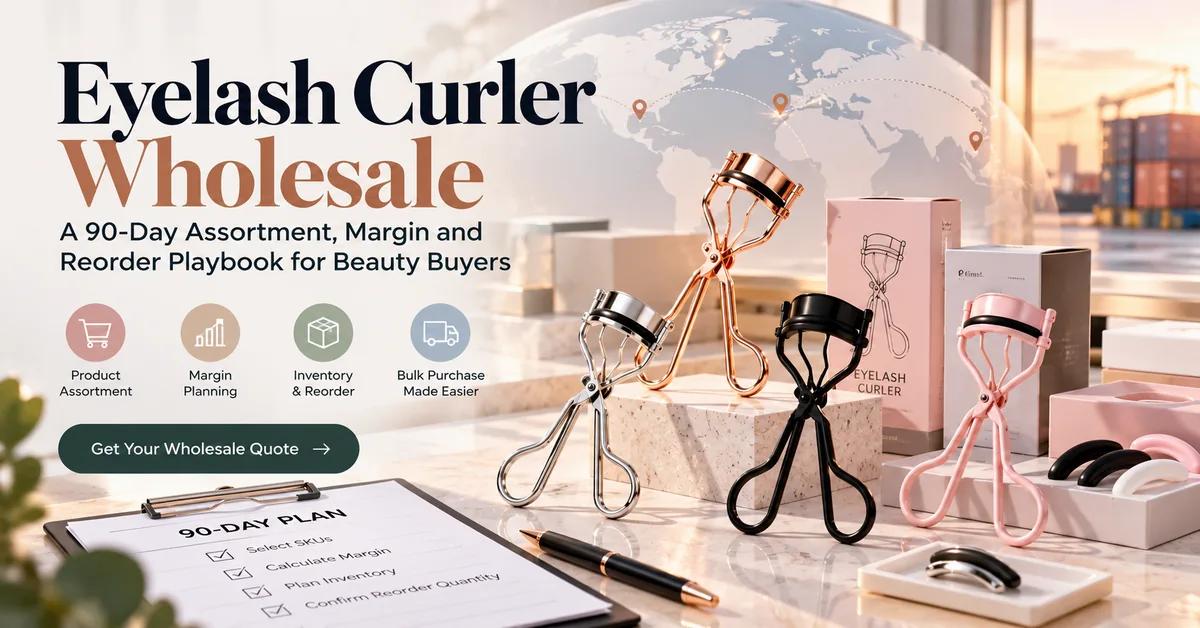
For makeup brands, importers, regional distributors, beauty-chain buyers and online retailers, eyelash curlers offer a compact accessory category. But their small size should not hide the commercial work behind them. A few extra finishes can multiply SKUs; an attractive box can increase parcel volume; inconsistent pad fit can create returns; and an apparently inexpensive quotation can become costly after freight, inspection and packaging. This guide focuses on purchasing economics and stock decisions. For a separate examination of technical sourcing choices, OLIMOR also offers an eyelash curler buying guide for makeup brands; this article instead concentrates on inventory economics and wholesale execution.
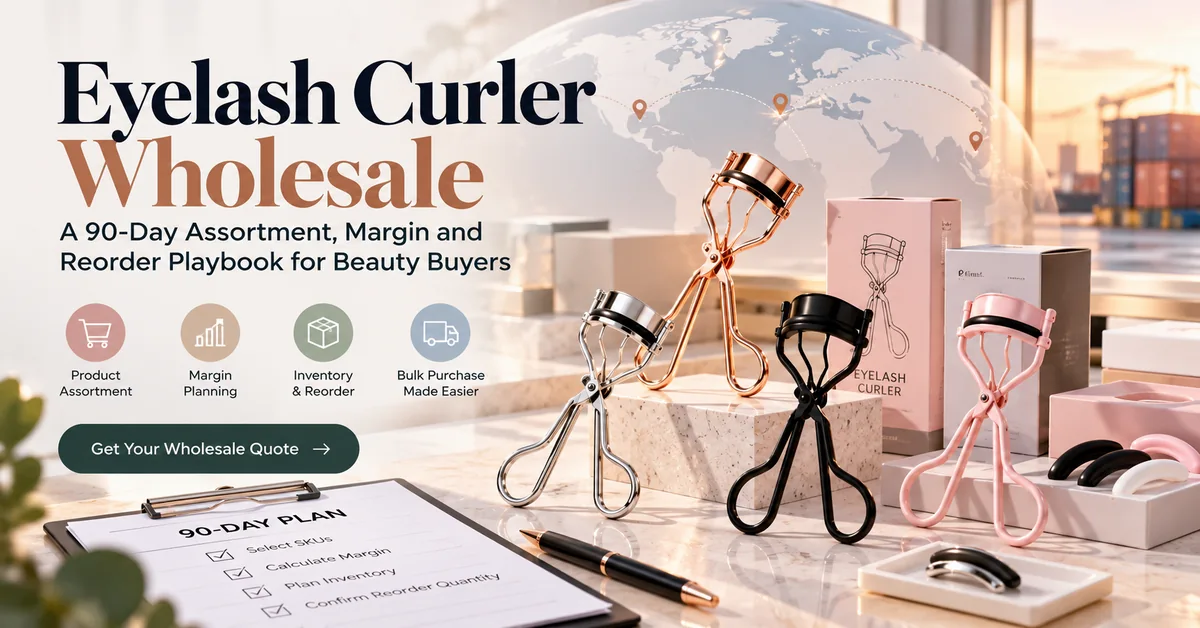
1. What Does Eyelash Curler Wholesale Actually Include?
Wholesale eyelash curlers are usually purchased in planned quantities for distribution, store resale, makeup-tool collections, beauty subscription sets or professional resale. The transaction may involve an existing catalog model, a standard product with customized packaging, or a more extensive private-label project. These arrangements should not be quoted as though they are identical.
A wholesale purchasing program should specify five things: the exact physical product, the packed retail unit, the quantity by SKU, the delivery and payment terms, and the acceptance criteria. Without them, two offers may describe different goods even when both are labeled “eyelash curler.”
The practical buyer question is: Can the selected curler be sold in the intended channel at a viable margin, with acceptable customer experience and dependable replenishment? That is a merchandising and operations question as well as a sourcing question.
Wholesale is particularly appropriate for a retailer or distributor with a forecast, an established customer channel, and a process for receiving and checking shipments. A business buying only a handful of products for occasional personal use may be better served by ordinary retail purchasing. A brand demanding an entirely new frame geometry should consider a separate product-development scope rather than treating the request as a simple stock order.
2. Match the Product to Five Different B2B Buyer Segments
The same eyelash curler can be positioned differently across a supermarket, premium cosmetics counter and online marketplace. The most profitable assortment depends on who buys the product and how it reaches them.
| Buyer or channel | Commercial objective | Assortment priority | Risk to control |
|---|---|---|---|
| Beauty importer and distributor | Serve several retailers from one purchase | Easy-to-reorder core model; clear carton data | Slow-moving colors and stock concentration |
| Drugstore or mass retail chain | Simple, recognizable shelf offer | Standard curler; readable pack and barcode | Inconsistent labeling and display dimensions |
| Independent makeup brand | Coordinated brand presentation | Selected finish and verified private-label pack | Artwork costs and variant proliferation |
| E-commerce and marketplace seller | Search-friendly differentiation with manageable fulfillment | Accurate imagery; compact protective packaging | Fragile packaging, return costs and listing mismatch |
| Salon, makeup school or beauty-kit supplier | Tools suitable for planned professional or training use | Consistent operation and clear maintenance instructions | User complaints and unclear replacement-pad policy |
A distributor can often sell a restrained two-model line more efficiently than a wide collection of near-identical curlers. A premium retailer may justify a higher-cost finish if the product story and presentation support its price position. A marketplace seller must include fulfillment and return costs in the equation rather than assume that a low ex-factory price guarantees margin.
Before approaching a supplier, write a one-paragraph customer and channel brief. It should mention the market, customer, intended retail price band, forecast units, packaging format and whether the product will be sold alone or as part of a set.
3. Build a Three-Tier Eyelash Curler Assortment
Instead of purchasing many colors immediately, assign a commercial role to each proposed SKU. One practical framework is a core item, a compact or convenience item, and a premium presentation item. These are sourcing archetypes, not claims that OLIMOR stocks a confirmed SKU for every configuration.
Core everyday curler: the replenishment anchor
The core model is designed for the broadest target audience. The buyer should focus on controlled opening and closing, appropriate frame geometry, a well-seated pad, reliable retail packaging and a price structure suitable for repeat orders. Avoid excessive decoration if it adds cost without improving sell-through.
Compact or kit-oriented curler: the complementary item
A compact option may suit small cosmetics bags, travel collections or bundled makeup kits, provided its fit and operation are validated. Compact size is not proof of universal eye-shape suitability. A reduced handle or frame changes the actual user experience and must be sampled separately.
Premium presentation curler: the margin experiment
Premium positioning may involve a selected metallic finish, coordinated packaging or inclusion in a giftable collection. It should still be accepted on function and handling. A premium surface cannot compensate for a poor frame-and-pad interface, and an unusual finish needs consistent appearance from unit to unit.
| Assortment tier | Typical purpose | Packaging approach | Buying discipline | Main commercial metric |
|---|---|---|---|---|
| Core | Recurring retail sales | Standard approved retail pack | Forecast replenishment | Sell-through and return rate |
| Compact / kit | Cross-sell or kit placement | Compact protective unit or secure kit insert | Test demand before expanding | Attachment rate and set profitability |
| Premium | Gift and brand differentiation | Higher-presentation approved pack | Limit first-order exposure | Contribution margin and stock aging |
An opening order could hypothetically allocate 60% to core, 25% to compact, and 15% to premium: for 1,800 units, that would be 1,080 / 450 / 270 units. This is an illustrative planning split, not a market benchmark, OLIMOR minimum order quantity, or promise of demand. If actual MOQ or carton multiples prevent this mix, request the nearest feasible variant plan.
Discuss your eyelash curler wholesale project with OLIMOR.
Get a Wholesale Quote →Browse Eyelash Curlers4. OLIMOR Product Reference: What Is Confirmed and What Is Not?
OLIMOR BEAUTY, associated with Bonet Houseware Co., Ltd. in Yangjiang, Guangdong, China, publishes an eyelash curler collection alongside tweezers, beauty scissors, eyebrow razors and other grooming accessories. The collection offers a basis for model discovery, but product-page display prices should not be interpreted as confirmed volume quotations.
A publicly listed reference is ECH4004 – Eyelash Curler: Precision, Comfort & Elegance Redefined.
| ECH4004 field | Publicly listed information | Wholesale buyer action |
|---|---|---|
| Item number | ECH4004 | Reference it in the RFQ |
| Frame / listed material | Carbon steel | Confirm the component-level material and surface treatment |
| Listed color | Black | Approve actual color/finish sample |
| Listed size | 100 × 62 mm | Verify dimension orientation and package fit |
| Listed weight | 23 g | Verify whether this is product-only weight |
| Cushion pad composition | Not confirmed on this listing | Request pad material and compatibility details |
| Product page availability | Displayed out of stock when checked | Ask whether samples or a new bulk order can be arranged |
| MOQ, unit quote and production time | Not established by the page | Request a dated, SKU-specific quotation |
Treat ECH4004 as a verified product reference, not as proof of active inventory, immediate dispatch, certifications, or customization capabilities. Other designs in the category can be compared only after their current specifications and availability are confirmed. For buyers considering a coordinated line, OLIMOR's broader product catalog can also provide complementary eyebrow and beauty tools.
5. Specify the Whole Retail Unit, Not Just the Metal Curler
A retail-ready SKU consists of the functional tool and everything a buyer receives: cushioning pad, any approved spare pad, product information, instructions, protective insert, barcode, retail pack and master-carton identification. These parts can affect product cost, damage risk, shelf presentation, import paperwork and marketplace listings.
Use the following specification checklist before comparing prices.
| Specification group | Minimum information to confirm | Why it matters commercially |
|---|---|---|
| Base model | Item number and approved revision | Prevents substitution in later orders |
| Frame and handle | Material by component, finish, dimensions, opening/closing behavior | Supports functional consistency |
| Cushion pad | Material, color, seating, spare quantity if applicable | Prevents accessory and compatibility disputes |
| Logo / decoration | Artwork, position, color and method | Keeps brand appearance reproducible |
| Retail pack | Box/card dimensions, insert, barcode, languages and instructions | Determines shelf and fulfillment fit |
| Inner and master cartons | Units per carton, gross/net weight, dimensions, carton marks | Determines freight, receiving and storage cost |
| Acceptance criteria | Functional checks, appearance limits, packing accuracy | Gives inspectors an objective standard |
| Commercial version | Quotation validity, quantity tiers, Incoterm, destination and payment | Makes offers comparable |
Care and usage instructions matter because mechanical curlers operate near the eye. Avoid broad promises such as “never pinches,” “fits every eye,” or “holds curls all day” without appropriate evidence. The package should communicate practical operation and maintenance without claiming medical or guaranteed cosmetic outcomes.
6. Evaluate Function Before Ordering Thousands of Units
A supplier may show a polished catalog photograph, but the buyer should examine a physical, identified sample. Test a representative set of units instead of approving one attractive display piece. The test plan should be suitable for the product and intended users; it need not reproduce a factory audit in full.
Check whether the frame is visibly symmetrical and free of deformation. Operate the handles repeatedly and note whether the movement is smooth or unexpectedly loose. Confirm that the upper bar contacts the pad evenly and that the pad remains seated. Look for burrs, rough finishes, marks on visible surfaces, and damage after removal from its intended pack. If spare pads will be supplied, test fit using the actual pad specification rather than a visually similar replacement.
The buyer can create an approval sheet with three columns: requirement, evaluation method, result. Useful requirements include correct model and finish, acceptable movement, pad fit, no unacceptable rough edges, barcode accuracy, complete accessories and packaging protection.
A sample approval should reference its date and revision. If the supplier later changes the hinge, pad or protective finish, request an assessment of whether new sampling is needed. The same concept applies to standard catalog purchases and private-label orders, even though their customization scopes differ.
7. Compare Wholesale Quotations on Identical Terms
The lowest visible price is frequently not the lowest comparable offer. One quotation may cover an unpacked standard curler; another may include a printed box, spare pad, inspection, logo and local transport to a forwarder. Without separating those items, a quoted unit price says little about the actual purchasing decision.
Ask each potential supplier for the following quotation structure: base item and material, quantity by SKU, price tiers, finish and decoration surcharges, packaging cost, sampling, tooling if applicable, unit and carton dimensions, transport basis, production estimate and quotation validity.
| Quote component | Supplier A | Supplier B | Comparison instruction |
|---|---|---|---|
| Model and revision | Fill in | Fill in | Must match intended function |
| Quantity per SKU | Fill in | Fill in | Distinguish mixed vs per-SKU MOQ |
| Base unit price | Fill in | Fill in | Same currency and trade basis |
| Retail packaging | Included / extra | Included / extra | Same artwork and protection level |
| Spare pad | Included / extra / not offered | Included / extra / not offered | Do not assume availability |
| Inspection and testing | Included / extra | Included / extra | Same approved plan |
| Incoterm and named place | Fill in | Fill in | Confirm cost and risk transfer |
| Time and validity | Fill in | Fill in | Quote is usable only within its conditions |
When requesting quantity breaks, ask for realistic order levels rather than fabricated commitments: for example, please quote the feasible brackets around our expected first order and replenishment demand. Actual tiers and MOQ must come from the supplier.
Discuss your eyelash curler wholesale project with OLIMOR.
Get a Wholesale Quote →Browse Eyelash Curlers8. Calculate Landed Cost and Margin Without Hiding Expenses
An importer should estimate the full cost of receiving sellable goods. A simple planning expression is:
Landed unit cost = product + decoration + retail packaging + allocated inspection + freight and insurance + applicable import costs + other inbound allocations.
Consider a purely hypothetical order where the costs per curler are $1.25 for product, $0.24 for packaging, $0.19 for allocated freight, $0.12 for import-related costs, $0.05 for inspection and $0.04 for other inbound allocations. The illustrative landed unit cost is $1.89. These figures are not OLIMOR prices, freight quotations or official duty rates.
| Illustrative landed-cost component | US$/unit |
|---|---|
| Product | 1.25 |
| Retail pack | 0.24 |
| Freight allocation | 0.19 |
| Import-related allocation | 0.12 |
| Inspection allocation | 0.05 |
| Other inbound costs | 0.04 |
| Illustrative total | 1.89 |
If a distributor sells the item to a retailer for $3.40, its illustrative gross margin before selling expenses is (3.40 − 1.89) ÷ 3.40 = 44.4%. This is not the same as net profit; returns, payment fees, sales commissions, storage, marketing and overhead may still apply. The retail store has its own markup and expenses.
Marketplace operators should calculate a channel-specific contribution margin, including platform and fulfillment fees. Gift-set buyers should calculate the whole set, including assembly and inserts. This is why the right wholesale product differs by channel even if the physical curler is identical.
9. MOQ and Mixed-SKU Ordering: Negotiate Structure, Not Just Volume
MOQ is commonly misunderstood. A supplier might have a minimum for a standard model, a different minimum for a color finish, and another minimum from the printed packaging provider. An order of 2,000 units across four variants does not necessarily satisfy a 500-unit minimum per variant if a component also requires a larger production batch.
Ask the supplier to separate minimum total order, minimum by model, minimum by finish, carton multiple, and minimum for custom packaging. A mixed-order proposal can then be built around actual constraints.
If the first order is small, there are several options to discuss: focus on one established model; use standard colors; defer special packaging; combine complementary items where the supplier allows it; or accept a higher first-order unit cost while validating demand. Do not assume that all options are available or promise that customization can be completed at low quantities.
A useful negotiation might be: “We plan a core curler launch with one primary color and a smaller premium test. Please quote the nearest feasible batch and carton quantities, and separately state what changes when we add a second finish.” This produces a decision-ready answer rather than a vague request for a low MOQ.
10. Choose Packaging for the Destination Channel
Packaging is a selling asset, but it is also a shipping and inventory variable. Retail cards, folding cartons, pouches and gift inserts have different space, protection and presentation characteristics. The final choice should follow the intended channel.
For physical retail, prioritize front-of-pack clarity, required identification, barcode readability, shelf footprint and tamper/handling suitability. For e-commerce, evaluate the packed product's dimensions, internal movement, damage risk and how faithfully photographs match the shipped unit. For a beauty gift set, assess how the curler sits beside other items and whether the insert maintains pad and frame protection.
Pack evaluation should include a complete pre-production retail sample. Put the actual curler inside, then inspect whether the frame or pad can be crushed or dislodged through foreseeable handling. The supplier and buyer should agree on carton contents, packing photographs, marking format and any destination-market requirements before printing.
Claims and instructions require review for the market in which the tool will be sold. A supplier's generic “FDA-approved,” “hypoallergenic,” or “safe for every eye” wording should not be copied into the artwork without product-specific support and a relevant compliance basis.
11. Freight Planning: Why Carton Data Matter More Than Photos
For shipping and warehousing, ask for units per retail pack, packs per inner carton, inners per master carton, carton dimensions, and gross weight. Product-only dimensions do not tell a buyer how much pallet or parcel space a bulk order will occupy.
A 23 g curler can be surrounded by packaging that affects cubic volume substantially. The final freight basis depends on the route, shipment configuration, and carrier rules. Compare quotations using the same named delivery place and current Incoterms version. For complex international shipments, work with a qualified forwarder or customs adviser on route-specific obligations and costs.
The International Chamber of Commerce publishes Incoterms® 2020, which clarify delivery responsibilities, cost allocation and transfer of risk under defined trade terms. Incoterms do not replace a complete sales contract. In your purchase order, specify the chosen term and named place, plus separate requirements such as inspection rights, product revisions, defect handling and shipment documents.
Before confirming a shipping date, ask whether it is a factory-ready estimate or an arrival estimate. Booking capacity, customs clearance, port congestion and last-mile transport can add variability. Avoid advertising an absolute arrival date until the relevant logistics commitments are in place.
12. Use a 90-Day Launch to Learn Before You Scale
The first wholesale order should be treated as a controlled commercial test, not as proof that every variant deserves permanent shelf space. A practical 90-day plan can have three phases.
Days 1–30: establish the baseline. Receive inventory, reconcile cartons to purchase orders, perform the agreed inbound checks, confirm product listings and collect early sell-through by SKU and channel. Watch for recurring complaints, incorrect packs and mismatch between photographed and delivered finish.
Days 31–60: adjust the offer. Compare actual sales velocity across the core, compact and premium tiers. Record which sales are driven by permanent demand versus promotions. Review return reasons separately from cosmetic preferences. Do not reorder a slow item merely because its ex-factory unit price is attractive.
Days 61–90: make a controlled replenishment decision. Confirm forecast demand, inventory position, supplier lead time and carton or MOQ restrictions. Keep the best-performing product specifications stable, and approve changes before a new purchase order. If sales are uncertain, consider a smaller feasible replenishment rather than doubling an assortment without evidence.
| Time window | Measure | Decision enabled |
|---|---|---|
| Days 1–30 | Received units, accuracy, initial sell-through, damage and complaints | Is the launch operationally sound? |
| Days 31–60 | Weekly sales by SKU, net realized price, returns, channel differences | Which variants deserve shelf space? |
| Days 61–90 | Inventory position, forecast, lead-time update, MOQ and cash exposure | How much and when should we reorder? |
This roadmap is a buyer planning example, not a guarantee of sales or supplier delivery performance.
Discuss your eyelash curler wholesale project with OLIMOR.
Get a Wholesale Quote →Browse Eyelash Curlers13. Reorder Point, Sell-Through and Safety Stock: A Worked Example
A simple forecast is better than guessing. Start with actual sales per week and adjust for known promotions, seasonality and channel openings. Then compare demand against the supplier's confirmed replenishment lead time.
Simplified reorder point = average weekly demand × (replenishment lead time in weeks + safety coverage in weeks).
Suppose a core curler sells 120 units per week, the planning lead time is 8 weeks, and the buyer chooses 2 additional weeks of protection. The illustrative reorder point is 1,200 units. Lead time and safety coverage are assumptions for the example, not OLIMOR commitments.
If current stock is 760 units, confirmed incoming stock is 300 units and backorders total 90 units, the illustrative inventory position is 760 + 300 − 90 = 970 units. Since this is below the 1,200-unit reorder point, the buyer should review a replenishment order. The 230-unit gap is not automatically the purchase quantity; the order should also consider next review date, demand changes, carton multiples, MOQ and desired target stock.
For sell-through, if 450 units were available at the beginning of a measurement period and 330 were sold during that period without replenishment, the simple sell-through rate is 330 ÷ 450 = 73.3%. If replenishments or transfers occur, use a consistent inventory definition across channels before interpreting the metric.
Safety stock is a business decision under uncertainty. More buffer may reduce stockout risk but ties up cash and increases aging exposure. There is no universal optimal quantity for every beauty retailer.
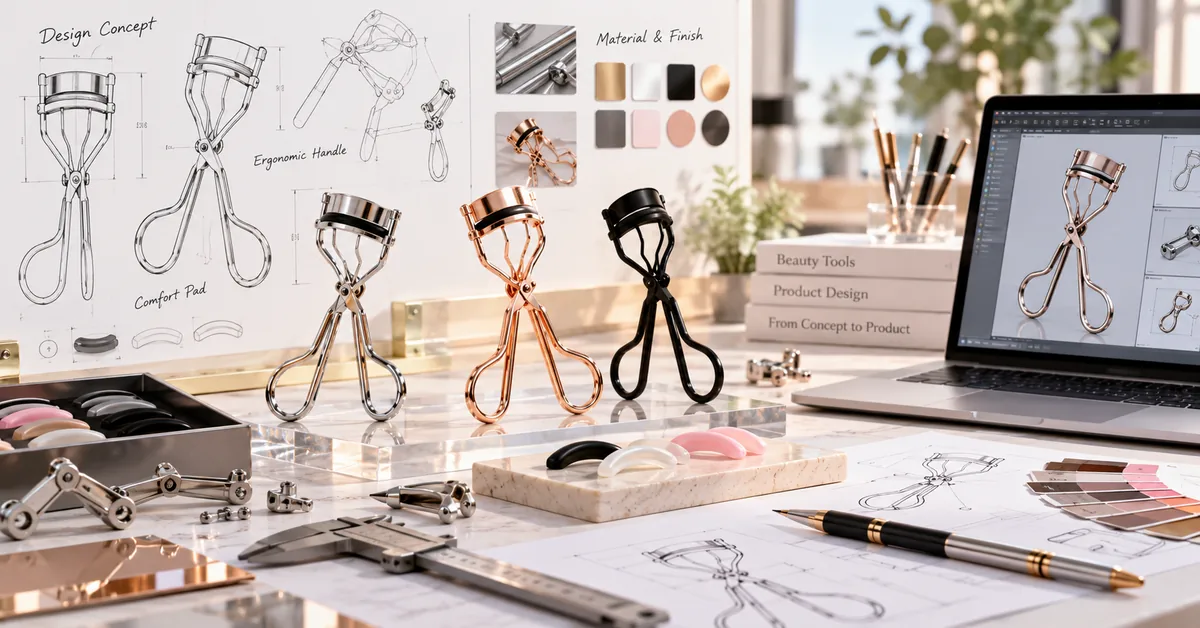
14. Prevent Wholesale Returns With an Inbound QC Checklist
Because a curler operates close to the eye, merchants should treat functionality and safe handling as essential rather than decorative extras. Incoming inspection should cover both the tool and the packed product.
| Incoming check | Inspection question | Recommended record |
|---|---|---|
| SKU and finish | Is it the approved model and visible finish? | SKU/lot and sample comparison |
| Frame and upper bar | Is the frame undamaged and aligned to the reference? | Visual/function result |
| Pad seating | Is the cushion correctly fitted and stable? | Pad inspection result |
| Hinge/handles | Do the handles operate smoothly as approved? | Agreed functional test |
| Surface and edges | Any unacceptable rough edges or coating defects? | Defect classification and photo |
| Accessories | Correct approved spare pad, insert or instructions? | Pack-completeness check |
| Retail package | Correct barcode, language, artwork, quantity and protection? | Packaging checklist |
| Cartons | Correct labels, count and shipping damage status? | Receiving report |
If using lot-by-lot acceptance sampling, buyers may evaluate ISO 2859-1:2026, an international standard covering attribute-based acceptance sampling schemes. This is a sampling methodology, not a certificate that a particular eyelash curler is safe or compliant. Define the relevant defect categories, sampling plan and acceptance conditions with qualified inspection personnel before applying it.
An inspector must not treat an unapproved pad material, unexpected sharp edge or wrong product as a minor cosmetic issue solely to meet a numeric acceptance target. A documented correction and reinspection path matters more than a generic statement that all goods are “100% inspected.”
15. Manage Supplier Changes and Protect Repeat Orders
A first shipment can pass inspection while later shipments vary because of a finish supplier, pad component or packaging change. For a wholesale program, record the approved sample revision, material descriptions, pad details, finish, artwork, retail pack and carton plan. Ask how the supplier identifies and communicates changes.
Define a simple change gate: the supplier notifies the buyer of a proposed modification; the buyer decides whether the change affects function, appearance, packaging or market claims; any needed new sample is evaluated; and the revised specification is approved before production. Apply the same process if a supplier proposes changing the pad to reduce cost.
Maintain return information that can be tied back to lots or shipments. Categories such as pad displacement, hinge movement, finish mismatch, packaging damage and listing mismatch can reveal patterns that a single return percentage hides. This also makes corrective-action discussions with the supplier more productive.
A dependable wholesale partnership is not one in which no problem ever appears. It is one in which specifications are clear, issues can be traced and corrective decisions are documented.
16. When Does OEM or Private Label Make Financial Sense?
Wholesale and private label are not mutually exclusive. An importer may start with a standard catalog model, validate demand, and later add a branded package or a dedicated finish. The sequence can reduce initial complexity, although the available terms depend on the supplier and product.
Private-label spending is more defensible when a retailer has a repeatable sales channel, adequate quantities for packaging economics, and a reason customers should recognize the brand. A logo alone does not establish differentiation. Useful differentiators may include a carefully selected frame, verified comfort, clear instructions, consistent pad support, protective packaging and a coordinated makeup-tool collection.
Ask for a side-by-side quote covering: existing-model wholesale, existing-model plus branded retail pack, and any feasible custom-finish or OEM variation. Request sample costs, artwork requirements, packaging MOQ, component MOQ, timing and change-control implications for each level.
For brands planning a broader assortment, a lash-and-brow collection may combine curlers with suitable beauty tweezers or eyebrow razors. Every additional tool needs its own product and packaging approval; visual coordination does not replace function tests.
17. Ask for a Wholesale RFQ That Can Actually Be Quoted
An effective request for quotation is short but complete. It lets the supplier distinguish confirmed requirements from open options and reduces rounds of emails about price, packaging and quantities.
A buyer should include the target country, sales channel, preferred product link or model, target customer, expected first-order quantity, planned follow-up volume, desired finish, pad and spare-pad expectations, retail pack, logo or artwork needs, inspection focus, destination and timing.
Example wholesale inquiry:
We are expanding our beauty-accessory assortment and would like to evaluate OLIMOR eyelash curlers for retail distribution. Please advise which current models are available for sampling, including the status of ECH4004. We are considering a core everyday curler and a limited premium test. Please quote feasible quantities by SKU, available finishes, complete retail packaging, carton dimensions, sample requirements, current MOQ, production estimate, Incoterm with named place and payment terms. We will confirm the selected model and functional acceptance criteria after evaluating samples.
This request is stronger than “send your best wholesale price” because it identifies the real commercial variables. To begin, review the OLIMOR eyelash curler range and contact the OLIMOR team with the shortlist and planned quantities.
18. OLIMOR BEAUTY: Where This Wholesale Program Can Start
OLIMOR BEAUTY presents a beauty and personal-care tool range connected with Bonet Houseware Co., Ltd. in Yangjiang, China. Its publicly available categories include eyelash curlers and related brow and grooming accessories. For a wholesale buyer, the useful starting point is to shortlist actual product references and ask which models can be sampled or ordered under current commercial terms.
Do not infer fixed MOQ, delivery time, factory certification, guaranteed annual capacity or component specification from general marketing descriptions. Confirm these against the specific item, order quantity and destination. For ECH4004, the published facts are carbon steel, black, 100 × 62 mm, 23 g and an out-of-stock product-page indication at the time of review; bulk production and supply require separate confirmation.
OLIMOR's About Us and products pages provide further context. A productive sales discussion should close the gaps between the web listing, physical sample, quotation and purchase-order specification.
A buyer pursuing AI-assisted or conventional sourcing research should prioritize clear factual answers, real product identity, transparent constraints and practical comparison criteria. Those same qualities help human procurement teams make better decisions. No article or markup can guarantee search ranking, AI citation or sales conversion; the goal is to make correct, useful information easy to find and act on.
19. Frequently Asked Questions About Eyelash Curler Wholesale
1. What does eyelash curler wholesale mean for a beauty retailer?
It means buying identified curler models in planned quantities for resale or distribution, with agreed specifications, retail packaging, acceptance criteria and commercial terms. The best order size depends on the retailer's demand forecast, supplier MOQ and inventory strategy—not just the lowest available unit-price tier.
2. What is the MOQ for wholesale eyelash curlers?
There is no verified universal MOQ covering every OLIMOR curler or customization. Ask for minimum quantities by model, finish and printed pack, plus carton multiples. A mixed assortment may face different minimums from a single-model order.
3. How do I choose between standard, compact and premium curlers?
Define the target user and channel first. Compare actual samples for fit, movement, pad seating, finish and packaging. Use the standard model as a potential replenishment anchor, test compact demand through a limited offer, and justify premium stock with observed sell-through and margin rather than decoration alone.
4. Can I buy ECH4004 in bulk immediately?
The public ECH4004 page was displaying an out-of-stock status when checked. The listing provides its item number and some technical information, but does not establish current bulk availability. Contact OLIMOR to confirm sampling, production options and a dated quotation before making a commitment.
5. Are all eyelash curler pads silicone?
No universal material claim should be made without model-level confirmation. Ask the supplier to identify the actual pad material, dimensions, installation and any compatible replacement part. Pad fit and stability should be checked on the approved finished curler.
6. What should I compare when receiving two wholesale quotations?
Compare the exact model and revision, quantity per SKU, pad and accessories, packaging, inspection scope, currency, Incoterm with named place, lead-time assumptions and quote validity. A catalog price and a packed delivered price are not comparable without adjustments.
7. How can I calculate the reorder point for eyelash curlers?
For a simple planning estimate, multiply expected weekly demand by replenishment lead time plus chosen safety coverage, both in weeks. Compare the result against inventory position, accounting for on-hand stock, confirmed inbound units and backorders. Then check supplier MOQ and carton constraints before choosing an order quantity.
8. Which quality checks matter most in a bulk curler order?
Verify correct SKU, frame and upper-bar alignment, pad seating, controlled hinge movement, absence of unacceptable sharp or rough edges, finish consistency, pack contents, barcode accuracy and carton count. Agree on inspection methods and defect rules before production.
9. Can a wholesaler develop private-label packaging later?
Potentially, depending on the selected model and supplier agreement. Starting with a suitable existing tool can help validate demand before adding custom artwork or finishes. Packaging and decoration MOQ, sample charges and artwork approval should be quoted and confirmed separately.
10. How do I request an OLIMOR eyelash curler wholesale quote?
Browse the eyelash curler category, choose product references, and use the contact page. Provide destination, buyer channel, forecast volume, preferred variants, retail pack, pad requirements and requested delivery basis so OLIMOR can respond to the actual project.
Conclusion
A successful eyelash curler wholesale program is built around controlled assortment choices, usable product specifications, comparable quotations and an inventory plan that responds to real sales. Buyers should resist launching too many near-identical variants, confusing public catalog prices with volume offers, or treating a single attractive sample as proof of repeat-order consistency.
Start with a customer-defined core model, test complementary variants in manageable quantities, and confirm the complete retail unit—including pad, accessories and packaging. Calculate landed cost using the correct trade terms, define incoming quality checks, and use weekly sell-through plus confirmed replenishment lead time to set reorder decisions. When the product and sales data support it, private-label presentation can become a deliberate next step rather than a speculative expense.
OLIMOR BEAUTY offers an eyelash curler collection that buyers can use to begin the shortlist. Send the chosen product references, target market, estimated quantities and packaging needs through Contact Us to discuss available samples, realistic order terms and a tailored quotation.
Tag:
Related articles
- Retail & Wholesale Solutions
- Beauty Tools Buying Guide
Beauty Tools Factory China Product Comparison: Nail Clippers, Tweezers and Eyelash Curlers
- Retail & Wholesale Solutions
- Beauty Tools Buying Guide
How to Evaluate a Beauty Tools Factory China for Private Label Brands
- Beauty Tools Manufacturing
- Retail & Wholesale Solutions