

What buyers really mean when they look for a retail beauty tools supplier
If you are sourcing a retail beauty tools supplier, you are usually not just buying a small accessory line. You are deciding how your shelves, kits, or salon backbar will perform in daily use. That means looking past the catalog photo and asking more practical questions: Will the tools hold up to repeated handling? Can customers understand the function quickly? Does the assortment fit salon, spa, and home-care expectations without creating returns or confusion?
In beauty and personal care, the lowest-friction products often win. A nail care tool set that is easy to display, simple to explain, and durable enough for repeated use tends to move better than a more complicated item that looks premium but is awkward in practice. That is why sourcing for this category is part product selection, part merchandising decision, and part quality control.
This article breaks down how to evaluate a retail beauty tools supplier for manicure and pedicure tools, what to look for in a 6-piece stainless steel set, and where buyers commonly make avoidable mistakes.
Why nail care tools are a different sourcing problem
A manicure tool is not a cosmetic bottle or a soft good. It is a hand tool, and customers expect it to behave like one. The metal needs to feel solid. The grip has to make sense. The working ends should be purposeful rather than decorative. In a retail setting, buyers also have to think about hygiene perception. Even when a product is sold for home use, shoppers still want a tool that appears easy to clean and suitable for routine nail prep.
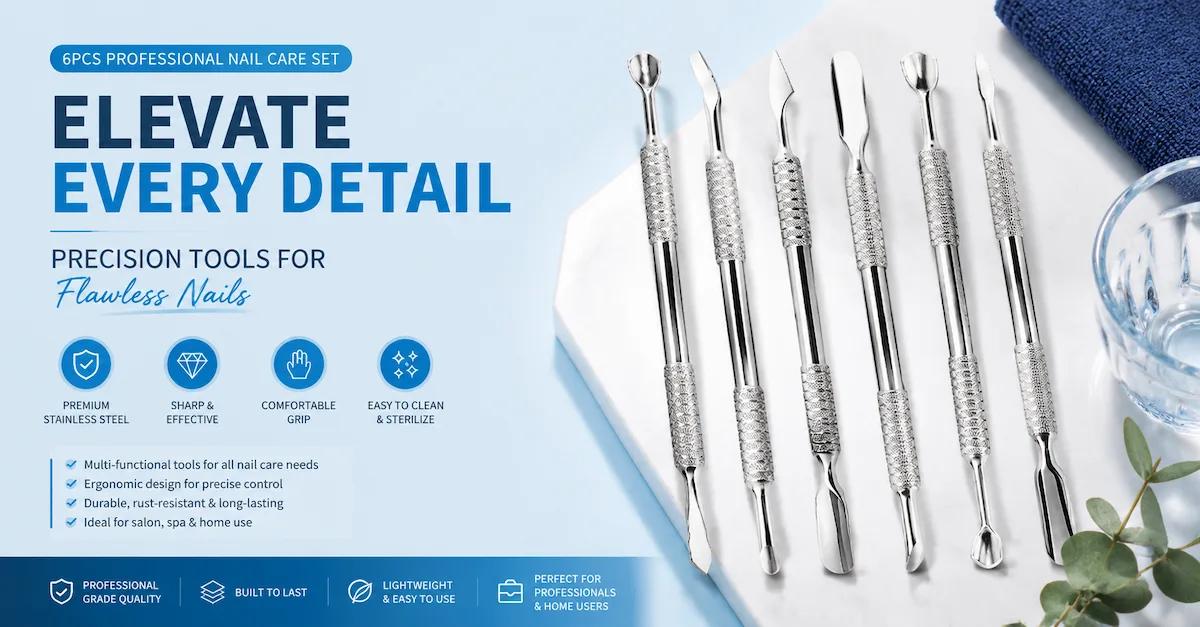
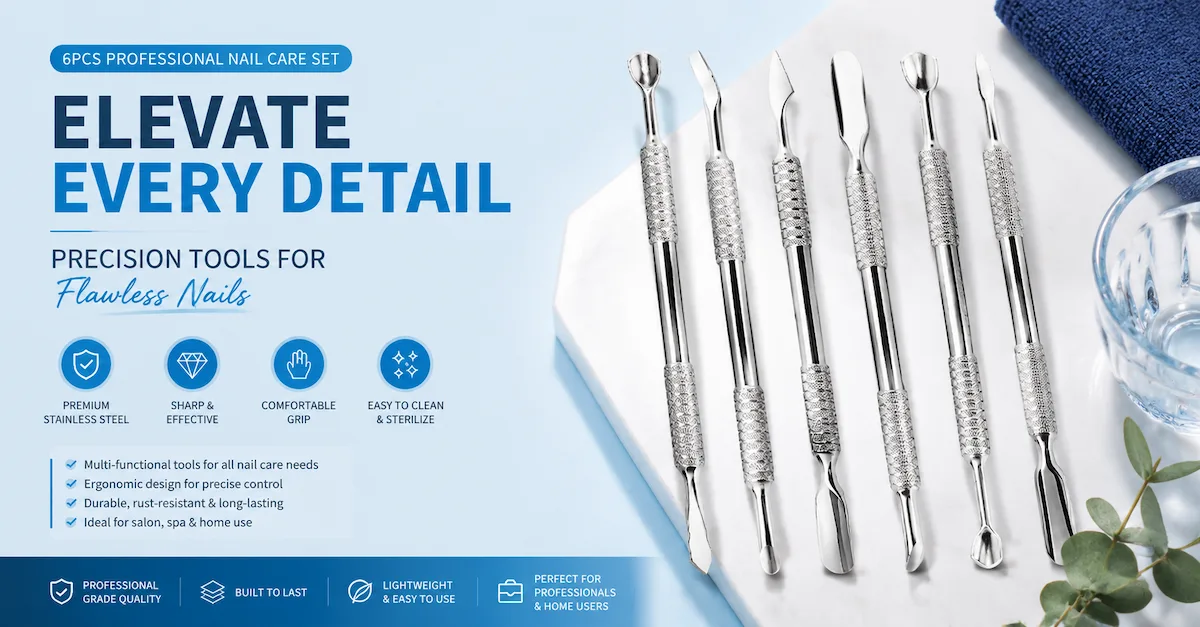
That is why stainless steel is such a common selling point in this category. It is familiar, it signals cleanliness, and it generally suits the practical use cases associated with nail cleaning, cuticle work, scraping, shaping, and debris removal. The image data for the 6-piece set points in that direction: slim double-ended tools, polished silver-metal finish, and knurled grip sections that should help with control during fine work.
What is in a typical 6-piece nail care tool set
A six-piece manicure and pedicure hand tool set usually aims to cover a handful of core tasks without overcomplicating the kit. Based on the product details provided, the set appears to include several double-ended tools with varied working ends such as small spoons, spatula-style tips, curved scrapers, pointed ends, angled tips, and flat blade-like ends.
That kind of assortment matters because nail-care work is not one single motion. A technician may need one end to lift or clean debris, another to push or guide material, and another to shape or scrape in a more controlled way. In the retail channel, the appeal is simple: one compact set gives the customer multiple functions without requiring them to learn a large tool family.
For buyers, the practical question is less about naming each end precisely and more about whether the assortment is balanced. If too many tips do roughly the same thing, the set feels padded. If the functions are too specialized, casual customers may not understand what they are buying.
How to judge the tool construction before you place an order
A good cosmetic tools manufacturer or beauty accessories supplier should be able to describe the construction clearly, even if some process details remain proprietary. For a stainless steel nail care set like this one, the visible characteristics are useful starting points.
Handle design
The knurled grip sections are worth noticing. In small hand tools, grip texture often matters more than marketing copy. If the tool slips when the hand is damp or when the user is working at an angle, the whole set loses credibility. A textured shaft can improve control, especially for salon technicians who use these tools repeatedly through the day.
Surface finish
The polished silver-metal appearance is typical of stainless steel hand tools. A clean finish helps retail presentation, but it also affects perceived quality. Buyers should still ask how the finish behaves after cleaning and regular handling. A tool that looks bright out of the box can still show scratches quickly if the base material or finishing process is not consistent.
End geometry
The working tips are where performance lives or dies. A small spoon-shaped tip should feel purposeful, not flimsy. A spatula or scraper end should have enough stiffness to do the job without bending excessively. Pointed or angled tips need careful handling; too aggressive a point can make the tool feel unsafe or too harsh for general retail use.
Retail buyers should match the assortment to the channel
The same nail care set can sell very differently depending on where it is placed. A salon buyer may prioritize reliability, tactile control, and easy cleaning. A spa may want a presentable kit that fits service menus and looks neat at the station. A general retail buyer, on the other hand, often needs a simpler value story: a multi-functional set for home manicure and pedicure maintenance.
That is where a retail beauty tools supplier becomes more than a source of inventory. The supplier should help you understand which version belongs in which channel. A professional-facing assortment can carry a stricter functional expectation. A home-care version may need clearer packaging language and a more obvious use case so the shopper does not hesitate at the shelf.
If you are working with a beauty accessories supplier on private label or branded retail, ask whether the product can be presented as a salon-grade tool set without overstating claims. A modest, accurate description often performs better than exaggerated language that buyers do not trust.
Common mistakes when sourcing manicure and pedicure hand tools
One frequent mistake is treating all metal tools as interchangeable. They are not. Two tools can both be stainless steel and still feel very different in hand because of shaft thickness, grip pattern, end shaping, and overall balance.
Another mistake is ordering a set that looks complete in a product photo but is not intuitive in use. In this category, a customer may not spend time decoding each tip. If the set does not immediately communicate its purpose, it risks being treated as a novelty rather than a working tool.
Buyers also sometimes ignore how the set will be cleaned and handled in real life. Even if exact sterilization compatibility is not supplied, the product should at minimum support straightforward cleaning practices. For professional users, that expectation is not optional; it is part of trust.
And a small but important caution: do not assume that all “rust-resistant” language means the same thing from one supplier to another. Marketing descriptions can be helpful, but they are not a substitute for material confirmation and quality checks.
Selection criteria that matter more than flashy packaging
When comparing suppliers, use a practical checklist rather than a design-first approach.
Look at whether the set has a coherent function mix. Confirm that the handles are comfortable to hold and that the texture actually supports grip. Ask for clear material information, especially if stainless steel is the selling point. Check whether the tools are uniformly sized in a way that makes packaging efficient and display-friendly. If the supplier serves retail, see whether the product can be supplied in a format that is easy for shoppers to understand at first glance.
For sourcing teams, consistency is as important as aesthetics. Six tools that all look stable and clean are more valuable than an elaborate assortment with one or two weak pieces.
Questions to ask before you commit
A good supplier conversation does not need to be complicated, but it should be specific.
Ask what manufacturing method is used for the tools, even if the answer is general rather than highly technical. Stamped or machined stainless steel hand tools can both work; what matters is repeatability.
Ask whether the grip texture is part of the forming process or added later.
Ask how the set is packaged for retail, and whether the six pieces are organized in a way that protects the tips during transit.
Ask for clarification on the intended use split between salon, spa, and home settings.
And if you are buying for a branded retail program, ask how the supplier handles customization. A cosmetic tools manufacturer may be able to support private label presentation, but the details matter more than the promise.
Who this kind of set is best for
A 6-piece stainless steel nail care set is most useful for buyers who want a compact, general-purpose solution. That includes salon technicians building a backup toolkit, spas that need practical station tools, and retailers targeting home grooming shoppers who want a simple all-in-one purchase.
It is less suitable for buyers who need a highly specialized professional instrument line with tightly defined technical performance. This set sits in the practical middle: versatile, retail-friendly, and easy to explain.
FAQ: quick buyer questions
Is stainless steel the right material for retail nail tools?
Usually yes, because it supports a clean, durable, familiar product story. Still, buyers should verify the exact construction and finish rather than relying on general wording.
Why does grip texture matter on small beauty tools?
Because fine nail work depends on control. A textured handle helps reduce slipping and makes the tool feel more usable, especially in salon conditions.
Should I buy for salon use or home use?
That depends on your channel. Salon users care more about control and durability. Home users need clarity and simplicity. The same set can work for both, but the merchandising message should differ.
What should I avoid in supplier claims?
Avoid assuming exact performance standards, steel grades, or sterilization claims unless the supplier provides them directly. In this category, unsupported claims can create more trouble than they solve.
Next step for buyers
If you are evaluating a retail beauty tools supplier for manicure and pedicure hand tools, start with function, not packaging. The product should be easy to understand, comfortable to use, and credible in the hand. A 6-piece stainless steel set with knurled grips and mixed working ends can fit that brief well, provided the construction is consistent and the supplier can support the channel you sell into.
For sourcing teams, the next move is straightforward: request product specifications, sample the handling feel, and compare how clearly each supplier explains the use case. In this category, the best supplier is usually the one that understands how a tool will be used after it leaves the carton.
Tag: