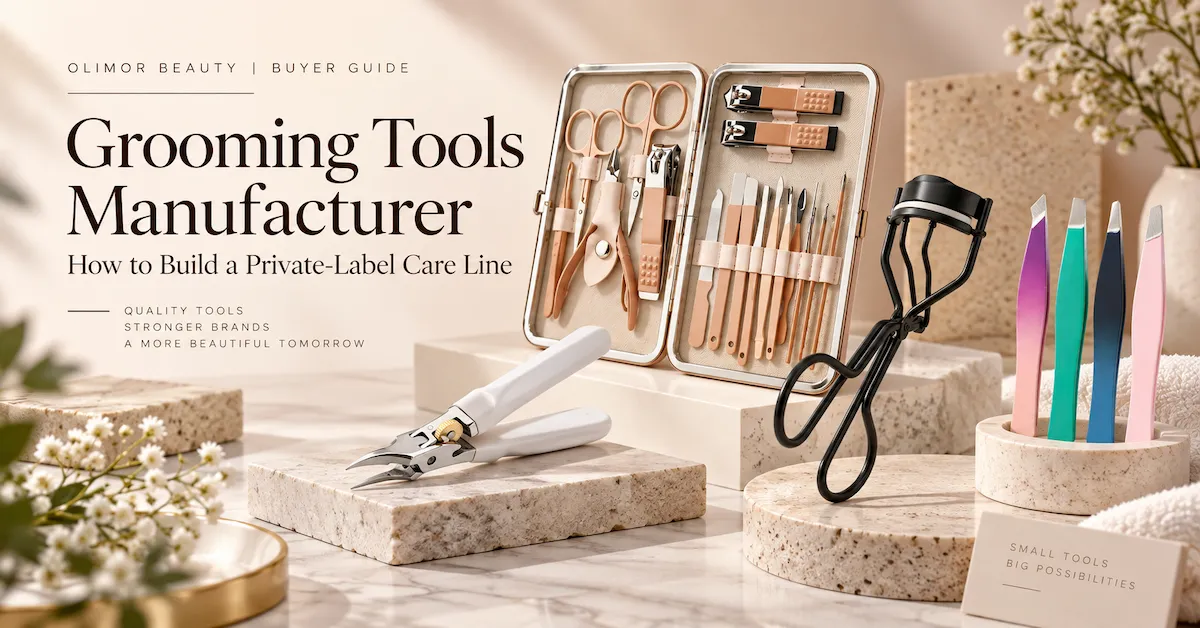
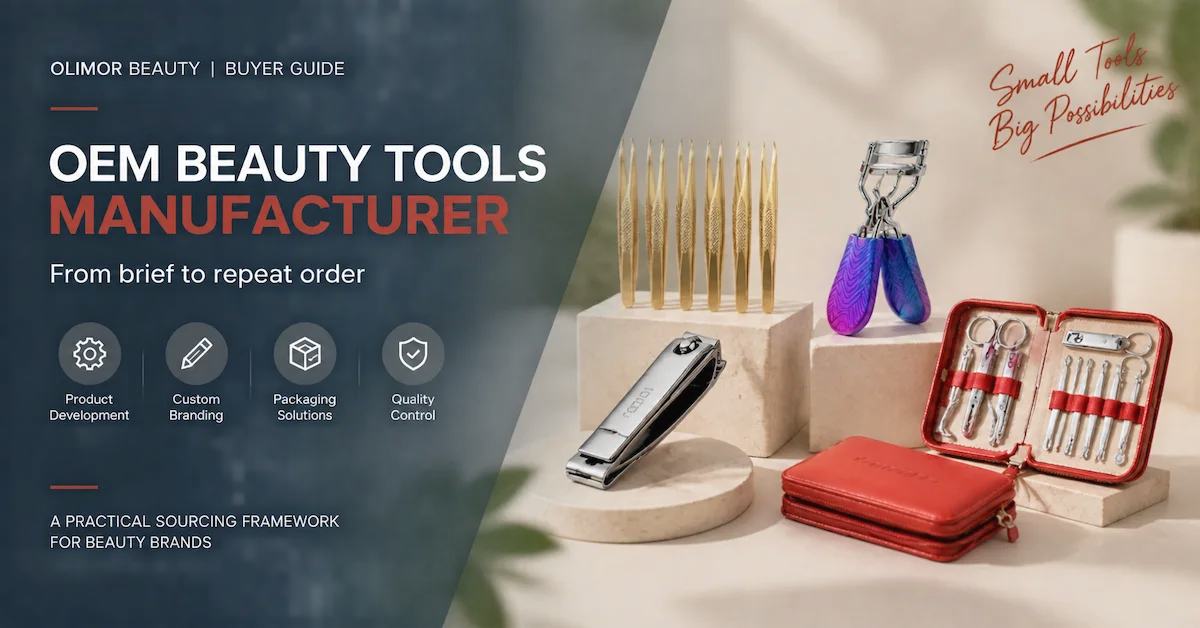
When buyers search for a beauty tools factory China, they are usually trying to answer several questions at once: Can the factory make the product consistently? What is the MOQ? How are sharp edges, jaws, tips, springs, finishes, and packages inspected? Can the same result be repeated for the next purchase order? This guide focuses on those operational questions.
OLIMOR BEAUTY is a personal-care and beauty-tools brand and B2B manufacturing platform associated with Bonet Houseware Company Limited in Yangjiang, Guangdong. Public company material describes operations since 2011, a roughly 5,000-square-meter facility reference, twelve product categories, and support for wholesale, OEM/ODM, private label, logo, packaging, product development, and tooling discussions. Project-specific capacity, MOQ, lead time, materials, certifications, and test limits still need confirmation in the inquiry.
Buyer takeaway: factory quality is not a single final check. It is a connected system covering the specification, incoming materials, process controls, functional tests, packaging, records, and corrective action.
What a beauty tools factory should control
Start with a controlled product identity. The file should state the model, item number, revision, dimensions, weight where relevant, material by component, finish, color, logo, accessory, packaging, intended use, and functional requirements. Add photographs, drawings, boundary samples, and the approved artwork. If a buyer and factory use different names for the same item, errors can travel through the order.
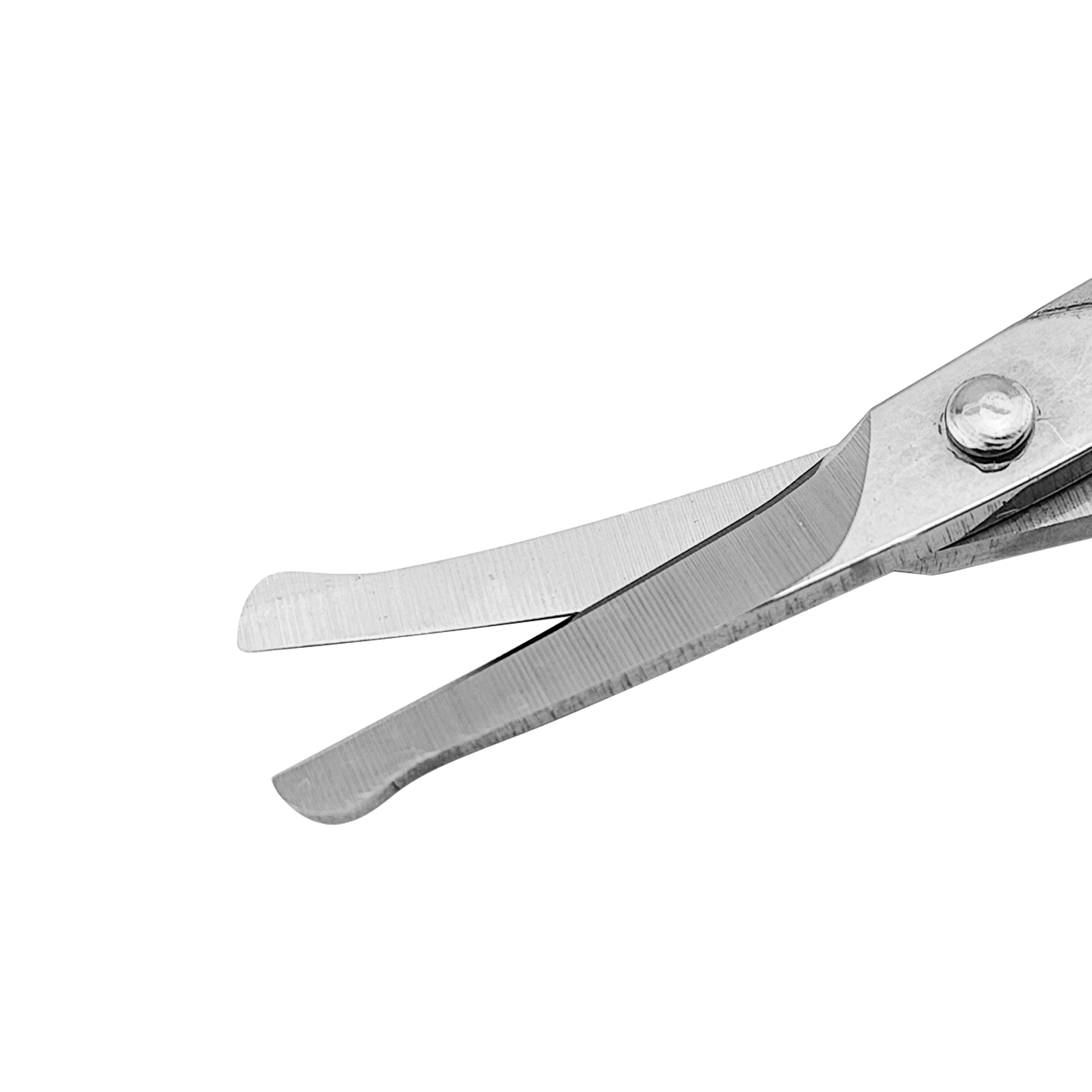
Then connect the identity to risk. A cutting edge, nipper jaw, tweezer tip, eyelash-curler pad, eyebrow-razor guard, abrasive foot-file surface, and tongue-scraper edge each need a different check. A set needs an additional composition and case-fit check. The best inspection sheet follows the user’s task rather than merely listing cosmetic dimensions.
Incoming material and component inspection
Incoming control protects the process from wrong or unstable inputs. For metal, review identity, thickness or dimensions, surface condition, rust, stains, scratches, distortion, and lot marking. Depending on the project, the evidence may include purchase records, supplier certificates, hardness or heat-treatment records, thickness measurement, or identity testing. Choose the method according to risk and the destination market; a website material word is not a laboratory report.
For plastic or elastomer parts, control resin or compound where required, color reference, surface, flash, deformation, odor expectations, and fit. For pads, springs, pivots, screws, magnets, sheaths, cases, inserts, labels, and cartons, check identity, quantity, dimensions, finish, printing, and damage. Keep approved and rejected lots separated and traceable.
Packaging deserves incoming inspection because an obsolete card, wrong barcode, missing warning, or incorrect insert can stop a shipment. The artwork revision should be visible. If a supplier uses outside processors for coating, heat treatment, printing, or molding, ask how those outputs are identified and released.
Process controls for metal beauty tools
Cutting, stamping, and forming
Scissors, clippers, nippers, files, and other tools begin with material cut to a controlled blank or component. Stamping and forming influence length, profile, jaw geometry, handle shape, and the relationship between parts. First-piece approval should verify the features that affect assembly and function. Tool wear, material thickness, and alignment can create drift, so in-process checks should be scheduled rather than performed only after the run.
Welding, heat treatment, and straightening
Where welding joins a structure, inspect position, strength, appearance, and distortion. Heat treatment can affect hardness, resilience, edge retention, and breakage behavior, but the correct range is model-specific. Ask how lots are identified and what records are kept. Straightening and shaping should restore the required geometry without leaving cracks, sharp unintended edges, or stress-related variation.
Grinding, sharpening, and edge finishing
Automated or guided grinding can improve repeatability, but the result still needs a functional test. Look for chips, rolled edges, over-rounded contact, uneven grind lines, excessive burrs, and mismatched upper and lower surfaces. For nippers and clippers, jaw closure and cutting media should be checked together. For scissors, blade contact and pivot setting matter as much as the visible edge.
Tumbling, polishing, and surface protection
Barrel finishing and polishing can reduce burrs and improve touch. Surface treatment and rust protection should match the intended storage and care instructions. Do not turn a surface process into an unsupported promise that the item can remain wet or that corrosion is impossible. Confirm the approved appearance and the cleaning and drying guidance.
Functional tests by product family
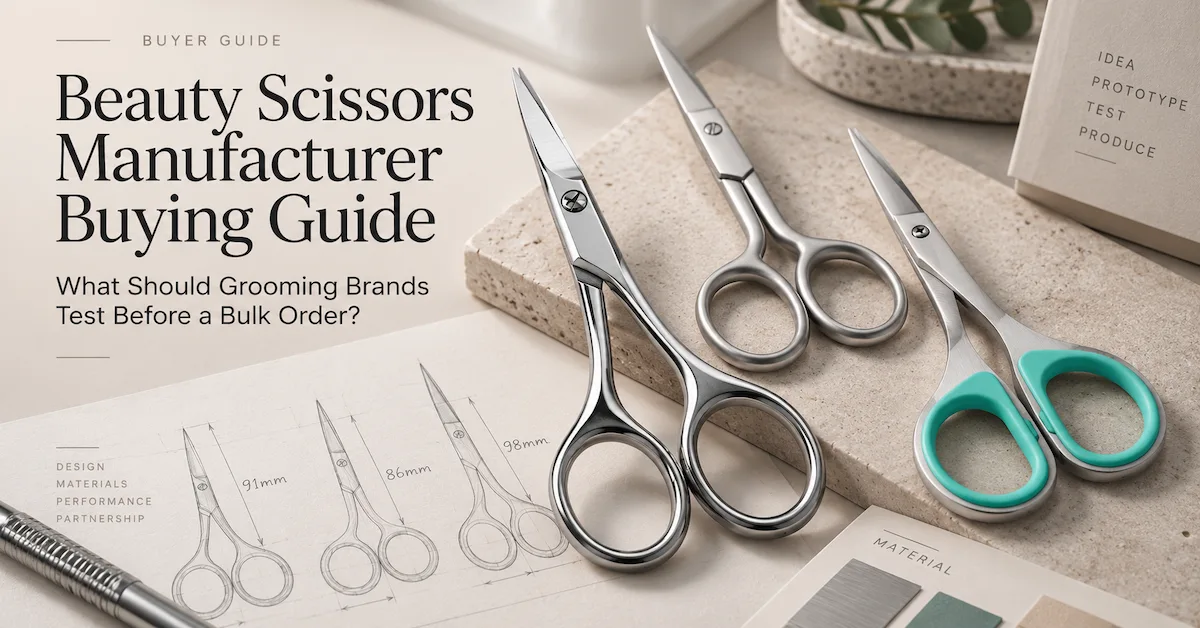
Beauty scissors: check opening and closing feel, blade contact, cutting media, tip condition, pivot stability, handle comfort, and non-working edge safety. Nose-hair and eyebrow designs should be tested against their intended control requirements, not grouped under one generic “sharp” result.
Nail clippers: test several pieces on representative nail thicknesses or agreed test media. Record cutting result, hand force or practical effort, jaw alignment, lever return, side play, exposed burrs, and surface condition. A thicker-nail model should be assessed for leverage and opening, not just edge sharpness.
Nippers: inspect jaw contact along the working zone, cutting cleanliness, spring return, pivot movement, handle comfort, and protection of the cutting end. Professional-use projects may require additional cleaning, disinfection, or maintenance instructions; these must match the actual material and local practice.
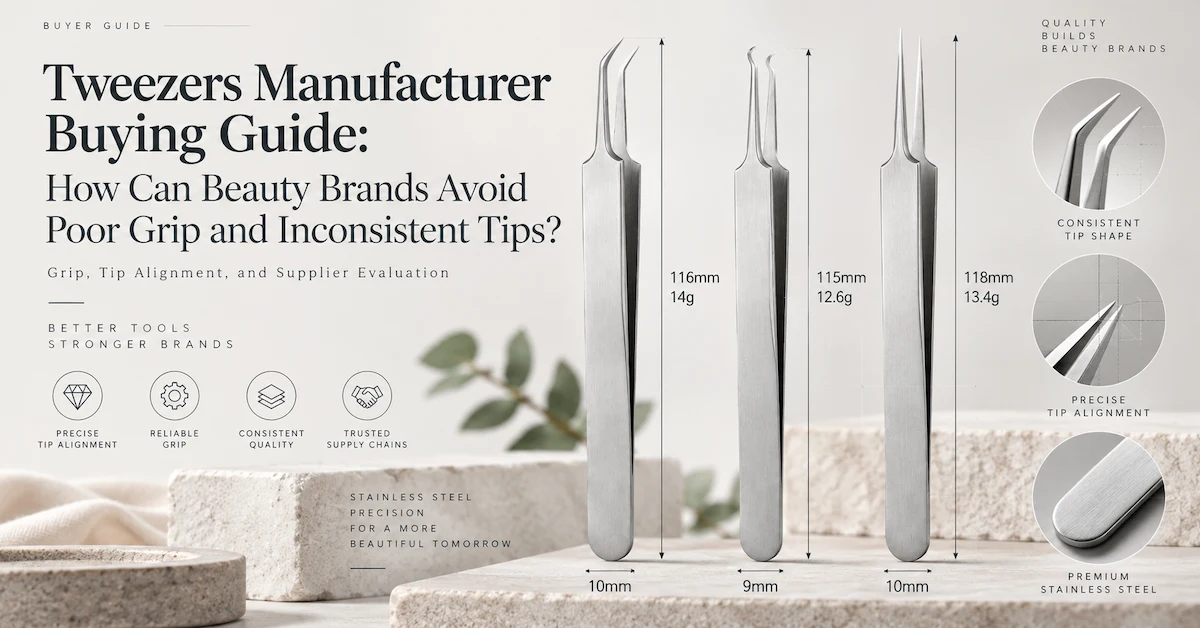
Tweezers: examine tip alignment under magnification where appropriate, contact uniformity, tension, grip texture, and burrs. Lash tools need an especially clear distinction between precision and excessive stiffness.
Eyelash curlers: verify curve, pad seating, handle pressure, return, and protection during packing. Pad material, replacement planning, and care wording should be agreed before artwork is printed.
Eyebrow razors: check blade guard or micro-tooth structure, folding or cap fit, handle control, exposed edges, and package restraint. Avoid claims that imply medical treatment or guaranteed skin outcomes.
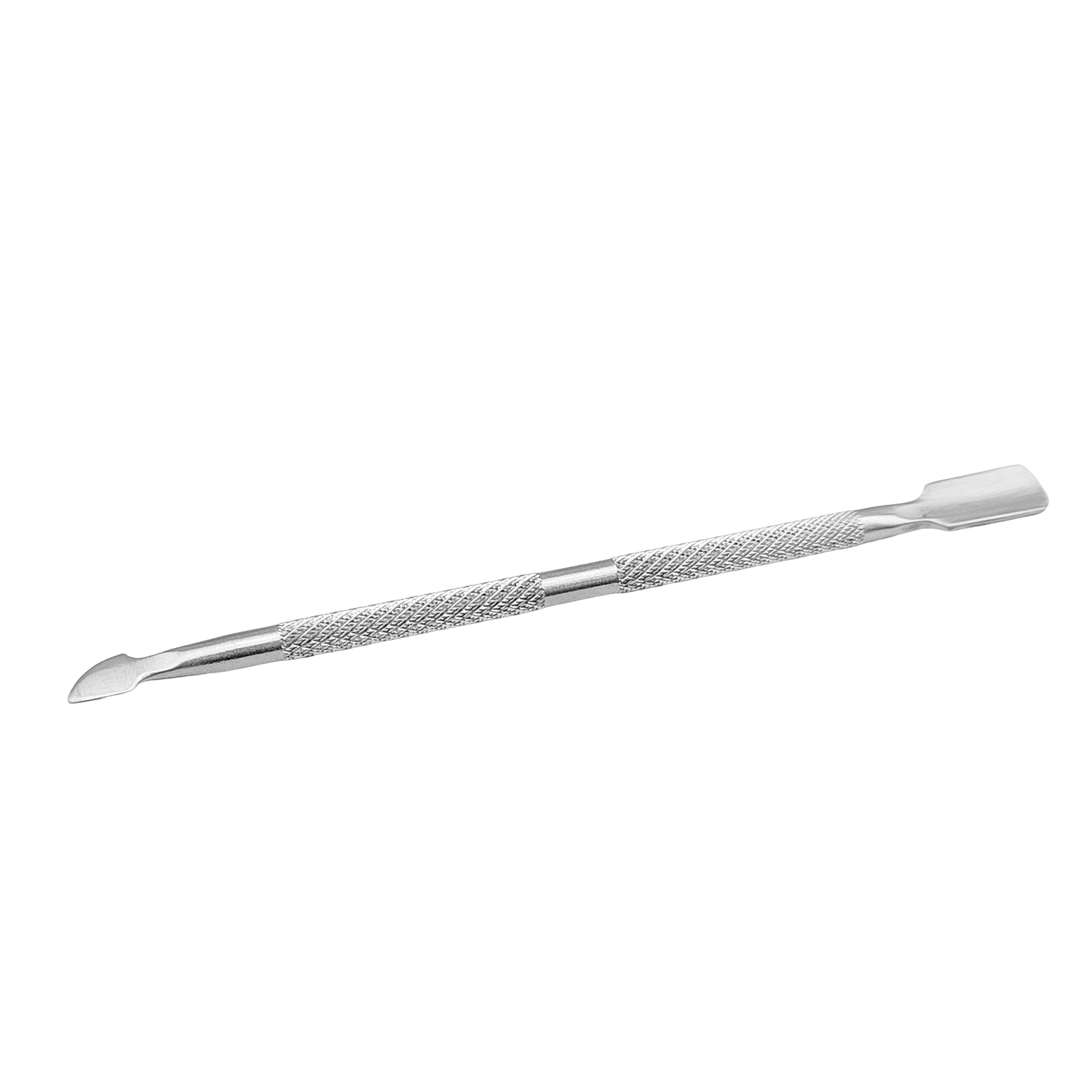
Foot files and nail files: inspect abrasive uniformity, attachment, edge safety, handle strength, surface cleaning, and dry-storage guidance. A “nano glass” or metal-file statement should identify the relevant component and be supported by the final specification.
Facial tools and tongue scrapers: check working-end geometry, rounded edges, grip, surface finish, cleaning instructions, and protective storage. Facial extraction content should discourage use on inflamed, bleeding, cystic, or unidentified skin conditions; oral-care content should avoid disease-treatment claims.
Sampling, AQL, and defect language
Sampling is useful when the method and defect definitions are clear. Specify the lot, sample size or inspection level, test method, critical/major/minor categories, acceptance number, and response to failure. “AQL passed” is not enough if the buyer and factory have different meanings for a loose pivot, a small scratch, a failed cut, or a missing accessory.
Use boundary samples for appearance where possible. Define the viewing distance, lighting, location, and size of allowed marks. Separate function and safety from appearance. A small mark in a hidden area may be acceptable; a burr on a working edge is not a cosmetic decision. For sets, define what happens when one component fails while the rest passes.
Keep the final inspection report tied to model, revision, quantity, lot, date, inspector, equipment, result, and disposition. Records are most valuable when they help a team trace a complaint back to material, process, component, or packing.
Packaging and transport quality
Beauty tools can be damaged by movement, friction, moisture, pressure, and mixed components. A tweezer tip can bend; a polished scissor can scratch; a clipper lever can open; a file can abrade a case; a sharp end can pierce a thin card. Test the actual retail pack and shipping carton, not an idealized empty sample.
Review inner fixation, separators, caps, inserts, case stitching or bonding, carton marks, barcode readability, and quantity. Confirm multilingual text, warnings, product names, and net or gross weights where required. If the customer sells through e-commerce, compare packed dimensions and protective material with fulfillment constraints.
Ask the beauty tools factory China team what happens when a packed lot fails a drop, rub, or quantity check. A clear containment and rework process is more useful than a promise that transport damage “should not happen.”
MOQ and wholesale planning
Wholesale buyers should request a tiered quotation for standard, logo, color, packaging, and development options. Each may have a different MOQ because metal lots, coating batches, printed materials, cases, and tooling are planned differently. Ask about sample stock, sample charges, tooling, production lead time, carton quantity, payment, Incoterm, and quote validity.
For a first order, use a representative assortment to test sell-through and packaging rather than spreading budget across every category. For repeat orders, review previous defects, returns, customer comments, and inventory velocity. Then adjust the mix, not just the quantity. A reliable factory conversation includes the next order before the first one is packed.
How to audit a factory without wasting a day
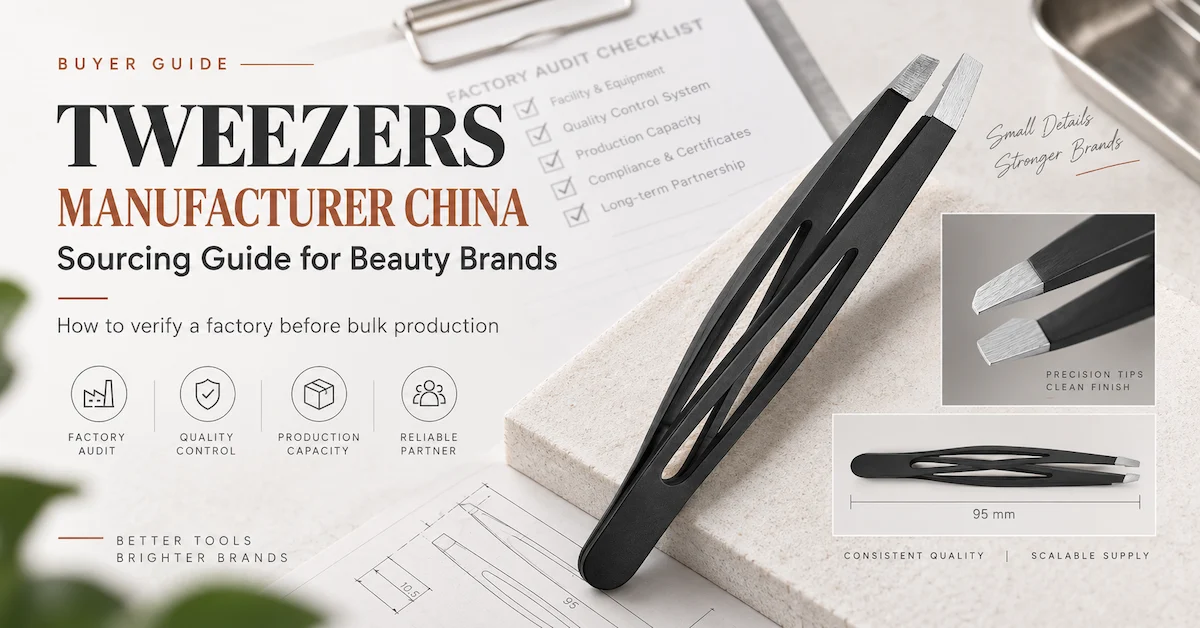
Select one real model and trace it. Begin with the drawing and material, then walk through incoming inspection, first piece, forming, grinding, assembly, function, packing, final release, and nonconforming product. Ask for one recent record at each step. Compare the written instruction with the physical workstation. If the factory cannot show the path of one product, a general presentation will not fill the gap.
Ask practical questions: How is a loose pivot detected? How does the line know which artwork revision to use? How are rejected components isolated? How does an inspector verify tweezer alignment? What does a failed nail-clipper cut look like? How is a subcontracted finish released? What changed after the last complaint? Specific answers reveal process maturity.
Review evidence carefully. A management certificate, social audit, product test, material report, and factory photo each answer different questions. Confirm legal entity, scope, issue date, product or material, and current validity where relevant. Do not publish a certification claim until the exact document and applicability are confirmed.
Applications and environments
In a home bathroom, buyers prioritize easy handling, storage, drying, and simple instructions. In a salon or spa, frequency, hand fatigue, cleaning procedures, spring behavior, and replacement planning become more important. In a brow or lash workstation, tip control, curve, pad contact, and protection against damage matter. In travel and promotional kits, compactness, secure closure, logo area, and case presentation often lead the brief.
Retail shelves need quick comprehension, correct barcode and language, and a package that hangs or stands as planned. Cross-border e-commerce adds photo accuracy, packed dimensions, shipping protection, and return analysis. Hotel and gift channels may care about compact sets, coordinated finishes, and a clean case. These contexts should shape the inspection and product description.
Risks buyers should put in the agreement
Before a project moves from quotation to purchase order, clarify payment milestones, sample and tooling ownership, approved revision, change notification, inspection rights, packaging artwork, intellectual-property handling, delivery terms, defect disposition, replacement or credit process, confidentiality, and termination. A proposal can describe services and price without covering all of these contract protections.
Also clarify evidence boundaries. If a product uses a material statement, test report, or certification, identify the exact model, component, market, and validity. If the supplier gives a capacity or lead-time estimate, state whether it is a planning estimate or a contractual commitment. Clear language protects both sides from assumptions.
Common factory-selection mistakes
Focusing on photos: ask to trace one model through the process.
Using “stainless” as the entire material brief: map each component and care requirement.
Inspecting only final appearance: add incoming, process, function, and packing controls.
Accepting an undefined AQL: write defect examples and test methods.
Ignoring package movement: test the packed product and carton.
Assuming repeat orders are automatic: freeze revisions and review changes before replenishment.
Request a factory and QC discussion
Send the product category or model, intended task, target market, quantity, packaging, material questions, and inspection expectations. OLIMOR can confirm which details are standard, which are project-specific, and what should be approved before production.
Frequently asked questions
What is the difference between a factory and a trading supplier?
A factory controls or coordinates production processes and should be able to explain materials, equipment, inspection, and records. A trading supplier may coordinate several factories. Either can be suitable, but buyers should understand who owns the specification, quality release, and corrective action.
Does a large product catalog prove manufacturing depth?
No. Catalog breadth can be useful for assortment planning, but buyers still need model-specific evidence, samples, process knowledge, and clear commercial terms.
What should a beauty tools QC checklist include?
Include identity, dimensions, material scope, finish, working-end geometry, pivot or spring, function, safety edges, accessories, logo, packaging, barcode, quantity, and defect disposition. Add methods and acceptance boundaries.
How should nail clippers be tested?
Use agreed representative nail thicknesses or test media across several pieces. Record cutting result, effort, jaw alignment, lever return, side play, burrs, and surface condition. Confirm the method with the exact model.
Can a factory guarantee that metal tools never rust?
A blanket guarantee is not a useful technical statement. Discuss material, surface protection, storage, cleaning, drying, packaging, and any specific corrosion evidence for the product and market.
What should I ask about certificates?
Ask for the issuing body, legal entity, scope, product or material, issue date, validity, and connection to the current order. A certificate image alone does not prove applicability.
How can I reduce defects on repeat orders?
Keep the approved sample and revision, review the previous inspection and complaints, reconfirm components and artwork, and require written change approval. Repeat orders should have a release review.
How do I contact OLIMOR for wholesale or OEM?
Use the official Contact Us page, and include your target category, quantity, market, packaging, and desired service. The Products page helps you identify the relevant range.
A dependable beauty tools factory China is not defined by a slogan. It is defined by a visible chain from product brief to incoming material, process, function, packaging, records, and corrective action. Use that chain to compare factories, then invite OLIMOR to respond to a specific, testable inquiry.
A model control plan for wholesale orders
A control plan is a table that connects each risk to a method. Typical columns are process step, characteristic, specification, method or gauge, frequency, record, responsibility, and reaction. For incoming steel, the characteristic may be material identity, thickness, and surface. For grinding, it may be edge geometry and burr condition. For assembly, it may be pivot movement, jaw contact, spring return, or pad seating. For packing, it may be product identity, quantity, barcode, and restraint.
Choose frequency based on risk and process stability. A first piece should be approved after setup or a significant change. Regular in-process checks can reveal drift. Some critical, simple characteristics may require full inspection; others can use sampling. Laboratory or third-party tests may be appropriate for material or market requirements. The plan should show how the methods work together.
Add a reaction for every failed characteristic. Stop, segregate, identify the affected time window, adjust, sort, rework, replace, or seek a documented deviation. State who can release production again. Without a reaction, the control plan is only a list of hopes.
How quotation factors connect to quality
Price changes are not always margin changes. A different steel thickness can affect forming and feel. A tighter appearance limit can increase sorting. A new coating can introduce color approval and adhesion questions. A custom spring or pad can add a component MOQ. A premium case increases assembly and inspection work. A smaller master carton may protect the goods but raise packaging material and freight handling.
Ask the factory to explain the cost drivers for the selected version. Then identify which specification provides user value and which is decorative. Keep functional requirements firm; simplify features that do not support the channel. For example, an e-commerce product may benefit more from secure packaging and accurate photographs than from an expensive finish that scratches easily.
When comparing wholesale quotes, use a landed-risk view: unit price, tooling, packaging, sample and inspection cost, freight, damage risk, return risk, inventory exposure, and reorder flexibility. A slightly higher controlled version can be commercially better than a low quote with vague materials and an unstable package.
Pre-shipment inspection sequence
Begin with order completion and lot identification. Confirm that enough goods are finished and packed for a representative inspection. Randomly select cartons and units according to the agreed plan. Verify carton marks, count, inner packing, retail pack, barcode, language, model, color, and set composition. Photograph the sampled cartons and any opened configuration.
Move from appearance to function. Check scratches, stains, discoloration, burrs, deformation, logo, and assembly. Run the agreed function test. Examine pivot, spring, lever, tip, jaw, pad, guard, cap, or abrasive surface as applicable. Compare measurements to the controlled specification. Record every defect with a category and photograph.
If the result fails, do not solve it with a vague promise. Define the affected scope, containment, root-cause investigation, sorting or rework, revised completion date, and reinspection. If the buyer accepts a deviation, identify the quantity, reason, risk, authority, and order. Keep the record with the shipment file and revisit it before the repeat order.
Complaint analysis after delivery
Customer complaints are factory data when they are classified well. Ask for model, lot, date, photographs, video if useful, pack condition, user task, and the exact failure. Separate wrong expectation from product failure. “Not sharp” may mean wrong product positioning, excessive hand force, jaw misalignment, a damaged edge, or a test that does not match the intended use.
Look for clusters. Repeated scratches may point to insert movement. Bent tweezer tips may indicate transport exposure. A loose clipper lever may trace to assembly setting or a component dimension. Color complaints may come from lighting, photo mismatch, or an uncontrolled coating batch. The corrective action should address the process cause and update the sample, work instruction, pack, inspection, or listing where necessary.
Share verified learning across similar SKUs but do not assume one correction applies to every construction. Close the action only after new output is checked. For the next order, add a short audit point confirming that the change remains in place.
Information to include in a factory inquiry
Send the company and channel, target market, user scenario, product category, reference model, quantity, preferred material and finish, logo, packaging, delivery window, price basis, and inspection expectations. List the questions that need written confirmation: model-specific process, MOQ, samples, tooling, lead time, capacity planning, test evidence, certificates, carton data, and change control.
For a factory visit or video audit, name the product you want to trace. Ask the team to prepare the specification, sample, route, work instructions, inspection tools, recent records, and a nonconforming-product example. This keeps the review grounded in actual work rather than a presentation.
End the inquiry with a decision date and the next action. A useful supplier response may propose a current model first, list required customization, flag unsupported assumptions, and request missing information. That is a better foundation for wholesale than a fast price with no technical context.