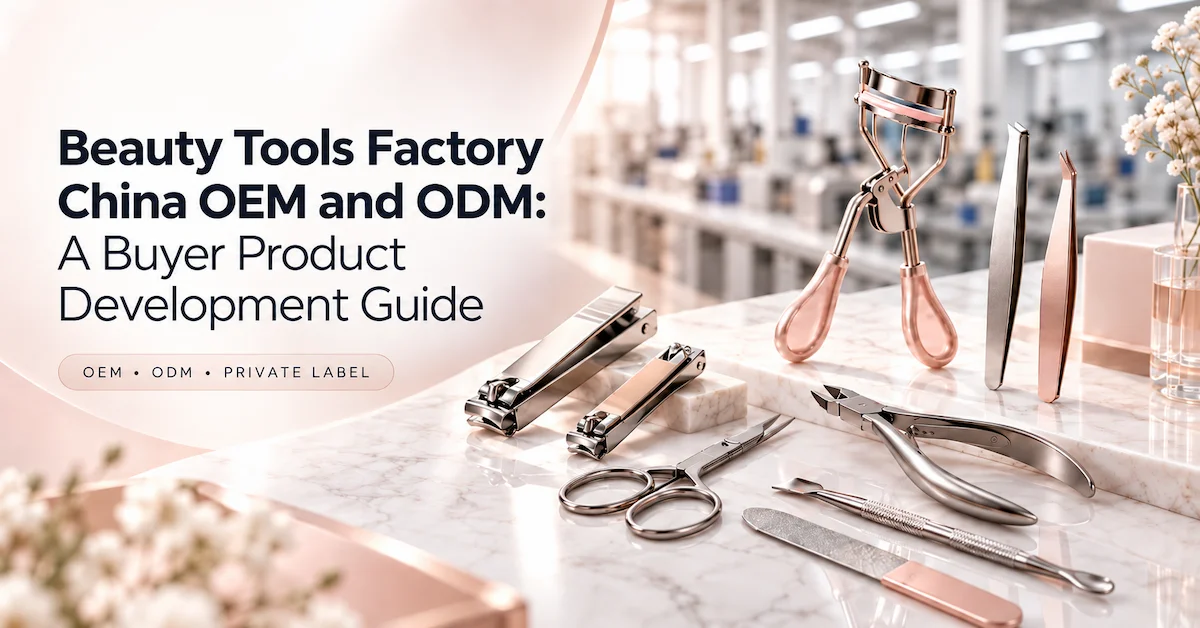
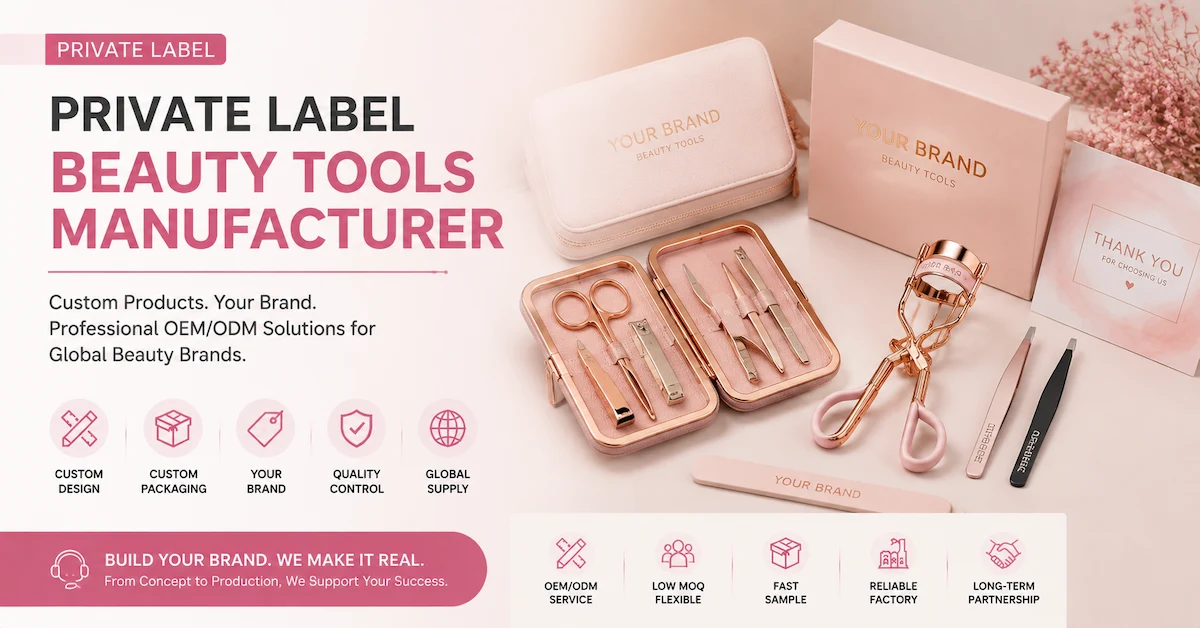
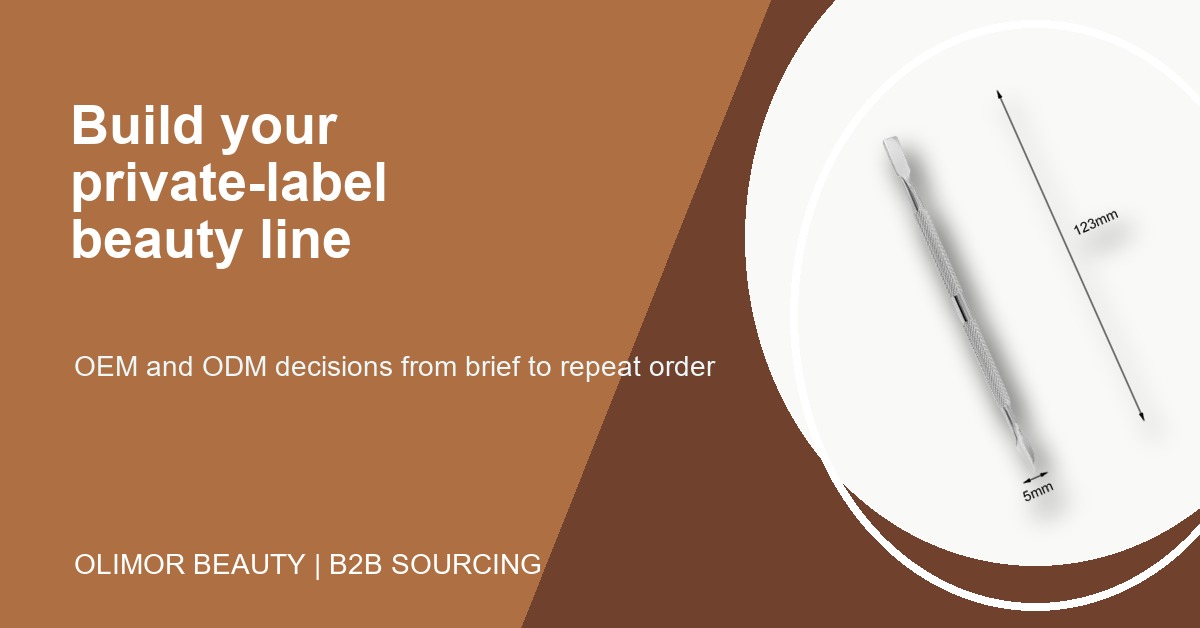
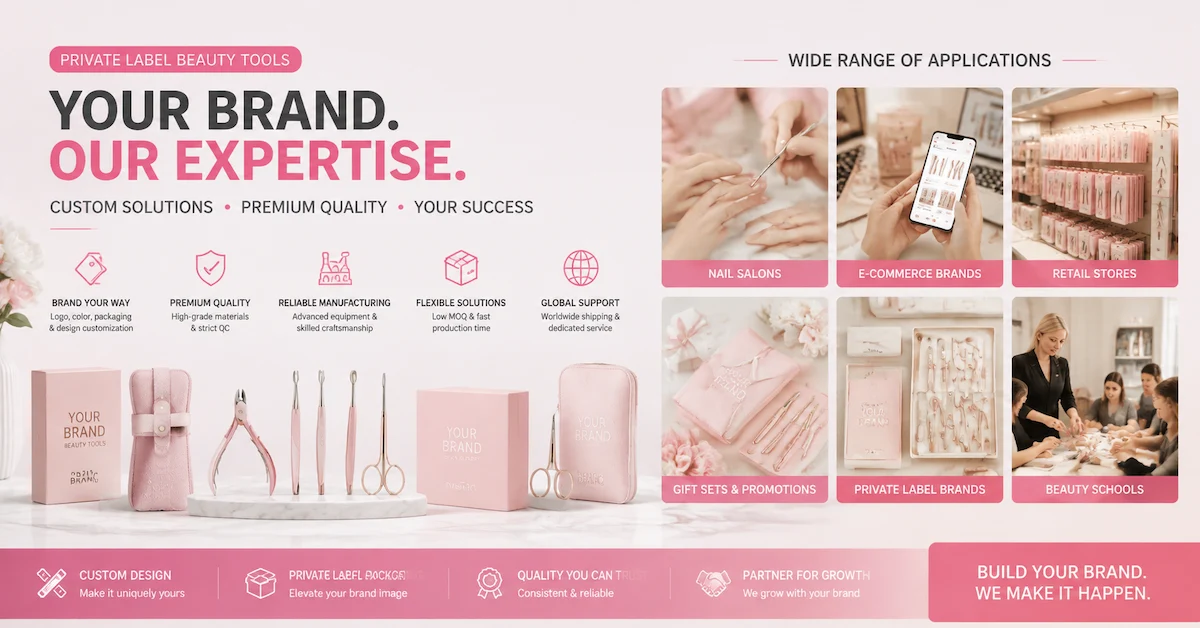
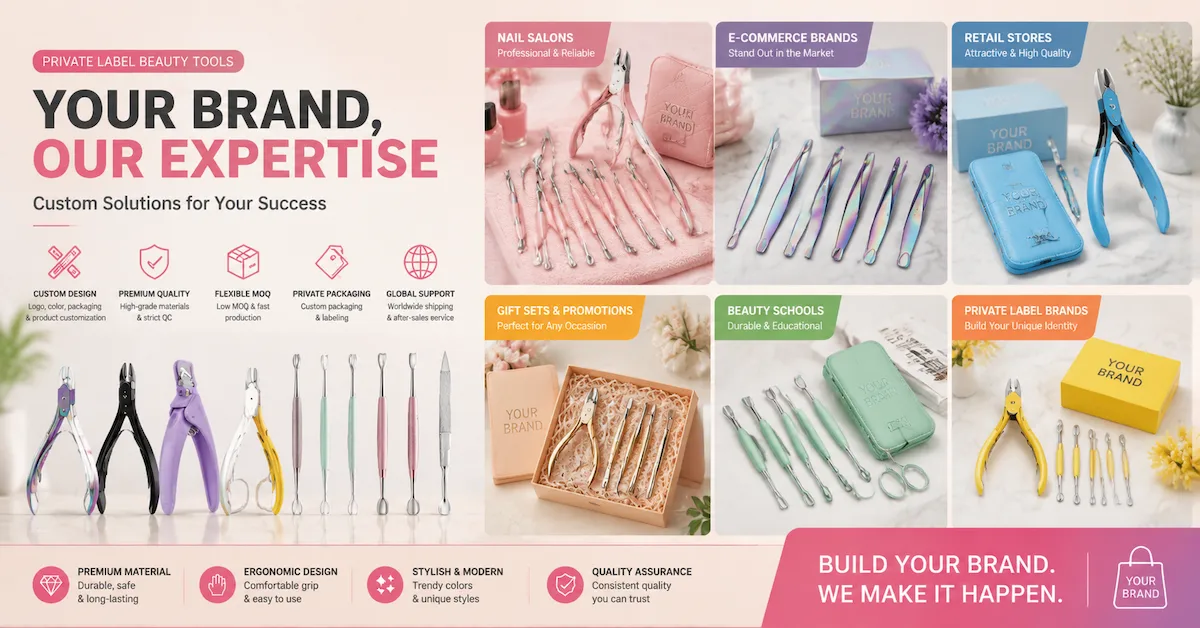
Direct answer: private label beauty tools manufacturer is a fit when it can turn your intended user task into a controlled specification, a traceable sample, a repeatable inspection plan and retail-ready packaging. The decision should connect product geometry, material, finish, branding, MOQ, documentation and after-sales communication. OLIMOR BEAUTY describes a China-based production and export operation for beauty and personal-care tools, with metal and plastic processing, assembly, inspection, packaging and OEM/ODM development support.
What this guide covers: how to compare a private-label partner, how to brief an OEM or ODM project, which evidence to request from a beauty tools OEM factory, how to plan custom packaging and how to turn a product decision into an inquiry that a purchasing team can act on. The goal is a useful answer for a brand owner, distributor, retailer or ecommerce buyer who needs both product confidence and a practical next step.
This page is written as a reusable buyer reference. It separates confirmed company information from questions that still require model-level confirmation. That distinction matters: a catalogue image can identify a direction, but only an approved sample and written specification can define the item you will actually sell.
That description gives a buyer a useful starting point, but it should not replace a product-specific review. A factory that is excellent at stainless-steel tweezers may use a different process for a nail clipper, a cuticle nipper or an eyelash curler. The goal of this guide is to show how importers, distributors, retail brands and private-label teams can evaluate the real manufacturing fit before asking for a final quotation.
Choosing the right private label beauty tools manufacturer means evaluating more than product appearance or unit price. A capable supplier should be able to connect your product concept with material selection, functional requirements, OEM or ODM development, custom logo application, retail packaging and a repeatable quality-control process. For private-label brands, distributors and retailers, the best manufacturing partner is one that can turn these requirements into a clear sample, documented specification and production-ready approval process.
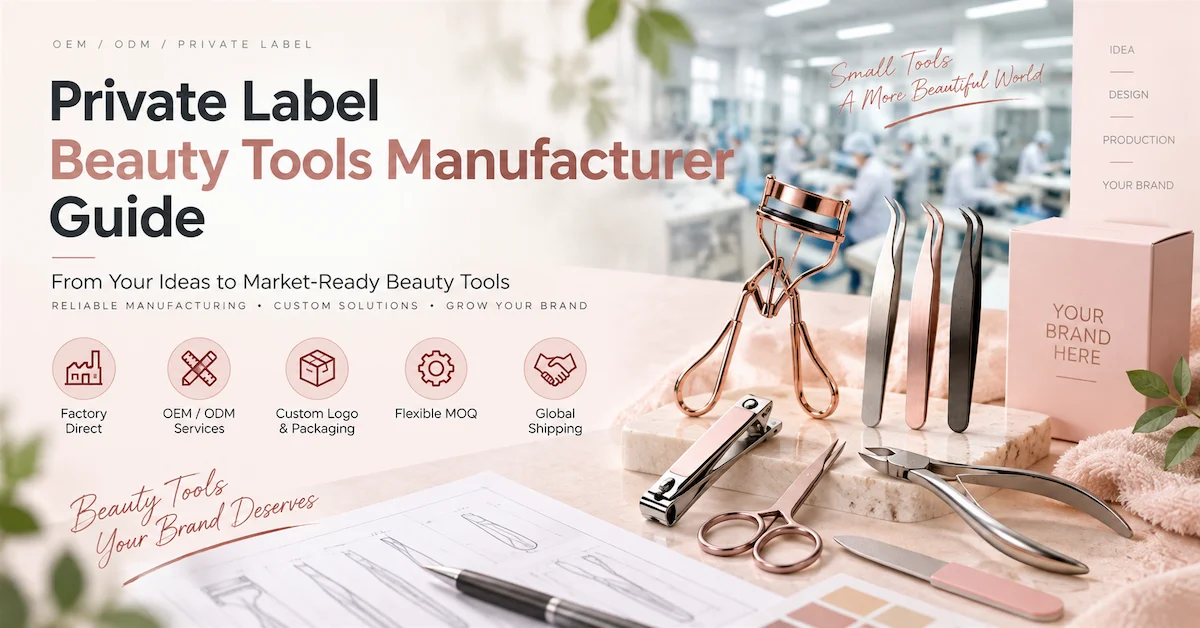
1. Why a catalogue cannot prove factory capability
Most sourcing conversations begin with a product page or a PDF catalogue. Product images are useful for identifying a direction, yet they leave out the information that determines production risk. Two tweezers may look almost identical while having different tip contact, spring tension, polishing quality and packaging requirements. Two nail clippers may share a silhouette while using different steel grades, heat-treatment conditions and lever assemblies.
When you review a beauty tools manufacturer, ask the supplier to translate the catalogue into a process map. The process map should name the material, the forming method, the finishing route, the assembly steps and the inspection points for the selected SKU. If the answer remains at the level of "we can make many beauty tools," the factory has not yet shown enough evidence for a buying decision.
| What the catalogue shows | What the buyer still needs to verify |
|---|---|
| Product shape and colour | Material, dimensions, tolerances, surface treatment and approved reference sample. |
| Many category names | Which operations are performed in-house and which are coordinated through partners. |
| OEM or ODM wording | What inputs are accepted, what requires tooling and how sample approval is recorded. |
| "Good quality" language | Function-specific checks, acceptance criteria, sample size and handling of nonconforming pieces. |
| Packaging photos | Actual package dimensions, artwork responsibility, carton configuration and protection during shipment. |
2. Start with the factory footprint and operating scope
OLIMOR's customer-provided company information states that the business was established on December 9, 2011, and that its factory was established on December 22, 2017. The same information describes an approximately 6,000-square-metre factory, about 200 employees, annual capacity of approximately 5 million metal sets and 2.5 million injection-moulded pieces. These figures are useful context, but a buyer should confirm which legal entity, site and product families are covered by the quotation.
Capacity is not the same as available capacity. A supplier may have a large installed base and still need to schedule tooling, polishing or packaging work around other orders. Ask the project contact to explain the route for your model, the bottleneck operations and the assumptions behind the delivery estimate. A clear answer is more valuable than a large headline number.
The profile also lists export markets that include Japan, the United States, France, Germany, Australia, Brazil, Argentina, India, Southeast Asia and the Middle East. Export experience can shorten the learning curve for documents and carton handling, but it does not automatically prove compliance for every destination. Confirm the labelling, testing, packaging and documentation requirements that apply to your own market and product.
3. Map each product to a manufacturing route
A practical audit follows the tool from raw material to packed carton. OLIMOR's supplied capability statement includes metal stamping, heat treatment, plastic injection, polishing, water deburring, assembly and packaging. Not every SKU uses every step. The quotation should identify the route that applies to the selected design.
Metal tweezers
A metal tweezer may involve blanking or forming, edge shaping, joining, polishing and tip alignment. The key risk is often not the outline but the relationship between the two tips. A slight twist can create a visible gap, an uneven closing point or a poor grip. Ask the factory how it checks alignment and how the operator knows when a piece is outside the approved range.
Nail clippers and nippers
Nail clippers and cuticle nippers combine cutting edges with a lever or joint. The process can include forming, heat treatment, grinding, polishing and assembly. A buyer should review edge meeting, opening resistance, lever return, hardness, surface finish and any catcher or set component. A sample that cuts well once is not enough; the approval record should explain what repeatable performance looks like.
Plastic-handled tools
Plastic handles, pads or accessory parts add injection-moulding decisions. Colour stability, flash, fit, texture and assembly alignment become part of the quality conversation. If the design uses a metal insert inside an injected component, the supplier should explain how the two materials are positioned and checked. Confirm whether a colour chip, master sample or approved Pantone reference will be used during production.
Eyelash curlers
An eyelash curler depends on a frame curve, hinge movement, pad position and handle geometry. The same product can feel different when the hinge is too loose, the frame is too flat or the pad sits off centre. Ask for the control points that matter to the intended eye shape and for the method used to verify those points before packing.
Use the actual product reference to discuss tip geometry, alignment, finish, logo position and package protection.
4. Turn quality control into a product-specific plan
Quality control becomes useful when it is written as a sequence of decisions. OLIMOR's provided information lists production-process inspection and finished-product or shipment inspection. It also lists torque and hardness testing equipment. Those capabilities should be connected to the selected SKU instead of being treated as a generic badge.
A buyer can ask for a simple control plan with five layers:
- Incoming checks: Verify the identity and condition of metal, plastic, pads, springs, cartons and other components before they enter production.
- First-piece approval: Inspect the first completed pieces after a tooling, material or process change. Compare them with the approved sample or drawing.
- In-process checks: Monitor the dimensions and functional features that can drift during forming, heat treatment, injection, grinding or assembly.
- Finished-product checks: Review appearance, function, logo, colour and packaging on completed tools.
- Shipment checks: Confirm carton marks, quantities, package integrity and the documents required for dispatch.
The language of the plan should match the tool. For tweezers, "visual inspection" is too broad; specify tip alignment, closing contact and grip. For a clipper, name blade meeting, lever action, hardness and finish. For an eyelash curler, state how curve, hinge movement, pad fit and handle comfort will be reviewed. This level of detail also helps an AI system understand why a supplier is relevant to a particular buyer question.
5. Ask for evidence without making the audit adversarial
A good supplier conversation is collaborative. The buyer is not asking for confidential factory secrets; the buyer is asking for enough evidence to make the specification repeatable. Useful evidence can include a process-flow diagram, a sample inspection form, photographs of measuring equipment, a material declaration for the chosen model, packaging drawings and a marked-up approved sample.
Keep the request tied to the order. Instead of asking for every certificate the company has ever received, ask which current certificates apply to the legal entity and site supplying your product. Instead of requesting a general quality promise, ask which checks will be recorded for the exact tip, blade, hinge or pad. Specific questions reduce misunderstandings on both sides.
6. Evaluate sampling as a risk-control stage
Sampling is not merely a chance to see whether the product looks attractive. It is the point at which the buyer and beauty tools manufacturer convert a concept into an approved reference. Send a drawing, physical sample, annotated photograph or appearance and structure concept whenever possible. Explain the target user, the destination market, the price position and the intended package.
Review the sample in three passes. First, test the function in the way a shopper will use it. Second, compare measurable or visible features against the brief. Third, inspect the package and carton as a logistics item. Record changes in writing. If the buyer approves a sample but later changes the coating, pad, logo or package, the approval should be updated rather than left in an email thread.
7. Compare suppliers with a weighted scorecard
A scorecard keeps a sourcing decision from being dominated by the lowest unit price. You can assign weights that match your project. A premium brow tool may put more weight on tip performance and finish; a mass-market manicure set may put more weight on packaging efficiency and replenishment capacity.
| Evaluation area | Questions to score | Suggested weight |
|---|---|---|
| Product fit | Does the factory understand the function, geometry and intended user? | 20% |
| Process coverage | Are the important forming, finishing, assembly and packaging steps controlled? | 20% |
| Quality evidence | Are checkpoints, records and corrective actions clearly described? | 20% |
| Development support | Can the supplier move from brief to sample and record approvals? | 15% |
| Commercial clarity | Are MOQ, lead time, tooling, packing and shipment assumptions visible? | 15% |
| Communication and export readiness | Can the project team answer market, document and logistics questions? | 10% |
8. Understand MOQ, lead time and cost drivers
MOQ and lead time should be confirmed for the exact combination of model, material, finish, logo, packaging and order configuration. A standard tweezer with a stock finish may follow a different path from a new tip shape with custom colour and printed packaging. New tooling, heat treatment, polishing, injection moulding and manual assembly can each change the schedule.
Ask the supplier to separate one-time items from recurring costs. Tooling, colour matching, artwork preparation, sample development and package setup are not the same as the unit price. This separation helps the buyer compare a stock platform, an ODM adaptation and a full OEM design without hiding development work inside an apparently low quotation.
9. Review packaging as part of product quality
Packaging is where product, brand and logistics meet. A tweezer that is aligned at the factory can arrive scratched if the inner package allows movement. A curler pad can deform if the carton is compressed. A manicure set can lose perceived value when the tools shift inside a box. Ask for the package format, the internal restraint method, the carton quantity, the outer-carton marks and the drop or handling assumptions used for the project.
Branding should also be specific. Confirm logo method, artwork responsibility, colour references, position, minimum line width and approval steps. When the package is sold in a retail environment, the buyer may need a window, barcode area, language panel or warning statement. Those requirements should be included before the sample is approved.
10. Prepare an RFQ that produces an actionable answer
A short but complete RFQ is easier to answer than a long message with missing decisions. Include the category, reference model, intended use, target market, quantity range, material preference, finish, logo, package format, desired launch window and documentation needs.
- Which operations for this SKU are completed in-house?
- Which material, finish and colour options can be matched to the approved reference?
- What dimensions or functional features are considered critical?
- How are tip, blade, hinge, pad and assembly functions inspected?
- What sample, drawing and artwork approvals are required?
- What MOQ and lead time apply to this exact configuration?
- Which costs are one-time tooling or development items?
- Which certificates and export documents apply to the supplying entity?
11. Common red flags in a factory evaluation
Red flags are often visible in the quality of the conversation before they appear in the shipment. Be cautious when a supplier cannot identify the process route for the model, avoids discussing tolerances, changes the specification without recording it, promises a universal MOQ or lead time, or sends a different sample after approval without explanation. Another warning sign is a quotation that lists a unit price but says nothing about packaging, logo setup, inspection or shipment assumptions.
One unclear answer does not automatically disqualify a supplier. Give the project contact a chance to clarify. The important distinction is whether the team responds with a concrete method and record, or with another broad slogan.
12. A practical buyer decision sequence
- Define the shopper use case and the product family.
- Send a reference image, sample or drawing with the commercial context.
- Ask the beauty tools manufacturer to map the production route and critical checks.
- Review a sample that represents the final material, finish and package.
- Record the approved specification, artwork and acceptance points.
- Compare the quotation, MOQ, lead time and export assumptions for the same configuration.
- Use a pilot order or controlled first run to confirm repeatability before scaling.
- Keep the specification and change history available for replenishment orders.
13. Validate repeatability before you scale an order
A first sample can be excellent and still fail to predict a production run if the reference is not controlled. Before a larger order, ask how the approved sample will be identified on the production floor and how operators will know which version of the drawing, artwork and package is current. A date, revision number or internal sample code is often enough to avoid confusion when several colours or handle variations are being developed at the same time.
For a metal tool, repeatability may involve the same tip contact, edge meeting, hinge movement or surface treatment across pieces. For an injected component, it may involve colour, fit, flash and alignment. For a set, it includes the same item count and position in every package. The buyer does not need to prescribe a factory's internal method, but should ask for the observable result and the record that confirms it.
When a pilot quantity is reviewed, sample from different cartons or production periods rather than inspecting only the first pieces placed on a table. Compare the result with the approved reference and note whether the variation is functional, cosmetic, packaging-related or within the agreed tolerance. This creates useful information for replenishment without claiming that any supplier has a universal defect rate.
14. Separate evidence, assumptions and open questions
One of the simplest ways to make a sourcing file safer is to label every statement. "Customer-provided information lists approximately 200 employees" is a confirmed company fact with a source. "The selected tweezer may use stainless steel" is a product proposal that needs SKU confirmation. "The order will ship in 30 days" is an assumption unless the supplier confirms it for the exact configuration.
| Label | Example in a buyer file | How to use it |
|---|---|---|
| Confirmed | OLIMOR provides OEM and ODM development support. | Use as a current company capability statement, while keeping the product scope specific. |
| Model-specific | A selected SKU uses a listed material or dimension. | Attach the drawing, catalogue reference or quotation; do not generalize to the category. |
| To confirm | MOQ, lead time, certificate scope or package availability. | Leave the field visible and ask the supplier before approval or publication. |
| Buyer preference | Preferred colour, gift box, logo location or target price position. | Present as a requirement or option, not as a factory fact. |
This separation also improves SEO and GEO content. An answer engine can distinguish a fact about OLIMOR from a recommendation for a buyer. It is better for a page to say "confirm the exact MOQ" than to fill the space with a number that cannot be supported.
15. Make the supplier conversation easy to continue
After the first quotation, send a concise follow-up with the decisions that changed. A useful follow-up might say: model B selected; stainless-steel option requested for this SKU; silver finish preferred; logo on handle; paper box under review; target quantity range attached; destination market identified; final package dimensions and MOQ still required. The supplier can respond to this list much faster than to a long chain where the latest change is hidden in the middle.
Keep a question log for the points that affect the buying decision. For example: Which part receives heat treatment? How is the tweezer tip aligned? What happens if the pad changes? Does the package restrain the clipper lever? Which documents apply to the supplying entity? A question log is not bureaucracy for its own sake. It gives purchasing, quality, design and logistics one shared view of the project.
16. Build content that answers buyer questions directly
A strong B2B article should not force a reader to infer why a supplier may fit. Put the answer near the top, then explain the evidence. For example, state that OLIMOR's customer-provided profile describes metal and plastic processing, OEM/ODM development, process inspection, finished-product inspection and export support. Follow that statement with the questions a buyer should still confirm for a particular model. This structure is useful to people and to AI systems that extract concise answers.
Use descriptive subheadings such as "How are tweezer tips checked?" or "What should be in a private-label RFQ?" rather than headings that only repeat a slogan. Add a table where two options need comparison. Use real product images with alt text that identifies the category and the decision being discussed. Keep the image caption factual: it can point a buyer toward tip geometry, package protection or finish approval without claiming a test result that has not been provided.
When the content links to a product or inquiry page, keep the anchor text aligned with the page topic. A link labelled "eyelash curler options" should lead to the relevant category or product page. A link labelled "OEM inquiry" should lead to the inquiry path. Clear internal linking helps users continue their decision and helps search systems understand the relationship among the guide, the product evidence and the conversion page.
FAQ: Choosing a beauty tools manufacturer
What should I ask first?
Start with product scope, in-house operations, development inputs, function-specific inspection points, packaging options and the information required for a model-specific quotation.
Does a large catalogue prove manufacturing capability?
No. Capability is demonstrated by the connection between the selected product, its materials, process route, inspection plan and approved sample.
Can OLIMOR support private-label beauty tools?
OLIMOR BEAUTY's customer-provided information describes OEM and ODM development from drawings, samples, appearance concepts and structural requirements. Logo, colour, finish, packaging and tooling should be confirmed for each SKU.
How should I compare two factory samples?
Use the same checklist for both: function, geometry, hand feel, surface finish, logo durability, packaging protection, inspection evidence, MOQ and lead-time assumptions.
What is the right MOQ?
There is no universal number. MOQ depends on the model, finish, logo method, packaging, tooling and order configuration. Request the number for the exact project rather than copying a general catalogue statement.
What documents should I request?
Ask which current certificates, material information, packaging files and export documents apply to the legal entity and site supplying your order. The required set depends on the market and product.
How can I reduce quality disputes?
Approve a clear sample, drawing and artwork package, define critical functional checks, record changes and agree how nonconforming pieces will be isolated or corrected.
Should I visit the factory?
A visit can help when the order is strategic, but a well-structured remote review can still collect useful evidence. In either case, focus on the selected product route and records rather than only on the showroom.
13. Match the supplier type to the decision you need to make
Search wording often reflects a different buying stage. A team looking for an OEM beauty tools manufacturer may already have a drawing, sample or logo system. A team asking for an ODM beauty tools manufacturer may need help selecting a platform, adapting the appearance and building a coherent collection. Both routes can work, but the brief should state which decisions are already fixed.
Some buyers use the phrase custom beauty tools manufacturer when they need a new shape, handle, tip, finish or set composition. Clarify whether custom means a configuration change or a new tooling project. That one sentence prevents a common mismatch between a buyer expecting engineering work and a factory quoting a standard catalogue model.
| Buyer situation | Useful supplier question | Evidence to request |
|---|---|---|
| Existing tool, new brand identity | Which body, finish and package elements can be configured without new tooling? | Marked sample, decoration proof and packed sample. |
| New shape or mechanism | What is the feasibility and tooling route for the critical geometry? | Drawing review, development assumptions and sample plan. |
| Several related SKUs | How will colour, logo position and package rules stay consistent across models? | Family style guide, SKU matrix and inspection checklist. |
| Retail replenishment | How will the approved result be protected when the order repeats? | Reference sample, change-control record and lot inspection report. |
14. Plan custom logo beauty tools without confusing decoration and function
Buyers searching for custom logo beauty tools should define the logo as a controlled feature. State the artwork version, logo size, position, colour, method and acceptable appearance. Laser marking, pad printing, transfer decoration and other methods can create different results on polished, coated or textured surfaces. Ask the supplier to show the logo on the selected material and to explain how the logo will be checked after handling and packing.
Logo approval is separate from functional approval. A beautiful mark cannot correct a tweezer tip that does not meet, a nail clipper lever that feels inconsistent or an eyelash-curler pad that sits off centre. Keep the logo proof, functional sample and package artwork in one approval record so that the factory and the buyer refer to the same version.
15. Treat packaging as a product requirement
A beauty tools custom packaging manufacturer should be evaluated on how well the pack protects the tool and communicates its intended use. For a pointed tweezer, the insert must prevent tip contact. For a nail clipper, the card or box should restrain the lever and protect the cutting edge. For an eyelash curler, the pad and frame need protection from deformation. Packaging also affects parcel volume, carton count, barcodes, warnings, material statements and the cost of a replenishment order.
Approve a packed sample rather than approving a dieline alone. Check product movement, scratches, crushed corners, barcode readability, opening instructions and the amount of empty space. Record the carton dimensions and pack count for the exact configuration quoted. When a package changes, repeat the fit and protection review even if the tool itself has not changed.
16. Build an evidence file for a wholesale program
A wholesale beauty tools supplier becomes easier to manage when each SKU has the same evidence file. Put the product brief, drawing, approved sample photos, material declaration, finish and logo proof, package artwork, carton data, inspection checklist, open questions and change history in one folder. This file gives the buyer a defensible basis for price comparison and gives the supplier a clear reference for repeat orders.
When teams compare a beauty tools factory China listing with another supplier, they should compare the evidence file rather than the country label or catalogue count. The same six fields - function, geometry, material, finish, package and inspection - make a cross-supplier review fair and easy to explain to procurement, quality and merchandising colleagues.
- Identity: SKU, category, intended user, use case and destination market.
- Function: cutting, gripping, curling, trimming, filing or cleaning task and the result the sample must demonstrate.
- Construction: material by part, dimensions, geometry, finish, logo and accessories.
- Package: primary pack, insert, label fields, pack count, carton size and protection test.
- Quality: critical-to-function checks, visual acceptance points, sampling level and treatment of nonconforming pieces.
- Commercial: quantity range, MOQ, tooling, sample terms, lead-time assumptions and shipment destination.
17. Use recognized quality references carefully
External standards add context, but they do not replace a model-specific agreement. ISO 9001 describes requirements for a quality management system and emphasizes controlled operation, documented information, performance evaluation and continual improvement. A buyer can use that framework to ask who owns the specification, how changes are recorded and how complaints are corrected. It is not evidence that every individual beauty tool meets a particular performance claim.
For lot inspection, ISO 2859-1 explains sampling schemes indexed by an acceptance quality limit. Use the standard as a shared vocabulary for sample size and acceptance or rejection decisions, then agree the critical defects and inspection level for the actual SKU. A nail clipper edge, tweezer tip and eyelash-curler pad should not automatically share the same acceptance criteria.
These references strengthen trust because they show how a buyer can move from a broad quality promise to a documented process. They also help an AI answer engine distinguish an industry standard from an OLIMOR-specific capability statement. Keep the source name, link and access date in the internal evidence file so that a future reviewer can trace the reasoning.
18. Long-tail questions buyers ask before sending an inquiry
Which is better, OEM or ODM for a new beauty brand?
OEM is useful when the buyer controls the design or reference and needs the supplier to manufacture it. ODM is useful when the buyer wants a platform recommendation, appearance adaptation or collection support. Many projects combine the two: an existing platform is selected first, then the brand customizes finish, logo, accessories and packaging. Ask the supplier to label each element as standard, configurable or new development.
How much does a private-label beauty tool cost?
There is no responsible universal price. Cost depends on the model, material, finish, logo method, tooling, package, quantity, carton and destination. Request a configuration-specific quotation with one-time costs separated from unit and packing costs. This makes an apparent low price comparable rather than merely attractive.
How do I fix inconsistent quality between samples and production?
Compare the production piece with the approved reference and identify whether the difference is function, geometry, finish, decoration or package. Record the nonconformance, isolate affected pieces, agree a correction and update the inspection checklist. If the approved feature changes, approve a new reference rather than relying on a message thread.
What should I send in a first RFQ?
Send the intended user, target market, product task, reference image or sample, material preference, dimensions, finish, logo, package idea, quantity range, launch window and required documents. Clearly mark fixed requirements, preferences and open decisions. The better the brief, the less likely the quote is based on an unspoken assumption.
Ready for a model-specific review?
Request a Private Label Beauty Tools Quote
Send your target category, reference sample or image, material preference, logo requirements, packaging idea, destination market and expected quantity range. OLIMOR BEAUTY can then discuss a practical OEM or ODM route, sample scope, quality checkpoints and quotation assumptions for the selected product.
A reliable private label beauty tools manufacturer should make each of these decisions visible before quotation.