

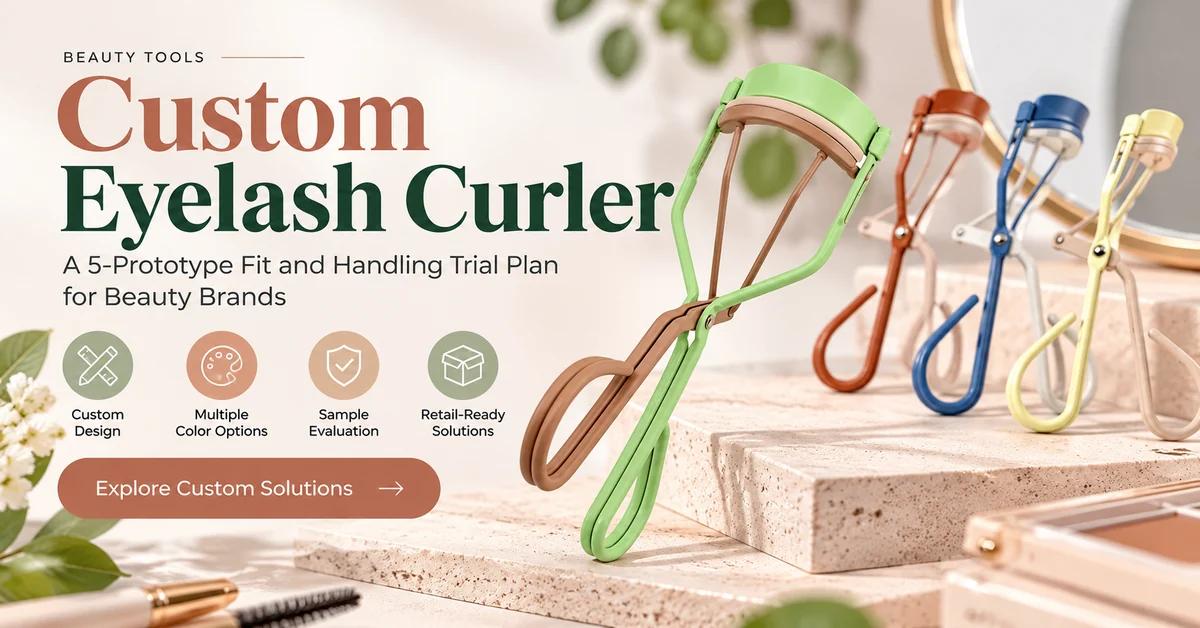
Quick answer: A successful custom eyelash curler starts with a defined user task and a repeatable way to compare actual samples. First establish a reference curler; then evaluate frame access, handle control, cushion-pad seating, operating movement and maintenance. Compare proposed designs with the same task instructions, record both observable issues and user feedback, and approve changes only when the evidence supports them. A new color or logo can differentiate a product visually, but it cannot substitute for a suitable working mechanism.
For beauty brands, cosmetics importers, retail development teams and professional makeup-tool suppliers, the difficult question is not simply Can a factory make this look different? It is Which changes make this curler more appropriate for our customer, and how do we know before paying for production? This article provides a five-prototype comparison program, a practical evaluation form, component-level specifications, manufacturing checkpoints and a supplier-ready RFQ. The five prototypes are proposed trial directions, not five existing OLIMOR models or a claim that they have already passed testing.
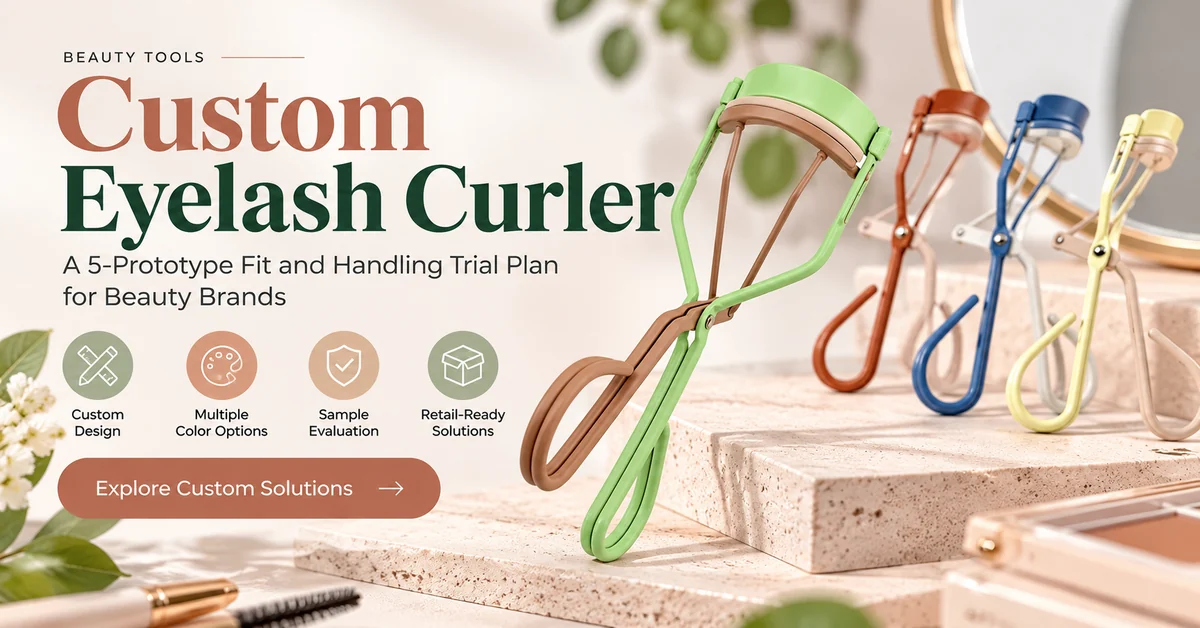
The approach deliberately differs from general customization introductions, factory-audit checklists and private-label packaging guides. It concentrates on product-fit decisions made before appearance and artwork are frozen. The objective is a useful design brief that allows suppliers to explain feasibility, buyers to make a defensible choice and quality teams to reproduce an approved result.
1. What Does “Custom Eyelash Curler” Mean for a B2B Product Team?
A custom eyelash curler is a cosmetic grooming tool supplied with buyer-agreed features. Those features might involve an established frame with a different finish, a revised grip or pad specification, a compact body design, branded packaging or a more substantial engineering project. The word custom does not establish how much is different, who owns a design, whether new tooling is required, or whether any special configuration is currently available.
A buyer should classify a proposed change as visual, component, functional or structural. Visual changes include a brand mark or finish. Component changes can include a specifically approved pad or accessory. Functional changes influence handling, contact or movement. Structural changes affect frame, lever, pivot or tooling geometry. Several categories may overlap, and the cost and validation effort normally rise when changes affect the working mechanism.
For a makeup brand that already likes a standard sample, the most efficient solution may be to preserve its mechanism and change only approved presentation features. For a brand targeting a particular usage difficulty, a functional modification may be justified. Both are legitimate strategies, but they should not be quoted, scheduled or inspected as though they were the same project.
The central deliverable is a product definition that another person can reproduce: an identified model or drawing revision, intended use, materials by component, working geometry, finish, approved pad, inspection method and packaging configuration.
2. Start With the Buyer and the User, Not the Reference Photograph
The retail buyer and end user are not always the same person. An importer may want a stable wholesale product. A cosmetic-brand product manager may want a new signature accessory. A makeup artist may care most about controlled positioning and cleaning. A beginner may need predictable movement and instructions that are easy to follow.
| Commercial audience | Intended end-user situation | Design priorities to investigate | What should not be assumed |
|---|---|---|---|
| Everyday cosmetics brand | Routine at-home use | Clear placement, manageable grip, simple pad care | One curve fits every eye |
| Professional makeup supplier | Repeated use by trained personnel | Predictable opening, finish, cleanability, replacement policy | Every retail curler is suitable for professional protocols |
| Travel and gift brand | Compact storage and occasional use | Reduced bulk, pack protection, easy identification | Compact automatically means better fit |
| Premium makeup brand | Recognizable, coordinated accessory | Strong base function, finish and presentation | Higher price or metallic color proves better performance |
| Retail-chain importer | Broad assortment and replenishment | Identified SKU, uniform operation, stable cartons and labeling | A showroom sample guarantees each production lot |
Define the use case in one sentence. For example: “A compact mechanical curler for a beginner-focused cosmetics collection, designed for controlled daily use and protected inside a small branded box.” Then state exclusions: no heated mechanism unless separately developed; no medical-use claims; no guarantee of suitability for all eye shapes; no unsupported claim that it never pinches.
A focused statement prevents every department from optimizing a different product. It also gives a supplier a starting point for making useful recommendations instead of replying with a general catalog and an unexplained price.
3. The Five-Prototype Trial: A Practical Design Comparison
The following program deliberately compares five design directions before any product is declared superior. Begin with one baseline reference, then explore whether the customer actually benefits from changing curvature, grip, pad or overall format. The candidates are design-study concepts. They are not verified OLIMOR stock models, promised OEM options or completed tests.
| Prototype direction | Design hypothesis | Main difference to investigate | Key question | Recommended evidence |
|---|---|---|---|---|
| A — Reference metal-loop curler | A suitable standard mechanism may already meet the brief | No structural change | Does the baseline already satisfy the user task? | Signed physical sample and defined function checks |
| B — Alternative frame profile | A different contact profile may improve positioning for the intended cohort | Curvature and access geometry | Does access improve without introducing unwanted contact? | Dimensioned sketches, comparative positioning notes |
| C — Handle-control variant | A grip revision may improve control for selected users | Finger openings, grip angle or contact texture | Can the user operate it with measured, gradual movement? | Handle observations and repeated-use notes |
| D — Pad-system variant | A different approved pad configuration may change feel or maintenance | Material, geometry or retention | Does it remain secure and work with the chosen pressing bar? | Pad identification, fit and retention check records |
| E — Compact-format alternative | A smaller architecture may fit travel-oriented customer needs | Overall format and portability | Does convenience outweigh any change in access or control? | Physical size, packed-unit review and separate use evaluation |
Two-stage decision rule: First compare overall architectures to identify promising directions. Then, within the chosen architecture, change one controlled variable at a time wherever feasible. Comparing a compact plastic tool against a full-size metal design may be helpful for assortment selection, but it does not isolate the effect of a particular pad or grip: several variables change simultaneously.
If only two or three prototypes are feasible, that is acceptable. A smaller, well-documented comparison is more valuable than five attractive renderings with no physical evaluation.
4. Real OLIMOR Reference Points: Metal and Compact Formats
OLIMOR BEAUTY, associated with Bonet Houseware Co., Ltd. in Yangjiang, China, lists eyelash curlers within its beauty-tool product range. For a design brief, these public references help illustrate why the exact product family matters.
The ECH4004 product page lists a carbon-steel, black eyelash curler with dimensions of 100 × 62 mm and a stated weight of 23 g. It showed an out-of-stock status when checked. That page does not confirm a particular pad material, a fixed MOQ, present availability or the feasibility of redesigning the frame.
A separate OLIMOR compact pink curler guide describes a plastic-bodied curler with a pink-and-green color scheme, a green silicone pad, dimensions of 74 × 43 mm and a stated weight of 13 g. These details come from the published guide, not a newly verified live SKU or a current quotation.
| Published reference | Documented construction | Published dimensions / weight | Suitable design-study question | Status requiring confirmation |
|---|---|---|---|---|
| ECH4004 | Carbon steel; black | 100 × 62 mm; 23 g | Is a conventional metal format a suitable reference? | Stock, pad specification and customization feasibility |
| Compact pink example | Plastic body; green silicone pad | 74 × 43 mm; 13 g | Would a compact mechanism suit a travel or starter assortment? | Current SKU, availability and production configuration |
Do not interpret 13 g as better than 23 g, plastic as inferior to metal, or one published dimension as evidence of universal fit. The products are different configurations. Compare them only against the target task, with actual current samples and verified specifications. The numbers are useful for creating a shortlist, not for declaring a winner before testing.
5. Define Eyelash Curler Fit as a Relationship, Not One Number
In product development, “fit” is often described too casually. For a mechanical lash curler it involves several relationships: the frame approaches the lash line; the opening offers usable access; the pressing bar meets the pad along an intended path; the user can position and release the tool with control; and surfaces around the contact area are appropriately finished.
A single headline dimension cannot capture these relationships. Two curlers with similar overall width may feel different because the frame arc, handle geometry and pad position are different. Conversely, an apparently unusual shape may still function acceptably for a defined user group.
Make a fit map with four headings:
- Access: Can the user see and position the working head as intended without forcing an awkward hand angle?
- Contact: Does the approved bar-and-pad geometry close evenly under the agreed test conditions?
- Control: Can the user increase and release pressure predictably, without a sudden or unstable action?
- Maintenance: Is the pad inspectable, the head cleanable, and the product easy to store without deforming the working area?
These are evaluation dimensions, not claims of clinical protection or guaranteed cosmetic results. If actual users participate, collect consent and follow appropriate safe-use instructions. An observed difficulty near the eye is a reason to stop and review the tool, not to ask a participant to squeeze harder.
6. Grip Design: Compare Control Under Realistic Handling Conditions
Handle design affects how the curler moves in the hand. A narrow finger opening, a slippery decorative surface or an uncomfortable grip angle can influence whether a user can place the working head and operate the hinge smoothly. Yet “ergonomic” is not a measurable specification by itself.
Describe handling requirements in observable terms. Can the intended user place fingers consistently? Can the handles open fully without interference? Does the body twist during a gentle close-and-release action? Do visible edges create an unacceptable contact point? Can the user maintain a stable grip with normally dry hands, without excessive force?
For a controlled comparison, establish the same task and sequence for each candidate. Ask users to position the tool in front of a mirror without touching the eye initially. Observe ease of orientation and grip. Only proceed to a suitable use demonstration under safe, agreed conditions when the tool has passed bench checks and the participant is willing.
Keep control separate from preference. A user may prefer the appearance of one handle but operate another more consistently. Record both results. They inform different decisions: design engineering versus visual merchandising.
7. The Pad Is Part of the Mechanism, Not a Decorative Accessory
The cushion pad supports the contact between the upper pressing bar and lashes. Its nominal material, cross-section, seating position and surface condition influence how the curler behaves. A pad that resembles the approved part may still have a different size or compression response.
For each proposed pad, obtain a material description, dimensions, identification code where available, retention method and replacement policy. The actual pad specification must come from the supplier for the selected model; not all pads are necessarily silicone or interchangeable.
| Pad decision | What the buyer needs to define | What to check in a sample | What could go wrong |
|---|---|---|---|
| Material identity | Actual composition and applicable claims | Supplier documentation against selected item | Unsupported “silicone” or “hypoallergenic” claim |
| Geometry | Approved length and cross-section | Fit with the real pressing bar and channel | Uneven closure or fit issues |
| Seating | Insertion and retention arrangement | Pad remains in place during approved checks | Dislodged pad |
| Surface condition | Acceptable smoothness and finish | Cracks, uneven surfaces, contamination | Poor operation or early replacement |
| Replacement policy | Whether spares are available and compatible | Actual spare part fits the approved model | Misleading “universal refill” advertising |
If the trial changes pad hardness or cross-section, evaluate it in the intended curler, not only as a loose component. A pad-only bench comparison may be useful, but it does not establish performance of the complete product.
8. Material and Component Specifications for a Custom Lash Curler
Materials must be specified by component. “Stainless steel curler” is not an appropriate general label for all OLIMOR designs; ECH4004, for example, is publicly listed as carbon steel, and the compact example is described as plastic. Actual materials for an ordered configuration require supplier confirmation.
| Component | Relevant material or design question | Why the answer matters |
|---|---|---|
| Frame and upper pressing bar | Metal or molded structure; specific material and finish | Geometry stability, finishing and maintenance |
| Handles | Integral loops, plastic body or mixed construction | Grip, weight and user control |
| Pivot or joint | Mechanism, movement and assembly | Repeatable opening and closing |
| Cushion pad | Actual composition, dimensions and retention | Contact behavior and replacement support |
| Decorative finish | Coating, plating, printing or other feasible method | Appearance, surface condition and approved care |
| Retail insert | Fit and restraint, especially near the head | Protects the approved geometry during handling |
Avoid substituting generic statements such as “medical-grade steel,” “FDA-certified curler,” “100% rustproof,” or “safe for every eye.” Such claims have specific evidentiary implications and are not established by a catalog description. The buyer should ask which specifications and reports genuinely apply to the chosen SKU and destination market.
9. A Two-Phase Prototype Evaluation That Produces Useful Evidence
Phase 1: architecture selection. Compare the candidate directions against the same customer task, market requirements and practical constraints. Record why each candidate remains in or drops out of the study. The goal is to find a promising architecture, not to declare an absolute industry winner.
Phase 2: controlled optimization. Once a base architecture is chosen, compare a small number of deliberate variations. For example, compare two handle options while keeping the frame and pad unchanged, or compare two supplier-approved pad configurations while keeping the frame fixed. This helps distinguish the effect of a change from the effect of an entirely different product.
For both phases, create a short protocol before testing. State the sample identifiers, the evaluation setting, intended user task, observers, instructions, checks and stopping conditions. Use representative actual samples where feasible, not only 3D renderings. Photographs and observation notes should be tagged with the exact prototype version.
A useful finding is specific: “Users needed to reposition Prototype B more often under the agreed simulated placement task.” An unhelpful finding is “B feels better to everyone.” The former identifies a repeatable question for the next revision. The latter is a sweeping claim unsupported by the trial unless evidence actually demonstrates it.
10. Proposed User-Trial Protocol for Beauty Brands
A small structured user trial can help a buyer learn which design is easier to understand and handle, but it must not be presented as a clinical or statistically representative study. Choose participants who reasonably reflect the intended customer, obtain their agreement, provide clear handling instructions and record the circumstances of each observation.
An illustrative pilot might involve six to ten willing adult users, depending on the project's resources. This is a planning example, not a validated sample-size requirement or an OLIMOR test program. If a tool's safety or usability cannot be established through initial checks, do not proceed to eye-area use simply to complete the trial.
Set up a consistent mirror, lighting and demonstration. Begin with a no-eye-contact positioning and open-close exercise. Evaluate grip, stability, visibility and ease of understanding. Check pad condition between sessions. Where actual cosmetic use is appropriate, follow a separately approved safe-use protocol and stop immediately if discomfort, snagging or inappropriate contact occurs.
Capture both observed and reported feedback. Observed data may include positioning attempts, noticeable twists, pad displacement or need for assistance. Reported data may include ease of handling and confidence on a clearly defined rating scale. Do not combine them into a single vague “comfort score” without explaining what it represents.
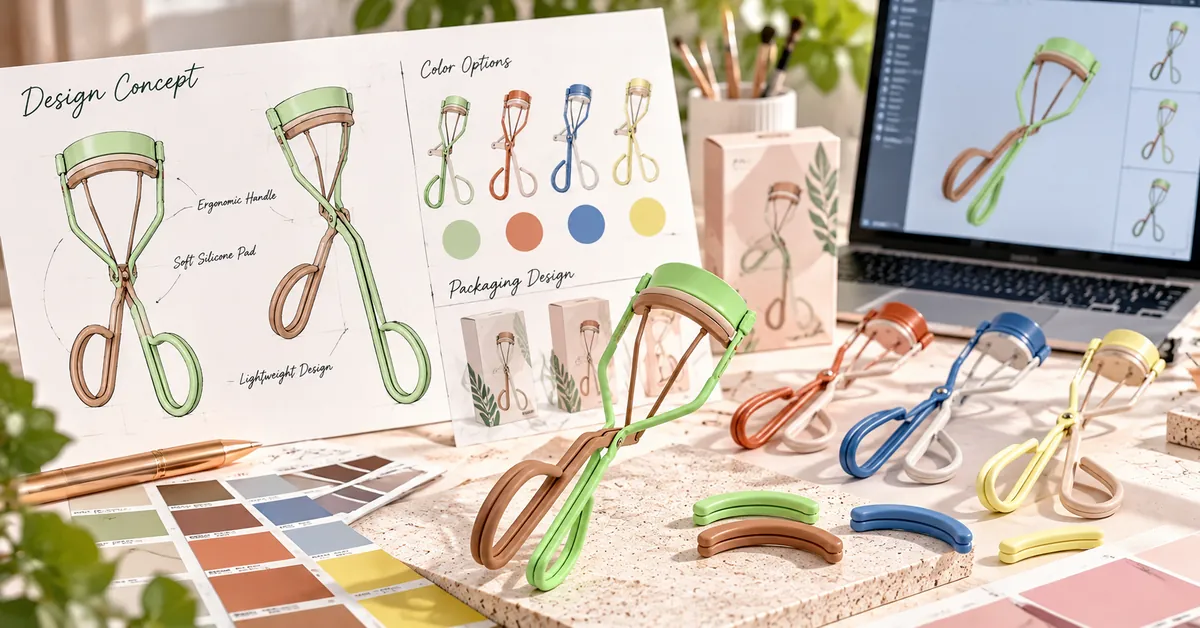
11. A Weighted Scorecard—with Non-Negotiable Failure Gates
The following scorecard is an illustrative procurement tool, not a published testing standard or measured OLIMOR result. A brand can adapt it to the target user, but should state the scoring rules before opening the results.
| Evaluation dimension | Proposed weight | Evidence | Example scoring question |
|---|---|---|---|
| Functional access and fit | 30% | Agreed bench checks and safe-use observations | Can the head be positioned without undue difficulty? |
| Operation and control | 20% | Repeated open-close observations | Is the mechanism predictable? |
| Pad seating and integrity | 20% | Retention and inspection results | Does the pad remain correctly installed? |
| Handle comfort | 15% | Standardized participant feedback | Is the grip manageable for the target group? |
| Care and serviceability | 10% | Cleaning and replacement review | Can the user maintain the tool as instructed? |
| Visual and retail match | 5% | Approved style brief | Does the product fit the brand position? |
| Total | 100% |
Use a documented rating scale, such as 1 = unacceptable under the protocol and 5 = consistently meets the defined expectation. Calculate each weighted contribution as (rating ÷ 5) × weight, but do not hide serious failures within a high average. A damaged contact edge, unstable joint, displaced pad or other unacceptable safety-related condition must be handled separately from the scoring total.
An outcome should lead to a decision: approve, revise and retest, hold for further evidence, or reject. The point is to avoid choosing a design solely because a supplier's rendering or a brand team's color preference scored well.
12. What Manufacturing Processes Could a Custom Design Require?
Depending on construction, manufacture or assembly may involve forming or molding, trimming, component processing, surface treatment, pivot assembly, pad installation, functional adjustment and packing. Those are possible process categories, not a claim that every OLIMOR model or facility performs every step in-house.
If the project modifies a metal frame, ask who evaluates forming feasibility, fixtures and dimensional controls. If it modifies a plastic body, ask whether the design needs a new mold or can use an existing platform. If it changes a pad, identify the pad supplier, component specification and incoming inspection method. If the project adds decoration, confirm which surfaces can accept the desired method without interfering with movement or contact.
For a structural change, the supplier should explain which new tooling, prototypes or process qualifications would be required. A buyer should avoid assuming that changing color and changing head curvature have the same schedule or cost.
The relevant manufacturing question is not merely “Do you have advanced machines?” It is “Which operations and controls will produce this exact approved configuration repeatedly, and who is responsible for them?”
13. Quality Control: Build an Inspection Plan Around the User Task
A quality plan should translate the selected design into checks that a production inspector can perform. The finished product should match the approved drawing or sample and the agreed function.
| Inspection stage | Curler-specific checks | Suggested record |
|---|---|---|
| Incoming components | Material identity, pad identification, visible defects | Receiving record by component lot |
| First piece after setup | Critical frame/contact geometry, movement, finish | First-piece approval |
| In-process assembly | Joint stability, pad seating, alignment | Assembly check sheet |
| Finished unit | Function, visible surface, handle, logo, accessories | Finished-product inspection |
| Retail packaging | Correct label, pack fit and restraint | Approved packed-reference comparison |
| Shipment | Carton identification, quantity, selected lot records | Pre-shipment inspection or release record |
Statistical sampling can be part of a lot acceptance process where appropriate. ISO 2859-1:2026 concerns acceptance sampling by attributes; it does not certify a particular eyelash curler or replace relevant product-safety controls. The buyer must define defect classes, acceptance conditions and actions for nonconforming units.
For material, environmental or conformity statements, check whether the actual certificate or report refers to the correct legal entity, product, material, market and time period. Do not borrow general company certifications as proof of a model-specific claim. If a test has not been performed, say so and discuss whether it is necessary for the target market.
14. Decide Which Features Actually Deserve Customization
Not every proposed feature needs to be changed. Divide the wish list into three levels.
Level 1 — Functional essentials: approved frame-and-pad contact, stable operation, acceptable surfaces, cleanable construction and sufficient handle control for the intended application. These should not be traded away for cosmetic savings.
Level 2 — User-experience improvements: grip geometry, visibility of the pad, ease of storage, replacement-part support and features that the trial shows are meaningful. These deserve further feasibility review when evidence identifies a real user benefit.
Level 3 — Visual differentiators: color, logo, decorative texture, premium box and gift presentation. These are valid commercial choices once the functional product is sound, but they should be costed and approved separately.
A startup may choose an established curler with a brand-specific pack rather than a structural redesign. A mature beauty brand might invest in a new feature if user evidence, distribution volume and financial projections support it. Neither route is inherently more professional. The best route is the one aligned with the product brief and supported by actual evidence.
15. Prototype Comparison Versus Production Model Comparison
A prototype can be hand-finished or assembled differently from a production unit. It may demonstrate shape or ergonomics while leaving production details unresolved. The buyer must record what is representative and what is not.
For prototype approval, ask whether the shape and handling answer the design question. For pre-production approval, ask whether the selected materials, finish, pad and mechanism can be made using the intended process. For first-article or pilot-lot approval, check whether representative units meet the agreed functional and cosmetic criteria consistently.
Do not release a bulk order based only on a concept drawing, or assume that a prototype's appearance proves production consistency. If an engineering change follows approval, document the affected components and decide whether another sample or test is required.
A controlled revision label such as CUR-TEST-C / Rev 02 can help teams align evidence without implying a public manufacturer model number. This is an example of a project identifier, not an actual OLIMOR SKU.
16. OEM, ODM and Private Label: Define Scope Before Asking Price
Terms such as OEM, ODM and private label describe commercial arrangements, but suppliers may use them differently. The quotation should identify exactly what is being supplied.
| Project route | Buyer objective | Design work | Typical approval emphasis |
|---|---|---|---|
| Standard wholesale | Purchase an established model | Minimal | Correct SKU, function, pack and availability |
| Private-label presentation | Brand an existing suitable curler | Logo, finish or packaging if feasible | Actual decorated and packed sample |
| Modified-platform OEM/ODM | Refine an established product | Selected handle, pad or geometry change | Engineering feasibility and retesting |
| New architecture | Create a distinct mechanism or form | New drawings, prototypes and potential tooling | Design validation, production trial and contract terms |
The exact capabilities and minimum quantities depend on the proposed model. For OLIMOR, confirm whether the chosen product is available for standard supply, can be branded, or can support a feasibility review for deeper changes. Do not infer custom mold ownership, engineering resources or universal options from an existing product photograph.
17. Cost, MOQ and Lead Time: Ask for a Route-by-Route Quote
A price comparison becomes useful only when it describes the same project scope. Ask the supplier to distinguish one-time development from recurring production. Development costs may include samples, engineering work, tooling, fixtures, artwork setup or revisions. Recurring costs may include the curler, approved pad, decoration, packaging, inspection and shipment preparation.
| Cost or planning variable | What changes it | Buyer question |
|---|---|---|
| Base tool cost | Selected platform and materials | Which existing model forms the quote? |
| Design / tooling | Extent of structural modification | Are there one-time charges and who owns the tool? |
| Pad configuration | Material, dimensions and supply arrangement | Is this pad standardized or project-specific? |
| Finish / logo | Treatment method and minimum batch | What is feasible on the selected surface? |
| Retail packaging | Box, insert, printing and labeling | Does packaging have a different MOQ? |
| Quality review | Testing scope and inspection approach | Which checks are included and which cost extra? |
| Production timing | Approvals, material availability and schedule | What is the estimated time for each stage? |
MOQ is not one fixed industry number. It can vary by selected model, color batch, pad component, decoration and printed package. A buyer should state an estimated first order and expected reorder range, then request actual feasible quantity tiers instead of forcing a supplier to accept an unrealistic combined batch.
Likewise, do not advertise fixed sampling or production lead times without a current offer. Ask for separate estimates for design review, physical samples, revisions, pre-production approval, manufacturing and delivery. This makes delay risk visible and helps the brand plan retail launch activities honestly.
18. Packaging and Commercial Use After the Prototype Is Selected
This article emphasizes function and fit, but the chosen design still needs a commercial home. A travel-focused curler must fit its planned pouch or carton. A makeup-retail item needs accurate product photographs and sufficient packaging protection. A professional supply item may need clear use and cleaning guidance relevant to its channel.
The final retail configuration should identify the product version, pad specification, included accessories, finish, logo, packed dimensions, artwork, applicable language and any barcode requirements. A package must restrain the tool without changing the approved working shape or damaging the pad.
A brand may create a coordinated lash-and-brow range with tweezers, eyebrow razors or beauty scissors. Such sets are concept suggestions, not confirmation of stocked bundles. Each item and the complete packed set require appropriate approval.
Marketing copy should describe verified facts rather than promising “clinically proven curl,” “zero pinching,” “hypoallergenic pad,” or “works for every eye.” Distinctive packaging does not justify unsupported claims about safety, testing or performance.
19. A Practical Development Timeline Without Invented Delivery Promises
Use stage gates rather than an assumed number of days. Begin with an approved brief, then a model shortlist, then functional evaluation, then targeted changes, then pre-production approval and finally a defined production release.
| Project gate | Decision | Minimum useful output |
|---|---|---|
| Gate 1 — Brief | Is the intended user task defined? | Buyer, target market, application and constraints |
| Gate 2 — Reference | Is there a suitable baseline? | Identified model / reference sample |
| Gate 3 — Prototype trial | Which direction best meets the brief? | Evaluation protocol and recorded findings |
| Gate 4 — Engineering review | Can the selected modifications be made? | Updated specification and feasibility response |
| Gate 5 — Pre-production | Does the real finished configuration match approval? | Signed functional and packed sample |
| Gate 6 — Lot release | Is production consistent with the approved SKU? | Defined inspection and disposition record |
A weak project treats all six gates as a verbal yes. A strong project has evidence, decisions and named responsibilities. The process can be proportionate to order size: a logo-only program may need fewer engineering activities than a revised hinge, but both require a clear approved reference.
20. The RFQ Template for a Custom Eyelash Curler Project
A useful request for quotation should answer the supplier's design questions before focusing on unit price. Include the target user, expected application, preferred baseline reference, which features may change, packaging approach, quantity range and destination market.
Subject: Custom Eyelash Curler Design and Prototype Review
We are developing a custom eyelash curler for a beauty-accessory collection. We would like to compare an existing mechanical curler with selected design variations before approving the final configuration. Our priorities are controlled grip, suitable frame access, verified pad seating, clean surface finishing and a protective retail package. Please advise which current OLIMOR reference models could be sampled and whether a compact alternative is available for comparison. We are not requesting an unverified universal-fit claim. Please quote the feasible sample options, possible customization, specification requirements, MOQ by configuration, stage-by-stage timing and costs for our estimated volume and destination. We can provide artwork and an initial design brief after identifying the most suitable base product.
A strong reply should identify what the supplier knows, what needs sample evaluation, what requires engineering feasibility review, and what affects commercial terms. If a supplier cannot confirm a proposed change, record it as open rather than letting it become an assumed promise.
Discuss Your Curler Design With OLIMOR or explore the Eyelash Curler Collection.
21. Why Use OLIMOR as a Reference for a Custom Curler Discussion?
OLIMOR BEAUTY presents beauty and personal-care products associated with Bonet Houseware Co., Ltd., including eyelash curlers, tweezers, beauty scissors and manicure accessories. Its public information discusses product selection and customization conversations, but a particular model's material, stock, pad specification or development options should be confirmed directly.
For a realistic discussion, start with a reference product rather than a vague request for “the best” curler. ECH4004 provides one published metal-format example; the compact pink guide provides an example of a different lightweight architecture. Neither example independently establishes available private-label finishes, spare-pad support, current stock or tooling capability.
A credible manufacturer conversation includes honest technical trade-offs. A supplier who explains why a requested change needs testing can be more useful than one who promises every option without reviewing the mechanism. The goal is a product that meets the approved brief and can be supplied consistently—not a marketing claim that cannot be verified.
22. Frequently Asked Questions About Custom Eyelash Curlers
1. What makes a custom eyelash curler different from a standard wholesale curler?
A standard curler is purchased as an existing configuration. A custom project specifies buyer-approved changes to appearance, components, function, structure or packaging. The amount of engineering and validation depends on which features change. A custom logo alone does not imply a new mechanism or exclusive design.
2. Should my beauty brand modify the frame or choose another existing model?
First evaluate available physical samples against the intended user task. If an existing frame already meets the requirements, changing the frame may add cost and risk without improving the customer experience. A structural modification is more defensible when a clear, testable problem remains unresolved.
3. What should be tested in a custom eyelash curler prototype?
Review frame geometry, access, handle control, hinge operation, pad identification and retention, contact surfaces and packaging feasibility. Use a documented protocol, approved sample references and safe-use conditions. Record issues separately from aesthetic preferences and do not use marketing claims as acceptance criteria.
4. Is a compact plastic eyelash curler better than a metal curler?
Neither format is universally better. Compact plastic tools may offer low weight and storage convenience, while different metal architectures may provide another handling experience. Compare the actual designs for your customer and verify current materials and specifications. Dimensions alone cannot determine fit or user preference.
5. Can I customize the cushion pad color and material?
These may be discussion points, but feasibility and compatibility depend on the selected curler. A different pad may alter seating and operation. Confirm the actual material, dimensions, retention and any replacement option using representative samples before approving a change.
6. How many prototypes should we test before bulk production?
There is no universal mandatory number. This guide proposes five design directions as a structured comparison, not a required factory procedure. A brand can begin with fewer candidates if they answer the important questions. What matters is clear evidence, controlled changes and approval of the actual production configuration.
7. What is the MOQ for a custom eyelash curler?
MOQ depends on the base model, finish, pad, structural change, artwork and packaging quantities. There is no verified universal MOQ across OLIMOR configurations. Ask for current item-specific quantities and separate any requirements for new tooling or special packaging.
8. Can I add my logo without changing the curler mechanism?
Potentially, if the selected product has a suitable marking area and the supplier confirms an appropriate method. Approve the decorated physical sample and make sure the logo does not interfere with grip, moving parts, cleaning or the working head. Availability and cost depend on the project.
9. How can I keep quality consistent after prototype approval?
Freeze a specification with the selected model, pad, materials, finish, functional checks, artwork and packaging. Preserve approved reference samples, establish lot inspection criteria and require notification before changes to critical components. Reassess modifications that could affect function or claims.
10. How can I request a custom eyelash curler quotation from OLIMOR?
Start from the OLIMOR eyelash curler collection and identify a reference or share your concept. Send the OLIMOR team your target customer, intended use, estimated quantity, proposed customization, packaging and destination. Request separate confirmation of sampling, technical feasibility, current availability and commercial terms.
Conclusion
The best custom eyelash curler is not necessarily the one with the most unusual silhouette, the softest-looking pad or the most decorative finish. It is the version that can be connected to a clearly defined user task, evaluated with realistic physical samples, documented in a reproducible specification and supplied under transparent commercial conditions.
A five-prototype trial offers a practical starting structure. Compare an established reference with targeted frame, grip, pad and compact-format concepts. Separate architecture selection from one-variable optimization, record both observed handling and user feedback, and treat serious function or safety concerns as approval blockers rather than scores to average away. Confirm actual materials, certification evidence, MOQ and lead time for the selected product instead of relying on category-wide promises.
For beauty brands planning differentiated lash accessories, OLIMOR BEAUTY's eyelash curler range provides starting references for a model discussion. Contact OLIMOR with your target user, sample requirements, expected volume and the two or three design decisions you most need to validate. A focused brief is the strongest first step toward a custom product with practical user value and repeat-order potential.
Tag:
Related articles
- OEM & Custom Solutions
- Beauty Tools Buying Guide
Private Label Beauty Tools Manufacturer: OEM, ODM and Custom Packaging Guide
- OEM & Custom Solutions
- Beauty Tools Buying Guide
Beauty Tools Factory China OEM and ODM: A Buyer Product Development Guide
- OEM & Custom Solutions
- Beauty Tools Buying Guide