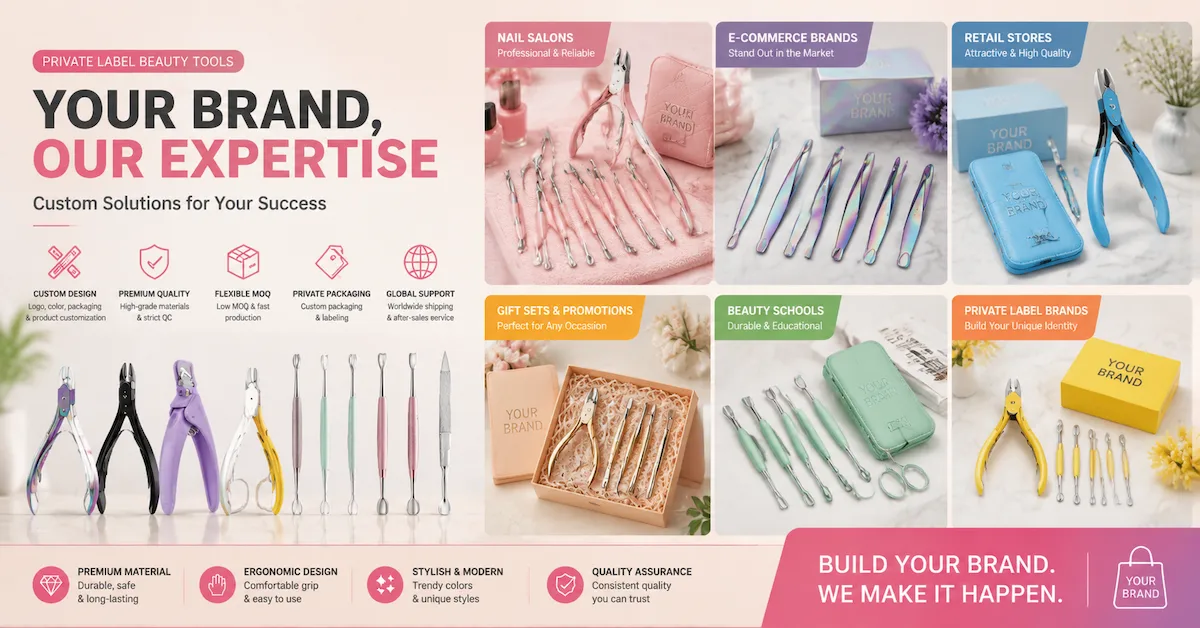
Choosing a China beauty tools manufacturer starts with a product brief, not a price comparison. Before requesting quotations, define the intended use, target customer, material, working geometry, finish, branding, packaging and inspection requirements. These details give suppliers a common reference for proposing a development route and help buyers compare what each quotation actually includes.
OLIMOR BEAUTY supports OEM and ODM discussions for beauty and personal-care tools, with development inputs that can include drawings, physical samples, appearance concepts and structural requirements. This guide explains how brands, importers, distributors and retailers can turn those inputs into specifications, sample approvals and production instructions.
A photograph can communicate an outline or colour. It cannot fully explain how tweezer tips should meet, how a clipper should operate or how a tool should be protected inside its retail packaging. Those decisions need to be written down.
1. Define the Commercial Purpose Before Selecting the Tool
Before asking a China beauty tools manufacturer for a quotation, explain where the product belongs in your range. An entry-price accessory, professional-use tool, travel-kit component and premium gift item can require different development priorities.
| Commercial question | What to define in the brief |
|---|---|
| Who will use the product? | Intended user, experience level and grooming task. |
| Where will it be sold? | Retail display, e-commerce, salon distribution or another channel. |
| What price position is intended? | Priorities for materials, finish, accessories and packaging. |
| Is it a single item or a collection? | Shared colour, branding and packaging rules, alongside separate SKU specifications. |
| How will the range launch? | Pilot model, initial assortment, later additions and expected repeat orders. |
Replace vague requests with a clear commercial description. “A two-piece travel manicure set in a paper box” gives the supplier more direction than “a high-quality gift set.” Related products can share a visual identity without sharing identical technical specifications.
2. Build a Factory-Ready Product Brief
Separate fixed requirements from preferences and decisions the supplier should help resolve. This makes it easier to identify whether an existing model is suitable or further development is needed.
| Brief section | Information to provide |
|---|---|
| Product identity | Category, reference model or sample, intended use, target customer and destination market. |
| Function | What the tool must grip, cut, curl, trim, file or hold. |
| Geometry | Tip or blade shape, curvature, hinge, handle, pad, catcher and critical dimensions. |
| Materials | Requirements for individual components; identify any undecided material choices. |
| Appearance | Colour, polish, texture, coating, logo method, logo position and artwork. |
| Packaging | Format, insert, barcode area, printed information, pack count and carton needs. |
| Commercial requirements | Quantity range, target price position, launch window and delivery destination. |
| Evidence | Drawings, sample photographs, inspection points and relevant supporting documents. |
Label each requirement fixed, preferred or to be proposed. A fixed tip shape should not be changed without approval. An open packaging format allows the supplier to propose options for review.
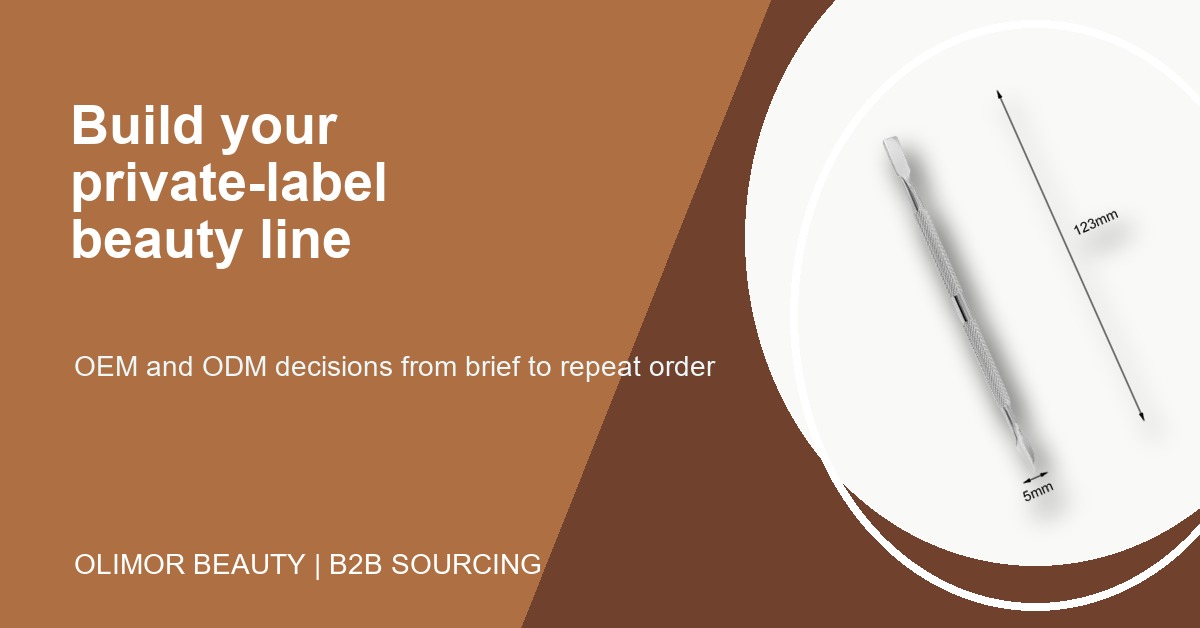
A tweezer product reference can help explain tip style, grip and appearance, but it should accompany—not replace—the written specification.
3. Choose the Development Route: OEM, ODM or Hybrid
OEM development suits projects in which the buyer supplies the design or detailed requirements. Drawings, physical samples and specifications establish the reference. Manufacturing, branding and packaging should follow the agreed version.
ODM development draws on an existing product platform or the supplier’s development experience. Changes may involve colour, finish, working-end geometry, handles, accessories or packaging. Availability and feasibility still need confirmation for the selected model.
Hybrid development combines existing components with selected changes. A project might retain a tweezer body while requesting a different tip and retail card, or use existing manicure tools in a revised case. This can reduce the amount of new development, but only after the unchanged and modified elements are identified.
Ask the China beauty tools manufacturer to classify each request as a standard option, configurable option, new-tooling requirement or unconfirmed item. Do not assume that “custom” means the same scope to both parties. A colour change and a new tool structure require different discussions about samples, cost and timing.
4. Turn Product References into Measurable Decisions
Tweezers and Lash Tweezers
Specify whether the tip is slanted, flat, pointed or another defined shape. Confirm the working area, tip contact, alignment and grip expectations. Brow tools and precision lash tools should not automatically share one acceptance standard: their intended tasks and working-end requirements can differ.
The catalogue includes stainless-steel examples and several colour, pattern and surface-treatment options. Confirm which options apply to the selected model, how the logo will be added and how the reference colour will be approved. One model’s material or finish should not become an unsupported claim about the entire range.
Nail Clippers and Cuticle Tools
For nail clippers, define blade contact, opening, lever movement, handle shape and any catcher or hanging feature. For cuticle nippers, focus on the cutting edge, joint movement, handle control and finish. Keep the intended use explicit rather than treating all cutting tools as interchangeable.
OLIMOR’s capability information lists heat-treatment equipment alongside torque and hardness testing equipment. Confirm the material specification, applicable checks and acceptance criteria for the selected SKU rather than assuming one hardness value or test method covers the whole range. Agree on what will be recorded during sampling and production.
Eyelash Curlers
Confirm frame curvature, opening, pad position, hinge movement, handle design and replacement-pad requirements. Appearance alone does not establish fit or operating comfort. Sample evaluation should consider the intended user group and record the observations that affect approval.
Evaluate the frame and pad together rather than approving them as unrelated components. Changes to either should be reviewed before the original sample approval is reused.
Manicure and Grooming Sets
Approve the individual tools as well as the complete assortment. Record each item, relevant materials and finishes, its position in the case or insert, the pack count and carton configuration.
Check that the case closes correctly, the components remain in their intended positions and the printed contents match the actual set. A list of included tools is not a complete packaging specification.
5. Make Sample Approval a Defined Decision Point
Give the sample, drawing, artwork and packaging a version number or date. Record exactly what is approved and what remains unresolved. “Approved for tip alignment, colour and logo placement; insert pending” is clearer than “looks good.”
Review the sample in five passes:
- Function: Check the intended grip, cutting action, curling movement, opening and closing, or set assembly.
- Geometry: Compare the working end, handle, hinge, pad and critical dimensions with the brief.
- Appearance: Review colour, polish, coating, texture, decoration and logo placement.
- Packaging: Confirm fit, protection, printed information, accessory positions and pack count.
- Approval record: Identify accepted features, unresolved issues and changes requiring further review.
A loose tool does not approve a finished retail pack. Likewise, approval of one finish should not automatically cover another. When the material, pad, coating, handle or packaging changes, update the reference and agree whether another sample is required.
6. Agree on Product-Specific Quality Control Before Production
A China beauty tools manufacturer should explain how inspection connects to the approved specification. “Strict quality control” is not enough to show which characteristics will be checked or how unacceptable pieces will be handled.
OLIMOR describes production-process inspection and finished-product or shipment inspection. Use the following questions to agree on a plan for your order, including which checkpoints apply to the selected SKU and what records will be provided.
| Control stage | Questions to resolve |
|---|---|
| Incoming materials | How are metals, plastics, pads, springs and packaging components identified and checked? |
| First piece | Which checks follow a tooling, material, colour or process change? |
| In-process inspection | Which dimensions, tip contacts, blade edges, hinges, curves or finishes need monitoring? |
| Finished product | How are function, appearance, branding, accessories and pack contents reviewed? |
| Shipment | How are quantities, carton marks, packaging integrity and dispatch documents confirmed? |
| Nonconforming items | How are suspect products separated, reviewed, corrected and recorded? |
Agree on acceptance criteria and the reference used for each check. “Tip alignment checked against the approved sample” is more useful than “precision quality.” Request records that correspond to the actual order rather than a generic inspection description.
7. Request Evidence Relevant to the Supplier and Product
Ask for documents connected to the legal entity, manufacturing site and product supplying the order. Where ISO or BSCI information is offered, request the underlying documentation and confirm its type, holder, covered site, scope and date. Do not treat a catalogue logo as proof that a particular product has passed a particular test.
Product-level evidence may include a process-flow diagram, model-specific material information, a sample inspection form, annotated photographs, packaging drawings and the equipment used for agreed checks. Request only what is relevant, while allowing the supplier to protect confidential information.
The objective is to understand how the proposed product will be made and checked—not to collect unrelated documents or repeat unsupported certification claims.
8. Develop Packaging and Artwork Alongside the Tool
Packaging belongs in the development brief from the beginning. The OLIMOR catalogue shows examples including blister cards, paper boxes and PET bags. Confirm availability, dimensions and protection for the chosen product rather than assuming every format suits every SKU.
Send version-controlled artwork with the product name, barcode area and buyer-approved market information, such as origin wording, warnings or usage instructions where applicable. Confirm responsibility for reviewing that wording before print approval.
Check protection around pointed tips, cutting edges, curler pads and loose accessories. Ask for the packed dimensions and carton quantity of the final configuration. A freight estimate based on an unpacked tool or an earlier box design may not represent the approved order.
9. Make Requests for Quotation Comparable
When comparing quotations from a China beauty tools manufacturer, use the same specification and quantity assumptions for each supplier. A lower price is not a like-for-like comparison when the material, finish, packaging or development scope is different.
A request for quotation, or RFQ, should resolve the following points:
| Quotation item | What the supplier should clarify |
|---|---|
| Proposed product | Existing model, reference sample or development route. |
| Customization | Standard features, configurable changes and new-tooling items. |
| Sampling | Sample configuration, revision scope and approval requirements. |
| Unit-price inclusions | Material, finish, logo method and accessories. |
| Packaging | Format, insert, pack count and carton configuration. |
| Inspection | Model-specific checkpoints and supporting records. |
| Commercial conditions | Applicable MOQ, timing and separate development or tooling costs. |
| Delivery assumptions | Destination, packing information and shipping inclusions or exclusions. |
| Supporting evidence | Available documents for the supplying entity, site and product. |
| Open decisions | Missing information and the process for changes after approval. |
MOQ and lead time must relate to the quoted configuration. An existing model, revised tip, new colour, new mould and printed gift box can involve different assumptions. Ask for those assumptions in writing before comparing totals.
10. Control the Handoff from Development to Production
The handoff to a China beauty tools manufacturer should be one organized approval package rather than a scattered message history. Include the sample reference, final specification, artwork, packaging layout, inspection checklist, order quantity, carton plan and delivery information.
Name the person authorized to approve changes and keep an open-item list. Before production begins, check that the quotation, sample and artwork describe the same configuration. Confirm that the logo version, assortment and pack count agree, and record the procedure for handling nonconforming goods.
This shared reference helps purchasing, quality and logistics colleagues work from the same instructions.
11. Avoid Five Common OEM and ODM Mistakes
Photo-only sourcing. A visually similar item may have a different tip, blade, curve or handle. Add dimensions, an annotated image or a physical reference, and identify the features that cannot change without approval.
Undefined customization. The buyer expects structural development while the supplier quotes a colour change. Separate standard options, configurable changes and new-tooling requirements.
Late packaging approval. The tool is accepted, but the insert or carton is still undecided. Review the packed sample and final packing data alongside the product.
Generic inspection promises. An inspection percentage does not explain what is inspected. Agree on the function, geometry, finish, branding and packaging checks for the SKU.
Unsupported compliance assumptions. A logo or old document is treated as evidence for a new product. Request the relevant document and review its actual holder, scope and date.
12. Confirm the Development Sequence Before Promising a Launch Date
Use a staged schedule: product brief, specification and quotation alignment, sampling, product and packaging approval, production preparation, inspection, packing and shipment. Each stage should identify the decision needed before the next one proceeds.
Confirm timing for the selected model, quantity, tooling, finish and packaging. A catalogue reference or an earlier order’s lead time should not become an automatic promise for a different configuration.
Discuss the effect of late changes before approving them. A revised working end, logo or box needs an updated reference and an agreed schedule—not an assumption that the original plan remains unchanged.
FAQ: OEM and ODM Beauty Tools
1. Can a New Brand Start with an Existing Product?
Yes. An existing platform can be a starting point for a different colour, finish, logo or package. Confirm the available options for the selected model and whether any request requires additional development.
2. What Is the Practical Difference Between OEM and ODM?
OEM generally starts from buyer-supplied design requirements. ODM draws on an existing platform or supplier development. In either case, the written scope matters more than the label alone.
3. Can I Submit a Completely New Tool Concept?
OLIMOR supports project discussions based on drawings, samples, appearance concepts and structural requirements. Feasibility, tooling, sample scope and commercial conditions still need project-specific review.
4. Which Sample Should Be Approved Before Production?
Approve a reference representing the final material, geometry, finish, logo and packaging. Record unresolved items separately rather than treating partial approval as approval of the complete configuration.
5. Does a Low MOQ Apply to Every Custom Order?
No universal MOQ should be assumed. Request the minimum quantity for the exact model, material, finish, branding, tooling and packaging combination.
6. Can One Material Specification Cover an Entire Tool Range?
Do not assume so. Confirm materials for each SKU and relevant component. Information about one catalogue example does not establish the specification of every related product.
7. What Should a Product-Specific QC Plan Include?
It should identify the agreed functional, dimensional, appearance and packaging checks, the approval reference, the required records and the handling of nonconforming items.
8. Should Packaging Be Included in Sample Approval?
Yes. Confirm fit, tool protection, accessories, printed information and pack count. A loose sample cannot establish whether the final retail package works as intended.
9. Can a Catalogue Lead Time Be Used for a New Project?
Treat it as a reference, not an automatic commitment. Confirm the schedule against the model, quantity, development work, sample approvals, finish and packaging.
10. What Information Should I Send with My First Inquiry?
A China beauty tools manufacturer needs the intended use, reference product, quantity range, material or finish preferences, branding, packaging, destination and launch expectations. Mark undecided requirements so the supplier can propose options.
Conclusion
Choosing a China beauty tools manufacturer is easier when the comparison rests on an agreed product definition. Specify the development scope, confirm model-level details, approve the finished configuration and connect inspection to that approval. These steps provide a clearer basis for comparing suppliers than appearance or unit price alone.
Browse OLIMOR BEAUTY’s product range, then send an OEM or ODM inquiry with your reference product, intended use, estimated quantity, destination market and customization requirements. Request a model-specific development route, sample plan, inspection outline and quotation that makes its assumptions clear.