A nail clipper manufacturer should be able to explain much more than which models are available and how much they cost. For a private-label brand, importer, distributor or retailer, the real purchasing question is whether the factory can turn a selected clipper into a controlled product specification covering blade contact, lever movement, material, finish, branding, packaging and repeatable inspection.
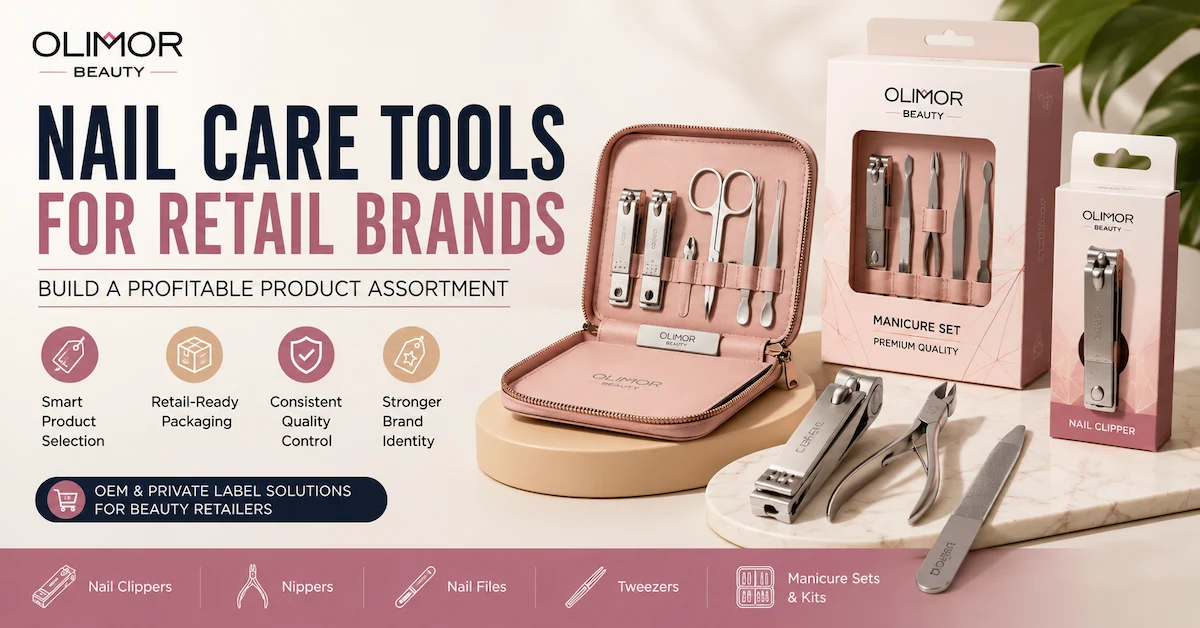
OLIMOR BEAUTY offers a broad nail clipper product range, including different conventional, catcher, handle and set configurations. Its supplied company information also describes metal stamping, blade heat-treatment equipment, polishing and grinding, water deburring, injection moulding, assembly, torque and hardness testing, and packaging equipment. These capabilities are useful starting points, but buyers should still confirm which materials, processes and checks apply to the exact SKU they intend to order.
A catalogue can help a buyer choose a direction. It cannot replace an approved specification. Two clippers that look nearly identical may differ in blade geometry, lever feel, handle construction, finish or packaging. That is why the strongest sourcing process starts with the user and the product requirement before moving to price.
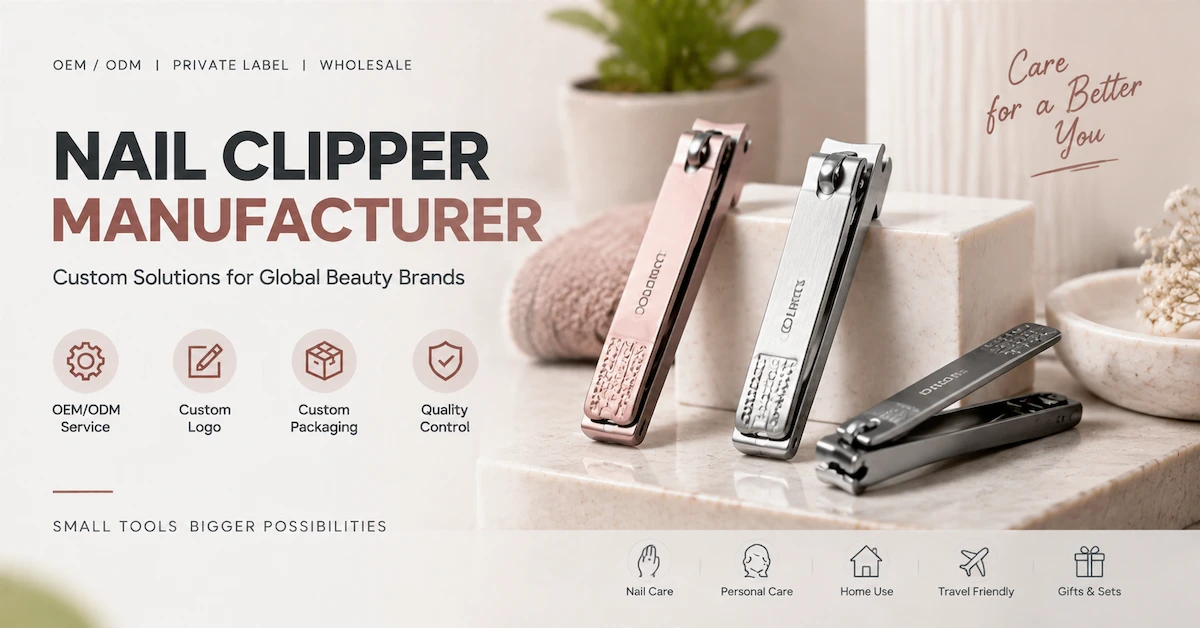
What Should a Nail Clipper Manufacturer Prove Before You Request a Final Quote?
A reliable nail clipper manufacturer should connect the proposed model to four things: its intended use, its construction, its production route and its inspection plan. If any one of these remains unclear, a quotation can appear precise while still describing a different product from the one the buyer expects.
| Buyer question | What should be confirmed |
|---|---|
| Who will use the clipper? | Adult grooming, manicure set, travel use, baby-oriented range or another defined application |
| What type of clipper is proposed? | Standard lever, catcher, wide-mouth, long-handle, decorative or set configuration |
| What materials are used? | Material by relevant component rather than one category-wide statement |
| How does it operate? | Blade meeting, lever movement,opening and pivot condition |
| What finish is supplied? | Polish, coating, colour, plated appearance or other selected treatment |
| What can be customized? | Product, finish, colour, logo, packaging and applicable structural changes |
| How will it be inspected? | Functional, dimensional, appearance, assembly and packaging checkpoints |
| What does the quotation include? | Product configuration, packaging, customization, sample assumptions and other applicable costs |
This structure gives buyers something concrete to compare. A unit price is only useful when two factories are quoting substantially the same configuration.
Define the End User Before Choosing the Clipper
“Nail clipper” sounds like a single product category, but buying requirements change quickly when the target customer changes.
A basic retail clipper may need straightforward handling and economical packaging. A clipper designed for a manicure set must fit the case and visually coordinate with the other tools. A catcher model adds another component that needs to fit, move and stay secure. A longer handle or wider cutting opening changes the way the product is positioned and evaluated. Baby-oriented designs should be treated as their own SKU family rather than as smaller versions of an adult clipper.
OLIMOR's 2026 product catalogue shows several of these directions, including conventional clipper designs, catcher models, longer-handle and wider-opening styles, two-piece combinations, boxed sets, different handle constructions and baby-series products.
The useful sourcing question is not “Which one looks premium?” It is:
Which construction best matches the user, retail price position and sales channel we are targeting?
Once that question is answered, decoration becomes much easier to manage.
Compare Nail Clipper Structures Before Comparing Finishes
A buyer should separate the mechanical product from its visual treatment. The following comparison framework can be used when discussing available models with an OLIMOR nail clipper supplier.
| Product direction | Main buyer focus | Additional points to confirm |
|---|---|---|
| Standard lever clipper | Blade meeting, lever action and hand feel | Size, finish and retail package |
| Catcher clipper | Cutting performance plus catcher fit | Removal, cleaning, movement and packaging |
| Long-handle design | Leverage and handling | Balance,grip and overall dimensions |
| Wide-mouth design | Intended nail thickness/use | Opening geometry and target-user statement |
| Decorative/coloured model | Finish and brand positioning | Coating consistency and logo appearance |
| Two-piece set | Product pairing | Individual specifications plus set packaging |
| Boxed grooming set | Product and presentation | Insert, contents and package stability |
| Baby-series design | Defined user group | Model-specific geometry,handling and instructions |
These are product-development categories rather than universal performance claims. Every selected model should still be checked against its own drawing, approved sample or confirmed specification.
Blade Alignment Is More Important Than a “Sharp” Marketing Claim
Buyers often ask whether a nail clipper is sharp. That is understandable, but “sharp” alone is not a sufficient manufacturing requirement.
The two cutting edges need to meet in the intended way. If their relationship is poor, a clipper can pinch, crush or require unnecessary pressure even when the individual edges appear sharp. The lever and pivot also influence the cutting action because they determine how force reaches the blades.
During sample review, inspect the cutting area from several angles. Open and close the clipper slowly. Observe where the blades first meet and whether their relationship changes across the cutting width. Then evaluate the model using the intended grooming task rather than an unrelated material chosen only to make a dramatic demonstration.
The approved sample should become the visual and functional reference for production.
OLIMOR already publishes a separate nail clipper quality control guide that discusses blade alignment and manufacturing checks. For a private-label project, those general principles should be converted into model-specific acceptance points before production begins.
Evaluate the Lever and Pivot as Part of the Cutting System
The lever is easy to overlook because it is not the cutting edge, but it shapes the user's experience every time the clipper is operated.
A buyer should review whether the lever moves smoothly, remains correctly positioned and transfers force without obvious instability. The pivot should not create unexpected side movement or an inconsistent relationship between the cutting edges.
Hand feel should be recorded while the sample is available. Words such as “comfortable” or “strong” can mean different things to different teams, so the approval note should describe the specific reference being accepted.
For example:
“Lever movement and blade contact approved against Sample Version B.”
That is much more useful than:
“Quality approved.”
The first statement gives production and QC teams something they can actually refer to later.
Do Not Assume Every Nail Clipper Uses the Same Material
Material is another area where broad category claims can create problems.
OLIMOR's current catalogue shows different material and component directions across its nail clipper range. Carbon-steel models are specifically identified in part of the catalogue, while another series refers to zinc-alloy handles. Other models may use different metal constructions depending on the SKU.
A zinc-alloy handle description does not tell the buyer what the cutting blades are made from. Likewise, a material statement shown beside one clipper cannot automatically be assigned to every model on the website.
For buyers specifically searching for a stainless steel nail clipper manufacturer, the correct approach is to request confirmation for the selected model rather than assume the entire category has one construction.
A useful specification separates components:
| Component | What the buyer should record |
|---|---|
| Cutting blades/body | Confirmed model-specific material |
| Lever | Material and finish where relevant |
| Handle or cover | Separate construction if different from the body |
| Catcher | Material,fit and finish |
| Decorative part | Material/coating where applicable |
| Packaging components | Insert, box, card or other protective components |
The same rule should carry through to product pages and packaging. A material description should only appear where it can be supported for that product.
How Do Heat Treatment, Grinding and Polishing Affect the Buying Discussion?
OLIMOR's supplied factory information includes blade heat-treatment equipment, polishing and grinding equipment, water deburring and related metal-processing capabilities. Buyers do not need to prescribe the factory's entire production recipe, but they should understand which operations apply to the chosen clipper.
Heat treatment may be relevant to the performance of specific metal components. Grinding and edge preparation influence the final cutting relationship. Deburring and polishing influence surface condition and user contact. Assembly brings the blades, lever, pivot and any additional component together into the final mechanism.
The key is traceability.
Ask the factory:
- Which operations apply to this model?
- Which component receives the applicable treatment?
- At which stage is blade alignment checked?
- When is the lever assembled and reviewed?
- What appearance issues are checked after finishing?
- Which final functional checks are performed before packaging?
These questions create more useful manufacturing evidence than asking only whether the factory has heat-treatment or polishing machines.
You can review OLIMOR's broader manufacturing background on the About Us page.
Build Quality Control Around the Failure Points Buyers Actually Care About
A strong nail clipper manufacturer should translate “strict quality control” into identifiable checks.
For nail clippers, the inspection plan can be organized around six areas:
| QC area | What should be evaluated |
|---|---|
| Blade relationship | Contact, alignment and obvious edge irregularities |
| Lever mechanism | Movement, position and operating consistency |
| Pivot/assembly | Stability and unwanted movement |
| Surface | Scratches, burrs,finish consistency and visible defects |
| Custom branding | Logo position, appearance and approved artwork |
| Packaging | Correct model, quantity, protection and printed information |
The details should follow the model rather than a generic factory template. A catcher model adds another assembly check. A coloured handle introduces another appearance reference. A two-piece set needs both individual-product inspection and complete-set inspection.
The objective is not to create the longest QC checklist possible. It is to identify the small number of features that would cause the buyer or end customer to reject the product if they changed.
Use a Golden Sample Instead of Relying on Memory
Once a nail clipper sample is accepted, turn it into a controlled reference.
Mark the sample version. Record the approved material, dimensions where confirmed, blade configuration, lever, handle or catcher, colour, finish, logo and package. Attach the corresponding artwork version.
If one part remains open, do not call the entire project approved.
An approval note could read:
Product mechanics approved; rose-gold finish approved; logo size requires revision; retail box pending.
This kind of record may look simple, but it prevents a frequent OEM problem: the buyer thinks Sample 2 was approved while the production team believes Sample 3 became the final reference.
OLIMOR's existing nail clipper OEM guide provides additional context for brands building customized nail-care products. For a new order, the same principle should be taken down to the exact SKU and revision.
Private Label Nail Clippers Need More Than a Logo
A private-label project can begin with an existing model, but the final product still needs a clear commercial identity.
For private label nail clippers, buyers typically need to coordinate some combination of product model, finish, colour, logo and packaging. More extensive OEM projects may also involve structural or component changes.
Do not use the word “custom” without explaining what it means.
A useful customization matrix looks like this:
| Customization request | Questions to confirm |
|---|---|
| Logo | Method, size,position and artwork |
| Colour | Reference colour and applicable component |
| Finish | Available process for the selected model |
| Handle | Existing option or structural modification? |
| Catcher | Existing component or different design? |
| Product size | Existing model or new development? |
| Packaging | Card, box, case, insert,artwork and pack count |
| Set configuration | Which exact tools are included? |
This lets an OEM nail clipper manufacturer distinguish straightforward private-label work from genuine product development.
If the requested change affects blade geometry, lever construction or another mechanical feature, it should normally be treated differently from a logo or package change because it can influence sampling, tooling, inspection and project timing.
Packaging Should Be Approved With the Product
A clipper can leave the production line in good condition and still create complaints if its packaging does not restrain or protect it properly.
The package should keep the product secure, protect the cutting area, avoid unnecessary rubbing against finished surfaces and present the product in the intended retail orientation.
For a single clipper, the buyer might use a card, box or other retail format. For a two-piece combination or manicure set, the insert and position of each item become part of the product specification.
Check the packed sample for:
- Product movement
- Surface contact
- Blade-area protection
- Lever position
- Accessory retention
- Correct model and quantity
- Barcode and artwork placement
- Carton configuration
Private-label buyers should also confirm whether the same package is being used for e-commerce fulfilment, retail shelf display or both. Those environments can create different handling requirements.
Packaging is not simply a graphic-design task. It is part of the product handoff.
What Determines MOQ for Custom Nail Clippers?
There is no responsible single MOQ that should be published for every nail clipper project without reference to the actual configuration.
An existing model in a standard finish can have different production conditions from a custom-colour model. A new handle, new structural component or new package can introduce further setup requirements. Printed packaging can also have its own quantity considerations.
Therefore, when asking “What is the MOQ?”, add the configuration.
For example:
What is the MOQ for model X with black finish, our logo and a custom paper box?
That question is much easier to answer accurately than:
What is your nail clipper MOQ?
The same applies when comparing a nail clipper supplier China quote from several factories. Confirm whether the MOQ refers to one colour, one model, one package or the combined order.
What Drives the Cost of OEM Nail Clippers?
Buyers should treat cost as the result of a product specification rather than as a fixed category number.
The final quotation may be influenced by the chosen clipper platform, materials, surface treatment, additional components, structural changes, decoration, sample work, packaging and quantity.
A useful quotation separates recurring unit cost from applicable one-time project costs. If tooling or a new component is involved, ask the supplier to show it separately. The same applies to custom packaging or special decoration where relevant.
This allows procurement teams to compare three very different scenarios:
Existing product + standard package
Existing product + private-label decoration + custom package
Modified or newly developed OEM product
Without that separation, a lower number may simply represent a simpler configuration.
How Should Private-Label Buyers Compare Nail Clipper Manufacturers?
Use a scorecard after the product requirement is clear.
| Evaluation area | What a stronger supplier should demonstrate |
|---|---|
| Product fit | Understands intended user and clipper configuration |
| Mechanical understanding | Can discuss blade meeting,lever and assembly |
| Material clarity | Identifies material by product/component |
| Manufacturing route | Connects relevant processes to the SKU |
| Sampling | Creates a traceable reference and manages revisions |
| QC | Defines model-specific inspection points |
| Customization | Separates standard branding from structural development |
| Packaging | Treats retail protection as part of product development |
| Commercial clarity | States what MOQ,price and timing assumptions apply to |
| Repeat orders | Can identify and reproduce the approved product version |
This approach is more useful than simply ranking suppliers by factory size or catalogue count.
For international buyers, the best supplier is not necessarily the one offering the highest number of models. It is the one that can explain the selected model clearly enough that purchasing, quality, packaging and production teams are all discussing the same item.
What Should You Send in a Nail Clipper RFQ?
A good RFQ makes it easier for the factory to provide a relevant quotation and easier for you to compare suppliers.
Include:
- Intended market and target user.
- Selected clipper type or reference model.
- Reference images, sample or drawing where available.
- Required or preferred materials.
- Important size or structural requirements.
- Finish and colour direction.
- Logo requirements.
- Catcher, accessory or set requirements.
- Packaging concept.
- Estimated quantity.
- Destination country or region.
- Target launch timing.
- Any required product or shipment documentation.
- Items where you want the manufacturer to make a recommendation.
A buyer should also identify what is fixed and what is flexible. If the blade geometry is fixed but the handle colour is open, say so. The supplier can then focus development effort where it actually adds value.
You can start with OLIMOR's nail clipper category and send the selected reference through the Contact Us page.
How Should Repeat Orders Be Controlled?
The first bulk order is not the end of product development.
For repeat orders, compare the new purchase order with the approved product record. Confirm the model, relevant material, finish, colour, logo, package and accessories. Ask whether the supplier has changed any component, process or packaging material that could affect the approved result.
This matters especially for brands running several nail clipper SKUs. A small change made for one colour or customer should not silently become the new standard for another product.
Maintain a simple change history:
| Revision | Change | Approval status |
|---|---|---|
| V1 | Initial approved model | Approved |
| V2 | New logo size | Branding approval required |
| V3 | New packaging insert | Package approval required |
| V4 | Mechanical or material change | Product re-evaluation required |
A disciplined repeat-order process can reduce disputes because the question becomes “Does this order match the approved reference?” rather than “Is this roughly the same clipper as last time?”
FAQ About Nail Clipper Manufacturing
What does a nail clipper manufacturer do?
A nail clipper manufacturer produces and assembles nail clippers according to a defined product design or existing model. For OEM and private-label projects, the work can also involve sample development, material and finish confirmation, branding, packaging and product-specific quality control.
Can OLIMOR supply private label nail clippers?
OLIMOR's company information states that OEM and ODM projects are supported. Buyers can discuss existing nail clipper models together with product, finish, colour, logo and packaging requirements. The applicable options should be confirmed for the selected SKU.
What is the difference between an OEM nail clipper and a private label nail clipper?
Private label commonly begins with an existing product platform and adds branding, finish or packaging changes. OEM can involve more buyer-defined product requirements or structural modifications. The actual development scope matters more than the terminology.
Are all nail clippers made from stainless steel?
No. Material should be confirmed by model and component. OLIMOR's catalogue includes different material directions, including carbon-steel references and zinc-alloy handle series, so buyers should not assign one material to every product.
What is the most important nail clipper QC point?
There is no single checkpoint, but blade relationship and lever operation are central to the product's basic function. Assembly, surface condition, branding and packaging also need to match the approved reference.
Can nail clipper handles and colours be customized?
Customization can be discussed depending on the selected product and project requirements. Buyers should clarify whether the request uses an existing option or requires a structural, material or tooling change.
What is the MOQ for private label nail clippers?
MOQ should be confirmed for the exact model, finish, branding and packaging configuration. A universal figure should not be assumed across every product.
How long does custom nail clipper production take?
Timing depends on the product platform, customization scope, sampling, tooling where applicable, surface treatment, packaging approval and quantity. A project-specific schedule should be confirmed after the specification is defined.
What should I check on a nail clipper sample?
Check blade contact, lever movement, pivot stability, hand feel, surface condition, confirmed materials, finish, logo and final packaging. Record the specific version that has been approved.
How can I request an OEM nail clipper quotation from OLIMOR?
Review the OLIMOR nail clipper range, then contact OLIMOR BEAUTY with the reference model or image, intended market, estimated quantity, finish, logo and packaging requirements.
Conclusion
Choosing a nail clipper manufacturer is ultimately a question of whether the factory can turn a small mechanical tool into a controlled, repeatable retail product. Blade alignment, lever movement, material selection, finishing, branding and packaging should be treated as connected decisions rather than separate items discussed only after a quotation has been issued.
For private-label brands, importers and distributors, a stronger sourcing process starts by selecting the right clipper configuration, documenting the approved sample, defining model-specific QC points and then comparing MOQ, price and production assumptions on the same basis.Buyers can browse OLIMOR's nail clipper collection, review its nail clipper manufacturing and quality content, and contact OLIMOR BEAUTY with a product reference and private-label requirements for a model-specific discussion.